


The Operating Architecture of Intelligent Institutions
For the last few years, most conversations about artificial intelligence have revolved around models.
Which model is bigger?
Which model is cheaper?
Which model reasons better?
Which model can generate text, code, images, or decisions more accurately?
Those are valid questions. But they are no longer the most important ones.
The deeper question is this:
What kind of institution is capable of using intelligence well?
That is the real frontier of the AI era.
The next wave of competitive advantage will not come only from access to powerful models.
It will come from designing organizations that can see reality clearly, interpret it intelligently, and act on it responsibly. Put differently, the winners of the AI era will not simply be the organizations with better AI. They will be the institutions with a better operating architecture for intelligence.
That is the shift of the decade.
In the industrial era, institutions were built to coordinate labor, capital, and physical assets.
In the digital era, institutions were redesigned to process information faster.
In the AI era, institutions must be redesigned to operate with machine-augmented perception, reasoning, and execution.
That requires a new architecture.
I call this architecture:
SENSE → CORE → DRIVER
This is not merely a technology stack. It is an institutional operating logic.
- SENSE is how reality becomes machine-legible.
- CORE is how the institution interprets reality and determines what matters.
- DRIVER is how the institution translates decisions into governed action.
Most organizations today are overinvesting in CORE, underinvesting in SENSE, and barely understanding DRIVER.
That is why so many AI programs create demos, pilots, dashboards, and excitement — but fail to create durable institutional advantage.

Why institutions need an operating architecture now
Across industries and geographies, organizations are moving from experimentation toward structured AI deployment.
But scaled value still remains concentrated among a relatively small set of companies that are redesigning workflows, governance, operating models, and human oversight — not merely installing AI tools.
McKinsey’s 2025 research describes this as “rewiring” the enterprise to capture value, while also highlighting the role of human validation and operating practices in distinguishing higher performers. (McKinsey & Company)
At the same time, AI governance is no longer being treated as a narrow software issue. NIST’s AI Risk Management Framework positions AI risk as a lifecycle and organizational challenge; the OECD AI Principles emphasize trustworthy, human-rights-respecting AI; and the EU AI Act adopts a risk-based regulatory structure that links AI use to obligations around transparency, safety, and oversight. (NIST)
This means something simple but profound:
AI is becoming institutional.
It is no longer enough to ask whether a model performs well in a benchmark, a sandbox, or a lab. We now have to ask:
- Can the institution trust what the system sees?
- Can it explain how decisions were formed?
- Can it prove whether the system was allowed to act?
- Can it stop, reverse, or review machine action when needed?
These are not model questions alone.
They are architecture questions.
And in the AI era, architecture becomes destiny.
What is the Operating Architecture of Intelligent Institutions?
The operating architecture of intelligent institutions is the structural framework that allows organizations to perceive reality, reason about decisions, and execute actions through governed systems.
This architecture consists of three foundational layers: SENSE, CORE, and DRIVER.
• SENSE makes the world machine-legible by detecting signals, identifying entities, modeling state, and tracking evolution over time.
• CORE performs reasoning by interpreting context, optimizing decisions, learning from feedback, and generating institutional intelligence.
• DRIVER provides legitimacy and execution by governing delegation, verifying authority, enforcing accountability, and implementing decisions safely.
Institutions that build this architecture move beyond isolated AI tools and become intelligent decision systems capable of operating at scale.

The central mistake most AI strategies make
Most AI strategies begin in the wrong place.
They begin with the model.
A leadership team sees a demo.
A vendor offers a platform.
A board asks for an AI roadmap.
A team launches copilots, assistants, agents, and automation layers.
But two prior questions are often skipped.
The first is:
What reality is this AI system actually connected to?
The second is:
What authority does this system actually have?
If those questions are not answered, the organization ends up with a system that can produce impressive output but is poorly grounded in reality and poorly bounded in action.
That is not intelligence.
That is institutional risk.
To understand why, we need to examine the three layers.

-
SENSE: The perception layer of the institution
Every institution depends on a working model of reality.
A hospital depends on signals about patient condition.
A bank depends on signals about fraud, liquidity, credit, market exposure, and customer behavior.
A retailer depends on signals about demand, inventory, weather, logistics, and pricing.
A government depends on signals about population needs, service delivery, public safety, benefits, and resource allocation.
If those signals are incomplete, delayed, fragmented, or misleading, everything built on top becomes fragile.
That is what SENSE solves.
In this framework, SENSE means:
- Signal — detecting events, changes, and traces from the world
- ENtity — attaching those signals to a persistent actor, object, account, location, patient, machine, or asset
- State representation — building a structured model of current condition
- Evolution — updating that state over time as new signals arrive
This is the layer where reality becomes machine-legible.
It may sound technical, but the intuition is simple.
Imagine an airport. If the airport cannot accurately detect aircraft status, passenger flow, gate congestion, baggage movement, weather shifts, and security conditions, no amount of optimization software will save it. The problem is not lack of intelligence. The problem is lack of legibility.
Now imagine a bank trying to use AI for fraud detection. If customer identity is fragmented across channels, transaction streams arrive with delay, device signals are inconsistent, and account relationships are poorly represented, then the AI is not reasoning over reality. It is reasoning over fragments.
That is why many AI failures happen before intelligence even begins.
The institution cannot see clearly enough to reason well.
This is also why the phrase “better data” is too weak. The real need is not just better data. It is better institutional sensing.
An intelligent institution must be able to answer four basic questions:
- What is happening?
- To whom or what is it happening?
- In what state is that entity right now?
- How is that state changing?
Without those answers, the institution is effectively blind.
Why SENSE matters more than most leaders realize
Many executives treat SENSE as a data engineering topic.
It is much bigger than that.
SENSE defines what an institution is capable of noticing. And what an institution cannot notice, it cannot govern. What it cannot represent, it cannot optimize. What it cannot track over time, it cannot learn from.
This is why the AI era is also becoming the era of signal infrastructure, identity infrastructure, and representation infrastructure.
That idea connects directly with several of my earlier arguments on the rise of the representation economy, the importance of signal infrastructure, and why many AI initiatives fail before intelligence even begins because institutions have not yet made reality visible enough to govern.

-
CORE: The reasoning layer of the institution
Once reality becomes legible, the institution needs to interpret it.
That is the job of CORE.
In this framework, CORE means:
- Comprehend context
- Optimize decisions
- Realize action
- Evolve through feedback
CORE is the cognition layer.
This is where models, reasoning systems, simulations, forecasting engines, retrieval systems, policy engines, and agent workflows operate. It includes both classic analytics and modern AI.
If SENSE is the institution’s eyes and ears, CORE is its ability to make sense of what it perceives.
Consider a health system.
SENSE captures symptoms, medical history, lab results, medication records, physician notes, wait times, bed availability, and patient movement.
CORE then asks:
- Which patient is deteriorating fastest?
- Which intervention is most likely to work?
- Which care pathway should be prioritized?
- Which resource allocation reduces systemic risk most effectively?
Or take a manufacturing network.
SENSE captures machine telemetry, supplier delays, route bottlenecks, quality deviations, production constraints, and demand shifts.
CORE then reasons:
- Which disruption is noise and which is a true threat?
- Which plant should rebalance production?
- Which supplier issue is likely to become a service failure next week?
- Which operating decision minimizes downstream loss?
This is where AI can create enormous value.
But it is also where executives are most easily seduced.
Because CORE is the most visible layer.
It is where demos happen.
It is where dashboards glow.
It is where copilots answer questions.
It is where agents appear “smart.”
So organizations mistake visible reasoning for complete intelligence.
But CORE without SENSE becomes speculation.
And CORE without DRIVER becomes unsafe.
That is why intelligence must never be treated as an isolated model capability. It must be understood as part of an institutional operating system.
Why most organizations overinvest in CORE
Because CORE is exciting.
It is easier to buy a model than redesign sensing.
It is easier to launch a chatbot than redesign decision rights.
It is easier to celebrate output quality than redesign accountability.
But mature institutions understand something fundamental:
The value of intelligence depends on the quality of the reality it interprets and the discipline of the action it drives.
That is where DRIVER enters.

-
DRIVER: The legitimacy and execution layer
DRIVER is the most neglected layer in AI strategy.
It is also the layer that matters most once systems begin to act.
In this framework, DRIVER means:
- Delegation — who authorized the system to act
- Representation — what model of reality the system used
- Identity — which entity was affected
- Verification — how the decision is checked
- Execution — how the action is carried out
- Recourse — what happens if the system is wrong
This is the governance and legitimacy layer of intelligent institutions.
It answers the most important question in AI operations:
Even if the system can act, was it allowed to act?
That distinction is everything.
A model may correctly predict that a loan should be denied.
A system may accurately identify a suspicious payment.
A triage engine may recommend deprioritizing a patient in a non-urgent pathway.
An AI agent may know how to execute a workflow step in an ERP or CRM system.
But accuracy alone is not legitimacy.
The institution still needs to know:
- Did the system have authority?
- Under which policy?
- At what confidence threshold?
- With what level of human oversight?
- With what record of reasoning?
- With what rollback mechanism?
- With what recourse if harm occurs?
This is why the future of AI governance is not just policy.
It is enforcement architecture.
That direction is increasingly visible in global governance frameworks. NIST emphasizes governance across the AI lifecycle; the OECD frames trustworthy AI around accountability and human-centered values; and the EU AI Act links risk levels to concrete obligations for providers and deployers. (NIST)
In other words:
DRIVER is where trustworthy AI becomes operational rather than rhetorical.
A simple example: traffic lights vs intelligent intersections
Think about a traditional traffic light system.
It does not “reason” very much. It mostly follows rules.
Now imagine an intelligent intersection:
- Cameras and sensors detect vehicle flow, pedestrians, emergency vehicles, weather, and road conditions
- AI systems infer congestion, urgency, collision risk, and priority
- Autonomous controls dynamically alter signals, lanes, and routing
Now ask the real institutional question:
Who is accountable if the system prioritizes one flow over another incorrectly?
What happens if emergency routing conflicts with pedestrian safety?
Can the decision be reconstructed later?
Can the action be overridden?
Who defined the acceptable trade-offs?
That is DRIVER.
Without DRIVER, intelligence becomes action without legitimacy.
This is precisely why debates about delegation infrastructure, legitimacy stacks, and recourse layers are becoming central to the future of AI-enabled institutions.
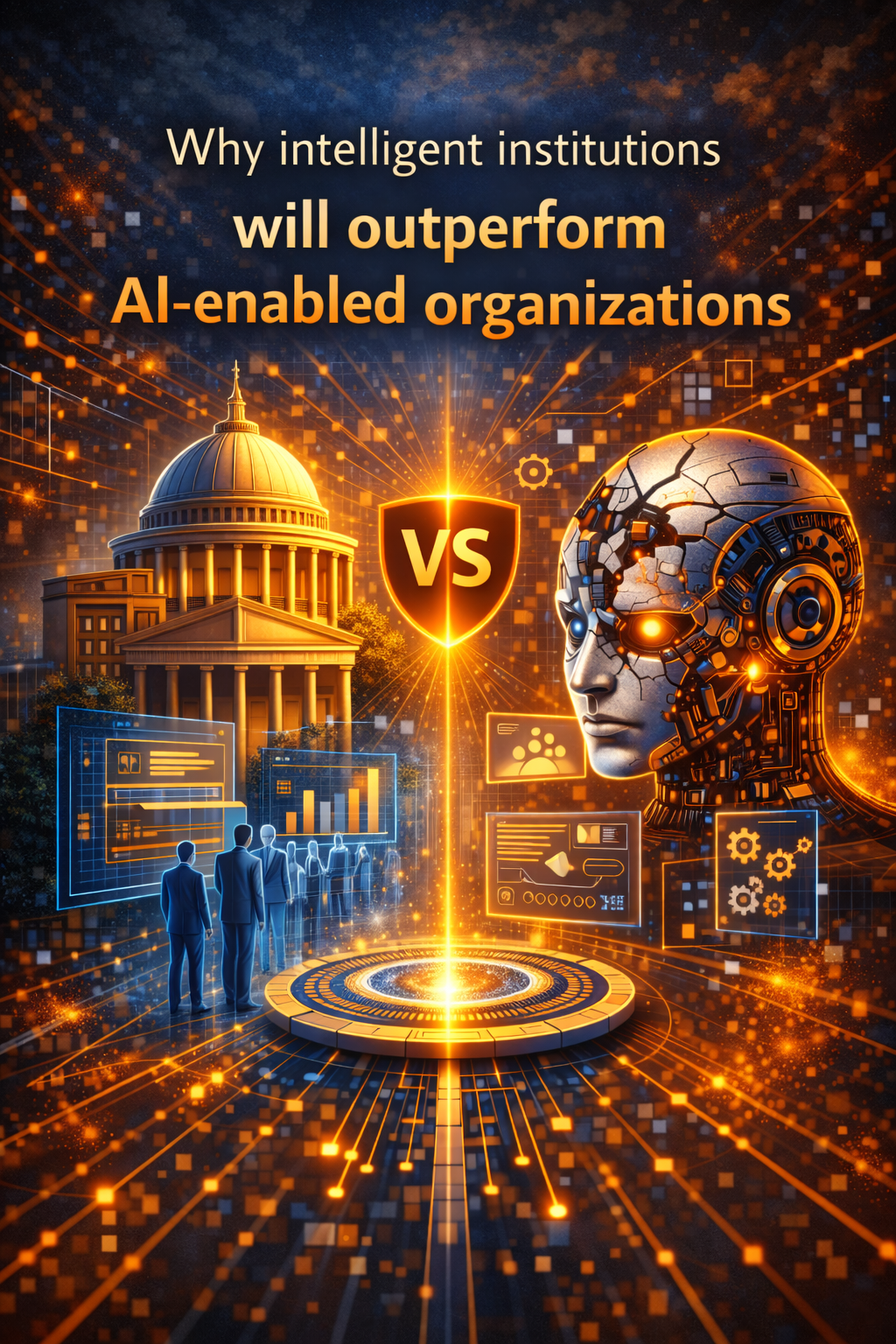
Why intelligent institutions will outperform AI-enabled organizations
Many organizations will adopt AI.
Far fewer will become intelligent institutions.
The difference is profound.
An AI-enabled organization uses models in scattered workflows.
An intelligent institution redesigns how it perceives, reasons, decides, executes, and learns.
That redesign has several defining characteristics.
-
It treats intelligence as infrastructure, not as an app
Apps are optional. Infrastructure is foundational.
An intelligent institution does not ask only, “Where can we add AI?” It asks, “What is the operating architecture through which intelligence flows?”
-
It designs for continuity, not isolated pilots
Pilots often fail because they never connect SENSE, CORE, and DRIVER into one operating loop.
The institution tests a model, but it does not redesign sensing.
It experiments with automation, but it does not redesign authority.
It adds dashboards, but it does not redesign feedback.
So value remains local rather than systemic.
-
It treats recourse as a core capability
In the AI era, being able to act is not enough.
Institutions must be able to:
- pause action
- review action
- unwind action
- explain action
- compensate for bad action
That is not bureaucracy.
That is maturity.
-
It understands that legitimacy compounds value
Fast decisions matter.
Good decisions matter.
But legitimate decisions at scale matter most.
Because institutions are not judged only by whether they are efficient. They are judged by whether they are defensible.
And in regulated industries especially, defensibility is not a communications issue. It is an operating capability.
What the operating architecture of intelligent institutions actually looks like
Put together, the architecture is simple to describe, even if hard to build.
SENSE
The institution becomes capable of perceiving reality with continuity.
It knows what is happening, to whom, in what condition, and how that condition is changing.
CORE
The institution becomes capable of interpreting reality with intelligence.
It can reason, predict, optimize, compare scenarios, and support better judgment.
DRIVER
The institution becomes capable of acting with legitimacy.
It can delegate safely, verify authority, execute responsibly, and offer recourse when needed.
This is the real operating architecture of intelligent institutions.
Not model alone.
Not data alone.
Not policy alone.
Not automation alone.
But the governed integration of all three.
Why this matters to boards and C-suites now
Boards do not need another abstract conversation about AI potential.
They need a way to ask better operating questions.
For example:
- Where is our institution still blind?
- Which AI decisions are informative versus consequential?
- Where are we letting systems recommend, and where are we letting them act?
- Can we reconstruct a high-stakes AI decision after the fact?
- Do we have recourse designed into action, or only apologies after action?
- Are we building intelligence capability, or merely accumulating AI tools?
These are the questions that separate experimentation from governance, and governance from advantage.
The board-level issue is no longer whether AI matters.
It does.
The real issue is whether the institution itself is being redesigned to use intelligence safely, coherently, and strategically.
That is why this topic sits naturally alongside my broader work on the Enterprise AI Operating Model, Enterprise AI Control Plane, Enterprise AI Runtime, Decision Failure Taxonomy, and the emerging idea that competitive advantage is shifting from tool adoption to institutional architecture.
For readers exploring this broader canon, useful companion essays include:
- The Enterprise AI Operating Model
- The Enterprise AI Control Plane (2026): The Canonical Framework for Governing AI Decisions at Scale
- The Enterprise AI Runtime: What Is Actually Running in Production
- The Representation Economy: Why the AI Decade Will Be Defined by Who Gets Represented
- Delegation Infrastructure: The Missing Layer in the Institutional AI Order
- The Governance of Visibility: Why AI Needs Rules for What Can Be Seen, Known, and Acted Upon
- The Future Belongs to Decision-Intelligent Institutions
These pieces are not separate arguments. They are parts of the same larger thesis: the AI era is ultimately an institutional redesign story.
Conclusion: The future belongs to institutions that can see, think, and act with legitimacy
The biggest mistake leaders can make is to assume that the AI era is mainly about adopting better tools.
It is not.
It is about redesigning the institution itself.
The institutions that win will:
- build sensing systems before overpromising intelligence
- connect reasoning systems to real operational context
- establish authority boundaries before scaling autonomous action
- treat legitimacy as a design layer, not a legal afterthought
- make recourse, reversibility, and traceability part of core architecture
This is why the future belongs not simply to digital institutions, but to intelligent institutions.
And intelligent institutions are not defined by how much AI they buy.
They are defined by whether they can:
see clearly, reason wisely, and act legitimately.
That is the real operating architecture of the AI age.
That is the shift from software deployment to institutional redesign.
And that is where the next decade of strategic advantage will be built.
Glossary
Intelligent institution
An organization redesigned to use machine-augmented perception, reasoning, and governed action as part of its operating model.
SENSE
The layer that makes reality machine-legible through signals, entities, states, and evolving context.
CORE
The cognition layer that interprets what is happening, compares options, supports decisions, and improves through feedback.
DRIVER
The governance and execution layer that determines what actions are authorized, verifiable, reversible, and legitimate.
Institutional sensing
The ability of an organization to detect, connect, and continuously represent meaningful changes in the environment in which it operates.
Legitimacy layer
The part of an institutional system that ensures a decision is not only technically possible, but institutionally permitted and defensible.
Recourse
The mechanism through which an AI-driven decision can be reviewed, challenged, corrected, reversed, or compensated for if it causes harm.
Delegation infrastructure
The rules, controls, permissions, and authority boundaries that define what machines are allowed to do on behalf of an institution.
Representation infrastructure
The systems and structures that make people, assets, events, and conditions visible enough to be governed, reasoned over, and acted upon.
FAQ
What is the operating architecture of intelligent institutions?
It is the institutional framework through which organizations sense reality, reason about it, and act on it responsibly. In this article, that architecture is described as SENSE, CORE, and DRIVER.
Why is AI not enough on its own?
Because AI models can produce output without being properly grounded in reality or bounded by institutional authority. Real value comes when AI is embedded inside sensing, reasoning, governance, and execution systems.
What does SENSE mean in AI architecture?
SENSE refers to Signal, ENtity, State representation, and Evolution. It is the layer where reality becomes machine-legible.
What does CORE mean?
CORE is the cognition layer: Comprehend context, Optimize decisions, Realize action, and Evolve through feedback.
What does DRIVER mean?
DRIVER is the legitimacy and execution layer: Delegation, Representation, Identity, Verification, Execution, and Recourse.
Why do most AI strategies fail before they scale?
Because many organizations focus on models and interfaces while neglecting sensing infrastructure, authority boundaries, operational recourse, and institutional redesign.
Why is this important for boards and C-suite leaders?
Because AI increasingly affects decisions, workflows, risk, customer outcomes, compliance, and accountability. That makes AI an operating-model and governance issue, not just a technology issue.
What is the difference between an AI-enabled organization and an intelligent institution?
An AI-enabled organization uses AI in selected workflows. An intelligent institution redesigns how it perceives, reasons, decides, executes, and learns across the enterprise.
References and further reading
Recent global frameworks increasingly support the central argument of this article: AI must be governed as an organizational and lifecycle capability, not merely as a model feature. NIST’s AI Risk Management Framework describes AI risk management as a structured, ongoing process across design, development, deployment, and use. (NIST)
The OECD AI Principles frame trustworthy AI in terms of human rights, democratic values, accountability, and long-term stewardship, reinforcing the need for institutions to connect intelligence with responsibility. (OECD)
The European Union’s AI Act establishes a risk-based legal framework for AI systems and models, underscoring that high-impact AI cannot be treated as an ungoverned technical add-on. (Digital Strategy)
And McKinsey’s 2025 research on the state of AI shows that organizations capturing greater value are not simply adopting tools; they are rewiring operating practices, incorporating human validation, and embedding AI into broader institutional workflows. (McKinsey & Company)
Explore the Architecture of the AI Economy
This article is part of a broader research series exploring how institutions are being redesigned for the age of artificial intelligence. Together, these essays examine the structural foundations of the emerging AI economy — from signal infrastructure and representation systems to decision architectures and enterprise operating models.
If you want to explore the deeper framework behind these ideas, the following essays provide additional perspectives:
- The Representation Economy: Why the AI Decade Will Be Defined by Who Gets Represented—and Who Designs Trusted Delegation
• Representation Infrastructure: Why the AI Economy Will Be Won by Those Who Make the Invisible Legible
• The Representation Stack: How Reality Becomes Identifiable, Legible, and Actionable in the AI Economy
• Identity Infrastructure: The Missing Layer Between Signals and Representation in the AI Economy
• Why Most AI Projects Fail Before Intelligence Even Begins
• The Intelligence Supply Chain: How Organizations Industrialize Cognition in the AI Economy
• The Enterprise AI Operating Model
• Decision Scale: Why Competitive Advantage Is Moving from Labor Scale to Decision Scale
• The Operating Architecture of the AI Economy: Why Intelligence Alone Will Not Transform Markets - The Silent Systems Doctrine: Why the AI Economy Will Be Won by Those Who Represent What Cannot Speak
- Signal Infrastructure: Why the AI Economy Begins Before the Model – Raktim Singh
- The Representation Economy: Why AI Institutions Must Run on SENSE, CORE, and DRIVER – Raktim Singh
- The Representation Economy Explained: 51 Questions About the SENSE–CORE–DRIVER Architecture – Raktim Singh
Together, these essays outline a central thesis:
The future will belong to institutions that can sense reality, represent it clearly, reason about it intelligently, and act through governed machine systems.
This is why the architecture of the AI era can be understood through three foundational layers:
SENSE → CORE → DRIVER
Where:
- SENSE makes reality legible
- CORE transforms signals into reasoning
- DRIVER ensures that machine action remains accountable, governed, and institutionally legitimate
Signal infrastructure forms the first and most foundational layer of that architecture.
AI Economy Research Series — by Raktim Singh



Raktim Singh is an AI and deep-tech strategist, TEDx speaker, and author focused on helping enterprises navigate the next era of intelligent systems. With experience spanning AI, fintech, quantum computing, and digital transformation, he simplifies complex technology for leaders and builds frameworks that drive responsible, scalable adoption.