

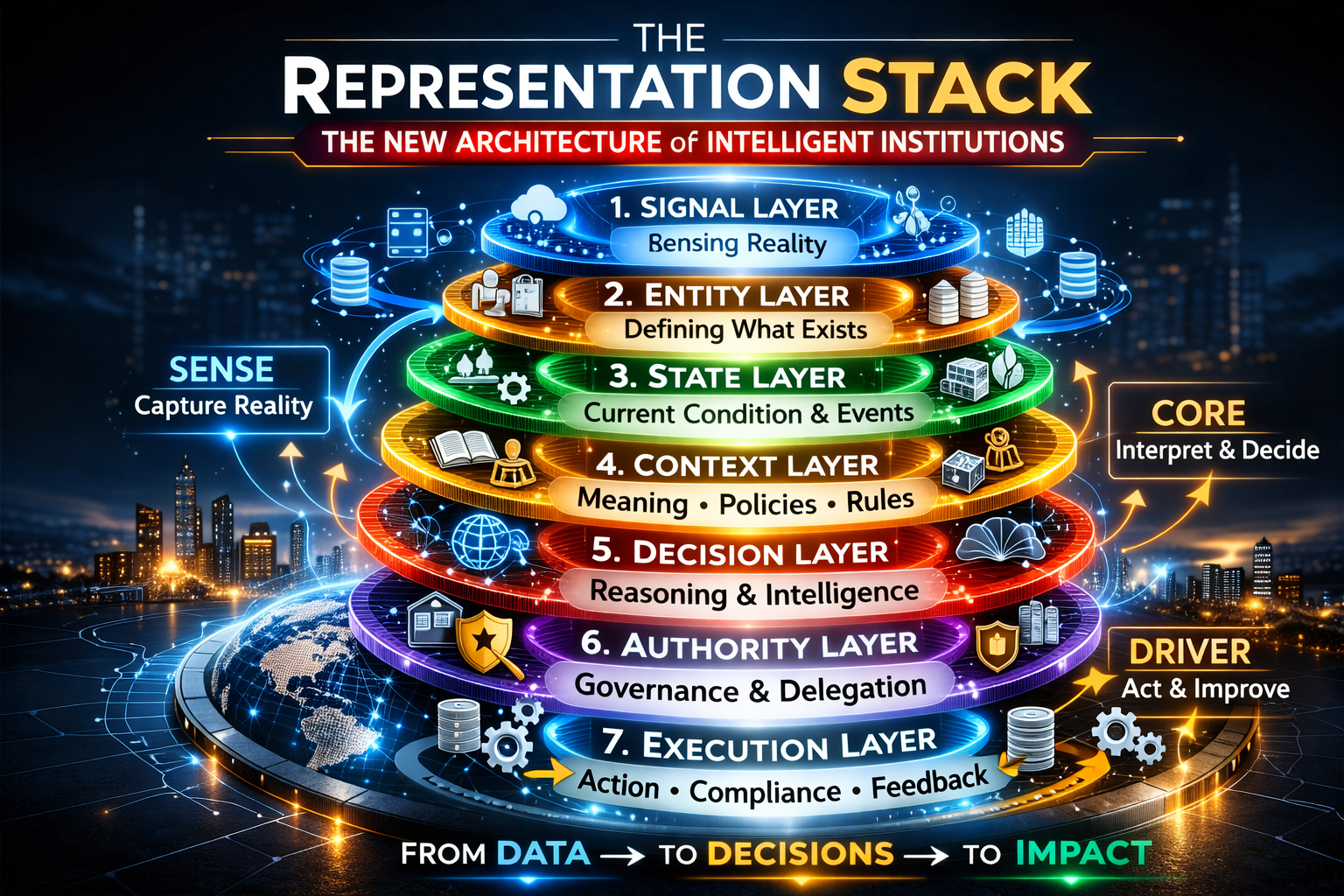
The Representation Stack
For the past few years, most AI strategy conversations have focused on models. Which model is more accurate? Which one is cheaper? Which one can reason better? But as artificial intelligence moves from generating content to influencing real institutional decisions—loans, claims, supply chains, healthcare triage, and infrastructure operations—a deeper question emerges. The real competitive advantage in the AI era will not come from models alone. It will come from how well institutions represent reality for those models to operate on. That architecture is what I call the Representation Stack.
The Real AI Question Has Changed
For the last two years, most AI strategy conversations have revolved around models.
Which model is more accurate?
Which one is cheaper?
Which one is safer?
Which one can reason better?
These questions still matter.
But they no longer reach the deepest layer of institutional advantage.
As AI adoption accelerates globally, the competitive divide is shifting from model selection to architectural design.
According to the Stanford AI Index 2025, 78% of organizations reported using AI in 2024, up from 55% the year before. Global private investment in generative AI reached $33.9 billion during the same period.
At that scale of adoption, the central issue is no longer:
“Can institutions access intelligence?”
The real question is:
“Can institutions structure reality well enough for intelligence to operate safely, consistently, and at scale?”
This shift introduces a new concept that will define the next phase of enterprise AI:
The Representation Stack.
What Is the Representation Stack?
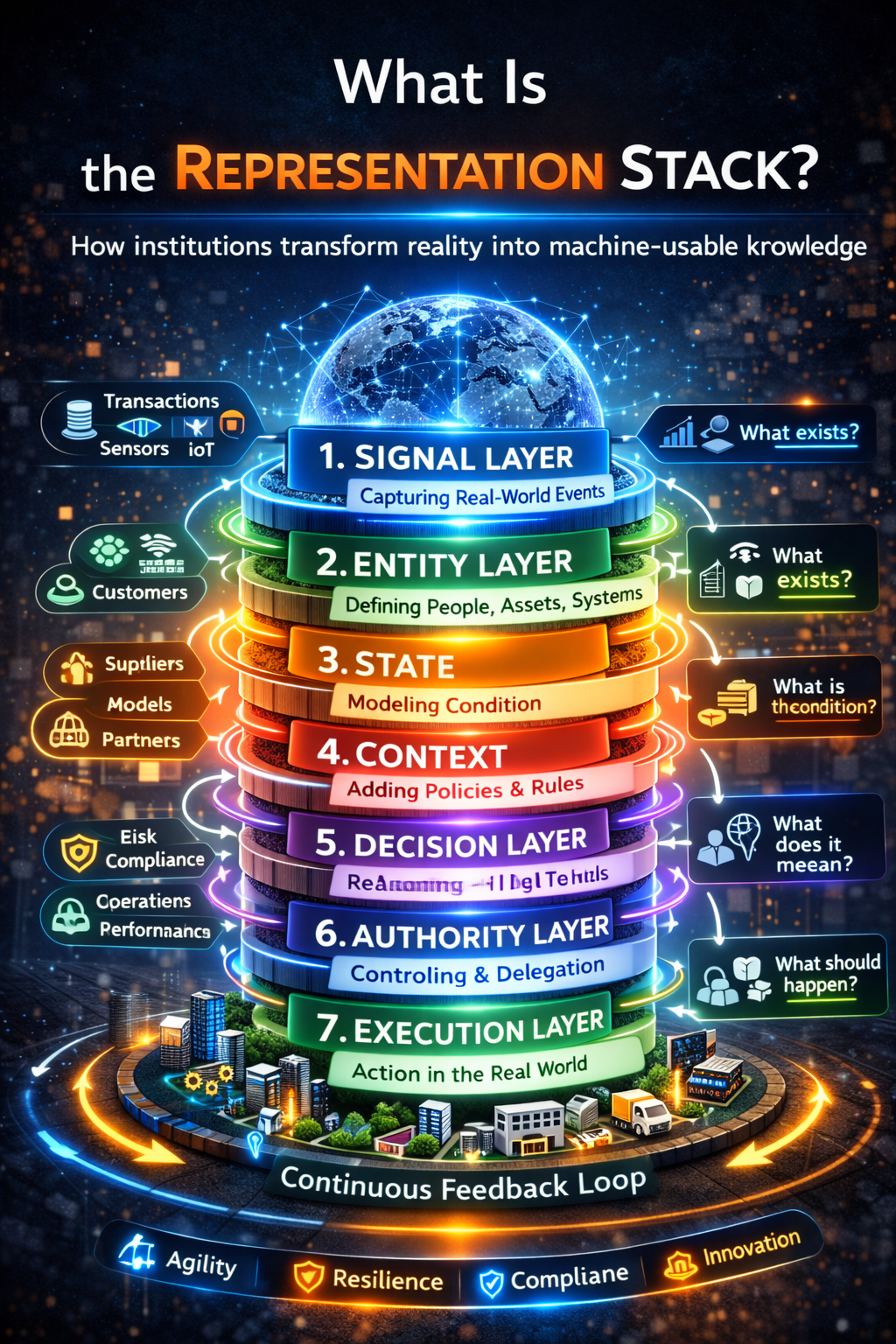
The Representation Stack is the layered architecture through which institutions transform complex, changing reality into something machines can sense, interpret, govern, and act upon.
It is the missing bridge between raw data and reliable AI decision-making.
In simple terms:
The Representation Stack explains how organizations convert the real world into machine-usable institutional reality.
Without this architecture:
AI systems reason over
- partial signals
- fragmented identities
- stale states
- incomplete context
- unclear authority boundaries
With it, AI becomes something far more powerful.
It becomes part of an intelligent institution.
From Model Advantage to Architectural Advantage
The Representation Stack emerges from a deeper economic shift.
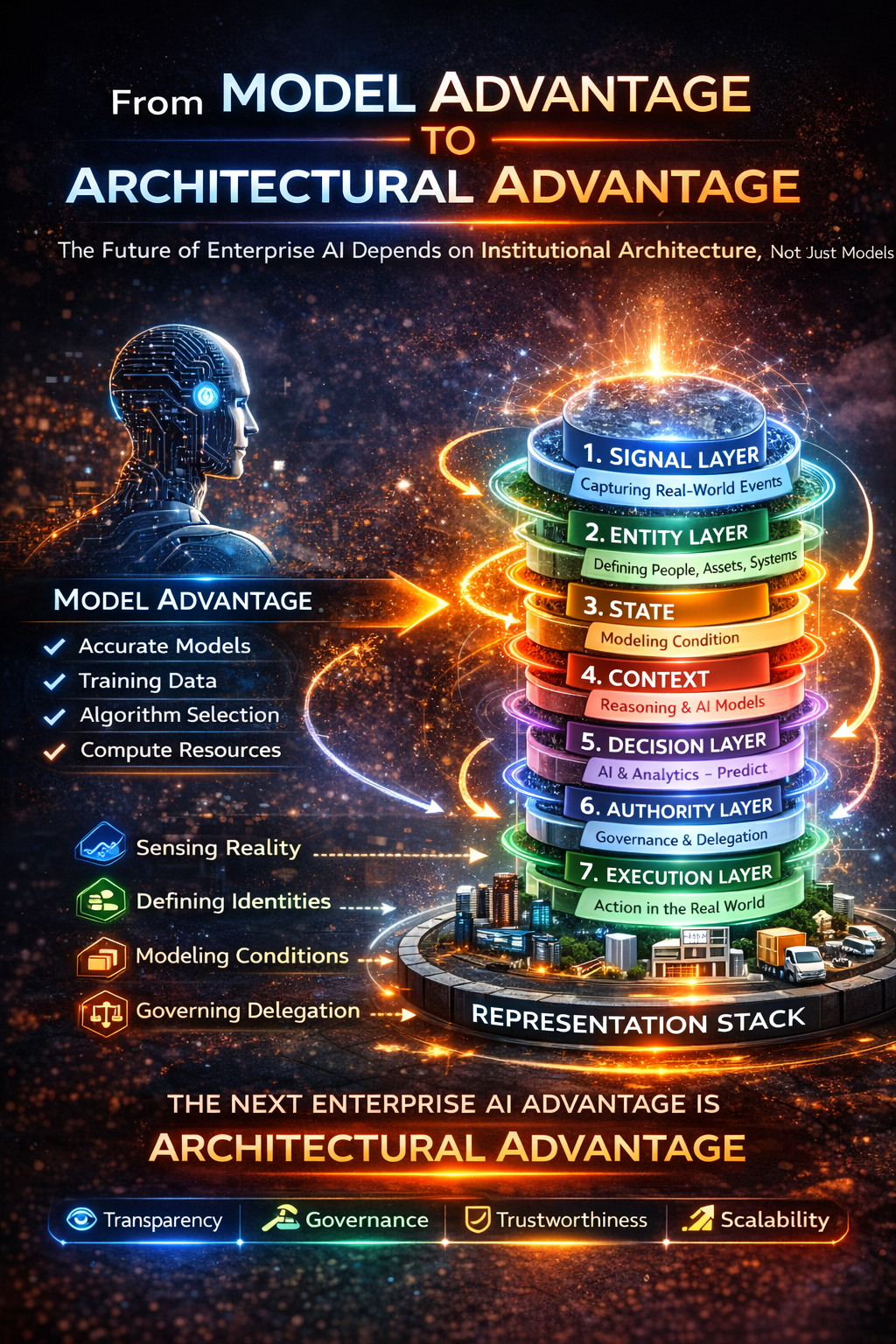
In the first phase of AI, competitive advantage came from building or accessing models.
Organizations competed on:
- model accuracy
- model scale
- training data
- compute resources
But in the next phase of AI, advantage increasingly comes from building the institutional architecture that makes intelligence trustworthy and operational.
That architecture must connect:
- signals
- entities
- states
- meaning
- decisions
- authority
- execution
into a coherent institutional system.
This is the deeper logic behind the Representation Economy, where the quality of institutional representation determines how effectively organizations can deploy intelligence.
Related concept:
Representation Capital – The Invisible Asset Deciding Which Institutions Win the AI Economy
From AI Systems to Intelligent Institutions
An organization does not become intelligent simply because it deploys AI.
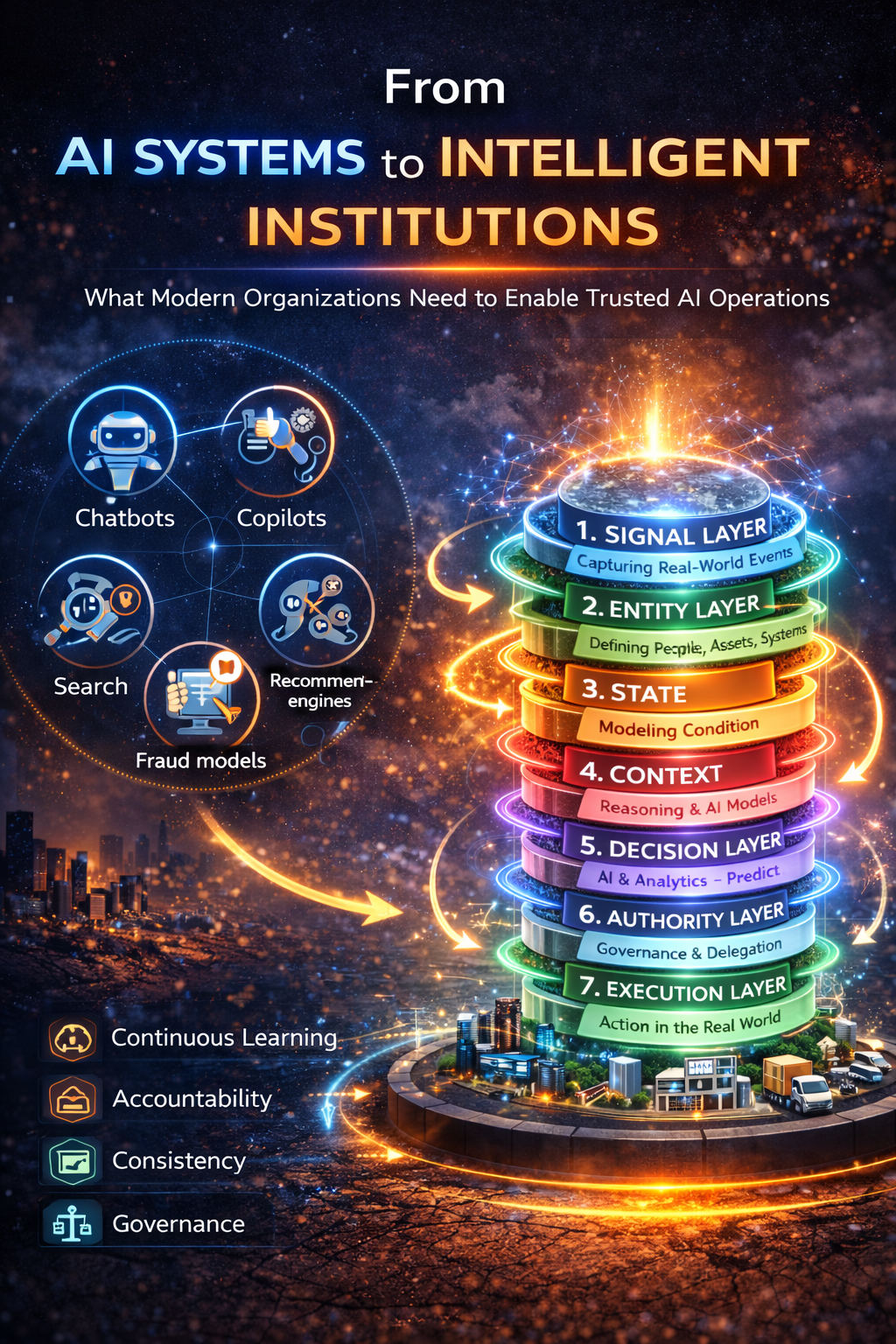
Many enterprises already operate:
- chatbots
- copilots
- search systems
- recommendation engines
- fraud detection models
- optimization algorithms
- agentic workflows
Yet most are still not intelligent institutions.
They are collections of AI tools attached to fragmented operating environments.
An intelligent institution is different.
It has a structured architecture to:
- Sense reality
- Interpret meaning
- Make decisions
- Delegate authority
- Execute actions within governance boundaries
Modern AI governance frameworks increasingly reflect this systemic view.
For example:
- NIST AI Risk Management Framework treats AI as a socio-technical system requiring monitoring, governance, and lifecycle oversight.
- OECD AI Principles emphasize accountability, transparency, and institutional governance.
- The EU AI Act introduces obligations around oversight, monitoring, logging, and human supervision.
These frameworks all point to the same emerging truth:
AI is no longer just about building models.
It is about designing institutional operating architecture.
The Representation Stack is that architecture.
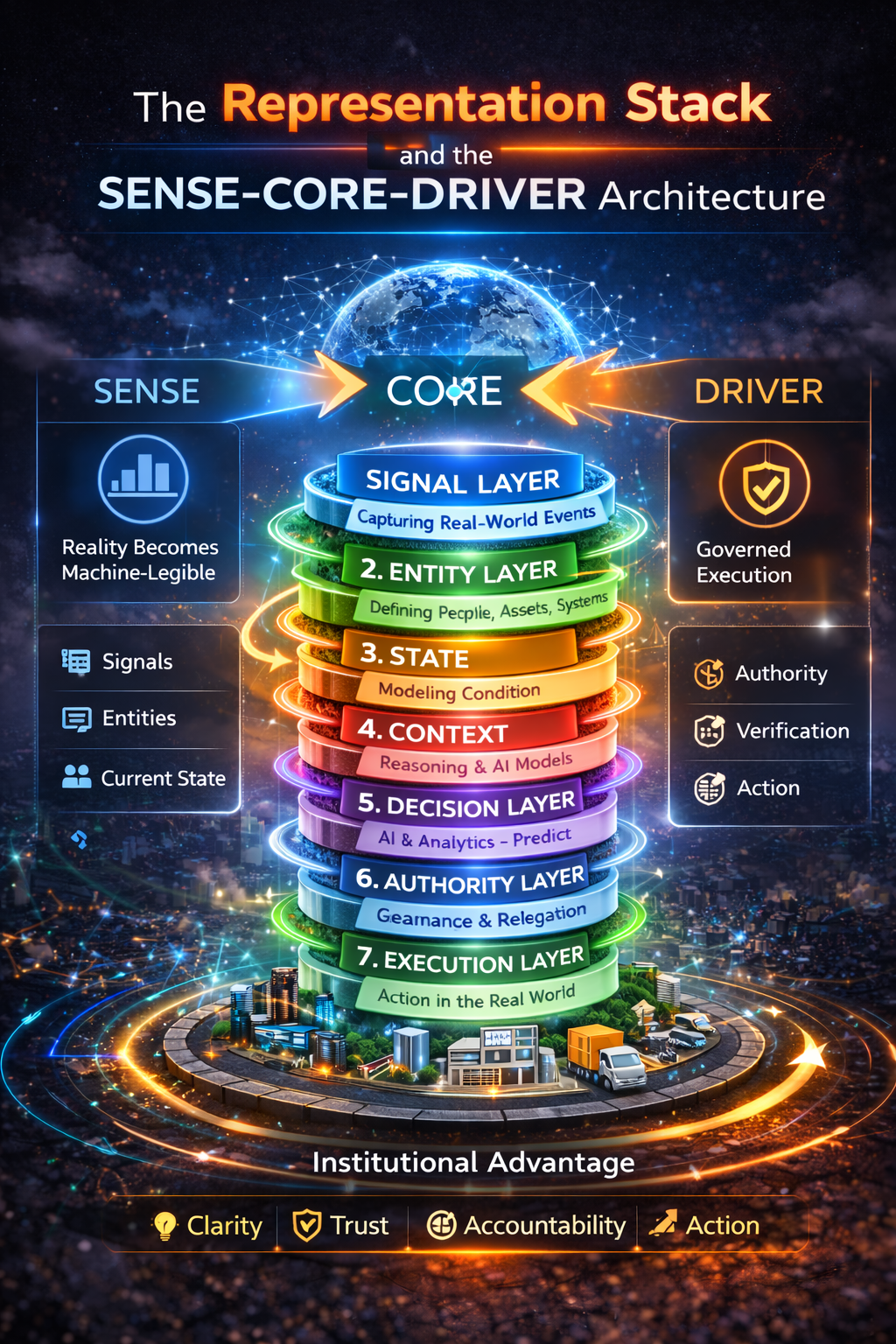
The Representation Stack and the SENSE–CORE–DRIVER Architecture
The Representation Stack becomes clearer when viewed through the SENSE–CORE–DRIVER framework.
SENSE
Reality becomes machine-legible.
CORE
Reality is interpreted and decisions are formed.
DRIVER
Decisions are executed within governed authority.
The Representation Stack operationalizes this architecture.
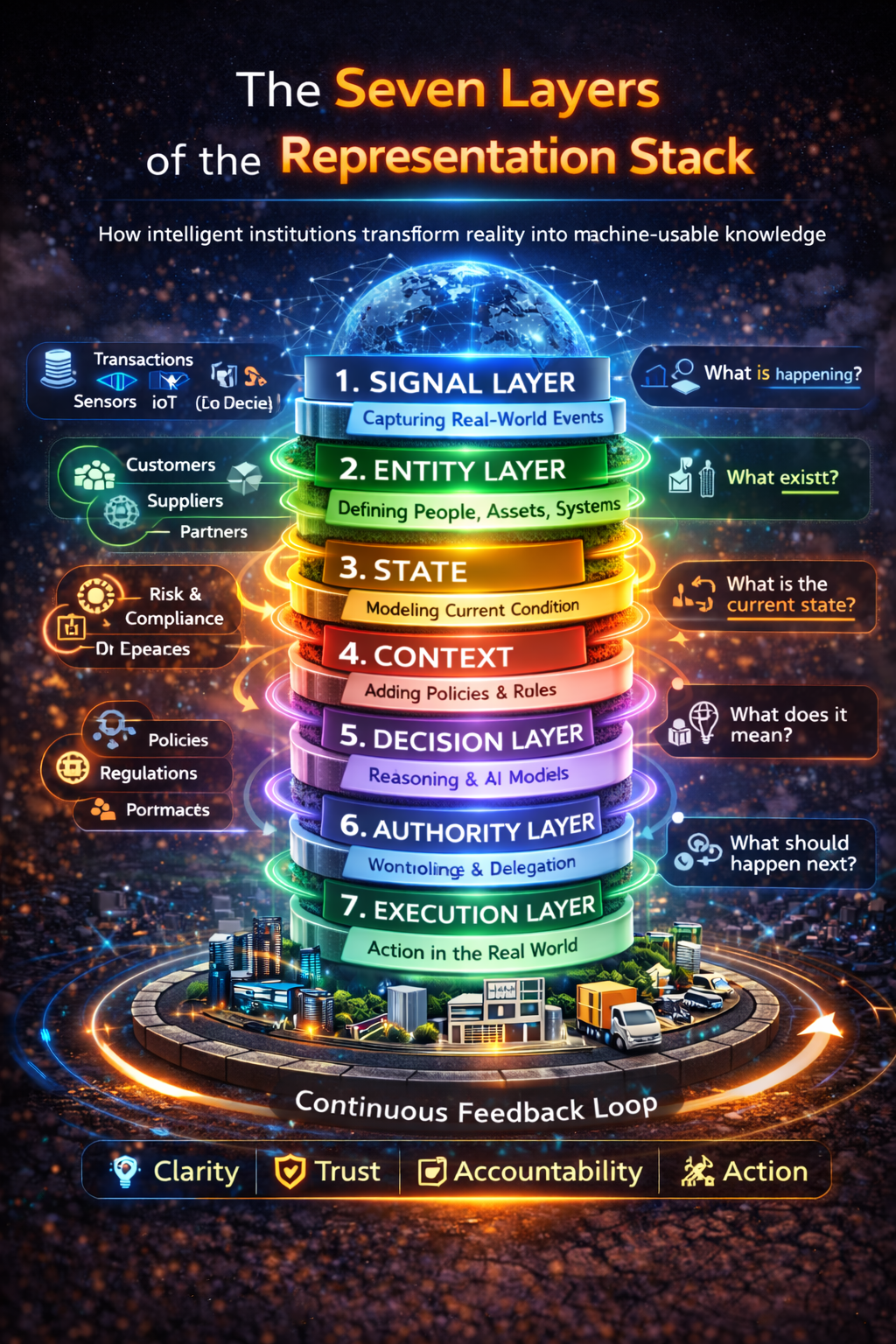
The Seven Layers of the Representation Stack
-
Signal Layer: Detecting Reality
The signal layer captures traces of reality.
Examples include:
- financial transactions
- sensor readings
- system events
- customer interactions
- operational telemetry
- documents and communications
Example:
A bank may observe:
- card transactions
- device changes
- login attempts
- call-center interactions
- unusual geographic patterns
A logistics company may observe:
- shipment scans
- temperature sensor readings
- route deviations
- warehouse events
Signals are not yet understanding.
They are simply evidence that something happened.
Weak signal layers create institutional blindness.
-
Entity Layer: Defining What Exists
Signals must connect to something.
The entity layer defines the actors and objects that exist in the system.
Examples include:
- customers
- suppliers
- shipments
- accounts
- contracts
- devices
- assets
This layer creates identity continuity across systems.
Without it, the same customer may appear differently across:
- marketing systems
- billing systems
- support systems
- risk systems
Once identity fragments, AI begins reasoning over inconsistent reality.
-
State Layer: Modeling Current Condition
Entities alone are not enough.
Institutions must understand the current condition of each entity.
This is the role of the state layer.
Examples:
A loan may be
- active
- overdue
- delinquent
- restructured
A shipment may be
- in transit
- delayed
- cleared by customs
- temperature-compromised
A patient may have
- vital sign states
- treatment status
- allergy records
- risk indicators
Decisions depend heavily on state accuracy.
Stale states lead to unreliable decisions.
-
Context Layer: Giving Meaning to Reality
Signals, entities, and states still do not explain what events mean.
That is the role of context.
Context includes:
- policies
- regulations
- business rules
- contractual obligations
- operational constraints
- market conditions
Example:
A delayed shipment means one thing if it breaches a service contract and another if the delay falls within tolerance.
A large transaction may be normal for one customer and suspicious for another.
Context converts raw facts into institutional meaning.
This is also where many AI deployments fail.
They assume context can be centralized and fixed.
In reality, context evolves constantly.
-
Decision Layer: Institutional Reasoning
Once reality is represented and contextualized, institutions can reason.
The decision layer includes:
- predictive models
- optimization engines
- rule systems
- AI reasoning systems
This layer determines:
- what action should be taken
- what options are available
- what outcomes are likely
However:
A strong model operating on weak representation produces weak decisions.
This reframes AI strategy.
The real question is not:
“How good is the model?”
The real question becomes:
“What reality is the model reasoning over?”
-
Authority Layer: Governing Delegation
The authority layer determines:
- what actions AI may take
- when humans must intervene
- which policies apply
- what approvals are required
Example:
AI may
- recommend decisions
- execute low-risk actions
- escalate high-risk cases
The authority layer defines the boundaries of machine autonomy.
As AI systems move closer to operational decisions, this governance layer becomes critical.
-
Execution Layer: Acting in the World
The final layer is execution.
This is where decisions become real actions.
Examples:
- approving payments
- routing support cases
- blocking fraud attempts
- adjusting supply chains
- triggering compliance workflows
Execution must also produce audit evidence.
Actions should be:
- traceable
- reviewable
- reversible when necessary
In mature systems, execution generates new signals.
The Representation Stack becomes a continuous feedback cycle.
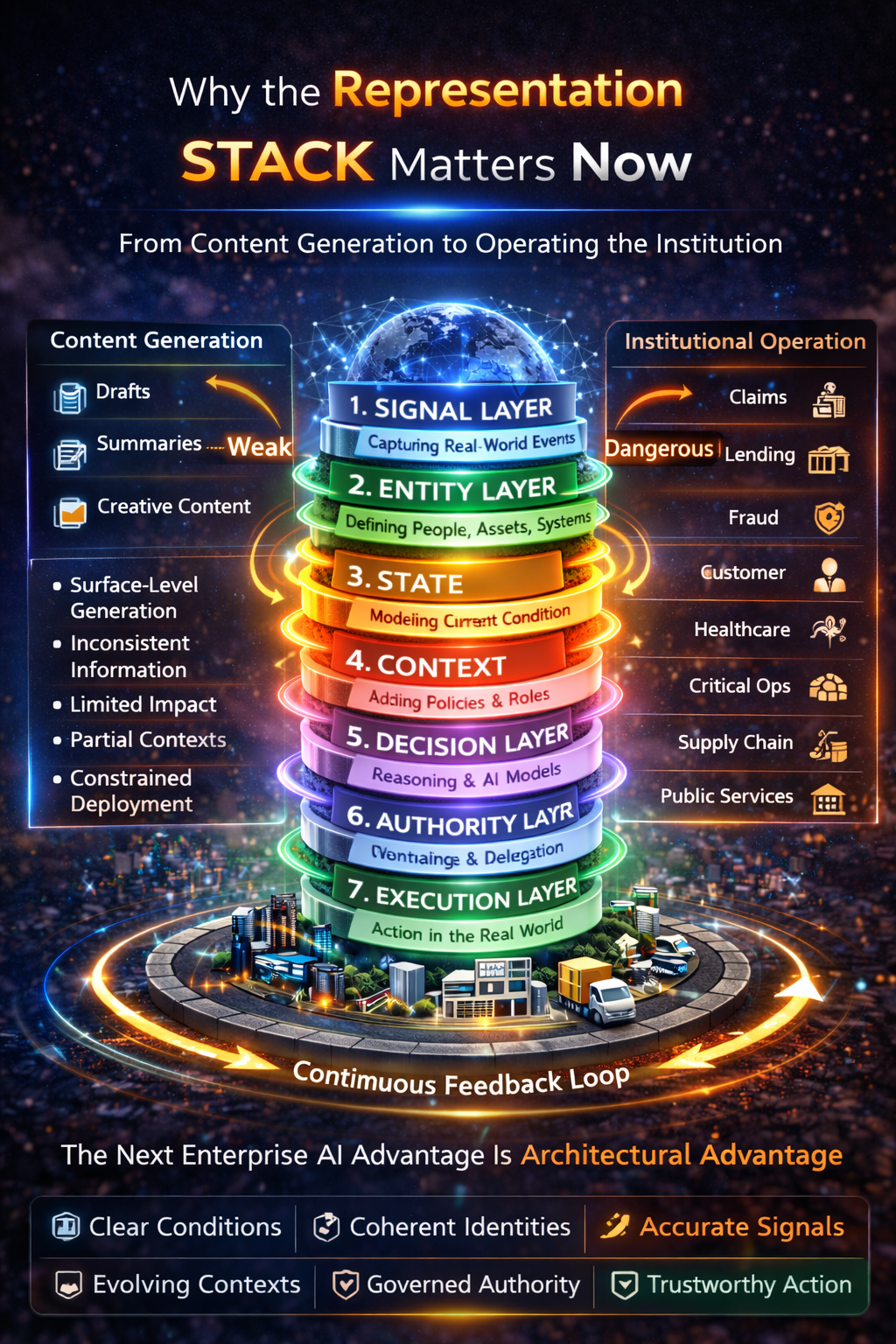
Why the Representation Stack Matters Now
AI is moving from content generation to institutional operation.
Earlier AI systems mostly produced:
- text
- code
- images
- summaries
Weak representation architecture was inconvenient but manageable.
But when AI begins influencing:
- lending decisions
- healthcare triage
- fraud detection
- supply chain operations
- customer treatment
- public services
weak representation architecture becomes dangerous.
The next wave of enterprise AI advantage will not come from models alone.
Those models are increasingly available to everyone.
Advantage will come from building superior institutional architecture around them.
Intelligence is becoming abundant.
Representation quality is becoming strategic.
Why Boards Should Care
Boards do not need to understand every ontology or schema.
But they must understand the consequences of weak representation architecture.
If the Representation Stack is weak:
- the institution sees reality poorly
- decisions rely on incomplete context
- authority boundaries become unclear
- AI risk accumulates invisibly
If the Representation Stack is strong:
- reality becomes legible
- decisions become coherent
- governance becomes enforceable
- intelligence compounds into advantage
The Representation Stack is therefore not just a technology issue.
It is a board-level design issue.
The Strategic Lesson
The institutions that win the AI era will not simply deploy the best models.
They will build the best stacks.
They will know how to transform:
signals → entities → states → meaning → decisions → authority → execution
into a coherent institutional system.
That is the architecture of intelligent institutions.
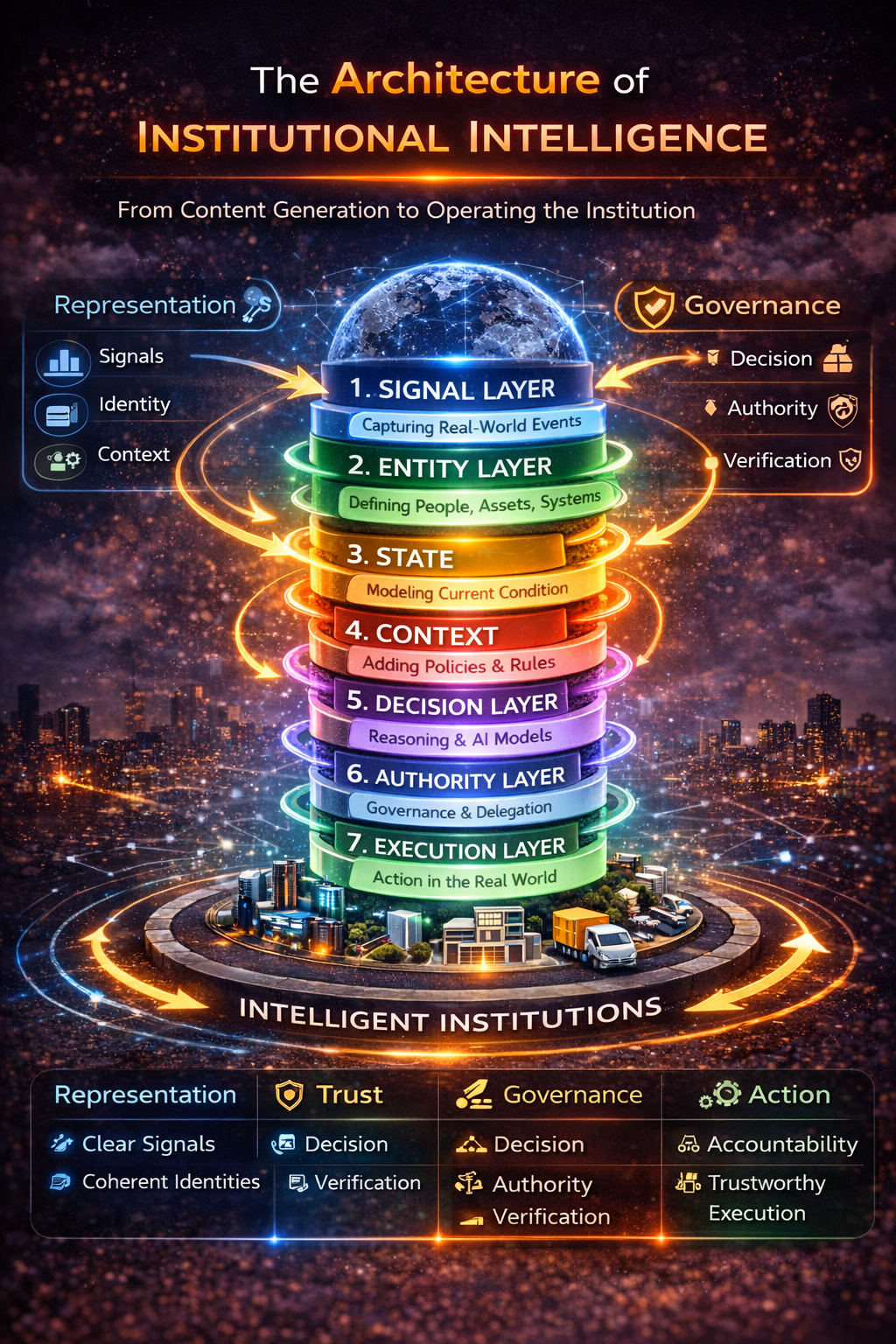
Conclusion: The Architecture of Institutional Intelligence
The internet had a stack.
Cloud computing had a stack.
Enterprise software had a stack.
Now intelligent institutions need one too.
The Representation Stack is the architecture that makes the Representation Economy real.
It allows institutions to:
- represent reality accurately
- reason over that reality coherently
- govern decisions responsibly
- execute actions with accountability
In the coming decade, the most important AI question will no longer be:
“Which model should we use?”
It will be:
“What architecture allows our institution to represent reality well enough to trust machine decisions?”
That architecture is the Representation Stack.
And the institutions that build it first will define how intelligence operates inside modern organizations.
FAQ
What is the Representation Stack?
The Representation Stack is a layered institutional architecture that converts real-world signals into machine-understandable representations, enabling AI systems to reason, decide, and act within governed boundaries.
Why is the Representation Stack important for enterprise AI?
Without a structured representation architecture, AI systems operate on incomplete or inconsistent information, increasing operational and governance risk.
How does the Representation Stack relate to AI governance?
The Representation Stack embeds governance into the architecture itself by defining signals, entities, states, context, decision authority, and execution accountability.
What is the relationship between the Representation Stack and SENSE–CORE–DRIVER?
The Representation Stack operationalizes the SENSE–CORE–DRIVER framework by defining the layers through which reality is sensed, interpreted, and acted upon within institutions.
Glossary
Representation Economy
An economic shift where competitive advantage depends on how effectively institutions represent reality for intelligent systems.
Representation Stack
The layered architecture that enables institutions to convert real-world complexity into machine-usable knowledge.
Institutional Intelligence
The ability of organizations to sense, interpret, decide, and act coherently using human and machine intelligence.
AI Governance Architecture
The structural framework ensuring AI systems operate within defined policies, authority boundaries, and oversight mechanisms.
Further Reading
Stanford AI Index Report
NIST AI Risk Management Framework
OECD AI Principles
EU Artificial Intelligence Act



Raktim Singh is an AI and deep-tech strategist, TEDx speaker, and author focused on helping enterprises navigate the next era of intelligent systems. With experience spanning AI, fintech, quantum computing, and digital transformation, he simplifies complex technology for leaders and builds frameworks that drive responsible, scalable adoption.