

The Representation Premium: Executive Insight
For the past decade, the global conversation about artificial intelligence revolved around a single question:
Which model is better?
Bigger models.
Faster models.
Cheaper models.
Safer models.
That question still matters.
But it is no longer the question that will determine who wins the AI economy.
A deeper shift is now underway.
As AI moves beyond generating content and begins influencing decisions, coordinating workflows, verifying risk, matching supply and demand, and acting inside institutional systems, markets will start rewarding a new kind of capability.
Not just model power.
Not just data scale.
Not even automation maturity.
Markets will reward representation quality.
In the next phase of the AI economy, institutions that are easier for intelligent systems to see, understand, trust, and coordinate with will gain an economic advantage.
That advantage is what I call:
The Representation Premium
The Representation Premium is the market reward earned by organizations whose reality is more legible to intelligent systems.
It is the premium attached to being machine-readable in the right way.
It is the advantage of being:
- easier to verify
- easier to integrate with
- easier to govern
- easier to coordinate with
- easier to trust
In the industrial era, markets rewarded scale.
In the digital era, markets rewarded software leverage.
In the AI era, markets will increasingly reward representability.
And that shift changes the nature of competitive advantage itself.
Because it means the future of strategy will depend not only on what an institution does, but on how clearly its reality can be represented for intelligent systems.
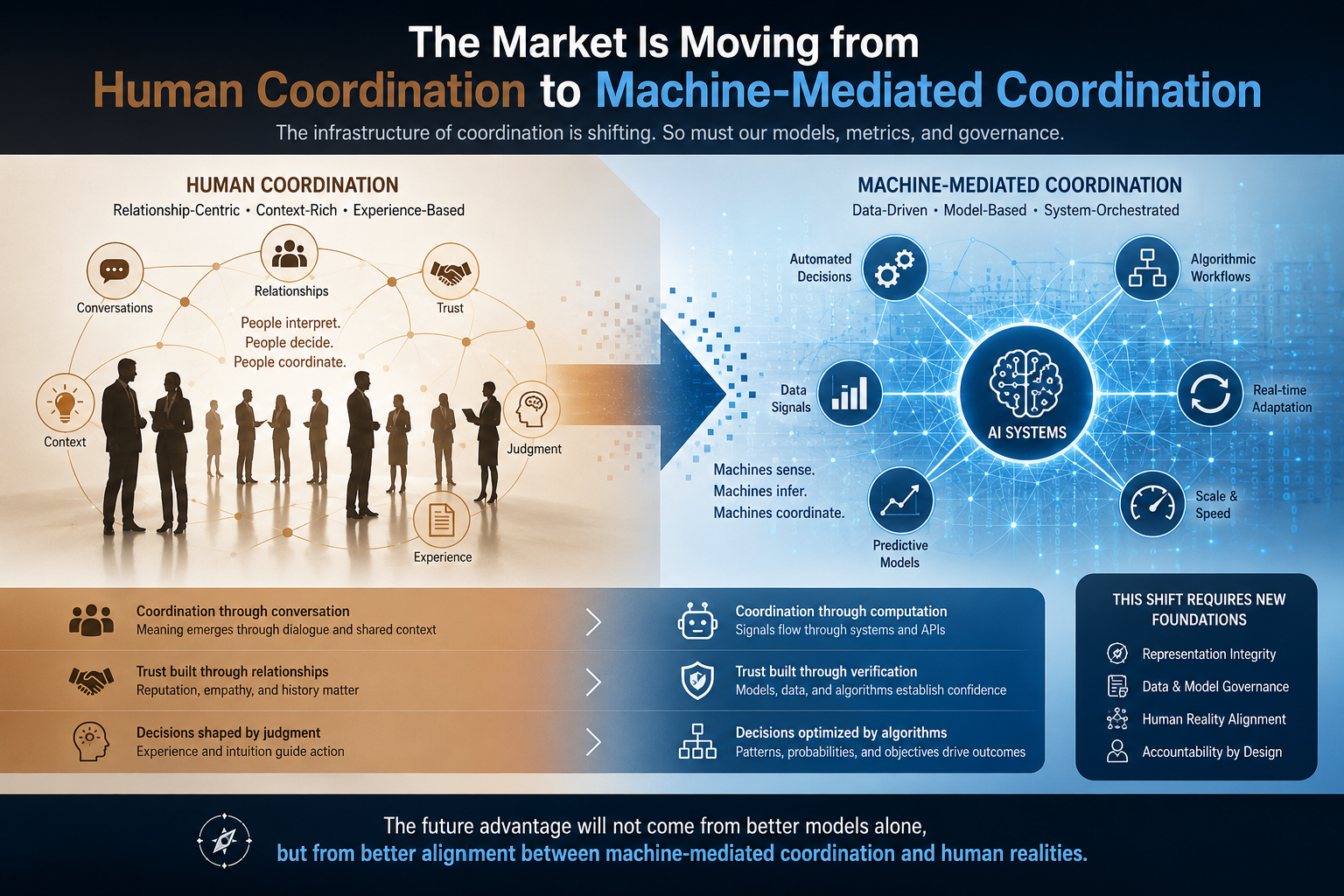
The Market Is Moving from Human Coordination to Machine-Mediated Coordination
Most markets were designed for human coordination.
Humans:
- read contracts
- interpreted reports
- assessed trust
- negotiated ambiguity
- reconciled incomplete information
But the coordination layer of markets is now changing.
AI systems are increasingly entering the decision and coordination infrastructure of institutions.
They now help:
- rank suppliers
- screen customers
- flag financial risk
- route transactions
- monitor compliance
- recommend decisions
In some environments, they are beginning to execute actions directly within bounded authority.
As this shift expands, markets will not simply reward the smartest algorithm.
They will reward the institutions that are easiest for those algorithms to work with.
That is the economic logic behind the Representation Premium.
An institution that is:
- difficult to interpret
- difficult to verify
- difficult to coordinate with
will increasingly create friction in AI-mediated markets.
An institution that is:
- legible
- structured
- traceable
- governable
will increasingly enjoy preference.
This is not theoretical.
The Stanford AI Index 2025 reports that 78% of organizations now use AI, up from 55% the year before.
At the same time, governance frameworks such as:
- the NIST AI Risk Management Framework
- the OECD AI Principles
are pushing institutions toward traceable, accountable, and trustworthy AI systems.
In other words:
AI is no longer just a productivity tool.
It is becoming part of the infrastructure through which markets perceive reality and coordinate action.
What Is the Representation Premium?
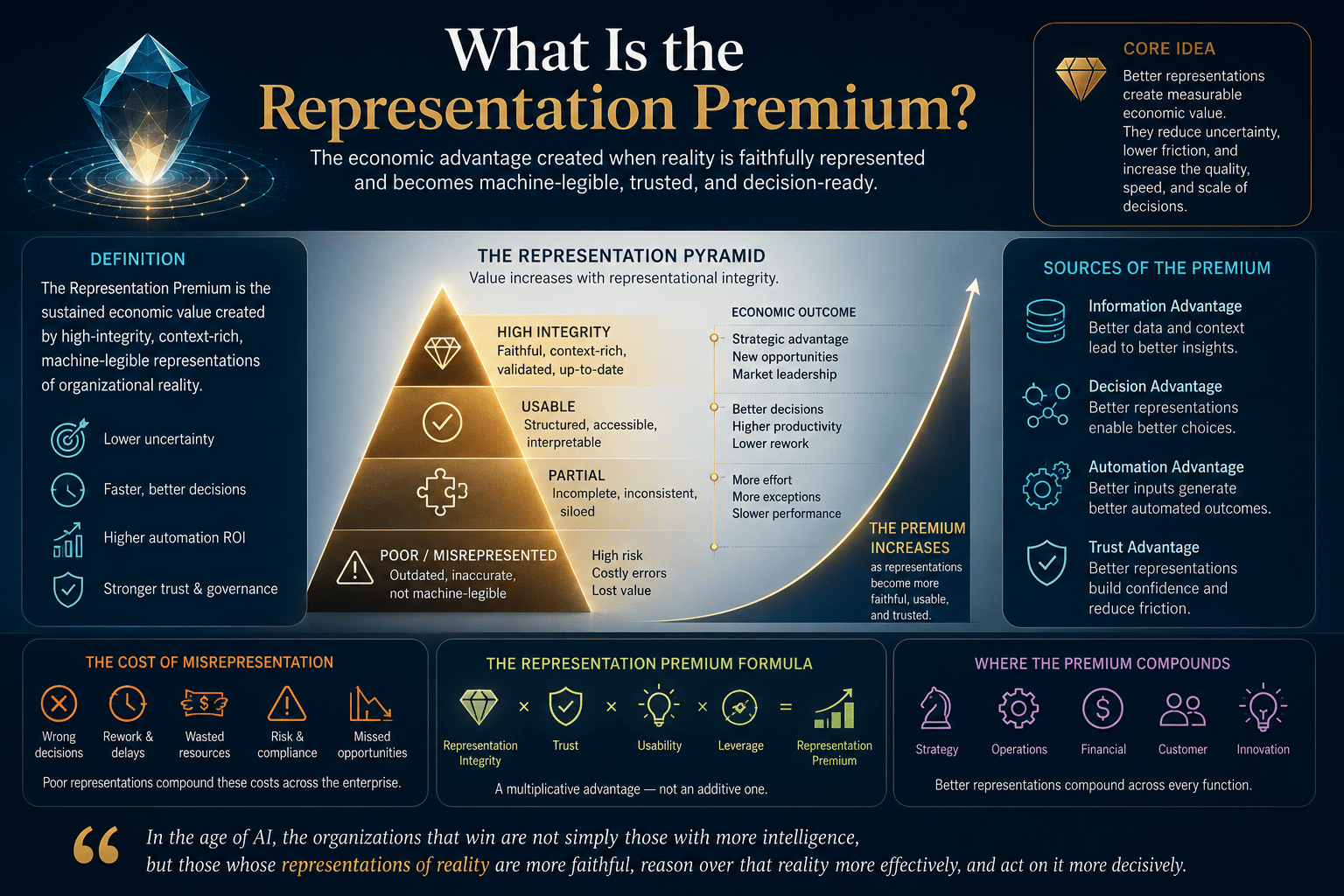
The Representation Premium is the economic advantage earned by institutions whose people, assets, commitments, processes, and decisions are easier for intelligent systems to represent accurately and act upon responsibly.
In simple terms:
If markets increasingly run through intelligent systems,
then institutions that are easier for those systems to understand will be rewarded.
This reward appears in very practical ways:
- faster onboarding
- lower compliance friction
- higher supplier ranking
- lower cost of capital
- faster approvals
- better ecosystem participation
- stronger machine-to-machine coordination
- higher institutional trust
This is not simply about structured data.
It is about whether an institution can expose the right parts of reality in a form that intelligent systems can use without losing context, identity, authority, or accountability.
This is where the idea connects directly with the Representation Economy described in:
➡ https://www.raktimsingh.com/representation-economy-sense-core-driver/
Why the Representation Premium Will Grow
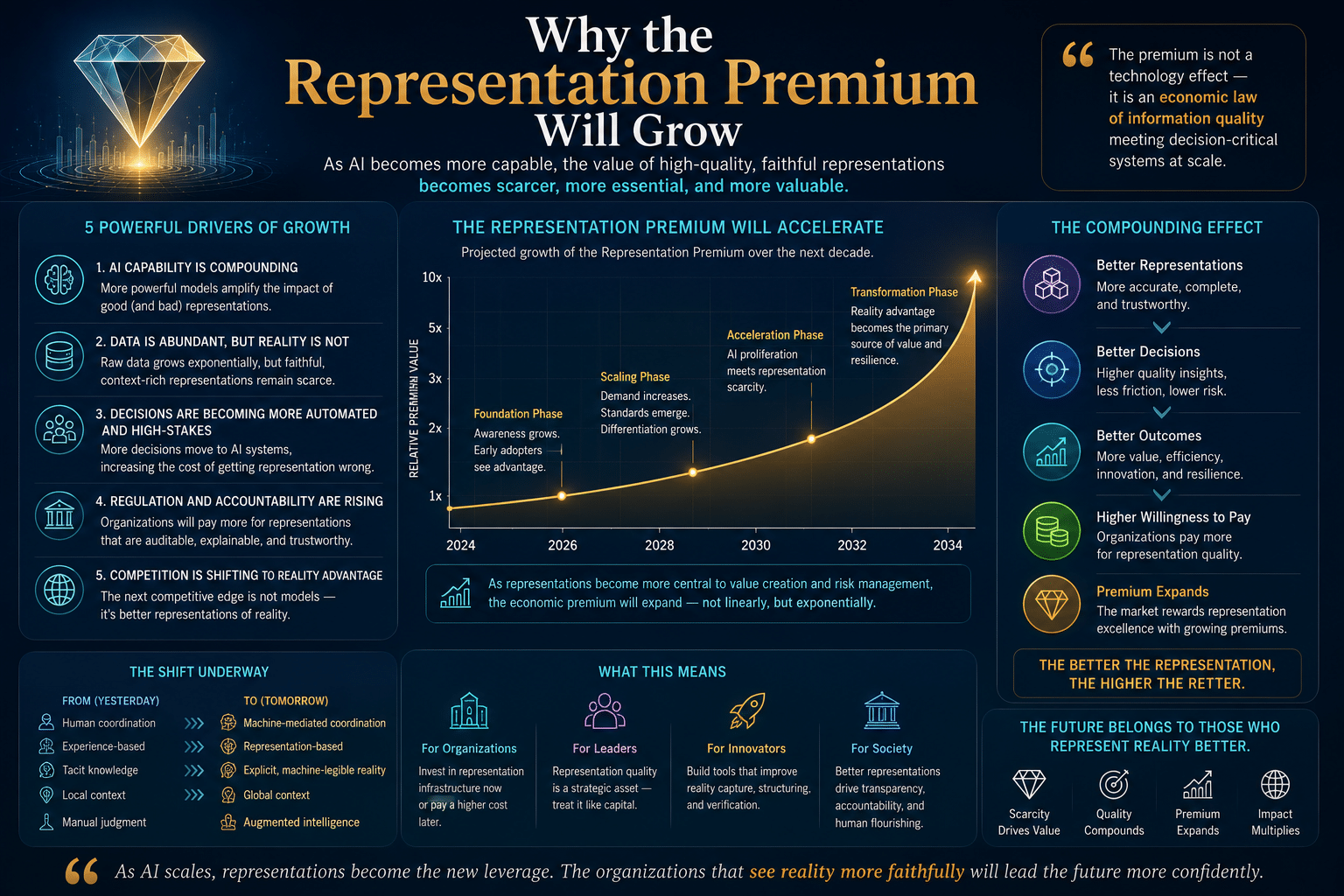
Markets are becoming increasingly dependent on machine judgment.
Examples are already visible across sectors.
A lender now uses AI-assisted credit evaluation.
A digital platform uses machine learning to rank sellers and filter quality.
A supply chain uses AI to anticipate disruption and reroute logistics.
A hospital uses AI-assisted triage and prioritization.
A regulator expects stronger traceability and lifecycle accountability from AI-enabled systems.
The NIST framework explicitly treats trustworthy AI as a core risk-management concern.
The OECD principles emphasize:
- transparency
- accountability
- robustness
- human oversight.
In this environment, the institutions that gain advantage will not simply be those with the strongest internal AI team.
They will be those whose external reality is easier for intelligent systems to process.
Put differently:
If an institution is hard to represent, it becomes expensive to trust.
If it is easy to represent, it becomes easy to coordinate with.
And that coordination advantage becomes a premium.
The SENSE–CORE–DRIVER Logic Behind the Representation Premium
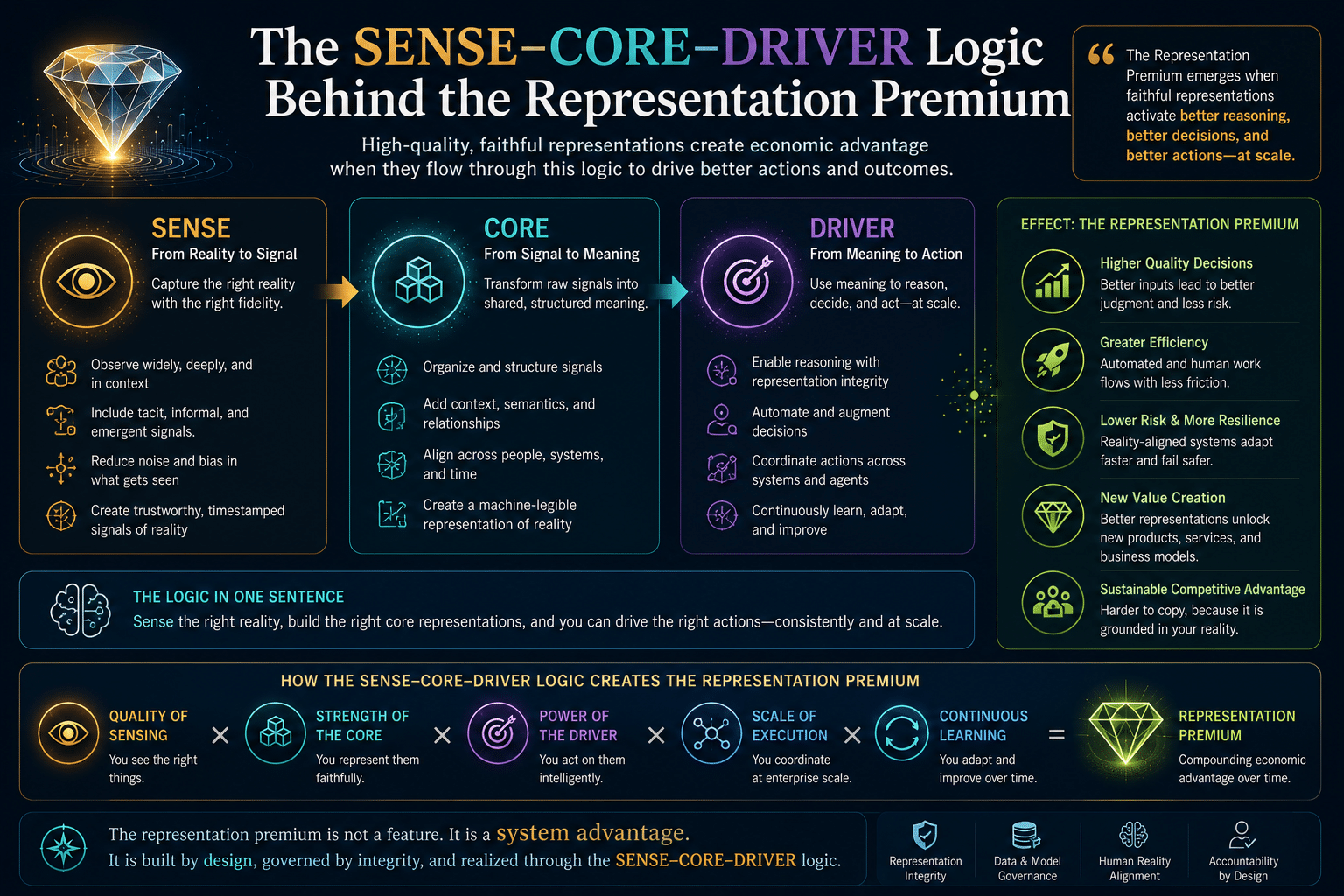
The Representation Premium becomes clearer when examined through the SENSE–CORE–DRIVER framework.
➡ https://www.raktimsingh.com/enterprise-ai-operating-model/
This framework describes how intelligent institutions operate.
But it also explains how markets will assign preference in the AI economy.
SENSE — Can the Institution Be Seen Clearly?
SENSE is the layer where reality becomes legible.
It includes:
- signals
- entities
- state representation
- evolution over time
An institution with strong SENSE capabilities is easier for AI systems to observe correctly.
Consider two logistics firms.
Both claim reliability.
But one exposes:
- real-time shipment state
- verified supplier identities
- warehouse conditions
- route changes
- disruption signals
- delivery confidence
The other exposes:
- delayed reports
- inconsistent identifiers
- fragmented systems
- unclear event tracking
Which firm will autonomous logistics platforms prefer?
The one whose reality is easier to observe accurately.
That is the first source of the Representation Premium.
CORE — Can the Institution Be Trusted in Reasoning?
CORE is the cognition layer.
It is where systems:
- comprehend context
- optimize decisions
- realize actions
- evolve through feedback
Markets increasingly reward institutions that expose decision-useful representations, not just raw data.
Consider two companies applying for credit.
One provides:
- scattered documents
- inconsistent reporting
- limited operational transparency
The other provides:
- structured financial flows
- verified counterparties
- clear operational state
- traceable business events
The second company is easier to reason about.
That can produce:
- faster credit decisions
- lower risk uncertainty
- better pricing
- stronger institutional trust
That is another form of Representation Premium.
DRIVER — Can the Institution Be Coordinated With Safely?
DRIVER is the execution and legitimacy layer.
It answers six essential questions:
- who authorized the action
- what representation informed it
- which identity was affected
- how the decision is verified
- how execution occurs
- what recourse exists if the system is wrong
As AI systems increasingly participate in approval, routing, verification, and execution, institutions with stronger DRIVER structures become safer to coordinate with.
Markets will therefore prefer institutions that are not only easy to see and score — but easy to act with safely.
Real-World Examples of the Representation Premium
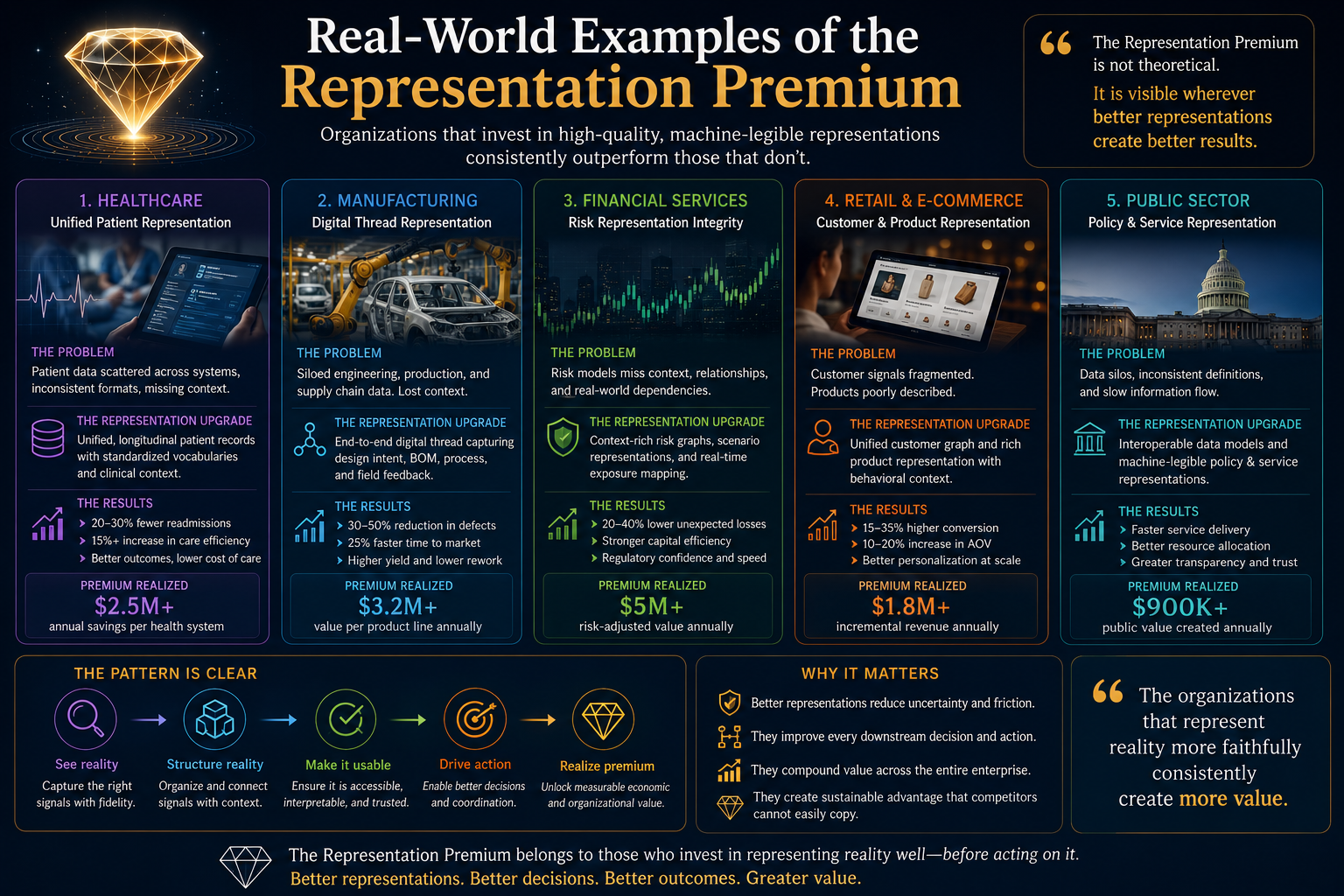
Finance
Companies with transparent financial representation may receive:
- faster underwriting
- reduced compliance friction
- stronger partner confidence
- better ecosystem access
The premium here becomes financial.
Supply Chains
Suppliers with strong representation expose:
- digital identity
- real-time inventory state
- traceable product flows
- disruption visibility
AI-enabled procurement systems will increasingly prefer such suppliers.
Healthcare
Hospitals with stronger representation of:
- patient state
- identity resolution
- event history
- governance boundaries
enable safer AI-assisted coordination.
Platforms
Digital platforms rely heavily on machine evaluation.
Companies that expose reliable signals and identities will perform better in:
- ranking
- trust scoring
- ecosystem participation.
Representation Premium vs Data Advantage
This idea is often misunderstood.
It is not the same as data advantage.
A company may have massive amounts of data and still be difficult for intelligent systems to understand.
Why?
Because data alone does not guarantee:
- consistent identity
- meaningful state
- temporal continuity
- authority clarity
- decision traceability.
Representation quality is a higher-order capability.
It means reality is not just stored.
It is structured in a machine-legible form that supports trustworthy decision-making.
This is why the next competitive divide will not be:
data-rich vs data-poor
It will be:
representation-rich vs representation-poor institutions.
The Hidden Penalty: Representation Discount
Where there is a premium, there is also a penalty.
Institutions that are difficult to represent may face a Representation Discount.
This may appear as:
- slower onboarding
- higher compliance cost
- lower trust from partners
- reduced ecosystem participation
- exclusion from automated systems.
In a world where markets increasingly run through machine-mediated coordination, this discount can become economically significant.
What Leaders Should Do Now
If the Representation Premium is real, leaders must ask a different strategic question.
Not just:
How do we deploy AI?
But also:
How easy is our institution for AI systems to see, trust, and coordinate with?
Five actions become essential.
-
Audit Legibility
Measure whether entities, states, and signals are consistently representable.
-
Strengthen Identity Infrastructure
Signals must connect to durable identities.
Identity is foundational.
-
Build Living State Models
Representations must evolve as reality changes.
-
Define Delegation Boundaries
Clarify when AI can recommend, escalate, block, or act.
-
Treat Representation as Market Infrastructure
Representation should be treated as competitive architecture, not technical plumbing.
Why Boards Must Pay Attention
Boards have spent years discussing:
- digital strategy
- cybersecurity
- cloud transformation
- AI adoption.
But the deeper strategic question is emerging now.
What is our Representation Strategy?
Institutions that earn the Representation Premium will be those that treat representation as a strategic asset.
The World Economic Forum notes that AI and information processing will transform the majority of businesses this decade.
That means institutional design decisions made today will shape competitive advantage tomorrow.
The Bigger Shift
The Representation Premium reveals a deeper transformation.
AI is not only changing how organizations operate.
It is changing how markets decide whom to prefer.
In earlier eras markets rewarded:
scale
efficiency
digital reach.
In the AI era markets will reward institutions whose reality is:
- visible
- verifiable
- interpretable
- governable
- coordinate-ready.
This is a change in market logic.
The next great competitive advantage may not be intelligence alone.
It may be legible intelligence-ready reality.

Conclusion
The Institutions That Win Will Be Easier for Machines to Trust
The Representation Premium is the economic reward that emerges when markets become mediated by intelligent systems.
As AI becomes embedded in how institutions:
- evaluate risk
- approve transactions
- rank partners
- route decisions
- verify compliance
organizations that are easier for those systems to understand responsibly will gain an advantage.
At first this advantage may appear subtle.
Faster approvals.
Lower friction.
Better ranking.
Preferred partnerships.
But over time these small advantages compound.
And they may become one of the defining economic forces of the Representation Economy.
The institutions that win the AI era will not simply deploy better models.
They will design better representations of reality.
Because in the end, markets will reward the institutions that intelligent systems can trust.
That reward is the Representation Premium.
What happens when representation quality itself becomes scarce?
Reality, trust, and representation capacity follow their own lifecycle — see The Scarcity of Reality: Why the AI Economy Will Be Defined by the Lifecycle of High-Trust Representation.
Glossary
Representation Premium
The economic advantage gained by institutions whose reality is easier for intelligent systems to observe, reason about, and coordinate with.
Representation Economy
An economic phase where competitive advantage depends on how effectively institutions represent reality for machine-mediated decision systems.
SENSE Layer
The architectural layer where signals, entities, and states make reality observable.
CORE Layer
The reasoning layer where decisions are evaluated and optimized.
DRIVER Layer
The governance layer where authority, verification, execution, and recourse are enforced.
Machine-Readable Trust
Institutional trust that emerges when systems can verify identity, state, and authority algorithmically.
Executive FAQ
What is the Representation Premium?
The Representation Premium is the market advantage gained by organizations whose reality is easier for intelligent systems to understand and coordinate with.
Why will AI markets reward representability?
Because AI systems require structured signals, identities, and states to make trustworthy decisions.
Is the Representation Premium the same as data advantage?
No. Representation quality depends on identity, state, governance, and decision traceability — not just raw data volume.
Why should boards care?
Because representation infrastructure will influence credit access, regulatory trust, ecosystem participation, and coordination efficiency.



Raktim Singh is an AI and deep-tech strategist, TEDx speaker, and author focused on helping enterprises navigate the next era of intelligent systems. With experience spanning AI, fintech, quantum computing, and digital transformation, he simplifies complex technology for leaders and builds frameworks that drive responsible, scalable adoption.