
Why agentic AI breaks traditional cost management
Enterprise AI has crossed a threshold.
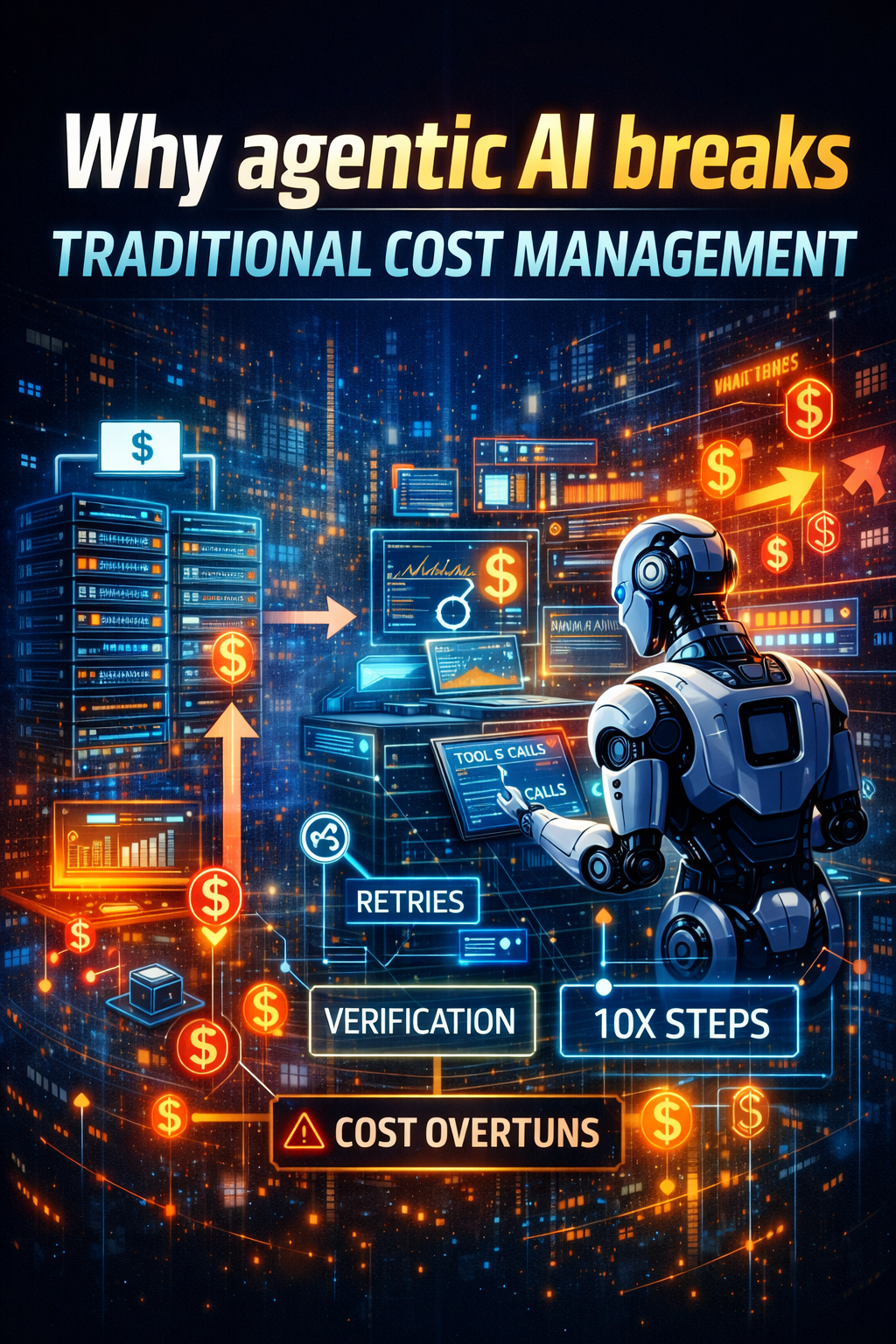
The first wave (copilots and chatbots) mostly created conversation cost: you paid for tokens, inference, and a bit of retrieval. The second wave—agents that take actions—creates autonomy cost: tokens, tool calls, retries, workflows, approvals, rollbacks, audit logging, safety checks, and the operational overhead of keeping it all reliable.
That shift changes the executive question.
It is no longer: “Which model are we using?”
It becomes: “Can we operate autonomy economically—predictably, transparently, and at scale?”
Gartner has already warned that over 40% of agentic AI projects may be canceled by the end of 2027 because of escalating costs, unclear business value, or inadequate risk controls. (Gartner)
That’s not an “agent problem.” It’s a missing operating layer problem—specifically, a missing Cost Control Plane for autonomous AI.
This article explains what “Agentic FinOps” really means, why traditional FinOps is not enough for agents, and how enterprises can build a cost control plane that makes autonomy affordable, defensible, and scalable—without slowing innovation.
Why agentic AI breaks traditional cost management
Classic cloud FinOps works because costs map to infrastructure primitives: compute, storage, network, reservations, and utilization curves.
Agents don’t behave like that.
Agents behave like living workflows:
- They plan, attempt, fail, retry, and escalate.
- They call tools (search, CRM updates, ticketing, payments, provisioning).
- They spawn sub-tasks and delegate to other agents.
- They “think” (token usage), “act” (tool calls), and “verify” (more calls).
So the real cost driver is not “the model.” It’s the chain of actions.
A CIO.com analysis highlights a pattern many enterprises are experiencing: AI costs overruns are adding up and becoming a leadership-level accountability issue. (CIO)
And as agent adoption accelerates in regulated environments, supervisors are emphasizing accountability and governance risk—because autonomy can move faster than management systems. (Reuters)
Most AI cost surprises don’t come from a single big bill. They come from “death by a thousand micro-decisions.”
Here are common leakage patterns you’ll recognize:
1) Retry storms
An agent fails to complete a task because one downstream system times out. It retries. Then it retries again. Meanwhile each attempt generates:
- new prompts
- new tool calls
- new retrieval
- new logs
- new safety checks
The user sees “still working.” Finance sees a quietly compounding bill.
2) Tool-call inflation
Agents can turn simple actions into tool-call cascades:
- “Update a record” becomes: read → reason → confirm → write → verify → re-read.
Multiply that by hundreds of workflows per day.
3) “Overthinking” for low-value work
Many tasks don’t deserve premium reasoning and long context windows.
But without routing controls, agents default to “best effort,” which often means “highest cost.”
4) Zombie agents
A misconfigured or forgotten agent continues to run scheduled tasks or background checks, producing cost without value. This is explicitly called out as a real enterprise risk: agents that “don’t do anything useful” can still rack up inference bills. (CIO)
5) The compliance tax (the necessary one)
As you add auditability, retention, and governance, you also add cost. FinOps for AI guidance increasingly emphasizes including governance and compliance overhead in budgeting and forecasting. (finops.org)
None of these problems are solved by negotiating model pricing alone. They’re solved by operating autonomy like a managed service—with cost guardrails embedded into the runtime.
What is “Agentic FinOps”?
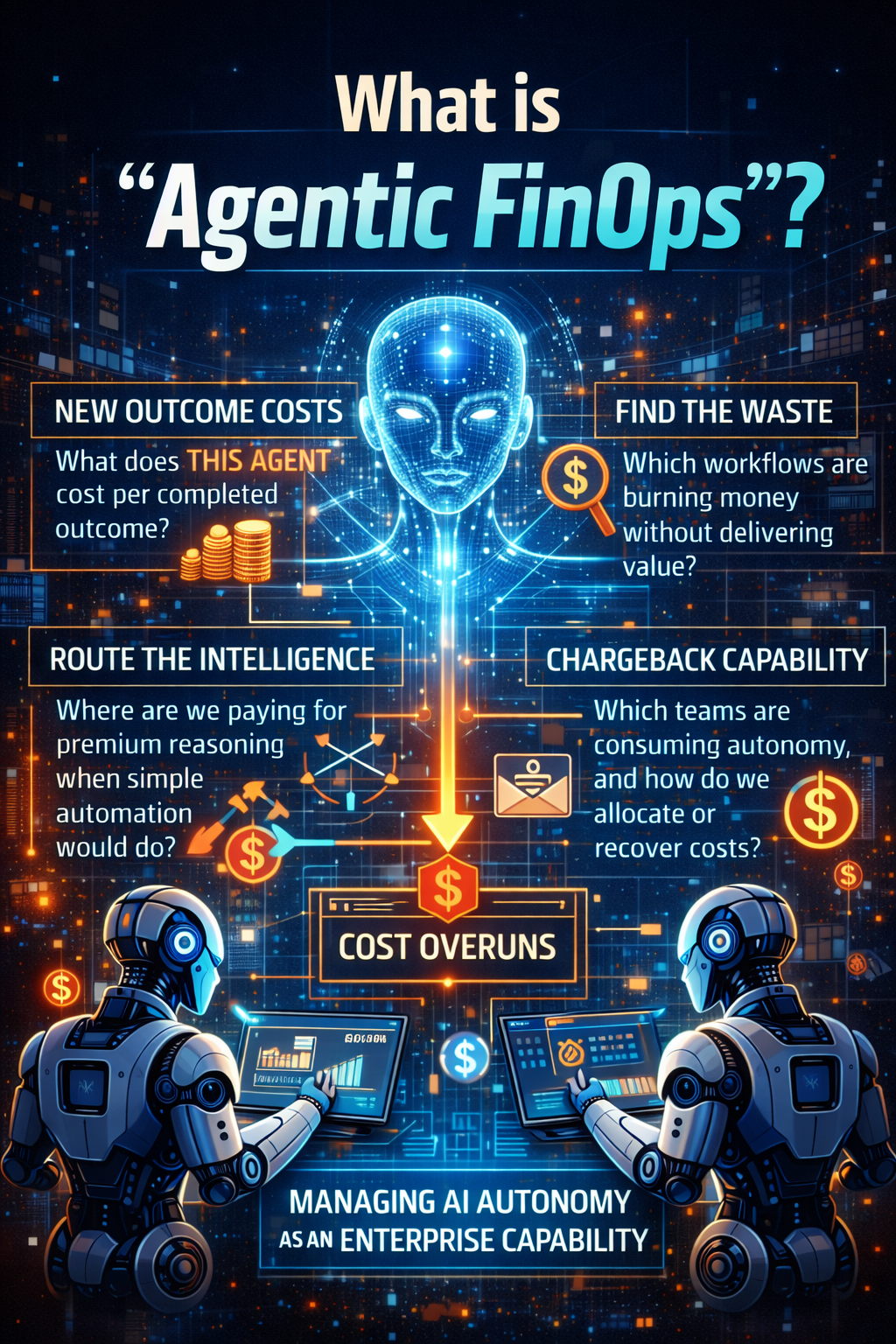
Agentic FinOps is the practice of managing AI autonomy like an enterprise operational capability, not a set of experiments.
It extends FinOps into the agent layer by answering questions such as:
- What does this agent cost per completed outcome?
- Which workflows are burning money without delivering value?
- Where are we paying for premium reasoning when simple automation would do?
- Which teams are consuming autonomy, and how do we allocate or recover costs?
- When do we automatically stop or throttle an agent that exceeds budget thresholds?
The FinOps Foundation has started publishing practical guidance on tracking generative AI cost and usage, forecasting AI services costs, and optimizing GenAI usage—signals that the discipline is becoming mainstream. (finops.org)
But for agents, the missing piece is a specific construct:
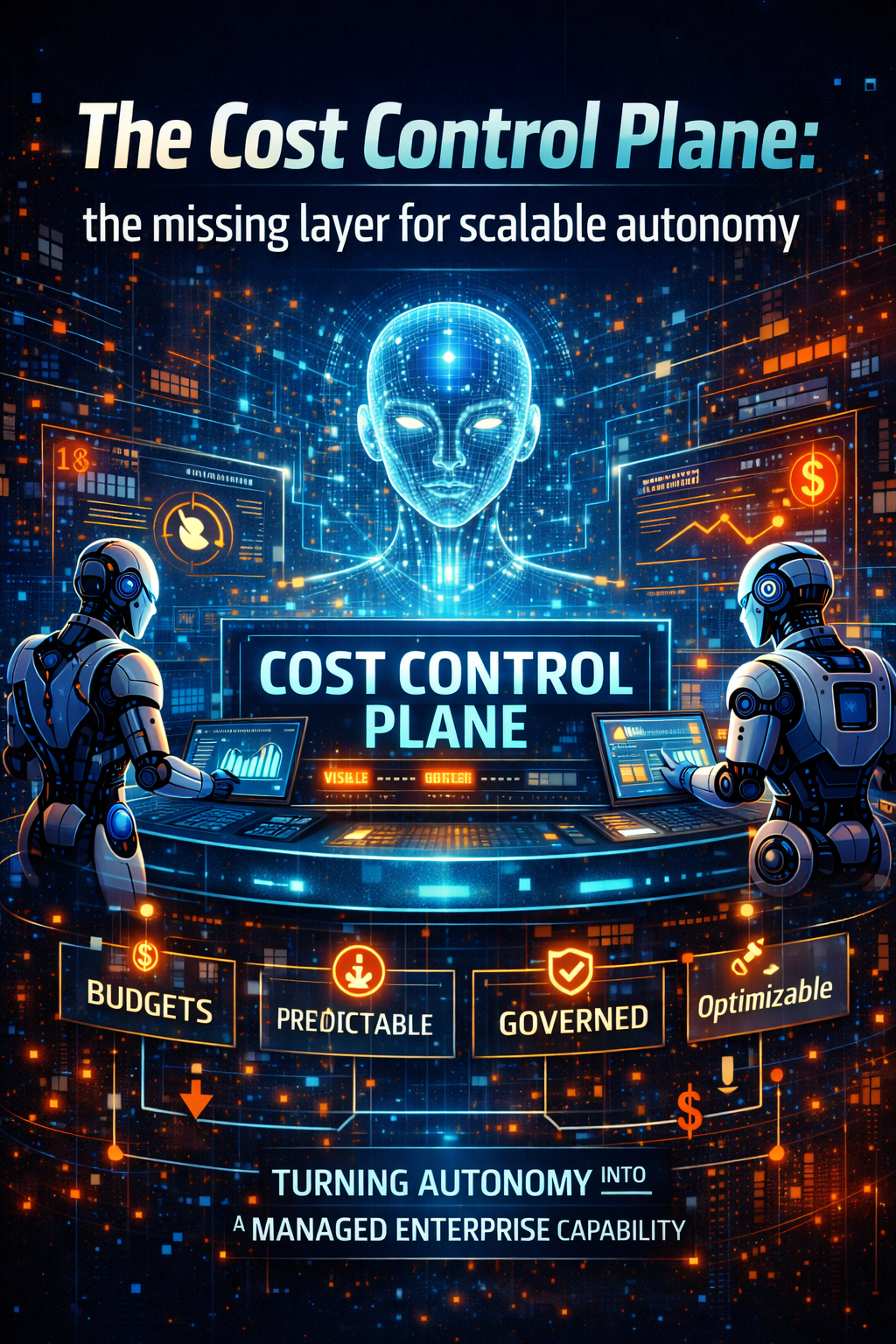
The Cost Control Plane: the missing layer for scalable autonomy
A Cost Control Plane is the enterprise system that makes agent costs:
- visible (you can see them in the unit that matters),
- predictable (you can forecast them),
- governed (you can enforce budget policies),
- optimizable (you can reduce cost without breaking outcomes).
Think of it like this:
- In cloud, you don’t run production without monitoring, alerts, and autoscaling.
- In autonomy, you shouldn’t run agents without budget awareness, cost attribution, and runtime throttles.
This isn’t theoretical. We’re seeing emerging patterns where budget awareness is injected into the agent loop specifically to prevent runaway tool usage. (CIO)
And hyperscalers increasingly publish cost planning and alerting guidance for AI services because “surprise bills” have become a recurring failure mode. (Microsoft Learn)
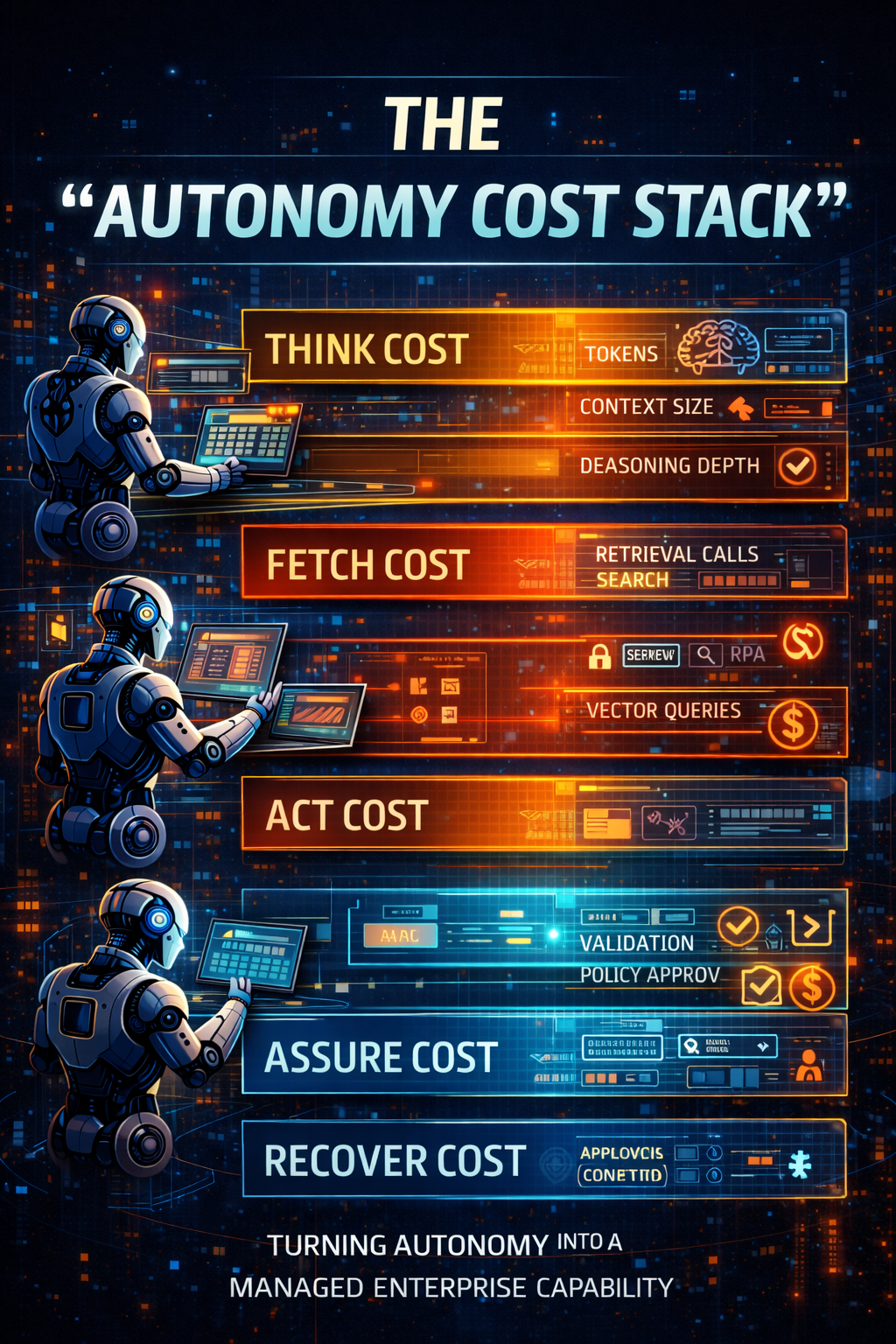
A simple mental model: the “Autonomy Cost Stack”
To make this easy for executives and teams, separate agent costs into five layers:
- Think cost: tokens, context size, reasoning depth
- Fetch cost: retrieval calls, search, vector database queries
- Act cost: tool calls into business systems (APIs, SaaS, RPA)
- Assure cost: validation, policy checks, approvals, evidence logs
- Recover cost: rollbacks, incident handling, human escalation
Your cost control plane needs to track and govern all five—not just the first one.
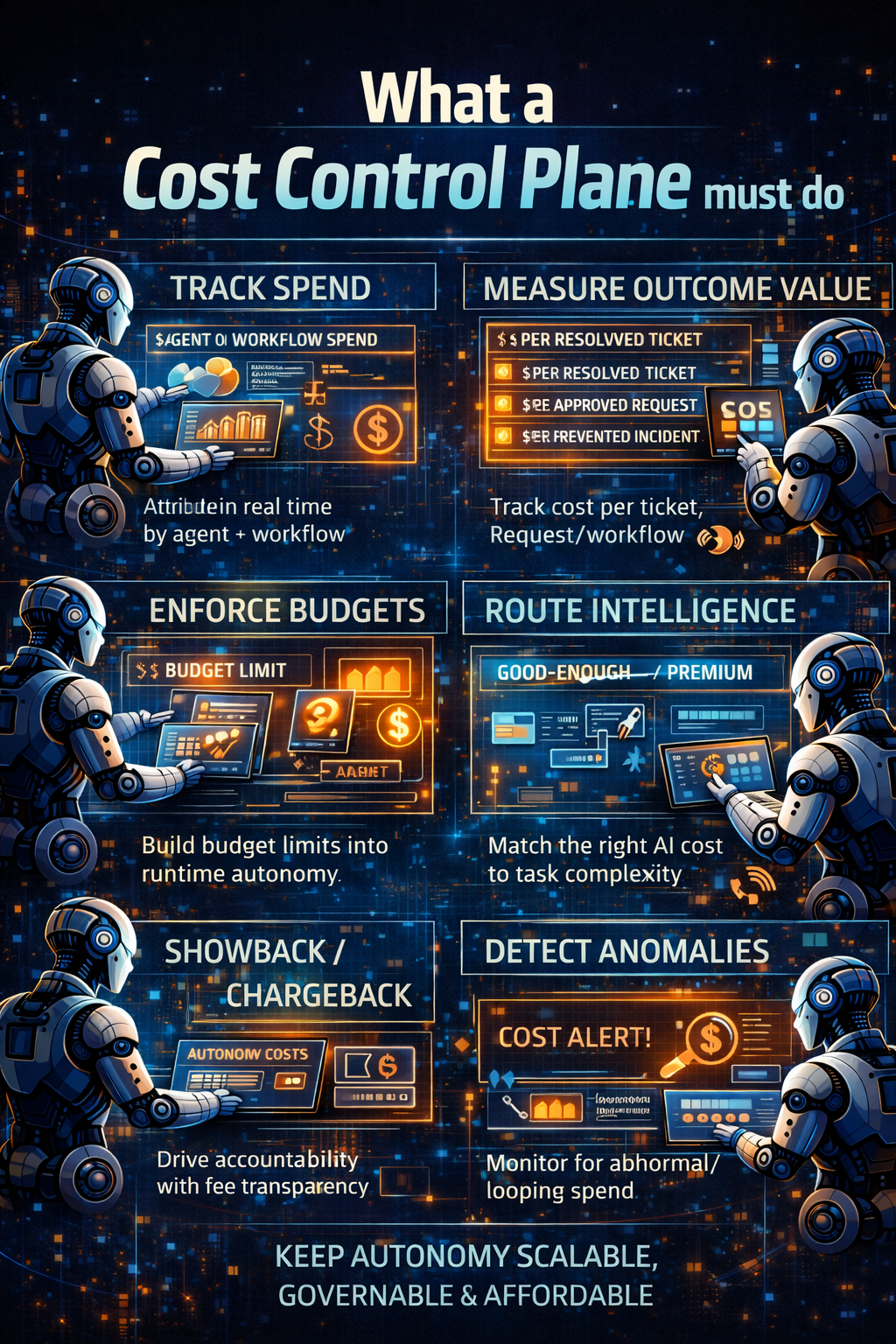
What a Cost Control Plane must do
1) Real-time usage and spend tracking at the “agent + workflow” level
Classic cloud reporting is not enough. You need to answer:
- “How much did the onboarding agent spend yesterday?”
- “What did it spend on thinking vs acting?”
- “Which tool integrations are the cost hotspots?”
This aligns with the FinOps Foundation’s emphasis on building AI cost and usage tracking into existing FinOps practices. (finops.org)
2) Outcome-based unit economics
Executives don’t want token counts. They want:
- cost per resolved ticket
- cost per approved request
- cost per successful workflow completion
- cost per prevented incident
That reframes the conversation from “AI is expensive” to “Is this outcome worth it?”
3) Budget policies enforced inside the agent runtime
This is the big shift: budgets must become runtime constraints.
Examples:
- If a workflow exceeds its budget, the agent must switch to a cheaper model or ask for approval.
- If an agent hits a daily cap, it should pause non-critical tasks.
- If a task seems to be looping, it should stop and escalate.
4) Routing to the right intelligence, not the “best” intelligence
Not every task needs deep reasoning.
A cost control plane should support:
- “good-enough mode” for routine work
- premium reasoning for high-risk or high-value tasks
- automatic escalation only when needed
5) Showback/chargeback that drives behavior change
Even basic showback changes behavior because teams can see the consequences of “agent sprawl.” Showback vs chargeback is a well-known FinOps mechanism; the difference is whether you just report costs or actually bill the consuming unit. (QodeQuay)
For agents, this becomes: “Which business workflows are consuming autonomy and why?”
6) Cost anomaly detection (the “credit card fraud detection” of AI spend)
You want automatic detection of:
- sudden cost spikes
- tool-call bursts
- unusually long reasoning traces
- patterns that indicate loops or misconfiguration
Cloud cost tooling already normalizes alerts and thresholds; similar concepts are being formalized for AI workloads. (Microsoft Learn)
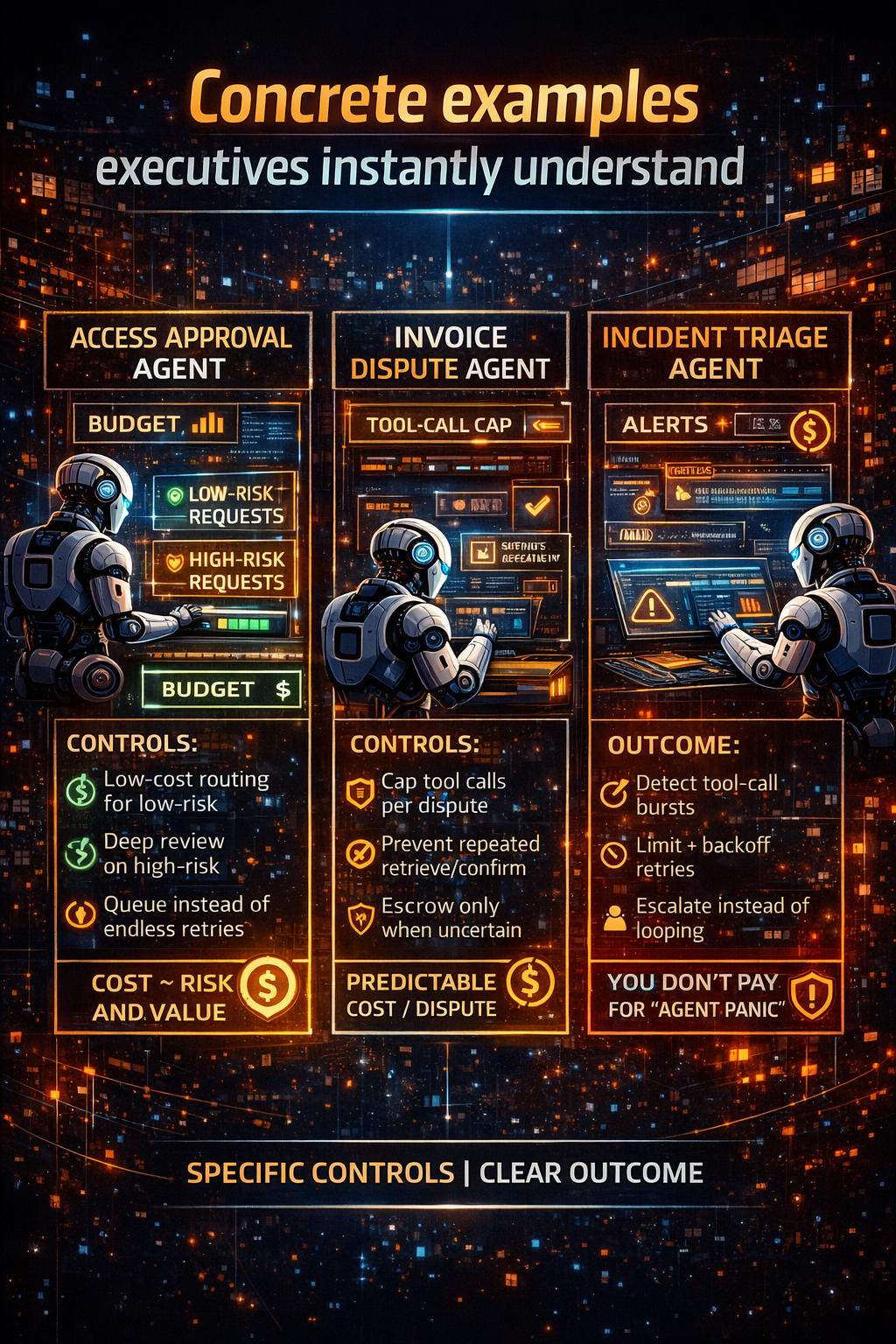
Concrete examples executives instantly understand
Example A: The “Access Approval Agent”
An agent reviews access requests, checks policy, validates manager approval, and provisions access.
Without a cost control plane:
- It “thinks” deeply for every request, even low-risk ones.
- It re-checks the same policy documents repeatedly.
- It retries provisioning API calls endlessly during outages.
With a cost control plane:
- Low-risk requests use a low-cost route (short context, cached policy, minimal tool calls).
- High-risk requests switch to deeper verification and require human approval.
- If the provisioning API is failing, the agent pauses and creates a queue instead of retrying.
Result: cost becomes proportional to risk and value.
Example B: The “Invoice Dispute Agent”
An agent reads dispute emails, checks transaction history, and drafts responses.
Cost plane controls:
- Caps tool calls per case
- Prevents repeated retrieval of the same history
- Switches to concise generation for routine disputes
- Escalates to a human only when confidence is low
Result: predictable cost per resolved dispute.
Example C: The “IT Incident Triage Agent”
Agents often spiral during incidents because data is messy and systems are failing.
Cost control plane:
- detects tool-call bursts (symptom of agent confusion)
- enforces a “maximum retries” rule
- switches to “summary mode” and escalates with evidence
Result: you avoid paying for “agent panic.”
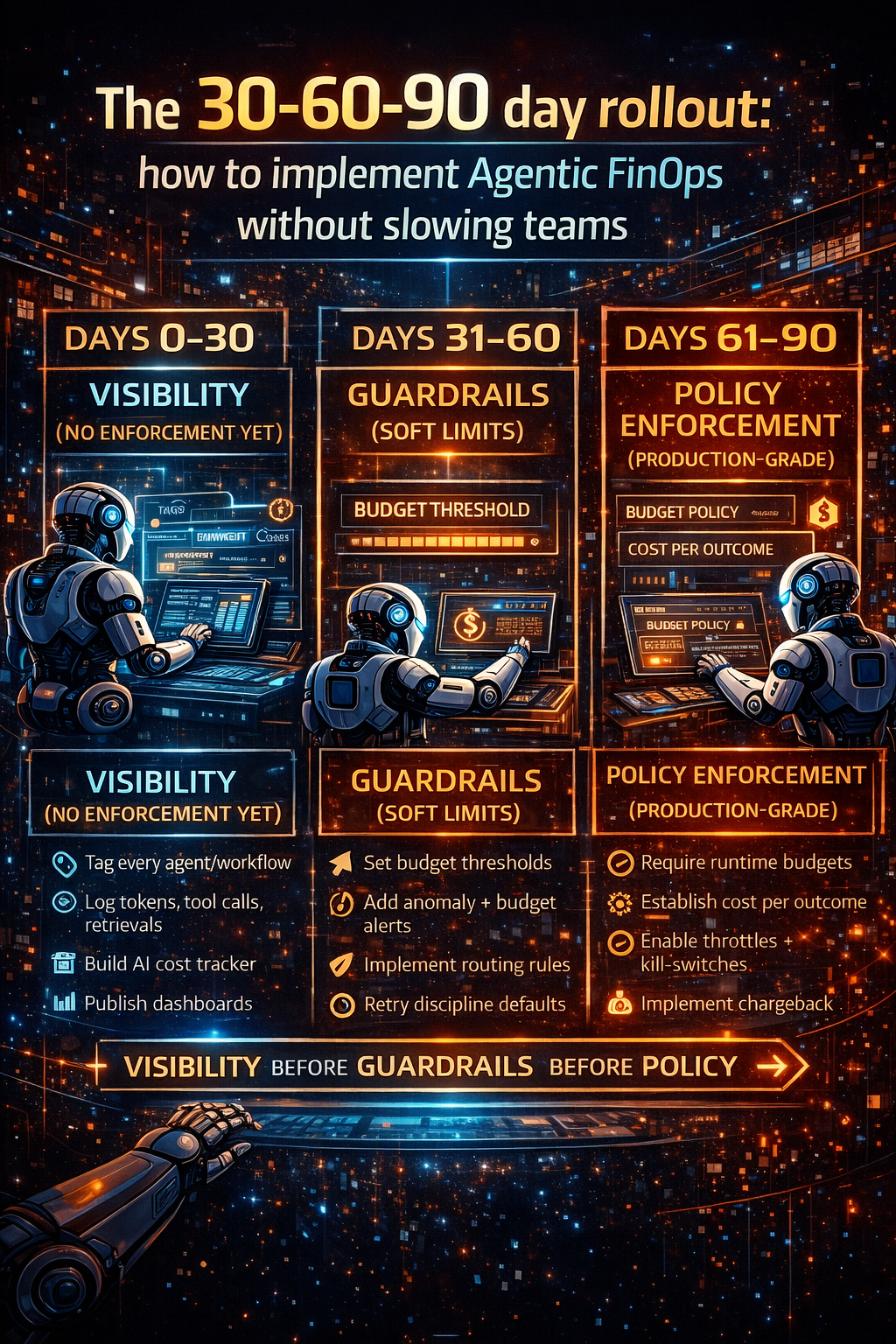
The 30–60–90 day rollout: how to implement Agentic FinOps without slowing teams
Days 0–30: Make costs visible (no enforcement yet)
- Tag every agent and workflow with an owner, business purpose, and environment.
- Turn on usage logging: tokens, tool calls, retrieval calls, retries.
- Build an “AI cost and usage tracker” integrated with FinOps reporting. (finops.org)
- Publish weekly showback dashboards: top spenders, fastest-growing costs, low-value spend.
Goal: transparency before control.
Days 31–60: Add guardrails (soft limits)
- Set budget thresholds per agent/workflow.
- Add alerting for anomalies and budget crossings. (Microsoft Learn)
- Implement routing rules (cheap vs premium).
- Add “retry discipline” defaults: backoff, max attempts, escalation policies.
Goal: reduce waste while preserving innovation.
Days 61–90: Enforce policies (hard limits for production autonomy)
- Require budget policies for production agents.
- Introduce unit economics targets (cost per outcome).
- Enable automated throttling and kill-switch for runaway patterns.
- Implement chargeback for high-consumption units if your culture supports it.
Goal: autonomy becomes operable and financially sustainable.
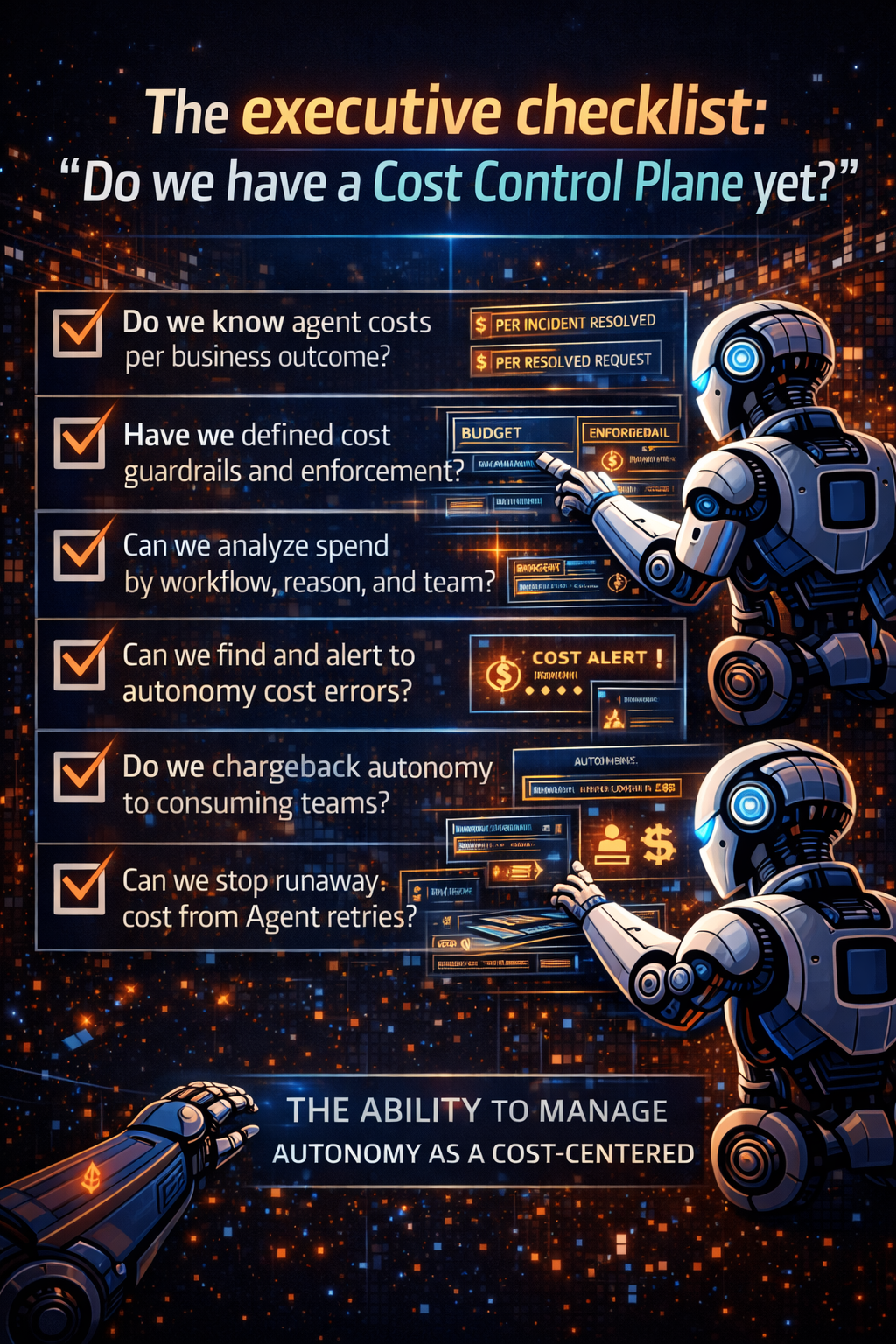
The executive checklist: “Do we have a Cost Control Plane yet?”
If you can’t answer these questions quickly, you don’t:
- What are our top 10 most expensive agents this month, and why?
- What is the cost per completed outcome for each critical workflow?
- Where are we paying premium reasoning for routine work?
- Which tool integrations are driving most costs?
- Do we automatically detect and stop runaway loops?
- Do we have budget policies enforced at runtime?
- Can we forecast next quarter’s autonomy spend with confidence? (finops.org)
- Can we prove value (not just spend) to leadership?
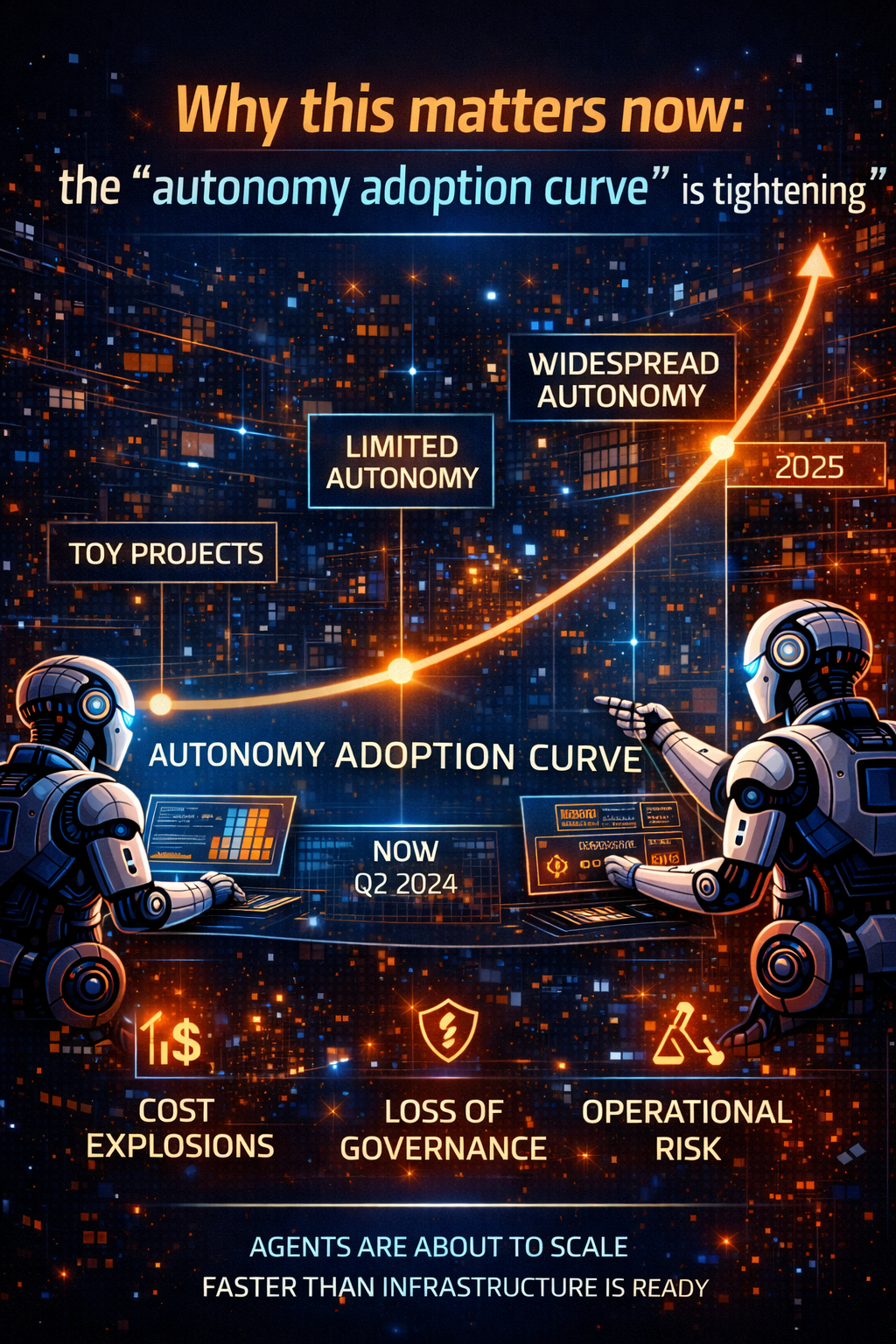
Why this matters now: the “autonomy adoption curve” is tightening
Agentic AI is moving into real-world trials in high-stakes environments, and regulators are explicitly focusing on accountability and governance risks that come from speed and autonomy. (Reuters)
Meanwhile, market narratives are converging on a hard truth: many agent programs struggle when real ROI and operability are demanded. (Business Insider)
The winners will not be the enterprises with “more agents.”
They will be the enterprises with:
- financially governed autonomy
- runtime cost guardrails
- outcome-level unit economics
- a platform layer that turns autonomy into a managed capability
In other words: a Cost Control Plane that makes autonomy safe for the balance sheet.
FAQs
Is Agentic FinOps just traditional FinOps with AI added?
No. Traditional FinOps manages infrastructure consumption. Agentic FinOps manages workflow autonomy consumption, where costs emerge from token reasoning plus tool-call cascades and retries. (finops.org)
What is the biggest driver of agent cost in production?
Usually not the model alone. It’s the interaction loop: retries, retrieval, tool calls, verification steps, and the operational envelope around governance and reliability. (CIO)
How do we stop runaway agent spend?
You need runtime policies: budget caps, anomaly detection, max retries, routing to cheaper modes, and escalation to humans when loops are detected—similar to how cloud budgets and alerts prevent cost surprises. (Microsoft Learn)
Do we need this even if we buy an “agent platform”?
Yes—because the cost control plane is a capability, not a checkbox. Some platforms provide pieces, but enterprises typically need integration across identity, governance, observability, and financial reporting.
FAQ 1
What is Agentic FinOps?
Agentic FinOps is the practice of managing AI agents as cost-bearing operational systems, not experiments—tracking spend per workflow, enforcing runtime budgets, and optimizing cost per outcome.
FAQ 2
Why do AI agents become expensive in production?
Because cost comes from retries, tool calls, reasoning loops, verification, and governance overhead—not just model inference.
FAQ 3
Is traditional FinOps enough for AI agents?
No. Traditional FinOps manages infrastructure. Agentic FinOps manages autonomous workflows operating at machine speed.
FAQ 4
What is a Cost Control Plane for AI?
It is a system that makes AI autonomy visible, predictable, governed, and optimizable—similar to how control planes made cloud computing scalable.

Final takeaway
Agentic AI is not just “AI plus tools.” It is autonomy at machine speed.
And autonomy without financial control becomes one of two outcomes:
- a cost blowout, or
- a shutdown.
Agentic FinOps is how enterprises avoid both—by building a Cost Control Plane that turns agents into an economically governed operating capability.
This article is part of a broader architectural framework defined in the Enterprise AI Operating Model, which explains how organizations design, govern, and scale intelligence safely once AI systems begin to act inside real enterprise workflows.
👉 Read the full operating model here:
https://www.raktimsingh.com/enterprise-ai-operating-model/
Further Reading & References
For readers who want to go deeper into the economics, governance, and operability of enterprise AI autonomy, the following resources provide valuable context and supporting research:
Enterprise AI Economics & FinOps
-
FinOps Foundation — FinOps for AI
Practical guidance on tracking, forecasting, and optimizing AI and generative AI costs, including usage-based attribution and cost governance models. -
FinOps Foundation — Building a Generative AI Cost & Usage Tracker
Explains how organizations can extend traditional FinOps practices to cover AI workloads, a foundational step toward Agentic FinOps. -
CIO.com — Enterprise AI Cost Management Coverage
Multiple analyses highlighting how AI cost overruns are becoming a CIO- and CFO-level accountability issue as AI systems move into production.
Agentic AI, Governance & Operability
-
Gartner — Agentic AI and Enterprise Risk Outlook (2024–2027)
Research forecasting that a significant percentage of agentic AI initiatives may be canceled due to cost escalation, unclear ROI, and inadequate controls—underscoring the need for stronger operating layers. -
Harvard Business Review — AI at Scale and the Operability Gap
Articles examining why many AI initiatives struggle beyond pilots, particularly when governance, accountability, and economic sustainability are not designed upfront. -
Reuters — Regulatory and Supervisory Perspectives on Autonomous AI
Reporting on how regulators are increasingly focused on accountability, auditability, and governance risks as AI systems gain autonomy.
Cloud & Platform Cost Control Analogies
-
Microsoft Learn — Cost Management and Budget Controls for Cloud and AI Services
Documentation on budgets, alerts, anomaly detection, and cost optimization patterns that inspire similar controls for autonomous AI workloads. -
Cloud Provider Guidance on AI Cost Planning
Hyperscaler documentation emphasizing proactive cost controls for AI services—evidence that “surprise AI bills” are now a recognized failure mode.
Conceptual Foundations
-
“From FinOps to Agentic FinOps” (emerging industry discussions)
Thought leadership exploring how cost management must evolve as AI shifts from inference to action, and from tools to autonomous workflows. - The Agentic Identity Moment: Why Enterprise AI Agents Must Become Governed Machine Identities – Raktim Singh
- Enterprise Agent Registry: The Missing System of Record for Autonomous AI – Raktim Singh
- Service Catalog of Intelligence: How Enterprises Scale AI Beyond Pilots With Managed Autonomy – Raktim Singh
- The Agentic AI Platform Checklist: 12 Capabilities CIOs Must Demand Before Scaling Autonomous Agents | by RAKTIM SINGH | Dec, 2025 | Medium
- The Agentic Identity Moment: Why Enterprise AI Must Treat Agents as Governed Machine Identities | by RAKTIM SINGH | Dec, 2025 | Medium
- The AI SRE Moment: How Enterprises Operate Autonomous AI Safely at Scale | by RAKTIM SINGH | Dec, 2025 | Medium
- The Enterprise AI Control Plane: Why Reversible Autonomy Is the Missing Layer for Scalable AI Agents | by RAKTIM SINGH | Dec, 2025 | Medium
- Enterprise AI Operating Model 2.0: Control Planes, Service Catalogs, and the Rise of Managed Autonomy – Raktim Singh
Glossary
Agentic FinOps
A discipline that extends FinOps into autonomous AI systems by managing the cost of reasoning, tool usage, workflows, retries, and governance overhead.
Cost Control Plane
An enterprise runtime layer that enforces budget awareness, cost attribution, throttling, and unit economics for AI agents.
AI Autonomy
The ability of AI systems to plan, act, retry, and escalate across real enterprise systems without continuous human intervention.
Outcome-based AI economics
Measuring AI cost based on business results (e.g., cost per ticket resolved) rather than raw infrastructure metrics.



Raktim Singh is an AI and deep-tech strategist, TEDx speaker, and author focused on helping enterprises navigate the next era of intelligent systems. With experience spanning AI, fintech, quantum computing, and digital transformation, he simplifies complex technology for leaders and builds frameworks that drive responsible, scalable adoption.