
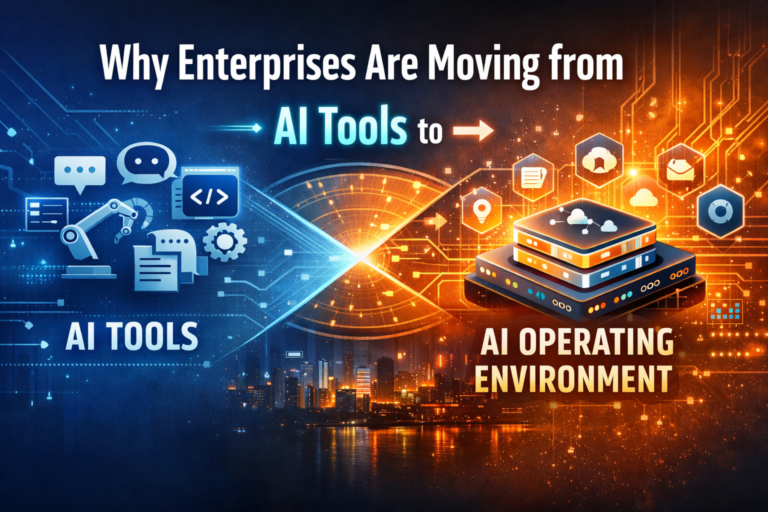
The Big Shift: AI Is No Longer “A Tool You Use.” It Is Work That Runs
The AI advantage has shifted.
It’s no longer about how smart your models are—
it’s about whether your enterprise can operate intelligence safely, reliably, and at scale.
For the last two years, enterprise AI has looked like an explosion of tools:
- Chat assistants for employees
- Copilots embedded in productivity suites
- RAG chatbots connected to internal documents
- Agent demos that can complete tasks end-to-end
They are impressive.
They attract funding.
They pass pilots.
And then—quietly—many of them stall.
Not because the models are weak.
Not because the data is missing.
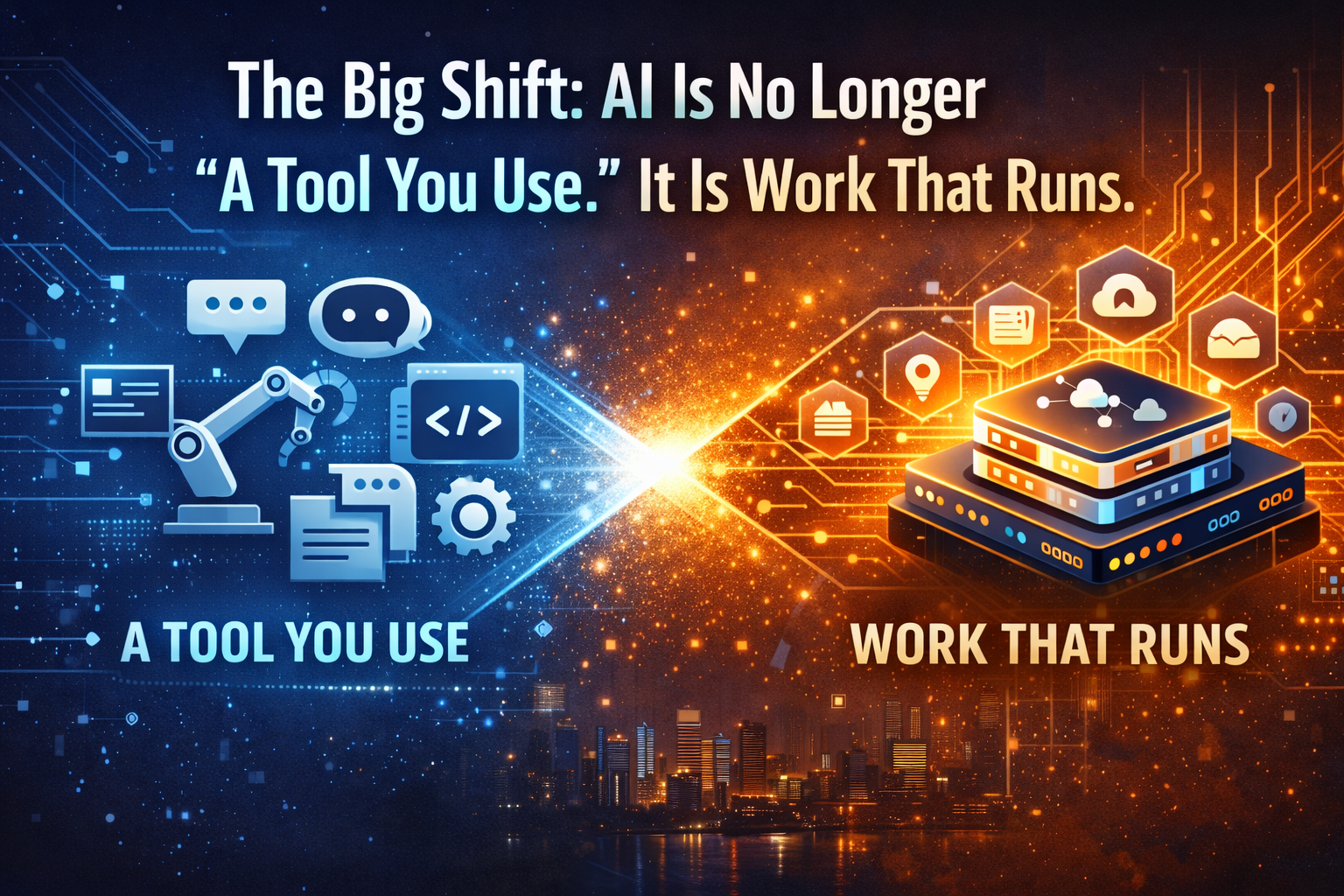
But because the enterprise cannot operate them.
That is why the next generation of enterprise winners will not be defined by how many AI tools they deploy. They will be defined by whether they build an AI operating environment: a unified, production-grade environment where AI can be designed, composed, executed, integrated, governed, observed, and cost-controlled—consistently and at scale.
This shift is already visible in global signals. Analysts and industry leaders increasingly point to a familiar failure pattern: pilot success followed by production collapse. Costs rise, risks multiply, and ownership becomes unclear. At the same time, enterprise AI leaders are converging on a new insight:
Real AI value appears only after intelligence is treated like infrastructure—not experimentation.
Which leads to a new executive question:
It is no longer “Which AI tool should we buy?”
It is “What environment allows us to run AI as a core enterprise capability?”
What Is an AI Operating Environment?
An AI operating environment is not a product.
It is not a single platform.
It is not another agent framework.
It is a complete enterprise operating layer that turns AI from isolated experiments into dependable, repeatable systems.
Think of the difference between:
- Buying a few developer tools, versus
- Running a full cloud environment where applications can be designed, deployed, governed, monitored, upgraded, and scaled
An AI operating environment applies the same discipline to intelligence.
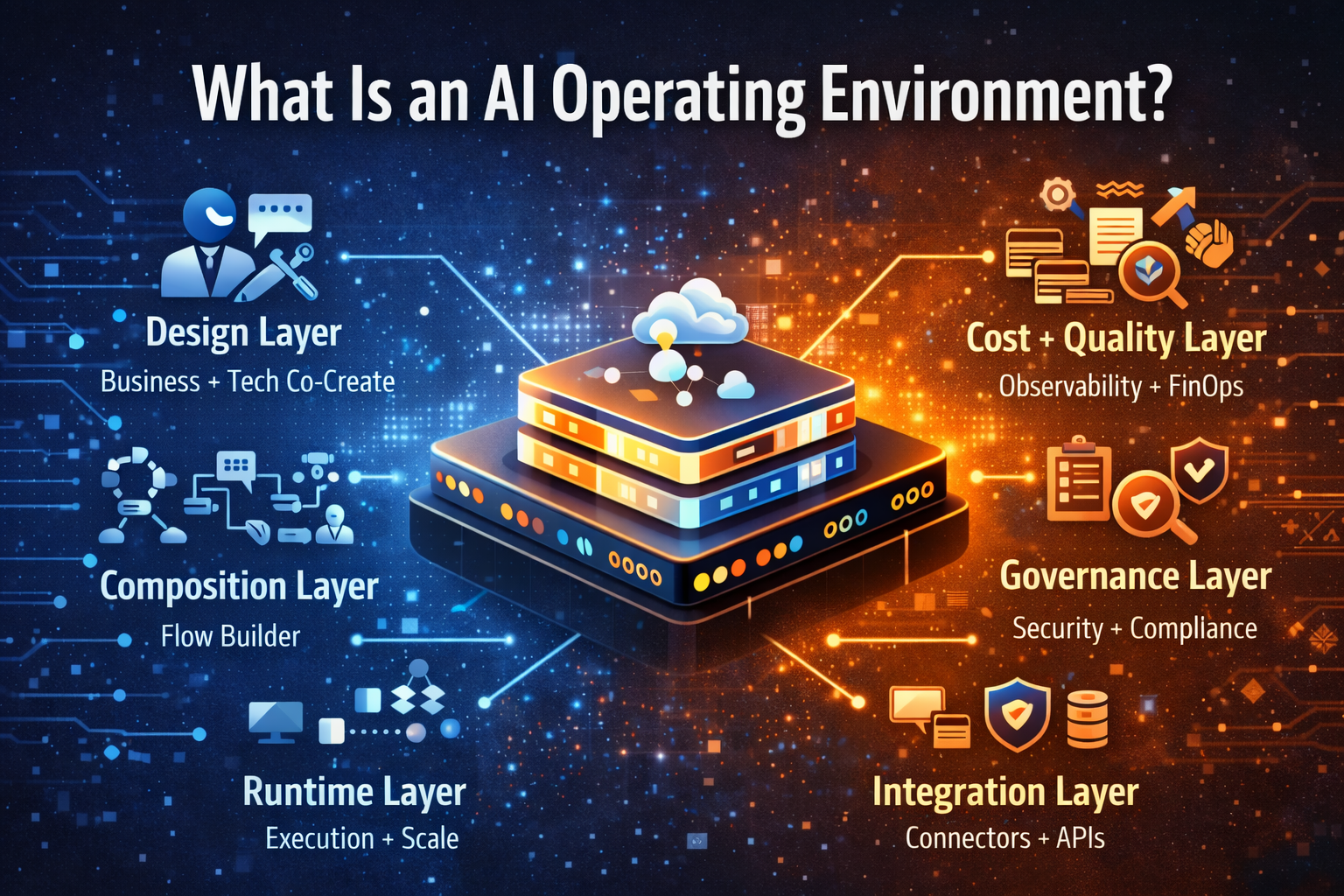
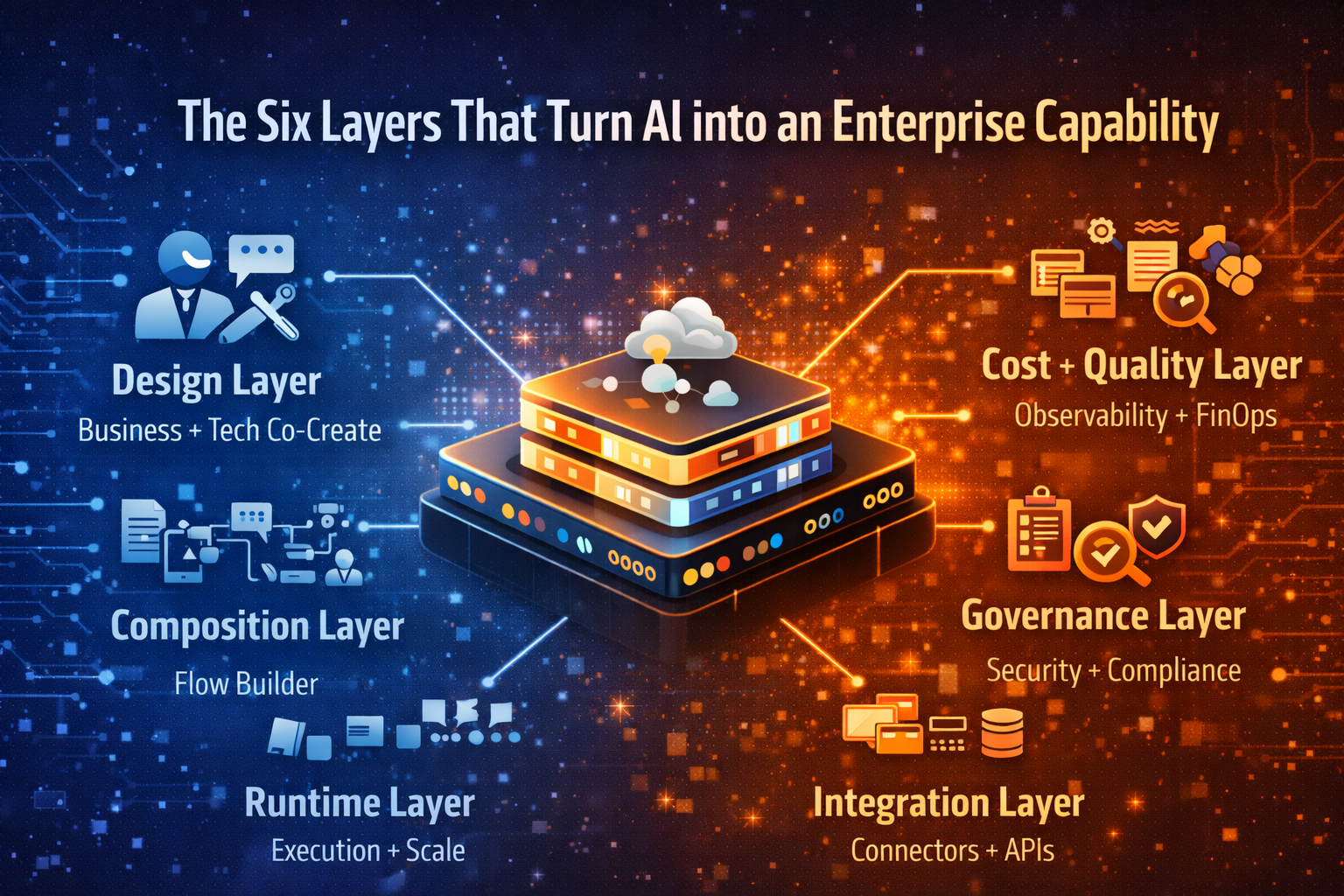
In mature enterprises, six capabilities always appear together:
- Design Layer (Studio)
Business and technology teams co-design AI experiences with intent, policy, and risk embedded from the start. - Composition Layer (Flow Builder)
AI work is composed as flows—combining models, tools, data, approvals, and humans. - Runtime Layer
Execution, reliability, routing, scaling, lifecycle management, and controlled change. - Integration Layer
Native connectivity to enterprise systems, data platforms, identity, and APIs. - Governance Layer
Continuous policy enforcement, security, compliance, auditability, and evidence. - Cost and Performance Layer
Observability, AI FinOps, quality engineering, and continuous optimization.
The critical insight is this:
These layers only work when treated as one system—not separate purchases.
Why AI Tools Plateau in Real Enterprises
-
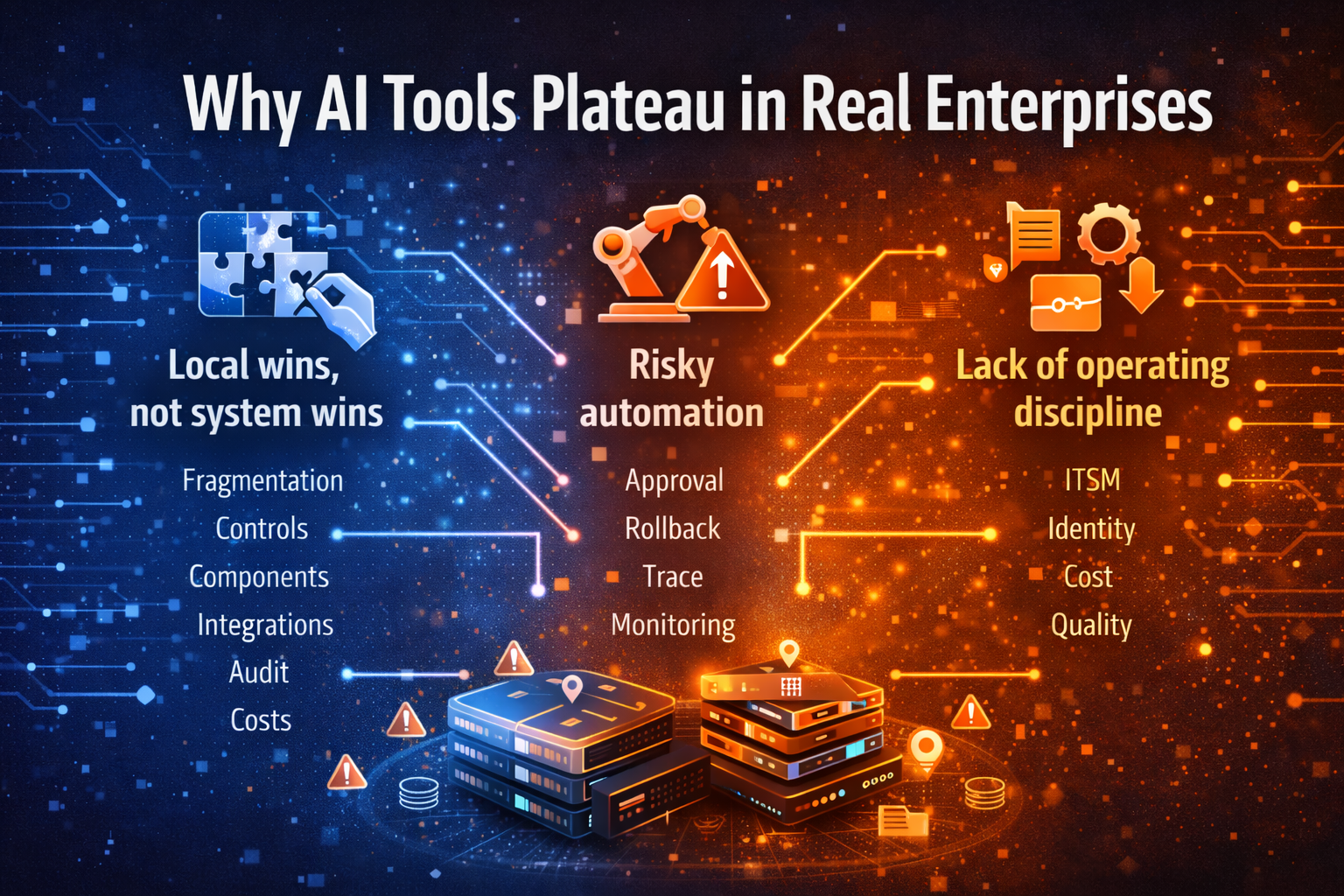
Tools Create Local Wins. Enterprises Need System Wins.
A single team adopts an AI tool and sees productivity gains. That is valuable—but temporary.
Enterprises do not scale isolated wins. They scale systems:
- Shared controls
- Reusable components
- Standard integration patterns
- Consistent audit trails
- Predictable costs
- Safe upgrade paths
When every team selects its own tools and invents its own operating logic, the result is not innovation. It is fragmentation.
-
AI Outputs Are Not the Real Risk. AI Actions Are.
A wrong answer is embarrassing.
A wrong action is expensive.
The moment AI moves from suggesting to doing, the engineering bar changes:
- Who approved this action?
- What data was used?
- Can we roll it back?
- Can we explain it to an auditor?
- Can we detect and contain failures?
These are not AI questions.
They are operational questions.
-
Enterprises Do Not Fail at AI Because of Models.
They fail because they lack operating discipline.
Modern enterprises already know how to run critical systems:
- Site reliability engineering
- Identity and access management
- Change control
- Cost governance
- Quality engineering
AI tools often bypass these disciplines.
AI operating environments embed them.
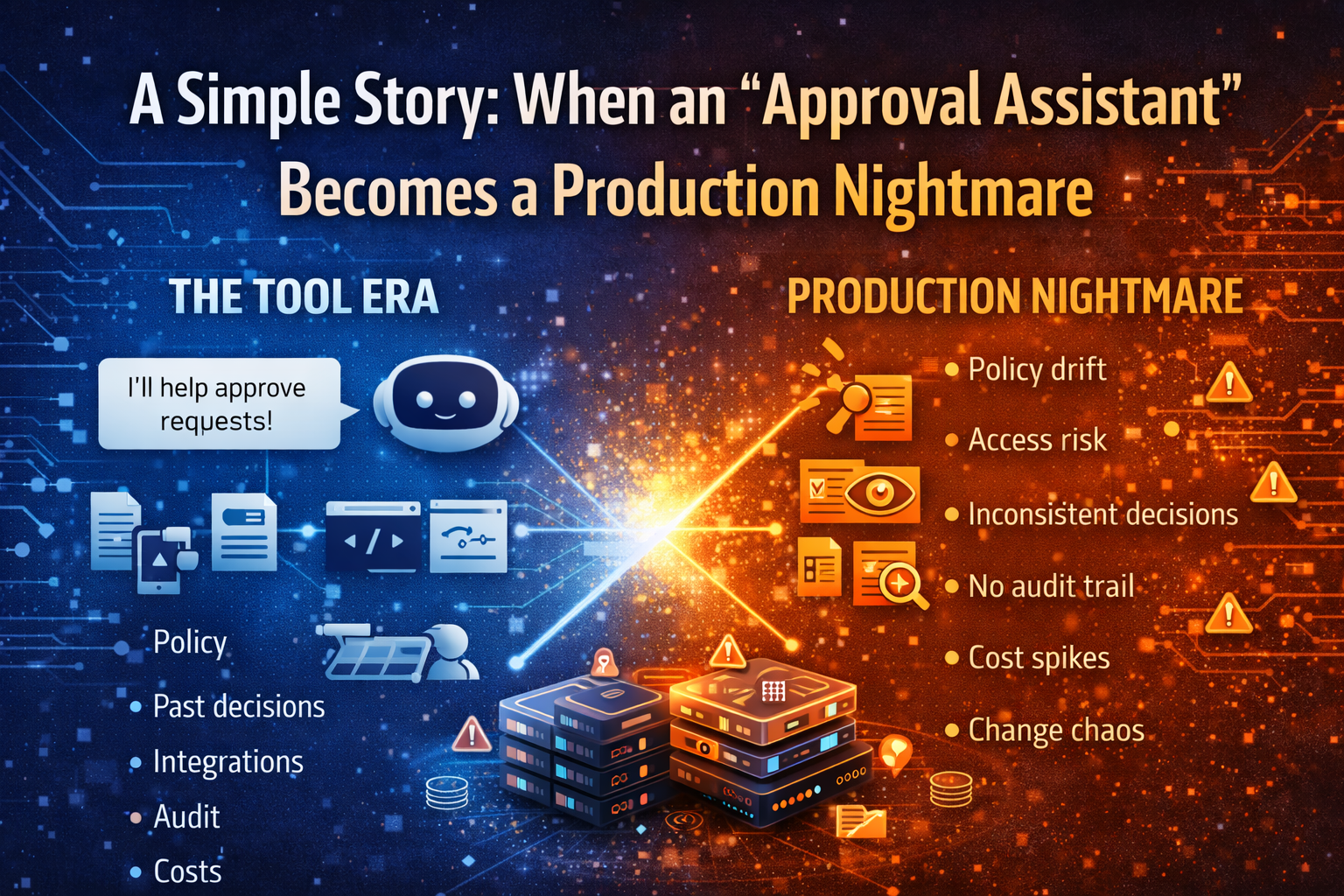
A Simple Story: When an “Approval Assistant” Becomes a Production Nightmare
Imagine a helpful use case:
An AI assistant helps approve requests.
It reads policy documents, checks past decisions, drafts a recommendation, and routes it to the correct approver.
In the tool era, this is easy:
- Connect to documents
- Prompt a model
- Ship a chat interface
It works—until adoption grows.
Then reality arrives:
- Policies change, but answers don’t
- Sensitive data becomes visible
- Identical cases receive different outcomes
- No one can reconstruct why a decision was made
- Costs spike unexpectedly
- Small prompt changes break downstream behavior
At this point, the enterprise does not need a better prompt.
It needs an operating environment:
- A design layer to model intent and policy
- A flow layer to make logic explicit
- A runtime layer with versioning and rollback
- An integration layer that respects access controls
- A governance layer that produces evidence
- An observability layer that keeps cost and quality predictable
That is the difference between a tool and an environment.
The Six Layers That Turn AI into an Enterprise Capability
-
The Design Layer: Design Before Deployment
AI is not just an interface.
It is a new decision surface.
The design layer answers:
- What is the business intent?
- What data is allowed?
- What actions are permitted?
- What must be reviewed by a human?
This is where responsible AI becomes practical—not theoretical.
-
The Flow Layer: Composable Intelligence Beats Point Agents
Point solutions are brittle.
Enterprises need flows:
- Retrieval → reasoning → validation
- Tool calls → checks → approvals
- Escalation paths
- Exception handling
Flows make intelligence visible and governable.
-
The Runtime Layer: AI Needs Production Engineering
Runtime is where enterprise reality lives:
- Versioning
- Rollouts
- Incident response
- Fallbacks
- Controlled evolution
Without a runtime, AI remains a demo.
-
The Integration Layer: AI Must Live Inside the Enterprise
When AI is bolted on, it creates:
- Bypassed access controls
- Duplicate logic
- Shadow systems
Integration ensures AI inherits enterprise trust—not bypasses it.
-
The Governance Layer: Continuous Control, Not After-the-Fact Audits
Governance must operate in real time:
- Policy enforcement
- Evidence trails
- Permissioned actions
- Security guardrails
This is how autonomy becomes defensible.
-
Cost and Quality: When AI FinOps Becomes Architecture
At scale, cost is not a finance problem.
It is an architectural one.
Enterprises need:
- Usage visibility
- Quality regression checks
- Cost budgets per workflow
- Early anomaly detection
Why This Shift Is Happening Now
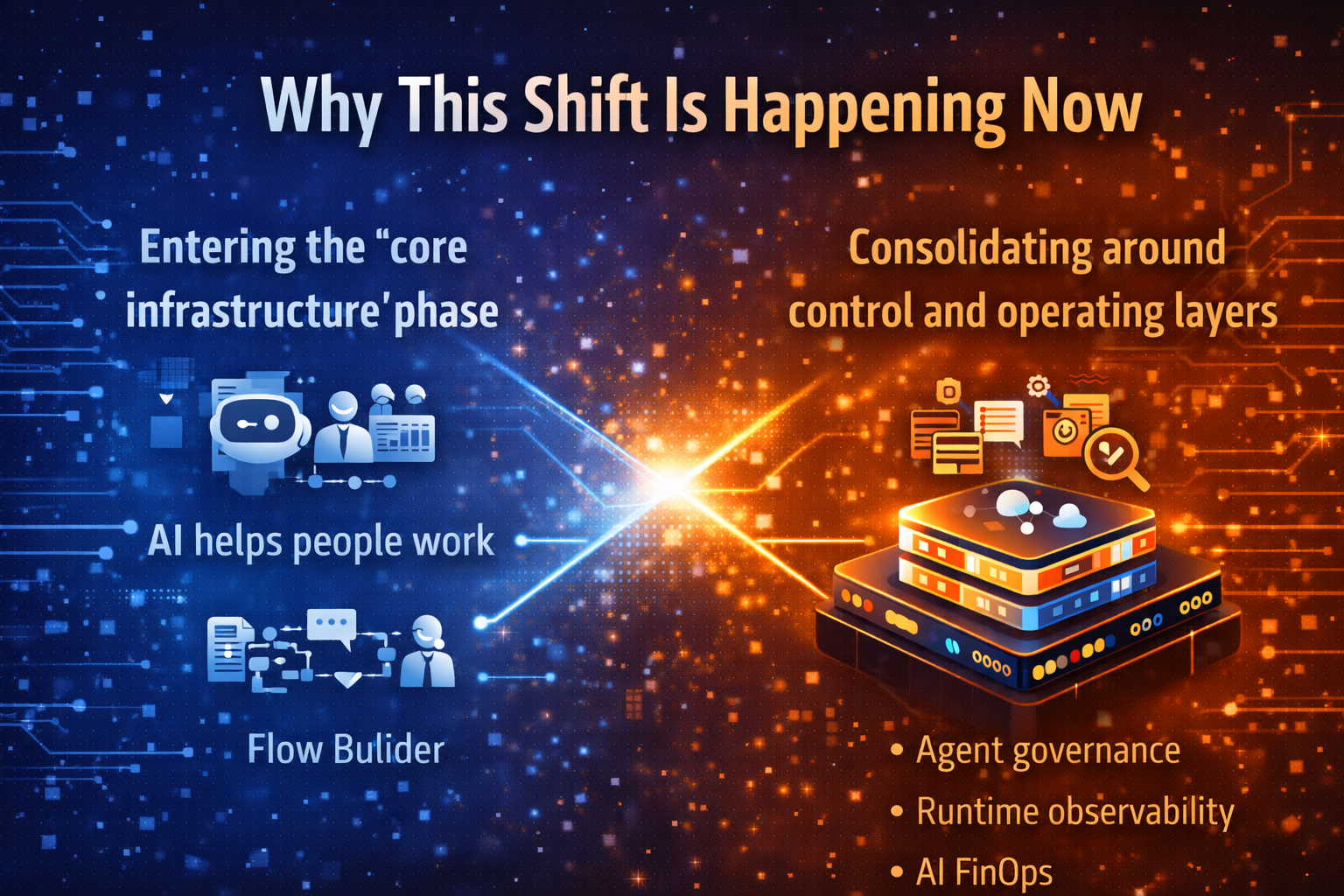
Because enterprises have crossed a threshold:
From
“AI helps people work”
To
“AI runs work across systems.”
That transition changes everything.
The market response is visible:
- Control planes
- Agent governance
- Runtime observability
- AI cost management
The industry is converging on a shared conclusion:
Autonomous work requires an operating environment.
The Executive Test
If you are a CIO or CTO, ask:
- Can we design AI with intent and policy upfront?
- Can we compose work as flows—not chat interfaces?
- Do we have a runtime with rollback and control?
- Do we integrate through enterprise access, not around it?
- Can we produce audit-ready evidence?
- Can we observe cost and quality per workflow?
If most answers are unclear, you do not have a scalable AI program.
You have tools.
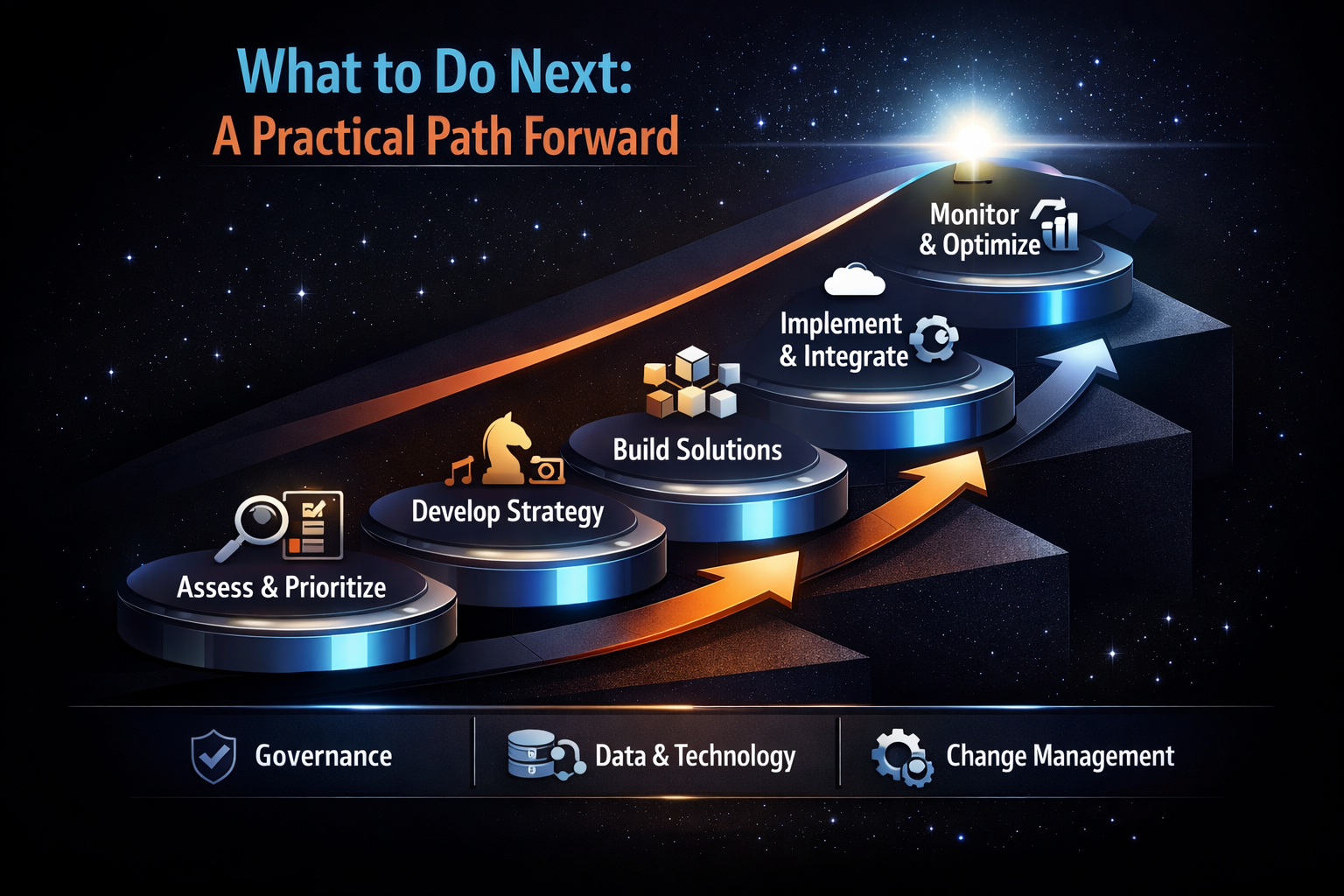
What to Do Next: A Practical Path Forward
Do not boil the ocean.
- Select 2–3 workflows that truly matter
- Build them as governed flows
- Run them through a controlled runtime
- Standardize integration and identity
- Add observability from day one
- Convert learnings into reusable services
Within months, AI stops being a feature.
It becomes enterprise capability.
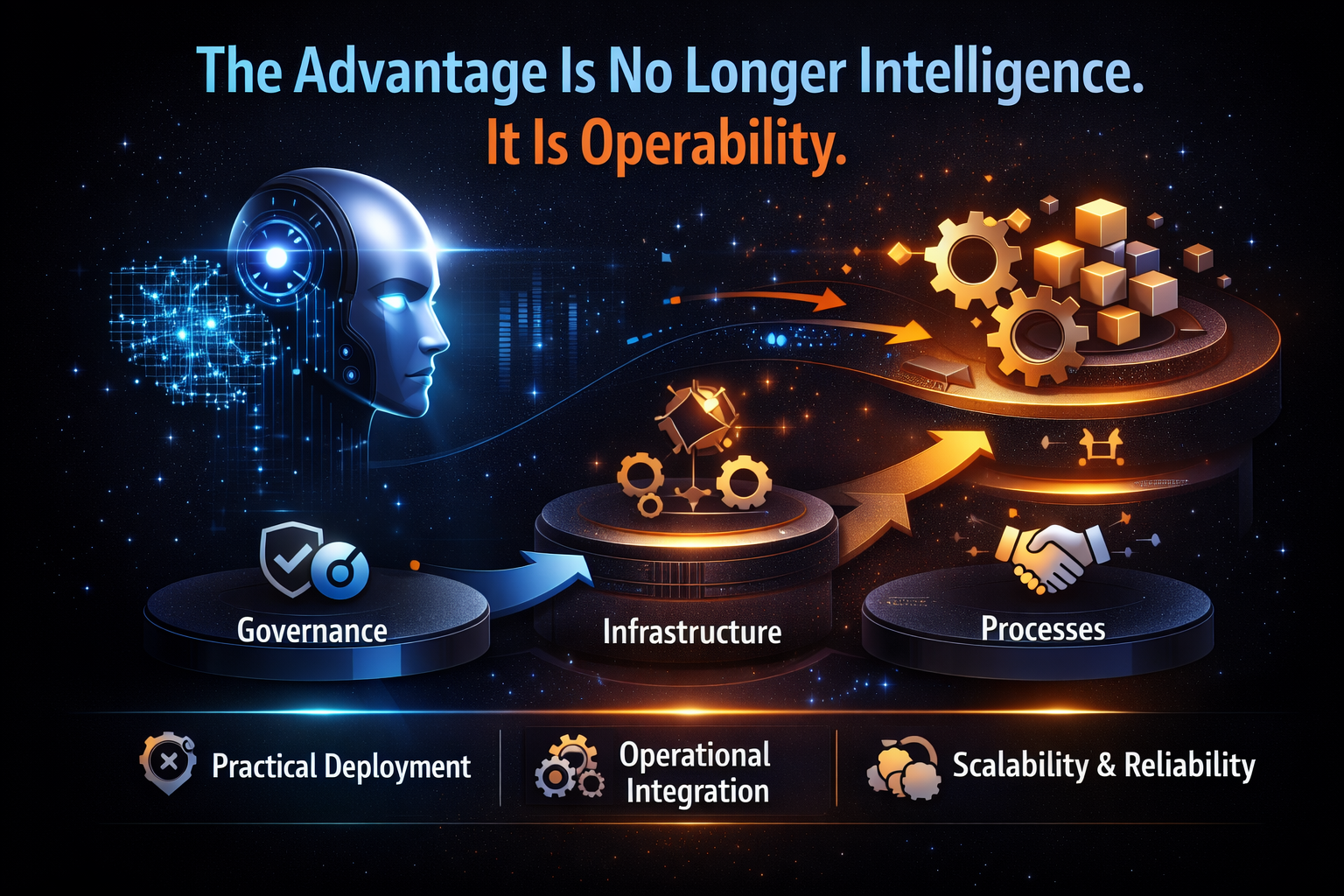
Conclusion: The Advantage Is No Longer Intelligence. It Is Operability.
Every major technology wave followed the same pattern.
The winners were not those who adopted the most tools.
They were those who built the operating environment.
The same will be true for AI.
Operable intelligence—not experimental intelligence—will define enterprise leadership.
Glossary
- AI Operating Environment: A unified system for designing, running, governing, and scaling AI in production
- Agentic AI: AI systems that can take actions across enterprise systems
- AI Runtime: The execution layer managing reliability, versioning, and control
- AI FinOps: Cost visibility and optimization for AI workloads
- Composable AI: Intelligence built from reusable flows and services
-
AI Operability
The capability to run AI systems reliably, securely, and repeatedly in production environments.Enterprise AI Governance
Policies, controls, and evidence mechanisms ensuring AI behaves safely and compliantly.Operable Autonomy
AI systems that can act independently while remaining observable, auditable, and reversible.AI Execution Layer
The layer where AI decisions turn into real business actions across systems.
FAQ
Is an AI operating environment the same as an AI platform?
No. Platforms focus on building AI. Operating environments focus on running AI safely at scale.
Why do AI pilots fail in production?
Because enterprises lack runtime control, governance, observability, and cost discipline.
What is the fastest way to begin?
Start with a small number of critical workflows and build them with full operating discipline.
The AI advantage has shifted.
It’s no longer about how smart your models are—
it’s about whether your enterprise can operate intelligence safely, reliably, and at scale.
FAQ 1: What does AI operability mean in an enterprise context?
AI operability refers to an organization’s ability to run AI systems reliably, safely, audibly, and at scale—beyond just model intelligence.
FAQ 2: Why are AI tools insufficient for large enterprises?
AI tools solve isolated problems but fail to provide governance, integration, cost control, and reliability required for enterprise-wide deployment.
FAQ 3: What is an AI operating environment?
An AI operating environment is a unified enterprise layer that governs how AI is deployed, monitored, audited, scaled, and improved over time.
FAQ 4: How does operability create competitive advantage?
Enterprises that operationalize AI can scale faster, reduce risk, reuse intelligence, and adapt continuously—while others stay stuck in pilots.
FAQ 5: Which industries benefit most from operable AI?
Highly regulated and complex industries such as banking, insurance, healthcare, telecom, manufacturing, and public sector benefit the most.
References & Further Reading
- Gartner research on agentic AI governance and operational risk
- OpenAI enterprise adoption reports
- Global enterprise AI architecture discussions across the US, EU, and India
- The Agentic AI Platform Checklist: 12 Capabilities CIOs Must Demand Before Scaling Autonomous Agents | by RAKTIM SINGH | Dec, 2025 | Medium
- The Enterprise AI Control Plane: Why Reversible Autonomy Is the Missing Layer for Scalable AI Agents | by RAKTIM SINGH | Dec, 2025 | Medium
- Services-as-Software: Why the Future Enterprise Runs on Productized Services, Not AI Projects | by RAKTIM SINGH | Dec, 2025 | Medium
- The Composable Enterprise AI Stack: Agents, Flows, and Services-as-Software — Built Open, Interoperable, and Responsible | by RAKTIM SINGH | Dec, 2025 | Medium
- The AI Platform War Is Over: Why Enterprises Must Build an AI Fabric—Not an Agent Zoo – Raktim Singh
- Why Every Enterprise Needs a Model-Prompt-Tool Abstraction Layer (Or Your Agent Platform Will Age in Six Months) – Raktim Singh
- The Synergetic Workforce: How Enterprises Scale AI Autonomy Without Slowing the Business – Raktim Singh
- AgentOps Is the New DevOps: How Enterprises Safely Run AI Agents That Act in Real Systems – Raktim Singh



Raktim Singh is an AI and deep-tech strategist, TEDx speaker, and author focused on helping enterprises navigate the next era of intelligent systems. With experience spanning AI, fintech, quantum computing, and digital transformation, he simplifies complex technology for leaders and builds frameworks that drive responsible, scalable adoption.