
Why the next generation of AI leaders will focus on visibility, identity, and real-time state before they deploy models
Most conversations about artificial intelligence begin at the wrong place.
They begin with the model.
They begin with large language models, copilots, agents, reasoning systems, benchmark scores, inference costs, or model selection.
Those topics matter. But they all sit downstream of a deeper reality: no institution can become intelligent unless it can first detect, capture, structure, and continuously update the signals that describe the world it is trying to understand.
NIST’s AI Risk Management Framework treats data, monitoring, validation, and lifecycle governance as core elements of trustworthy AI, not optional work that happens after model deployment. The EU AI Act similarly emphasizes data governance, logging, traceability, and monitoring for high-risk AI systems. (NIST)
That is why the AI economy does not truly begin with the model.
It begins with signal infrastructure.
Signal infrastructure is the technical, institutional, and operational layer that allows an organization to detect relevant events, collect meaningful traces, connect those traces to the right entities, maintain current state, and update that state as reality changes.
It includes sensors, logs, transactions, workflow events, geospatial feeds, customer interactions, operational telemetry, documents, and machine-generated records. But it also includes the rules, standards, semantics, and governance that make those signals trustworthy, traceable, and usable in decisions. (NIST)
This is the strategic truth many leaders still miss: AI fails before intelligence begins when reality is not legible enough to be modeled.
A brilliant model cannot rescue a weak sensing layer. A powerful agent cannot compensate for missing, stale, fragmented, or misidentified signals. A reasoning engine cannot produce dependable action from a distorted picture of the world.
That is the heart of the next economic shift. The winners in the AI era will not simply be those with access to the best models. They will be those that build the best signal infrastructure.
Key Insight
AI does not begin with the model.
It begins with the infrastructure that allows institutions to detect signals, attach them to entities, maintain evolving state, and govern decisions.
Organizations that build strong signal infrastructure gain a structural advantage in the AI economy because they can see reality earlier, interpret it better, and act with greater confidence.
Why this matters now
Across industries and across countries, the conversation about AI readiness is widening from models to infrastructure.
The World Bank’s recent work on digital progress and AI readiness argues that AI capability depends on foundational infrastructure, data governance, institutional capacity, and human capital. OECD work on smart cities, agriculture, and geospatial analysis points in the same direction: AI creates value when institutions can observe and interpret changing real-world conditions with enough fidelity to make better decisions. (World Bank)
That shift is overdue.
For years, many organizations treated data as a byproduct, logs as technical residue, and observability as an IT concern. In the AI economy, those supposedly back-office layers become strategic assets. They determine what the institution can see, what it can know, what it can represent, and what it can act upon.
A bank cannot intelligently serve a small business it cannot properly observe. A hospital cannot improve outcomes if patient state is scattered across incomplete records, delayed updates, and disconnected systems.
A city does not become smart because it installs AI software; it becomes smarter when mobility, flooding, land use, energy, safety, and service delivery become observable as evolving systems. OECD work on AI in cities and geospatial analysis makes that point clearly. (OECD)
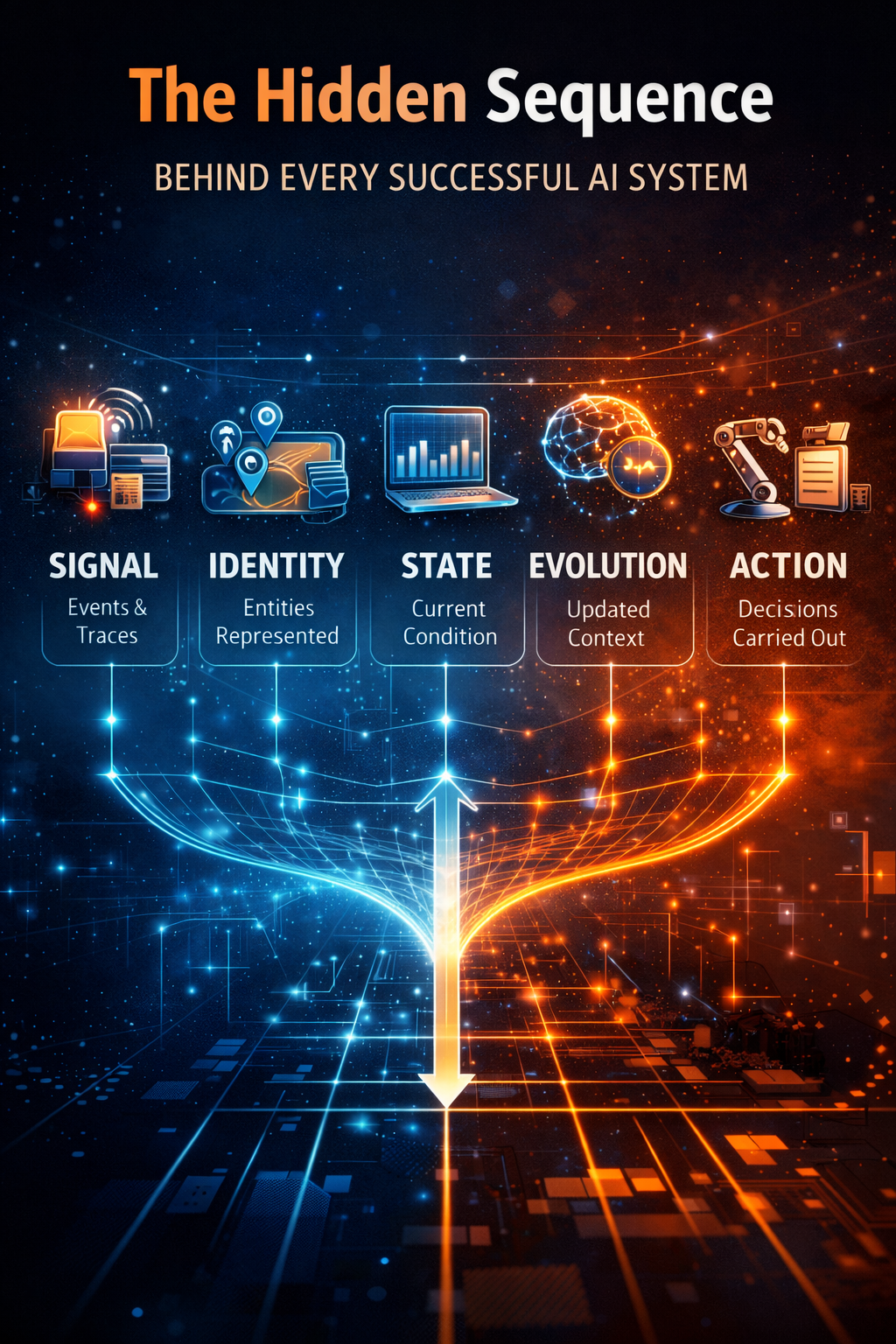
The hidden sequence behind every successful AI system
Most people imagine AI in this order:
data → model → output
But real institutional intelligence works more like this:
signal → identity → state → evolution → interpretation → action
That is exactly why the SENSE–CORE–DRIVER framework matters.
SENSE: the layer where reality becomes machine-legible
In this framework, SENSE means:
Signal — detecting events, changes, and traces from the world
ENtity — attaching those signals to a persistent actor, object, location, or asset
State representation — building a structured model of the current condition of that entity
Evolution — updating that state over time as new signals arrive
SENSE is the layer where reality becomes machine-legible.
CORE: the layer where signals become reasoning
CORE means:
Comprehend context
Optimize decisions
Realize action
Evolve through feedback
CORE is the cognition layer. It is where institutions interpret reality, generate judgment, and convert context into decisions.
DRIVER: the layer where machine action becomes legitimate
DRIVER means:
Delegation — who authorized the system to act
Representation — what model of reality the system used
Identity — which entity was affected
Verification — how the decision is checked
Execution — how the action is carried out
Recourse — what happens if the system is wrong
DRIVER is the governance and legitimacy layer. It is what makes machine action institutionally valid rather than merely technically possible.
This matters because most enterprises still overinvest in CORE and underinvest in SENSE. They buy models before they build observability. They experiment with copilots before fixing event quality, entity resolution, state freshness, provenance, and traceability. They want intelligence without legibility.
That is why so many AI projects look impressive in demos and disappoint in production.
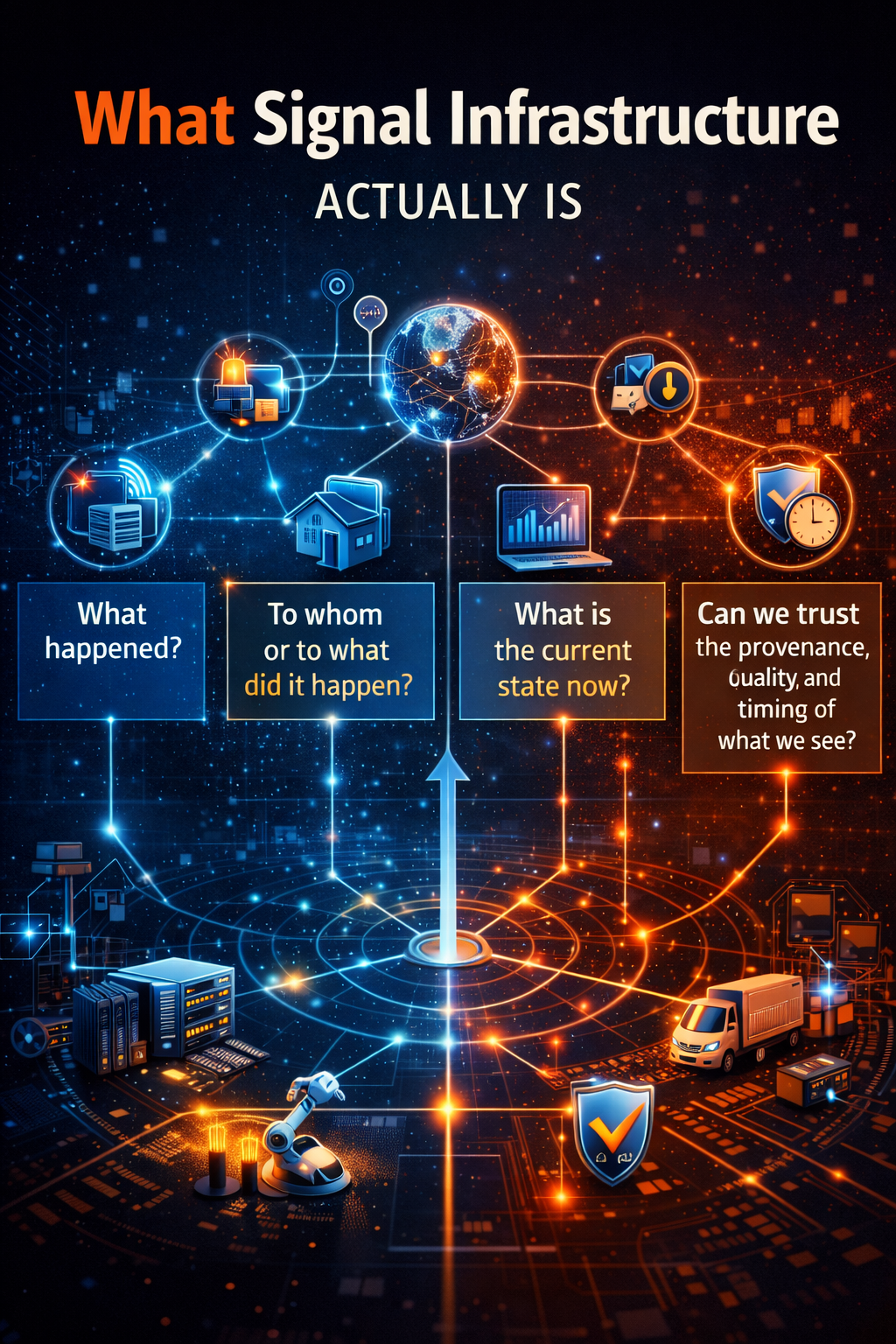
What signal infrastructure actually is
Signal infrastructure is not just “more data.” That phrase is too vague to be useful.
Signal infrastructure is the system that allows an institution to answer five questions continuously and with confidence:
What happened?
To whom or to what did it happen?
What is the current state now?
How is that state changing over time?
Can we trust the provenance, quality, and timing of what we see?
When these questions cannot be answered well, organizations operate in partial darkness.
That darkness is more expensive than most leaders realize. It creates slow decisions, false confidence, poor automation, brittle models, weak governance, and delayed interventions. In many cases, the real problem is not that the organization lacks AI capability. It is that the organization lacks a sufficiently visible version of reality.
Why this changes value creation
Signal infrastructure is not merely a technical foundation. It is an economic one.
For years, leaders assumed advantage came from data abundance. That assumption is now incomplete. The next advantage comes from signal advantage: the ability to detect more meaningful events, faster, with better identity binding, richer state representation, and tighter feedback loops.
This creates value in four powerful ways.
First, it reduces blindness. Problems are detected earlier. Fraud appears sooner. drift becomes visible. service failures are noticed before they become crises.
Second, it expands representability. New customers, assets, risks, and opportunities enter the formal system because they can now be observed with greater fidelity.
Third, it improves adaptation. Institutions stop relying only on static snapshots and begin acting on living, evolving state.
Fourth, it strengthens accountability. Better signals create better logs, better traceability, better monitoring, and stronger recourse. This is one reason official AI frameworks emphasize record-keeping, provenance, and lifecycle monitoring so heavily. (NIST)
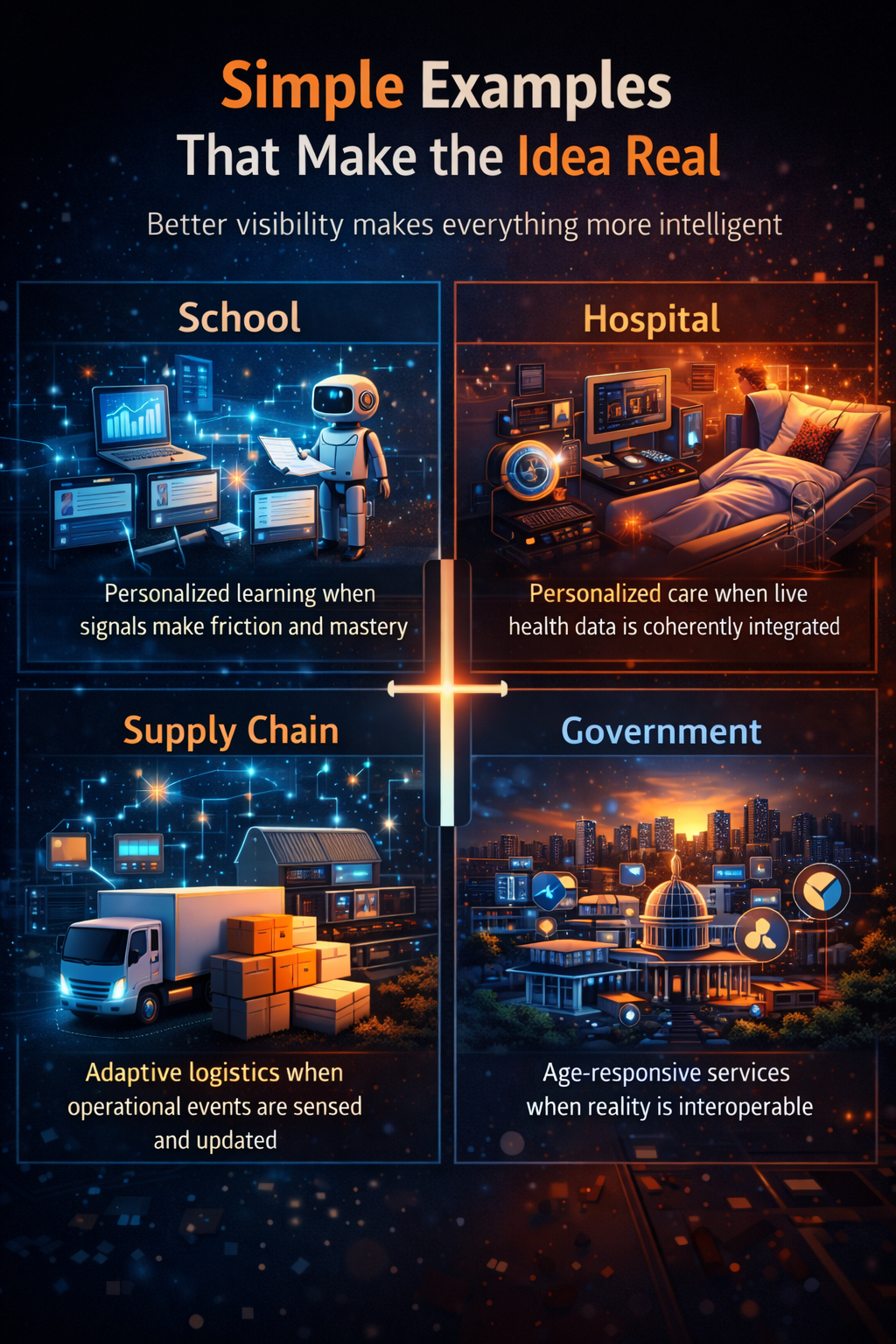
Simple examples that make the idea real
Consider lending to small merchants.
Traditional credit systems often rely on financial statements, bureau files, forms, and periodic reviews. But many small merchants live through dynamic signals: payment frequency, inventory movement, supplier reliability, digital receipts, customer demand, seasonal variability, and operational continuity. Once those signals become visible and structured, a merchant who looked invisible under the old system becomes legible under the new one.
The breakthrough is not only better prediction.
It is better representation.
Now consider agriculture.
A field is not just land on a map. It is a living state system: soil moisture, crop stress, pest activity, weather exposure, irrigation health, logistics timing, and local market conditions. OECD work on digital opportunities in agriculture shows that new digital systems can reduce information gaps and improve policy and operational outcomes precisely because they make these realities more observable. (OECD)
The same logic applies to manufacturing.
A factory does not become intelligent simply because a model is deployed on top of it. It becomes more intelligent when equipment behavior, maintenance signals, quality deviations, throughput fluctuations, and workflow bottlenecks are continuously sensed and updated. The factory stops being a black box and becomes a living system.
A school does not become intelligent because it buys an AI tutor. It becomes more intelligent when attendance, learning friction, concept mastery, engagement, and intervention timing become visible enough to personalize support.
A government does not become intelligent because it launches a chatbot. It becomes more intelligent when beneficiaries, land records, payments, grievances, mobility, weather exposure, and infrastructure conditions become visible in interoperable ways that support better action. The World Bank’s work on digital public infrastructure reflects this broader point: foundational digital layers can make economies and public services more inclusive, interoperable, and actionable. (World Bank)
In every case, intelligence begins before the model.
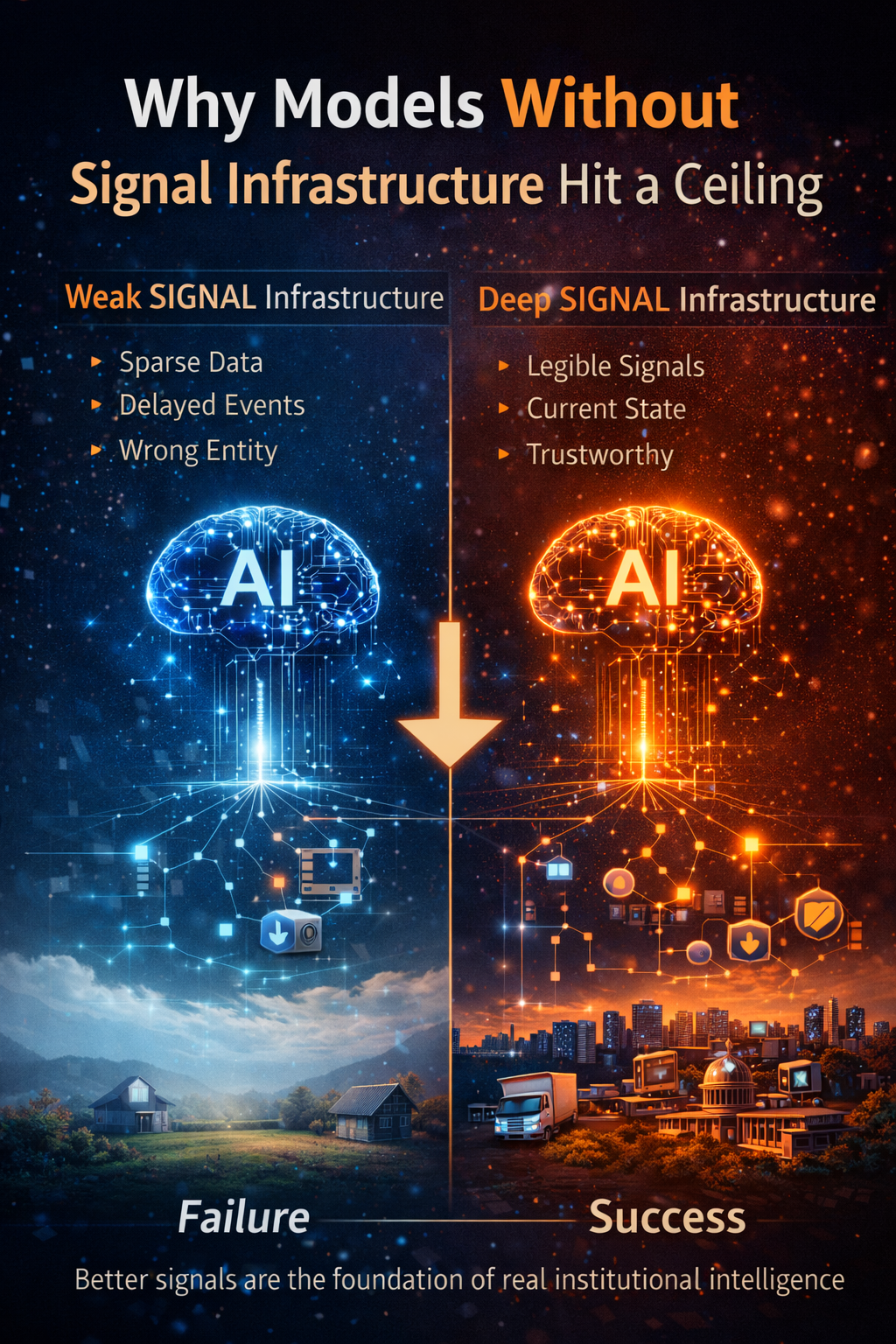
Why models without signal infrastructure hit a ceiling
This is the most important technical point in the entire article.
Models consume representations of reality. They do not create reality’s visibility from nothing.
If signals are sparse, delayed, noisy, fragmented, untraceable, or attached to the wrong entity, the model inherits those weaknesses. Better architectures can sometimes compensate at the margins, but they cannot produce deep institutional intelligence from a fundamentally weak sensing layer.
In simple language: if you cannot trust the signals, you cannot fully trust the reasoning.
That is why provenance, validation, monitoring, and logging matter so much. NIST’s framework and related guidance emphasize testing, evaluation, verification, and validation across the AI lifecycle. The EU AI Act similarly requires logging, data governance, and deployer responsibilities for high-risk systems. These are not bureaucratic accessories. They are institutional safeguards against acting on a distorted picture of reality. (NIST Publications)
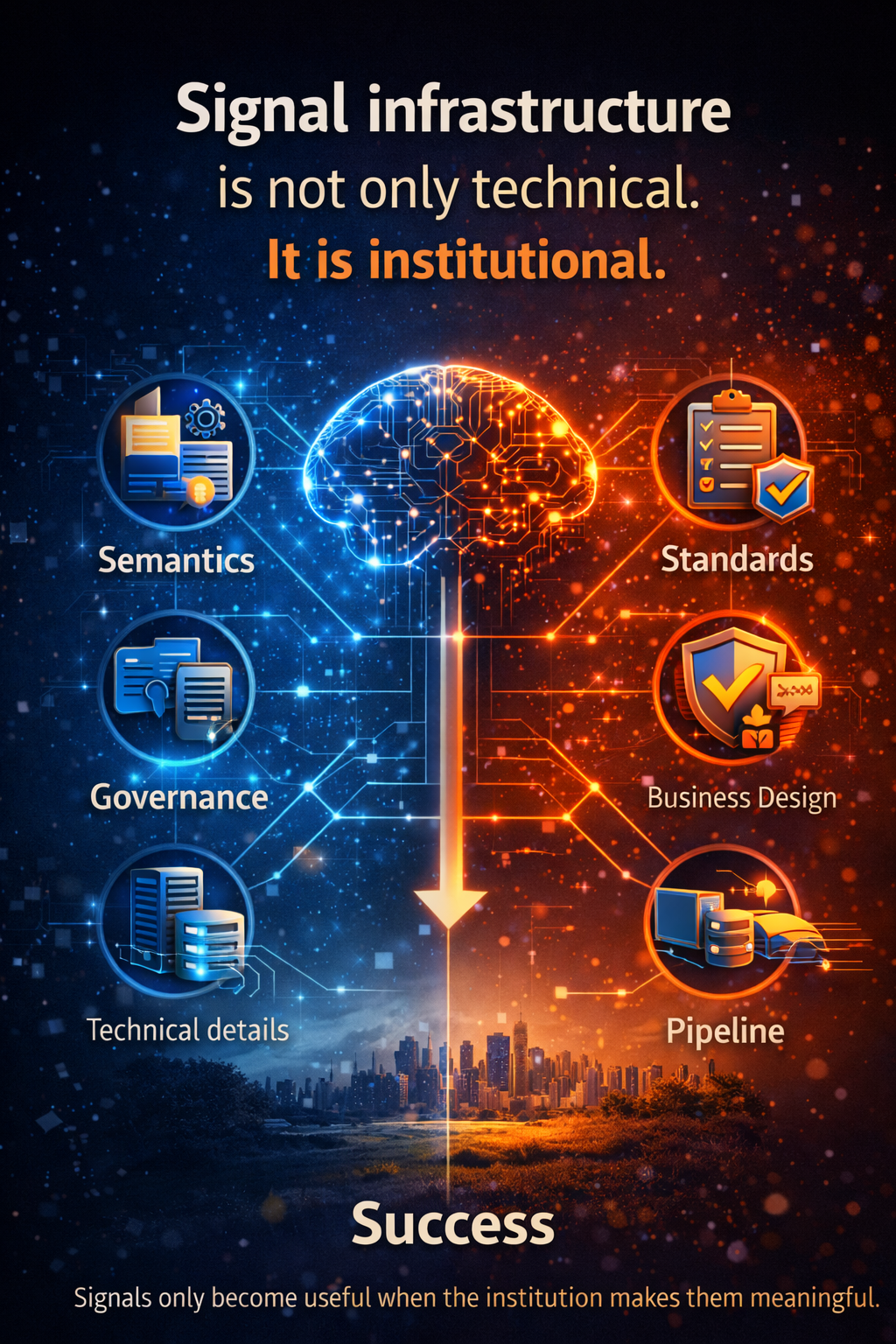
Signal infrastructure is not only technical. It is institutional.
This is where many organizations make a second mistake.
They assume signal infrastructure is only a pipeline problem for engineers.
It is not.
It is also a governance problem, a semantics problem, a standards problem, and a business-design problem.
A signal only becomes economically useful when the institution decides what it means, where it belongs, how it should be validated, how long it matters, which entity it updates, and who is allowed to act on it.
A payment delay may indicate distress in one context, negotiation leverage in another, and normal seasonality in a third. A geolocation change could mean fraud, mobility, logistics activity, or ordinary travel. The raw trace alone is not enough. The institution needs semantic discipline around the signal.
That is why the strongest signal infrastructures are never just sensor grids or event buses. They are systems of meaning, context, and governance wrapped around observability.
A global lesson: AI capacity is becoming infrastructure capacity
There is a broader geopolitical lesson here as well.
The global AI debate is shifting from “Who has the best model?” to “Who has the right stack of compute, power, connectivity, data, institutions, and control?” The World Bank’s recent digital work explicitly places AI readiness inside a broader development and infrastructure agenda, while OECD and smart-city discussions increasingly frame AI competitiveness as a question of institutional and informational capability, not model access alone. (World Bank)
But even inside that wider infrastructure debate, one layer remains underappreciated: signal infrastructure.
Compute determines how much AI you can run.
Signal infrastructure determines how much reality you can understand.
That difference is profound.
A company, city, or country can import models. It is much harder to import the continuous, local, context-rich signal layer that makes those models genuinely useful. That layer must be built in place, through operational discipline, institutional integration, domain knowledge, and trusted standards.
The strategic mistake leaders keep making
Leaders often ask, “Which model should we use?”
A better first question is, “What parts of reality are still invisible to us?”
That question is more strategic because it reveals the true bottleneck.
If the answer is that customer state is stale, asset identity is fragmented, field conditions are not observable, process deviations are poorly logged, or operational traces are trapped in silos, then the institution’s biggest problem is not model selection.
It is weak signal infrastructure.
This is where many AI strategies still fail. They focus on use cases before observability gaps. They prioritize pilots before legibility. They budget for algorithms but not for instrumentation, event quality, entity resolution, monitoring, and feedback loops.
That is backwards.
The right order is much simpler:
make reality observable,
make signals trustworthy,
make entities legible,
make state current,
then apply intelligence.
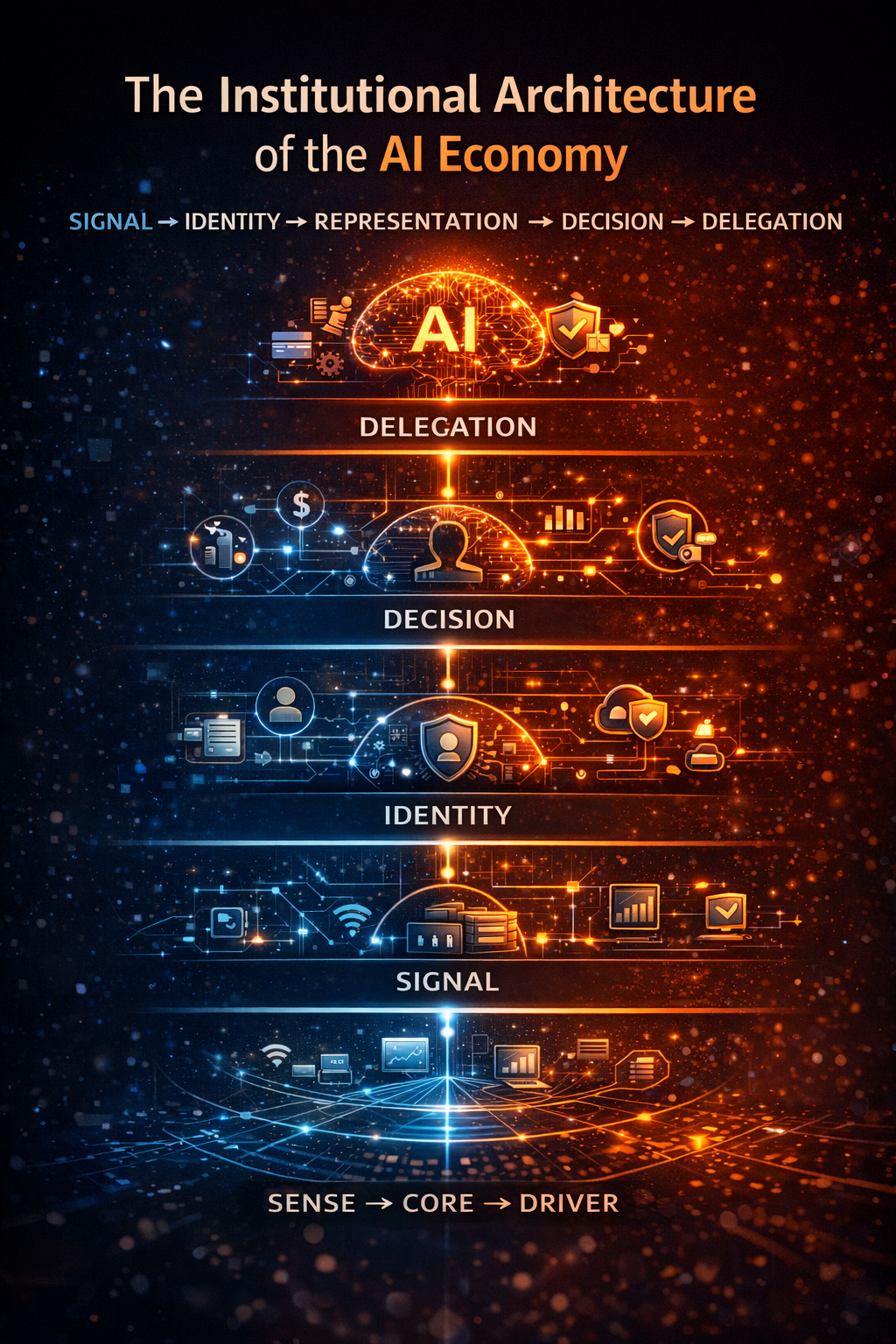
Why this matters for boards and the C-suite
Boards and executives should not treat signal infrastructure as a technical prelude to AI. They should treat it as a strategic asset class.
Because once an institution can sense reality better than its competitors, it can decide faster, intervene earlier, personalize more precisely, govern more responsibly, and create value from populations, assets, and flows that previously sat outside its field of vision.
This is where your larger Goal 2 doctrine becomes especially powerful.
The future will belong to institutions that can see, reason, and act through machine systems with legitimacy.
That is exactly what SENSE–CORE–DRIVER captures.
SENSE asks whether reality has become legible.
CORE asks whether that legible reality can be interpreted intelligently.
DRIVER asks whether the resulting action is governed, authorized, verifiable, and reversible.
Signal infrastructure belongs to the first and most foundational layer of that doctrine.
It is the precondition for everything that follows: representation, decision quality, automation, delegation, auditability, and legitimacy.
Without SENSE, CORE becomes guesswork.
Without SENSE, DRIVER becomes dangerous.
Without signal infrastructure, the AI economy remains mostly theater.
Executive Summary
Artificial intelligence systems do not begin with models. They begin with signal infrastructure — the systems that detect events, connect them to entities, maintain evolving state, and make reality machine-legible.
Organizations that invest in signal infrastructure gain a structural advantage in the AI economy because they can observe reality earlier, interpret it better, and act more effectively.
The future of AI will belong to institutions that master three layers:
SENSE — making reality legible
CORE — reasoning about reality
DRIVER — acting with legitimacy and governance
Signal infrastructure forms the foundation of that stack.
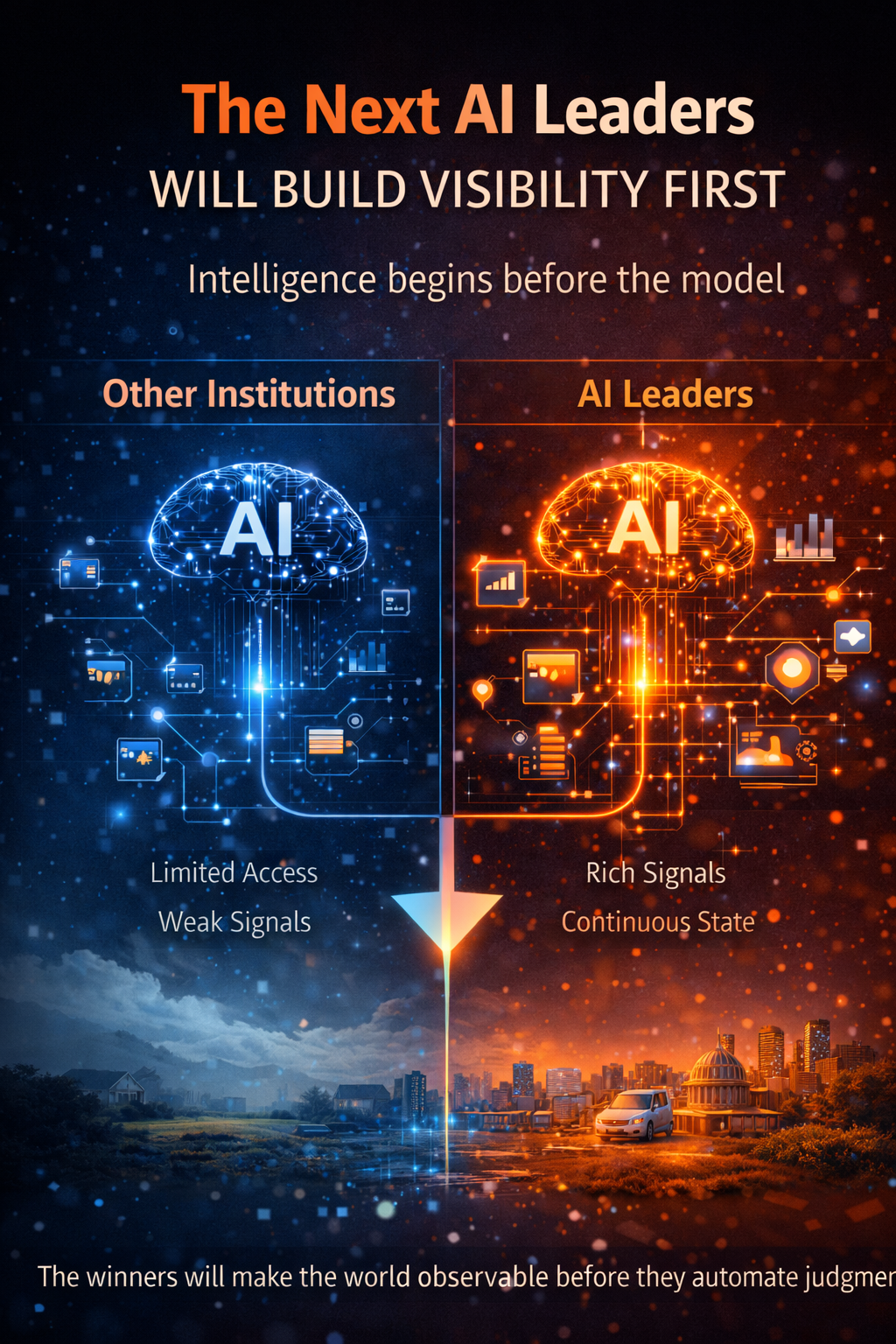
Conclusion: the next AI leaders will build visibility first
The coming decade will not be won only by firms with bigger models, cheaper inference, or better prompts.
It will be won by institutions that make more of reality observable, attach signals to the right entities, maintain richer state, and update that state continuously enough to support judgment and action.
That is why signal infrastructure is not a technical footnote.
It is the opening layer of the AI economy.
The organizations that understand this will stop asking only how to deploy AI. They will start asking how to build systems that make the world more legible.
And once reality becomes legible, intelligence becomes possible.
That is where the real race begins.
FAQ
What is signal infrastructure in AI?
Signal infrastructure is the system of events, logs, telemetry, transactions, documents, and governance mechanisms that helps institutions detect what is happening in the world and convert it into machine-legible signals.
Why does the AI economy begin before the model?
Because a model can only reason over what an institution is able to observe, identify, and represent. If signals are weak, stale, or fragmented, even strong models will underperform.
What does SENSE mean?
SENSE stands for Signal, ENtity, State representation, and Evolution. It is the layer where reality becomes machine-legible.
What does CORE mean?
CORE stands for Comprehend context, Optimize decisions, Realize action, and Evolve through feedback. It is the layer where signals are interpreted and turned into judgment.
What does DRIVER mean?
DRIVER stands for Delegation, Representation, Identity, Verification, Execution, and Recourse. It is the layer that makes machine action accountable and institutionally legitimate.
How is signal infrastructure different from data infrastructure?
Data infrastructure focuses on storing and moving data. Signal infrastructure focuses on detecting meaningful changes in the world, binding them to entities, maintaining current state, and updating that state over time.
Why is signal infrastructure important for AI governance?
Because governance depends on traceability, provenance, logging, monitoring, and quality controls. Without these, AI systems become harder to audit, verify, and correct. (NIST)
Glossary
Signal infrastructure
The systems and governance mechanisms that capture meaningful events, traces, and changes from the world and make them usable for institutional intelligence.
Entity
The person, asset, machine, organization, location, or object to which signals are attached.
State representation
A structured description of an entity’s current condition.
Evolution
The process of updating state over time as new signals arrive.
Observability
The ability to detect and understand what is happening inside a system or across a real-world process.
Provenance
Information about where data or signals came from, how they were collected, and how they changed over time. (NIST Publications)
Traceability
The ability to reconstruct how a system arrived at an output using logs, records, and linked evidence. (Artificial Intelligence Act)
Legibility
The extent to which reality is visible and understandable to an institution.
SENSE
Signal, ENtity, State representation, Evolution.
CORE
Comprehend context, Optimize decisions, Realize action, Evolve through feedback.
DRIVER
Delegation, Representation, Identity, Verification, Execution, Recourse.
Explore the Architecture of the AI Economy
This article is part of a broader research series exploring how institutions are being redesigned for the age of artificial intelligence. Together, these essays examine the structural foundations of the emerging AI economy — from signal infrastructure and representation systems to decision architectures and enterprise operating models.
If you want to explore the deeper framework behind these ideas, the following essays provide additional perspectives:
- The Representation Economy: Why the AI Decade Will Be Defined by Who Gets Represented—and Who Designs Trusted Delegation
• Representation Infrastructure: Why the AI Economy Will Be Won by Those Who Make the Invisible Legible
• The Representation Stack: How Reality Becomes Identifiable, Legible, and Actionable in the AI Economy
• Identity Infrastructure: The Missing Layer Between Signals and Representation in the AI Economy
• Why Most AI Projects Fail Before Intelligence Even Begins
• The Intelligence Supply Chain: How Organizations Industrialize Cognition in the AI Economy
• The Enterprise AI Operating Model
• Decision Scale: Why Competitive Advantage Is Moving from Labor Scale to Decision Scale
• The Operating Architecture of the AI Economy: Why Intelligence Alone Will Not Transform Markets - The Silent Systems Doctrine: Why the AI Economy Will Be Won by Those Who Represent What Cannot Speak
Together, these essays outline a central thesis:
The future will belong to institutions that can sense reality, represent it clearly, reason about it intelligently, and act through governed machine systems.
This is why the architecture of the AI era can be understood through three foundational layers:
SENSE → CORE → DRIVER
Where:
- SENSE makes reality legible
- CORE transforms signals into reasoning
- DRIVER ensures that machine action remains accountable, governed, and institutionally legitimate
Signal infrastructure forms the first and most foundational layer of that architecture.
AI Economy Research Series — by Raktim Singh
Institutional Perspectives on Enterprise AI
Many of the structural ideas discussed here — intelligence-native operating models, control planes, decision integrity, and accountable autonomy — have also been explored in my institutional perspectives published via Infosys’ Emerging Technology Solutions platform.
For readers seeking deeper operational detail, I have written extensively on:
- What Makes an Enterprise Intelligence-Native? The Blueprint for Third-Order AI Advantage
https://blogs.infosys.com/emerging-technology-solutions/artificial-intelligence/what-is-enterprise-ai-the-operating-model-for-compounding-institutional-intelligence.html - Why “AI in the Enterprise” Is Not Enterprise AI: The Operating Model Difference Most Organizations Miss
https://blogs.infosys.com/emerging-technology-solutions/artificial-intelligence/why-ai-in-the-enterprise-is-not-enterprise-ai-the-operating-model-difference-that-most-organizations-miss.html - The Enterprise AI Control Plane: Governing Autonomy at Scale
https://blogs.infosys.com/emerging-technology-solutions/artificial-intelligence/the-enterprise-ai-control-plane-governing-autonomy-at-scale.html - Enterprise AI Ownership Framework: Who Is Accountable, Who Decides, and Who Stops AI in Production
https://blogs.infosys.com/emerging-technology-solutions/artificial-intelligence/enterprise-ai-ownership-framework-who-is-accountable-who-decides-and-who-stops-ai-in-production.html - Decision Integrity: Why Model Accuracy Is Not Enough in Enterprise AI
https://blogs.infosys.com/emerging-technology-solutions/artificial-intelligence/decision-integrity-why-model-accuracy-is-not-enough-in-enterprise-ai.html - Agent Incident Response Playbook: Operating Autonomous AI Systems Safely at Enterprise Scale
https://blogs.infosys.com/emerging-technology-solutions/artificial-intelligence/agent-incident-response-playbook-operating-autonomous-ai-systems-safely-at-enterprise-scale.html - The Economics of Enterprise AI: Designing Cost, Control, and Value as One System
https://blogs.infosys.com/emerging-technology-solutions/artificial-intelligence/the-economics-of-enterprise-ai-designing-cost-control-and-value-as-one-system.html
Together, these perspectives outline a unified view: Enterprise AI is not a collection of tools. It is a governed operating system for institutional intelligence — where economics, accountability, control, and decision integrity function as a coherent architecture.



Raktim Singh is an AI and deep-tech strategist, TEDx speaker, and author focused on helping enterprises navigate the next era of intelligent systems. With experience spanning AI, fintech, quantum computing, and digital transformation, he simplifies complex technology for leaders and builds frameworks that drive responsible, scalable adoption.