
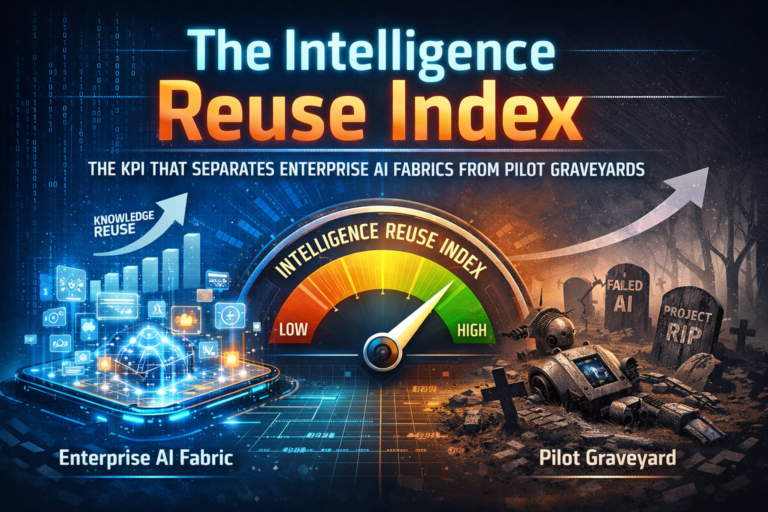
The Intelligence Reuse Index: The Metric That Defines Enterprise AI Advantage
The Intelligence Reuse Index is emerging as one of the most important measures of enterprise AI maturity—not because it tracks how many models an organization builds, but because it reveals how effectively intelligence is reused across the enterprise.
While most companies continue to generate AI ideas, pilots, and proofs of concept at an impressive pace, very few succeed in turning those efforts into repeatable, scalable capability.
The Intelligence Reuse Index captures this gap by focusing on what truly creates advantage today: reusable intelligence that can move safely, economically, and consistently across teams, systems, and use cases.
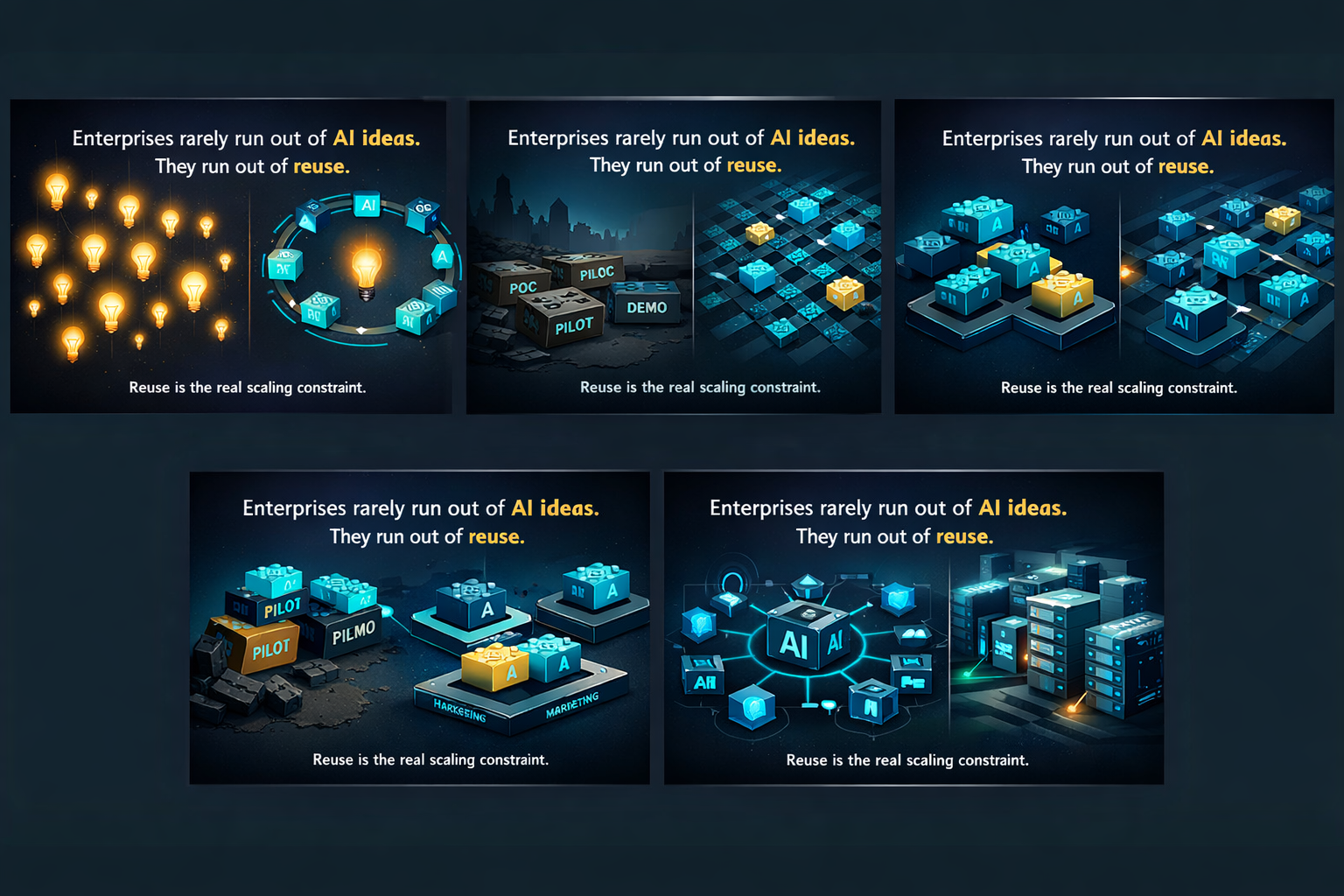
Enterprises rarely run out of AI ideas.They run out of reuse.
A team builds a brilliant assistant for customer support.
Another builds a compliance checker.
A third builds a workflow agent for IT tickets.
Each looks promising.
Each wins a demo.
Each secures a pilot budget.
And then—quietly—the same pattern repeats:
- The next business unit can’t reuse it without rebuilding
- The next process needs slightly different data, policies, approvals, and tools
- Costs rise because every agent is a bespoke one-off
- Risk increases because each workflow invents its own guardrails
- Trust erodes because no one can explain what is running where, under which policy, with what data, and at what cost
This is how enterprises end up with a pilot graveyard:
a scattered collection of AI point solutions that cannot be industrialized.
The organizations that break out of this trap do something fundamentally different.
They do not treat AI as a stream of projects.
They treat AI as manufactured capability—built once, reused many times, governed centrally, and adapted locally.
That difference can be captured in a single KPI.
This is a core component of the The Enterprise AI Operating Model: How organizations design, govern, and scale intelligence safely – Raktim Singh, which defines how organizations design, govern, and scale intelligence safely.
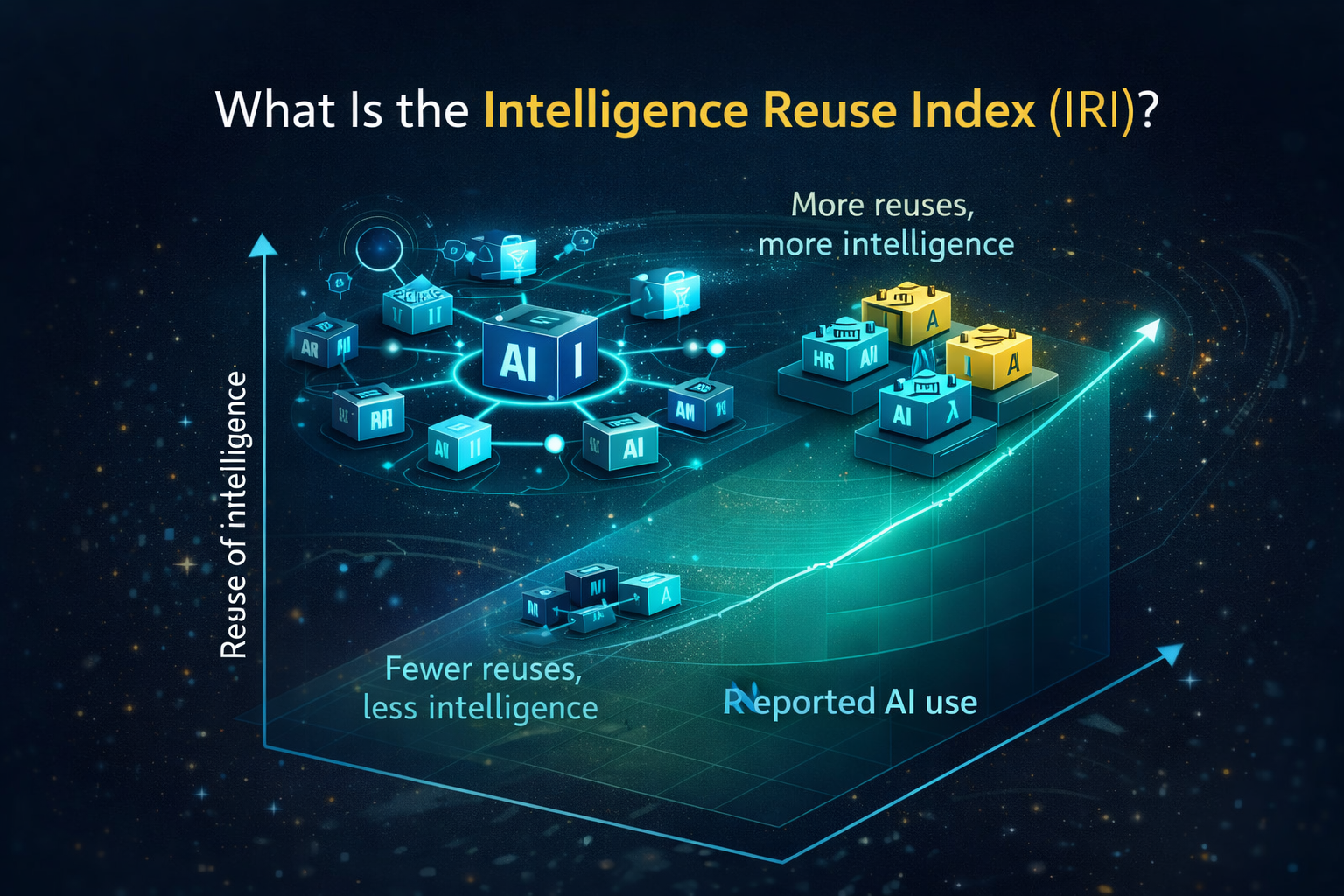
What Is the Intelligence Reuse Index (IRI)?
The Intelligence Reuse Index (IRI) measures how much of an enterprise’s AI capability can be reused safely and repeatedly across teams, workflows, and time.
A high IRI means intelligence compounds.
A low IRI means intelligence fragments.
In practical terms, IRI reflects whether your AI is:
- Reusable across multiple workflows and teams
- Composable into new solutions without rebuilding
- Governed consistently (policy, audit, security, privacy)
- Economical at scale (cost attribution, budgets, throttles)
- Evolvable as models, tools, and regulations change
In plain language:
The Intelligence Reuse Index is the ratio between
“AI you can reuse safely” and “AI you must rebuild every time.”
When IRI is low, enterprises enjoy impressive demos and painful scale.
When IRI is high, each new use case becomes cheaper, faster, safer, and more reliable.
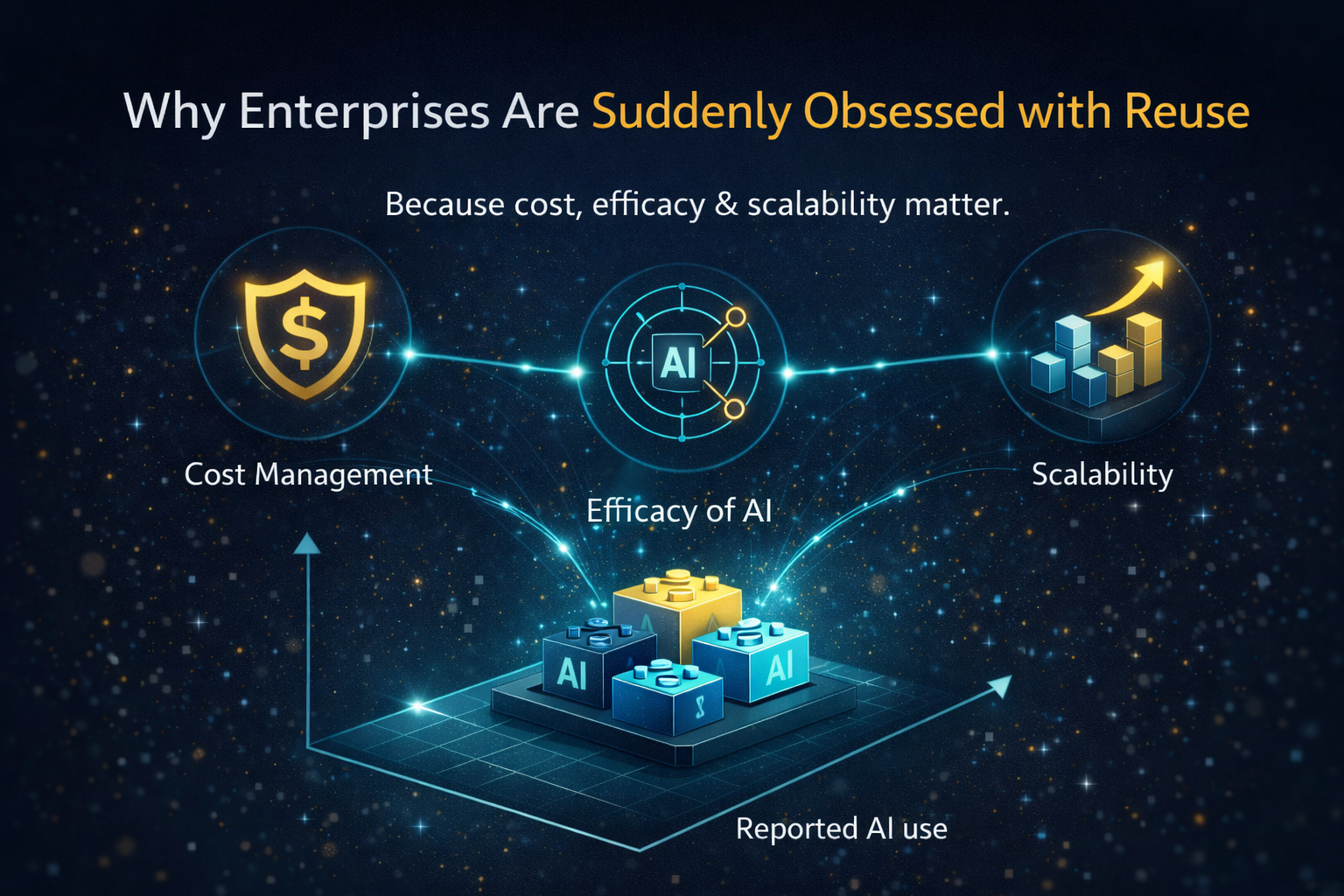
Why Enterprises Are Suddenly Obsessed with Reuse
In the early days, leaders asked:
“Can AI do this task at all?”
Today, the question has changed:
“Can we run this in production, across many teams, without chaos?”
Two forces are driving this shift.
- AI Is Moving From Answers to Actions
Once AI systems start triggering real actions—creating tickets, changing records, sending messages, initiating approvals—reuse stops being a developer convenience.
It becomes an executive risk issue.
That is why conversations around control planes, observability, and reversibility are accelerating across enterprises, with standards like OpenTelemetry gaining traction.
- AI Costs Do Not Scale Linearly
Bespoke agents create bespoke cost profiles:
- retries
- tool calls
- orchestration overhead
- governance overhead
This is exactly why organizations like the FinOps Foundation are expanding their focus to include AI cost management and autonomy economics.
Reuse is no longer just efficiency.
It is operability.
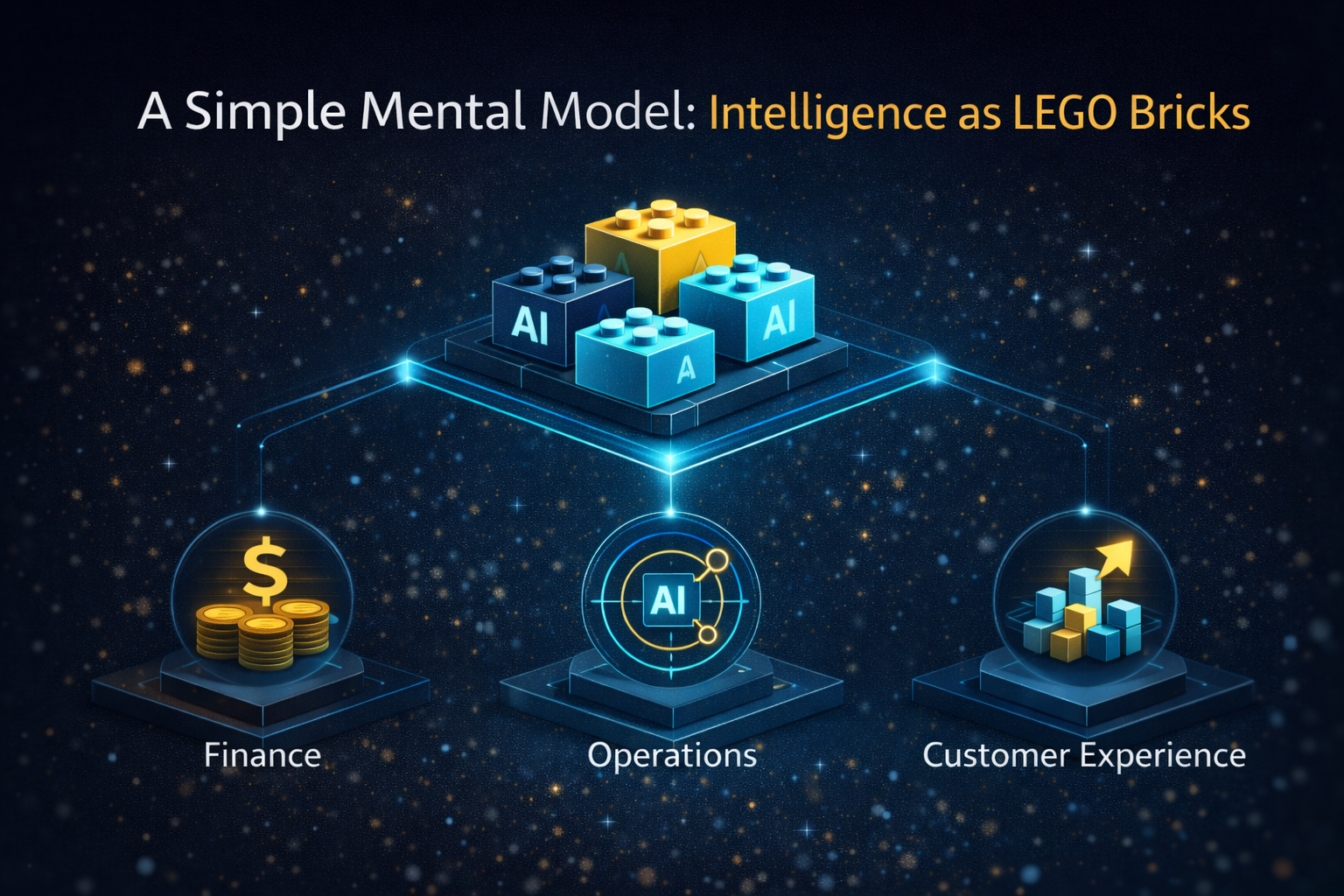
A Simple Mental Model: Intelligence as LEGO Bricks
Most enterprises build AI like custom furniture:
- One use case, one build
- Hard to move
- Hard to modify
- Expensive to replicate
High-IRI enterprises build AI like LEGO:
- Standard bricks (reusable capabilities)
- Shared connectors (APIs, tools, policies)
- Reconfigurable designs (workflows)
- Replaceable pieces (models can change without rebuild)
This LEGO view captures the essence of an enterprise AI fabric:
a modular yet integrated stack designed for reuse, interoperability, and continuous change.

The Five Things Enterprises Must Be Able to Reuse
Many teams think reuse means reusing a prompt or a model endpoint.
That is not enterprise reuse.
Enterprise reuse runs deeper.
-
Reuse the Workflow Pattern, Not Just the Bot
Example: Exception approval
- In finance, exceptions are invoices
- In IT, exceptions are policy violations
- In procurement, exceptions are supplier deviations
If each team builds a new “exception agent,” scale collapses.
If teams reuse a shared pattern—
detect → explain → request approval → record decision → audit trail—
scale accelerates.
The reusable unit is not the agent.
It is the decision pattern.
-
Reuse Guardrails, Not Just Interfaces
Guardrails include:
- policy checks
- redaction rules
- human approval gates
- audit logging
- data access constraints
Example: Draft-and-send communications
Whether it’s:
- customer emails
- internal announcements
- supplier messages
the same guardrails must apply.
Otherwise, every workflow becomes a compliance snowflake.
This is why control-plane thinking matters:
guardrails must be centralized, reusable, and enforceable.
-
Reuse Tool Integrations
Enterprises run hundreds of systems.
Every agent needs tools—ticketing, CRM, knowledge bases, document stores.
If each use case wires tools from scratch, bottlenecks are guaranteed.
High-IRI organizations build a reusable tool layer and orchestration approach that works across agent types.
-
Reuse Measurement
If performance cannot be compared, it cannot be governed.
Two teams may deploy “policy check agents.”
Without shared telemetry conventions, both claim success in incompatible ways.
This is why observability standards—again, see OpenTelemetry—are decisive for enterprise AI.
-
Reuse Economics
The enterprise question is never “does it work?”
It is: “Can it run within acceptable unit economics?”
High-IRI enterprises reuse:
- cost attribution models
- per-agent budgets
- throttles for runaway behavior
- limits on reasoning spend
Without this, reuse scales cost as fast as it scales output.

What Kills the Intelligence Reuse Index
Seven recurring traps collapse reuse:
- Every team chooses its own stack
- Prompts become the de-facto API
- Tool sprawl across agents
- Guardrails added late as patches
- No abstraction between workflow and model/vendor
- No shared runtime discipline
- Pilot success becomes the primary metric
Pilot KPIs reward local wins.
IRI measures enterprise capability.
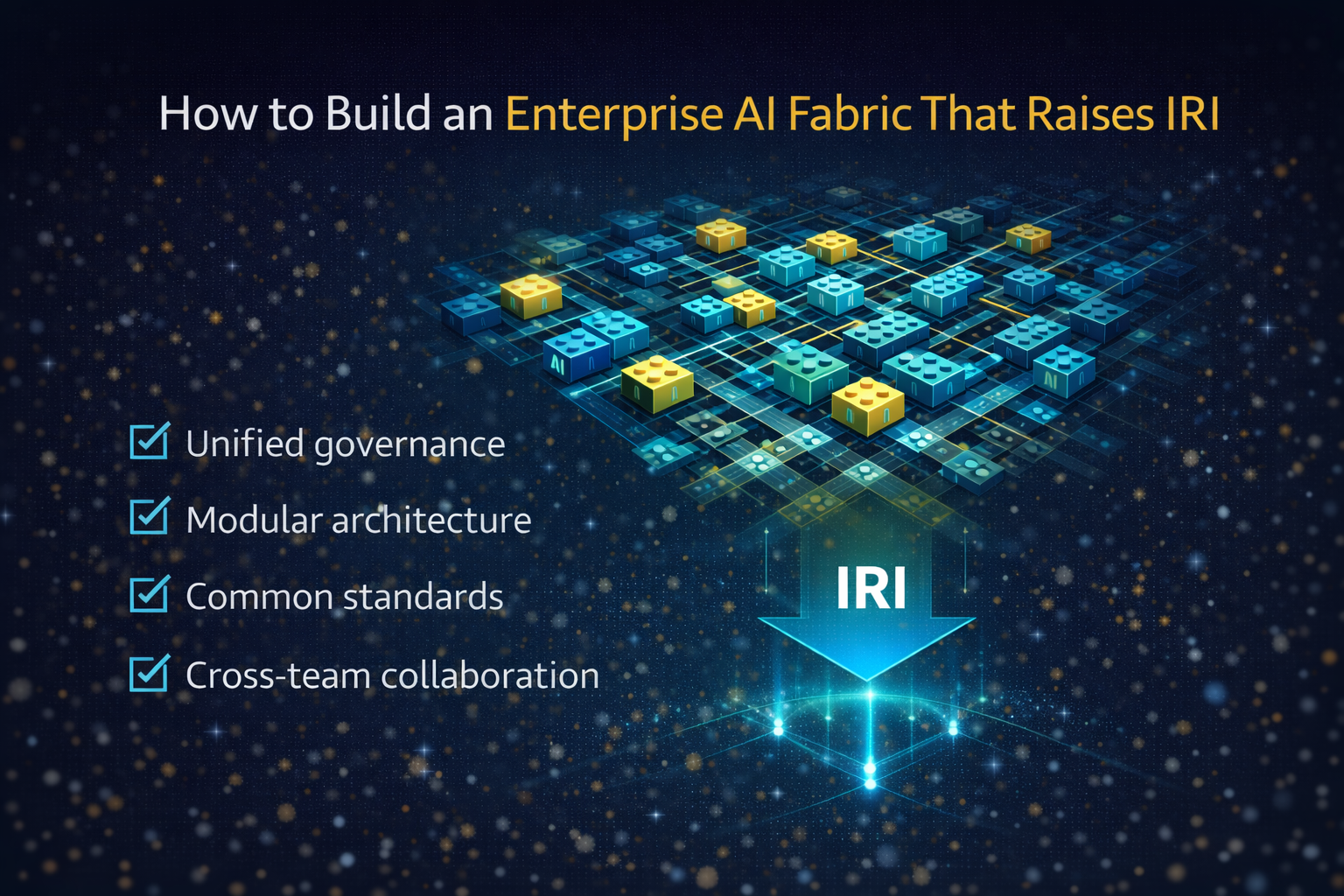
How to Build an Enterprise AI Fabric That Raises IRI
You do not raise IRI by launching a program.
You raise it by changing what teams are allowed to build.
A fabric-like enterprise AI stack typically includes:
- A Build Plane
Reusable patterns, policies, connectors, and test harnesses.
- A Runtime Plane
Standardized orchestration, retries, fallbacks, human-in-the-loop, and rollback.
- A Control Plane
Identity, permissions, policy evaluation, auditability, and observability.
- A Cost Plane
AI-native FinOps: attribution, budgets, and economic guardrails.
- An Abstraction Layer
Decoupling workflow logic from models, tools, and vendors—future-proofing reuse.
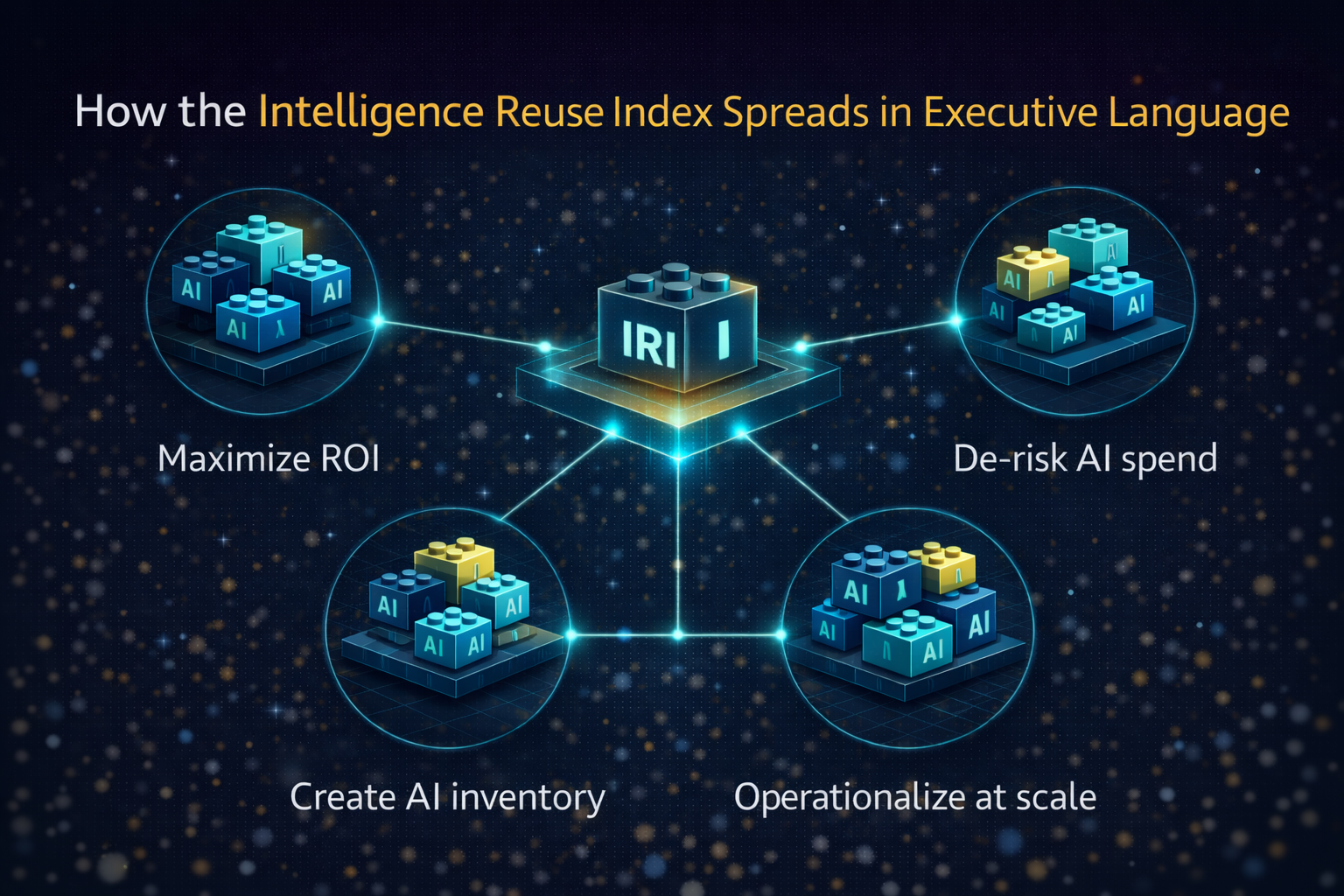
How the Intelligence Reuse Index Spreads in Executive Language
Ideas go viral in enterprises when they are repeatable.
Three lines that travel:
- “We don’t have an AI problem. We have a reuse problem.”
- “Our AI doesn’t scale because our intelligence doesn’t compound.”
- “The winners will treat intelligence like a reusable supply chain—not a stream of projects.”
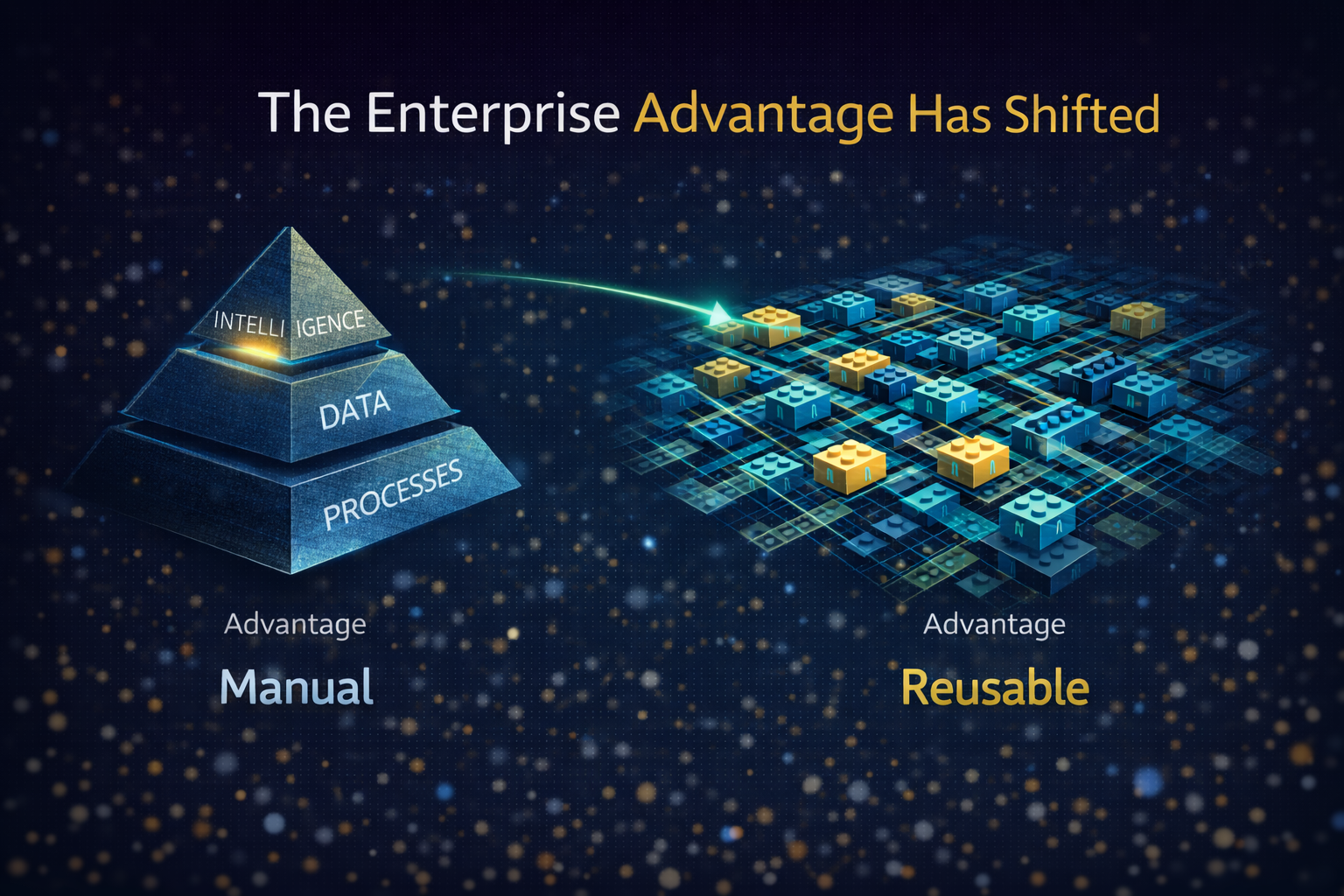
Conclusion: The Enterprise Advantage Has Shifted
Enterprise AI is not a race to deploy more agents.
It is a race to build reusable, governable, evolvable intelligence.
That is what the Intelligence Reuse Index captures.
- Low IRI creates pilot graveyards
- High IRI creates enterprise AI fabrics
- And fabrics—not pilots—compound value over time
In the AI era, the enterprise advantage is not how much intelligence you deploy—
it is how much intelligence you can reuse safely.
Glossary
- Enterprise AI Fabric: A modular, integrated architecture that enables reusable, governed AI capabilities
- Control Plane: Centralized layer for policy, audit, observability, and reversibility
- Intelligence Reuse Index (IRI): Measure of reusable AI capability versus bespoke rebuilds
- Agentic AI: AI systems that can plan, decide, and act across workflows
- FinOps for AI: Financial governance of AI usage, cost, and autonomy
Frequently Asked Questions (FAQ)
Is the Intelligence Reuse Index an official standard?
Not yet. It is an emerging executive metric reflecting how enterprises actually succeed—or fail—at AI scale.
Can small enterprises benefit from IRI thinking?
Yes. Reuse discipline matters even more when resources are limited.
Is this about tools or operating models?
Primarily operating models. Tools matter only insofar as they support reuse.
Does reuse slow innovation?
No. It accelerates innovation by removing reinvention.
FAQ 1: What is the Intelligence Reuse Index (IRI)?
The Intelligence Reuse Index measures how frequently enterprise intelligence—models, prompts, logic, data, and workflows—is reused across teams and use cases.
FAQ 2: Why is reuse more important than building new AI models?
Because enterprise AI fails not due to lack of ideas, but due to fragmentation, cost, and governance challenges caused by one-off implementations.
FAQ 3: How does an Enterprise AI Fabric improve IRI?
It standardizes intelligence, enforces governance, and enables modular reuse across business functions.
FAQ 4: Who should care about the Intelligence Reuse Index?
CIOs, CTOs, CDOs, COOs, and boards overseeing AI investment, risk, and scale.
References & Further Reading
- OpenTelemetry — Observability standards for distributed systems
- FinOps Foundation — AI cost governance and financial operations
- Industry research on enterprise AI control planes, agent governance, and services-as-software delivery models
- The AI Platform War Is Over: Why Enterprises Must Build an AI Fabric—Not an Agent Zoo – Raktim Singh
- What Is Enterprise AI? Why “AI in the Enterprise” Is Not Enterprise AI—and Why This Distinction Will Define the Next Decade – Raktim Singh
- Why Enterprises Need Services-as-Software for AI: The Integrated Stack That Turns AI Pilots into a Reusable Enterprise Capability – Raktim Singh
- The Advantage Is No Longer Intelligence—It Is Operability: How Enterprises Win with AI Operating Environments – Raktim Singh
- Service Catalog of Intelligence: How Enterprises Scale AI Beyond Pilots With Managed Autonomy – Raktim Singh
- Enterprise AI Operating Model 2.0: Control Planes, Service Catalogs, and the Rise of Managed Autonomy – Raktim Singh
- The One Enterprise AI Stack CIOs Are Converging On: Why Operability, Not Intelligence, Is the New Advantage | by RAKTIM SINGH | Dec, 2025 | Medium
- The Enterprise AI Factory: Why AI Pilots Fail-and What Scales Instead | by RAKTIM SINGH | Dec, 2025 | Medium
- The Enterprise Model Portfolio: Why Model Selection Is the Wrong Question for 2026: By Raktim Singh
- Why Autonomous AI Fails in Production — and What CIOs Must Do to Control It: By Raktim Singh



Raktim Singh is an AI and deep-tech strategist, TEDx speaker, and author focused on helping enterprises navigate the next era of intelligent systems. With experience spanning AI, fintech, quantum computing, and digital transformation, he simplifies complex technology for leaders and builds frameworks that drive responsible, scalable adoption.