
Machine-Readable-Boundary-of-the-Firm: Executive Summary
For more than a century, firms have been shaped by a familiar strategic question: What should we do ourselves, what should we buy from others, and what should we coordinate through partners? In the AI era, that question is not disappearing. It is becoming sharper. But the basis for answering it is changing.
Leaders are no longer deciding only on cost, control, and speed. They are deciding on something deeper: what parts of the enterprise can be made legible enough for machines to understand, reason over, and act upon safely. This matters because AI does not operate on mission statements, org charts, or managerial intent. It operates on representations: entities, states, permissions, histories, constraints, tools, and outcomes.
This is why we need a new concept: the machine-readable boundary of the firm. It is the line that separates work a company can reliably expose to AI systems from work that still depends on tacit human judgment, fragmented context, political negotiation, or unstructured institutional memory.
As AI adoption accelerates, this boundary will shape strategy as much as the classic questions of scale and specialization once did. Stanford’s 2025 AI Index reports that 78% of organizations said they used AI in 2024, up from 55% in 2023, while the share using generative AI in at least one business function rose from 33% to 71%. (Stanford HAI)
The next generation of winning firms will not simply deploy better models. They will redesign themselves around what can be represented, governed, delegated, and coordinated.
A New Theory of the Firm for the AI Era
The traditional boundary of the firm was shaped by coordination costs. Companies kept activities inside when it was more efficient to manage them internally than to transact through the market. Digital systems reduced some of those coordination costs. APIs, cloud platforms, software integration layers, and shared data environments made it easier to unbundle work.
AI introduces a deeper shift.
The critical question is no longer just:
Can this task be done more cheaply outside the firm?
It is increasingly:
Can this activity be represented clearly enough for machines to participate meaningfully?
That is a different question altogether.
A bank may keep credit policy and exception logic inside, but outsource document extraction, model hosting, and portions of customer service. A manufacturer may retain product architecture and quality thresholds internally, while relying on external robotics providers, sensor platforms, and predictive-maintenance networks. A retailer may keep pricing strategy and brand governance in-house while opening fulfillment, returns, and inventory coordination to ecosystem partners and AI agents.
In each case, the line is not drawn only by economics in the old sense. It is drawn by whether the activity can be made machine-readable, governable, and auditable.
Q: How is AI redefining the boundary of the firm?
AI is redefining the boundary of the firm by shifting it from ownership-based structures to representation-based structures. Companies will retain functions where they have superior proprietary representations (data, models, decision systems), outsource standardized functions, and build ecosystems where coordination across multiple entities creates greater value.
Why This Matters Now
This is not a theoretical issue waiting for some distant future. It is already becoming strategic.
McKinsey’s 2025 State of AI research found that organizations generating more value are not merely experimenting with models. They are redesigning workflows, elevating governance, and building new operating structures around AI. High performers are far more likely than others to fundamentally redesign workflows, and workflow redesign is identified as one of the strongest contributors to meaningful business impact. (McKinsey & Company)
That finding matters because it reveals something leaders often miss: the real bottleneck is rarely model intelligence alone. It is organizational legibility.
An AI system may be able to summarize a contract in seconds. But can it see the right contract version? Can it identify the right customer entity? Can it understand the risk tier, the approval hierarchy, the regulatory context, the current exception rules, and the audit requirements? Can it record the basis of its recommendation and route the outcome to the correct authority?
If not, the issue is not intelligence in the abstract. The issue is the machine-readability of the firm.
The Representation Economy Lens
This is where the broader idea of the Representation Economy becomes essential.
In the AI era, firms will increasingly compete not only on products, brands, and talent, but on how well they represent reality in forms that machines can safely use. That means representing:
- who or what an entity is,
- what state it is currently in,
- what history led to that state,
- what permissions apply,
- what actions are allowed,
- what constraints matter,
- and how outcomes should be verified.
Put differently, AI scales where reality becomes legible.
This is exactly why the machine-readable boundary of the firm is not a narrow technical idea. It is a strategic and economic one.
SENSE–CORE–DRIVER: The Operating Logic Behind the Boundary
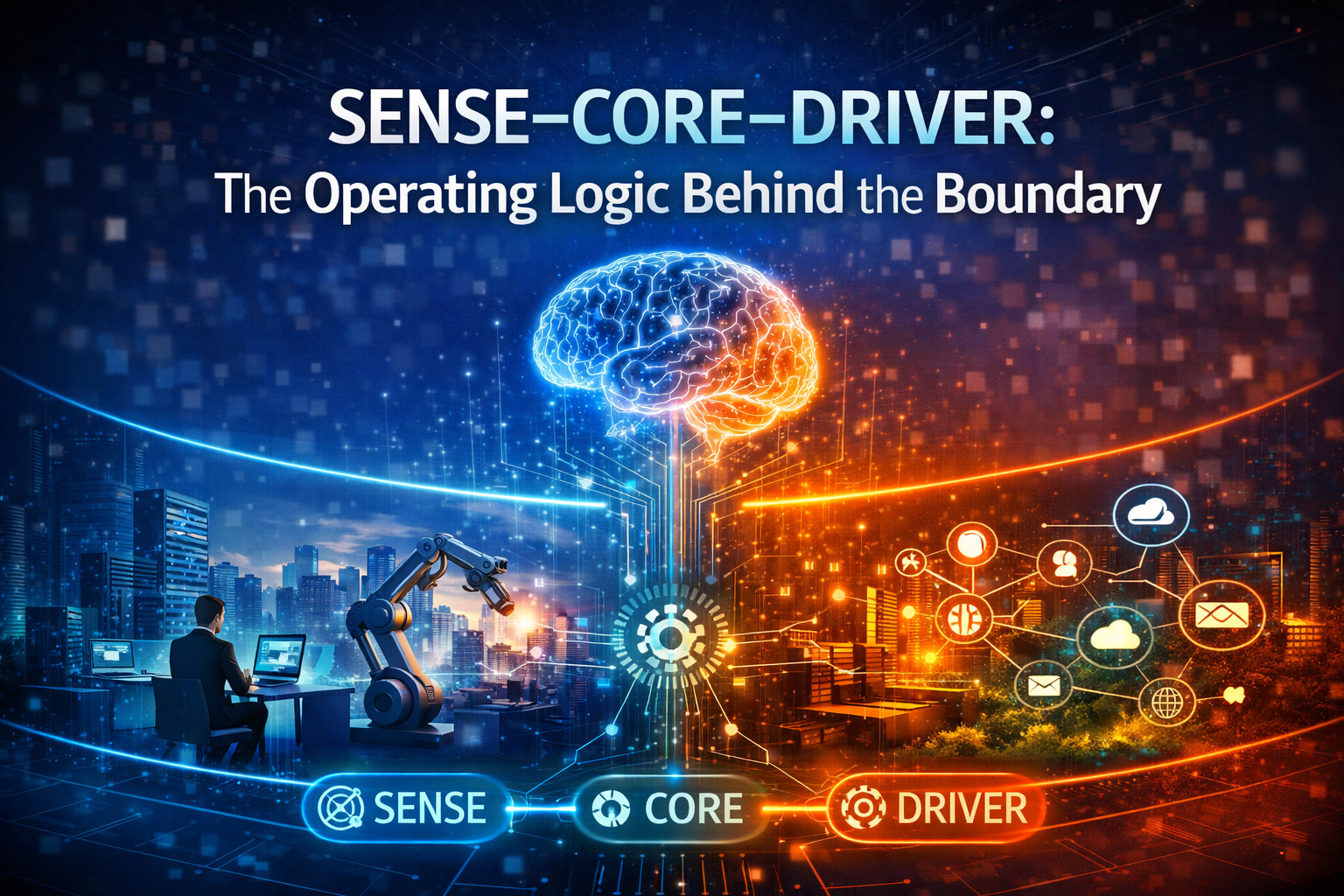
The machine-readable boundary becomes much clearer through the SENSE–CORE–DRIVER framework.
SENSE: Making the Firm Legible
SENSE is the layer that captures signals, attaches them to entities, represents current state, and updates that state over time. It is the legibility layer.
If a firm cannot reliably identify a customer, asset, supplier, shipment, claim, machine, document, or employee state, AI systems will struggle to act effectively.
CORE: Making the Firm Intelligible
CORE is the reasoning layer. It interprets context, optimizes decisions, recommends action, and evolves through feedback.
This is where models operate, but they are only as good as the reality they are given to work with.
DRIVER: Making the Firm Actionable
DRIVER is the execution and legitimacy layer. It determines who delegated authority, what action is permitted, how it is verified, and what recourse exists if the system is wrong.
This matters because AI in enterprises is not only about prediction. It is about action under authority.
A firm’s machine-readable boundary is effectively the point at which all three layers remain strong enough for reliable delegation. When one fails, the task either stays more human, remains more internal, or becomes too risky to scale.
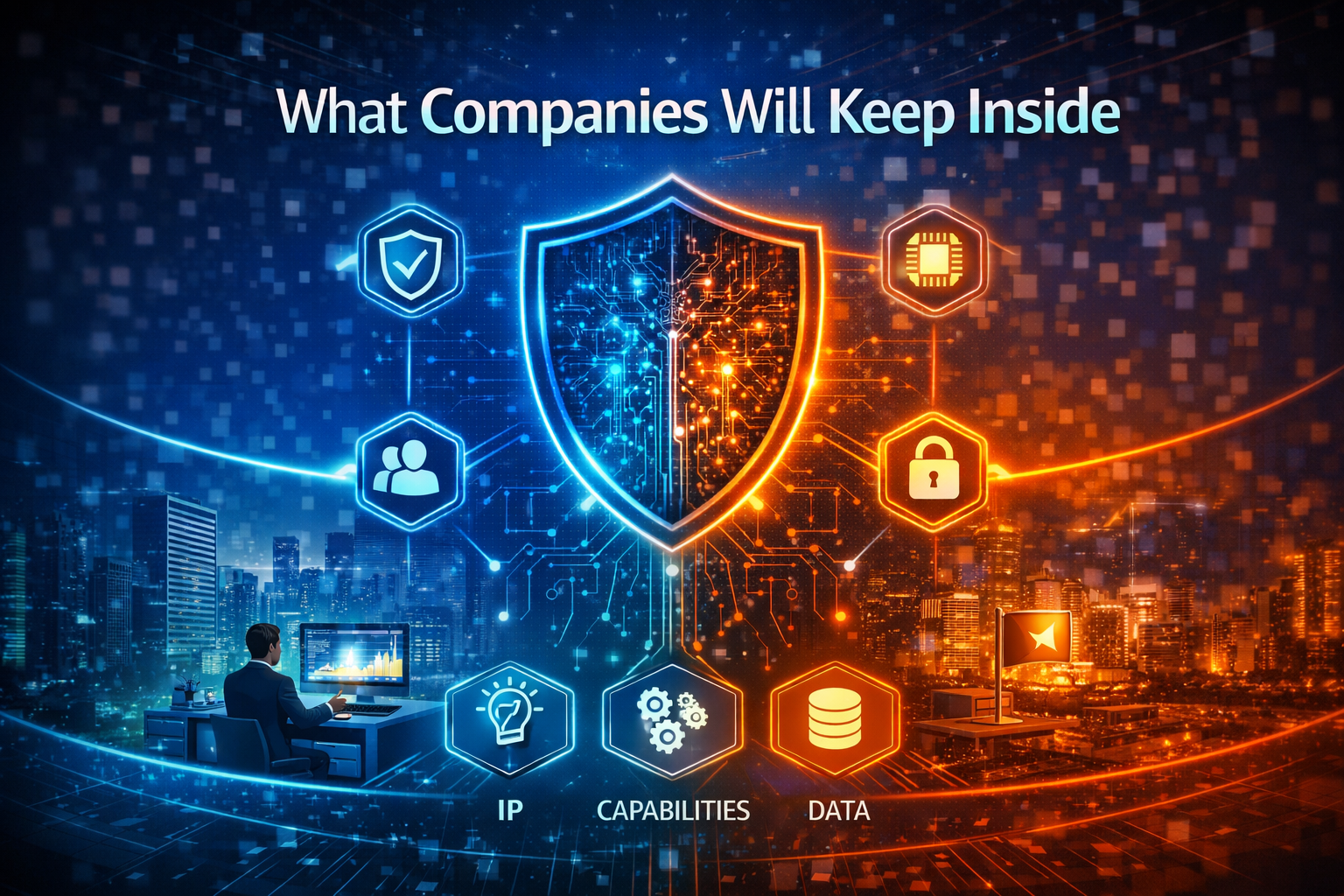
What Companies Will Keep Inside
The first major consequence of this shift is that firms will keep inside those capabilities where representation quality, strategic sensitivity, and authority design matter most.
-
Core Judgment Logic
Not generic foundation models, but the organization’s internal decision logic: pricing philosophy, risk interpretation, escalation rules, exception handling, and strategic trade-offs.
These are not just workflows. They are expressions of institutional intent.
-
Identity and State Systems
As AI acts more on behalf of firms, the value of high-integrity internal state rises. Trusted records of customers, suppliers, assets, liabilities, permissions, and workflow status become strategic.
The OECD AI Principles emphasize the need for inclusive, dynamic, and interoperable digital ecosystems, including mechanisms for safe, fair, legal, and ethical data sharing. (OECD)
-
Delegation Rules
What can an agent do? When must it seek human review? What evidence must it preserve? How are errors reversed?
Delegation logic will become a competitive differentiator.
-
Proprietary Context
The more capable AI becomes, the more valuable proprietary institutional memory becomes: customer nuance, negotiation history, edge-case knowledge, tacit process understanding, and internal feedback loops.
-
Trust and Liability Layers
The NIST AI Risk Management Framework treats governance as a cross-cutting function and organizes risk management around governing, mapping, measuring, and managing AI risk. That is a strong signal that enterprises cannot treat AI as a detached software add-on. They need operating accountability around it. (NIST)
In short, firms will keep inside those things that define how reality is represented, how decisions are authorized, and how responsibility is assigned.
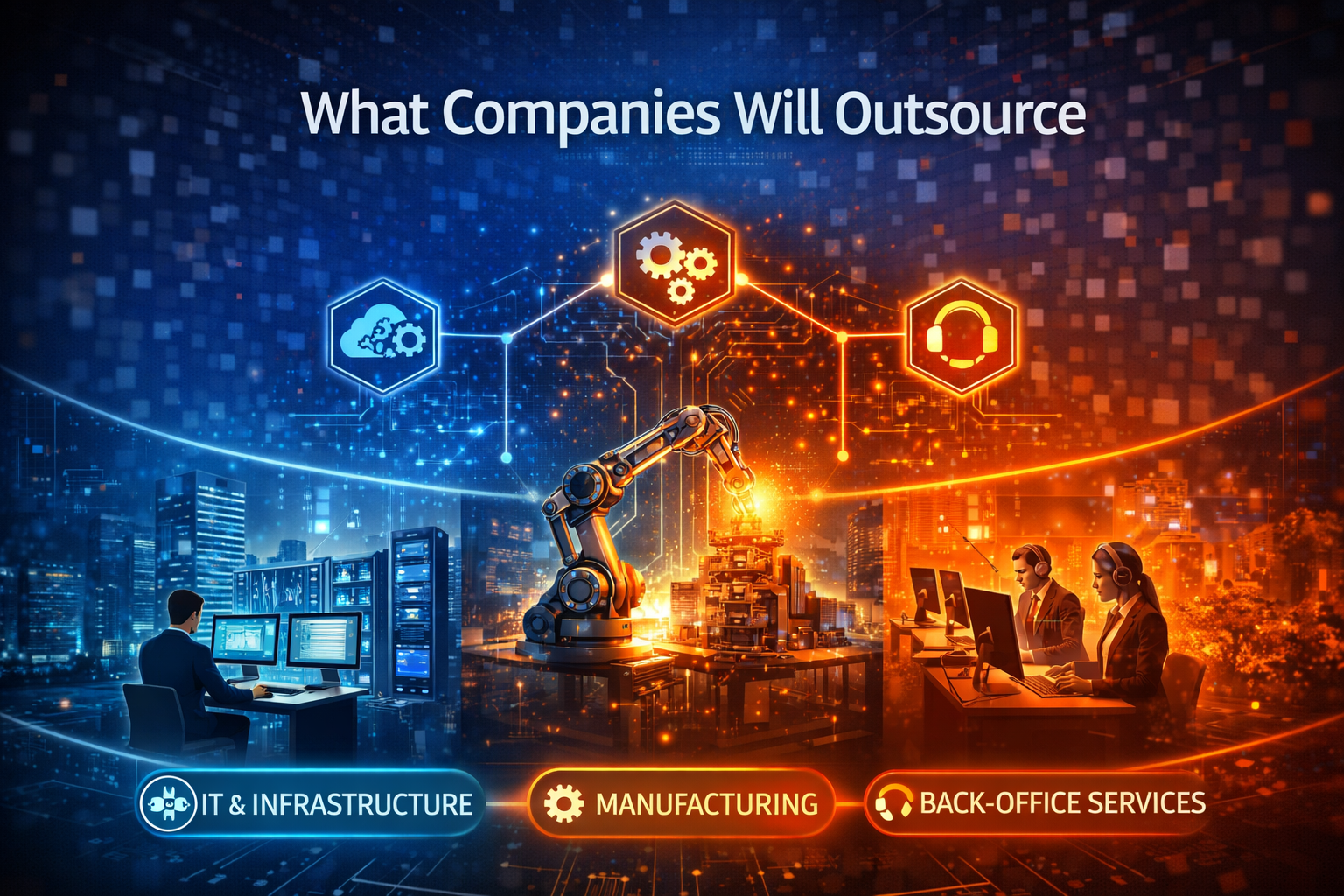
What Companies Will Outsource
At the same time, AI will make it easier to outsource work that is easier to standardize, observe, measure, and connect.
These will often include:
- model infrastructure and inference layers,
- generic copilots for productivity,
- narrow back-office workflows,
- standardized document handling,
- specialist external agents,
- orchestration tooling,
- modular automation services.
Why? Because these capabilities are becoming more connectable and more modular.
Anthropic’s Model Context Protocol is described as an open standard for secure, two-way connections between data sources and AI-powered tools. OpenAI’s Agents SDK and Responses API similarly emphasize easier development of agentic applications with tool use, tracing, and external system connectivity. (Anthropic)
That matters because once intelligence can connect more easily to tools and systems, some parts of the enterprise stop looking like permanent departments and start looking like configurable services.
A procurement function, for example, may keep supplier policy, approval thresholds, and exception governance inside the firm while outsourcing supplier discovery, benchmark research, compliance screening, and document preparation to external tools and specialist agents.
The firm does not outsource judgment entirely. It outsources parts of the machine-readable workflow around judgment.
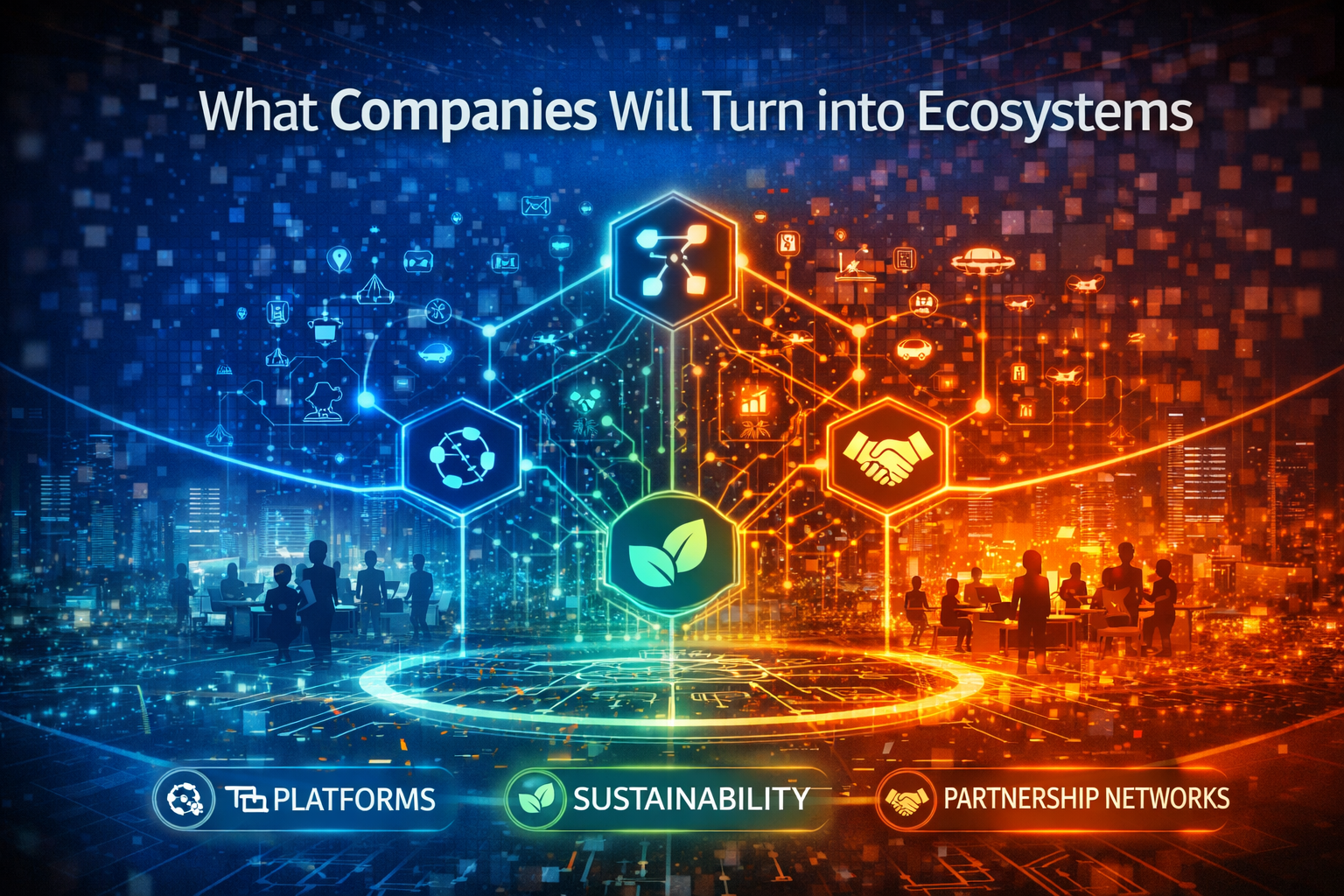
What Companies Will Turn into Ecosystems
The most profound shift may happen in the middle ground.
Some functions will no longer fit neatly into “inside” or “outside.” Instead, they will become ecosystems. In these cases, the firm’s strategic role is not to own every activity. It is to define interfaces, permissions, incentives, protocols, and trusted state exchange.
Think of logistics. No major logistics enterprise owns every vehicle, route, customs step, warehouse action, payment mechanism, and last-mile interaction. Coordination already depends on distributed actors.
In the AI era, this ecosystem logic will expand into more knowledge-intensive domains:
- healthcare coordination,
- trade finance,
- industrial maintenance,
- enterprise procurement,
- software delivery,
- education pathways,
- public services.
The OECD explicitly links trustworthy AI to interoperable ecosystems. The World Economic Forum has similarly argued that AI transformation requires coordinated enablers across business, government, governance, and ecosystem design. (OECD.AI)
That means some of the most important firms of the next decade may not win by owning the whole value chain. They may win by becoming the trusted coordination layer around which the value chain organizes.
In the language of the Representation Economy, they will become the most reliable representation hub in their domain.
The New Strategic Question
For decades, strategy often revolved around a simple question:
Should we make this, buy this, or partner for this?
In the AI era, leaders need a richer set of questions:
- Can this activity be represented clearly enough for machines to participate?
- Can it be governed safely enough for delegation?
- Should it remain proprietary, or should it be opened as a network interface?
- Is the firm’s advantage in doing the work itself, or in defining the state model through which the work is coordinated?
That is a much more powerful lens than old sourcing logic.
A software firm may discover that coding becomes more modular, while architecture, ontology, policy, and release authority become more central. A hospital may automate triage, scheduling, and summarization, while tightening control over patient-state accountability and care authority. A financial institution may automate monitoring and servicing while protecting control over identity, policy interpretation, and approval logic.
This is why the machine-readable boundary of the firm is not a cost-cutting framework. It is a strategic control framework.
Why Incumbents Should Worry
Incumbents often assume AI will favor scale. Sometimes it will. But AI may also expose hidden fragility.
A large organization with fragmented systems, duplicated identities, stale records, weak permissions, disconnected workflows, and inconsistent escalation paths may look powerful on paper. Yet it may be far less machine-readable than a smaller rival designed around cleaner state, better interoperability, and clearer delegation.
That creates a new risk.
Some incumbents may be too complex to coordinate internally and too illegible to expose effectively to AI systems and external ecosystems.
In plain language: they may be too large for old coordination and too messy for new coordination.
Why Startups Should Pay Attention
Startups should not misread this as a story about enterprise disadvantage alone.
The AI era will produce a new class of firms designed from day one around machine-readable operations. These companies will structure entities, permissions, process states, feedback loops, and delegation pathways from the start.
They will not merely use AI. They will be built so that AI can operate inside them with far less friction.
That design advantage may prove more durable than many founders expect. In sectors where coordination complexity is high, the winners may be the firms that make themselves easiest for machines to understand and govern.
The Global Implication
This shift extends beyond corporate design. It has implications for industries, national competitiveness, and institutional trust.
If machine-readable boundaries become economically decisive, then countries and sectors with stronger digital identity systems, interoperable data environments, credible governance frameworks, and safer sharing mechanisms may enable stronger AI ecosystems.
The OECD’s AI Principles stress interoperable ecosystems and trustworthy governance. The World Economic Forum has also highlighted that AI infrastructure and governance must evolve together, and that trustworthy AI ecosystems will be a critical differentiator for safe and scalable deployment. (OECD.AI)
The next global race may not be won only by who has the biggest model. It may also be won by who has the most governable, interoperable, machine-readable institutional environment.
That is a far bigger story than software.
What Boards and CEOs Should Do Next
Boards and executive teams should begin asking a new class of questions.
-
Where is our firm still opaque to machines?
Map the activities that depend on fragmented context, undocumented rules, manual judgment, or disconnected systems.
-
Where does delegation break?
Identify points where AI recommendations cannot safely become action because authority, verification, or recourse is unclear.
-
What must remain proprietary?
Clarify which state models, internal memory layers, and delegation rules are core to competitive advantage.
-
What should become modular?
Decide which activities can be exposed through standardized interfaces and externalized without losing strategic control.
-
Where could we become the ecosystem hub?
Ask where the firm can define the representation layer that others will depend on.
These are not just IT questions. They are board-level strategy questions.
Conclusion: The Boundary Will Be Drawn by Representation
The firm of the future will not be defined only by what it owns. It will be defined by what it can make legible, delegate safely, and coordinate at scale.
That is why the machine-readable boundary of the firm matters.
AI will not simply automate tasks inside today’s organizations. It will reshape the very edge of the organization itself. Some functions will move inward because representation quality, trust, and authority matter too much to let go. Some will move outward because they have become modular and machine-connectable. Others will become ecosystems because no single firm should own the entire chain, yet one firm may still define the representation layer that makes the chain work.
This is the deeper strategic shift of the Representation Economy.
In the industrial era, firms were built to organize labor and assets.
In the software era, firms were built to organize information and workflows.
In the AI era, the most successful firms may be built to organize machine-readable reality.
And once that happens, the boundary of the firm will no longer be drawn only by contracts, departments, or cost curves.
It will be drawn by representation.
FAQ
What is the machine-readable boundary of the firm?
It is the line between activities a company can reliably expose to AI systems and activities that still depend on tacit human judgment, fragmented context, or poorly structured institutional knowledge.
Why does AI change the boundary of the firm?
Because AI requires work to be represented in forms machines can interpret and act on safely. That changes what firms can keep inside, outsource, or coordinate through ecosystems.
What will companies keep inside in the AI era?
They are most likely to keep internal judgment logic, identity and state systems, delegation rules, proprietary context, and trust or liability layers.
What will companies outsource?
They will often outsource modular capabilities such as model infrastructure, generic copilots, narrow automation services, standardized document workflows, and specialist agents.
What does it mean for a firm to become machine-readable?
It means the firm can represent entities, states, permissions, workflows, and outcomes clearly enough for AI systems to reason over and act on them with traceability and control.
Why is governance central to this topic?
Because AI is not only about generating outputs. In enterprises, it increasingly affects decisions and actions. That requires clear authority, verification, accountability, and recourse.
How does this connect to the Representation Economy?
The Representation Economy argues that in the AI era, competitive advantage increasingly depends on how well firms represent reality in machine-usable forms.
Why should boards care?
Because this is not merely an IT issue. It affects sourcing, control, ecosystem power, risk, institutional design, and long-term competitive advantage.
What is the boundary of the firm in the AI era?
The boundary of the firm in the AI era is defined by what can be effectively represented and operated by AI systems, rather than what is owned or controlled.
What will companies keep inside in the AI economy?
Companies will retain proprietary data, core decision systems, and strategic control layers that provide representation advantage.
What functions will companies outsource due to AI?
Standardized, repeatable, and well-represented functions such as infrastructure, support services, and commoditized operations will increasingly be outsourced.
Why will companies become ecosystems?
AI enables coordination across multiple entities, making ecosystems more efficient than vertically integrated firms for many industries.
What is the role of representation in enterprise AI?
Representation determines what AI systems can understand and act upon, making it the key driver of competitive advantage.
How does SENSE–CORE–DRIVER relate to firm boundaries?
It defines how firms capture reality (SENSE), make decisions (CORE), and execute actions (DRIVER), shaping what remains internal vs external.
What is the biggest shift in firm strategy due to AI?
The shift from ownership to orchestration—companies will compete based on how well they coordinate intelligence across systems and partners.
Glossary
Machine-readable boundary of the firm
The strategic line separating work that can be reliably handled with AI participation from work that still requires heavily human, tacit, or politically negotiated coordination.
Representation Economy
An economic lens in which organizations compete increasingly on how well they represent reality in forms that machines can understand, trust, and act upon.
Machine-readable organization
A firm whose entities, states, permissions, workflows, and decisions are structured clearly enough for AI systems to operate within them effectively.
Delegation
The transfer of limited decision or action authority from humans or institutions to AI systems under defined rules and controls.
State representation
A structured description of the current condition of an entity, process, system, or relationship.
Ecosystem strategy
A strategy in which value is created not by owning the whole chain, but by coordinating multiple participants through shared interfaces, trust layers, and rules.
Agentic enterprise
An enterprise in which AI systems do more than assist; they participate in reasoning, coordination, and action across workflows under governance constraints.
Governance
The structures, policies, roles, and control mechanisms that ensure AI systems are used responsibly, lawfully, and in alignment with institutional intent.
Machine-Readable Boundary of the Firm
The dynamic boundary of an organization defined by what AI systems can interpret, optimize, and execute.
Representation Economy
An economic system where value is determined by how effectively entities are represented for machine understanding and coordination.
SENSE Layer
The layer where real-world signals are captured, structured, and made machine-readable.
CORE Layer
The intelligence layer where decisions are made using AI, reasoning systems, and optimization models.
DRIVER Layer
The execution and governance layer ensuring decisions are carried out with accountability, identity, and verification.
Representation Advantage
A firm’s competitive edge derived from superior machine-readable models of its operations, customers, or environment.
AI-Native Firm
An organization designed around machine-readable systems rather than human-only processes.
References and Further Reading
- Stanford HAI, The 2025 AI Index Report — for enterprise AI adoption and generative AI usage trends. (Stanford HAI)
- McKinsey, The State of AI: Global Survey 2025 — for workflow redesign, governance, and characteristics of AI high performers. (McKinsey & Company)
- OECD, AI Principles and Fostering a Digital Ecosystem for AI — for trustworthy AI ecosystems, interoperability, and data-sharing governance. (OECD)
- NIST, AI Risk Management Framework (AI RMF 1.0) — for governance as a cross-cutting function and the govern-map-measure-manage model. (NIST)
- Anthropic, Introducing the Model Context Protocol — for open standards connecting data sources and AI tools. (Anthropic)
- OpenAI, New tools for building agents, Responses API, and Agents SDK — for the growing modularity of agentic application development. (OpenAI)
- World Economic Forum, Advancing AI Transformation and related governance work — for the ecosystem and governance dimensions of AI scaling. (World Economic Forum)
Institutional Perspectives on Enterprise AI
Many of the structural ideas discussed here — intelligence-native operating models, control planes, decision integrity, and accountable autonomy — have also been explored in my institutional perspectives published via Infosys’ Emerging Technology Solutions platform.
For readers seeking deeper operational detail, I have written extensively on:
- What Makes an Enterprise Intelligence-Native? The Blueprint for Third-Order AI Advantage
https://blogs.infosys.com/emerging-technology-solutions/artificial-intelligence/what-is-enterprise-ai-the-operating-model-for-compounding-institutional-intelligence.html - Why “AI in the Enterprise” Is Not Enterprise AI: The Operating Model Difference Most Organizations Miss
https://blogs.infosys.com/emerging-technology-solutions/artificial-intelligence/why-ai-in-the-enterprise-is-not-enterprise-ai-the-operating-model-difference-that-most-organizations-miss.html - The Enterprise AI Control Plane: Governing Autonomy at Scale
https://blogs.infosys.com/emerging-technology-solutions/artificial-intelligence/the-enterprise-ai-control-plane-governing-autonomy-at-scale.html - Enterprise AI Ownership Framework: Who Is Accountable, Who Decides, and Who Stops AI in Production
https://blogs.infosys.com/emerging-technology-solutions/artificial-intelligence/enterprise-ai-ownership-framework-who-is-accountable-who-decides-and-who-stops-ai-in-production.html - Decision Integrity: Why Model Accuracy Is Not Enough in Enterprise AI
https://blogs.infosys.com/emerging-technology-solutions/artificial-intelligence/decision-integrity-why-model-accuracy-is-not-enough-in-enterprise-ai.html - Agent Incident Response Playbook: Operating Autonomous AI Systems Safely at Enterprise Scale
https://blogs.infosys.com/emerging-technology-solutions/artificial-intelligence/agent-incident-response-playbook-operating-autonomous-ai-systems-safely-at-enterprise-scale.html - The Economics of Enterprise AI: Designing Cost, Control, and Value as One System
https://blogs.infosys.com/emerging-technology-solutions/artificial-intelligence/the-economics-of-enterprise-ai-designing-cost-control-and-value-as-one-system.html
Together, these perspectives outline a unified view: Enterprise AI is not a collection of tools. It is a governed operating system for institutional intelligence — where economics, accountability, control, and decision integrity function as a coherent architecture.
Explore the Architecture of the AI Economy
This article is part of a broader research series exploring how institutions are being redesigned for the age of artificial intelligence. Together, these essays examine the structural foundations of the emerging AI economy — from signal infrastructure and representation systems to decision architectures and enterprise operating models.
If you want to explore the deeper framework behind these ideas, the following essays provide additional perspectives:
-
- The Representation Economy: Why the AI Decade Will Be Defined by Who Gets Represented—and Who Designs Trusted Delegation
• Representation Infrastructure: Why the AI Economy Will Be Won by Those Who Make the Invisible Legible
• The Representation Stack: How Reality Becomes Identifiable, Legible, and Actionable in the AI Economy
• Identity Infrastructure: The Missing Layer Between Signals and Representation in the AI Economy
• Why Most AI Projects Fail Before Intelligence Even Begins
• The Intelligence Supply Chain: How Organizations Industrialize Cognition in the AI Economy
- The Silent Systems Doctrine: Why the AI Economy Will Be Won by Those Who Represent What Cannot Speak
- Signal Infrastructure: Why the AI Economy Begins Before the Model – Raktim Singh
- The Representation Economy Explained: 51 Questions About the SENSE–CORE–DRIVER Architecture – Raktim Singh
- The Representation Economy: Why AI Institutions Must Run on SENSE, CORE, and DRIVER – Raktim Singh
- The Representation Economy: Why Intelligent Institutions Will Run on the SENSE–CORE–DRIVER Architecture – Raktim Singh
- The Representation Economy Explained: 51 Questions About the SENSE–CORE–DRIVER Architecture – Raktim Singh
- Representation Debt: Why Institutions Accumulate Hidden AI Risk Long Before Failure Becomes Visible – Raktim Singh
- The Representation Deficit: Why Institutions Fail When Reality Cannot Enter the Decision System – Raktim Singh
- The Representation Maturity Model: How Boards Decide When AI Can Be Trusted With Real Decisions – Raktim Singh
- Representation Capital: The Invisible Asset That Will Decide Which Institutions Win the AI Economy – Raktim Singh
- Representation Failure: Why AI Systems Break When Institutions Misread Reality – Raktim Singh
- The Board’s Representation Strategy: How Intelligent Institutions Decide What Must Be Seen, Modeled, Governed, and Delegated – Raktim Singh
- The Representation Premium: Why Institutions That Are Easier for AI to See, Trust, and Coordinate With Will Win the Next Economy – Raktim Singh
- The Firm of the AI Era Will Be Built Around Representation: Why Institutions Must Redesign Themselves for the SENSE–CORE–DRIVER Economy – Raktim Singh
- The Representation Balance Sheet: How AI Is Redefining Assets, Liabilities, and Institutional Strength – Raktim Singh
- The Representation Stack: The New Architecture of Intelligent Institutions in the AI Economy – Raktim Singh
- Representation Economics: The New Law of Value Creation in the AI Era – Raktim Singh
- The Representation Economy: Why the AI Decade Will Be Defined by Who Gets Represented—and Who Designs Trusted Delegation
Together, these essays outline a central thesis:
The future will belong to institutions that can sense reality, represent it clearly, reason about it intelligently, and act through governed machine systems.
This is why the architecture of the AI era can be understood through three foundational layers:
SENSE → CORE → DRIVER
Where:
- SENSE makes reality legible
- CORE transforms signals into reasoning
- DRIVER ensures that machine action remains accountable, governed, and institutionally legitimate
Signal infrastructure forms the first and most foundational layer of that architecture.
AI Economy Research Series — by Raktim Singh



Raktim Singh is an AI and deep-tech strategist, TEDx speaker, and author focused on helping enterprises navigate the next era of intelligent systems. With experience spanning AI, fintech, quantum computing, and digital transformation, he simplifies complex technology for leaders and builds frameworks that drive responsible, scalable adoption.