

Representation Arbitrage: Executive Summary
Most commentary on AI still treats advantage as a function of model quality, compute scale, or deployment speed. That view is becoming incomplete. As foundational intelligence becomes more accessible, differentiation is moving toward something deeper: who can represent reality in a form machines can reliably use.
That shift creates a new strategic opening: representation arbitrage.
Representation arbitrage is the ability to create value by identifying parts of the world that remain economically important but poorly represented to machines, then turning them into structured, current, governed, and actionable reality.
In finance, that may mean representing the true health of a small business more accurately than legacy credit systems. In healthcare, it may mean creating a consistent longitudinal patient state rather than relying on fragmented records. In supply chains, it may mean transforming paperwork into verifiable machine-readable product history. Across sectors, the same logic is emerging: the winners will not merely think faster. They will see more clearly. (McKinsey & Company)
This is where the representation economy becomes strategically decisive. In the representation economy, value is shaped not only by what exists, but by what can be reliably sensed, modeled, verified, delegated, and acted upon by digital systems.
That is why the SENSE–CORE–DRIVER framework matters. SENSE makes reality legible. CORE reasons over that reality. DRIVER turns decisions into governed action. When companies redesign the SENSE layer before incumbents do, they often create the foundations for an entirely new market position.
The next great AI companies may therefore look like software firms on the surface, but underneath, many will be reality-design firms.
What is Representation Arbitrage?
Representation Arbitrage is the strategic advantage gained by making parts of the real world machine-readable, verifiable, and actionable before others do. It occurs when companies capture and structure reality—entities, states, and relationships—in ways that enable superior AI-driven decisions, while competitors still operate on incomplete or outdated representations.
The Real Shift in AI Advantage
Artificial intelligence is often described as a race for bigger models, lower inference cost, faster chips, and more capable copilots. All of that matters. But it does not fully explain where durable advantage will come from.
McKinsey has argued that the real payoff from generative and agentic AI depends less on generic access to models and more on deep organizational rewiring, proprietary context, and workflow redesign.
NIST’s AI Risk Management Framework similarly emphasizes trustworthiness characteristics such as accountability, transparency, reliability, privacy enhancement, and resilience. Put differently, value is moving away from intelligence alone and toward the quality of the reality that intelligence can safely act upon. (McKinsey & Company)
That is why representation arbitrage matters now.
The next great AI companies will not win simply because they apply a model to industry X. That phrase has already become too generic to be strategically useful.
They will win because they identify a part of the world that incumbents still model poorly, incompletely, too slowly, or in forms that machines cannot trust. They then redesign that slice of reality so it becomes machine-legible and economically actionable.
This is not a marginal improvement. It changes the basis of competition.
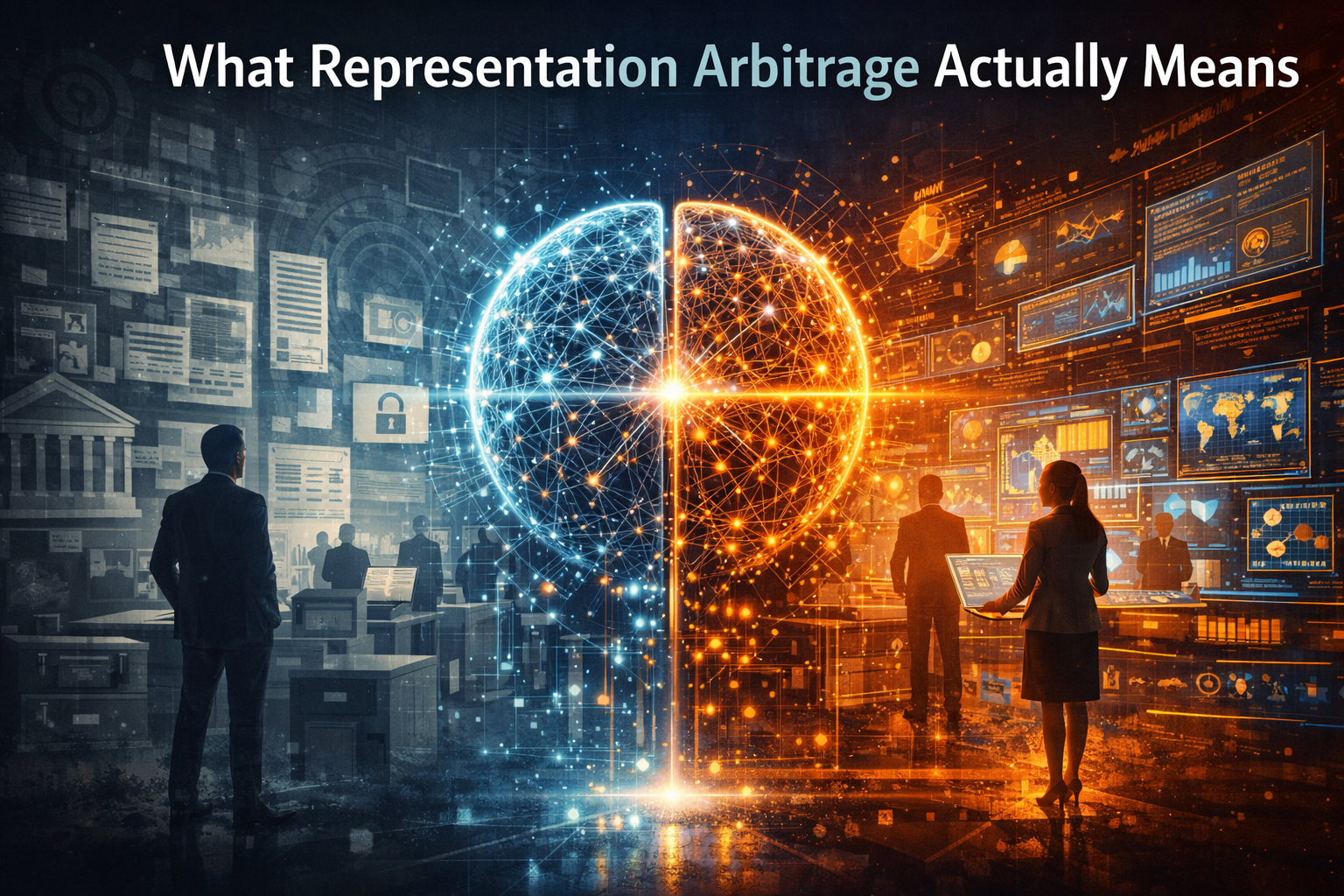
What Representation Arbitrage Actually Means
Classical arbitrage exploits a gap between two prices.
Representation arbitrage exploits a gap between two realities:
- the world as it actually behaves, and
- the world as incumbent institutions currently represent it.
When that gap is wide, markets misprice risk, miss customers, overlook opportunities, waste assets, and make slower or weaker decisions than they should.
The company that closes that gap first does more than improve efficiency. It changes what the market can see.
That is why many breakthrough firms appear to be AI companies, data companies, or workflow companies, but are better understood as representation companies. Their true edge is not a smarter dashboard or a more fluent model. Their edge is a better map of reality.

Why So Much of the Economy Is Still Invisible to Machines
Many industries are digitized, but not deeply represented.
A hospital may have large volumes of data, yet still lack a live, interoperable, semantically consistent patient state. WHO’s global digital health strategy emphasizes both syntactic and semantic interoperability as foundational for modern health systems, and WHO’s standards work highlights interoperable information exchange as essential for safe digital health ecosystems. (World Health Organization)
A supply chain may have records, invoices, and tracking events, yet still lack a trusted, machine-readable history of provenance, composition, condition, and compliance. GS1’s work on EPCIS and trusted certification exchange shows why common identifiers, structured event data, and machine-readable standards are becoming critical to supply-chain visibility and digital product passports. (GS1)
A lender may have transactional data, but still lack a continuously updated, trustworthy representation of the actual health of the borrower or merchant. The World Bank’s work on digital identity and trusted payment ecosystems shows how interoperable digital identity and secure infrastructure reduce friction and strengthen participation in digital finance. (fastpayments.worldbank.org)
These are not small technical gaps. They are structural blind spots. And wherever these blind spots persist, there is room for representation arbitrage.
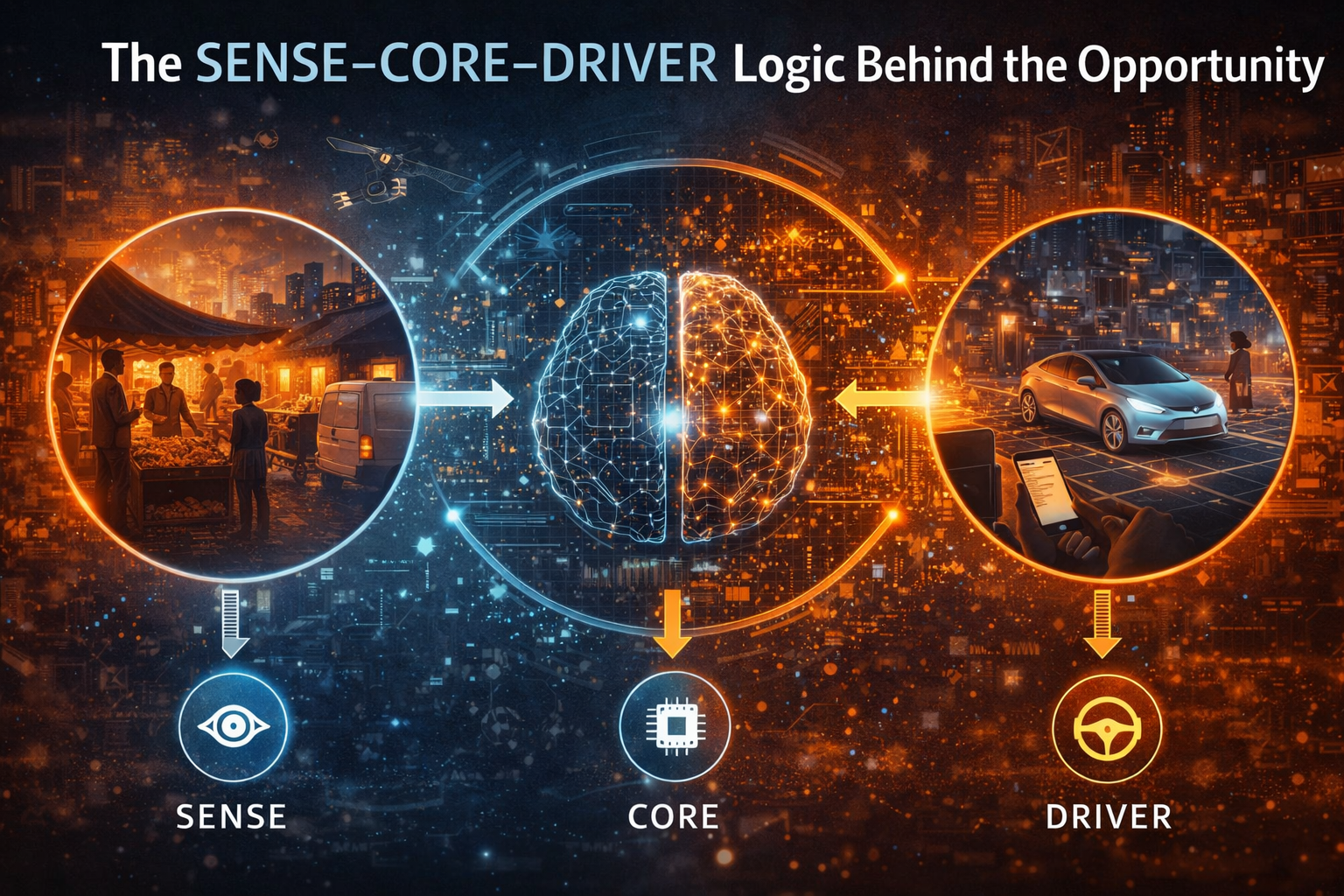
The SENSE–CORE–DRIVER Logic Behind the Opportunity
To understand why this is so powerful, it helps to move beyond the vague language of “data” and “AI” and look at the institutional stack.
SENSE: The Legibility Layer
SENSE is where reality becomes machine-readable.
It answers four questions:
- What signals matter?
- Which entity do those signals belong to?
- What is the current state of that entity?
- How is that state changing over time?
The firm that wins representation arbitrage often starts here. It captures signals incumbents ignore, resolves identity more accurately, maintains fresher state, and updates that state more continuously.
CORE: The Reasoning Layer
CORE is where intelligence operates over representation.
A strong model built on weak representation still produces brittle outcomes. A weaker model operating on cleaner, more current, better-governed representation can often outperform in the real world because it is reasoning over reality rather than over distortion.
DRIVER: The Delegation Layer
DRIVER is where decisions become action.
This is where governance, authority, verification, execution, and recourse matter. If a system cannot establish who is affected, what authority exists, what constraints apply, and what happens if the system is wrong, decision quality does not translate into trusted action.
That is why representation arbitrage is not just a data play. It is a full-stack institutional advantage.
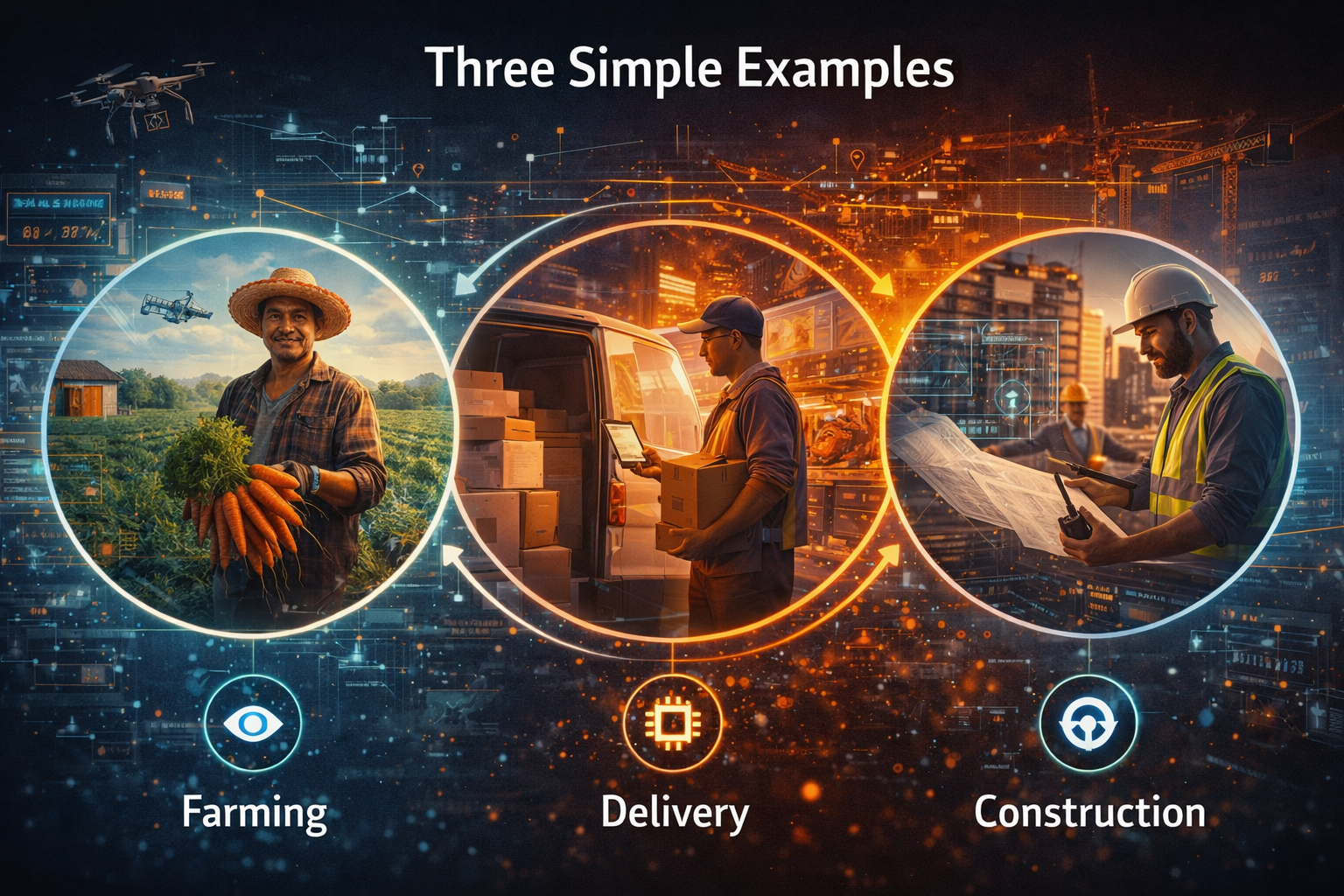
Three Simple Examples
-
Small-Business Finance
Traditional lending often depends on stale statements, narrow bureau data, and broad risk buckets. A challenger that can combine cash-flow patterns, invoicing behavior, tax traces, platform signals, repayment history, and identity-linked business activity can build a much more current representation of the business.
The advantage is not “better AI” in the abstract.
The advantage is a better economic picture of reality.
-
Healthcare Coordination
Many providers still work across fragmented records, disconnected systems, and inconsistent semantics. A company that creates a safer and more consistent longitudinal state for the patient unlocks better triage, care coordination, claims integrity, and resource planning.
The value comes from improving representability before improving prediction.
-
Supply Chain Verification
For years, companies digitized forms without truly digitizing the product’s machine-readable identity and lifecycle. Once provenance, chain-of-custody, composition, and compliance become structured and verifiable, entirely new services emerge: automated sourcing, machine-led compliance, dynamic insurance, sustainability scoring, and better financing.
In all three cases, the breakthrough is the same.
The winner redesigns the representation layer of the market.
Why This Matters More Now Than Before
Three global trends are making representation arbitrage more important.
First, foundational intelligence is becoming more widely available
As models spread through APIs, open ecosystems, and enterprise platforms, basic intelligence becomes more abundant. That pushes differentiation upward into context, governance, workflow design, and proprietary representations of reality. McKinsey’s recent work on agentic AI and AI-enabled transformation reinforces exactly this point: real advantage comes from how organizations embed intelligence into the structure of work, not from access to generic capability alone. (McKinsey & Company)
Second, trust is becoming infrastructure
NIST’s AI RMF centers trustworthiness as a practical design concern, not a public-relations theme. The same pattern is visible across health standards, digital identity, and supply-chain traceability. If reality cannot be attributed, verified, and governed, AI systems become harder to trust, insure, regulate, or scale. (NIST Publications)
Third, interoperability is becoming a growth issue, not just a technical issue
OECD’s recent work on AI, data governance, and privacy emphasizes the need to bridge governance domains that often operate separately. In parallel, international institutions continue to stress that digital trade and digital public infrastructure depend on more coherent digital systems. Representation arbitrage expands wherever interoperability is weak, because weak interoperability leaves economic value trapped behind institutional fragmentation. (OECD)
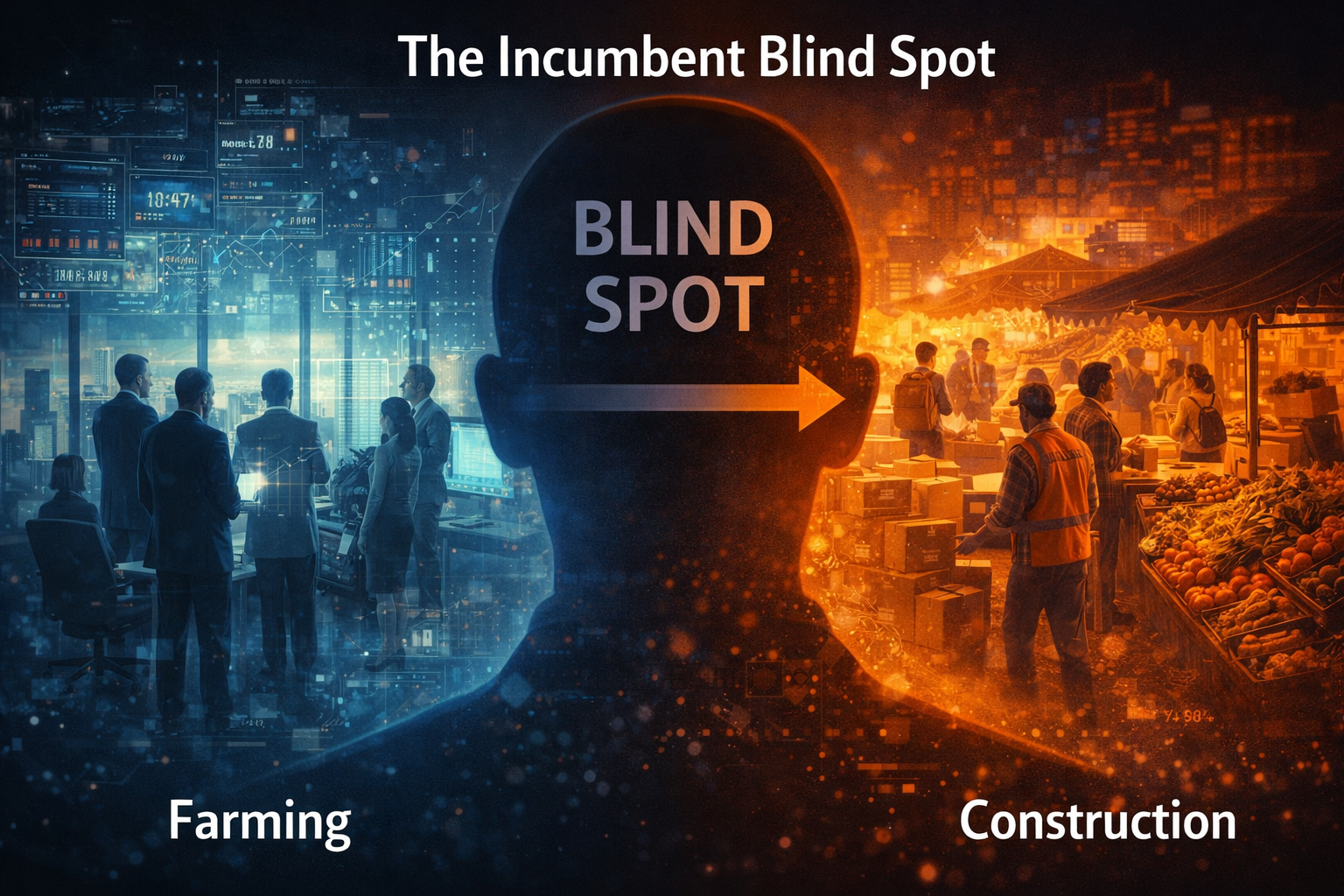
The Incumbent Blind Spot
Incumbents usually think in terms of the systems they already own: ERP, CRM, reports, dashboards, documents, workflows, policies, warehouses, archives.
But many of these systems were built for:
- periodic human review
- manual reconciliation
- siloed accountability
- delayed reporting
- narrow functional control
They were not built for a world in which software agents, AI copilots, procurement engines, compliance systems, and autonomous workflows increasingly need a coherent and current machine-readable view of entities, state, permissions, constraints, and recourse.
This is why a company can be data-rich and still be representation-poor.
A bank may know accounts but not the customer’s true financial state.
A manufacturer may know inventory but not the live condition of each asset.
A retailer may know past sales but not a trustworthy machine-readable history of product authenticity and origin.
A government may have registries but still lack integrated, machine-usable views of identity, eligibility, entitlement, and service history.
This is exactly where challengers enter.
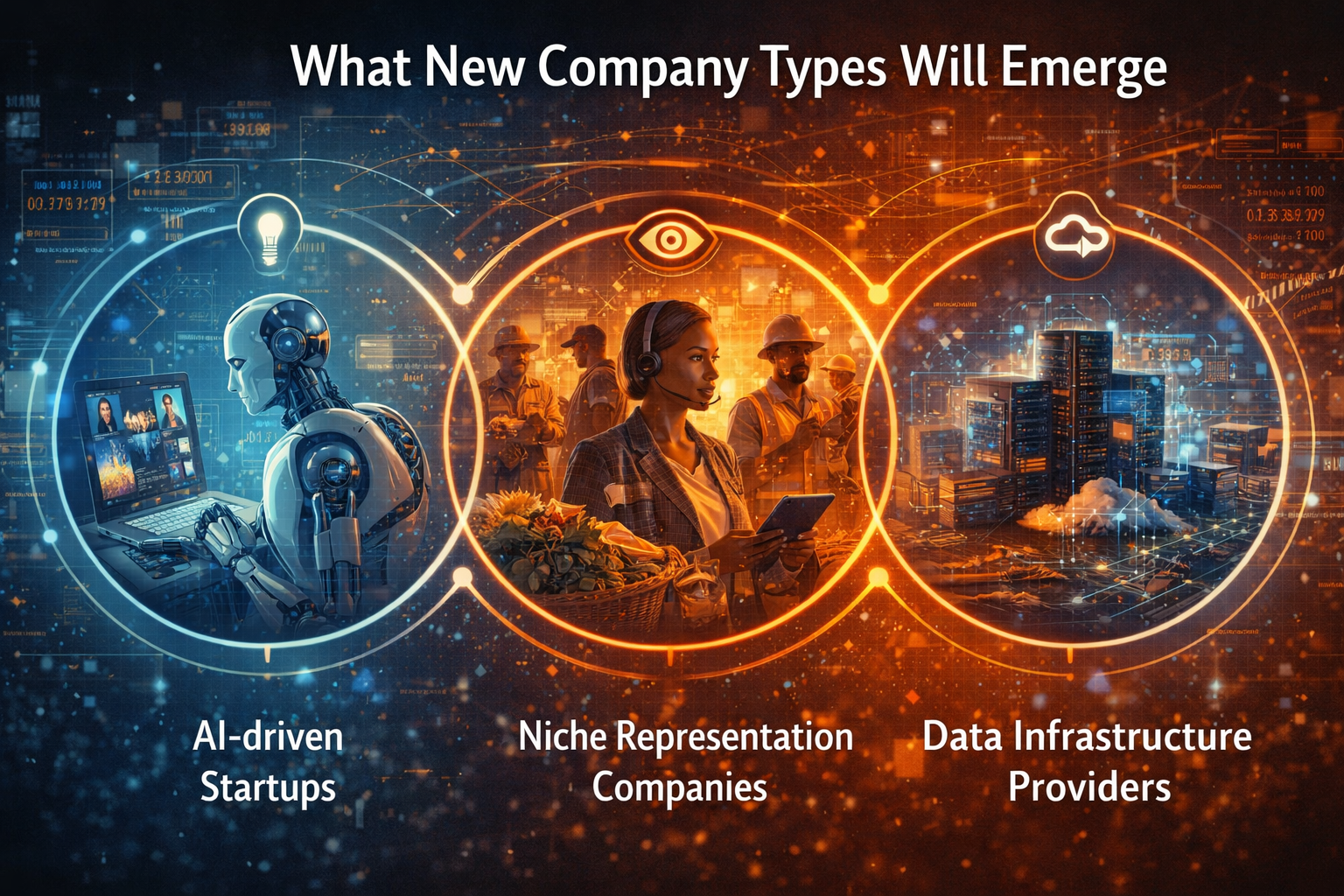
What New Company Types Will Emerge
If representation arbitrage becomes a major source of advantage, we should expect at least four new classes of AI-era firms.
Representation Infrastructure Firms
These firms will build identity resolution, provenance systems, machine-readable compliance layers, digital product passports, state models, and permissioned data-sharing rails.
Representation Intelligence Firms
These firms will continuously update state, reconcile conflicting signals, detect drift, score trustworthiness, and maintain operational reality in forms machines can use.
Representation Assurance Firms
These firms will audit, verify, certify, monitor, and assure the quality of machine-readable reality for downstream AI systems and institutions.
Representation Market Firms
These firms will enable representations to be priced, licensed, exchanged, consumed, and orchestrated across ecosystems.
This is why the next great AI companies may look less like model labs and more like reality infrastructure companies.
Why Boards and Founders Should Care Now
Boards should care because representation arbitrage changes the source of strategic advantage.
The central question is no longer only:
Where can we deploy AI?
It is now:
Where is our market poorly represented today, and can we become the institution that defines the trusted representation layer of that market?
Founders should care because this is where category creation is likely to happen. Thin wrappers around common models may be easy to launch, but the hardest and most valuable businesses will be built by those who capture overlooked signals, attach them to the right entities, keep state current, and make that representation safe enough for action.
In short, many incumbents will think they are competing against a smarter model.
In reality, they may be competing against a better reality map.
Key Takeaways
-
AI advantage is shifting from model capability → representation quality
-
Markets reward companies that make reality machine-readable and trustworthy
-
Representation Arbitrage creates defensible competitive moats
-
The SENSE–CORE–DRIVER framework explains how AI systems see, think, and act
-
The next generation of companies will be reality infrastructure providers
Conclusion: The Companies That Win Will Redesign Visibility
The next great AI companies will not win because they are magical. They will win because they notice that an important part of the world remains economically valuable but institutionally invisible — and then they make it legible.
That is representation arbitrage.
In its earliest form, it looks like better data.
Then it looks like better AI.
Then, suddenly, it becomes something far more consequential: a new market standard for what counts as trustworthy reality.
That is the deeper lesson for boards, founders, and policymakers.
The decisive contest in the AI economy may not be over who owns the biggest model. It may be over who defines the representation layer through which markets, machines, and institutions increasingly see the world.
The real prize is not intelligence alone.
It is the power to determine what machines can reliably see, trust, and act upon.
FAQ
What is representation arbitrage in simple terms?
Representation arbitrage is the ability to create value by making an important part of reality more visible, trustworthy, and usable by machines than incumbents currently can.
How is representation arbitrage different from data advantage?
Data advantage usually means having more data or better proprietary data. Representation arbitrage is broader. It means turning fragmented signals into a coherent, current, governed model of reality that machines can reason over and act upon.
Why does this matter in the AI era?
As model access becomes more widespread, competitive advantage shifts toward context, trust, workflow design, and the representation layer that makes AI reliable in the real world. (McKinsey & Company)
Which industries are most exposed to representation arbitrage?
Finance, healthcare, supply chain, industrial operations, government services, insurance, and workforce systems are especially exposed because they depend on fragmented entities, changing states, trust, and governed action. (World Health Organization)
Can incumbents still win?
Yes, but only if they stop treating AI as a model deployment project and start treating representation as a strategic design problem. Incumbents often have access to rich signal environments. Their challenge is to unify, govern, and modernize those signals into machine-usable representations.
What is the role of SENSE–CORE–DRIVER in this article?
SENSE captures and structures reality. CORE reasons over that structured reality. DRIVER governs action, authority, verification, and recourse. Together, they explain why better representation compounds into better decisions and more trustworthy execution.
Why should board members care?
Because this changes what advantage means. The firms that define the trusted representation layer of a market may shape pricing power, trust, compliance, discoverability, and machine-mediated demand for years.
1. What is Representation Arbitrage in AI?
Representation Arbitrage is the ability to gain competitive advantage by structuring and capturing real-world data in a way that AI systems can use more effectively than competitors.
2. Why is Representation Arbitrage important for AI companies?
Because AI models are becoming commoditized, the real advantage lies in proprietary representations of reality—data that is structured, trusted, and continuously updated.
3. How is Representation Arbitrage different from data advantage?
Data advantage is about volume. Representation Arbitrage is about quality, structure, and usability of reality for machines.
4. What industries will benefit most from Representation Arbitrage?
Finance, healthcare, supply chain, manufacturing, and digital identity ecosystems.
5. How can enterprises build Representation Arbitrage?
By investing in:
-
entity resolution systems
-
real-time state models
-
data governance and trust layers
-
interoperability standards
Glossary
Representation Arbitrage
The strategic advantage created by making hidden, fragmented, or poorly modeled reality machine-readable before incumbents do.
Representation Economy
An economic environment in which value increasingly depends on what can be sensed, modeled, verified, delegated, and acted upon by digital systems.
Machine-Readable Reality
A form of operational, commercial, or institutional reality that software systems can interpret and use consistently.
Machine Legibility
The degree to which an entity, event, asset, state, or rule can be understood and processed by digital systems.
SENSE
The layer that captures signals, links them to entities, models state, and updates reality over time.
CORE
The reasoning layer that interprets and optimizes decisions using structured representations.
DRIVER
The action-and-governance layer that handles delegation, authority, verification, execution, and recourse.
Entity Resolution
The process of determining which signals or records belong to the same real-world entity.
State Model
A structured representation of the current condition of an entity and how it changes over time.
Provenance
The traceable origin and history of data, content, products, or decisions.
Interoperability
The ability of systems to exchange and use information consistently across institutional or technical boundaries.
Representation Layer
The institutional layer that turns messy reality into structured, governed, machine-usable forms.
Reality Infrastructure
The technical and governance systems that make real-world entities, states, and events legible to machines.
SENSE–CORE–DRIVER Framework
A three-layer model of AI systems:
-
SENSE: Captures and structures reality
-
CORE: Interprets and reasons
-
DRIVER: Executes decisions with governance
Representation Infrastructure
Systems that define how reality is captured, structured, verified, and shared across digital ecosystems.
References and Further Reading
- McKinsey on rewiring organizations and agentic AI value creation. (McKinsey & Company)
- NIST AI Risk Management Framework and trustworthiness characteristics. (NIST)
- WHO digital health strategy and interoperability standards. (World Health Organization)
- GS1 standards for traceability, EPCIS, certification exchange, and digital trust in supply chains. (GS1)
- OECD work on AI, data governance, privacy, and digital economy implications. (OECD)
- World Bank work on digital identity, trusted payment ecosystems, and financial inclusion infrastructure. (fastpayments.worldbank.org)
Institutional Perspectives on Enterprise AI
Many of the structural ideas discussed here — intelligence-native operating models, control planes, decision integrity, and accountable autonomy — have also been explored in my institutional perspectives published via Infosys’ Emerging Technology Solutions platform.
For readers seeking deeper operational detail, I have written extensively on:
- What Makes an Enterprise Intelligence-Native? The Blueprint for Third-Order AI Advantage
https://blogs.infosys.com/emerging-technology-solutions/artificial-intelligence/what-is-enterprise-ai-the-operating-model-for-compounding-institutional-intelligence.html - Why “AI in the Enterprise” Is Not Enterprise AI: The Operating Model Difference Most Organizations Miss
https://blogs.infosys.com/emerging-technology-solutions/artificial-intelligence/why-ai-in-the-enterprise-is-not-enterprise-ai-the-operating-model-difference-that-most-organizations-miss.html - The Enterprise AI Control Plane: Governing Autonomy at Scale
https://blogs.infosys.com/emerging-technology-solutions/artificial-intelligence/the-enterprise-ai-control-plane-governing-autonomy-at-scale.html - Enterprise AI Ownership Framework: Who Is Accountable, Who Decides, and Who Stops AI in Production
https://blogs.infosys.com/emerging-technology-solutions/artificial-intelligence/enterprise-ai-ownership-framework-who-is-accountable-who-decides-and-who-stops-ai-in-production.html - Decision Integrity: Why Model Accuracy Is Not Enough in Enterprise AI
https://blogs.infosys.com/emerging-technology-solutions/artificial-intelligence/decision-integrity-why-model-accuracy-is-not-enough-in-enterprise-ai.html - Agent Incident Response Playbook: Operating Autonomous AI Systems Safely at Enterprise Scale
https://blogs.infosys.com/emerging-technology-solutions/artificial-intelligence/agent-incident-response-playbook-operating-autonomous-ai-systems-safely-at-enterprise-scale.html - The Economics of Enterprise AI: Designing Cost, Control, and Value as One System
https://blogs.infosys.com/emerging-technology-solutions/artificial-intelligence/the-economics-of-enterprise-ai-designing-cost-control-and-value-as-one-system.html
Together, these perspectives outline a unified view: Enterprise AI is not a collection of tools. It is a governed operating system for institutional intelligence — where economics, accountability, control, and decision integrity function as a coherent architecture.
Explore the Architecture of the AI Economy
This article is part of a broader research series exploring how institutions are being redesigned for the age of artificial intelligence. Together, these essays examine the structural foundations of the emerging AI economy — from signal infrastructure and representation systems to decision architectures and enterprise operating models.
If you want to explore the deeper framework behind these ideas, the following essays provide additional perspectives:
-
- • Why Most AI Projects Fail Before Intelligence Even Begins
• The Intelligence Supply Chain: How Organizations Industrialize Cognition in the AI Economy
- The Silent Systems Doctrine: Why the AI Economy Will Be Won by Those Who Represent What Cannot Speak
- Signal Infrastructure: Why the AI Economy Begins Before the Model – Raktim Singh
- The Representation Economy Explained: 51 Questions About the SENSE–CORE–DRIVER Architecture – Raktim Singh
- The Representation Economy: Why AI Institutions Must Run on SENSE, CORE, and DRIVER – Raktim Singh
- The Representation Economy: Why Intelligent Institutions Will Run on the SENSE–CORE–DRIVER Architecture – Raktim Singh
- The Representation Economy Explained: 51 Questions About the SENSE–CORE–DRIVER Architecture – Raktim Singh
- Representation Debt: Why Institutions Accumulate Hidden AI Risk Long Before Failure Becomes Visible – Raktim Singh
- The Representation Deficit: Why Institutions Fail When Reality Cannot Enter the Decision System – Raktim Singh
- The Representation Maturity Model: How Boards Decide When AI Can Be Trusted With Real Decisions – Raktim Singh
- Representation Capital: The Invisible Asset That Will Decide Which Institutions Win the AI Economy – Raktim Singh
- Representation Failure: Why AI Systems Break When Institutions Misread Reality – Raktim Singh
- The Board’s Representation Strategy: How Intelligent Institutions Decide What Must Be Seen, Modeled, Governed, and Delegated – Raktim Singh
- The Representation Premium: Why Institutions That Are Easier for AI to See, Trust, and Coordinate With Will Win the Next Economy – Raktim Singh
- The Firm of the AI Era Will Be Built Around Representation: Why Institutions Must Redesign Themselves for the SENSE–CORE–DRIVER Economy – Raktim Singh
- The Representation Balance Sheet: How AI Is Redefining Assets, Liabilities, and Institutional Strength – Raktim Singh
- The Representation Stack: The New Architecture of Intelligent Institutions in the AI Economy – Raktim Singh
- Representation Economics: The New Law of Value Creation in the AI Era – Raktim Singh
- The Representation Reserve Currency: Why AI Will Trust Only a Few Forms of Reality – Raktim Singh
- The Machine-Readable Boundary of the Firm: How AI Is Redefining What Companies Own, Outsource, and Orchestrate – Raktim Singh
- Representation Insurance: Why Machine-Readable Trust Will Power the AI Economy – Raktim Singh
- • Why Most AI Projects Fail Before Intelligence Even Begins
Together, these essays outline a central thesis:
The future will belong to institutions that can sense reality, represent it clearly, reason about it intelligently, and act through governed machine systems.
This is why the architecture of the AI era can be understood through three foundational layers:
SENSE → CORE → DRIVER
Where:
- SENSE makes reality legible
- CORE transforms signals into reasoning
- DRIVER ensures that machine action remains accountable, governed, and institutionally legitimate
Signal infrastructure forms the first and most foundational layer of that architecture.
AI Economy Research Series — by Raktim Singh



Raktim Singh is an AI and deep-tech strategist, TEDx speaker, and author focused on helping enterprises navigate the next era of intelligent systems. With experience spanning AI, fintech, quantum computing, and digital transformation, he simplifies complex technology for leaders and builds frameworks that drive responsible, scalable adoption.