
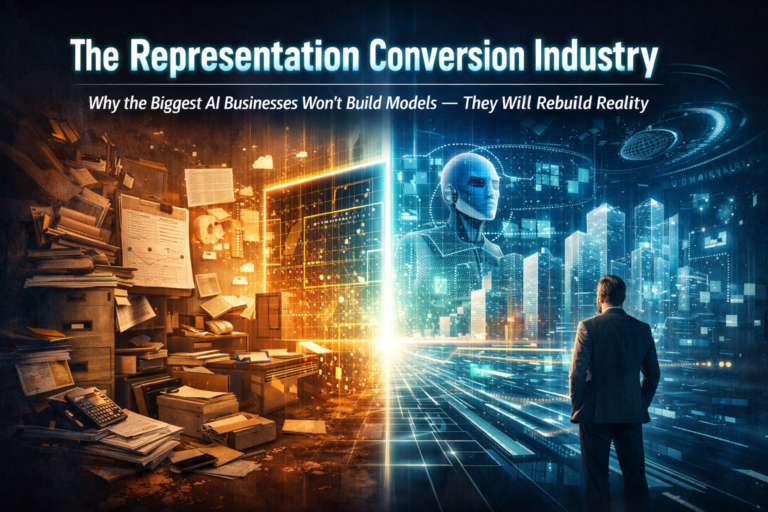
The larger commercial opportunity may lie elsewhere.
The next great AI businesses may not be the ones that create the most intelligence. They may be the ones that do the harder job first: turning messy reality into something intelligence can actually use.
That is the heart of what I call the Representation Conversion Industry.
This industry will not sell AI magic. It will sell something far more foundational: the conversion of fragmented, ambiguous, stale, and poorly structured reality into machine-usable institutional infrastructure.
In practical terms, it will take the world as it exists — paper forms, PDFs, scanned records, scattered spreadsheets, voice calls, field notes, disconnected sensors, inconsistent identifiers, undocumented processes, weak provenance, and tacit human judgment — and rebuild it into systems that AI can identify, reason over, govern, and act through.
That sounds technical. It is. But it is also economic.
In the AI era, value will not flow first to whoever has the best model. It will flow to whoever makes reality easier to represent, trust, and operationalize. That is why the Representation Conversion Industry may become one of the most important business categories of the decade.
This broader pattern is already visible. McKinsey’s March 2025 global survey found that while AI use is spreading, the strongest value comes from rewiring how organizations run, especially through workflow redesign, governance, and operating discipline rather than model access alone. NIST’s AI Risk Management Framework likewise treats trustworthy AI as a system challenge involving governance, mapping, measurement, and management, not just model quality. (McKinsey & Company)
What is the Representation Conversion Industry?
The Representation Conversion Industry is the emerging sector that converts real-world complexity—documents, workflows, identities, and systems—into structured, machine-readable formats that AI can reliably use for decision-making and automation.
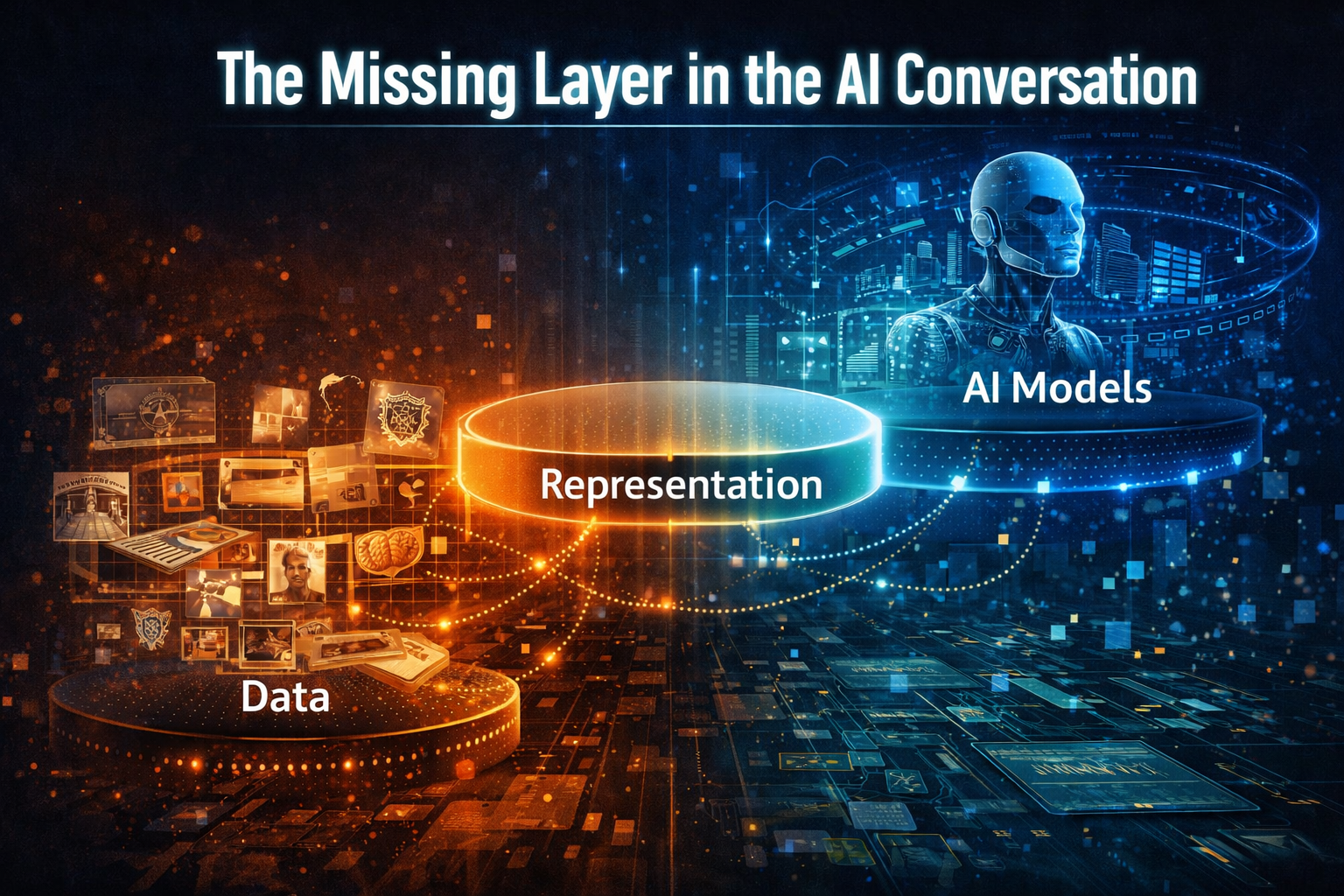
The missing layer in the AI conversation
Most AI commentary is still obsessed with what I describe as CORE.
In my SENSE–CORE–DRIVER framework:
SENSE: the legibility layer
This is where reality becomes machine-readable through:
- signal capture
- entity identification
- state representation
- continuous updating over time
CORE: the cognition layer
This is where systems:
- comprehend context
- optimize decisions
- reason over alternatives
- evolve through feedback
DRIVER: the legitimacy layer
This is where action becomes governable through:
- delegation
- representation
- identity
- verification
- execution
- recourse
Most of today’s AI market remains concentrated in CORE. But the world is still deeply underbuilt in SENSE and DRIVER.
That gap is enormous, and it is where the Representation Conversion Industry emerges.
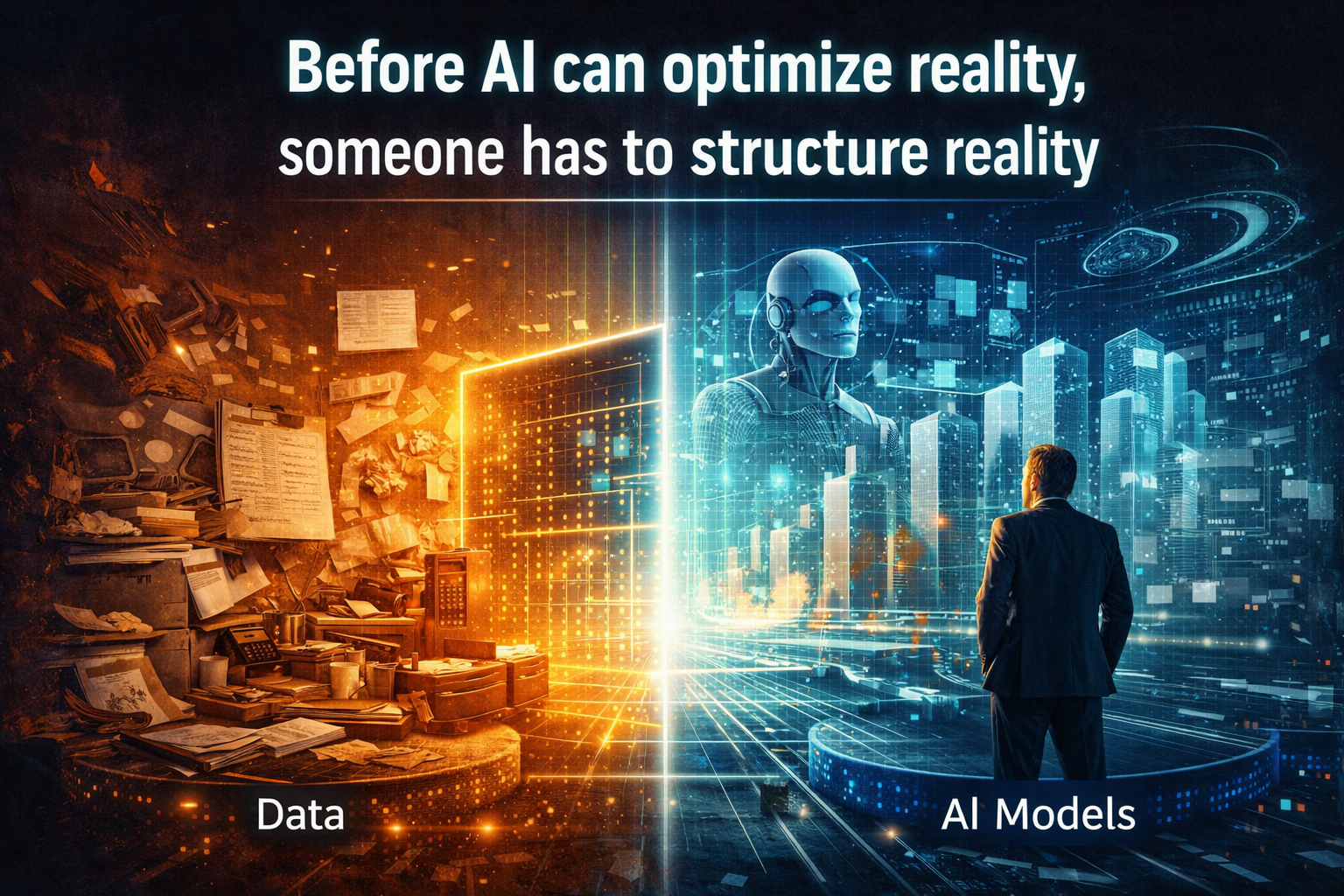
Before AI can optimize reality, someone has to structure reality
This is the central insight.
Before AI can improve decisions, it needs a usable version of the world. Before agents can act, they need structured entities, current states, trusted links, permissions, thresholds, and auditability. Before autonomy can scale, institutions need legibility.
Take a hospital. Its doctors may be excellent. Its care may be effective. But if patient history is scattered across free-text notes, scanned files, incompatible systems, departmental silos, and ambiguous identifiers, the institution is not truly machine-ready.
An AI system may summarize a chart beautifully while still missing the most important fact because that fact never entered the system in a clean, linked, current, machine-usable form.
Take a supply chain. A manufacturer may have advanced planning software, but if supplier identities are inconsistent, shipment events arrive late, inventory states are only partially digitized, and quality incidents are buried in email threads, AI will not see the network as it exists. It will see a partial shadow of it.
Take a government service. A citizen may appear in many databases, but if those records cannot be securely linked, verified, updated, and governed, intelligent public services will remain brittle. This is one reason digital public infrastructure has become so important globally: the World Bank defines DPI as foundational digital building blocks for the public benefit, such as digital identity, digital payments, and data sharing, which can be reused across sectors and services. (Open Knowledge Repository)
That is why the Representation Conversion Industry matters.
It exists to do the hard work that most AI narratives skip: not creating intelligence first, but converting reality into something intelligence can safely use.
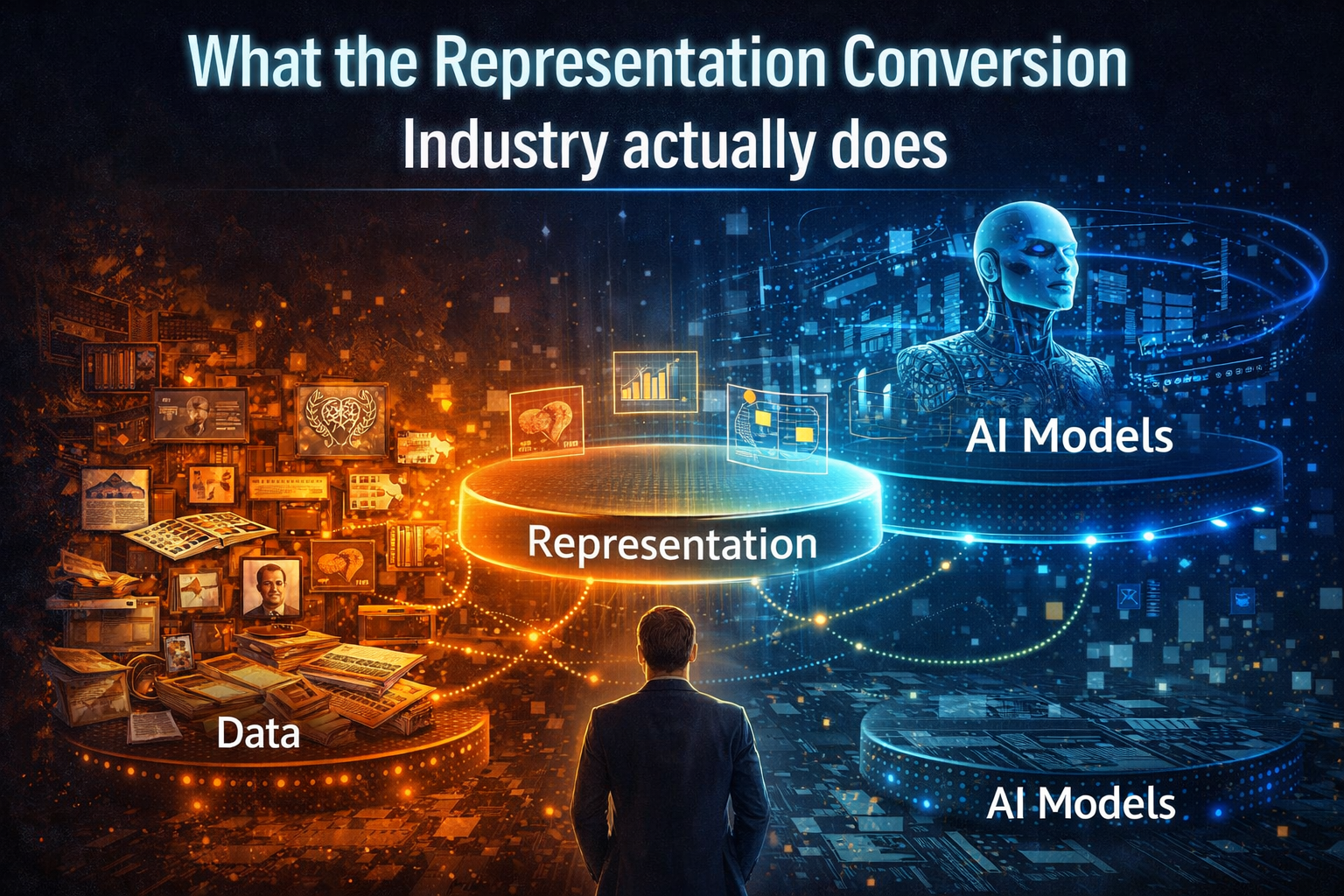
What the Representation Conversion Industry actually does
At its core, this industry performs five kinds of work.
-
Signal capture
It ingests the raw traces of reality: documents, forms, images, operational logs, workflow events, messages, telemetry, and sensor feeds.
-
Entity resolution
It determines when multiple records refer to the same real-world thing. This is one of the most underestimated tasks in the AI economy. A machine cannot reason properly about “the same supplier,” “the same patient,” “the same product,” or “the same contract” if the institution itself cannot reliably unify those references.
-
State representation
It turns isolated events into an updated model of what is true now. Not what was true last month. Not what someone manually reconciled last week. What is true now.
-
Provenance and validation
It makes truth more defensible by attaching lineage, verification, confidence, and change history. In digital media, for example, the C2PA standard for Content Credentials is designed to make source and history more traceable and verifiable. That is not just a media issue. It is an early signal of a broader economic need: machine-usable provenance. (C2PA)
-
Delegation readiness
It connects representation to governance. That includes permissions, thresholds, escalation paths, audit trails, and recourse. Without this, a system may “know” something but still cannot act responsibly.
Put simply, the Representation Conversion Industry does not merely clean data. It manufactures institutional legibility.
That phrase matters. Data cleaning sounds tactical. Institutional legibility sounds strategic — because it is.
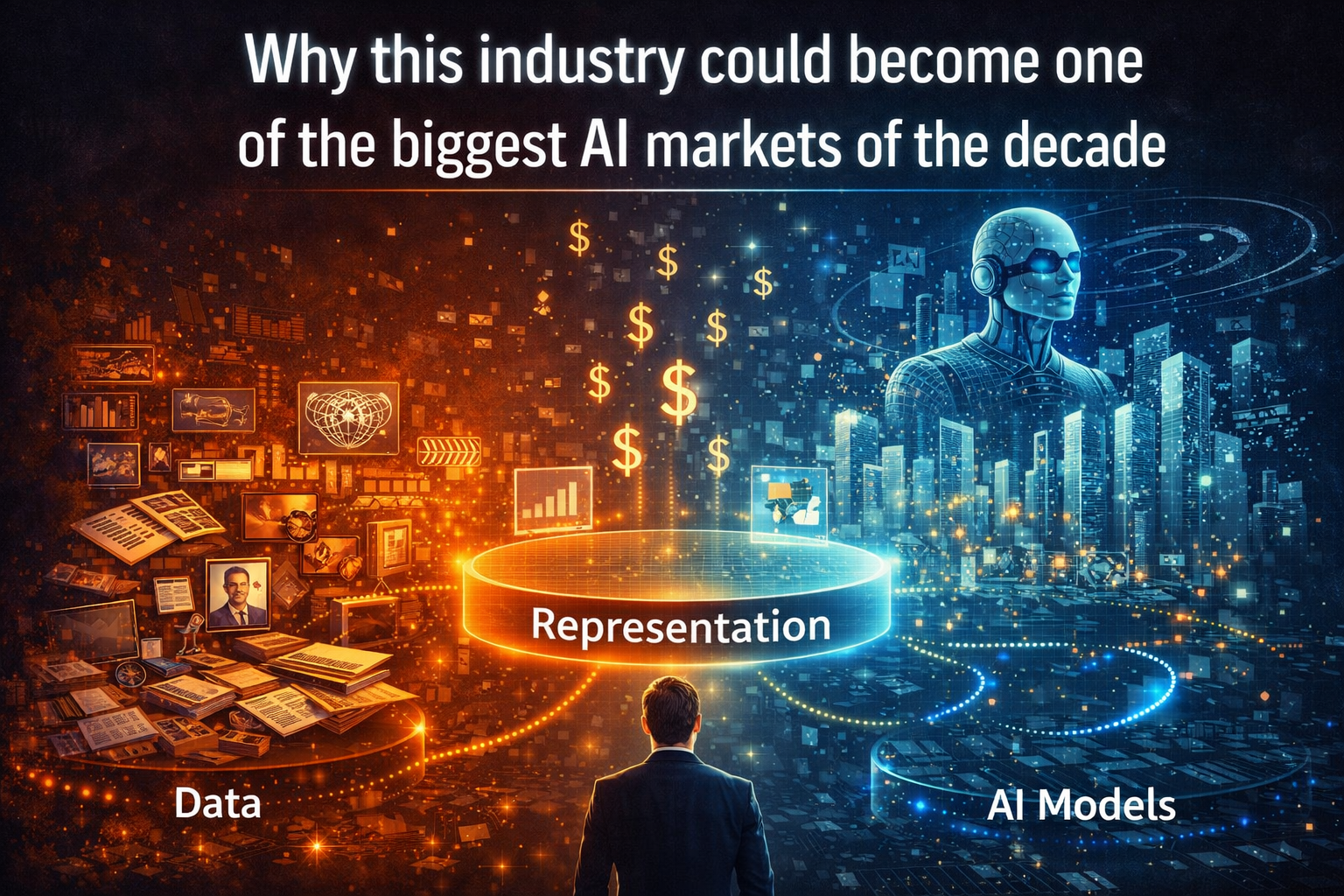
Why this industry could become one of the biggest AI markets of the decade
There are three reasons.
First, the world is still messy
Enterprise systems, public systems, and physical systems were not designed for autonomous machine coordination. They were built for humans, departments, and limited software integration. AI raises the required quality of representation dramatically. A chatbot can tolerate ambiguity. A decision system cannot. An acting agent cannot. A multi-agent enterprise certainly cannot.
Second, trust is becoming architectural
The OECD has explicitly noted that AI and privacy policy communities often work in silos, even though real-world deployment requires them to be connected. That means institutions will increasingly need operating capabilities that unify representation, governance, privacy, and accountability instead of treating them as separate layers. (OECD)
Third, AI is moving from answering to acting
As systems move from generating responses to triggering workflows, approvals, purchases, interventions, and compliance decisions, representation quality stops being a back-office issue. It becomes the difference between scalable autonomy and expensive failure. NIST’s AI RMF and GenAI profile reinforce exactly this point: risk emerges not only from outputs, but from context, governance, oversight, and downstream effects. (NIST Publications)
This is why the biggest AI businesses may look less like model companies and more like reality conversion companies.
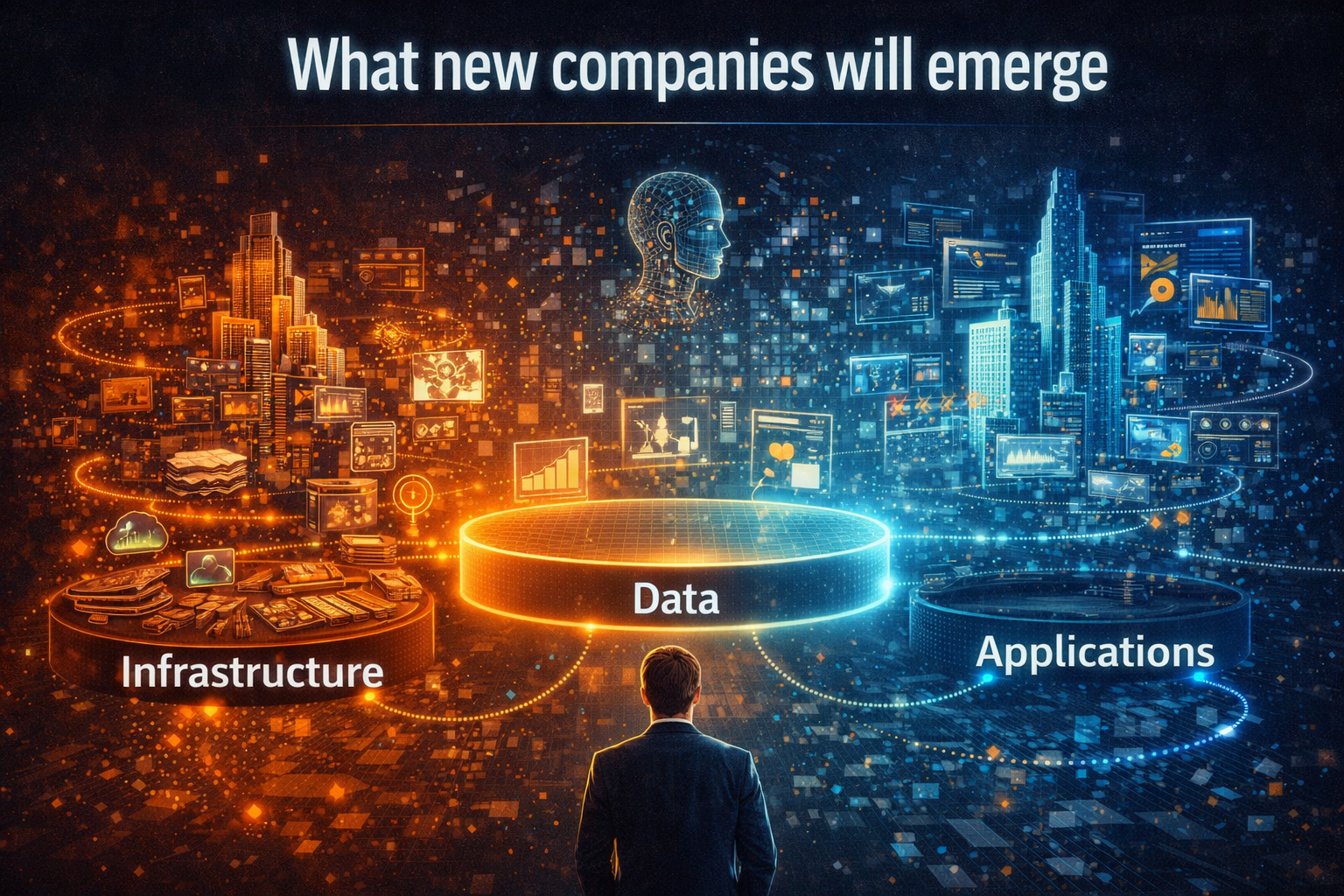
What new companies will emerge
A new market stack is forming underneath the visible AI race.
Industry-specific representation converters
These firms will rebuild messy sectors such as healthcare, banking, insurance, logistics, manufacturing, retail, public services, and agriculture into machine-usable operating systems.
Identity and entity infrastructure firms
These companies will solve a deceptively hard question: who or what is the system actually talking about right now?
Digital twin and state infrastructure providers
ISO’s digital twin standards show how structured digital representations of observable elements can support synchronized, updatable operational understanding. Over time, digital twins will extend beyond manufacturing into broader economic infrastructure. (ISO)
Provenance and validation layers
These firms will provide trust infrastructure for content, transactions, workflows, and institutional evidence.
Delegation-readiness platforms
These businesses will connect representation to policy, verification, identity, and recourse so intelligent systems can act safely in real environments.
Together, these players form a new stack.
Not the model stack.
The representation stack.
Why existing companies should care immediately
Many incumbents are sitting on valuable reality that is economically underrepresented.
A bank may have decades of customer relationships but weak machine-usable context.
A manufacturer may have deep process knowledge but poor real-time state visibility.
A retailer may have rich demand signals but inconsistent product truth.
A city may have records but no unified representation of people, assets, entitlements, and service events.
In the old economy, institutions could survive with fragmented visibility because humans filled the gaps. In the AI economy, those gaps become structural disadvantages.
The danger is not only inefficiency. It is substitution.
If your company cannot represent suppliers well, a better-represented marketplace may insert itself between you and your suppliers.
If your hospital cannot represent patient pathways well, a better-structured care platform may intermediate coordination.
If your logistics network cannot represent status and risk well, an external orchestration layer may become the real decision-maker.
That is why the Representation Conversion Industry is not just a startup opportunity. It is also an incumbent survival issue.
The deeper strategic shift: from intelligence advantage to reality advantage
The easiest way to misunderstand AI strategy is to assume the model is the business.
It rarely is.
In SENSE–CORE–DRIVER terms, most visible market excitement still sits in CORE. But durable advantage often comes from the layers around it.
If SENSE is weak, the system reasons over distortions.
If DRIVER is weak, the system cannot act legitimately.
If both are weak, more intelligence often amplifies error instead of reducing it.
That is why the Representation Conversion Industry matters so much. It strengthens SENSE by making reality legible. It strengthens DRIVER by making action governable. In doing so, it turns generic intelligence into institution-specific value.
And this is why it compounds.
Once reality is captured, structured, validated, and connected to governed action, many downstream capabilities become easier: forecasting, compliance, copilots, automation, negotiation, optimization, audit, orchestration, and autonomous workflow execution. The first use case may look narrow. The infrastructure it creates is not.
What boards and C-suites should do now
The old AI question was:
Who has the smartest model?
The more important question is becoming:
Who has rebuilt enough of reality that smart models can safely create value?
That is a very different competition.
It changes what boards should fund.
It changes what CIOs should modernize.
It changes what entrepreneurs should build.
It changes what regulators should notice.
It changes what “AI readiness” actually means.
For boards and C-suites, the implication is clear: AI strategy cannot stop at model adoption. It must include representation strategy.
That means asking:
- Where is our reality still trapped in PDFs, spreadsheets, field memory, fragmented systems, and unlinked records?
- Which entities do we still fail to identify consistently?
- Where are our state representations stale, partial, or unverifiable?
- Which decisions are blocked not by lack of intelligence, but by lack of trustworthy institutional legibility?
- Where do we need DRIVER capabilities before we scale action?
These are not technical clean-up questions. They are competitive questions.
Conclusion: the biggest AI businesses may rebuild reality first
We are entering a phase of the AI economy where intelligence is becoming more available, but usable reality is still scarce.
That scarcity will create a new industry.
The companies that win the next decade will not only train models, deploy agents, or launch copilots. Some of the most important among them will do something more consequential: they will rebuild reality so machines can finally work with it.
That is not a supporting industry.
That is one of the main industries of the AI era.
If you want durable advantage in the AI economy, do not ask only where intelligence is improving.
Ask where reality is still waiting to be converted.
Glossary
Representation Conversion Industry
The emerging business category focused on turning fragmented, messy, and poorly structured reality into machine-usable institutional infrastructure.
Representation Economics
A framework for understanding how value in the AI era increasingly depends on what can be represented, trusted, and acted upon by machines.
Machine-readable reality
A structured version of the world that software and AI systems can identify, interpret, and use reliably.
Institutional legibility
The degree to which an institution’s operations, entities, processes, and states are visible and understandable to machine systems.
Entity resolution
The process of determining when multiple records refer to the same real-world entity, such as a person, supplier, asset, or contract.
State representation
A structured model of the current condition of an entity, system, or process.
Provenance
Documented information about the origin, history, and changes associated with content, data, or a decision trace.
Digital twin
A digital representation of an observable physical or operational element, updated over time to reflect changing reality.
SENSE
The legibility layer where signals are captured, entities identified, states represented, and reality continuously updated.
CORE
The cognition layer where systems interpret context, reason, optimize, and generate decisions.
DRIVER
The legitimacy layer where authority, identity, verification, execution, and recourse make intelligent action governable.
FAQ
Why is this industry important for AI?
Because AI systems do not operate on reality directly. They operate on representations of reality. If those representations are incomplete, stale, or untrustworthy, even advanced AI systems underperform or fail.
How is this different from data cleaning?
Data cleaning is usually a narrow operational task. Representation conversion is broader. It includes signal capture, entity resolution, state representation, provenance, governance, and delegation readiness.
What kinds of companies will emerge in this space?
Industry-specific converters, entity infrastructure firms, digital twin providers, provenance and validation platforms, and delegation-readiness infrastructure companies.
Why should boards care about representation conversion?
Because competitive advantage in AI increasingly depends not only on intelligence, but on whether the institution has rebuilt enough of reality for intelligence to create trustworthy value.
How does this relate to SENSE–CORE–DRIVER?
Representation conversion primarily strengthens SENSE and DRIVER. It makes reality legible and action governable, which allows CORE to deliver institution-specific value more safely and at greater scale.
Is this relevant only for large enterprises?
No. It matters for enterprises, governments, startups, supply chains, healthcare systems, and any organization that wants to move from isolated AI use cases to durable operational advantage.
What is the biggest mistake leaders make here?
Treating model access as the core strategic question while ignoring the harder work of representation, governance, and operating architecture.
Q1. What is the Representation Conversion Industry?
A: It is the industry focused on converting messy real-world data into structured, machine-usable systems for AI.
Q2. Why is representation important in AI?
A: AI systems depend on structured representations of reality. Without it, even advanced models fail to deliver reliable outcomes.
Q3. What problems does this industry solve?
A: It solves fragmented data, inconsistent identities, lack of real-time state, weak governance, and unstructured workflows.
Q4. What companies will emerge in this space?
A: Data structuring platforms, digital twin companies, entity resolution systems, AI governance platforms, and representation infrastructure providers.
Q5. Why should enterprises invest in this now?
A: Because AI advantage will shift from model access to representation quality and institutional legibility.
References and further reading
For credibility with both human readers and answer engines, place this section at the end of the article.
- McKinsey, The State of AI: How Organizations Are Rewiring to Capture Value (March 12, 2025), on workflow redesign, governance, and scaled AI value. (McKinsey & Company)
- NIST, AI Risk Management Framework (AI RMF 1.0), on trustworthy AI as a governance and system challenge. (NIST Publications)
- NIST, Generative AI Profile, extending risk management guidance to generative AI systems. (NIST Publications)
- OECD, AI, Data Governance and Privacy, on connecting AI, data, and privacy policy rather than treating them as separate silos. (OECD)
- World Bank, Digital Public Infrastructure and Development, on foundational digital building blocks for the public benefit. (Open Knowledge Repository)
- C2PA, Content Credentials Specification, on provenance and authenticity signals for digital content. (C2PA)
- ISO 23247 and related digital twin standards, on frameworks for digital representation and synchronization in manufacturing. (ISO)
Explore the Architecture of the AI Economy
This article is part of a broader research series exploring how institutions are being redesigned for the age of artificial intelligence. Together, these essays examine the structural foundations of the emerging AI economy — from signal infrastructure and representation systems to decision architectures and enterprise operating models.
If you want to explore the deeper framework behind these ideas, the following essays provide additional perspectives:
-
- • Why Most AI Projects Fail Before Intelligence Even Begins
- The Representation Economy: Why AI Institutions Must Run on SENSE, CORE, and DRIVER – Raktim Singh
- The Representation Economy: Why Intelligent Institutions Will Run on the SENSE–CORE–DRIVER Architecture – Raktim Singh
- The Representation Economy Explained: 51 Questions About the SENSE–CORE–DRIVER Architecture – Raktim Singh
- The Representation Deficit: Why Institutions Fail When Reality Cannot Enter the Decision System – Raktim Singh
- The Representation Maturity Model: How Boards Decide When AI Can Be Trusted With Real Decisions – Raktim Singh
- Representation Capital: The Invisible Asset That Will Decide Which Institutions Win the AI Economy – Raktim Singh
- Representation Failure: Why AI Systems Break When Institutions Misread Reality – Raktim Singh
- The Board’s Representation Strategy: How Intelligent Institutions Decide What Must Be Seen, Modeled, Governed, and Delegated – Raktim Singh
- The Representation Premium: Why Institutions That Are Easier for AI to See, Trust, and Coordinate With Will Win the Next Economy – Raktim Singh
- The Firm of the AI Era Will Be Built Around Representation: Why Institutions Must Redesign Themselves for the SENSE–CORE–DRIVER Economy – Raktim Singh
- The Representation Stack: The New Architecture of Intelligent Institutions in the AI Economy – Raktim Singh
- Representation Economics: The New Law of Value Creation in the AI Era – Raktim Singh
- The Representation Reserve Currency: Why AI Will Trust Only a Few Forms of Reality – Raktim Singh
- The Machine-Readable Boundary of the Firm: How AI Is Redefining What Companies Own, Outsource, and Orchestrate – Raktim Singh
- Representation Insurance: Why Machine-Readable Trust Will Power the AI Economy – Raktim Singh
- The Representation Commons: Why Broad-Based AI Value Begins Before the Model – Raktim Singh
- The Representation Access Economy: Why AI Will Decide Who Gets Seen, Structured, and Trusted – Raktim Singh
- Representation Bankruptcy: Why AI Will Break Companies That Machines Cannot Trust – Raktim Singh
- The Representation Kill Zone: Why Companies Become Invisible Before They Realize They Are Losing – Raktim Singh
- Representation Alpha: Why Competitive Advantage Will Come from Better Representation, Not Better Models – Raktim Singh
- Representation Fiduciaries: The Missing Institution the AI Economy Cannot Scale Without – Raktim Singh
- The Representation Commons: Why Broad-Based AI Value Begins Before the Model – Raktim Singh
Together, these essays outline a central thesis:
The future will belong to institutions that can sense reality, represent it clearly, reason about it intelligently, and act through governed machine systems.
This is why the architecture of the AI era can be understood through three foundational layers:
SENSE → CORE → DRIVER
Where:
- SENSE makes reality legible
- CORE transforms signals into reasoning
- DRIVER ensures that machine action remains accountable, governed, and institutionally legitimate
Signal infrastructure forms the first and most foundational layer of that architecture.
AI Economy Research Series — by Raktim Singh



Raktim Singh is an AI and deep-tech strategist, TEDx speaker, and author focused on helping enterprises navigate the next era of intelligent systems. With experience spanning AI, fintech, quantum computing, and digital transformation, he simplifies complex technology for leaders and builds frameworks that drive responsible, scalable adoption.