
Introduction: the myth that is misleading boardrooms
A dangerous myth is spreading through boardrooms, strategy decks, and AI transformation plans.
It says companies will lose in the AI era because they were too slow to adopt AI.
That is only partly true.
Many firms will not lose because they ignored AI. They will lose because, long before they understand what is happening, they become hard for AI systems to see, trust, compare, route to, and work with. Their products may still be good. Their people may still be capable. Their customer relationships may still be strong. But in an economy where discovery, evaluation, procurement, compliance, insurance, service delivery, and coordination are increasingly shaped by machine-mediated systems, being good is no longer enough. A company must also become machine-legible.
That is the Representation Kill Zone.
The Representation Kill Zone is the competitive danger zone that forms when a company’s reality is too poorly structured, too weakly verified, too inconsistently described, or too institutionally fragmented for AI-mediated systems and markets to engage with it reliably. The company may still look healthy in the human economy. But it is already becoming invisible in the machine economy.
This is not science fiction. It is the next stage of competition.
Google’s own documentation already shows a simple version of this shift. It states that structured data helps Google understand page content, and that adding structured data can make pages eligible for richer search experiences; Google also says merchant listing markup can make products eligible for shopping-related search experiences that show details such as price, availability, shipping, and return information. (Google for Developers)
That is the early warning. The larger shift is much bigger.
What is the Representation Kill Zone?
The Representation Kill Zone is the stage where a company becomes invisible to AI systems—unable to be discovered, trusted, or selected—leading to declining relevance and revenue before executives recognize the problem.
The real shift in AI competition
For years, digital competition was about websites, apps, and platforms. Then it became about data, models, and automation. Now it is becoming about representation.
In the Representation Economy, value does not flow only to the most intelligent firm. It increasingly flows to the firm that can convert reality into forms machines can reliably interpret, validate, and act upon.
That is why the SENSE–CORE–DRIVER framework matters.
SENSE
SENSE is the institutional ability to capture relevant reality continuously and credibly.
CORE
CORE is the ability to convert that reality into stable institutional understanding.
DRIVER
DRIVER is the ability to govern what can be delegated into action, under what conditions, with what safeguards and recourse.
A company enters the kill zone when one or more of these layers fails.
It may sense too little.
It may model reality badly.
It may delegate action without legitimacy.
Or it may remain too ambiguous for external machine systems to trust.
The result is subtle at first. The company does not collapse overnight. It becomes less selectable. Less discoverable. Less routable. Less insurable. Less automatable. Less governable.
Then one day it appears to have “suddenly” lost relevance.
It did not suddenly lose. It became invisible in stages.

Why invisibility is now a market problem
In the industrial era, companies could remain viable even when internal processes were messy, undocumented, inconsistent, or heavily dependent on human intervention. Human judgment compensated for missing structure. Human relationships carried trust where systems could not.
AI changes the cost of coordination.
Machines can only act where reality is represented in forms they can use. If policies are inconsistent, product data is incomplete, supplier state is unclear, compliance logic is buried in emails, service commitments are not machine-verifiable, and operational truth is spread across disconnected systems, then AI-mediated markets will increasingly route around the company.
This is the central insight:
The AI economy does not only reward intelligence. It rewards representability.
That is why this article is about survival, not theory.
A simple example: the invisible supplier :The Representation Kill Zone
A simple example: the invisible supplier
Imagine two mid-sized suppliers competing for enterprise contracts.
The first supplier has ordinary products but clean machine-readable catalogs, verified certifications, current inventory states, standardized service-level commitments, structured compliance artifacts, and transaction records that are easy for enterprise systems to process.
The second supplier may actually have better products and more experienced people. But its certifications are scattered across PDFs, product details are inconsistent, delivery performance is not structured, return terms vary from customer to customer, and compliance evidence lives across inboxes and spreadsheets.
A careful human buyer may still choose the second supplier.
But an AI procurement layer, sourcing agent, or supplier-ranking engine will often favor the first.
Not because it is better in the deepest sense.
Because it is easier to evaluate, compare, trust, and transact with.
The second supplier is entering the Representation Kill Zone.
This logic will not stay limited to procurement. It will spread into lending, insurance, healthcare, logistics, hiring, partner ecosystems, digital commerce, public services, and any industry where selection increasingly happens through machine interfaces.
The kill zone often begins before AI adoption
One of the biggest misunderstandings in enterprise AI is that the danger begins when a company deploys AI.
Often, the danger begins much earlier.
It begins when the company allows its operating reality to become unstructured, opaque, fragmented, or unverifiable in a world moving toward machine-mediated selection.
This is why so many AI efforts struggle before “model intelligence” becomes the real issue. NIST says its AI Risk Management Framework is intended to help organizations incorporate trustworthiness considerations into the design, development, use, and evaluation of AI systems, and its core functions include govern, map, measure, and manage. (NIST)
That is not merely a model problem. It is an institutional representation problem.
If an organization cannot clearly define what is being seen, measured, trusted, and acted on, the system becomes brittle.
The kill zone, then, is not created mainly by a lack of AI pilots.
It is created by a lack of representation discipline.
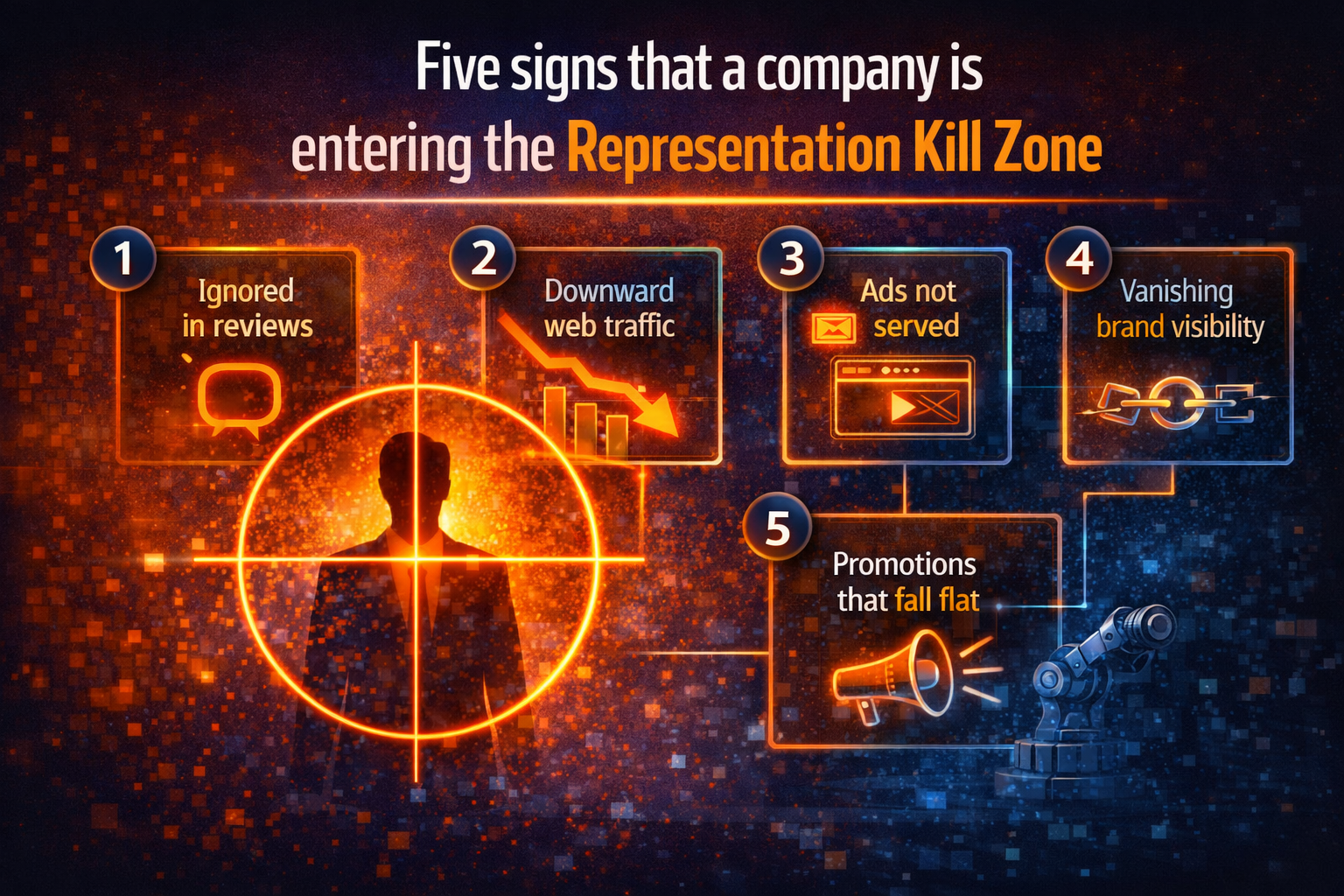
Five signs that a company is entering the Representation Kill Zone
-
It cannot describe itself consistently across systems
The same customer, supplier, product, policy, or risk appears differently across departments and tools. There is no stable institutional truth.
-
It depends on human heroics for routine coordination
Employees constantly “know how to interpret” ambiguous records, informal exceptions, and undocumented states. Humans are carrying the representation burden manually.
-
Its evidence is trapped in unstructured artifacts
Critical operating truth lives in PDFs, presentations, call notes, inboxes, and tribal memory instead of machine-usable states, rules, and evidence chains.
-
It has automation without legitimacy
Tasks are automated, but the organization cannot clearly explain what the system is allowed to decide, under what conditions, with what approvals, and with what recourse if something goes wrong.
-
External systems struggle to trust it
Search engines, partner platforms, procurement tools, regulators, lenders, and insurers require disproportionate effort to verify, classify, integrate, or underwrite the company.
These signs rarely look dramatic in isolation. They appear as friction, delay, lower conversion, repeated exceptions, higher scrutiny, and hidden operational drag. Together, they indicate something far more serious: the company is becoming less visible to the systems that increasingly shape market outcomes.

Search was the first warning
Many executives still think this argument is abstract. It is not.
Search has already trained the market to value structure. Google explains that structured data provides explicit clues about the meaning of a page and can enable richer search results. Its merchant listing documentation says product markup can make items eligible for shopping-related experiences, and return policy markup can add more information that improves user experience. Google also shares case studies showing that structured data implementations were associated with materially higher click-through or engagement metrics for several publishers and brands. (Google for Developers)
That is an early version of representation economics in action.
Now extend that same pattern from product search to supplier discovery, AI shopping agents, autonomous contract comparison, machine-driven underwriting, algorithmic compliance review, workflow routing, and partner selection.
The principle stays the same:
What is better represented gets selected more often.
Why agentic systems will make the kill zone harsher
This becomes more serious as enterprises move from copilots to agents.
Anthropic’s research on agent autonomy highlights that as autonomy rises, questions of monitoring, visibility, activity logging, and governance become more important; the same research notes broader concerns around agentic harms, power concentration, and the need for practical oversight. (Anthropic)
That matters because agents do not merely answer questions. They gather evidence, compare alternatives, trigger actions, initiate workflows, and increasingly coordinate operational tasks.
An agent cannot scale ambiguity well.
It needs state clarity.
Policy clarity.
Identity clarity.
Evidence clarity.
In other words, it needs representation.
So the rise of agents will not only increase the value of good representation. It will punish bad representation faster.
Why the Representation Kill Zone is a global issue
This is not a niche problem for a few digital-native firms. It is global.
The World Economic Forum has argued that mistrust acts like a tax on the intelligent economy, and that interoperability, inclusion, and cooperation are essential for building trust in AI governance across borders. (World Economic Forum)
That matters because the kill zone is not only a technical failure. It is also a trust failure.
Companies become less selectable when machine systems cannot establish reliable confidence in what they are seeing.
That is why digital identity, provenance, policy semantics, and verification layers matter so much. In an AI-mediated economy, representation is never just description. It is description plus trust.
What the kill zone looks like across industries
Banking and lending
A borrower may be solid in reality but weak in representation. Incomplete documentation, inconsistent transaction structure, unclear ownership trails, and poor evidence chains make the entity harder for AI-enabled risk systems to trust.
Healthcare
A provider may deliver excellent care, but fragmented records, inconsistent coding, and weak interoperability reduce machine confidence, coordination quality, and reimbursement efficiency.
Manufacturing
A plant may be operationally capable, yet if machine status, maintenance history, quality evidence, and supplier dependencies are not represented well, AI planning systems will either make weak recommendations or avoid deeper automation.
Retail and commerce
A merchant may have strong products, but poor markup, inconsistent availability data, unclear fulfillment logic, and weak return-policy representation reduce discoverability and machine-mediated conversion. Google’s merchant and return-policy documentation shows exactly how eligibility and richer visibility depend on structured representation. (Google for Developers)
Professional services
A firm may have deep expertise, but if its capabilities, prior outcomes, workflow states, and trust signals are not legible to machine-mediated sourcing systems, more representable competitors gain the advantage.
The point is not that every company must become fully autonomous.
The point is that every company will increasingly be judged through machine interfaces.
The SENSE–CORE–DRIVER interpretation
To make the concept actionable, map the kill zone back to the framework.
SENSE failure
The organization does not capture enough relevant reality, or captures it too late, too noisily, or too inconsistently.
CORE failure
The organization collects signals but cannot convert them into stable meaning. It lacks durable state models, consistent definitions, and cross-functional coherence.
DRIVER failure
The organization has some representation but cannot govern delegation. It cannot clearly define what systems may act on, what humans must approve, what evidence is required, or how recourse works.
A company in the kill zone usually does not fail in only one of these layers. It suffers a compounding breakdown across all three.
Why incumbents are especially vulnerable
Startups often begin with cleaner workflows because they design around modern systems from day one.
Incumbents carry history.
They have legacy systems, acquisitions, policy exceptions, undocumented workarounds, and years of operational logic that was never designed to be machine-legible. Their revenues and brand strength can mask this weakness for a while. But as markets become more machine-mediated, internal inefficiency becomes external disadvantage.
That is why the Representation Kill Zone is especially dangerous for established firms.
It punishes the gap between real capability and machine-visible capability.
How companies survive the kill zone
The answer is not “buy more AI.”
The answer is to redesign institutional legibility.
First, identify the realities that matter most
Which parts of your organization must become machine-legible for your sector to remain competitive? Product attributes, customer state, supplier credentials, policy rules, provenance, risk evidence, service commitments, and operational status are common examples.
Second, build representation quality as a strategic capability
This is more than data quality. It is the ability to describe reality in forms that machines can safely interpret and act upon.
Third, create a board-level representation strategy
Boards should ask:
What must be sensed continuously?
What must be modeled explicitly?
What must never be delegated without oversight or recourse?
Fourth, treat trust as infrastructure
Verification, provenance, identity, authorization, and evidence chains are no longer secondary controls. They are competitive assets.
Fifth, redesign around SENSE–CORE–DRIVER
This is not just an architecture framework. It is a survival framework for the AI economy.
The deeper strategic warning
The most dangerous companies in the next decade may not be those with the smartest models.
They may be the ones that become easiest for the machine economy to work with.
That means the next great divide may not be AI adopters versus non-adopters.
It may be:
machine-selectable versus machine-ignored
machine-trusted versus machine-questioned
machine-coordinatable versus machine-fragile
That is the Representation Kill Zone.
And once a company enters it, the market may notice before the board does.
Conclusion column: what boards should reflect on now
Here is the uncomfortable truth.
The first firms to lose ground in the AI economy may not look weak by traditional measures. They may still have customers, products, talented employees, installed relationships, and cash flow. But beneath that surface, they will already be losing access to the systems that increasingly shape selection, trust, coordination, and action.
They will be too hard for machines to see clearly.
Too hard to compare fairly.
Too hard to verify quickly.
Too hard to govern safely.
Too hard to route into the new economy.
That is why representation economics matters.
The future will not belong only to those who build intelligence.
It will belong to those who make reality legible enough for intelligence to act on.
And in that world, the most important strategic question for every board is no longer simply, “How do we adopt AI?”
It is:
Are we becoming more visible to the machine economy—or are we already entering the kill zone?
FAQ
What is the Representation Kill Zone?
The Representation Kill Zone is the stage at which a company becomes too poorly represented for AI-mediated systems to discover, trust, compare, route to, or coordinate with effectively.
Is this the same as poor data quality?
No. Poor data quality is part of the problem, but the kill zone is broader. It includes weak identity, fragmented state models, unstructured evidence, unclear policy semantics, and poorly governed delegation.
Why is this important now?
Because AI systems are increasingly influencing search, procurement, workflow orchestration, compliance review, and autonomous decision support. As those systems expand, firms with better machine-legibility gain an increasing advantage. (Google for Developers)
Does this affect only digital businesses?
No. It affects manufacturing, retail, healthcare, finance, logistics, professional services, and public-sector institutions. Any organization evaluated through machine interfaces is exposed.
What should boards do first?
Boards should identify the realities that most affect machine-mediated competitiveness in their sector, assess where representation is weak, and develop a representation strategy grounded in sensing, modeling, trust, and delegation.
How does this connect to SENSE–CORE–DRIVER?
SENSE captures reality, CORE converts it into institutional understanding, and DRIVER governs delegation into action. A kill-zone condition usually reflects weakness across one or more of these layers.
1. What is the Representation Kill Zone?
It is the stage where companies become invisible to AI systems, reducing their discoverability, trust, and ability to participate in digital markets.
2. Why is AI making companies invisible?
AI systems rely on structured, machine-readable data. Companies that lack this become harder to discover and evaluate.
3. How is this different from digital transformation?
Digital transformation focuses on tools. The kill zone is about being machine-understandable and selectable.
4. What are early warning signs of the kill zone?
Declining search visibility, reduced AI recommendations, lower discoverability in procurement systems, and weak digital representation.
5. How can companies avoid the kill zone?
By becoming representation-native—building systems aligned with SENSE (capture), CORE (understand), and DRIVER (act).
Glossary
Representation Economics
A framework for understanding how value in the AI economy increasingly flows to firms and institutions that are easier for machines to interpret, trust, and coordinate with.
Representation Kill Zone
The competitive zone where a company becomes machine-invisible before it looks weak by traditional business measures.
Machine Legibility
The degree to which an organization’s products, policies, processes, and evidence are understandable and usable by machine systems.
Machine-Readable Trust
Trust signals expressed in structured, verifiable, machine-usable form, such as identity, provenance, policy, and evidence.
Machine-Selectable
A firm or offering that AI-mediated systems can easily discover, evaluate, compare, and choose.
SENSE
The institutional capacity to capture relevant reality continuously and credibly.
CORE
The institutional capacity to turn sensed reality into durable, coherent understanding.
DRIVER
The institutional capacity to govern what may be delegated into machine-assisted or machine-executed action.
Representation Discipline
The organizational practice of structuring, verifying, governing, and maintaining the representations on which machine systems depend.
References and further reading
Google Search Central explains that structured data helps Google understand content and can enable rich results; its merchant listing and return-policy documentation shows how structured product, shipping, pricing, availability, and return data affect eligibility and presentation in search experiences. (Google for Developers)
NIST’s AI Risk Management Framework states that it is intended to help organizations incorporate trustworthiness into the design, development, use, and evaluation of AI systems, and organizes this work through govern, map, measure, and manage. (NIST)
The World Economic Forum argues that mistrust has become a major drag on the AI economy and emphasizes interoperability, inclusion, and cooperation in global AI governance. (World Economic Forum)
Anthropic’s work on measuring agent autonomy highlights the importance of oversight, monitoring, and visibility as AI systems become more agentic and more operationally consequential. (Anthropic)
Institutional Perspectives on Enterprise AI
Many of the structural ideas discussed here — intelligence-native operating models, control planes, decision integrity, and accountable autonomy — have also been explored in my institutional perspectives published via Infosys’ Emerging Technology Solutions platform.
For readers seeking deeper operational detail, I have written extensively on:
- What Makes an Enterprise Intelligence-Native? The Blueprint for Third-Order AI Advantage
https://blogs.infosys.com/emerging-technology-solutions/artificial-intelligence/what-is-enterprise-ai-the-operating-model-for-compounding-institutional-intelligence.html - Why “AI in the Enterprise” Is Not Enterprise AI: The Operating Model Difference Most Organizations Miss
https://blogs.infosys.com/emerging-technology-solutions/artificial-intelligence/why-ai-in-the-enterprise-is-not-enterprise-ai-the-operating-model-difference-that-most-organizations-miss.html - The Enterprise AI Control Plane: Governing Autonomy at Scale
https://blogs.infosys.com/emerging-technology-solutions/artificial-intelligence/the-enterprise-ai-control-plane-governing-autonomy-at-scale.html - Enterprise AI Ownership Framework: Who Is Accountable, Who Decides, and Who Stops AI in Production
https://blogs.infosys.com/emerging-technology-solutions/artificial-intelligence/enterprise-ai-ownership-framework-who-is-accountable-who-decides-and-who-stops-ai-in-production.html - Decision Integrity: Why Model Accuracy Is Not Enough in Enterprise AI
https://blogs.infosys.com/emerging-technology-solutions/artificial-intelligence/decision-integrity-why-model-accuracy-is-not-enough-in-enterprise-ai.html - Agent Incident Response Playbook: Operating Autonomous AI Systems Safely at Enterprise Scale
https://blogs.infosys.com/emerging-technology-solutions/artificial-intelligence/agent-incident-response-playbook-operating-autonomous-ai-systems-safely-at-enterprise-scale.html - The Economics of Enterprise AI: Designing Cost, Control, and Value as One System
https://blogs.infosys.com/emerging-technology-solutions/artificial-intelligence/the-economics-of-enterprise-ai-designing-cost-control-and-value-as-one-system.html
Together, these perspectives outline a unified view: Enterprise AI is not a collection of tools. It is a governed operating system for institutional intelligence — where economics, accountability, control, and decision integrity function as a coherent architecture.
Explore the Architecture of the AI Economy
This article is part of a broader research series exploring how institutions are being redesigned for the age of artificial intelligence. Together, these essays examine the structural foundations of the emerging AI economy — from signal infrastructure and representation systems to decision architectures and enterprise operating models.
If you want to explore the deeper framework behind these ideas, the following essays provide additional perspectives:
-
- • Why Most AI Projects Fail Before Intelligence Even Begins
• The Intelligence Supply Chain: How Organizations Industrialize Cognition in the AI Economy
- The Silent Systems Doctrine: Why the AI Economy Will Be Won by Those Who Represent What Cannot Speak
- Signal Infrastructure: Why the AI Economy Begins Before the Model – Raktim Singh
- The Representation Economy Explained: 51 Questions About the SENSE–CORE–DRIVER Architecture – Raktim Singh
- The Representation Economy: Why AI Institutions Must Run on SENSE, CORE, and DRIVER – Raktim Singh
- The Representation Economy: Why Intelligent Institutions Will Run on the SENSE–CORE–DRIVER Architecture – Raktim Singh
- The Representation Economy Explained: 51 Questions About the SENSE–CORE–DRIVER Architecture – Raktim Singh
- Representation Debt: Why Institutions Accumulate Hidden AI Risk Long Before Failure Becomes Visible – Raktim Singh
- The Representation Deficit: Why Institutions Fail When Reality Cannot Enter the Decision System – Raktim Singh
- The Representation Maturity Model: How Boards Decide When AI Can Be Trusted With Real Decisions – Raktim Singh
- Representation Capital: The Invisible Asset That Will Decide Which Institutions Win the AI Economy – Raktim Singh
- Representation Failure: Why AI Systems Break When Institutions Misread Reality – Raktim Singh
- The Board’s Representation Strategy: How Intelligent Institutions Decide What Must Be Seen, Modeled, Governed, and Delegated – Raktim Singh
- The Representation Premium: Why Institutions That Are Easier for AI to See, Trust, and Coordinate With Will Win the Next Economy – Raktim Singh
- The Firm of the AI Era Will Be Built Around Representation: Why Institutions Must Redesign Themselves for the SENSE–CORE–DRIVER Economy – Raktim Singh
- The Representation Balance Sheet: How AI Is Redefining Assets, Liabilities, and Institutional Strength – Raktim Singh
- The Representation Stack: The New Architecture of Intelligent Institutions in the AI Economy – Raktim Singh
- Representation Economics: The New Law of Value Creation in the AI Era – Raktim Singh
- The Representation Reserve Currency: Why AI Will Trust Only a Few Forms of Reality – Raktim Singh
- The Machine-Readable Boundary of the Firm: How AI Is Redefining What Companies Own, Outsource, and Orchestrate – Raktim Singh
- Representation Insurance: Why Machine-Readable Trust Will Power the AI Economy – Raktim Singh
- Representation Arbitrage: The New AI Advantage That Will Redefine Who Wins and Who Disappears – Raktim Singh
- • Why Most AI Projects Fail Before Intelligence Even Begins
Together, these essays outline a central thesis:
The future will belong to institutions that can sense reality, represent it clearly, reason about it intelligently, and act through governed machine systems.
This is why the architecture of the AI era can be understood through three foundational layers:
SENSE → CORE → DRIVER
Where:
- SENSE makes reality legible
- CORE transforms signals into reasoning
- DRIVER ensures that machine action remains accountable, governed, and institutionally legitimate
Signal infrastructure forms the first and most foundational layer of that architecture.
AI Economy Research Series — by Raktim Singh



Raktim Singh is an AI and deep-tech strategist, TEDx speaker, and author focused on helping enterprises navigate the next era of intelligent systems. With experience spanning AI, fintech, quantum computing, and digital transformation, he simplifies complex technology for leaders and builds frameworks that drive responsible, scalable adoption.