
Representation Monopolies:
The biggest monopoly in AI will not come from who builds the smartest model.
It will come from who defines reality itself.
Because in the AI economy, power does not flow to intelligence alone—it flows to those who decide what is visible, structured, and actionable.
In the industrial age, monopoly power came from controlling production.
In the digital age, it came from controlling platforms.
In the AI age, it may come from controlling representation.
That is the shift many leaders still underestimate.
Most conversations about AI concentration still revolve around the visible bottlenecks: chips, cloud, data centers, frontier models, and capital.
Those are real sources of power. OECD research shows that cloud markets remain highly concentrated, with Amazon and Microsoft together reaching up to 80% share in some major OECD economies, while the top three cloud providers collectively hold more than 60% of the global market.
OECD also notes that these hyperscalers occupy privileged positions in AI because many model developers depend on them for training and deployment infrastructure. At the same time, Stanford’s 2025 AI Index reports that U.S.-based institutions produced 40 notable AI models in 2024, versus 15 in China and just three in Europe, showing that frontier model production remains geographically concentrated even as competition intensifies. (OECD)
But the deepest monopoly in the AI economy may not be a compute monopoly or even a model monopoly.
It may be a representation monopoly.
That is the power to become the default system through which reality is made visible, structured, classified, trusted, and made actionable for machines.
This matters because AI does not act directly on the world. It acts on a representation of the world. If a company becomes the dominant layer through which customers, suppliers, workers, products, assets, permissions, risks, and behaviors are represented, it gains a new form of structural power. It does not merely sell software. It begins to shape what can be seen, what can be compared, what can be optimized, and eventually what can be decided.
That is why the next battle in AI is not only over intelligence.
It is over who gets to define reality for everyone else.
The real source of monopoly power is shifting
Traditional monopolies controlled scarce goods. Digital monopolies controlled distribution, attention, and network effects. AI monopolies may control something even more foundational: the machine-readable map of the world.
Think about a navigation app. At first, it feels like a convenience. It helps you get from one place to another. But once millions of people depend on it, it is no longer just showing roads. It is deciding which roads matter, which shops are visible, which routes count as efficient, which traffic signals deserve weight, and which destinations deserve to surface first.
A road that is not mapped properly may as well not exist for the machine.
Now extend that logic to enterprise AI, finance, healthcare, logistics, education, manufacturing, insurance, and government.
The company that becomes the dominant layer for customer identity, workflow visibility, product ontology, supplier trust, policy interpretation, exception handling, audit evidence, and execution boundaries does not simply participate in the AI economy. It starts to govern its terms.
This is exactly where the Representation Economy becomes important.
In the SENSE–CORE–DRIVER framework, AI success depends on far more than model quality.
SENSE is the layer where reality becomes machine-legible: signals are detected, attached to entities, represented as state, and updated over time.
CORE is the cognition layer where systems interpret, reason, optimize, and learn.
DRIVER is the legitimacy layer where action is authorized, verified, executed, and made reversible.
The monopoly risk appears when one firm becomes the default provider of the representational foundations inside SENSE and the control logic inside DRIVER. At that point, it is no longer just offering intelligence. It is shaping the field on which intelligence operates.
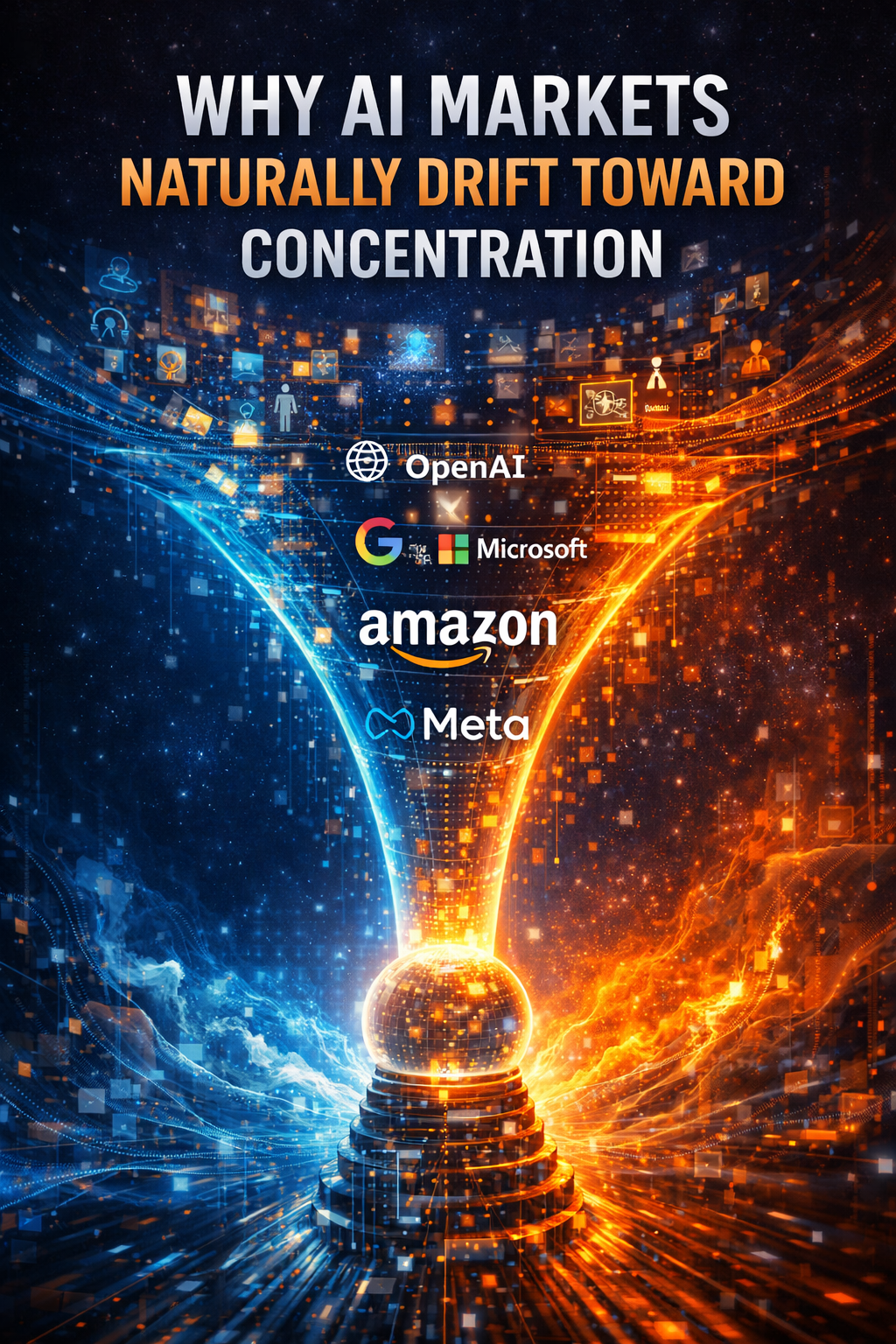
Why AI markets naturally drift toward concentration
AI markets look dynamic on the surface. OECD research finds more than 1,000 foundation models from nearly 100 providers across different modalities. It also finds that model prices have dropped quickly as supply has increased. Stanford’s AI Index similarly reports that open-weight models sharply narrowed the performance gap with closed models in 2024, while inference costs for GPT-3.5-level capability fell by more than 280 times between late 2022 and late 2024. (OECD)
That dynamism is real.
But it can also be misleading.
Competition at the model layer does not automatically prevent concentration in the deeper layers that matter most. In fact, cheaper models may accelerate concentration elsewhere. When raw intelligence becomes more abundant and more affordable, strategic value shifts to the layers that organize and govern its use: identity, memory, workflows, policy, permissions, connectors, runtime controls, trust systems, and switching costs.
This is how representation monopolies form.
A firm does not need to own the best model forever. It only needs to become the system in which everyone else must describe themselves.
Once that happens, switching becomes painful.
Not because another model is unavailable.
But because the institution itself is now encoded inside one representational architecture.
A hospital may be able to replace one large language model with another. But can it easily replace the layer that encodes patient identity, consent history, triage status, diagnostic context, escalation logic, and clinical evidence?
A bank may switch copilots. But can it replace the system that encodes authority flows, fraud states, customer risk categories, transaction context, and auditability requirements?
A manufacturer may pilot multiple AI agents. But can it replace the representational layer that defines machine states, maintenance history, supplier quality, part lineage, and operational exceptions?
That is the real lock-in.
Monopoly by definition, not just by market share
Most monopoly discussions focus on customers, revenue, or distribution. Representation monopolies require a broader lens.
The first sign is not only scale. It is definition power.
When one company’s schema becomes the default schema, its categories begin to look like reality itself. Its object model becomes the language of the market. Its identity model becomes the gatekeeper of participation. Its confidence scores start shaping trust. Its exception rules determine what counts as normal and abnormal. Its logging standards decide what evidence exists after a machine acts.
This is more than software dependence.
It is ontological dependence.
A useful analogy is credit scoring. For decades, the most powerful institutions in lending were not always those with the largest physical footprints. They were often the ones whose standards shaped who could be seen as creditworthy in the first place. In the AI economy, more sectors will experience a similar shift. The firms that decide how the machine sees you may gain structural power over whether the machine serves you properly, prices you fairly, or routes opportunity toward you at all.
That is why representation monopolies may become more consequential than classic platform monopolies.
Platforms mediate transactions.
Representation systems mediate recognition itself.

The vertical stack makes concentration even stronger
Representation monopolies become especially powerful when firms are vertically integrated across the AI stack.
OECD’s work on AI infrastructure explains that hyperscalers already benefit from large economies of scale and from their control over cloud capacity, networking, and deployment channels. It also notes that AI developers often enter strategic relationships with cloud providers for training and deployment.
In the UK, the Competition and Markets Authority concluded in 2025 that competition in cloud infrastructure services is not working well, citing concentration, barriers to entry, and frictions that reduce switching and multi-cloud flexibility. UN Trade and Development has also warned that generative AI is reinforcing concentration because large technology firms dominate key parts of the value chain, including cloud, compute, and strategic partnerships. (OECD)
Now imagine what happens when the same firms also control:
The model marketplace
They decide which models are easiest to access, compare, and fine-tune.
The runtime layer
They control how agents are deployed, monitored, and governed in production.
The identity and access layer
They define who or what is allowed to act.
The memory and workflow layer
They shape how context is retained, retrieved, and reused.
The policy and safety layer
They influence what the system can refuse, escalate, or silently reshape.
The enterprise connector layer
They become the bridge between AI and the systems where institutional reality already lives.
At that point, the customer is not just buying infrastructure.
The customer is entering a governed reality.
That reality may be efficient. It may reduce friction. It may even accelerate enterprise value. But it also becomes increasingly difficult to exit because the vendor is no longer supplying a tool. It is supplying the environment in which machine-legible existence takes place.

Why these monopolies are hard to see
Representation monopolies rarely arrive as monopolies.
They arrive as convenience.
A vendor says: let us unify your customer data, workflow metadata, retrieval layer, policy engine, agent identities, approval chains, memory, and audit trails. This sounds practical. It simplifies implementation. It makes AI easier to deploy. It reduces the mess.
And in the early phases, it genuinely creates value.
The problem begins later.
Over time, the vendor’s ontology hardens. The organization starts making decisions according to what the system can represent, rather than what reality actually requires. Edge cases get forced into predefined categories. Non-standard actors become invisible. New business models become expensive to express. Suppliers, partners, and internal teams must adapt themselves to the incumbent’s representational logic in order to participate.
That is the hidden danger.
Institutions slowly begin adapting themselves to the representation layer, instead of adapting the representation layer to reality.
That is when monopoly power deepens.
The system no longer reflects the world.
The world starts bending to the system.
The geopolitical dimension: dependence on someone else’s map of reality
This issue is not only enterprise-level. It is geopolitical.
UNCTAD has warned that digital markets are increasingly concentrated and that generative AI may widen existing divides as large technology firms consolidate their lead across the value chain. Its 2025 Technology and Innovation Report also highlights that AI development remains highly concentrated and that the private sector dominates most frontier AI research and model production.
Meanwhile, the EU AI Act places explicit obligations on general-purpose AI model providers, including technical documentation, copyright compliance, and public summaries of training data content, with additional expectations for models that present systemic risk. These rules reflect a growing recognition that general-purpose AI providers are not ordinary software companies. They are systemic actors. (UN Trade and Development (UNCTAD))
But sovereignty in the AI era is not only about hosting models locally.
It is about controlling the representational layer through which a country, sector, or enterprise becomes machine-readable.
If a nation depends on foreign firms to define agricultural identity, industrial ontologies, health record structure, supply chain traceability, public service eligibility, and machine-action permissions, then it does not fully control its digital future, even if local applications sit on top.
In that sense, representation monopolies may become the next strategic dependency after cloud dependency.
What this means for boards and C-suites
Boards should stop asking only, “Which model should we use?”
That is now too small a question.
The better questions are:
Who defines our entities?
Who decides what counts as a customer, supplier, product, risk event, or exception?
Who defines our state?
Who determines how reality is structured, updated, and represented over time?
Who owns our machine memory?
Who controls the institutional context on which future decisions depend?
Who sets confidence and exception thresholds?
Who decides when the system acts, escalates, hesitates, or overrides?
Who owns the evidence trail?
When machines act, who controls the logs, the decision traces, and the proof?
How portable is our representation layer?
Could we migrate without losing institutional meaning?
Can our SENSE and DRIVER survive a vendor switch?
Or have we quietly outsourced the foundations of our own institutional sovereignty?
These are not technical questions.
They are strategy questions.
They are governance questions.
They are future-of-the-firm questions.
What smart institutions should do now
The answer is not to reject large AI ecosystems. That would be unrealistic.
The answer is to prevent convenience from becoming representational capture.
Build portable ontologies
Do not bury institutional meaning inside vendor-specific schemas.
Separate model choice from representation choice
A flexible model layer matters, but a sovereign representation layer matters more.
Treat identity, memory, policy, and evidence as strategic assets
These are not implementation details. They are enduring sources of power.
Demand exportability beyond raw data
Schemas, states, permissions, audit logs, and decision evidence must also be portable.
Map which layers of SENSE and DRIVER are too strategic to outsource
Not every layer deserves the same level of control.
Preserve the ability to challenge machine categories
Especially in high-stakes settings, institutions must be able to revise the system’s assumptions about reality.
The organizations that do this will not only reduce lock-in.
They will preserve the ability to evolve.

Why this matters to the future of the AI economy
The most powerful companies of the AI age may not be the ones with the smartest chatbot, the biggest model, or the flashiest interface.
They may be the ones that become the accepted layer through which everyone else must be seen.
That is the real warning.
When one company defines your customer, your supplier, your employee, your asset, your risk, your compliance state, your exception path, and your machine-action boundary, it does not merely support your institution.
It starts to shape its possibilities.
That is why representation monopolies deserve far more attention from boards, regulators, founders, and policymakers.
The central question of the next AI economy is not only:
Who owns the model?
It is:
Who owns the map of reality on which all models depend?
And once that map becomes concentrated, monopoly stops looking like a market-share problem.
It becomes a civilization problem.

Conclusion: the next monopoly will not merely sell intelligence. It will define legibility.
The AI economy is often described as a race for bigger models, cheaper inference, and broader deployment.
That view is incomplete.
The deeper battle is over who gets to define the categories through which institutions become visible to machines. As intelligence becomes cheaper, the scarce asset shifts upward: not just computation, but representation; not just answers, but legibility; not just automation, but the authority to define what the system believes is real.
That is why representation monopolies matter.
They sit beneath the surface of AI excitement, but above the level where real institutional power accumulates. They shape switching costs, governance, sovereignty, trust, and competitive advantage. They can quietly turn convenience into dependence and dependence into structural control.
The institutions that win in the AI era will not be those that simply consume intelligence fastest. They will be those that understand which parts of reality they must continue to represent for themselves.
Because in the end, AI will not simply reward those who compute more.
It will reward those who remain in control of how their world is seen.
FAQ
What is a representation monopoly in AI?
A representation monopoly emerges when one company becomes the default system through which reality is structured for machines. It controls how entities, states, relationships, permissions, and evidence are represented, making others dependent on its model of reality.
How is a representation monopoly different from a traditional AI monopoly?
A traditional AI monopoly may focus on compute, chips, models, or cloud access. A representation monopoly goes deeper. It controls the categories, schemas, and identity structures on which AI decisions depend.
Why does this matter for enterprises?
Because enterprises can often swap models more easily than they can swap the systems that encode customer identity, workflows, memory, policy, and machine-action boundaries.
Why are representation monopolies dangerous?
They can create hidden lock-in. Over time, organizations may begin adapting themselves to the system’s assumptions rather than ensuring the system reflects reality.
Are representation monopolies only a private-sector issue?
No. They also have geopolitical implications. Countries and sectors that do not control critical representational layers may become dependent on external actors for machine-readable visibility and action.
What does SENSE–CORE–DRIVER have to do with this?
The SENSE–CORE–DRIVER framework explains where monopoly power can accumulate. SENSE governs how reality becomes machine-readable. CORE governs reasoning. DRIVER governs legitimate action. Concentration in SENSE and DRIVER can create deep dependence.
Does open-source AI solve this problem?
Not by itself. Open models may reduce dependency at the model layer, but they do not automatically solve dependency in identity, workflow, memory, policy, connectors, and runtime governance.
What should boards ask management?
Boards should ask who controls the institution’s representation layer, whether it is portable, which parts are too strategic to outsource, and whether key evidence and governance trails remain under institutional control.
Is this just another term for platform lock-in?
No. Platform lock-in is about dependency on a service ecosystem. Representation lock-in is about dependency on the categories and structures through which machines interpret reality.
What is the biggest strategic takeaway?
The most important AI decision may not be which model to use. It may be which parts of reality your institution must continue to define for itself.
Why do AI markets tend to concentrate?
AI markets concentrate due to data network effects, infrastructure scale, and control over representation layers.
How is this different from traditional monopolies?
Traditional monopolies control supply or distribution. AI monopolies control how reality itself is defined and understood.
What is the biggest risk of AI concentration?
Dependence on external systems to interpret reality, leading to economic, strategic, and geopolitical vulnerability.
How can companies compete in this environment?
By building strong SENSE (representation) and DRIVER (governance) layers—not just CORE intelligence.
Glossary
Representation Economy
An economic system in which value increasingly depends on how accurately, fairly, and usefully reality is made visible and actionable for machines.
Representation Monopoly
A situation in which one actor becomes the dominant source of machine-readable representation for others.
Machine-Readable Reality
The structured version of the world that AI systems can recognize, process, compare, and act upon.
SENSE
The legibility layer where signals are captured, attached to entities, represented as state, and updated over time.
CORE
The reasoning layer where AI interprets context, optimizes decisions, learns, and generates responses or recommendations.
DRIVER
The legitimacy layer where action is authorized, verified, executed, and made reversible when needed.
Ontology
A structured way of defining entities, categories, and relationships so machines can reason about them consistently.
Ontological Dependence
A condition in which one institution becomes dependent on another institution’s way of defining reality.
Representational Capture
The gradual process by which an institution starts conforming to a vendor’s model of reality rather than keeping the model aligned with reality itself.
Identity Layer
The system that determines who or what an entity is in machine-readable form.
Decision Evidence
The logs, context, rules, traces, and records that explain why a machine system acted the way it did.
AI Sovereignty
The ability of an enterprise, industry, or nation to maintain meaningful control over its AI stack, especially over strategic layers of representation, governance, and action.
Hyperscaler
A very large cloud provider with substantial control over infrastructure, scale economics, and AI deployment channels.
References and Further Reading
This article draws on current public evidence about concentration in cloud and AI markets, frontier model geography, and emerging regulatory responses to general-purpose AI systems. OECD has documented concentration in cloud markets and the strategic role of hyperscalers in AI infrastructure.
Stanford HAI’s 2025 AI Index shows continued concentration in notable frontier model production, even as open models improve and inference costs fall. UN Trade and Development has warned that digital and generative AI markets are becoming increasingly concentrated. The UK CMA’s 2025 cloud market investigation and the EU AI Act’s obligations for general-purpose AI models both reflect growing recognition that core AI infrastructure providers have systemic significance. (OECD)
For readers who want to go deeper, the most useful public sources include OECD work on cloud competition and AI infrastructure, Stanford HAI’s AI Index, UNCTAD’s Technology and Innovation Report 2025, the UK CMA cloud market investigation, and the EU AI Act provisions for general-purpose AI models. (OECD)
Explore the Architecture of the AI Economy
This article is part of a broader research series exploring how institutions are being redesigned for the age of artificial intelligence. Together, these essays examine the structural foundations of the emerging AI economy — from signal infrastructure and representation systems to decision architectures and enterprise operating models.
If you want to explore the deeper framework behind these ideas, the following essays provide additional perspectives:
-
- • Why Most AI Projects Fail Before Intelligence Even Begins
- The Representation Economy: Why AI Institutions Must Run on SENSE, CORE, and DRIVER – Raktim Singh
- The Representation Economy: Why Intelligent Institutions Will Run on the SENSE–CORE–DRIVER Architecture – Raktim Singh
- The Representation Deficit: Why Institutions Fail When Reality Cannot Enter the Decision System – Raktim Singh
- The Representation Maturity Model: How Boards Decide When AI Can Be Trusted With Real Decisions – Raktim Singh
- Representation Failure: Why AI Systems Break When Institutions Misread Reality – Raktim Singh
- The Representation Premium: Why Institutions That Are Easier for AI to See, Trust, and Coordinate With Will Win the Next Economy – Raktim Singh
- The Firm of the AI Era Will Be Built Around Representation: Why Institutions Must Redesign Themselves for the SENSE–CORE–DRIVER Economy – Raktim Singh
- The Representation Stack: The New Architecture of Intelligent Institutions in the AI Economy – Raktim Singh
- Representation Economics: The New Law of Value Creation in the AI Era – Raktim Singh
- The Representation Reserve Currency: Why AI Will Trust Only a Few Forms of Reality – Raktim Singh
- The Machine-Readable Boundary of the Firm: How AI Is Redefining What Companies Own, Outsource, and Orchestrate – Raktim Singh
- Representation Insurance: Why Machine-Readable Trust Will Power the AI Economy – Raktim Singh
- The Representation Commons: Why Broad-Based AI Value Begins Before the Model – Raktim Singh
- The Representation Access Economy: Why AI Will Decide Who Gets Seen, Structured, and Trusted – Raktim Singh
- Representation Bankruptcy: Why AI Will Break Companies That Machines Cannot Trust – Raktim Singh
- The Representation Kill Zone: Why Companies Become Invisible Before They Realize They Are Losing – Raktim Singh
- Representation Alpha: Why Competitive Advantage Will Come from Better Representation, Not Better Models – Raktim Singh
- Representation Fiduciaries: The Missing Institution the AI Economy Cannot Scale Without – Raktim Singh
- Representation Clearinghouses: The Missing Infrastructure the AI Economy Needs to Reconcile Reality Before It Acts – Raktim Singh
- Recourse Platforms: The Next AI Infrastructure Market for Correction, Appeal, and Recovery – Raktim Singh
- Representation Workflows: The Hidden Operating System That Will Decide the Winners of the AI Economy – Raktim Singh
- Representation Switching Costs: Why the AI Economy’s Deepest Lock-In Will Come From Who Defines Reality – Raktim Singh
- Representation Fragility and Exclusion: The Hidden Fault Line That Will Break the AI Economy – Raktim Singh
- Representation Drift & Labor: Why AI Systems Fail When Reality Moves Faster Than Machines – Raktim Singh
Together, these essays outline a central thesis:
The future will belong to institutions that can sense reality, represent it clearly, reason about it intelligently, and act through governed machine systems.
This is why the architecture of the AI era can be understood through three foundational layers:
SENSE → CORE → DRIVER
Where:
- SENSE makes reality legible
- CORE transforms signals into reasoning
- DRIVER ensures that machine action remains accountable, governed, and institutionally legitimate
Signal infrastructure forms the first and most foundational layer of that architecture.
AI Economy Research Series — by Raktim Singh



Raktim Singh is an AI and deep-tech strategist, TEDx speaker, and author focused on helping enterprises navigate the next era of intelligent systems. With experience spanning AI, fintech, quantum computing, and digital transformation, he simplifies complex technology for leaders and builds frameworks that drive responsible, scalable adoption.