
Representation Switching Costs:
In the next phase of the AI economy, competitive advantage will not come only from better models, lower inference costs, or bigger data estates. It will come from controlling the machine-readable representation of reality that workflows, agents, and institutions depend on to act.
Representation switching costs refer to the difficulty of moving from one AI system to another when the real dependency lies not in data or software, but in how reality is represented—entities, states, permissions, and decisions. In the AI economy, this layer becomes the deepest source of lock-in and competitive advantage.
Executive Summary
For years, leaders understood switching costs through a familiar lens: enterprise software, cloud migration, network effects, payments, and platforms. But the AI economy is introducing a deeper form of lock-in.
The hardest thing to move in the AI era may not be the application, the model, or even the data. It may be the representation of reality that sits beneath machine action.
That representation includes how a system identifies entities, tracks state, interprets events, applies permissions, learns exceptions, and decides what is authoritative enough to trigger action. Once an institution builds workflows, controls, agentic systems, audit trails, and external partner coordination on top of that structure, switching providers becomes far more difficult than replacing software.
This is the new strategic fault line.
The real question is no longer only: Who owns the model?
It is increasingly: Who defines reality well enough that everyone else builds on top of it?
That is where the deepest switching costs of the AI economy will form.
The Old Switching Cost Was Technical. The New Switching Cost Is Ontological.
For two decades, digital strategy was shaped by familiar switching costs.
Enterprise software created process lock-in. Cloud platforms created infrastructure lock-in. Marketplaces and social networks created network lock-in. Payment systems created merchant dependence. These were painful, expensive, and strategically important. But they were still largely technical and operational.
The AI economy changes the depth of the problem.
When an organization adopts AI seriously, it is not merely installing a new tool. It is gradually teaching a system how to perceive the world, classify what matters, track what changes, and determine what is valid enough to act upon. That means the institution is no longer just adopting software. It is adopting a reality model.
This is why the new switching cost is ontological.
A traditional migration asks: can another system process the same records?
An AI migration asks: can another system recreate the same machine-readable understanding of customers, patients, shipments, assets, permissions, exceptions, and history?
That is a much harder problem.
NIST’s AI Risk Management Framework is useful here because it treats AI as a socio-technical system whose risks emerge not only from the model itself, but also from people, processes, governance, and operational context. In other words, AI risk does not sit neatly inside the model layer. It sits across the broader environment in which machine judgments are interpreted and used. (NIST Publications)
That matters because it shows why AI lock-in is not just a model problem. It is a systems-of-reality problem.
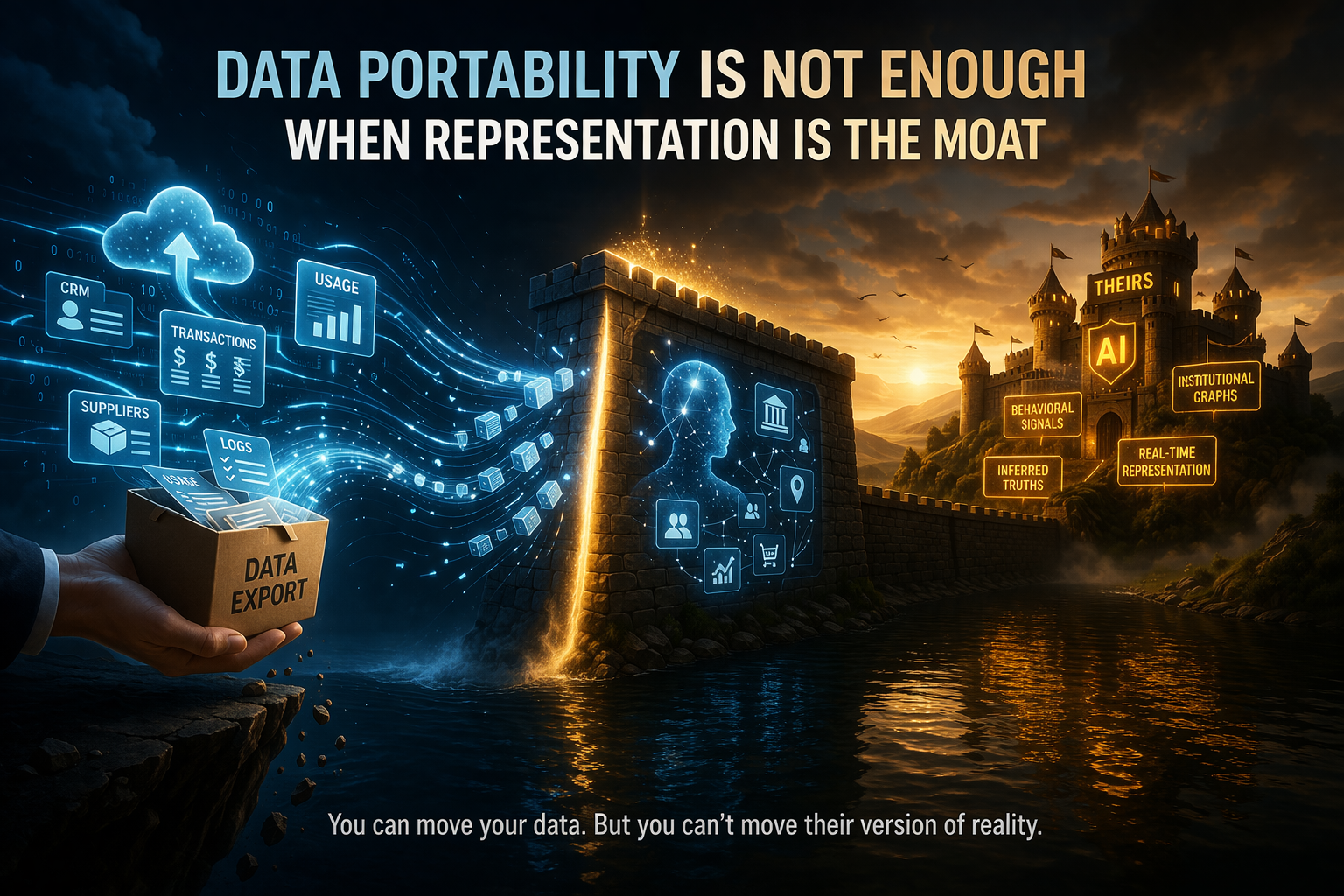
Data Portability Is Not Enough When Representation Is the Moat
Many executives still think in the language of the previous digital era. They assume that if data can be exported, lock-in can be reduced.
That logic is incomplete.
The OECD has repeatedly emphasized that data portability can reduce switching costs and lock-in only when portability leads to effective usability and interoperability in the receiving environment. A static export of records is not the same thing as a living, trusted, and operational representation that another system can immediately use. (OECD)
This distinction is becoming decisive.
A spreadsheet of transactions is portable.
A machine-operational understanding of a customer’s risk profile, consent boundaries, transaction behavior, exception patterns, and authorized decision pathways is not easily portable.
The European Union’s Digital Markets Act reflects the same strategic concern. Its purpose is to make digital markets fairer and more contestable, and it includes obligations around data portability and interoperability because policymakers increasingly recognize that entrenched ecosystems become hard to leave when users and business partners cannot realistically move their data and interactions elsewhere. (Digital Markets Act (DMA))
The AI economy intensifies this problem.
The real moat is no longer only the dataset. The moat is the structured, evolving, machine-usable representation of the world that the dataset supports.
That is where lock-in deepens.
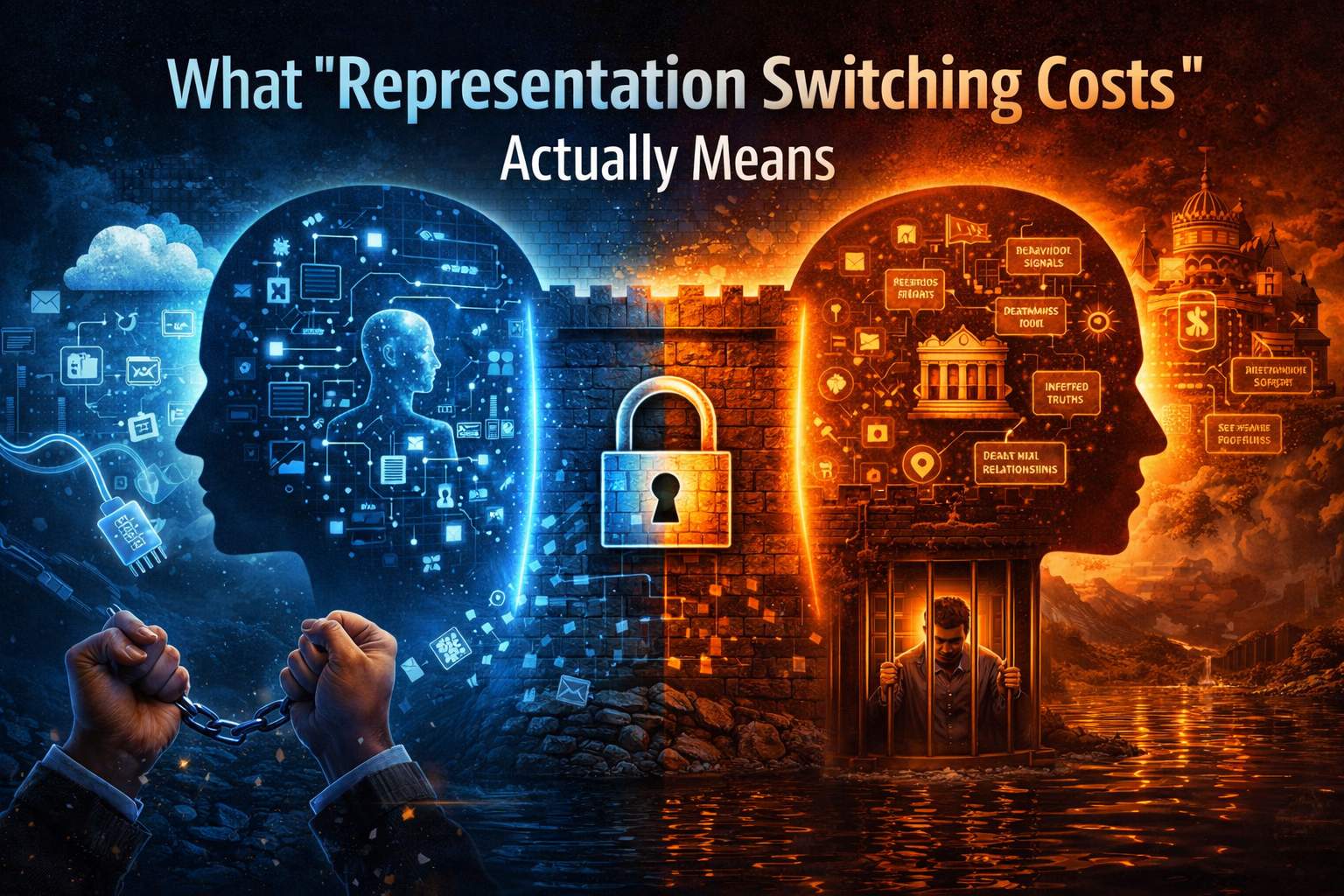
What “Representation Switching Costs” Actually Means
Representation switching costs arise when an organization becomes dependent not merely on a vendor’s software, but on that vendor’s way of defining reality.
This includes:
Entity definitions
Who counts as a customer, patient, supplier, account, shipment, field worker, or asset?
State logic
What counts as active, risky, delayed, fraudulent, approved, disputed, or complete?
Event authority
Which signal is trusted enough to update the system’s understanding of reality?
Permission structures
What is the machine allowed to see, infer, recommend, or act on?
Exception histories
How has the institution learned to handle ambiguity, edge cases, reversals, appeals, and overrides?
Operational meaning
What do records mean when they are used for action, not just storage?
Once these structures are deeply embedded into workflows, agents, decisions, recourse, and external coordination, switching becomes extremely difficult. The organization is no longer moving to another vendor. It is trying to reconstruct the world as the prior system had taught it to be seen.
That is why representation switching costs can become more durable than software switching costs, cloud switching costs, or even data portability barriers.
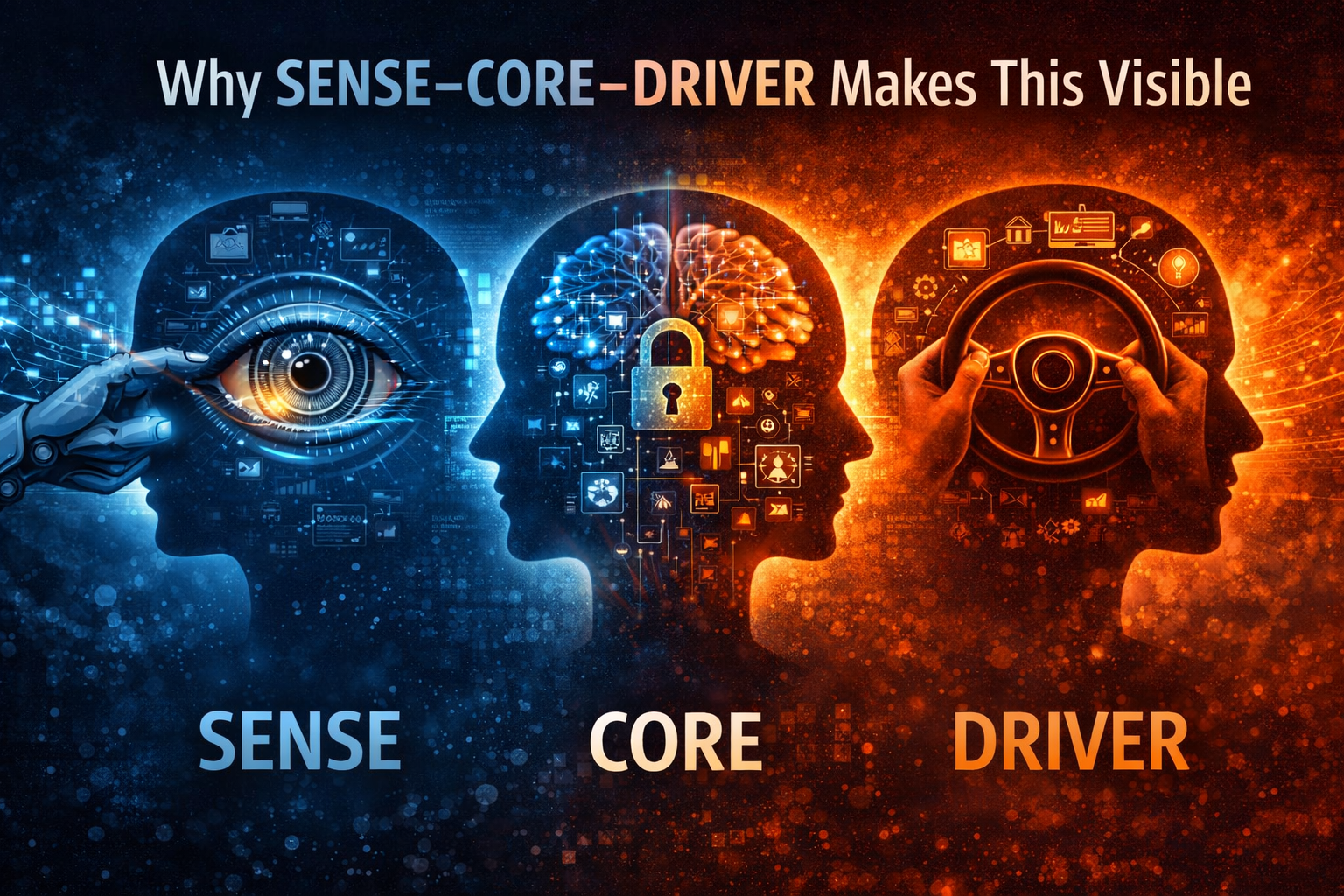
Why SENSE–CORE–DRIVER Makes This Visible
The SENSE–CORE–DRIVER framework helps explain exactly where this lock-in forms.
SENSE: where reality becomes machine-legible
Signal is captured. Entity is identified. State is represented. Evolution is tracked over time.
This is the layer where reality is converted into something a machine can work with. When this layer becomes deeply embedded, workflows begin treating it as the default truth.
CORE: where machine cognition interprets that reality
The system comprehends context, optimizes decisions, realizes action, and evolves through feedback.
If CORE is trained, tuned, or orchestrated around one particular representation of the world, switching becomes harder because a different representation changes what the system thinks is happening.
DRIVER: where action becomes governed and legitimate
Delegation, representation, identity, verification, execution, and recourse define the authority structure around machine action.
Once policies, escalation pathways, audit trails, liabilities, and recourse processes are built on top of one representational layer, the institution becomes dependent not only technically, but also operationally and legally.
This is the deeper insight: as organizations move from AI pilots to real-world AI systems, switching costs migrate downward. They move away from visible interfaces and into the hidden architecture that defines what the system believes to be real.
A Logistics Example: The Company That Cannot Leave
Imagine a global logistics company.
At first, it adopts an AI system to improve shipment routing. That seems replaceable. Another provider could likely offer similar route optimization.
But then the system expands.
It begins ingesting sensor data, customs events, warehouse scans, weather disruptions, service-level commitments, route anomalies, handoff histories, customer claims, and carrier reliability signals. Over time, it creates a dynamic state model of shipments, routes, delays, obligations, and exceptions.
At this point, the system is no longer just optimizing transportation. It is defining operational reality.
Teams rely on it for customer communication, rerouting, service recovery, claims, penalties, forecasting, and escalation. Partners begin synchronizing with it. Auditors and insurers begin referencing it. Autonomous actions start to sit on top of it.
Now the switching question changes.
It is no longer: can another AI system optimize routes?
It becomes: can another provider recreate the same living representation of shipments, exceptions, obligations, permissions, and trust pathways without months of ambiguity, risk, and dispute?
That is a much higher switching barrier.
A Healthcare Example: Access Does Not Equal Actionability
Healthcare makes the point even more clearly.
CMS’s interoperability and prior authorization rules are designed to improve health information exchange and require impacted payers to implement APIs for prior authorization information and related decision flows. These are important steps because they increase access and help reduce operational friction. (Centers for Medicare & Medicaid Services)
But access alone does not solve the deeper problem.
A patient record is not just a file. It sits inside a broader machine-actionable context that includes identity resolution, medication history, treatment pathways, coding conventions, risk flags, prior authorization requirements, provider relationships, and permissible next actions.
Moving the data is useful.
Recreating the same trusted operational meaning is harder.
This is why representation switching costs matter so much in sectors like healthcare. The challenge is not merely exchanging records. It is preserving meaning, trust, and actionability across institutions.
WHO’s digital health strategy has similarly emphasized interoperability, open standards, and structured exchange because digital health systems cannot scale safely without common foundations for trust and semantic coordination. The EU’s European Health Data Space follows the same direction by building a common framework for access, exchange, and use of electronic health data across the Union. (World Health Organization)
The broader lesson is clear: portability matters, but representational continuity matters more.
A Finance Example: Open Banking Still Does Not Transfer Reality
The same logic applies in finance.
Open banking and financial data rights are expanding. In the United States, the CFPB’s Section 1033 framework requires covered data to be made available in electronic form to consumers and authorized third parties, and it is designed to support standardized formats and a more open ecosystem. (eCFR)
That is a major development. But even here, portability does not eliminate the harder representational problem.
A lender’s or financial agent’s operating reality includes far more than transaction data. It includes behavioral context, consent logic, identity resolution, fraud signals, account relationships, risk boundaries, and decision history.
So the real lock-in is not just access to records. It is dependence on the machine-readable representation that turns those records into action.
This is why the next strategic moat in finance may not be who stores the most data. It may be who structures financial reality in the most trusted and operationally usable way.
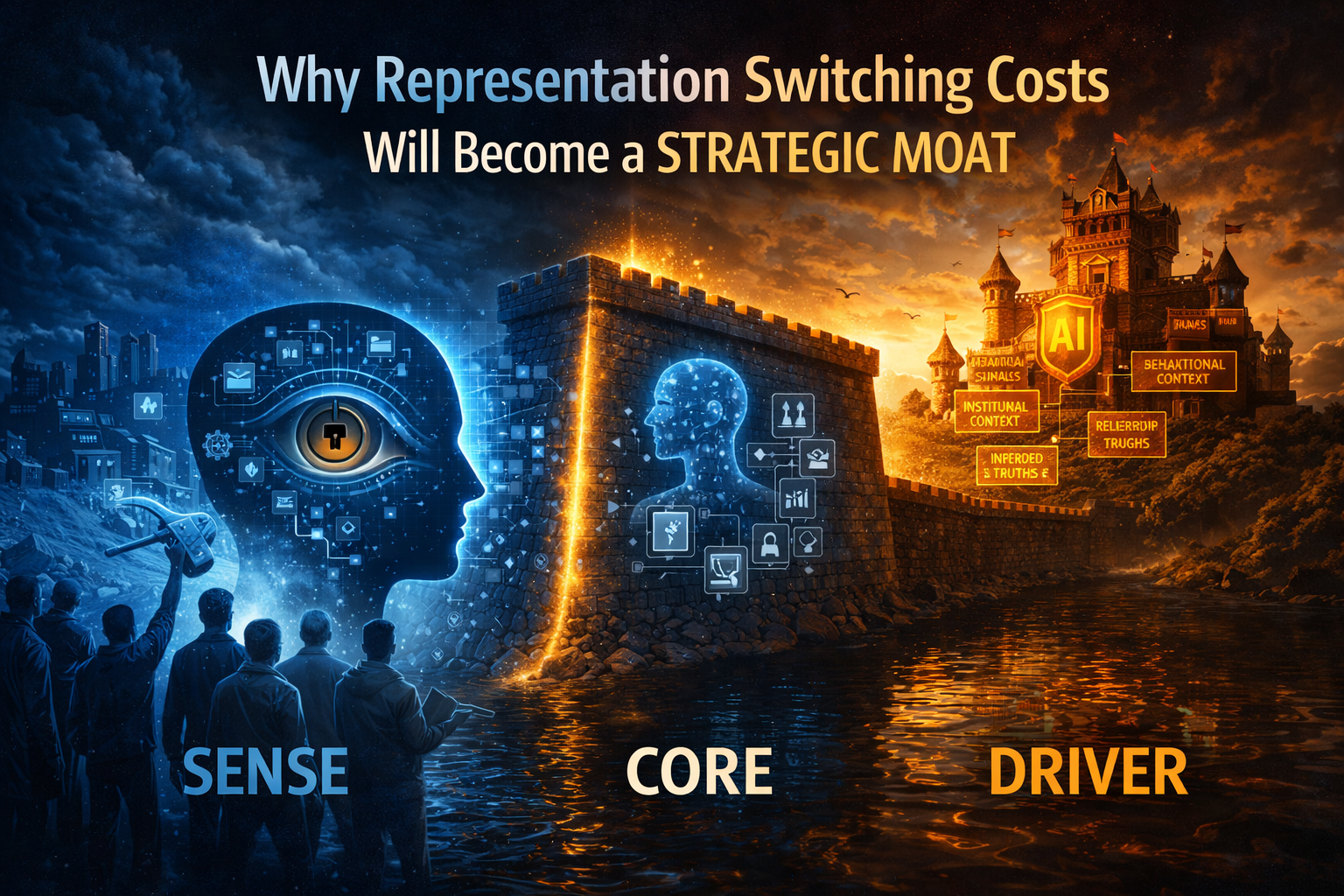
Why Representation Switching Costs Will Become a Strategic Moat
Many leaders still believe the AI race will be won primarily by superior models.
That view is too narrow.
Models are becoming easier to access, compare, and swap. But representations are stickier. They accumulate institutional history. They encode exceptions. They shape workflows. They define meaning. They attract counterparties. They become embedded in governance.
This creates four powerful moats.
-
Semantic moat
The system does not merely store records. It defines what those records mean.
-
Workflow moat
The representation is woven into decisions, approvals, escalations, recourse, and operations.
-
Network moat
Partners, regulators, customers, and external systems begin syncing around the same representation.
-
Governance moat
Verification, auditability, liability, and authority structures become tied to that representational model.
Once these moats mature, leaving becomes difficult even if the underlying software is technically replaceable.
That is why representation switching costs deserve board-level attention.
Why This Matters for Competition, Inclusion, and Power
Representation switching costs are not only about enterprise efficiency. They also affect who becomes visible, who gets access, and who becomes dependent.
A small farmer, a microbusiness, a migrant worker, a rural patient, or a thin-file borrower may become economically legible only when a system finally represents them well enough for institutions to act. That can be transformative.
But it can also create dependence.
If a platform becomes the only institution that can represent such an entity in a trusted and machine-usable way, then the benefits of visibility may arrive together with a new form of lock-in.
This is why Representation Economics is not only a strategy framework. It is also a power framework.
The institutions that define reality well may unlock inclusion. But if those representations are not portable, contestable, or interoperable, they may also create a new concentration of economic power.
What Boards and C-Suites Should Ask Now
Boards should stop asking only whether their AI strategy is innovative.
They should ask whether their firm is outsourcing its understanding of reality.
Five questions matter:
-
Can we export more than data?
Can we carry our entity models, state logic, event histories, permissions, and exception pathways into another environment?
-
Do we know where our deepest lock-in sits?
Is it in the model, the workflow, the governance layer, or the representational layer beneath all three?
-
Have we separated model choice from representation dependence?
Or are we accidentally allowing one vendor to define both?
-
Which parts of our machine-readable reality are portable, shared, proprietary, or contestable?
Most firms do not know.
-
If our current representation layer failed tomorrow, could we still operate, verify, and recover?
That is the real resilience test.
These are not technical housekeeping questions. They are strategic autonomy questions.
Summary
Representation switching costs describe the hidden lock-in that emerges when organizations depend not just on a vendor’s software or data, but on its machine-readable representation of reality. In the AI economy, the deepest strategic moat may come from who defines entities, state, permissions, and operational meaning well enough for workflows, agents, and institutions to act on top of that representation.
In the AI economy, intelligence will be abundant.
Control over representation will not.
Conclusion: The Real Battle Is Over Who Defines Reality
The AI economy will create fierce competition around models, chips, agents, clouds, and data. But beneath all of that, a deeper struggle is forming.
It is the struggle to become the institution whose representation of reality others depend on.
That is where the deepest switching costs will live.
Because once an institution controls the machine-readable representation of customers, patients, suppliers, assets, permissions, transactions, and evolving states, it no longer simply sells software. It becomes part of the market’s operating reality.
That is a much more durable position.
The winners in the AI economy will not be defined only by who has the smartest model. They will be defined by who builds the most trusted, portable, governable, and action-ready representation of reality.
In the Representation Economy, the deepest lock-in will come from who defines reality well enough that everyone else builds on top of it.
Glossary
Representation Switching Costs
The difficulty of moving from one AI or digital environment to another when the real dependency lies in the underlying machine-readable model of reality, not just the visible software.
Machine-Readable Reality
A structured representation of entities, events, states, permissions, and relationships that allows machines to interpret the world and take action.
Data Portability
The ability to transfer data from one service or provider to another in a usable format.
Interoperability
The ability of systems to exchange and use data or services effectively across environments.
Semantic Moat
A competitive advantage created when a system defines the meaning of records, states, and relationships in ways that others depend on.
SENSE
The layer where reality becomes machine-legible through signals, entity identification, state representation, and evolution over time.
CORE
The cognition layer where systems comprehend context, optimize decisions, realize action, and evolve through feedback.
DRIVER
The governance and legitimacy layer that determines delegation, representation, identity, verification, execution, and recourse.
Representational Resilience
The ability of an institution to preserve operational continuity, trust, and actionability even when its representation systems are disrupted or replaced.
FAQ
What are representation switching costs?
They are the hidden costs that arise when an organization depends on a vendor’s machine-readable representation of reality, not just its software, cloud environment, or data store.
How are representation switching costs different from normal software switching costs?
Traditional switching costs are mostly technical and operational. Representation switching costs are deeper because they involve rebuilding how the system understands entities, states, permissions, history, and meaning.
Why does data portability not fully solve AI lock-in?
Because moving records is not the same as moving a trusted operational representation. Data may transfer, while meaning, context, and actionability do not.
Why is this important for boards and C-suites?
Because many firms may believe they are buying AI capabilities when they are actually becoming dependent on another institution’s reality model.
Which sectors will feel this most strongly?
Healthcare, finance, logistics, public services, insurance, agriculture, and any domain where machine action depends on identity, state, permissions, trust, and evolving context.
How does this connect to the SENSE–CORE–DRIVER framework?
SENSE creates machine legibility, CORE interprets that reality, and DRIVER governs action. Switching costs deepen as all three layers become tied to one representational structure.
References and Further Reading
For credibility and GEO strength, include a short references section at the end of the published article such as:
- OECD work on data portability, interoperability, switching costs, and competition. (OECD)
- European Commission materials on the Digital Markets Act, contestability, data portability, and interoperability. (Digital Markets Act (DMA))
- NIST AI Risk Management Framework for the socio-technical framing of AI systems and risk. (NIST Publications)
- CMS interoperability and prior authorization rule materials for health-data exchange and API-based decision flows. (Centers for Medicare & Medicaid Services)
- WHO Global Strategy on Digital Health and EU European Health Data Space materials for international interoperability direction. (World Health Organization)
- CFPB materials on personal financial data rights and standardized electronic access to financial data. (eCFR)
Explore the Architecture of the AI Economy
This article is part of a broader research series exploring how institutions are being redesigned for the age of artificial intelligence. Together, these essays examine the structural foundations of the emerging AI economy — from signal infrastructure and representation systems to decision architectures and enterprise operating models.
If you want to explore the deeper framework behind these ideas, the following essays provide additional perspectives:
-
- • Why Most AI Projects Fail Before Intelligence Even Begins
- The Representation Economy: Why AI Institutions Must Run on SENSE, CORE, and DRIVER – Raktim Singh
- The Representation Economy: Why Intelligent Institutions Will Run on the SENSE–CORE–DRIVER Architecture – Raktim Singh
- The Representation Deficit: Why Institutions Fail When Reality Cannot Enter the Decision System – Raktim Singh
- The Representation Maturity Model: How Boards Decide When AI Can Be Trusted With Real Decisions – Raktim Singh
- Representation Failure: Why AI Systems Break When Institutions Misread Reality – Raktim Singh
- The Representation Premium: Why Institutions That Are Easier for AI to See, Trust, and Coordinate With Will Win the Next Economy – Raktim Singh
- The Firm of the AI Era Will Be Built Around Representation: Why Institutions Must Redesign Themselves for the SENSE–CORE–DRIVER Economy – Raktim Singh
- The Representation Stack: The New Architecture of Intelligent Institutions in the AI Economy – Raktim Singh
- Representation Economics: The New Law of Value Creation in the AI Era – Raktim Singh
- The Representation Reserve Currency: Why AI Will Trust Only a Few Forms of Reality – Raktim Singh
- The Machine-Readable Boundary of the Firm: How AI Is Redefining What Companies Own, Outsource, and Orchestrate – Raktim Singh
- Representation Insurance: Why Machine-Readable Trust Will Power the AI Economy – Raktim Singh
- The Representation Commons: Why Broad-Based AI Value Begins Before the Model – Raktim Singh
- The Representation Access Economy: Why AI Will Decide Who Gets Seen, Structured, and Trusted – Raktim Singh
- Representation Bankruptcy: Why AI Will Break Companies That Machines Cannot Trust – Raktim Singh
- The Representation Kill Zone: Why Companies Become Invisible Before They Realize They Are Losing – Raktim Singh
- Representation Alpha: Why Competitive Advantage Will Come from Better Representation, Not Better Models – Raktim Singh
- Representation Fiduciaries: The Missing Institution the AI Economy Cannot Scale Without – Raktim Singh
- The Representation Commons: Why Broad-Based AI Value Begins Before the Model – Raktim Singh
- The Representation Conversion Industry: Why the Biggest AI Companies Will Rebuild Reality Before They Build Intelligence – Raktim Singh
- Representation Alpha: Why Competitive Advantage Will Come from Better Representation, Not Better Models – Raktim Singh
- Representation Fiduciaries: The Missing Institution the AI Economy Cannot Scale Without – Raktim Singh
- Representation Accounting: The New Discipline That Will Decide Which AI-Driven Institutions Can Be Trusted – Raktim Singh
- Synthetic Representation: How the AI Economy Will Construct Reality When It Cannot Fully Observe It – Raktim Singh
- Representation Clearinghouses: The Missing Infrastructure the AI Economy Needs to Reconcile Reality Before It Acts – Raktim Singh
- Recourse Platforms: The Next AI Infrastructure Market for Correction, Appeal, and Recovery – Raktim Singh
- Representation Workflows: The Hidden Operating System That Will Decide the Winners of the AI Economy – Raktim Singh
Together, these essays outline a central thesis:
The future will belong to institutions that can sense reality, represent it clearly, reason about it intelligently, and act through governed machine systems.
This is why the architecture of the AI era can be understood through three foundational layers:
SENSE → CORE → DRIVER
Where:
- SENSE makes reality legible
- CORE transforms signals into reasoning
- DRIVER ensures that machine action remains accountable, governed, and institutionally legitimate
Signal infrastructure forms the first and most foundational layer of that architecture.
AI Economy Research Series — by Raktim Singh



Raktim Singh is an AI and deep-tech strategist, TEDx speaker, and author focused on helping enterprises navigate the next era of intelligent systems. With experience spanning AI, fintech, quantum computing, and digital transformation, he simplifies complex technology for leaders and builds frameworks that drive responsible, scalable adoption.