

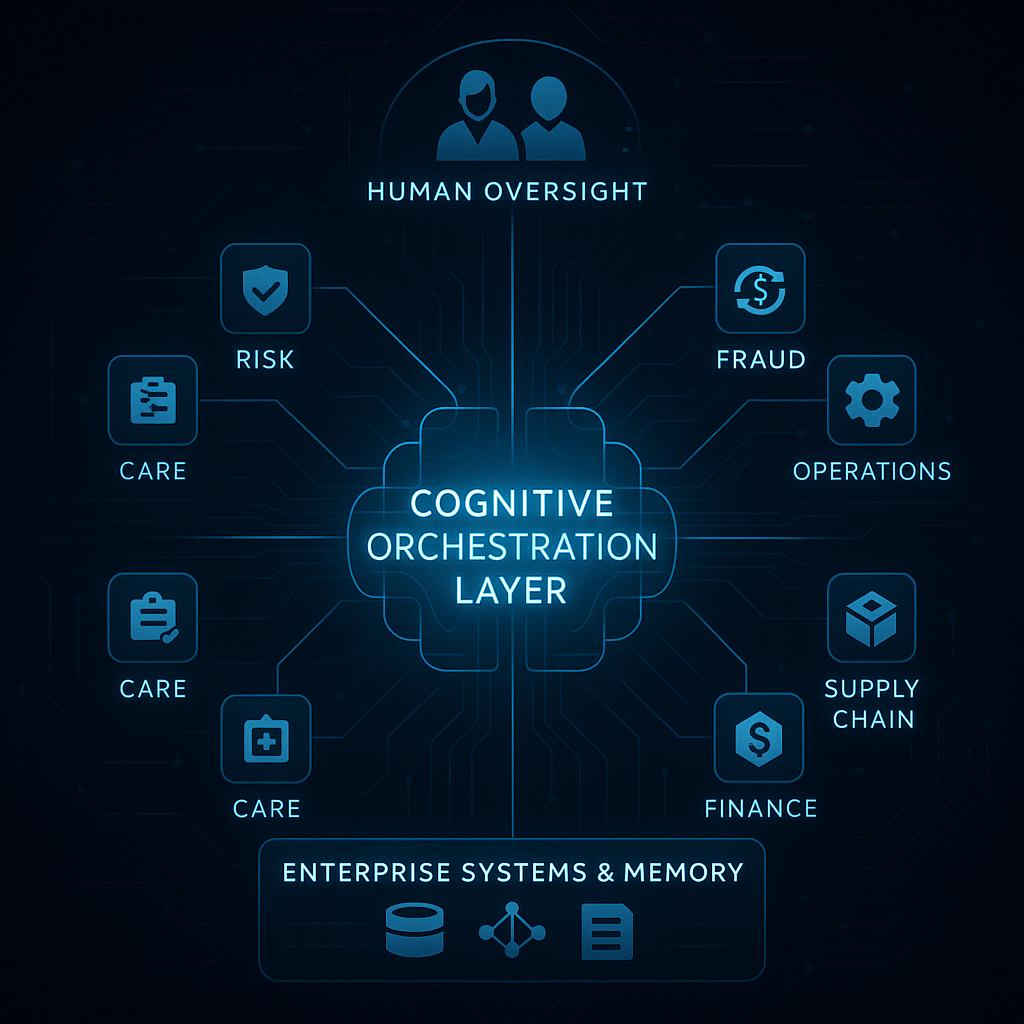
The Cognitive Orchestration Layer: How Enterprises Coordinate Reasoning Across Hundreds of AI Agents
Executive Summary (TL;DR)
As enterprises move from isolated copilots to fleets of AI agents, the central challenge is no longer model selection but cognitive coordination.
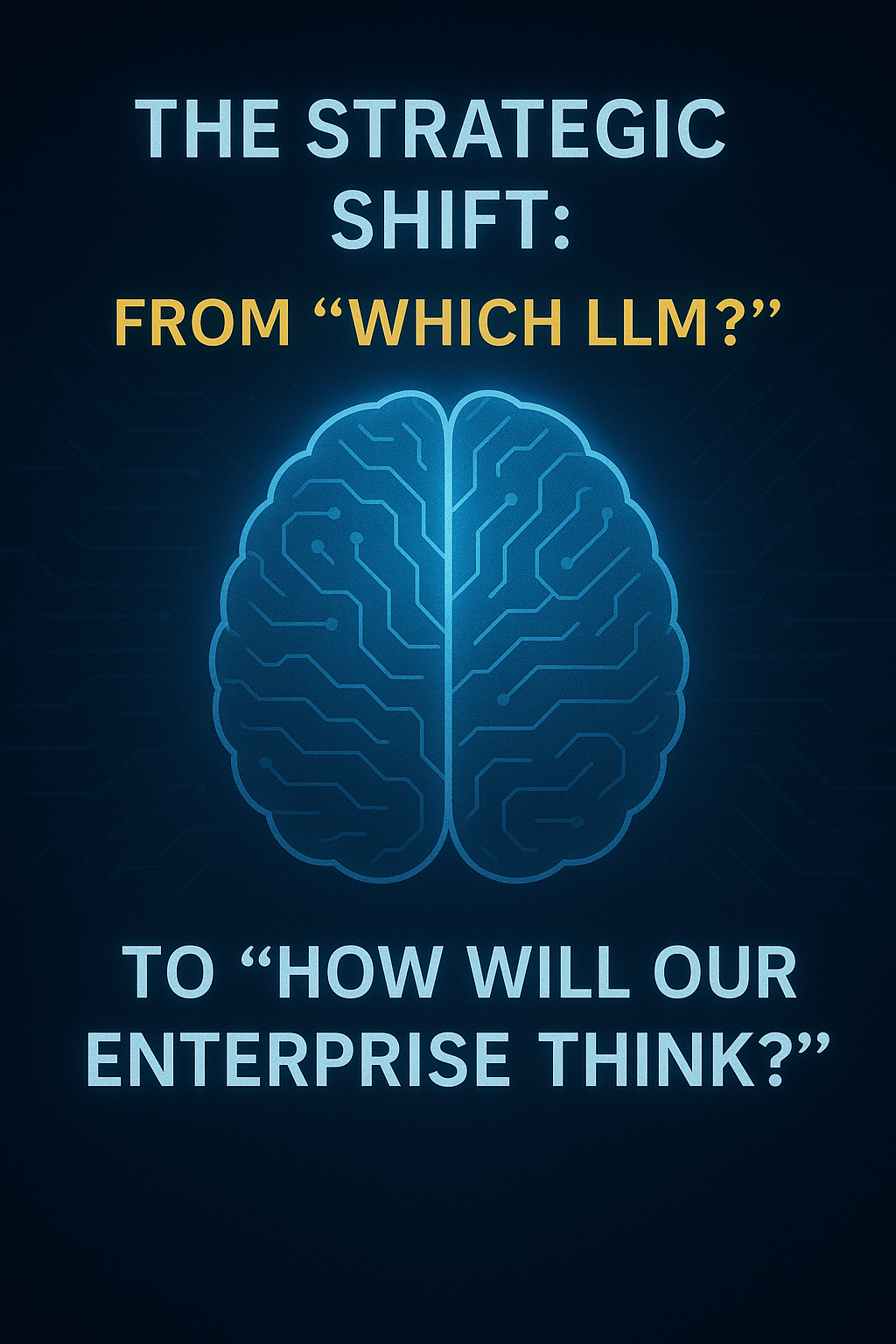
The real question has shifted from:
“Which LLM should we buy?”
to:
“How do we make hundreds of AI agents think together—safely, coherently, and under human control?”
This article introduces the Cognitive Orchestration Layer: an enterprise-grade architectural layer that functions like the prefrontal cortex of organizational intelligence. It coordinates reasoning, governs decision flows, enforces policy, and integrates human oversight across large populations of AI agents.
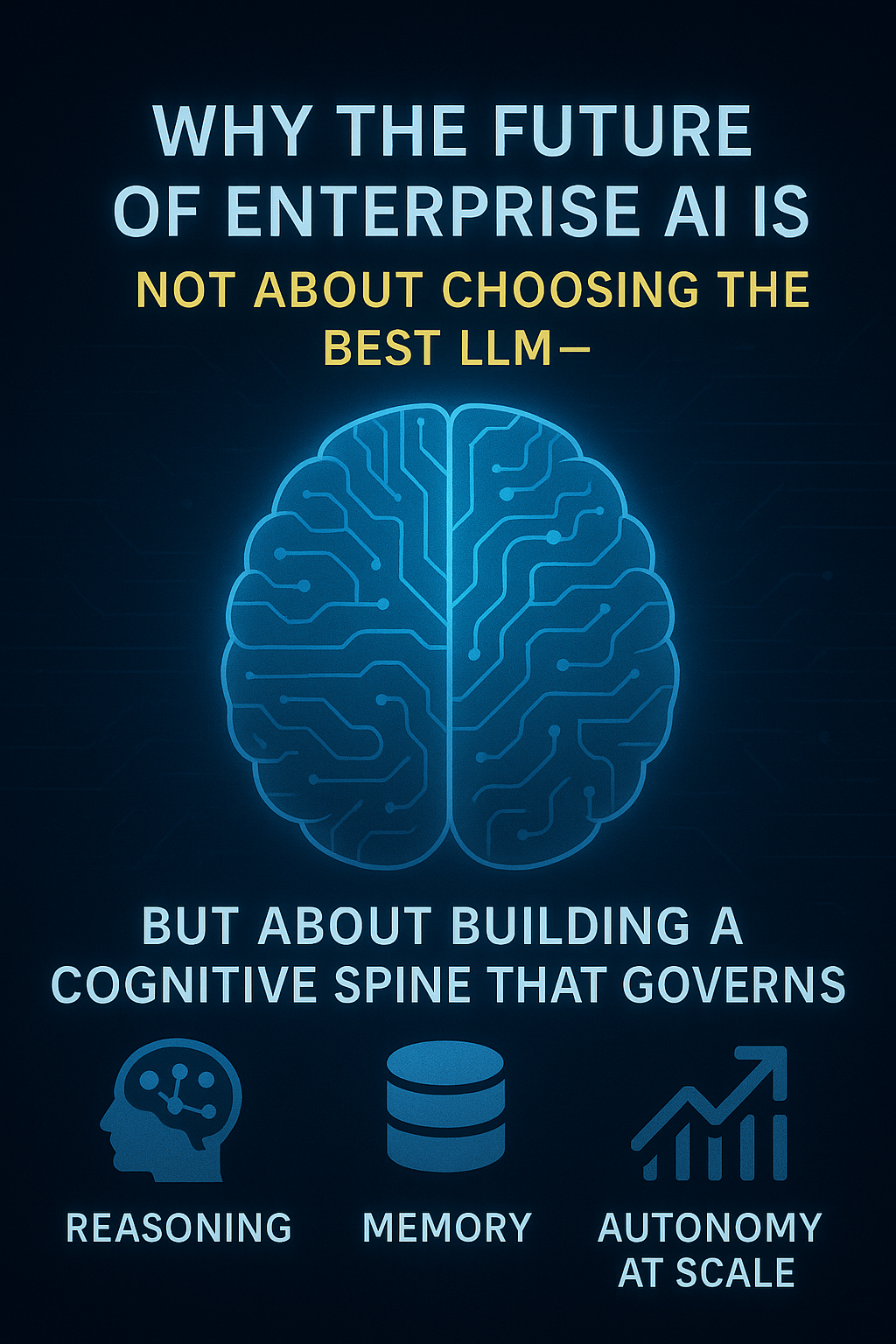
You will learn:
- Why enterprises need orchestration to avoid fragmented intelligence, policy drift, and hidden risk
- The core building blocks—from shared enterprise memory to orchestration “brains” and human interfaces
- Real-world scenarios in banking, healthcare, and manufacturing
- How this concept aligns with global research in multi-agent systems and cognitive governance
- A practical, four-stage roadmap to evolve from copilots to an enterprise cognitive mesh
Bottom line:
The future of enterprise AI is not about choosing smarter models.
It is about building a brain that helps the enterprise think.
-
The Strategic Shift: From “Which LLM?” to “How Will Our Enterprise Think?”
As the number of AI agents inside organizations quietly explodes, a subtle but profound shift occurs.
Leadership conversations stop revolving around model benchmarks and start focusing on questions like:
- How do we coordinate reasoning across dozens—or hundreds—of agents?
- How do we ensure decisions are consistent across departments?
- How do we govern autonomy without slowing the business down?
Each AI agent is a miniature brain—highly capable within a narrow scope, but limited without coordination.
The missing layer is not another model. It is cognitive integration.
That missing layer is what we call the Cognitive Orchestration Layer.
Think of it as the prefrontal cortex of enterprise AI—the part that decides:
- Which agent should work on which task
- In what sequence and priority
- With which information and memory
- Under which policies, constraints, and approval thresholds
This article:
- Defines the Cognitive Orchestration Layer and why it becomes inevitable at scale
- Explains its architectural building blocks and mental models
- Demonstrates real-world applications across industries
- Offers design principles and a phased roadmap for adoption
The language remains business-first, with enough technical depth to be credible to CIOs, CTOs, architects, and AI leaders.
-
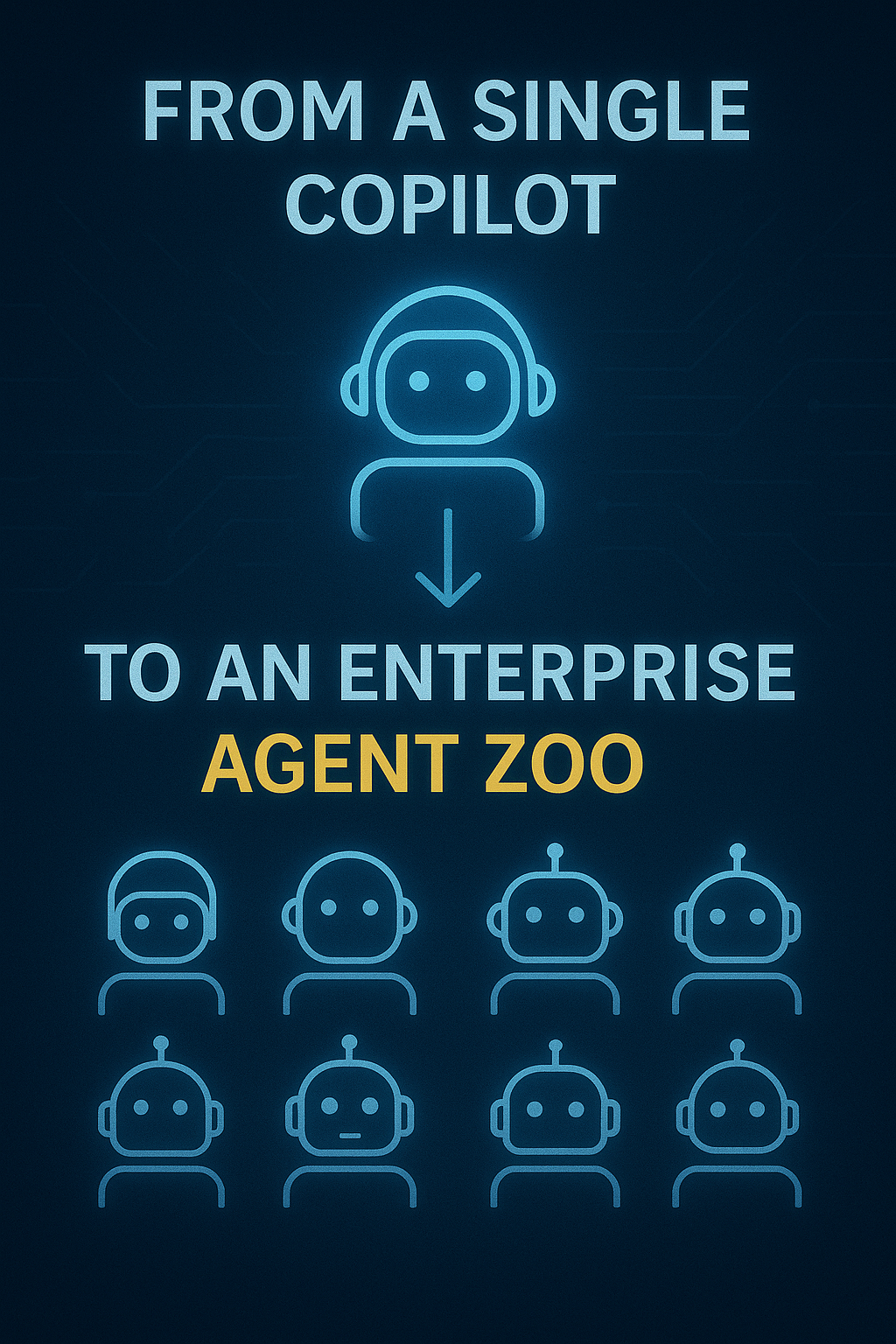
From a Single Copilot to an Enterprise “Agent Zoo”
Most organizations begin their AI journey modestly:
- A developer copilot
- A customer service chatbot
- A document summarization tool
Within a year, this turns into an agent ecosystem:
- Banking: KYC agent, fraud agent, credit agent, collections agent
- Healthcare: triage agent, coding agent, care coordination agent, claims agent
- Manufacturing: supply-chain agent, maintenance agent, pricing agent, quality agent
In parallel, vendors and researchers introduce:
- Reasoning models optimized for multi-step problem decomposition
- Small Language Models (SLMs) for domain-specific, on-prem, or cost-sensitive use cases
Research consistently shows that multi-agent systems can outperform single models, but only when coordination, communication, and conflict resolution are deliberately designed.
Without structure, enterprises encounter predictable failures:
- Duplicate prompts and logic across teams
- Conflicting decisions between departments
- No central place to encode policy or safety rules
- No coherent explanation of why decisions were made
That is the precise moment when a Cognitive Orchestration Layer becomes unavoidable.
-
What Is a Cognitive Orchestration Layer?
3.1 A Clear Definition
A Cognitive Orchestration Layer is an enterprise-wide control plane that plans, routes, supervises, and explains reasoning across AI agents, humans, and systems.
It does not replace agents.
It coordinates them.
If agents are musicians, the orchestration layer is the conductor—ensuring timing, harmony, policy compliance, and coherence.
3.2 Four Mental Models
The layer can be understood through four complementary lenses:
- Air Traffic Control
Decides which agents activate when, with what context, urgency, and priority. - Project Manager
Breaks complex goals into tasks, assigns work, and synthesizes outcomes. - Policy Guardian
Ensures every decision flows through regulatory, ethical, and risk filters. - Memory Router
Provides each agent only the relevant slice of enterprise memory—nothing more, nothing less.
Recent research frameworks such as knowledge-aware cognitive orchestration explicitly model what agents know, detect cognitive gaps, and dynamically adjust communication to prevent contradiction and drift.
The concept emerges at the intersection of:
- Multi-agent systems research
- Agentic AI platforms
- Enterprise AI governance and observability
This is not speculative. It is a structural response to scale.
-
Why Enterprises Need Cognitive Orchestration
4.1 Fragmented Intelligence
When teams build agents independently:
- The same question yields different answers
- Local optimization undermines enterprise outcomes
- No shared, trusted memory exists
Orchestration adds: a single cognitive spine—shared goals, memory, and policy.
4.2 No End-to-End Reasoning Visibility
Agents solve tasks well, but enterprises struggle to answer:
- Who verified the full decision?
- Which constraint applied where?
Orchestration adds: a reasoning narrative, not just logs.
A story regulators, boards, and auditors can understand.
4.3 Inconsistent Guardrails
Public agents may be tightly governed while internal agents quietly create risk.
Orchestration centralizes:
- Red lines
- Policy templates
- Verifiable autonomy mechanisms (Proof-of-Action)
4.4 Cost and Latency Explosion
Independent agents repeatedly process the same context.
Orchestration optimizes:
- Parallel vs sequential execution
- Memory reuse
- Model routing (SLM vs heavy reasoning)
4.5 Human-in-the-Loop Chaos
Without design, humans are pulled into workflows randomly.
Orchestration creates structure:
- Before: intent and constraints
- During: ambiguity resolution
- After: audit and learning
Human oversight becomes architected, not reactive.
-
Architecture: Core Building Blocks
5.1 Agents and Reasoning Models (Specialists)
Task agents, tools, and models remain focused and replaceable.
Frameworks like LangGraph, AutoGen, CrewAI help—but do not govern cognition.
5.2 Shared Enterprise Memory (The Brain Warehouse)
Includes:
- Knowledge bases and vector stores
- Episodic memory
- Policy memory
This is where Enterprise Neuro-RAG and MemoryOps live.
5.3 The Orchestrator Brain (Prefrontal Cortex)
Its five functions:
- Goal understanding
- Planning and decomposition
- Routing and role assignment
- Policy enforcement
- Reflection and optimization
This is where enterprises transition from automation to learning cognition.
5.4 Human and System Interfaces
Humans and systems interact with one orchestrator, not dozens of agents—simplifying trust, control, and explanation.
-
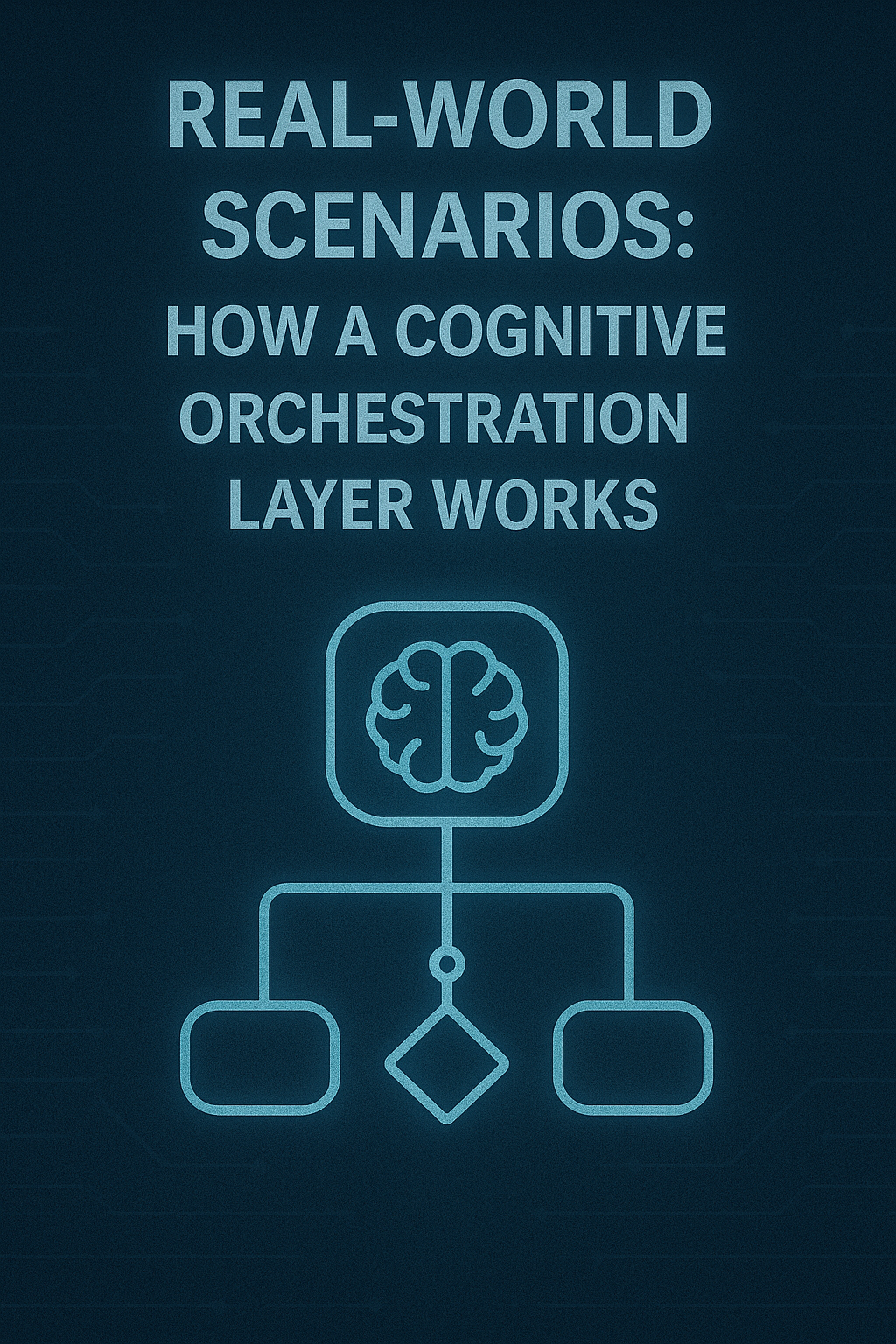
Real-World Scenarios: How a Cognitive Orchestration Layer Works
6.1 Global Bank – Approving a Complex Trade Deal
Objective: Approve or reject a complex cross-border trade finance deal for a corporate customer.
Without orchestration
- The relationship manager emails the deal details to KYC, legal, credit, treasury
- Each team runs its own agents or tools
- Long email threads, meetings, conflicting interpretations
- No unified view of the reasoning used
- High risk of misalignment and regulatory gaps
With a Cognitive Orchestration Layer
- The relationship manager submits the deal via a unified AI portal.
- The orchestrator interprets the goal: “Assess and approve/reject this trade finance deal.”
- It creates a plan:
- KYC agent checks identities and sanctions lists
- Legal agent checks jurisdiction-specific clauses
- Credit agent evaluates risk and limits
- Treasury agent analyses FX and liquidity impact
- It routes tasks in parallel wherever possible, pulling from shared enterprise memory (similar deals, risk policies, client history).
- It enforces rules such as:
- “If exposure exceeds threshold X, escalate to human credit officer.”
- “If country Y is involved, use stricter sanctions list.”
- It compiles all reasoning into an explainable decision memo with links to each agent’s contribution and referenced policy.
- A human credit officer reviews the memo, asks follow-up questions if required, then approves or rejects.
The layer doesn’t replace the human; it compresses the cognitive load and creates a transparent, auditable process.
6.2 Hospital Network – Triage and Care Coordination
Objective: Triage patients, propose care paths, and coordinate across departments.
- Triage agent – reads symptoms, vitals, and history
- Coding agent – prepares clinical codes for billing
- Care coordination agent – schedules tests and referrals
- Knowledge agent – surfaces evidence-based guidelines
The orchestrator:
- Ensures all agents use the same clinical knowledge base and policy repository
- Routes complex or uncertain cases to human physicians
- Maintains a care timeline—a reasoning narrative explaining why each test, referral, or prescription was suggested
For regulators and hospital leadership, this becomes not just a log of clicks but a cognitive audit trail of clinical decision support.
6.3 Manufacturing & Logistics – From Incident to Improvement
Objective: Resolve an unexpected equipment failure and update the standard operating procedure (SOP).
- A monitoring agent detects sensor anomalies.
- The orchestrator triggers:
- Root-cause analysis agent
- Supply-chain agent (parts availability, vendors)
- Scheduling agent (downtime impact, shift planning)
- It ensures all agents share:
- The same event timeline
- The same asset history
- The same safety and cost constraints
- Once resolved, the orchestrator:
- Stores the “incident + solution” as an episodic memory
- Updates the troubleshooting SOP
- Flags emerging patterns for continuous improvement
Over time, the plant moves from simply automating reactions to learning from every incident via orchestrated reasoning.

-
How This Connects to Current Research and Tools
Several research and industry trends converge on this idea:
- LLM-based multi-agent systems
Surveys describe how agents can have different roles, communication styles, and control strategies, and how multi-agent systems may be a promising path towards more general intelligence. (SpringerLink) - Cognitive orchestration research (OSC)
OSC proposes a knowledge-aware orchestration layer that models each agent’s knowledge, detects cognitive gaps, and guides agent communication to improve consensus and efficiency. (arXiv) - Agentic AI in enterprises
Industry guidance increasingly frames AI agents as “digital employees” that must operate under clear roles, workflows, and oversight structures. (NASSCOM Community) - Agent orchestration platforms
Articles and frameworks on AI agent orchestration describe the orchestration layer as the conductor that coordinates specialised agents to achieve complex objectives. ([x]cube LABS)
Vendor whitepapers already describe a cognitive orchestration layer that oversees collaboration among agents, humans, and systems while enforcing safety, explainability, and compliance across the enterprise. (Visionet)
What has been missing is a clear, simple conceptual model for CXOs and architects. That is the gap this article aims to fill.
This concept aligns with:
- Multi-agent systems research
- Cognitive orchestration frameworks
- Enterprise agent governance models
-
Design Principles & Four-Stage Roadmap
Principles
- Start from decisions, not models
- Separate orchestration from agents
- Favor many small specialists
- Make reasoning observable
- Bake governance in from day one
Four Stages
- Copilots
- Domain agent clusters
- Cognitive orchestration layer
- Enterprise cognitive mesh
This roadmap is geo-agnostic and regulation-aware.
-
Conclusion: The Enterprise Needs a Cognitive Spine
Enterprise AI is crossing a threshold.
The question is no longer:
Can an agent do this task?
It is: Can an organization reason coherently at scale?
The Cognitive Orchestration Layer is the missing spine:
- It coordinates intelligence
- Keeps humans in control
- Makes governance architectural
- Turns experiments into systems
Enterprises that build this layer early will scale faster, comply more easily, and adapt across geographies without re-engineering cognition each time.
You stop collecting agents.
You start building an enterprise that can think.
-
Glossary
AI Agent
An autonomous software component that perceives inputs, reasons about them, and takes actions (or recommends actions) to achieve defined goals. (arXiv)
Agentic AI
A style of AI system design where AI agents act more like “digital employees”with goals, tools, memory, and the ability to make decisions—rather than just answering isolated prompts.
Cognitive Orchestration Layer
An enterprise-wide layer that plans, routes, supervises, and explains the reasoning done by many AI agents, humans, and systems.
Reasoning Model
A large language model fine-tuned to break complex problems into multi-step reasoning traces (chain-of-thought) before producing an answer, especially for logic-heavy domains like maths and coding. (IBM)
Small Language Model (SLM)
A smaller, focused language model designed for domain-specific tasks, often cheaper, easier to govern, and easier to deploy on local infrastructure than giant general-purpose LLMs. (IBM)
Enterprise Memory / Neuro-RAG
A controlled fabric that combines retrieval, reasoning, and memory—storing documents, events, decisions, and policies in a way that agents can safely and consistently access.
Proof-of-Action (PoA)
A mechanism that records and proves what actions an AI agent took, on which data, under which policy—creating an auditable trail of behaviour.
RAGov (Retrieval-Augmented Governance)
A framework where policies, laws, and internal guidelines are stored as retrieval-ready knowledge and are actively used by agents during reasoning—not just referenced in static documents.
Episodic Memory
A log of recent tasks, interactions, and incidents that agents can refer to, helping enterprises learn from past situations instead of treating each case as new.
-
FAQ: Cognitive Orchestration Layer & Enterprise AI
Q1. How is a Cognitive Orchestration Layer different from a traditional workflow engine?
A. A workflow engine focuses on sequencing steps. A Cognitive Orchestration Layer focuses on sequencing and supervising reasoning. It understands goals, decomposes them into reasoning tasks, routes them to agents and models, enforces governance, and keeps a narrative of why each decision was made.
Q2. Do I need a Cognitive Orchestration Layer if I only have one or two AI agents today?
A. Not immediately. But as soon as you start deploying agents across multiple business units—risk, finance, HR, operations—you will face conflicts, duplication, and governance gaps. Designing with orchestration in mind now will save you major rework when your “agent zoo” grows.
Q3. Is this only relevant for large global enterprises, or also for mid-sized companies in India, Europe, or APAC?
A. The principles are geo-agnostic. Whether you are a mid-sized bank in India, a healthcare network in Europe, or a telecom in the Middle East, you will face similar coordination and governance challenges. Local regulations (RBI, SEBI, GDPR, HIPAA, etc.) will shape the guardrails, but the orchestration model remains the same.
Q4. How does this layer interact with my existing MLOps / DataOps / DevOps stack?
A. Think of MLOps, DataOps, and DevOps as the infrastructure and plumbing. The Cognitive Orchestration Layer sits above them as the cognitive control plane—deciding how agents use models, data, and tools and how decisions are governed and observed.
Q5. Can I build a Cognitive Orchestration Layer using existing tools like LangGraph, LangChain, CrewAI or AutoGen?
A. Yes, but with nuance. These frameworks are excellent implementation substrates for multi-agent workflows—but you still need to design the governance, policies, memory architecture, and human oversight. The orchestration layer is as much an organisational design pattern as it is a tech stack.
Q6. What is the biggest risk if we ignore cognitive orchestration and let teams build agents independently?
A. The biggest risk is silent fragmentation: different departments using different agents, models, and policies, leading to conflicting decisions, regulatory risk, and loss of trust. You might achieve local efficiency but lose global coherence—and eventually face a painful, expensive consolidation project.
Q7. How can this concept help with AI safety and responsible AI?
A. AI safety is much easier to manage at the orchestration layer than at the level of each agent. You can centralise policies, red lines, approvals, logging, and audits. This allows you to enforce consistent guardrails and show regulators and customers that your enterprise AI is accountable by design.
References & Further Reading
- SpringerLink — Surveys on LLM-based multi-agent systems
- arXiv — Orchestrating Cognitive Synergy (OSC)
- IBM Research — Reasoning models and Small Language Models
- NASSCOM Community — Agentic AI in enterprises
- Visionet — Cognitive orchestration architecture
- LangChain Blog — Multi-agent workflow patterns
- Cognitive Orchestration Layer: The Next Enterprise AI Architecture That Lets Hundreds of Agents Think Together | by RAKTIM SINGH | Nov, 2025 | Medium
- From Architecture to Orchestration: How Enterprises Will Scale Multi-Agent Intelligence – Raktim Singh
- AI Orchestration Layer: Why A2A and MCP Aren’t Enough for Multi-Agent Systems | by RAKTIM SINGH | Stackademic
- When Large Reasoning Models Fail on Hard Problems — And How to Build Reliable Reasoning for Your Business – Raktim Singh



Raktim Singh is an AI and deep-tech strategist, TEDx speaker, and author focused on helping enterprises navigate the next era of intelligent systems. With experience spanning AI, fintech, quantum computing, and digital transformation, he simplifies complex technology for leaders and builds frameworks that drive responsible, scalable adoption.