

Why the old operating models break
Enterprise AI is not failing quietly—but it is failing predictably.
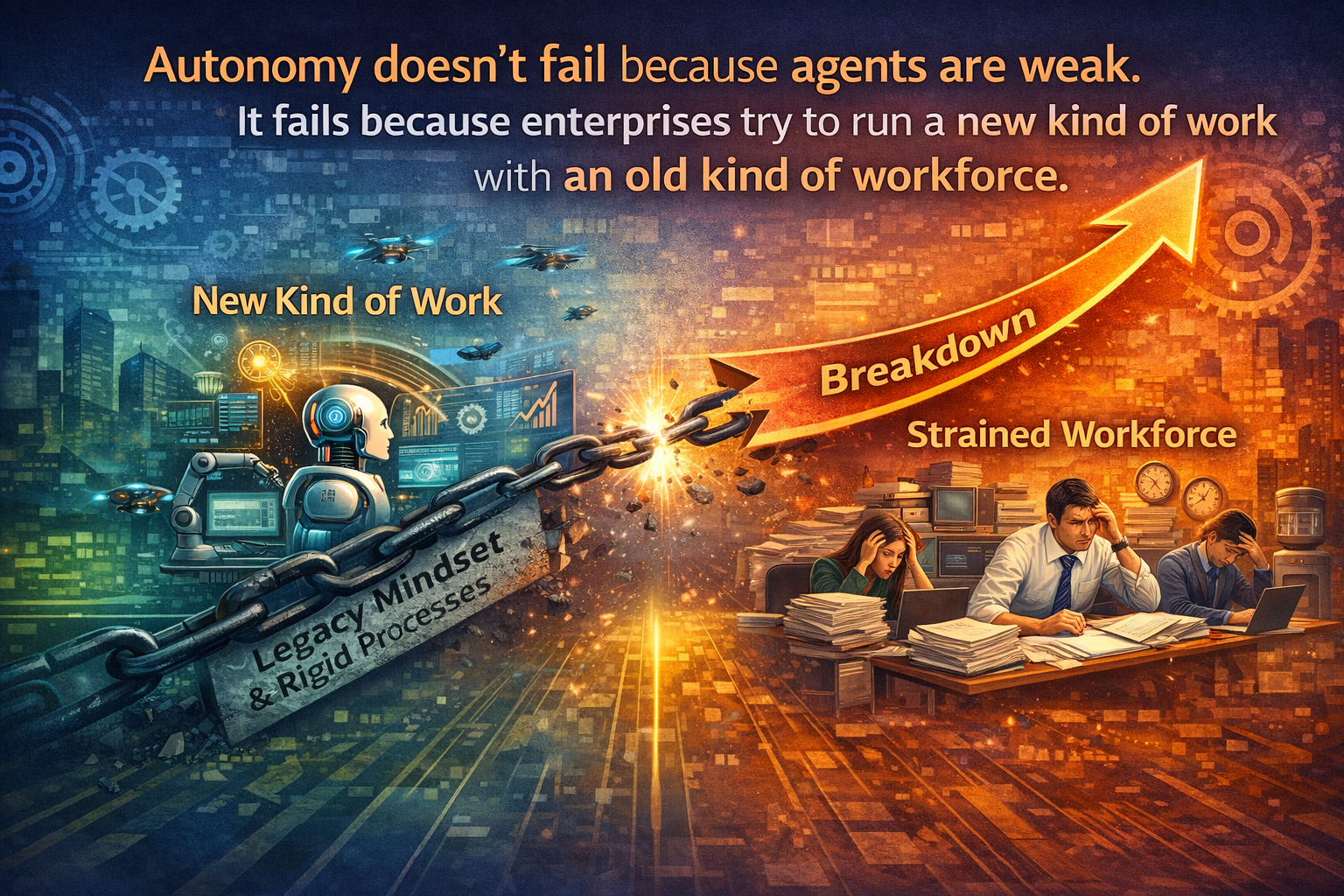
Across industries, organizations are deploying increasingly capable AI agents: systems that approve requests, trigger workflows, update records, coordinate across tools, and act inside real production environments. The models are improving. The tools are maturing. The demos look impressive. Yet many of these initiatives stall, get constrained, or are rolled back—not because the AI is weak, but because the enterprise operating model is unprepared.
This is the uncomfortable truth most AI post-mortems avoid: autonomy does not collapse at the level of intelligence. It collapses at the level of work design.
Enterprises are trying to run a fundamentally new kind of work—continuous, probabilistic, machine-speed work—using a workforce model built for manual processes, linear escalation paths, and constant human oversight. The result is friction everywhere: humans overloaded with approvals, automation constrained by legacy controls, and AI agents forced into narrow roles they were never designed for.
To scale AI safely and sustainably, enterprises don’t just need better models. They need a new workforce model—one designed explicitly for autonomy.
The Real Problem: New Work, Old Workforce
Most enterprise conversations about AI focus on models, platforms, and tooling. Those matter—but they are not the bottleneck.
The real constraint sits between strategy and execution: how work is allocated between humans, software, and AI. Traditional enterprises implicitly assume one dominant pattern: humans decide, tools assist, and automation executes narrowly defined tasks. That assumption breaks the moment AI starts reasoning, planning, and acting.
When AI agents enter production, three failure modes appear almost immediately:
- Humans are pulled into every decision, slowing execution and creating backlogs
- Automation becomes brittle, over-controlled, or blocked by mismatched process design
- AI agents are constrained so tightly that their value evaporates
This is not a technology failure. It is a workforce design failure.
Introducing the Synergetic Workforce
The enterprises that are scaling AI successfully are converging on a different idea—often implicitly, sometimes intentionally:
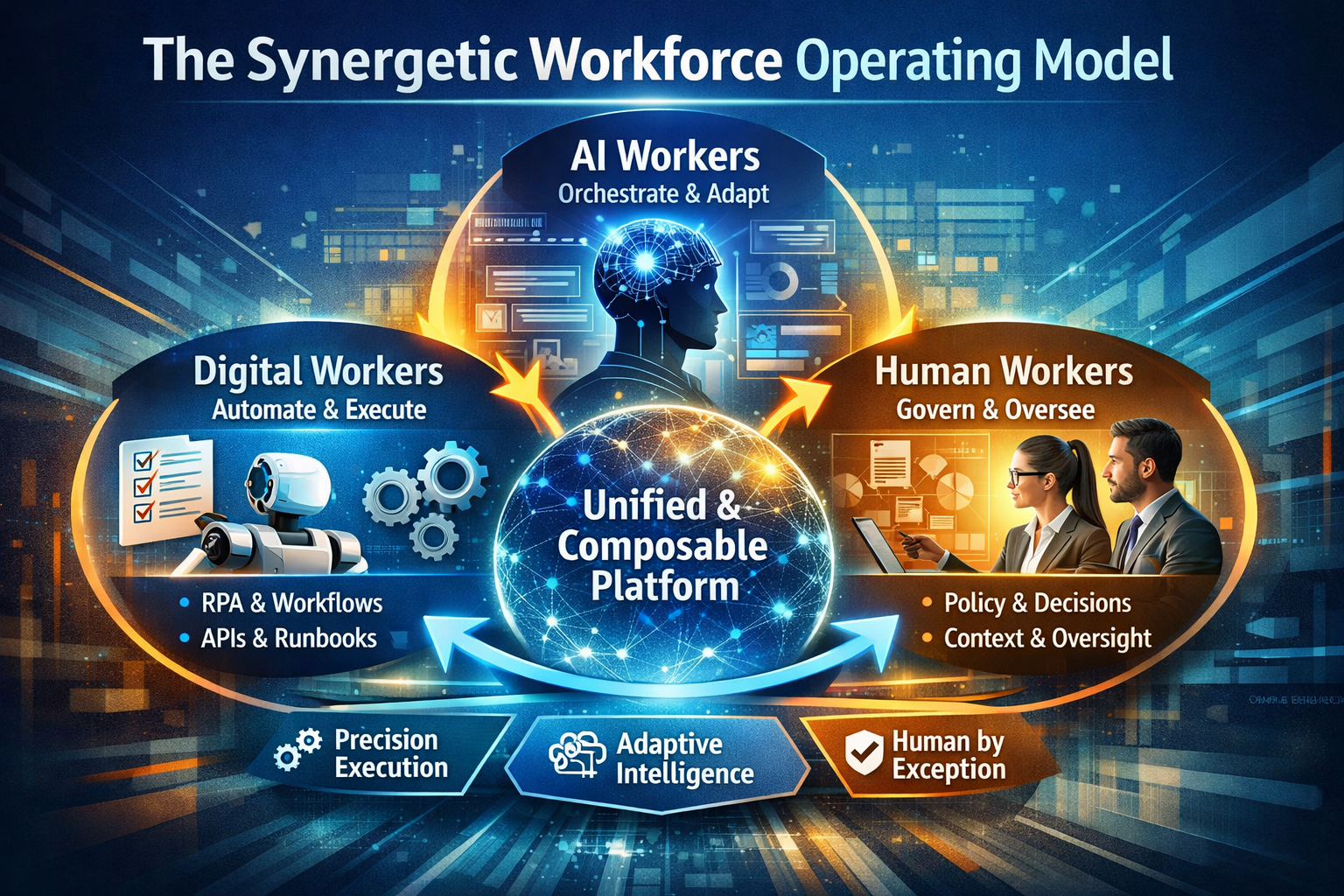
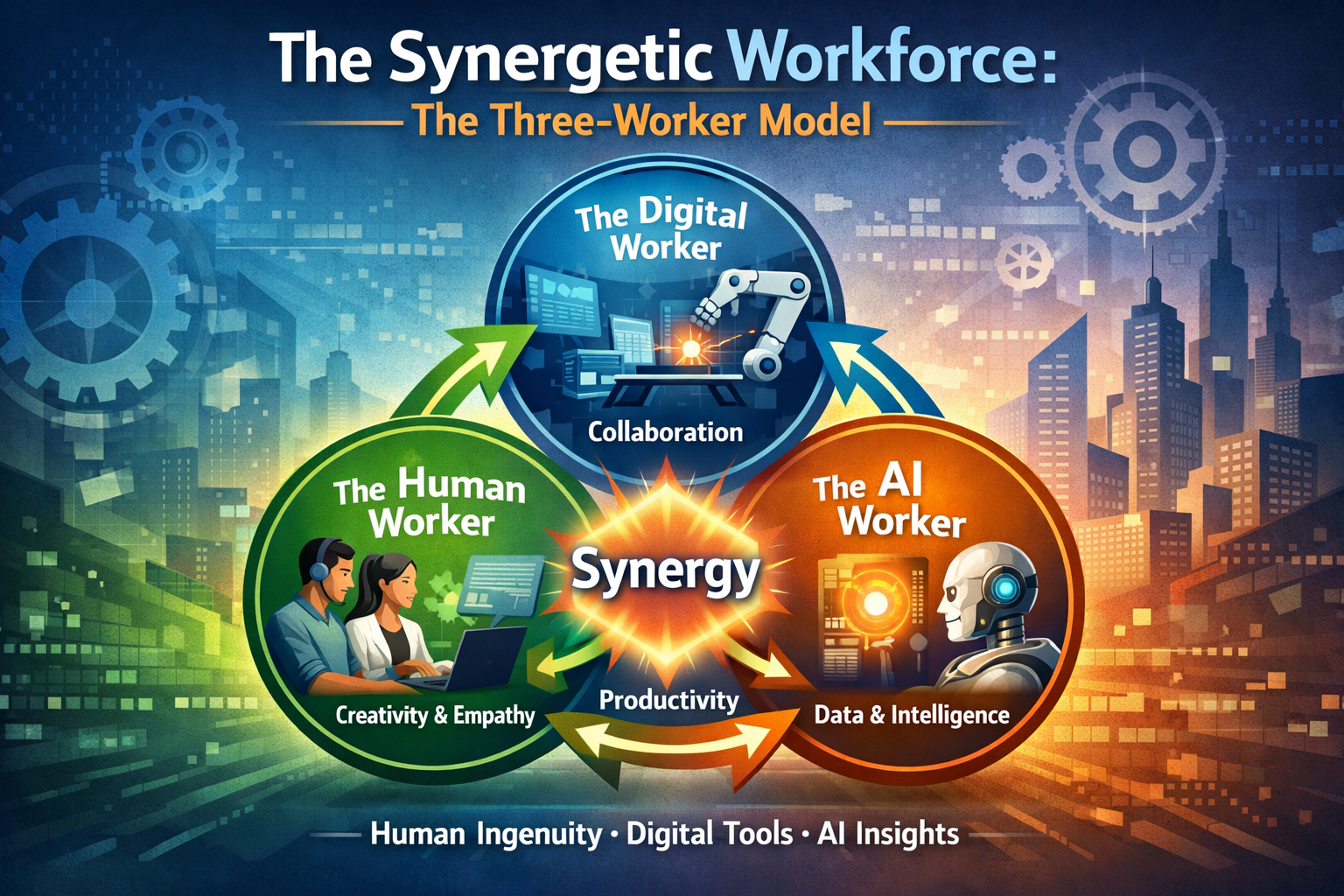
Work is no longer performed by humans alone, or even by humans with tools. It is performed by a coordinated system of three workers.
- Human workers, who bring judgment, creativity, context, and accountability
- Digital workers, which execute deterministic, repeatable processes reliably
- AI workers, which reason, learn, and adapt across ambiguous situations
This is the Synergetic Workforce: a model where each worker type does what it is best suited for, and where productivity emerges from collaboration—not substitution.
The Three-Worker Model Explained
1) The Human Worker
Humans remain essential—but not as constant supervisors.
In a synergetic workforce, the human role shifts toward:
- Defining intent, outcomes, and policy
- Setting boundaries, thresholds, and escalation rules
- Handling ambiguity and edge cases
- Governing performance, risk, and accountability
- Improving the system through feedback and redesign
Humans move up the value chain, away from routine approvals and into judgment-heavy decision-making.
2) The Digital Worker
Digital workers are deterministic systems: workflows, scripts, automation bots, and integration logic.
They excel at:
- Executing known processes at scale
- Enforcing consistency and auditability
- Performing high-volume tasks reliably
- Reducing operational variation
They do not reason—but they anchor execution with speed and repeatability.
3) The AI Worker
AI workers operate in the gray zone between intent and execution.
They can:
- Interpret context across signals and data
- Propose options or take actions under constraints
- Make probabilistic decisions under uncertainty
- Coordinate work across systems and tools
- Detect patterns that humans and deterministic rules may miss
They are neither traditional tools nor employees—but autonomous collaborators operating within defined guardrails.
The Key Design Shift: From Human-in-the-Loop to Human-by-Exception
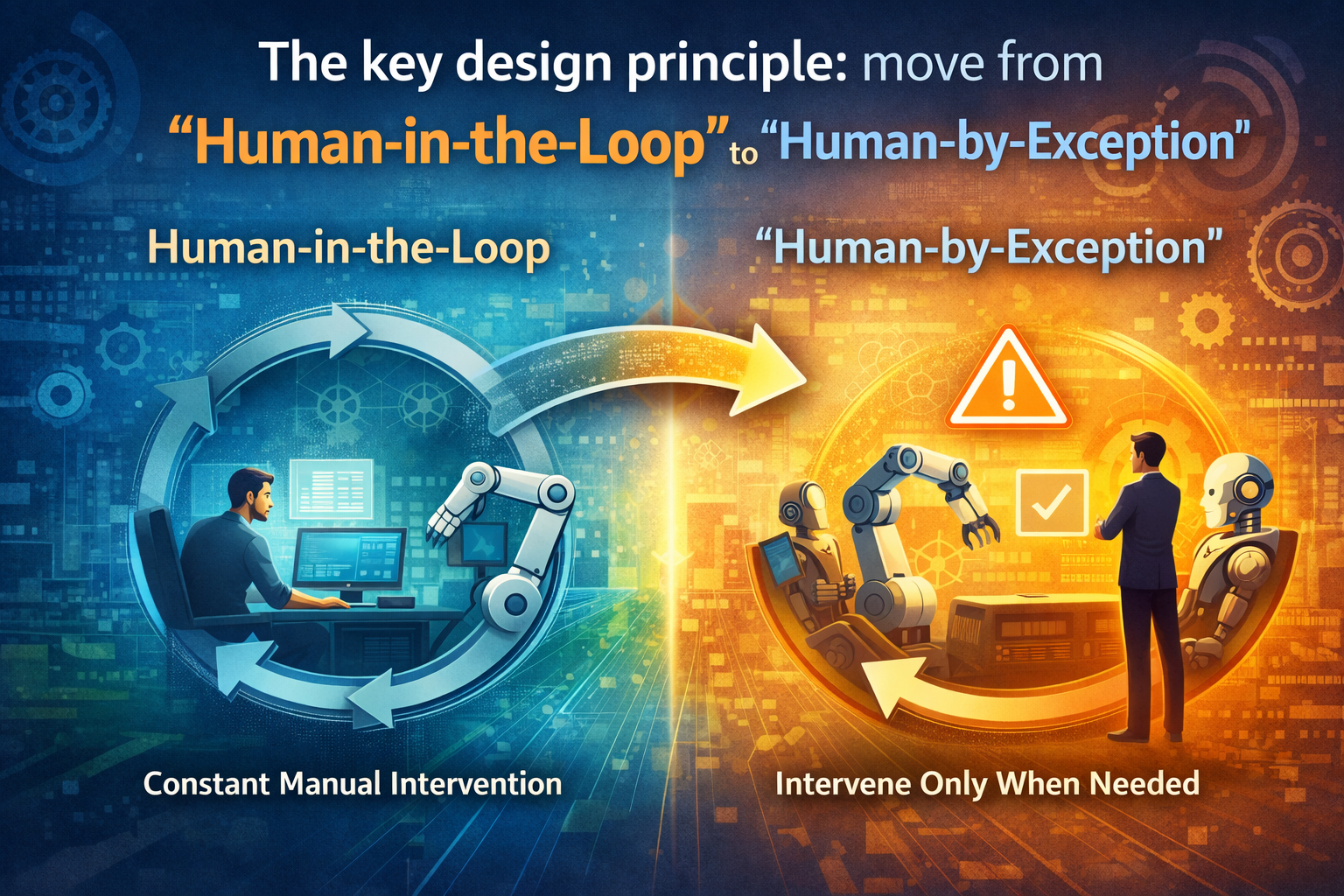
Most enterprises attempt to control AI by placing humans “in the loop” everywhere. It feels safe—but it doesn’t scale.
In practice, it creates:
- Bottlenecks and queue-driven work
- Approval fatigue and human overload
- Slow response cycles that erode business value
- A false sense of safety, because everything becomes an “exception”
The scalable alternative is human-by-exception.
In this model:
- AI and digital workers operate continuously within policies
- Guardrails, approvals, and limits are encoded upfront
- Humans intervene only when signals cross defined boundaries
- Oversight becomes outcome-driven, not step-driven
Oversight shifts from micromanagement to governance—and that’s what makes autonomy operable at scale.
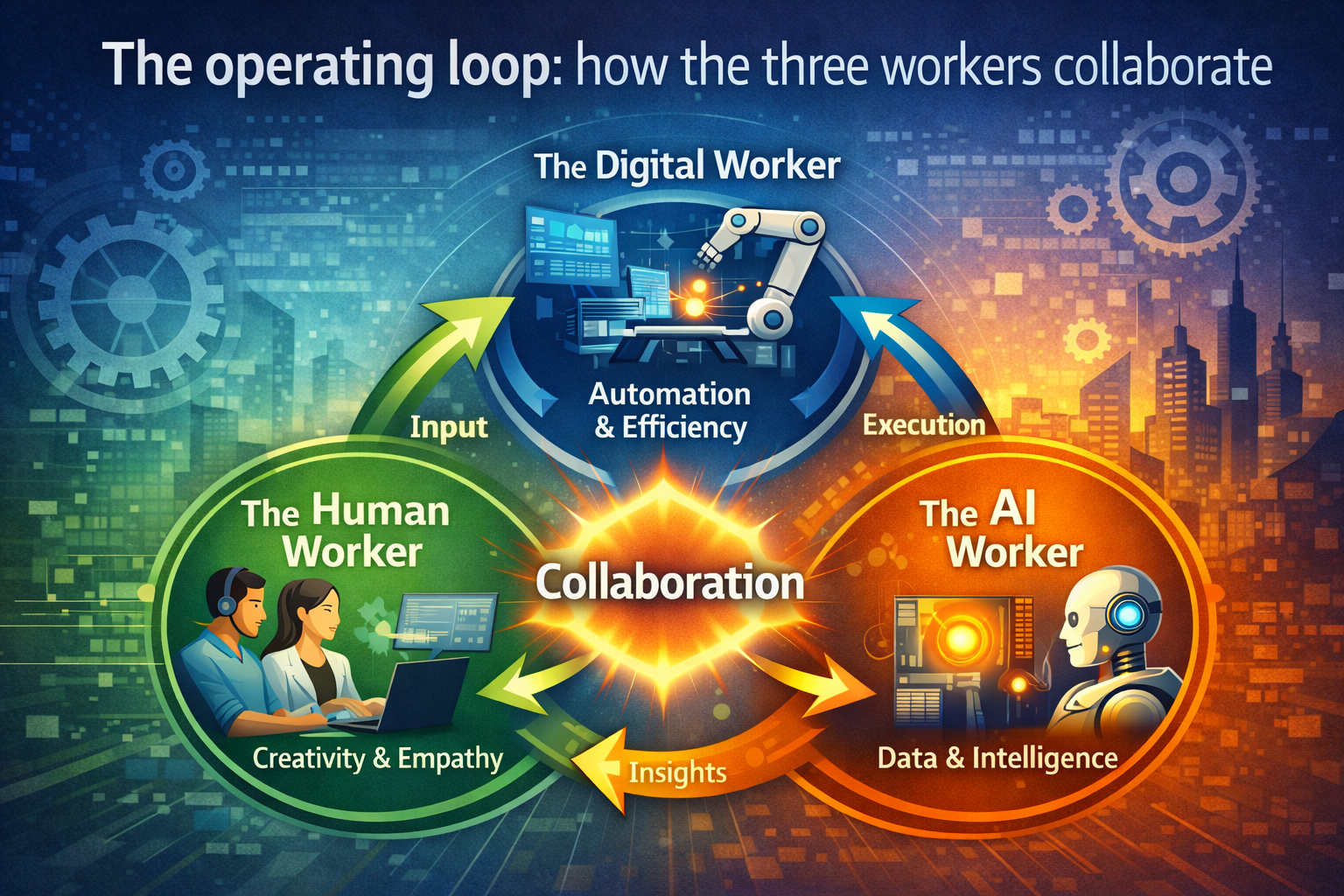
The Operating Loop: How the Three Workers Collaborate
The synergetic workforce is not a hierarchy. It is an operating loop.
- Humans define goals, policies, constraints, and escalation thresholds
- AI workers interpret context and recommend or take actions within those boundaries
- Digital workers execute the actions reliably across enterprise systems
- Telemetry and evidence capture outcomes, policy compliance, and exceptions
- Humans intervene only when exception signals trigger escalation—and then refine rules and thresholds
This loop enables machine-speed execution with human-grade accountability.
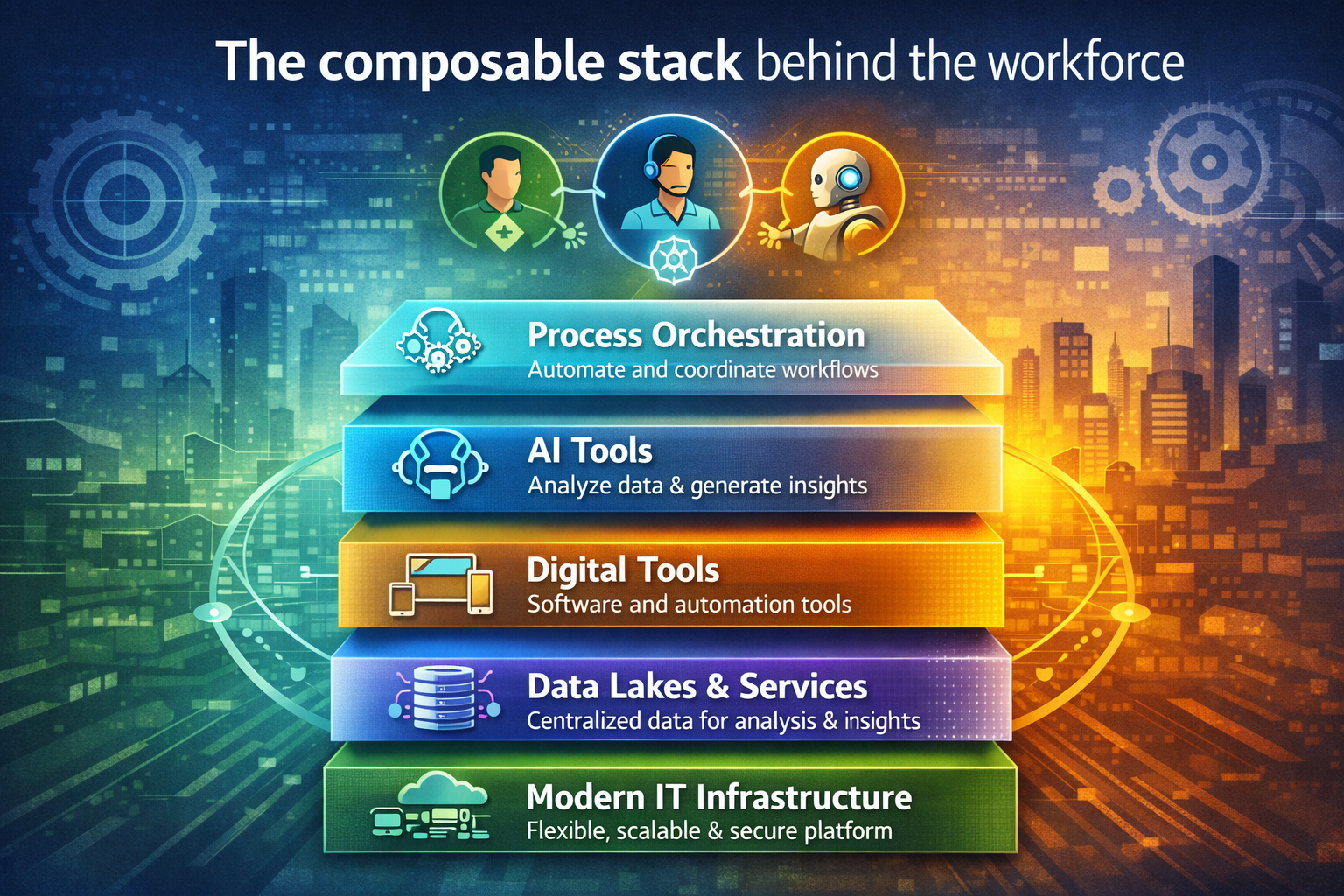
The Composable Stack Behind the Workforce
A new workforce model needs a modern, composable stack behind it.
At a minimum, enterprises require:
- Orchestration to coordinate work across humans, AI, and automation
- Identity and access controls that support machine actors and scoped permissions
- Policy and guardrails to enforce boundaries, thresholds, and compliance
- Observability to track actions, outcomes, drift, and exceptions
- Automation and integration to execute actions across business systems
- Data services and context to ground decisions in enterprise truth
- Resilience and rollback to recover safely when systems behave unexpectedly
The workforce model is the why.
The stack is the how.
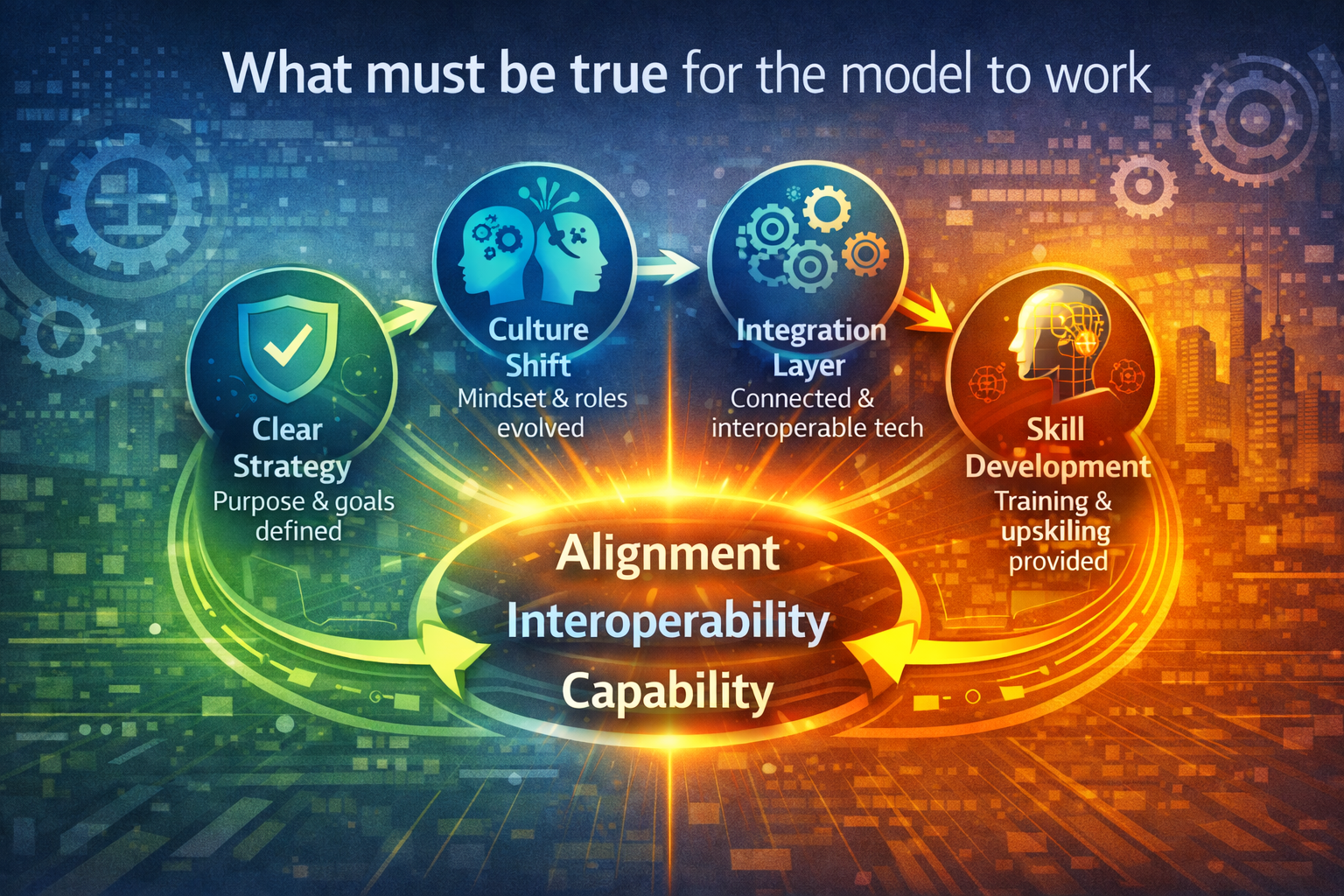
What Must Be True for the Model to Work
Three conditions are non-negotiable:
1) Alignment
The organization must align incentives, accountability, and operating norms with autonomy. If teams are penalized for responsible autonomy, they will revert to manual controls and defensive work.
2) Interoperability
Autonomy cannot scale on disconnected systems. If tools, workflows, and data are fragmented, AI agents become brittle and digital workers become constrained.
3) Capability
Humans must be trained to govern AI systems: set thresholds, review evidence, manage exceptions, and improve operating loops. Without this, the enterprise falls into fear, over-control, or blind trust.
Without these foundations, autonomy becomes either chaos—or paralysis.
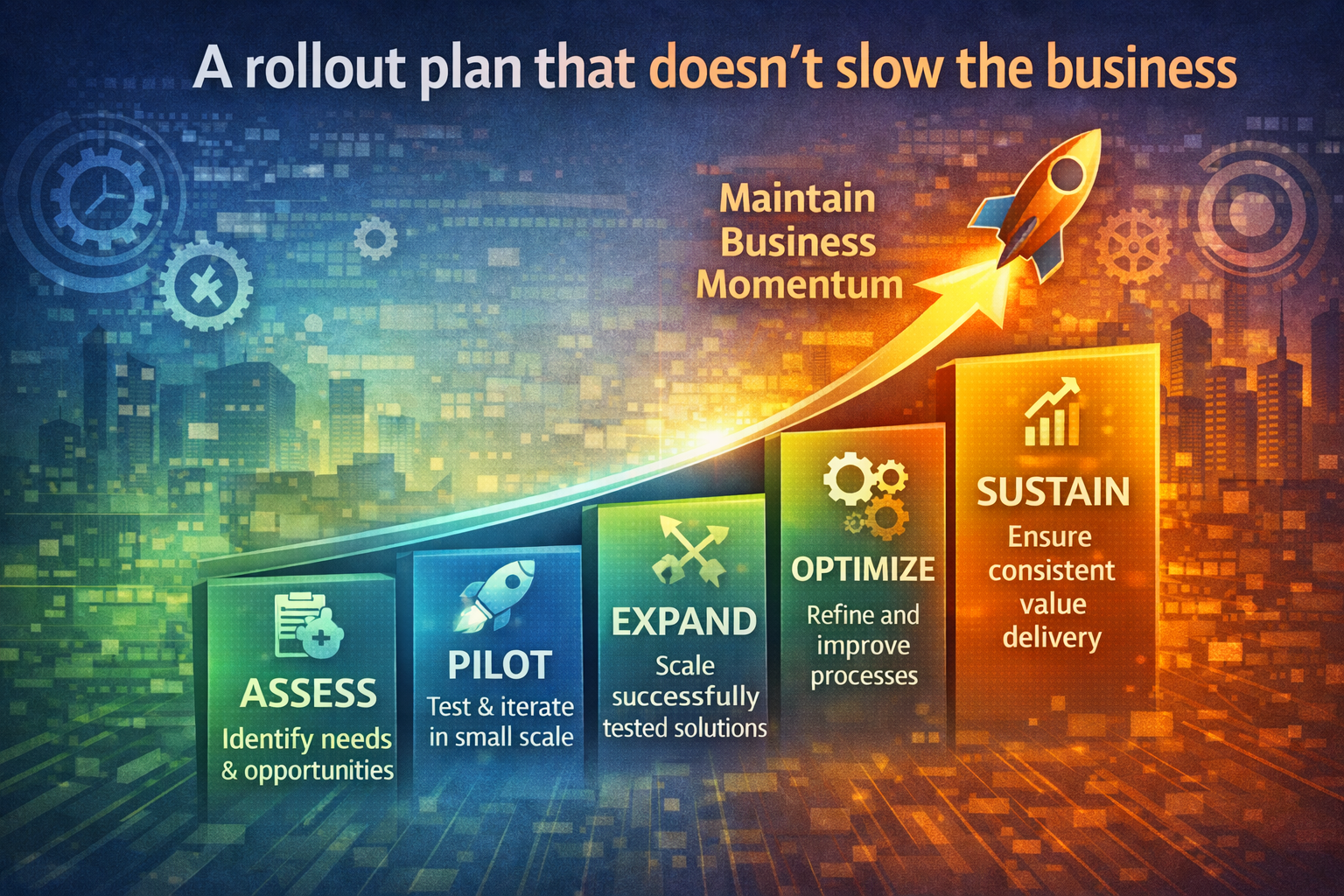
Successful enterprises do not “flip the switch” on autonomy. They roll it out like a disciplined operating upgrade.
Phase 1: Start with bounded workflows
Pick use cases with clear goals, measurable outcomes, and limited blast radius.
Phase 2: Encode guardrails early
Define policies, thresholds, and escalation paths upfront. Treat governance as product design, not a late-stage review.
Phase 3: Build exception handling as a first-class feature
The goal is not perfection. The goal is reliable escalation and fast learning.
Phase 4: Expand through a repeatable playbook
Standardize patterns so every new AI workflow is faster, safer, and easier to operate than the last.
Phase 5: Institutionalize human-by-exception
Shift oversight from continuous supervision to outcome governance, auditability, and periodic review.
The objective is not disruption. It is compounding advantage—scaling autonomy without sacrificing speed.
Why This Model Works Globally
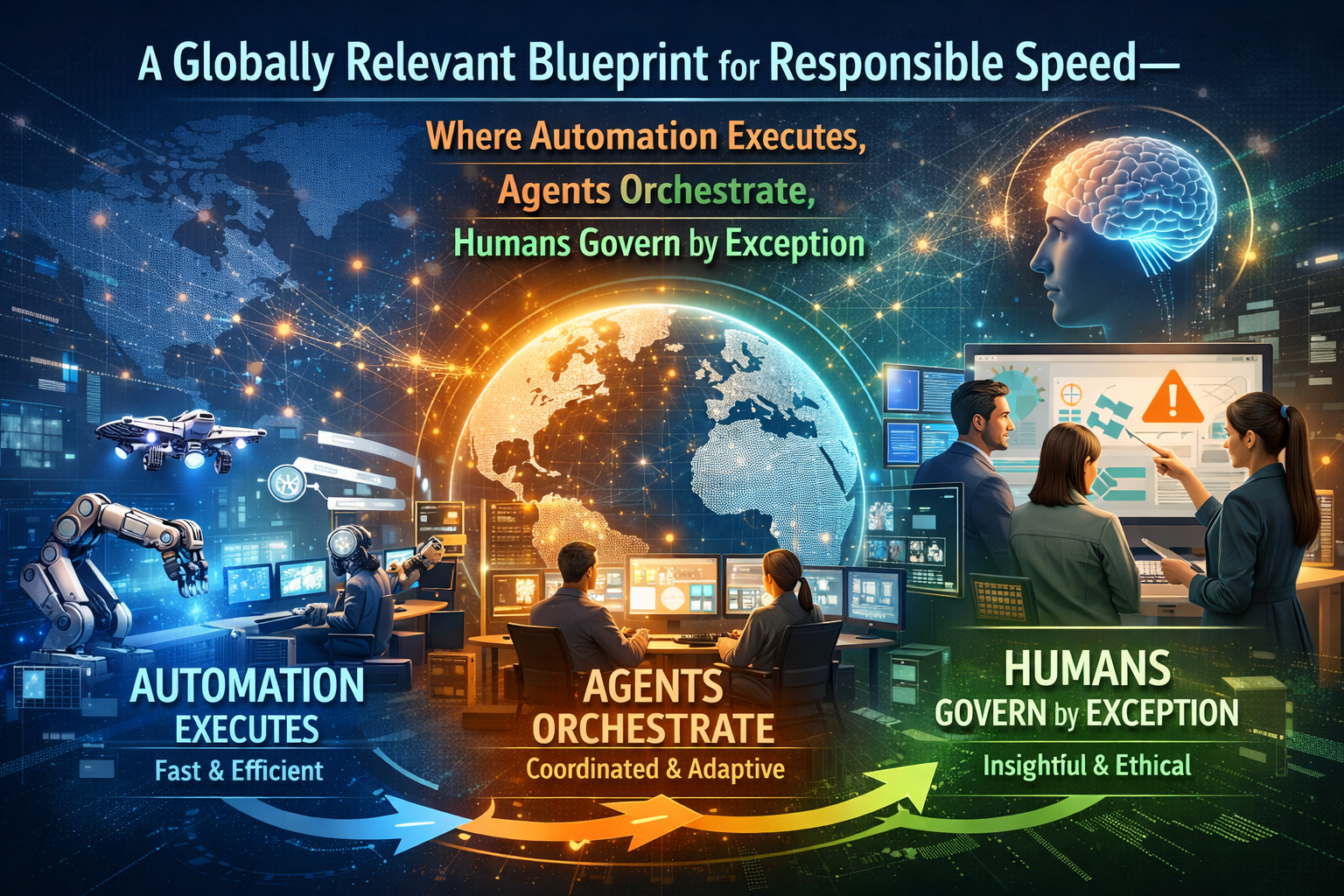
This workforce model travels well because it is not tied to a specific technology stack or region.
It works in mature markets where risk and governance expectations are high, and it works in fast-growth markets where scale and efficiency matter most—because it is built on a universal principle:
separate judgment from execution, and govern exceptions with evidence.
That is as relevant in heavily regulated environments as it is in high-velocity business operations.
Conclusion: The Workforce Is the Real AI Multiplier
Enterprise AI has reached a turning point.
The question is no longer whether AI models can reason, act, or coordinate. They already can. The harder—and more consequential—question is whether enterprises are structurally prepared to operate that autonomy without slowing down, breaking trust, or overwhelming their people.
The synergetic workforce reframes the challenge correctly. It recognizes that scaling AI is not a tooling exercise, nor a talent replacement strategy, but a work design problem. When human judgment, digital execution, and AI reasoning are deliberately orchestrated, autonomy stops being risky and starts becoming repeatable.
Autonomy doesn’t fail because agents are weak. It fails because enterprises try to run a new kind of work with an old kind of workforce.
The enterprises that succeed in the next phase of AI adoption will not be the ones with the most agents in production. They will be the ones that redesign how work itself gets done.
Autonomy doesn’t fail because intelligence is missing.
It fails when the workforce model is outdated.
Glossary
Synergetic Workforce
A workforce model in which human workers, digital workers, and AI workers collaborate through defined roles and operating loops to execute work at scale.
Human-by-Exception
A design principle where humans intervene only when AI or automation encounters uncertainty, risk thresholds, or policy boundaries.
AI Worker
An autonomous or semi-autonomous AI system capable of reasoning, planning, and acting across enterprise workflows within defined guardrails.
Digital Worker
Deterministic automation systems such as workflows, scripts, or bots that reliably execute predefined processes.
Agentic AI
AI systems designed to take goal-directed actions rather than merely generate outputs.
Enterprise AI Operating Model
The governance, workforce, and platform structure required to run AI safely and repeatedly in production environments.
Frequently Asked Questions
Why do enterprise AI initiatives fail at scale?
Many failures occur not because AI models are weak, but because enterprises use workforce models designed for manual or tool-assisted work to govern autonomous systems.
What is the synergetic workforce model?
It is a workforce design that intentionally combines human judgment, digital execution, and AI reasoning into a single operating loop for work.
What does “human-by-exception” mean in practice?
Humans define goals, guardrails, and escalation thresholds, intervening only when AI systems encounter ambiguity, risk, or policy boundary conditions.
Is this model relevant only for large enterprises?
No. While most visible in large organizations, the model applies to any organization deploying AI agents across real workflows.
How is this different from traditional automation?
Traditional automation replaces tasks. The synergetic workforce redesigns how decisions, execution, and accountability are distributed.
Does this model work across regions and regulations?
Yes. It is effective globally because it makes accountability explicit and supports governance-through-evidence.
Why does enterprise AI autonomy fail?
Because organizations attempt to run autonomous AI using workforce models designed for manual or tool-assisted work.
Is this model relevant globally?
Yes. It applies across regulated and fast-growing markets—including the US, EU, India, and the Global South.
Further Reading
If you’re exploring how enterprises are re-architecting AI at scale, the following topics provide useful context:
-
- Enterprise AI operating models and control planes
- Agentic AI and autonomous systems in production
- Human-by-exception governance frameworks
- Digital workers and intelligent automation
- AI safety, accountability, and enterprise governance
- Services-as-Software and composable AI platforms
- AgentOps Is the New DevOps: How Enterprises Safely Run AI Agents That Act in Real Systems – Raktim Singh
- The Agentic AI Platform Checklist: 12 Capabilities CIOs Must Demand Before Scaling Autonomous Agents | by RAKTIM SINGH | Dec, 2025 | Medium
- Agentic FinOps: Why Enterprises Need a Cost Control Plane for AI Autonomy – Raktim Singh
- Service Catalog of Intelligence: How Enterprises Scale AI Beyond Pilots With Managed Autonomy – Raktim Singh
- The Agentic Identity Moment: Why Enterprise AI Agents Must Become Governed Machine Identities – Raktim Singh
- The Enterprise AI Control Plane: Why Reversible Autonomy Is the Missing Layer for Scalable AI Agents | by RAKTIM SINGH | Dec, 2025 | Medium
- The AI SRE Moment: How Enterprises Operate Autonomous AI Safely at Scale | by RAKTIM SINGH | Dec, 2025 | Medium
If you found this useful, explore more essays on enterprise AI, autonomy, and operating models at raktimsingh.com.



Raktim Singh is an AI and deep-tech strategist, TEDx speaker, and author focused on helping enterprises navigate the next era of intelligent systems. With experience spanning AI, fintech, quantum computing, and digital transformation, he simplifies complex technology for leaders and builds frameworks that drive responsible, scalable adoption.