


The Institutional Redesign of Indian IT: From Services Firms to Intelligence Institutions
For three decades, Indian IT built one of the most successful scale stories in modern business—powered by delivery excellence, process maturity, and a globally trusted talent engine.
But the AI decade is changing the unit of value.
As generative AI improves productivity and agentic systems begin to execute multi-step work inside enterprise workflows, the old question—“How many people does this require?”—is being replaced by a sharper board question:
“How intelligently can this enterprise operate—and how safely can it delegate decisions to machines?”
That is why today’s “doom” debate—amplified by market anxiety around IT services and AI disruption—is both understandable and incomplete. Reuters has reported the widening “AI scare trade” across sectors and the spillover into market narratives that punish labor-intensive models. (Reuters)
But here is the board-level truth that reframes the decade:
AI is not only a productivity shock. It is an institutional shock.
It doesn’t just change how work is done. It changes what organizations are.
The winners will not be the firms that adopt the most AI tools the fastest. They will be the firms that redesign themselves into intelligence institutions: organizations built to produce, govern, and operate enterprise intelligence reliably—like a utility, not a prototype.
This article is written for board members and C-suite leaders across India’s IT ecosystem—Bengaluru, Hyderabad, Pune, Chennai, Gurugram, Mumbai—and for global enterprise leaders who depend on Indian IT as a strategic partner.
It is not a defense of the past. It is a blueprint for the next institutional form.
Executive summary for boards
- AI compresses effort in delivery and engineering. (McKinsey & Company)
- AI expands enterprise complexity through autonomous workflows, faster change cycles, and new accountability surfaces.
- The market will increasingly pay for operated intelligence: reliability, auditability, defensibility, cost control, and safe delegation.
- Indian IT can win by becoming intelligence institutions—not just AI-enabled services firms.
- Boards must lead five institutional shifts: decision capacity, recurring capability revenue, trust maturity, intelligence density, institutional identity.

1) Why this is an institutional moment, not a technology moment
Every major technology wave has two phases:
- Phase 1: Tool adoption (teams experiment; pockets of productivity appear)
- Phase 2: Institutional redesign (operating models, contracts, KPIs, governance, and talent systems change)
We are crossing into Phase 2.
The tool impact is already measurable. McKinsey has reported that developers can complete certain coding tasks up to twice as fast with generative AI in specific contexts. (McKinsey & Company)
Meanwhile, Gartner projected that up to 40% of enterprise applications may include integrated task-specific AI agents by 2026 (up from <5% in 2025). (Gartner)
This matters because agents don’t just assist. They act—inside workflows, approvals, customer interactions, and operational systems. And once systems act, enterprises need more than tools. They need institutions of accountability.
So, the redesign is not optional. It is the price of scaling.
The AI era is not a tool shift. It is an institutional shift.
Services firms build projects. Institutions build trust.
2) What is an “intelligence institution”?
An intelligence institution is not “a services firm that uses AI.”
It is a firm designed to operate intelligence as a governed enterprise capability.
Think of the difference between:
- a team that uses spreadsheets, and
- a finance institution that produces audited statements, maintains controls, and can be trusted under scrutiny.
AI is pushing Indian IT toward the second model.
A simple definition
An intelligence institution is a company whose core product is trusted, operated enterprise intelligence—delivered repeatedly, economically, and defensibly across clients.
Not “projects.”
Not “headcount.”
Not “tool rollout.”
But a repeatable institutional capability: run intelligence in the enterprise, under real constraints.

3) The institutional shock: why the old services form becomes fragile
The classic services form was optimized for effort economics:
- scope defined upfront
- work decomposed into tasks
- quality managed through process
- pricing aligned to time-and-materials or fixed scope
- governance focused on delivery risk and timelines
AI breaks each assumption in subtle—but decisive—ways:
-
A) Effort becomes a declining unit of value
When productivity tools accelerate tasks, effort becomes less scarce. Value shifts upward—from execution to outcomes, reliability, and accountability. (McKinsey & Company)
-
B) Work becomes continuous, not episodic
Agentic systems evolve in production. Prompts change. Policies change. Retrieval sources change. Tool access expands. The “project” frame becomes insufficient.
-
C) Risk surfaces change shape
Traditional risk: delays, defects, security vulnerabilities.
AI risk: wrong actions, untraceable recommendations, compliance ambiguity, drift, and costs that rise after “successful adoption.”
Gartner has predicted that over 40% of agentic AI projects may be canceled by end of 2027 due to escalating costs, unclear business value, or inadequate risk controls. (Gartner)
That isn’t a reason to fear agents. It is evidence that institutions—not demos—will decide outcomes.
-
D) Clients won’t buy tools; they’ll buy assurance
As AI embeds into regulated and mission-critical workflows, clients will demand evidence: what happened, why it happened, and who is accountable.
That is institutional territory.
4) The redesign thesis: Indian IT must shift from services firms to intelligence institutions
Here is the central proposition:
Indian IT’s opportunity is not to “compete with AI.”
It is to become the operating layer that makes enterprise AI safe, scalable, and economically sustainable.
That is a premium global role—because most enterprises are not built to operate autonomy. They are built to operate software.
Indian IT can become the partner that helps enterprises cross this gap—at speed, with discipline, and at scale.
But to do that, boards must lead redesign across five institutional dimensions.
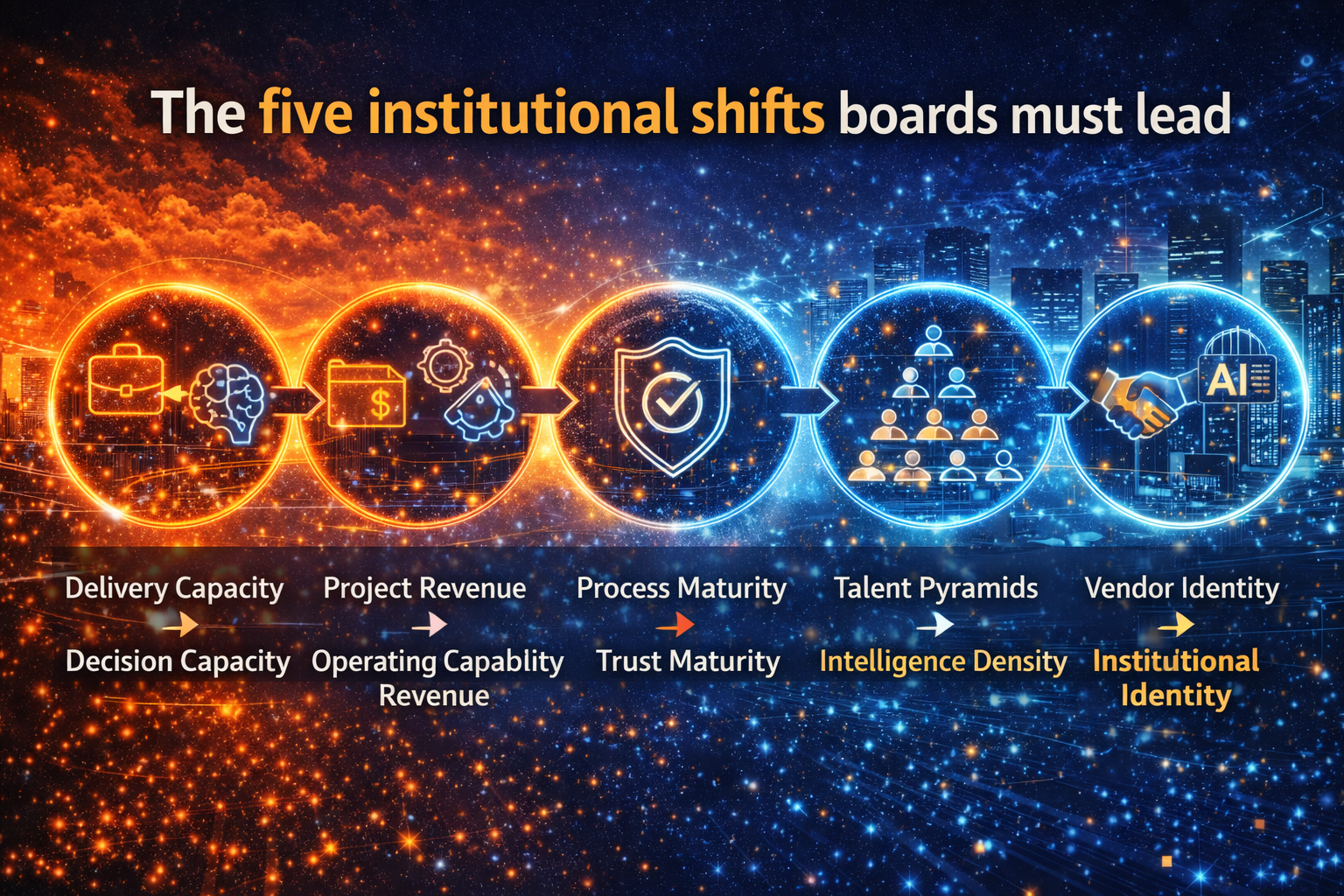
5) The five institutional shifts boards must lead
Shift 1: From delivery capacity to decision capacity
In the old model, scale meant more delivery—more people, more throughput.
In the new model, scale means decision capacity:
- how quickly decisions move through the enterprise
- how defensible those decisions are
- how reliably autonomy can be delegated
Simple example:
Two vendors automate the same customer workflow.
Vendor A delivers a bot quickly.
Vendor B delivers a governed decision workflow with auditability, escalation paths, and reversibility.
Boards will trust—and renew—Vendor B.
That is institutional advantage.
Shift 2: From project revenue to operating-capability revenue
If AI compresses effort, project pricing gets pressured. That pressure is visible in market narratives that treat AI as a compression force on labor-linked business models. (Reuters)
The response is not defensive cost cutting. The response is productizing capability.
New recurring revenue forms:
- managed intelligence operations (agent runtime management Enterprise AI Runtime: What Is Actually Running in Production (And Why It Changes Everything) – Raktim Singh
- compliance-grade AI assurance
- intelligence cost governance (FinOps for AI Agentic FinOps: Why Enterprises Need a Cost Control Plane for AI Autonomy – Raktim Singh
- reusable workflow packs for industries (BFSI, telecom, healthcare, retail)
This moves Indian IT toward capability subscriptions—away from episodic bespoke dependence.
Shift 3: From process maturity to trust maturity
Indian IT’s historic moat was process excellence—predictability, quality, reliability.
In the AI era, the moat becomes trust maturity:
- explainability where needed
- traceability and evidence
- policy alignment
- audit readiness
- safe delegation and reversibility
This is not about building the most advanced model. It is about building the most governable enterprise intelligence.
That is the institutional product.
Shift 4: From talent pyramids to intelligence density
The old operating logic optimized pyramids: leverage junior layers through standardized processes.
AI changes leverage. It reduces the need for some repetitive work while increasing demand for:
- workflow designers who understand decision points
- system owners who can run agentic workflows safely
- QA engineers who test autonomy, not just outputs
- cost governors who can manage AI spend variability
The board-level metric shifts from headcount growth to intelligence density:
- how much governed, high-quality output is produced per unit of organizational complexity
Shift 5: From vendor identity to institutional identity
In the past, many services brands were evaluated on:
- cost advantage
- delivery track record
- scale
In the next decade, identity must become:
- AI operating partner
- trusted intelligence operator
- governed autonomy institution
This is how you stop being benchmarked like a vendor and start being trusted like infrastructure.
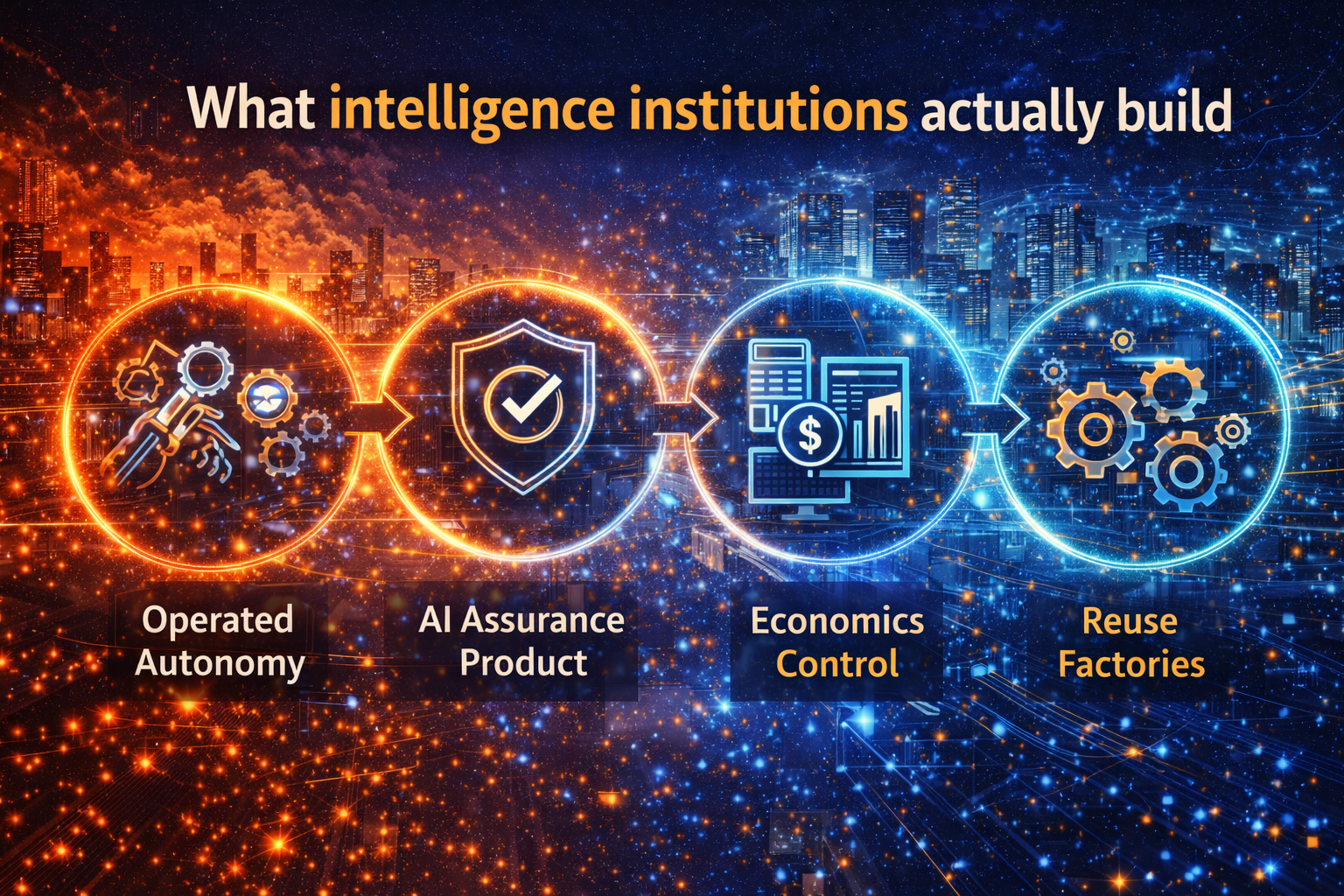
6) What intelligence institutions actually build
To make this concrete—without turning the article into a technical manual—here are the institution-grade capabilities boards should sponsor:
Capability A: Operated autonomy
Not “AI that generates,” but AI that acts in workflows—with:
- clear boundaries
- escalation paths
- evidence and traceability
- safe rollbacks
Capability B: AI assurance as a product
Think of it as “auditability for intelligence.”
Clients pay for:
- evaluation regimes
- compliance mapping
- operational controls
- incident response playbooks
Capability C: Economics governance
AI cost is not linear. It spikes with usage and varies by model and workflow.
An intelligence institution makes cost predictable through governance—turning “AI spend” into AI margin.
Capability D: Reuse factories
The most profitable future is not bespoke delivery. It is reuse:
- reusable agent patterns
- reusable domain workflows
- reusable guardrail policies
- reusable operating templates
- The Intelligence Reuse Index: Why Enterprise AI Advantage Has Shifted from Models to Reuse – Raktim Singh
This is how Indian IT moves from “execution at scale” to “capability at scale.”
7) A board-friendly view of the opportunity: the new value pools
The institutional redesign unlocks value pools larger than “AI rollout services”:
- Enterprise AI-fication programs: redesigning workflows for intelligence (not one-off pilots)
- Agentic runtime operations: running agent fleets like mission-critical infrastructure
- AI assurance and compliance: operationalizing trust Agentic Quality Engineering: Why Testing Autonomous AI Is Becoming a Board-Level Mandate – Raktim Singh
- AI FinOps and cost governance: making intelligence economically sustainable
- Reusable industry intelligence packs: BFSI/telecom/healthcare/retail accelerators
- Decision throughput transformation: accelerating the enterprise’s decision metabolism
These are multi-year relationships, not episodic projects.
And that is the point: institutions create durable value because they create durable trust.
8) What boards should do in the next 12 months
Boards usually want clarity, not slogans. Here are five decisions that matter now:
1) Mandate a shift in business model vocabulary
Replace internal language like:
- billable utilization
- resource mix
- effort estimates
With:
- operating capability
- governed autonomy
- reuse and repeatability
- trust maturity
- outcome economics
Language is strategy. Boards shape language.
2) Redesign KPIs to reward institutional capability
If incentives remain effort-centric, the organization will defend effort-centric models.
Board-level KPI evolution should include:
- % revenue from recurring capability services
- reuse rate of workflow assets
- reduction in cost variance for AI operations
- trust maturity measures (audit readiness, traceability coverage)
- customer outcome metrics—not tool adoption metrics
3) Create an institutional platform strategy—not a tool strategy
Tools will change fast. Institutions endure.
Sponsor reusable platforms, not vendor dependency:
- a unified operating layer across clients
- governance patterns that repeat
- economic control patterns that scale
4) Talent strategy: build institutional roles
Not “AI training for everyone,” but role creation:
- autonomy reliability leads
- AI assurance leads
- workflow decision designers
- AI cost governors
5) Tell the market the truth—confidently
The market fear isn’t irrational. It is reacting to AI as a compression force—often broadly and quickly. (Reuters)
The answer is not denial. The answer is a credible institutional story:
- which value pools are being built
- what capabilities are now productized
- how recurring revenue will rise
- how margins will expand through reuse
Institutional strategy must be communicated as strategy—not PR.
9) The global context: why this redesign is inevitable worldwide
This is not only an Indian story. It is a global enterprise story.
- Agentic systems are moving into enterprise apps quickly. (Gartner)
- Many agentic projects will fail without cost and risk controls—creating demand for operating partners. (Gartner)
- Productivity acceleration is real, but it shifts value upward into governance, reliability, and economics. (McKinsey & Company)
This combination creates a predictable outcome:
The world will need intelligence operators.
Firms that can run governed autonomy will become infrastructure providers.
Indian IT has the enterprise proximity, operational discipline, and delivery scale to occupy this role—if it redesigns itself institutionally.
Indian IT is not facing an extinction event.
It is facing a structural promotion.
From executing work
to governing intelligence.
From selling effort
to selling institutional capability.
From vendor identity
to infrastructure identity.
Boards that understand this early will not be defending margins.
They will be defining the global blueprint for enterprise AI operations.
And that blueprint will outlast any single technology cycle.
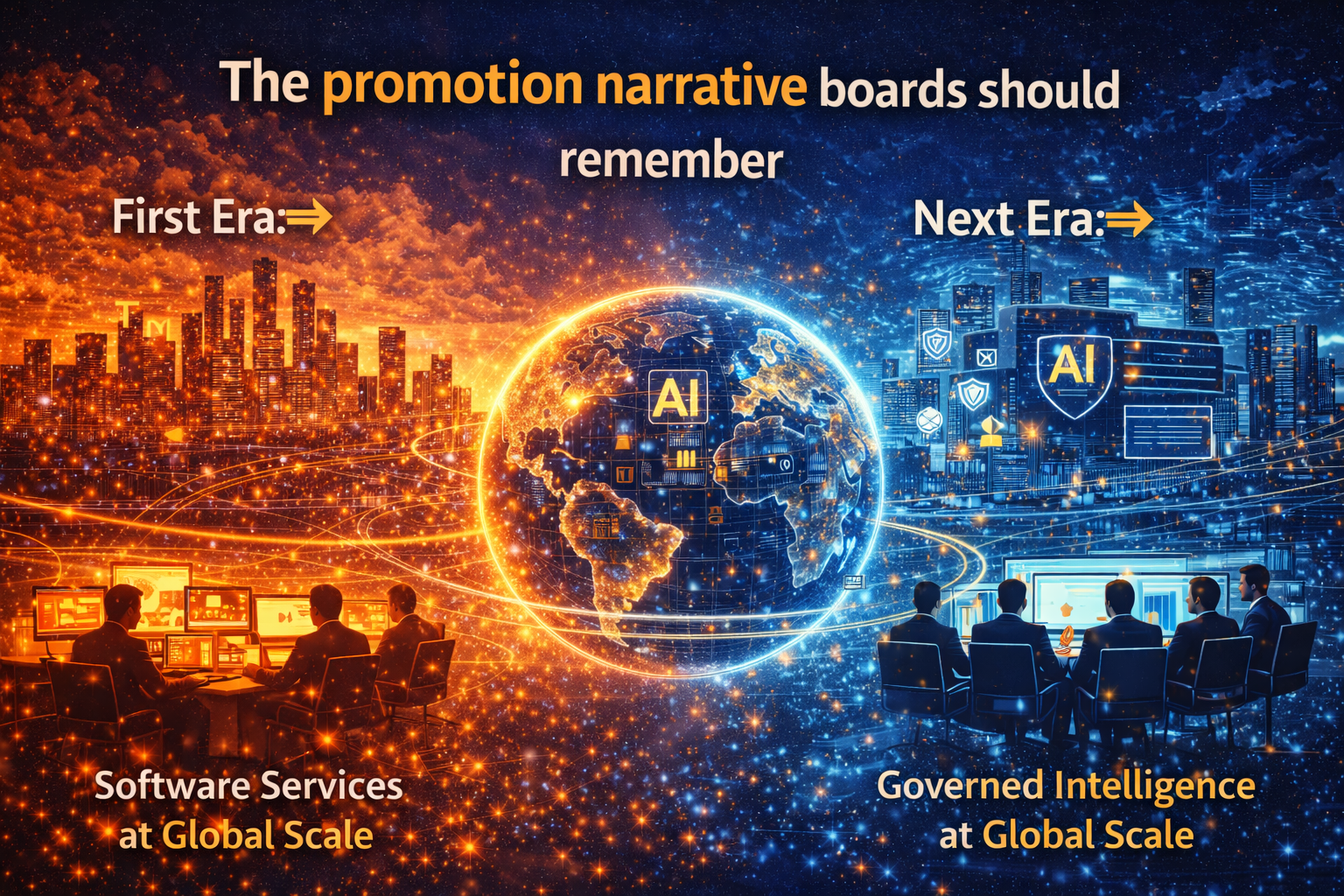
Conclusion column: the promotion narrative boards should remember
Indian IT is not facing an extinction event.
It is facing a category promotion.
The first era was built on delivering software services at global scale.
The next era will be built on delivering governed intelligence at global scale.
That requires more than adopting AI tools. It requires becoming a different institutional form—an intelligence institution with:
- repeatable operating capability
- trust maturity as a product
- economics governance as a discipline
- reuse as the engine of margin
- decision capacity as the core value unit
Boards that lead this redesign won’t merely protect revenue in the AI decade.
They will define the global blueprint for what enterprise AI services becomes.
And that blueprint—done right—will not just be read.
It will be referenced.
Enterprise AI Operating Model
Enterprise AI scale requires four interlocking planes:
Read about Enterprise AI Operating Model The Enterprise AI Operating Model: How organizations design, govern, and scale intelligence safely — Raktim Singh
- Read about Enterprise Control Tower The Enterprise AI Control Tower: Why Services-as-Software Is the Only Way to Run Autonomous AI at Scale — Raktim Singh
- Read about Decision Clarity The Shortest Path to Scalable Enterprise AI Autonomy Is Decision Clarity — Raktim Singh
- Read about The Enterprise AI Runbook Crisis The Enterprise AI Runbook Crisis: Why Model Churn Is Breaking Production AI — and What CIOs Must Fix in the Next 12 Months — Raktim Singh
- Read about Enterprise AI Economics Enterprise AI Economics & Cost Governance: Why Every AI Estate Needs an Economic Control Plane — Raktim Singh
Read about Who Owns Enterprise AI Who Owns Enterprise AI? Roles, Accountability, and Decision Rights in 2026 — Raktim Singh
Read about The Intelligence Reuse Index The Intelligence Reuse Index: Why Enterprise AI Advantage Has Shifted from Models to Reuse — Raktim Singh
Read about Enterprise AI Agent Registry Enterprise AI Agent Registry: The Missing System of Record for Autonomous AI — Raktim Singh
Glossary
- Intelligence institution: An organization designed to produce and operate trusted enterprise intelligence repeatedly, safely, and economically.
- Institutional redesign: Changing governance, KPIs, contracts, talent systems, and identity—not just technology.
- Governed autonomy: AI systems that can act within workflows under policies, boundaries, and traceability.
- Trust maturity: The ability to prove decisions are compliant, traceable, auditable, and reversible.
- Intelligence density: Governed, high-quality output produced per unit of organizational complexity.
- Reuse factory: A system for creating reusable workflows, policies, and agent patterns that scale across clients.
-
Intelligence Institution
An organization designed to operate governed enterprise intelligence reliably and repeatedly.Institutional Redesign
The transformation of governance, incentives, KPIs, contracts, and talent models—not just tools.Governed Autonomy
AI systems that act within defined boundaries, with traceability and reversibility.Trust Maturity
The ability to prove AI decisions are compliant, auditable, and defensible.Intelligence Density
High-quality, governed output produced per unit of organizational complexity.Operating Capability Revenue
Recurring revenue from managed AI capabilities rather than effort-based projects.
FAQ
1) Is this saying Indian IT must become a product industry?
No. It is saying Indian IT must productize operating capability—recurring, reusable, governed intelligence services—beyond bespoke project effort.
2) Why can’t enterprises build these capabilities themselves?
Some will. Many won’t—because operating autonomy requires assurance, cost control, governance discipline, and continuous recomposition. That gap is the partner opportunity.
3) What is the one board decision that matters most?
Reset incentives: away from effort metrics and toward capability metrics—reuse, recurring revenue, trust maturity, and outcome economics.
4) Are agents real value or hype?
They are moving into enterprise software, but many projects will fail without risk/cost controls—exactly why intelligence institutions will matter. (Gartner)
5) How does this connect to Enterprise AI strategy?
Enterprise AI becomes durable when it becomes institutional: ownership, controls, economics, and repeatability—not experiments.
1. Is AI a threat to Indian IT services?
AI compresses effort-based work but expands demand for governed, operated intelligence capabilities.
2. What is an intelligence institution?
It is a firm built to operate enterprise AI reliably under governance, economic control, and regulatory constraints.
3. Why must boards lead institutional redesign?
Because the shift affects revenue models, KPIs, incentives, risk structures, and identity—not just technology adoption.
4. Will Indian IT need fewer people?
The focus shifts from headcount growth to intelligence density and high-value institutional roles.
5. How does this connect to Enterprise AI strategy?
Enterprise AI becomes durable when it is institutionalized—ownership, controls, economics, and repeatability.
References and further reading
- Reuters on AI-driven disruption narratives and cross-sector “AI scare trade” dynamics. (Reuters)
- McKinsey on developer productivity gains with generative AI. (McKinsey & Company)
- Gartner on task-specific AI agents embedded in enterprise apps by 2026. (Gartner)
- Gartner on >40% of agentic AI projects being canceled by 2027 due to cost/value/risk controls. (Gartner)



Raktim Singh is an AI and deep-tech strategist, TEDx speaker, and author focused on helping enterprises navigate the next era of intelligent systems. With experience spanning AI, fintech, quantum computing, and digital transformation, he simplifies complex technology for leaders and builds frameworks that drive responsible, scalable adoption.