

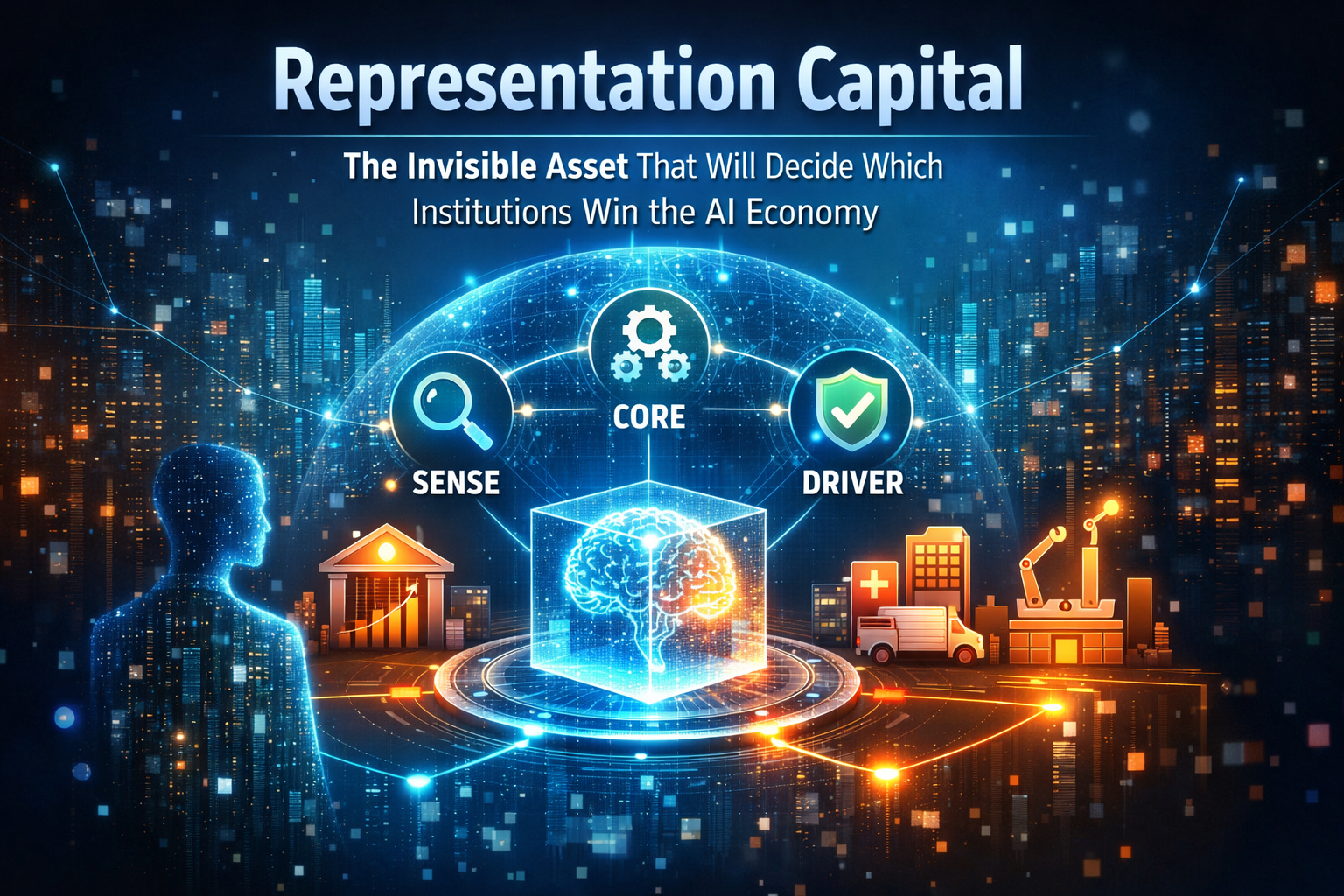
Representation Capital
The first wave of the AI era was about model power.
Organizations competed on:
- larger models
- more parameters
- faster inference
- benchmark performance.
The second wave has been about operational AI power.
Enterprises now compete on:
- governance
- safe deployment
- integration with enterprise systems
- scalable AI operations.
But the third wave of the AI economy is deeper than both.
It is about representation power.
As AI moves from generating content to shaping decisions, delegating authority, and coordinating institutional systems, the real competitive advantage will not come only from who has the best model.
It will come from who has built the strongest capacity to:
- observe reality
- represent it accurately
- reason over it
- act on it with legitimacy and accountability
That institutional capability is what I call Representation Capital.
Representation Capital is the invisible asset that will decide which organizations truly succeed in the AI economy.
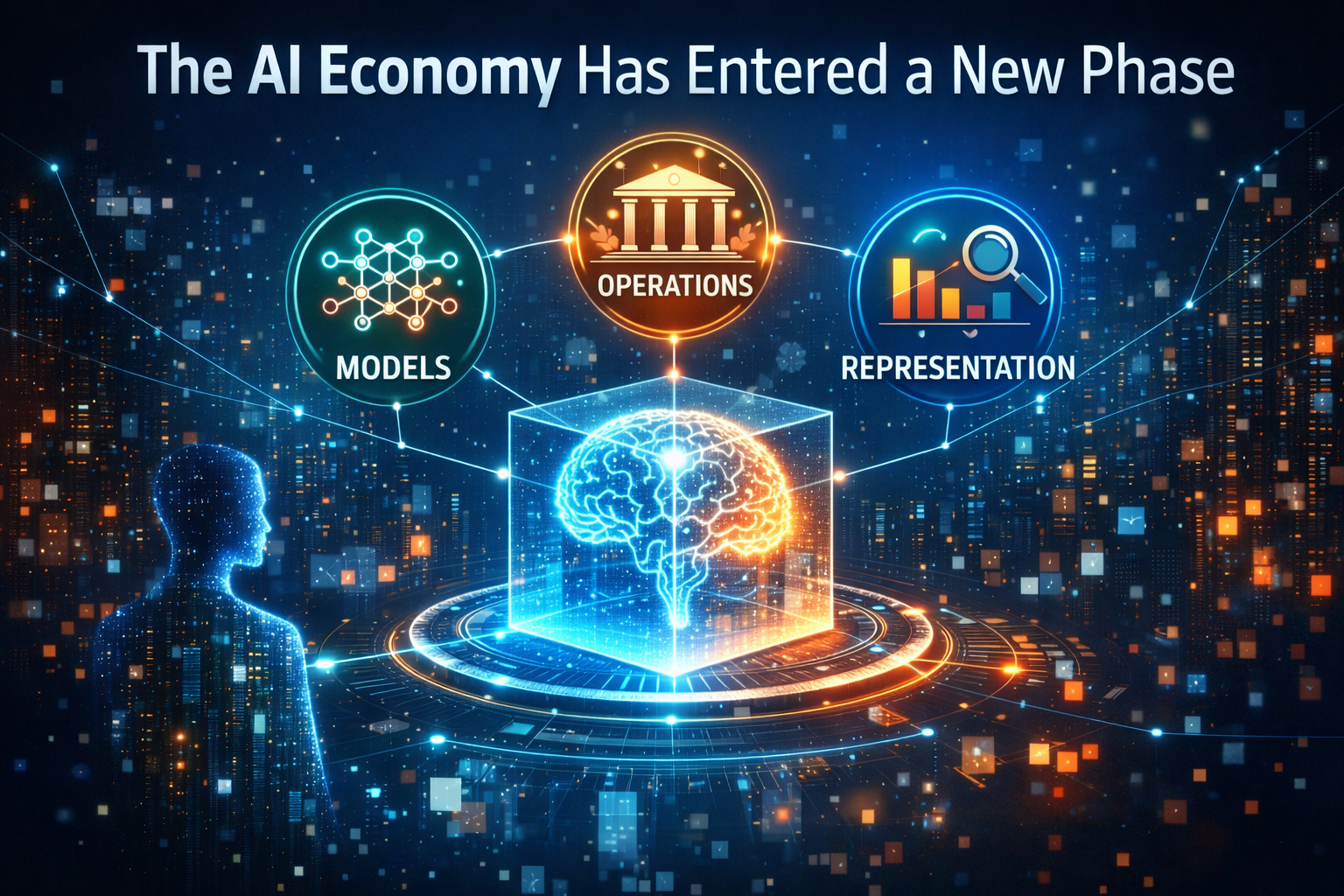
The AI Economy Has Entered a New Phase
For more than a decade, the technology industry framed AI primarily as a model development challenge.
The race was about better algorithms and more compute.
But as AI systems enter real-world operations — banking, healthcare, logistics, manufacturing, and government — a new reality is emerging.
The hardest challenge is no longer training models.
The hardest challenge is representing reality correctly enough for AI to act safely.
Global indicators confirm that AI adoption has now reached enterprise scale.
According to the Stanford Human-Centered AI Institute AI Index Report, more than 78% of organizations reported using AI in 2024, up from 55% the previous year.
At the same time, governance expectations are rising globally.
Frameworks such as:
- the National Institute of Standards and Technology AI Risk Management Framework
- the Organisation for Economic Co-operation and Development AI Principles
emphasize trustworthiness, traceability, accountability, and governance across the entire AI lifecycle.
This shift changes the central question facing leaders.
The question is no longer:
“Can your AI system produce an answer?”
The real question is:
“Does your institution know what must be seen, how it should be represented, what authority can be delegated, and how decisions can be trusted?”
This is where Representation Capital becomes the defining institutional asset.
Representation Capital is the institutional capability to accurately represent reality through AI systems that sense signals, model entities, reason about decisions, and execute actions. Institutions with strong Representation Capital make faster and better decisions in the AI economy.
Representation Capital Definition
Representation Capital is the institutional capability to create accurate, continuously evolving representations of reality using AI systems that sense signals, reason about decisions, and execute actions.
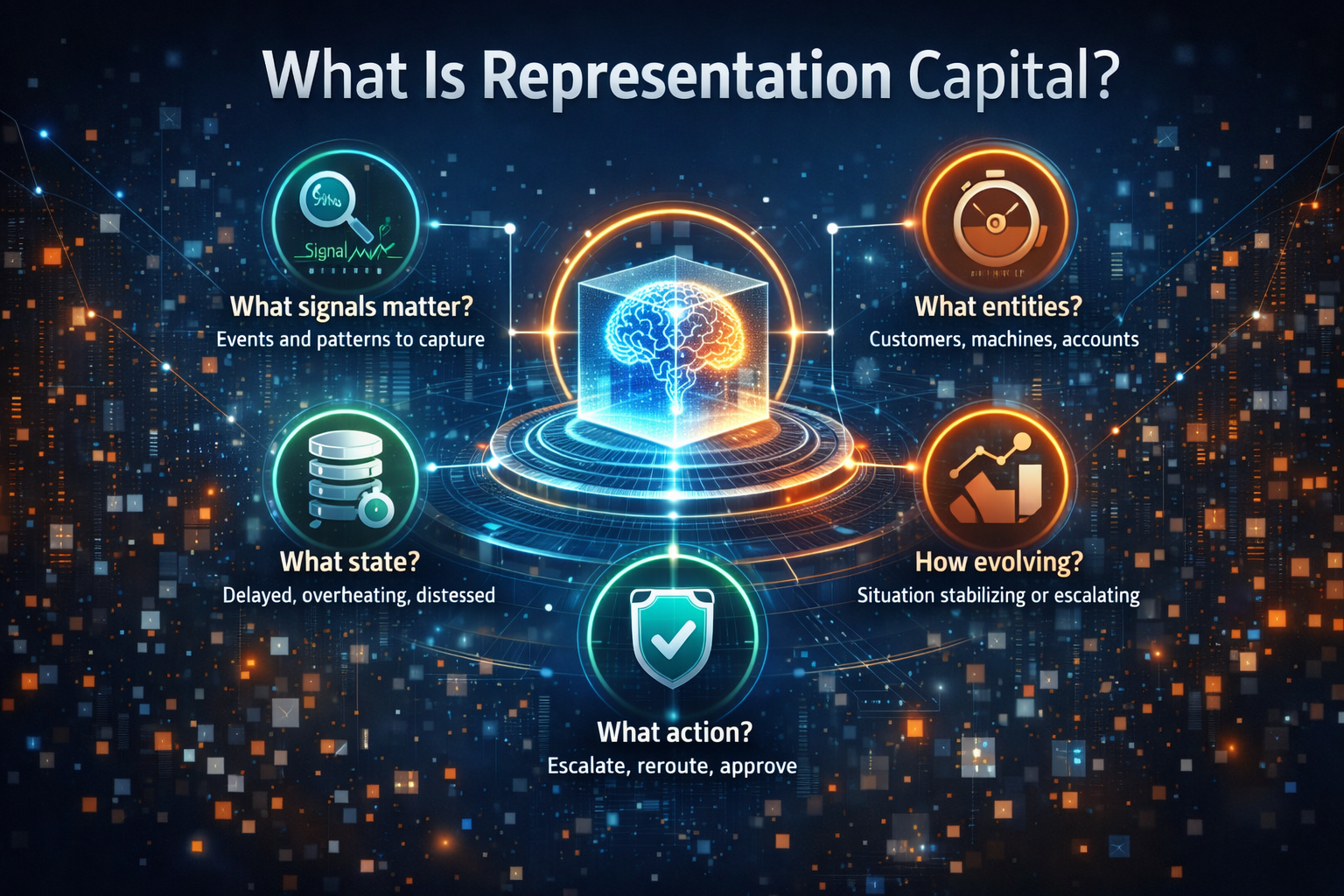
What Is Representation Capital?
Representation Capital is the accumulated institutional capability to make complex reality machine-legible without losing meaning, context, accountability, or recourse.
It goes far beyond:
- raw data
- metadata
- dashboards
- digital twins
- knowledge graphs.
Instead, Representation Capital reflects an institution’s ability to answer five foundational questions repeatedly and reliably.
-
What signals matter?
Which events, changes, patterns, or risks from the world should be captured?
Examples include:
- financial transactions
- supply disruptions
- medical symptoms
- network anomalies
- customer behavior shifts.
-
What entities do those signals belong to?
Signals must connect to real entities:
- customers
- machines
- shipments
- suppliers
- patients
- infrastructure assets.
Without entity identity, signals remain noise.
-
What state is that entity in?
Is the shipment delayed?
Is the machine overheating?
Is the patient deteriorating?
Is the account compromised?
State representation transforms raw data into meaningful institutional understanding.
-
How is that state evolving?
Reality is dynamic.
Institutions must understand:
- trends
- escalation
- drift
- stabilization.
Without temporal representation, AI becomes static.
-
What action is allowed?
AI systems must know their authority boundaries.
Can they:
- recommend
- escalate
- block
- reroute
- approve
- execute autonomously?
Institutions that answer these questions consistently begin to accumulate Representation Capital.
And like financial capital, this asset compounds over time.
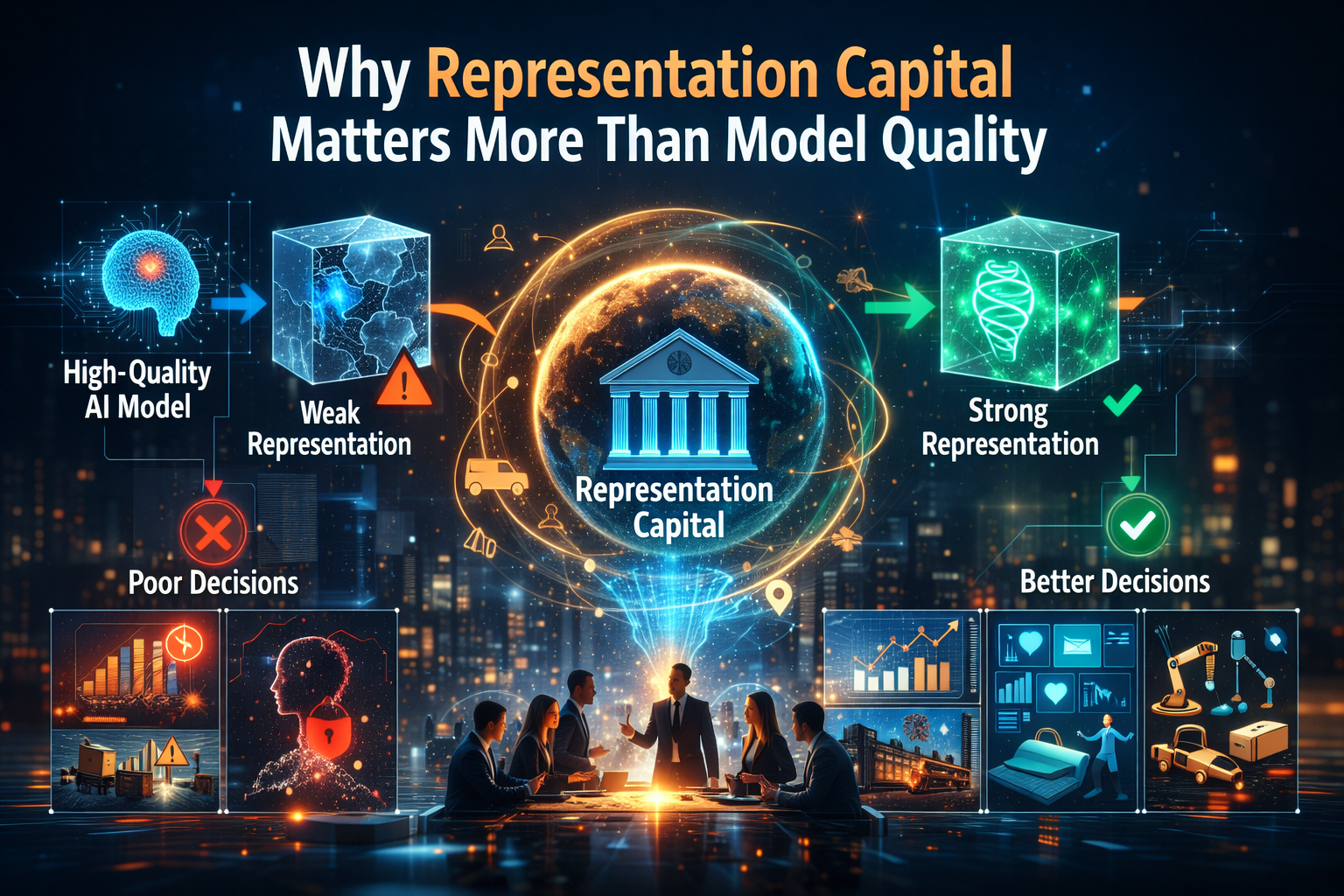
Why Representation Capital Matters More Than Model Quality
Many organizations still believe AI advantage comes primarily from better models.
This assumption is increasingly wrong.
A brilliant model operating on weak representation will still fail.
A modest model operating on rich institutional representation often performs far better.
Why?
Because most enterprise challenges are not purely intelligence problems.
They are visibility problems.
Example: Banking
A bank may deploy a sophisticated fraud detection model.
But if it cannot correctly represent:
- identity relationships
- device fingerprints
- behavioral drift
- transaction intent
fraud will still succeed.
Example: Healthcare
A hospital may deploy advanced diagnostic AI.
But if it cannot represent:
- patient history
- medication interactions
- evolving symptoms
- treatment responses
the system will remain shallow or unsafe.
Example: Supply Chains
A logistics company may use advanced forecasting algorithms.
But if it cannot represent:
- supplier dependencies
- geopolitical risk
- weather disruptions
- warehouse state
then decisions will collapse under real-world pressure.
In each case, the model is not the problem.
Representation is the problem.
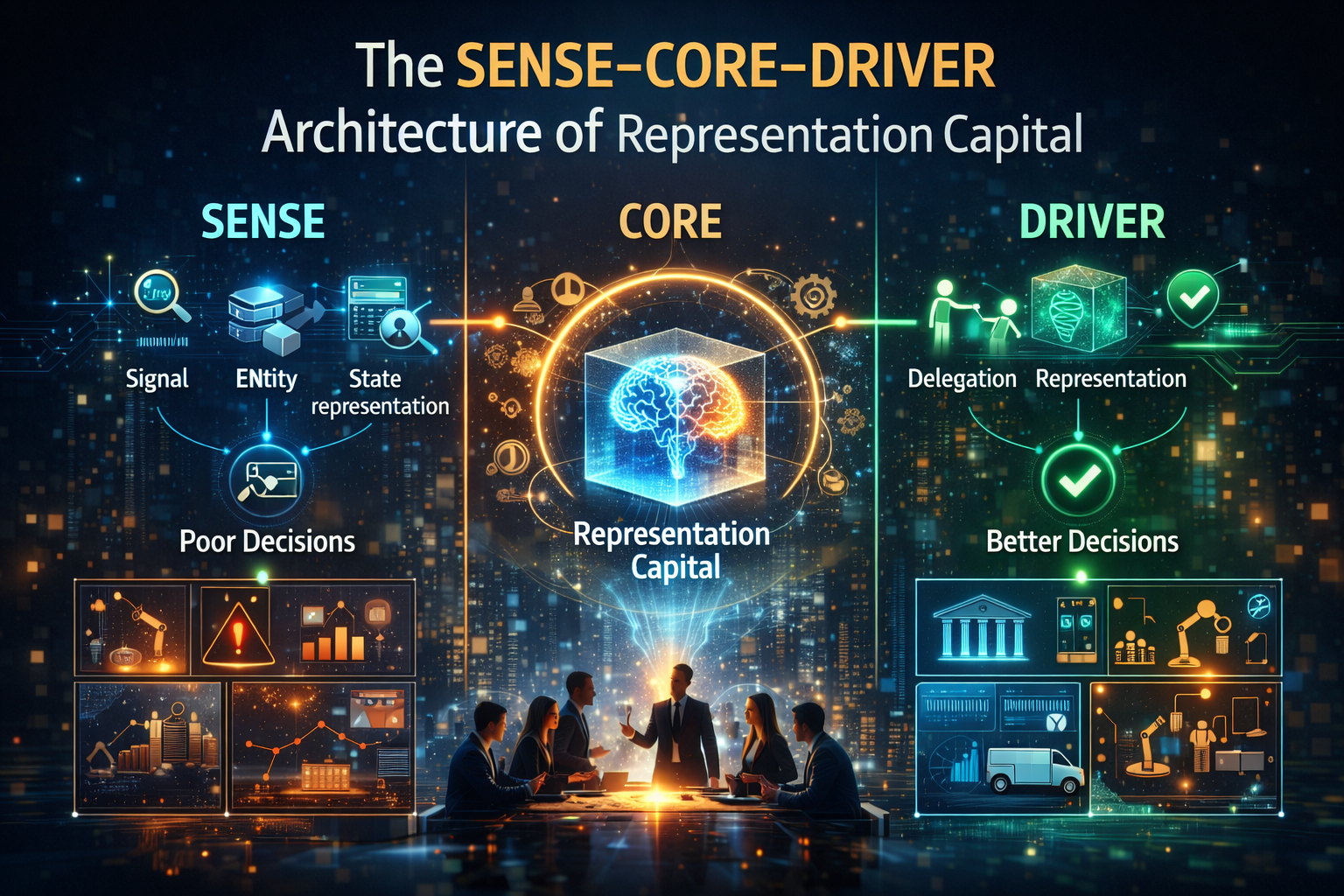
The SENSE–CORE–DRIVER Architecture of Representation Capital
Representation Capital becomes clearer when viewed through the SENSE–CORE–DRIVER architecture.
This architecture explains how intelligent institutions actually function.
SENSE: Making Reality Legible
The first layer of Representation Capital is SENSE.
SENSE is where reality becomes machine-readable.
It includes four core elements:
- Signal – detecting events and patterns
- ENtity – linking signals to actors and assets
- State representation – modeling current conditions
- Evolution – tracking how those conditions change over time.
This is where the majority of invisible institutional advantage is created.
Two retailers may both use AI.
But the retailer with stronger SENSE will know:
- which products are actually moving
- which customers are hesitating
- which warehouses are becoming risky
- which local signals indicate demand shifts.
That is Representation Capital in action.
CORE: Turning Representation Into Judgment
Once reality becomes legible, institutions require a reasoning layer.
That layer is CORE.
CORE performs four functions:
- Comprehend context
- Optimize decisions
- Realize actions
- Evolve through feedback
This is where institutional intelligence emerges.
A credit decision is not simply a score.
It incorporates:
- economic context
- policy rules
- customer history
- fraud risk
- regulatory requirements.
Representation Capital strengthens CORE because reasoning quality depends entirely on representation quality.
If the institution’s model of reality is distorted, the reasoning will be distorted too.
DRIVER: Turning Judgment Into Legitimate Action
The final layer is DRIVER.
This is where institutional AI becomes operational.
DRIVER defines the governance of action:
- Delegation – who authorized the system
- Representation – which model of reality informed the decision
- Identity – which entity is affected
- Verification – how the decision is validated
- Execution – how action occurs
- Recourse – how errors are corrected.
Without DRIVER, even accurate AI systems cannot operate safely.
Consider an insurance AI approving claims.
The real value is not just prediction accuracy.
It is the ability to demonstrate:
- which evidence was used
- which rules applied
- what authority the AI had
- how customers can challenge outcomes.
That capability reflects institutional maturity, not merely AI maturity.
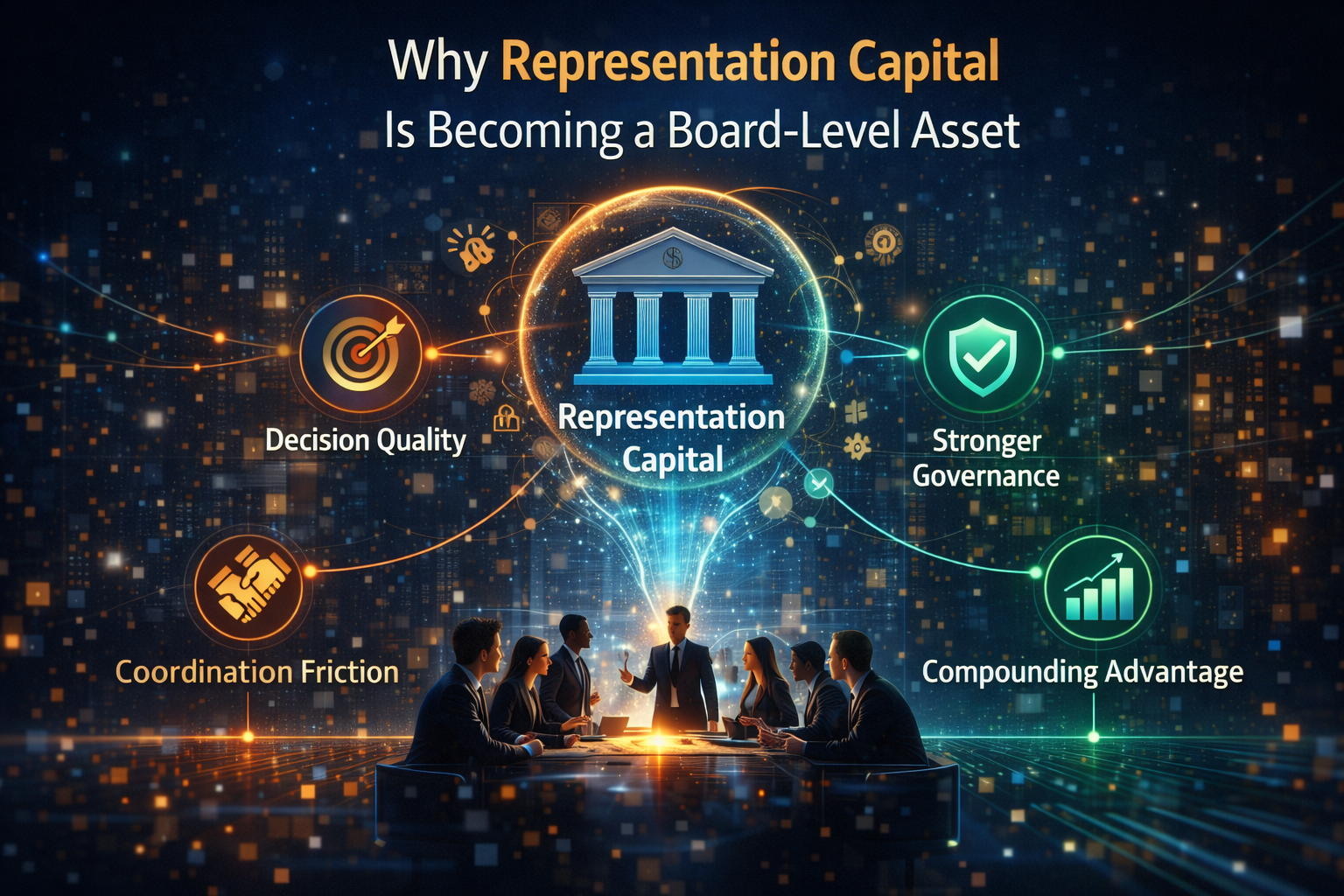
Why Representation Capital Is Becoming a Board-Level Asset
For decades, boards asked whether companies had:
- a digital strategy
- a data strategy.
Now boards must ask something deeper:
Does the organization have a representation strategy?
Representation Capital matters to boards for four reasons.
-
It improves decision quality
Institutions win or lose through decisions. Representation Capital improves those decisions at scale.
-
It reduces organizational friction
Shared representations reduce disagreement across departments.
-
It strengthens AI governance
Traceability, accountability, and challengeability become easier when decisions are well represented.
-
It compounds as a competitive moat
Models can be replaced.
Vendors can change.
But institutions with strong Representation Capital own a durable strategic asset.
The Risk of Representation Debt
Institutions with weak representation exhibit common symptoms:
- fragmented data systems
- inconsistent entity definitions
- weak state models
- unclear authority boundaries
- AI pilots without institutional memory.
This creates representation debt.
Representation debt accumulates when institutions act on incomplete or distorted models of reality.
It often appears harmless at first.
A team launches a copilot.
Another team builds an agent.
A third automates a workflow.
But underneath, definitions differ, assumptions conflict, and exceptions multiply.
The result is not intelligence.
It is coordinated confusion.
How Institutions Build Representation Capital
Building Representation Capital does not begin with buying frontier models.
It begins with disciplined institutional design.
Leaders should focus on five priorities:
Start with critical decisions
Identify decisions that drive value, risk, and trust.
Map signals to entities
Ensure signals connect to persistent identities.
Build living state models
Reality changes constantly.
Representation must evolve accordingly.
Define delegation boundaries
Clearly define when AI advises, escalates, or acts.
Preserve recourse
Every AI decision should remain contestable and reversible.
Institutions that treat representation as core infrastructure will outperform those treating it as an afterthought.
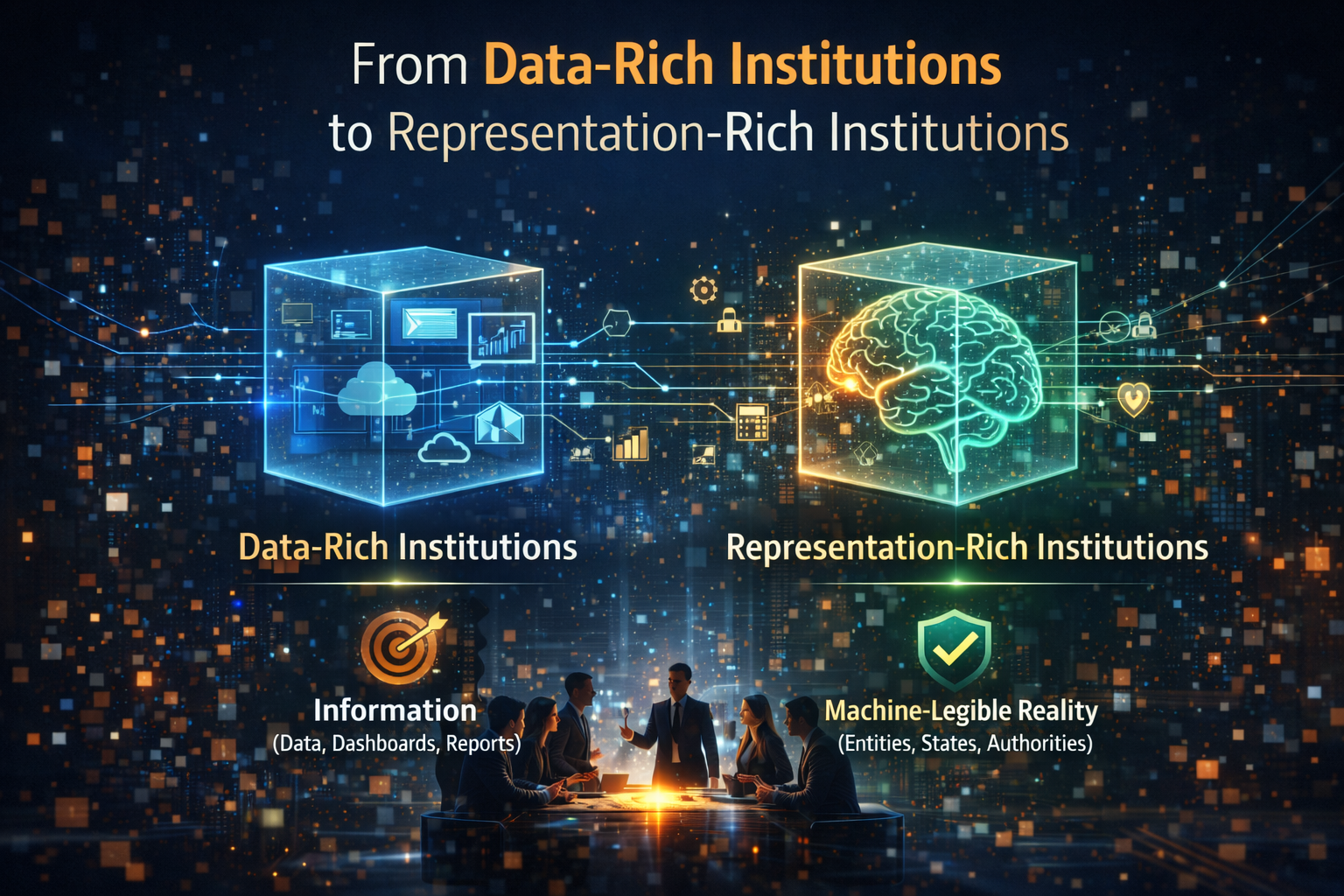
From Data-Rich Institutions to Representation-Rich Institutions
The last decade taught organizations to become data-driven.
The next decade will require them to become representation-rich.
The difference is profound.
A data-rich institution stores information.
A representation-rich institution maintains machine-legible reality.
This shift will determine which organizations can move from:
- analytics → autonomy
- reporting → reasoning
- automation → intelligent action.
Conclusion: The Most Important Invisible Asset of the AI Economy
In the industrial era, advantage came from physical capital.
In the digital era, advantage came from software and data capital.
In the AI economy, a new asset is emerging.
Representation Capital.
Representation Capital is the institutional ability to represent reality well enough for intelligent systems to act without collapsing trust, accountability, or governance.
It rarely appears on balance sheets.
But it will increasingly determine balance sheets.
Because in the years ahead, institutions will not be separated by who has more AI.
They will be separated by who has built more Representation Capital.
And that invisible asset may become the single most important foundation of the intelligent institution.
Glossary
Representation Capital
The institutional capability to represent real-world entities, states, and relationships in machine-legible form for AI-driven decision systems.
Representation Economy
An economic system where competitive advantage depends on the ability to represent reality accurately enough for AI systems to act.
SENSE Layer
The infrastructure that captures signals, identifies entities, models states, and tracks evolution.
CORE Layer
The reasoning layer where AI systems interpret representation and generate decisions.
DRIVER Layer
The governance layer that authorizes, verifies, executes, and provides recourse for AI actions.
Representation Capital
The institutional capability to model reality through structured data, entities, states, and relationships so AI systems can reason and act effectively.
Representation Economy
An economic system where competitive advantage comes from how well institutions represent reality through AI systems.
Institutional AI Architecture
The structural design that enables organizations to integrate AI into decision-making and operational workflows.
FAQ
What is Representation Capital in AI?
Representation Capital is the institutional ability to model real-world entities, states, and relationships accurately enough for AI systems to make reliable decisions.
Why is Representation Capital important?
Because AI systems rely on accurate representations of reality. Poor representation leads to incorrect decisions even with powerful models.
How does Representation Capital relate to AI governance?
Strong representation improves traceability, accountability, and decision auditability, which are essential for responsible AI governance.
Can companies measure Representation Capital?
While it is not yet a standard metric, indicators include entity resolution accuracy, state model completeness, decision traceability, and governance maturity.
Why will Representation Capital matter in the AI economy?
As AI systems move from advisory tools to decision systems, institutions with stronger representations of reality will operate more effectively and safely.
Why is Representation Capital important in the AI economy?
Because AI systems make decisions based on how reality is represented. Institutions with better representations make better decisions and gain competitive advantage.
What is the difference between data and representation?
Data is raw information. Representation organizes that data into structured models of entities, states, and relationships that AI systems can reason about.
How does Representation Capital relate to enterprise AI?
Enterprise AI systems rely on structured representations of workflows, customers, policies, and assets. Representation Capital determines how accurately those systems operate.
What is the SENSE–CORE–DRIVER architecture?
The SENSE–CORE–DRIVER architecture is an institutional AI framework:
SENSE – Observing reality through signals and entity states
CORE – Reasoning and decision intelligence
DRIVER – Executing actions with governance and accountability
Why will boards care about Representation Capital?
Because it directly influences:
- decision quality
• operational coordination
• governance reliability
• long-term competitive advantage
What industries benefit most from Representation Capital?
Representation Capital will reshape:
- financial services
• healthcare
• logistics
• manufacturing
• public infrastructure
• cybersecurity
How is Representation Capital different from AI models?
Models generate predictions.
Representation Capital defines how reality is structured for those models.
Without strong representation, even powerful models fail.



Raktim Singh is an AI and deep-tech strategist, TEDx speaker, and author focused on helping enterprises navigate the next era of intelligent systems. With experience spanning AI, fintech, quantum computing, and digital transformation, he simplifies complex technology for leaders and builds frameworks that drive responsible, scalable adoption.