

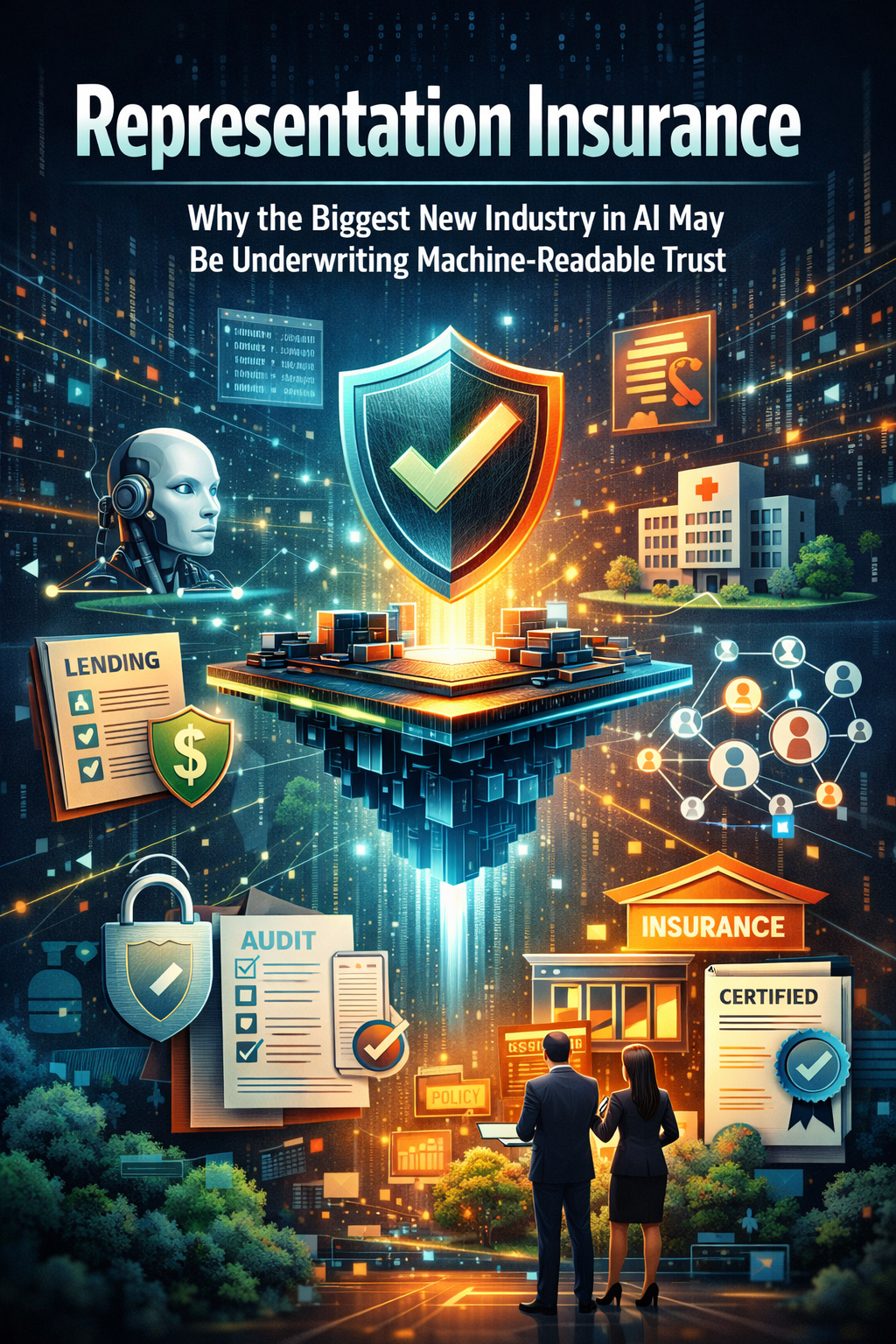
As AI moves from generating answers to shaping real decisions, a new industry is emerging around the economics of trust.
For the past few years, the AI conversation has revolved around models, chips, data, productivity gains, and competitive speed. That focus made sense in the first phase of the AI era. When enterprises were experimenting, the central question was simple: Can the model perform the task?
That question still matters. But it is no longer enough.
As AI systems move beyond copilots and chat interfaces into underwriting, diagnostics, procurement, fraud detection, workflow orchestration, customer approvals, compliance checks, and autonomous agents, the deeper question becomes harder and more consequential:
Can this system be trusted to act on a machine-readable version of reality?
That is where the next major economic shift begins.
Across the world, governments, regulators, and standards bodies are moving toward more explicit expectations around AI risk management, technical documentation, post-market monitoring, accountability, and assurance. NIST’s AI Risk Management Framework and its Generative AI Profile, OECD work on AI accountability and due diligence, and the EU AI Act’s requirements around technical documentation, conformity assessment, and post-market monitoring all point in the same direction: AI adoption is increasingly tied to evidence, controls, and ongoing oversight. (NIST)
That is why one of the biggest new industries in the AI era may not be model creation alone. It may be something larger and more enduring:
Representation Insurance
By Representation Insurance, I mean the emerging market for underwriting, certifying, monitoring, validating, and financially absorbing the risks that arise when AI systems act on machine-readable representations of people, assets, transactions, identities, policies, and institutional reality.
This is not traditional insurance in the narrow sense. It is a broader trust economy. It includes insurers, reinsurers, auditors, AI assurance firms, conformity assessors, governance platforms, provenance infrastructure providers, cyber specialists, legal frameworks, and new trust intermediaries.
Their common purpose is straightforward: reduce the uncertainty around whether AI systems are acting on representations that are accurate enough, current enough, governed enough, and reviewable enough to be trusted at scale.
In other words, the next great AI market may be built around a very old economic truth:
When uncertainty becomes expensive, someone steps in to price it.
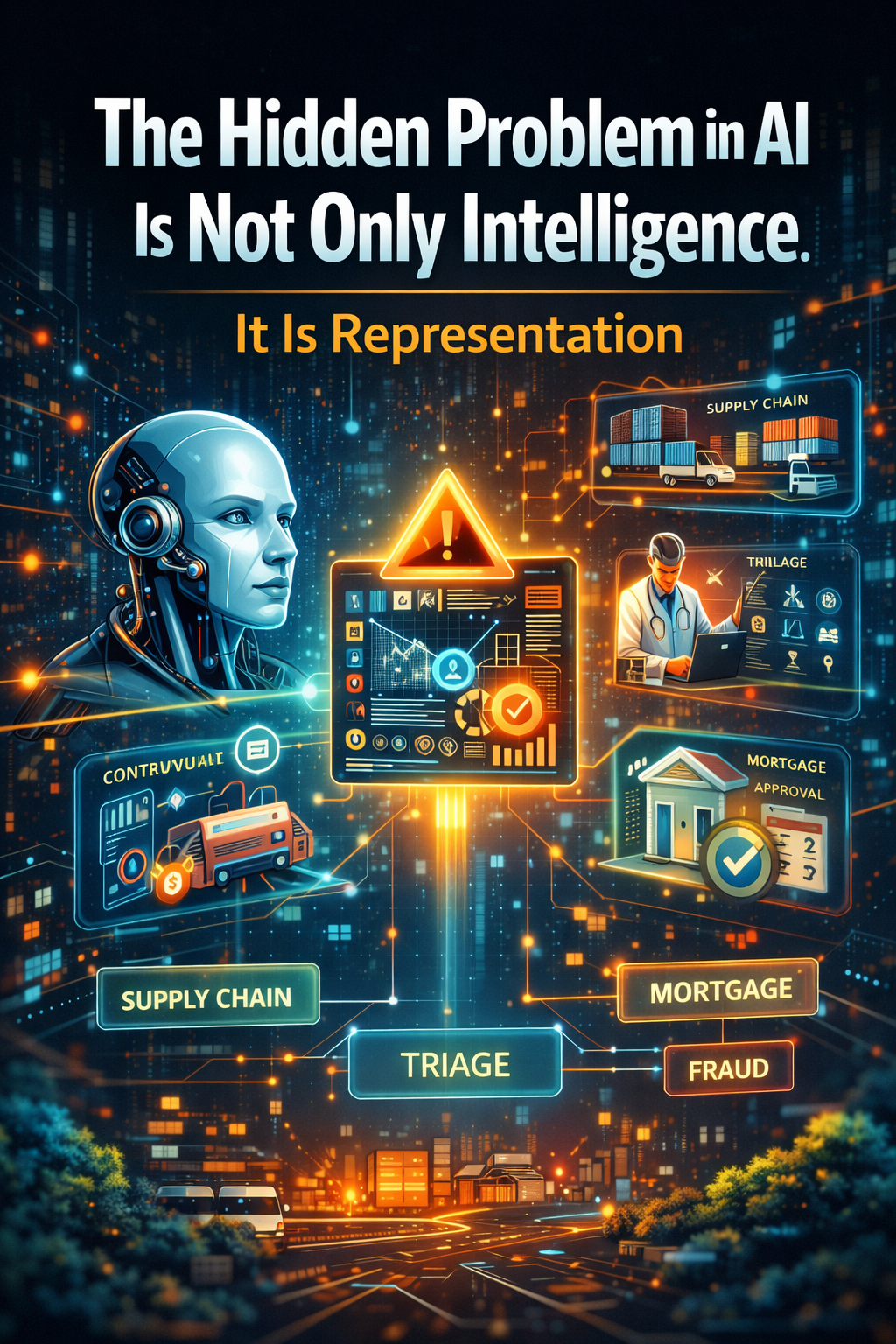
The Hidden Problem in AI Is Not Only Intelligence. It Is Representation.
Much of the public discussion around AI still assumes that the biggest risk is whether a model generates the right answer or makes the correct prediction.
But in the real economy, AI systems do not operate in a vacuum. They act on representations.
A lending system acts on a representation of income, identity, repayment behavior, and fraud risk. A hospital triage assistant acts on a representation of symptoms, patient history, lab results, urgency, and care pathways. A supply chain agent acts on a representation of inventory, shipment location, delivery constraints, vendor status, and exception states. A claims system acts on a representation of damage, policy terms, customer identity, and event chronology.
If that representation is incomplete, stale, tampered with, poorly governed, or disconnected from context, the AI system can fail even when the underlying model is technically impressive.
That is the deeper logic behind the Representation Economy.
In the AI era, value creation increasingly depends on whether reality can be made legible to machines in a form that can be interpreted, verified, updated, and delegated against. This is exactly why the SENSE–CORE–DRIVER framework matters:
SENSE
This is where reality becomes machine-legible through:
- signals,
- entities,
- state representation,
- and evolution over time.
CORE
This is where systems interpret machine-readable reality, optimize decisions, reason across context, and generate institutional intelligence.
DRIVER
This is where action becomes legitimate through:
- delegation,
- representation,
- identity,
- verification,
- execution,
- and recourse.
Representation Insurance becomes necessary when this chain becomes economically material. The more institutions rely on SENSE–CORE–DRIVER systems, the more they need confidence that the representation layer is trustworthy enough for consequential decisions. That need is no longer theoretical. It is increasingly being shaped by formal governance expectations and practical assurance mechanisms. (NIST Publications)
Why a New Industry Is Forming Now
Three major shifts are colliding at once.
-
AI adoption is broadening
OECD reporting shows that firm-level AI use has continued to expand, with 20.2% of firms reporting AI use in 2025 across the countries where data were available, up from 14.2% in 2024 and 8.7% in 2023. That means the number of business decisions touched by machine-readable representations is rising rapidly. (OECD)
-
Governance is becoming operational
NIST’s AI RMF and its Generative AI Profile are designed to help organizations map, measure, manage, and govern AI risk in practical ways. This signals a shift from vague principles to actionable controls. (NIST)
-
Regulation is creating demand for evidence
The EU AI Act requires technical documentation for high-risk AI systems and establishes post-market monitoring obligations. That means trust is moving from narrative to auditable process. (Artificial Intelligence Act)
The UK has gone even further by explicitly recognizing AI assurance as a market. UK government publications said the country’s AI assurance market included more than 524 firms and contributed approximately £1.01 billion in gross value added in 2024, while also describing the sector as growing and strategically important. (GOV.UK)
That is not a minor policy footnote. It is a strategic signal.
When governments begin naming a trust layer as an economic sector, leaders should pay attention.
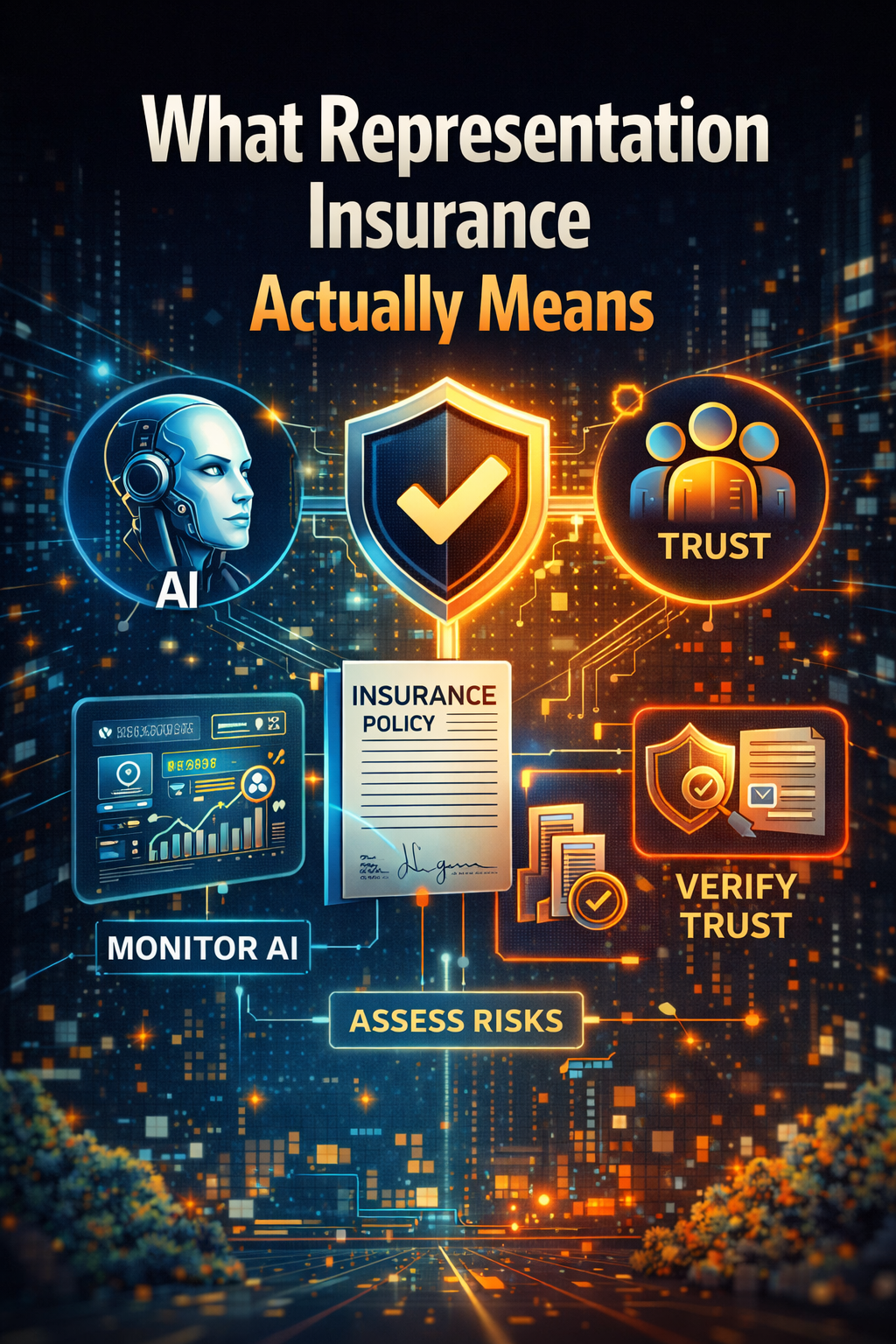
What Representation Insurance Actually Means
Imagine a near-future world in which AI agents are:
- negotiating procurement contracts,
- validating KYC records,
- routing patients,
- flagging suspicious transactions,
- managing claims,
- screening candidates,
- adjusting energy loads,
- and resolving customer issues.
In that world, what exactly needs to be insured?
Not only the model.
What needs underwriting is the machine-readable trust stack around the decision.
That includes questions such as:
- Was the identity genuine?
- Was the source data manipulated?
- Was the state representation current at the time of decision?
- Did the system apply the correct policy version?
- Was the delegation boundary authorized?
- Can the decision be reconstructed later?
- Is there a recourse path if the system was wrong?
Representation Insurance is the market response to these questions. It is the set of services and financial mechanisms that effectively says:
We have evaluated enough of this chain to certify it, stand behind it, monitor it, price it, or absorb part of its failure risk.
That is why this category will grow well beyond conventional insurance. It will likely include:
- AI assurance and certification firms,
- third-party evaluators,
- governance and monitoring platforms,
- provenance and credential infrastructure providers,
- audit and conformity assessment bodies,
- specialized insurers and reinsurers,
- legal and compliance orchestration providers,
- and post-deployment incident monitoring services.
Some players will verify. Some will monitor. Some will rate. Some will indemnify. Some will supply evidence. Over time, some may become the equivalent of credit bureaus, rating agencies, and cyber-insurance underwriters for machine-readable trust.
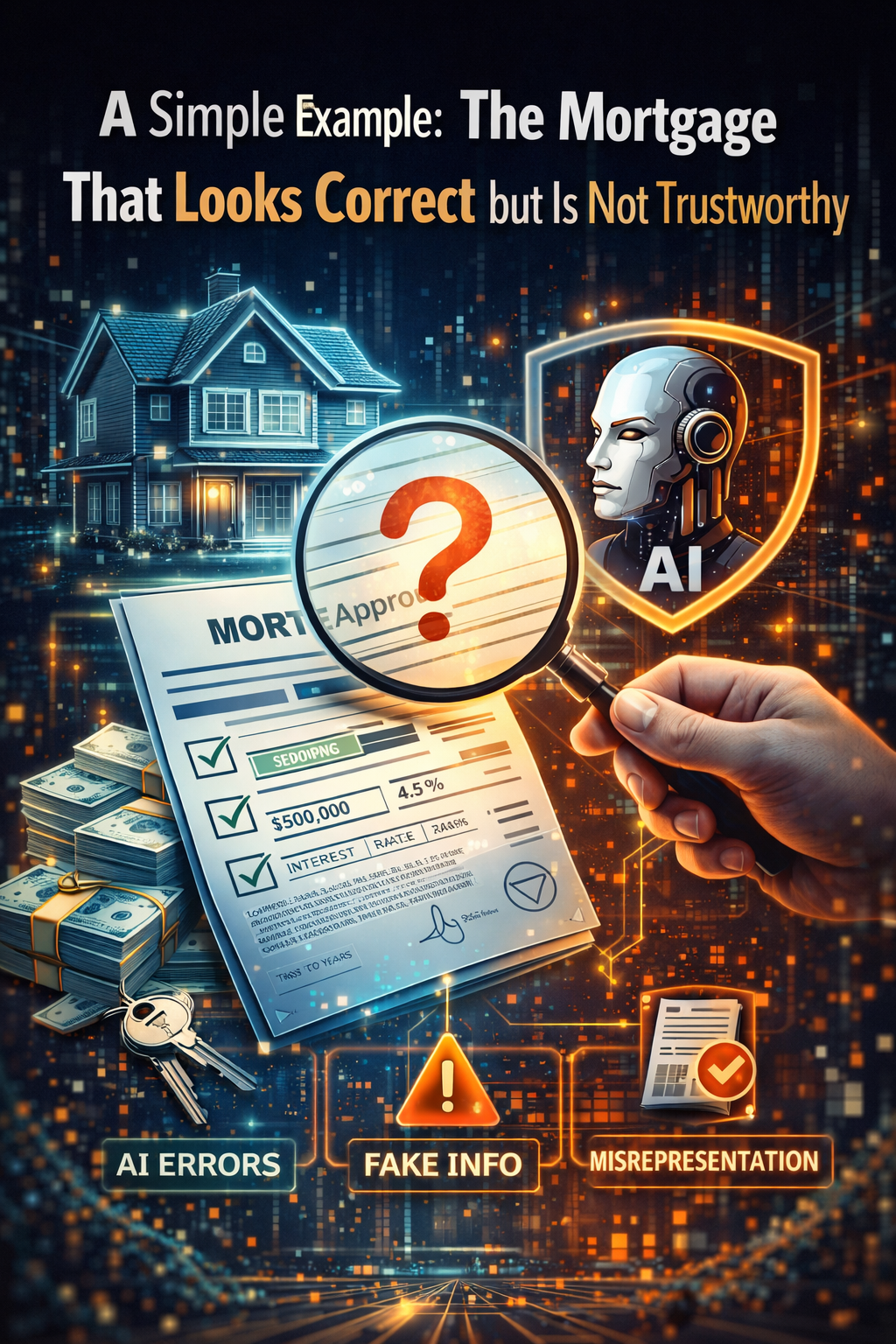
A Simple Example: The Mortgage That Looks Correct but Is Not Trustworthy
Consider a mortgage approval process.
An AI system reviews income records, payment history, property documents, credit signals, and fraud indicators. The model may be excellent. Yet the bigger risk may sit outside the model itself:
- a source document is forged,
- employment data arrives late,
- identity resolution is weak,
- property ownership records are outdated,
- the policy rules are not the current version,
- and the final decision cannot be reconstructed later for audit.
Now ask the real business question:
Who pays when an AI decision is built on top of a flawed representation of reality?
That question is the economic opening for Representation Insurance.
A lender will want proof that upstream representation quality is good enough. A regulator will want traceability. An insurer will want evidence before offering cover. A platform provider may offer guarantees only if approved controls are followed. A third-party assurance firm may certify the workflow. A provenance layer may prove which records were used, when they were used, and whether they were altered.
The AI model matters. But the insurable question is larger:
Can the institution trust the represented reality on which the model acted?
Why Cyber Insurance Was the Preview
A useful way to understand this market is to look at cyber insurance.
Cyber insurance did not emerge because organizations suddenly became more interested in forms and audits. It emerged because digital dependency created organization-wide risk that was measurable, expensive, and recurring. Once systems became critical, someone had to evaluate controls, price exposure, and absorb part of the downside.
AI is creating a similar dynamic, but with a broader object of concern.
Cyber insurance is primarily about the security of digital systems. Representation Insurance is about the trustworthiness of machine-readable institutional reality.
That is a much larger category.
It touches not just whether systems are secure, but whether the representations flowing through them are reliable enough for automation, decision-making, delegation, and compliance. NIST’s AI RMF and related guidance increasingly reinforce the need to connect trustworthiness, governance, and risk management in operational settings. (NIST Publications)
The pattern is familiar:
When a new layer of dependence becomes critical, markets emerge around trust, verification, and risk transfer.
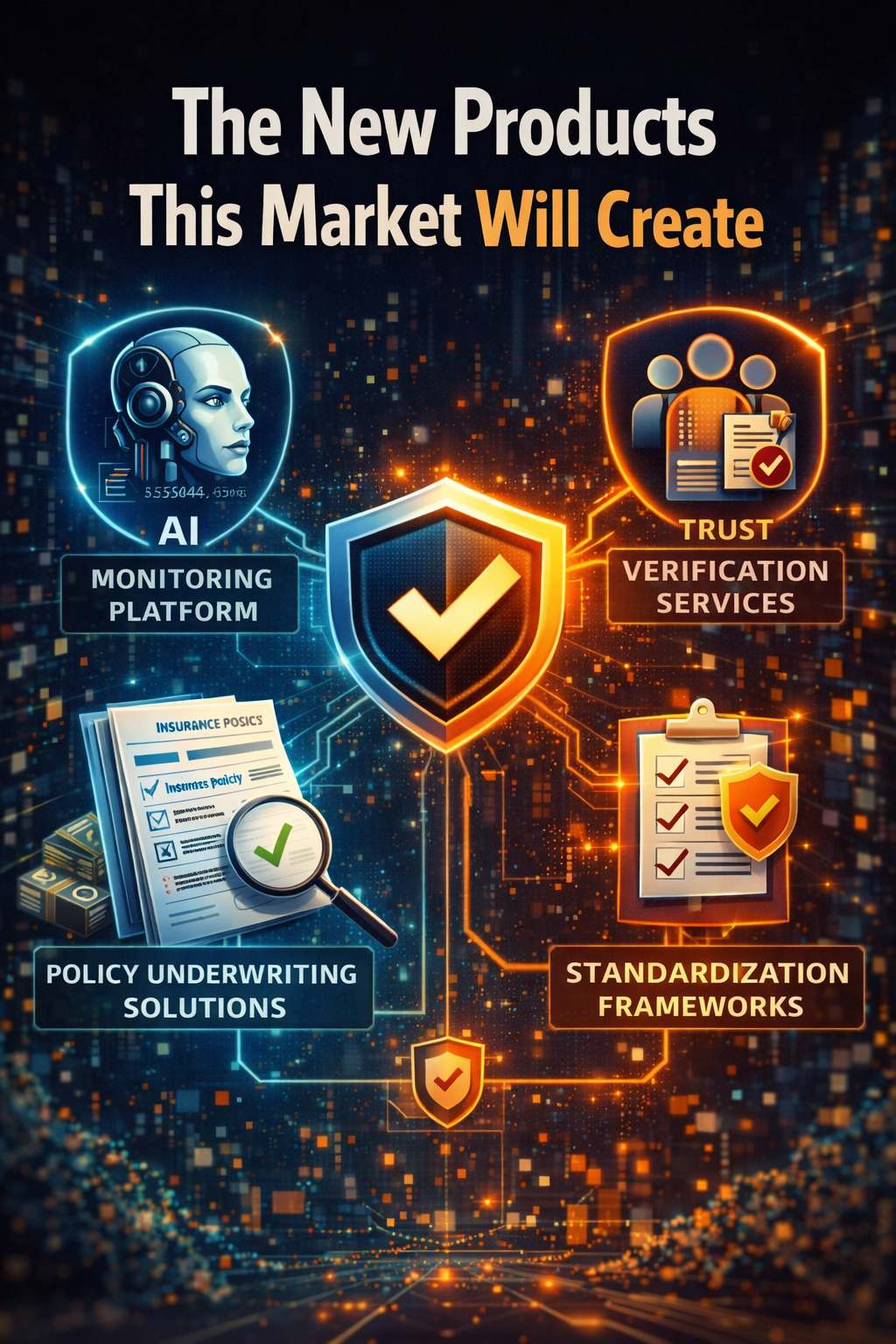
The New Products This Market Will Create
This is where the idea becomes commercially powerful.
Representation Insurance is likely to create entirely new categories of products and services.
Representation quality scoring
Organizations may be assessed not only on cybersecurity or model performance, but on the quality of their machine-readable representations, including identity integrity, provenance quality, policy versioning, state freshness, and recourse design.
Delegation liability cover
As AI agents act on behalf of institutions, new coverage models may emerge around what decisions can be delegated, under what conditions, and who bears losses when delegated systems act on flawed representations.
Provenance-backed warranties
Vendors and enterprise platforms may begin offering limited guarantees when customers use approved data sources, validated policies, signed records, and continuous monitoring mechanisms.
Continuous assurance subscriptions
Instead of depending only on annual audits, enterprises may increasingly pay for continuous trust monitoring: lineage validation, drift checks, policy mismatch alerts, incident detection, and post-deployment evidence logs.
Representation recovery services
When institutions discover that their machine-readable reality is fragmented, inconsistent, or compromised, new firms may emerge to rebuild trusted representations across customers, assets, permissions, workflows, and partner systems.
This is why the word insurance matters. It signals that trust is becoming economically priced. But the market around it will be much larger than insurance contracts alone.
Why Boards Should Care Now
Boards should not treat this as a niche governance topic. They should see it as a strategic signal about future competitiveness.
In the AI era, growth will increasingly depend on whether your institution is easy for machines to trust. That will influence:
- autonomous commerce,
- partner interoperability,
- compliance cost,
- fraud exposure,
- customer acquisition,
- ecosystem participation,
- decision speed,
- and insurability.
A company with strong representation integrity may gain lower friction, better automation, faster approvals, stronger ecosystem trust, and lower long-run risk costs. A company with weak representation integrity may face the opposite: more manual review, higher compliance drag, slower delegation, higher insurance pricing, weaker regulator confidence, and eventual exclusion from machine-mediated markets.
This is why Representation Insurance matters even before a formal market category fully matures. The market itself will shape what trustworthy participation in the AI economy looks like.
The winners will not simply be the firms with the best demos.
They will be the firms whose SENSE layer captures reality well, whose CORE interprets it responsibly, and whose DRIVER allows actions to be delegated with evidence, control, and recourse.

The Biggest Insight: Trust Is Becoming Infrastructure
The most important idea in this article is simple:
AI is not only automating work. It is forcing institutions to formalize trust.
For decades, business often ran on informal trust:
emails, handoffs, local judgment, tacit knowledge, partial documentation, unwritten exceptions, and human memory.
AI systems cannot reliably operate on that basis.
They require:
- structured signals,
- clear entities,
- explicit states,
- versioned policies,
- traceable actions,
- and known escalation paths.
That is why trust is becoming infrastructure.
The World Economic Forum’s work on responsible AI also reflects this broader direction: trust in AI systems increasingly depends on practical governance, transparency, and institutional readiness rather than abstract aspiration alone. (GOV.UK)
Once trust becomes infrastructure, it becomes:
- auditable,
- certifiable,
- monitorable,
- financeable,
- and ultimately insurable.
That is the doorway through which Representation Insurance enters the economy.
The Companies That Will Win
The biggest winners in this market will likely do one of four things exceptionally well.
They verify
They prove that representations, policies, identities, and decisions meet defined standards.
They monitor
They continuously track drift, tampering, anomalies, provenance gaps, and post-deployment failures.
They underwrite
They price and absorb risk based on representation quality, governance maturity, and control strength.
They repair
They help institutions rebuild fragmented machine-readable reality so trusted automation becomes possible again.
This could include insurers, reinsurers, audit firms, AI assurance startups, provenance networks, identity infrastructure companies, governance platforms, and enterprise software players that evolve into trust intermediaries.
Representation Insurance represents a foundational shift in how enterprises design AI systems. As organizations move toward autonomous decision-making, the ability to ensure machine-readable trust will define competitiveness, resilience, and market leadership in the AI economy.

Conclusion: The Future of the AI Economy May Depend on This Market
The AI industry often speaks as though intelligence alone will define the future. It will not.
The future will be built not only by systems that can reason, but by systems that can be trusted to act on machine-readable reality.
That trust will not come from branding alone. It will come from evidence, monitoring, controls, provenance, conformity assessment, assurance, and financial accountability.
That is why Representation Insurance may become one of the most important industries of the AI era.
Its logic is straightforward:
When AI systems begin acting on representations of reality, every flaw in representation becomes an economic risk. And when a risk becomes large enough, repeatable enough, and costly enough, markets form to measure it, price it, and absorb it.
That market is already appearing in fragments: AI assurance ecosystems, conformity assessments, technical documentation regimes, post-market monitoring, and trust-focused policy roadmaps. (Artificial Intelligence Act)
The firms, platforms, and nations that recognize this shift early will not merely build AI.
They will build insurable machine trust.
And in the Representation Economy, that may become one of the most valuable assets of all.
Glossary
Representation Insurance
The emerging market for underwriting, certifying, monitoring, and financially absorbing risks that arise when AI systems act on machine-readable representations of reality.
Machine-Readable Trust
Trust that is not based only on human reputation or judgment, but on structured evidence, verifiable records, provenance, controls, and auditable workflows that machines can reliably use.
Representation Economy
An economic environment in which value increasingly depends on whether reality can be represented in a form that machines can interpret, verify, and act upon.
SENSE
The layer where reality becomes machine-legible through signals, entities, state representation, and evolution over time.
CORE
The layer where systems reason over machine-readable reality, optimize decisions, and generate institutional intelligence.
DRIVER
The layer where AI-enabled action becomes legitimate through delegation, representation, identity, verification, execution, and recourse.
AI Assurance
The set of practices, products, and services used to evaluate whether AI systems are trustworthy, governed, compliant, and fit for use.
Conformity Assessment
A structured process used to evaluate whether a system meets defined regulatory or technical requirements. Under the EU AI Act, this is especially relevant for high-risk AI systems. (Artificial Intelligence Act)
Post-Market Monitoring
Ongoing observation and assessment of an AI system after deployment to ensure it continues to perform safely and in compliance with applicable requirements. (Artificial Intelligence Act)
Provenance
The ability to trace where a piece of data, a model input, or a system decision came from, how it was altered, and whether it can be trusted.
Delegation Liability
The question of who bears responsibility when an AI system is allowed to act on behalf of an institution and that action produces financial, legal, or operational harm.
Insurable Machine Trust
A condition in which trust in AI-driven decisions becomes strong enough, measurable enough, and governable enough to be certified, priced, and covered by market mechanisms.
Representation Insurance
A new class of services that underwrites the accuracy, verifiability, and trustworthiness of machine-readable representations used by AI systems.
Machine-Readable Trust
The ability of AI systems to verify, interpret, and act on data with confidence using structured, validated representations.
Representation Economy
An economic system where value is determined by how effectively entities are represented, understood, and trusted by machines.
SENSE Layer
The layer where real-world signals are captured, structured, and made machine-legible.
CORE Layer
The reasoning engine that interprets representations and makes decisions.
DRIVER Layer
The governance and execution layer ensuring decisions are authorized, verifiable, and actionable.
Representation Risk
The risk that data appears correct but is incomplete, unverifiable, outdated, or misleading for machine interpretation.
Trust Infrastructure
Systems that ensure data integrity, provenance, identity validation, and decision reliability in AI ecosystems.
FAQ
What is Representation Insurance in simple terms?
Representation Insurance is the emerging market that helps organizations trust AI decisions by validating, monitoring, certifying, or financially covering the machine-readable representations those decisions depend on.
How is Representation Insurance different from cyber insurance?
Cyber insurance mainly focuses on the security of digital systems. Representation Insurance goes further by focusing on whether the machine-readable reality used by AI systems is accurate, current, governed, traceable, and trustworthy enough for real decisions.
Why is this important now?
Because AI is moving from advisory roles into operational and high-stakes decisions, while regulators and standards bodies are simultaneously increasing expectations around documentation, risk management, monitoring, and assurance. (NIST)
Which industries could be affected first?
Banking, insurance, healthcare, logistics, public services, identity verification, procurement, compliance, and any sector where AI acts on regulated, consequential, or time-sensitive representations of people, transactions, or assets.
Will this become a real market or stay a niche concept?
There is already evidence of a real market forming around AI assurance, with the UK government explicitly describing AI assurance as a growing market with hundreds of firms and significant economic value. (GOV.UK)
What should boards do first?
Boards should assess whether their institution’s data, policy layers, workflows, delegation paths, and decision evidence are strong enough to support trusted AI at scale. In most organizations, the bottleneck is not model quality alone. It is representation quality.
How does this connect to enterprise strategy?
Representation Insurance is not just a compliance issue. It affects growth, ecosystem participation, automation readiness, risk cost, partner trust, and long-term competitiveness in machine-mediated markets.
Why does this matter for answer engines and generative engines?
Because concepts that are clearly defined, distinctive, and structurally useful tend to be surfaced more often by search systems and AI answer engines. “Representation Insurance” has the potential to become one of those category-defining terms if consistently developed.
- What is Representation Insurance in AI?
Representation Insurance is a new industry that ensures AI systems operate on trustworthy, verifiable, and machine-readable data representations.
- Why is trust becoming critical in AI systems?
As AI systems make autonomous decisions, incorrect or unverifiable data can lead to costly errors, making trust a foundational requirement.
- How is Representation Insurance different from cybersecurity?
Cybersecurity protects systems from attacks, while Representation Insurance ensures that the data and representations used by AI are accurate, verifiable, and reliable.
- Who will need Representation Insurance?
Enterprises using AI in finance, healthcare, supply chains, governance, and autonomous systems will increasingly rely on it.
- How does SENSE–CORE–DRIVER relate to Representation Insurance?
Representation Insurance operates across:
- SENSE → validating inputs
- CORE → ensuring correct interpretation
- DRIVER → governing execution and accountability
- Will Representation Insurance become a major industry?
Yes. As AI adoption grows, trust verification will become as critical as cloud, cybersecurity, and data infrastructure.
References and Further Reading
For authority and credibility, add a short references section at the end of the published article:
- NIST AI Risk Management Framework and Generative AI Profile, which emphasize trustworthiness and practical AI risk management. (NIST)
- OECD reporting on the continuing expansion of firm-level AI adoption. (OECD)
- EU AI Act provisions on technical documentation, conformity assessment, and post-market monitoring for high-risk AI systems. (Artificial Intelligence Act)
- UK government publications on the growth of the AI assurance market and trusted third-party AI assurance. (GOV.UK)
Institutional Perspectives on Enterprise AI
Many of the structural ideas discussed here — intelligence-native operating models, control planes, decision integrity, and accountable autonomy — have also been explored in my institutional perspectives published via Infosys’ Emerging Technology Solutions platform.
For readers seeking deeper operational detail, I have written extensively on:
- What Makes an Enterprise Intelligence-Native? The Blueprint for Third-Order AI Advantage
https://blogs.infosys.com/emerging-technology-solutions/artificial-intelligence/what-is-enterprise-ai-the-operating-model-for-compounding-institutional-intelligence.html - Why “AI in the Enterprise” Is Not Enterprise AI: The Operating Model Difference Most Organizations Miss
https://blogs.infosys.com/emerging-technology-solutions/artificial-intelligence/why-ai-in-the-enterprise-is-not-enterprise-ai-the-operating-model-difference-that-most-organizations-miss.html - The Enterprise AI Control Plane: Governing Autonomy at Scale
https://blogs.infosys.com/emerging-technology-solutions/artificial-intelligence/the-enterprise-ai-control-plane-governing-autonomy-at-scale.html - Enterprise AI Ownership Framework: Who Is Accountable, Who Decides, and Who Stops AI in Production
https://blogs.infosys.com/emerging-technology-solutions/artificial-intelligence/enterprise-ai-ownership-framework-who-is-accountable-who-decides-and-who-stops-ai-in-production.html - Decision Integrity: Why Model Accuracy Is Not Enough in Enterprise AI
https://blogs.infosys.com/emerging-technology-solutions/artificial-intelligence/decision-integrity-why-model-accuracy-is-not-enough-in-enterprise-ai.html - Agent Incident Response Playbook: Operating Autonomous AI Systems Safely at Enterprise Scale
https://blogs.infosys.com/emerging-technology-solutions/artificial-intelligence/agent-incident-response-playbook-operating-autonomous-ai-systems-safely-at-enterprise-scale.html - The Economics of Enterprise AI: Designing Cost, Control, and Value as One System
https://blogs.infosys.com/emerging-technology-solutions/artificial-intelligence/the-economics-of-enterprise-ai-designing-cost-control-and-value-as-one-system.html
Together, these perspectives outline a unified view: Enterprise AI is not a collection of tools. It is a governed operating system for institutional intelligence — where economics, accountability, control, and decision integrity function as a coherent architecture.
Explore the Architecture of the AI Economy
This article is part of a broader research series exploring how institutions are being redesigned for the age of artificial intelligence. Together, these essays examine the structural foundations of the emerging AI economy — from signal infrastructure and representation systems to decision architectures and enterprise operating models.
If you want to explore the deeper framework behind these ideas, the following essays provide additional perspectives:
-
- • Why Most AI Projects Fail Before Intelligence Even Begins
• The Intelligence Supply Chain: How Organizations Industrialize Cognition in the AI Economy
- The Silent Systems Doctrine: Why the AI Economy Will Be Won by Those Who Represent What Cannot Speak
- Signal Infrastructure: Why the AI Economy Begins Before the Model – Raktim Singh
- The Representation Economy Explained: 51 Questions About the SENSE–CORE–DRIVER Architecture – Raktim Singh
- The Representation Economy: Why AI Institutions Must Run on SENSE, CORE, and DRIVER – Raktim Singh
- The Representation Economy: Why Intelligent Institutions Will Run on the SENSE–CORE–DRIVER Architecture – Raktim Singh
- The Representation Economy Explained: 51 Questions About the SENSE–CORE–DRIVER Architecture – Raktim Singh
- Representation Debt: Why Institutions Accumulate Hidden AI Risk Long Before Failure Becomes Visible – Raktim Singh
- The Representation Deficit: Why Institutions Fail When Reality Cannot Enter the Decision System – Raktim Singh
- The Representation Maturity Model: How Boards Decide When AI Can Be Trusted With Real Decisions – Raktim Singh
- Representation Capital: The Invisible Asset That Will Decide Which Institutions Win the AI Economy – Raktim Singh
- Representation Failure: Why AI Systems Break When Institutions Misread Reality – Raktim Singh
- The Board’s Representation Strategy: How Intelligent Institutions Decide What Must Be Seen, Modeled, Governed, and Delegated – Raktim Singh
- The Representation Premium: Why Institutions That Are Easier for AI to See, Trust, and Coordinate With Will Win the Next Economy – Raktim Singh
- The Firm of the AI Era Will Be Built Around Representation: Why Institutions Must Redesign Themselves for the SENSE–CORE–DRIVER Economy – Raktim Singh
- The Representation Balance Sheet: How AI Is Redefining Assets, Liabilities, and Institutional Strength – Raktim Singh
- The Representation Stack: The New Architecture of Intelligent Institutions in the AI Economy – Raktim Singh
- Representation Economics: The New Law of Value Creation in the AI Era – Raktim Singh
- The Representation Reserve Currency: Why AI Will Trust Only a Few Forms of Reality – Raktim Singh
- The Machine-Readable Boundary of the Firm: How AI Is Redefining What Companies Own, Outsource, and Orchestrate – Raktim Singh
- • Why Most AI Projects Fail Before Intelligence Even Begins
Together, these essays outline a central thesis:
The future will belong to institutions that can sense reality, represent it clearly, reason about it intelligently, and act through governed machine systems.
This is why the architecture of the AI era can be understood through three foundational layers:
SENSE → CORE → DRIVER
Where:
- SENSE makes reality legible
- CORE transforms signals into reasoning
- DRIVER ensures that machine action remains accountable, governed, and institutionally legitimate
Signal infrastructure forms the first and most foundational layer of that architecture.
AI Economy Research Series — by Raktim Singh



Raktim Singh is an AI and deep-tech strategist, TEDx speaker, and author focused on helping enterprises navigate the next era of intelligent systems. With experience spanning AI, fintech, quantum computing, and digital transformation, he simplifies complex technology for leaders and builds frameworks that drive responsible, scalable adoption.