


Representation Rights
As AI moves from prediction to delegation, the real question is no longer only whether a model is accurate. It is whether any institution has the right to define a machine-readable version of you, keep it updated, infer from it, and act on it at scale.
What are Representation Rights?
Representation Rights are the emerging rights that determine who can create, update, interpret, and act on a machine-readable representation of a person, organization, asset, or system in AI-driven environments.
This article is part of an ongoing body of work on Representation Economics, a framework that explains how value in the AI era shifts from model performance to how reality itself is structured, interpreted, and acted upon.
Through the SENSE–CORE–DRIVER architecture, this work explores how institutions can build more legitimate, scalable, and economically effective AI systems.
Introduction: the next AI battle will be about rights, not just models

The next major struggle in AI will not be only about compute, model size, or automation. It will be about who has the right to represent reality.
That may sound philosophical, but it is rapidly becoming operational. As AI systems move deeper into finance, healthcare, hiring, procurement, logistics, insurance, public services, and enterprise workflows, institutions are no longer just storing data or generating recommendations. They are constructing machine-readable versions of entities and using those representations to decide who gets credit, who gets flagged, who gets prioritized, who gets routed, who gets trusted, and who gets excluded.
Existing legal and governance frameworks already contain important fragments of this future. GDPR grants rights such as access, rectification, portability, and protection against certain solely automated decisions. The EU AI Act adds obligations around data governance, technical documentation, logging, transparency, and human oversight for high-risk systems. NIST and the OECD have also pushed the global conversation toward trustworthiness, accountability, and responsible governance. But these frameworks still do not amount to a complete doctrine for governing representation itself. (GDPR)
That is why Representation Rights matter.
Representation Rights are the emerging rights that entities will need over how they are modeled, how their machine-readable state is updated, how inferences are drawn from that representation, and who is allowed to act on their behalf. This is the next frontier of the Representation Economy. It is also the next frontier of institutional legitimacy.
The shift most leaders still underestimate
In earlier generations of software, the core question was simple: Is the record correct?
When software became predictive, the question evolved: Is the model accurate?
But when AI systems begin sensing, inferring, ranking, coordinating, deciding, and acting across institutions, the question changes again:
Who has the right to create the representation that the system now treats as reality?
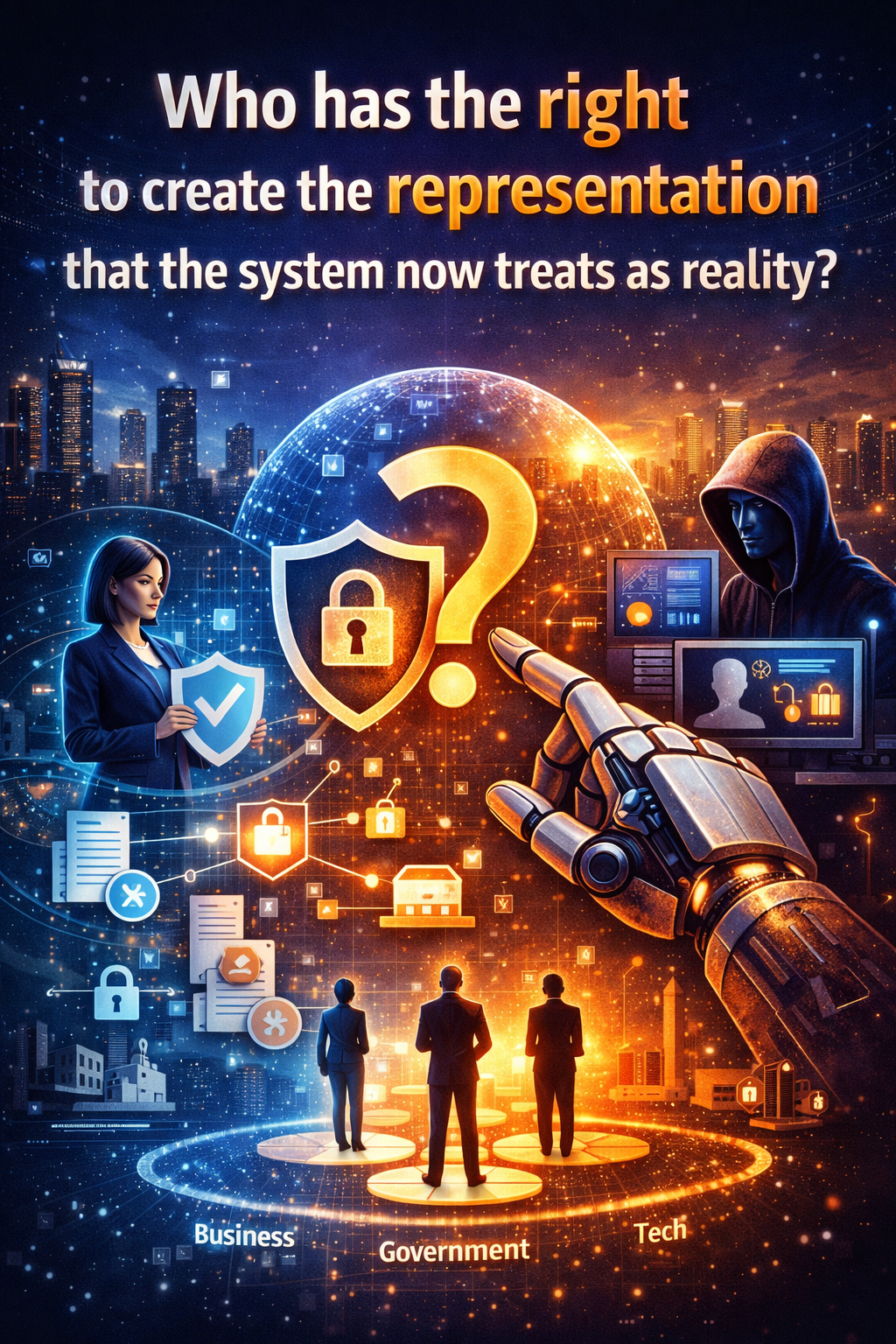
This is the shift many leaders still underestimate.
A bank may maintain a machine-readable profile of a small business and use it to assess creditworthiness. A hospital may maintain a patient representation and use it to prioritize diagnosis or care pathways.
A procurement platform may maintain a dynamic representation of a supplier’s reliability, compliance, and delivery quality. A digital marketplace may continuously score a seller or product based on signals spread across many systems. An industrial platform may maintain a digital representation of a machine and trigger service decisions based on that representation.
In each case, the institution is doing more than collecting facts. It is building a working model of an entity and then using that model to shape economic outcomes. GDPR and the EU AI Act acknowledge parts of this problem through rights and governance obligations, but they do not yet define a full rights architecture for who gets to build, update, infer from, and act on these representations. (GDPR)
That is the real shift. The AI economy is not only about intelligence. It is about authorized representation.

Why Representation Rights are bigger than privacy
Many executives will first interpret this as a privacy issue. That is too narrow.
Privacy asks: what data about me may be collected, stored, processed, or shared?
Representation Rights ask a wider and more consequential set of questions:
Who can build a machine-readable model of me?
Who can update that model over time?
Who can infer things about me that I did not explicitly state?
Who can merge signals from different contexts into a decisive profile?
Who can rely on that profile for ranking, access, or exclusion?
Who can challenge it when it is wrong?
Who captures the economic value when that representation becomes useful?
That is much larger than privacy. It reaches into access, authority, delegation, due process, economic participation, and institutional power.
A person may not be denied a loan because anyone stole their raw data. They may be denied because the institution’s representation of them is outdated, shallow, or built from proxies that no longer reflect reality.
A supplier may not lose a contract because anyone lied. They may lose because no recognized mechanism exists to update the machine-readable view of their improved performance.
A patient may not be harmed because the model was “bad” in the abstract. Harm may arise because the representation the system relied upon was narrow, stale, or disconnected from the context that a human expert would have considered. NIST’s AI RMF and the OECD AI Principles both emphasize accountability, robustness, transparency, and human-centered values; in practice, however, the failure often begins even earlier, at the level of representation design. (NIST Publications)
This is why Representation Rights deserve to become a first-class concept.

The SENSE–CORE–DRIVER lens
This is where the SENSE–CORE–DRIVER framework becomes especially important.
SENSE is the legibility layer. It determines which signals are captured, which entity those signals belong to, how state is represented, and how that state evolves over time.
CORE is the cognition layer. It interprets those representations, reasons over them, optimizes decisions, and generates judgments, recommendations, or priorities.
DRIVER is the legitimacy layer. It governs who authorized the action, which representation was used, how the decision is verified, how execution happens, and what recourse exists if the system is wrong.
Representation Rights sit across all three.
At the SENSE layer, the question is whether an entity has rights over how it is made legible in the first place.
At the CORE layer, the question is whether inferences drawn from that representation are bounded, contestable, and proportionate.
At the DRIVER layer, the question is whether any system or institution actually had the authority to act on behalf of that entity at all.
This is the doctrine gap in today’s AI debate. Current governance frameworks address data quality, transparency, oversight, and accountability, but the next phase of AI governance must go further: it must recognize rights over representation formation, representation change, inferred meaning, and delegated machine action. (Artificial Intelligence Act)
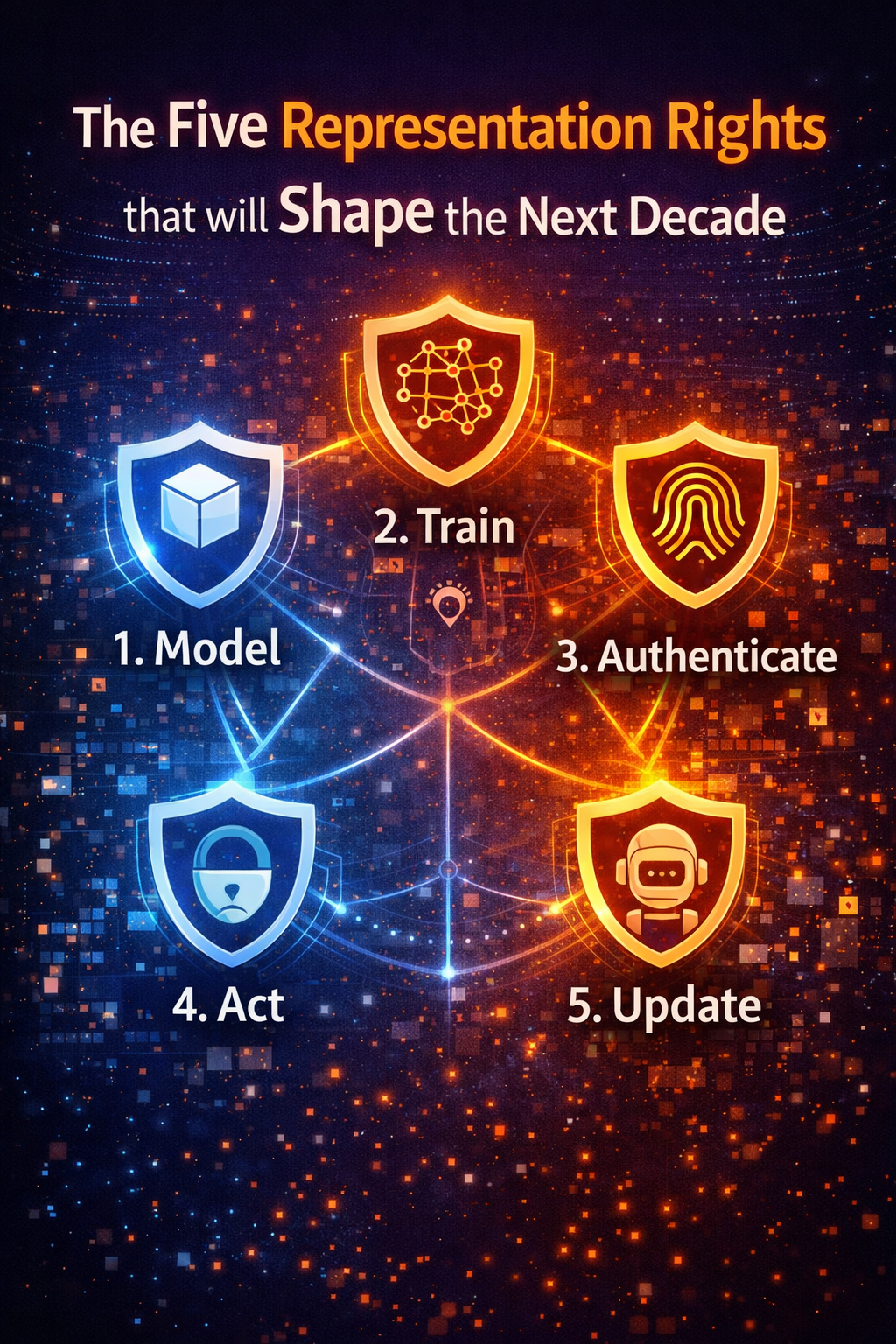
The five Representation Rights that will shape the next decade
To make this practical, the AI economy is likely to converge toward at least five categories of Representation Rights.
-
The right to be modeled fairly
If an institution is going to build a machine-readable representation of an entity, that representation cannot be assembled casually from noisy, incomplete, outdated, or context-poor signals. The EU AI Act already pushes in this direction by requiring appropriate data governance for high-risk systems, including attention to relevance, representativeness, errors, and completeness as far as possible. (Artificial Intelligence Act)
In simple terms: if a system is going to decide with you, it should not begin by mis-seeing you.
-
The right to have state updated
A large share of AI harm does not come from the first classification. It comes from stale representation.
A worker gains new skills.
A supplier improves reliability.
A borrower repays consistently.
A patient’s condition changes.
An asset is repaired.
A merchant resolves old disputes.
But the machine-readable representation stays frozen.
GDPR’s right to rectification is an important precursor, but the future issue is larger than correcting a field in a database. The real challenge is ensuring that consequential machine-readable reality evolves when reality itself evolves. (GDPR)
-
The right to know when inference becomes action
An AI system may infer risk, intent, reliability, urgency, fraud likelihood, eligibility, or trustworthiness. Those inferences stop being merely analytical once they drive ranking, pricing, denial, prioritization, routing, or execution.
At that point, representation becomes power.
GDPR already creates protections around certain solely automated decisions that produce legal or similarly significant effects, but institutions increasingly need a broader operational principle: entities should know when inferred representation is being used not just to observe them, but to act on them. (GDPR)
-
The right to contest representation
If a system’s representation is wrong, incomplete, or unfairly inferred, there must be a real pathway to challenge it.
Not as an afterthought.
Not as a buried appeal mechanism.
As part of the architecture.
A mature institution will need processes for contesting not only outputs, but also the representational assumptions beneath them: a broken identity link, a missing context signal, an outdated state, a misleading proxy, or an invalid delegation chain. That direction is consistent with the broader human-centered and accountability-based approach reflected in OECD and NIST guidance. (NIST Publications)
-
The right to control delegated action
This may become the deepest Representation Right of all: the right to know who is allowed to act on your behalf, in what scope, using which representation, and with what recourse.
This will matter everywhere AI becomes agentic: in workflow automation, procurement, financial orchestration, healthcare navigation, enterprise operations, customer support escalation, and digital identity ecosystems.
There is a major difference between a model that estimates and an agent that commits. Once a system can approve, deny, purchase, reroute, schedule, escalate, freeze, unlock, or transact, authority becomes central. NIST’s governance-oriented guidance increasingly emphasizes roles, responsibilities, monitoring, and risk management, but the specific rights layer around delegated machine action is still underdeveloped. (NIST)
A simple example: the invisible supplier
Imagine a mid-sized supplier that has spent two years improving quality, sustainability practices, delivery performance, and reporting discipline. Human buyers who visit the factory can see the improvement immediately.
But the procurement AI used by large buyers still sees the supplier through an old machine-readable representation: missed shipments, low confidence, incomplete traceability, and outdated certification status.
No one may have acted maliciously. No law may have been openly broken. But the supplier is still economically punished because its machine-readable self never caught up with reality.
Representation Rights would change that logic.
The supplier would have the right to know which consequential representation is being used, to update its state through recognized channels, to challenge stale or misleading machine inference, to understand when AI-driven rankings affect access to contracts, and to require that delegated procurement systems rely on validated representation pathways.
That is not a small compliance tweak. It is the beginning of a new market order.
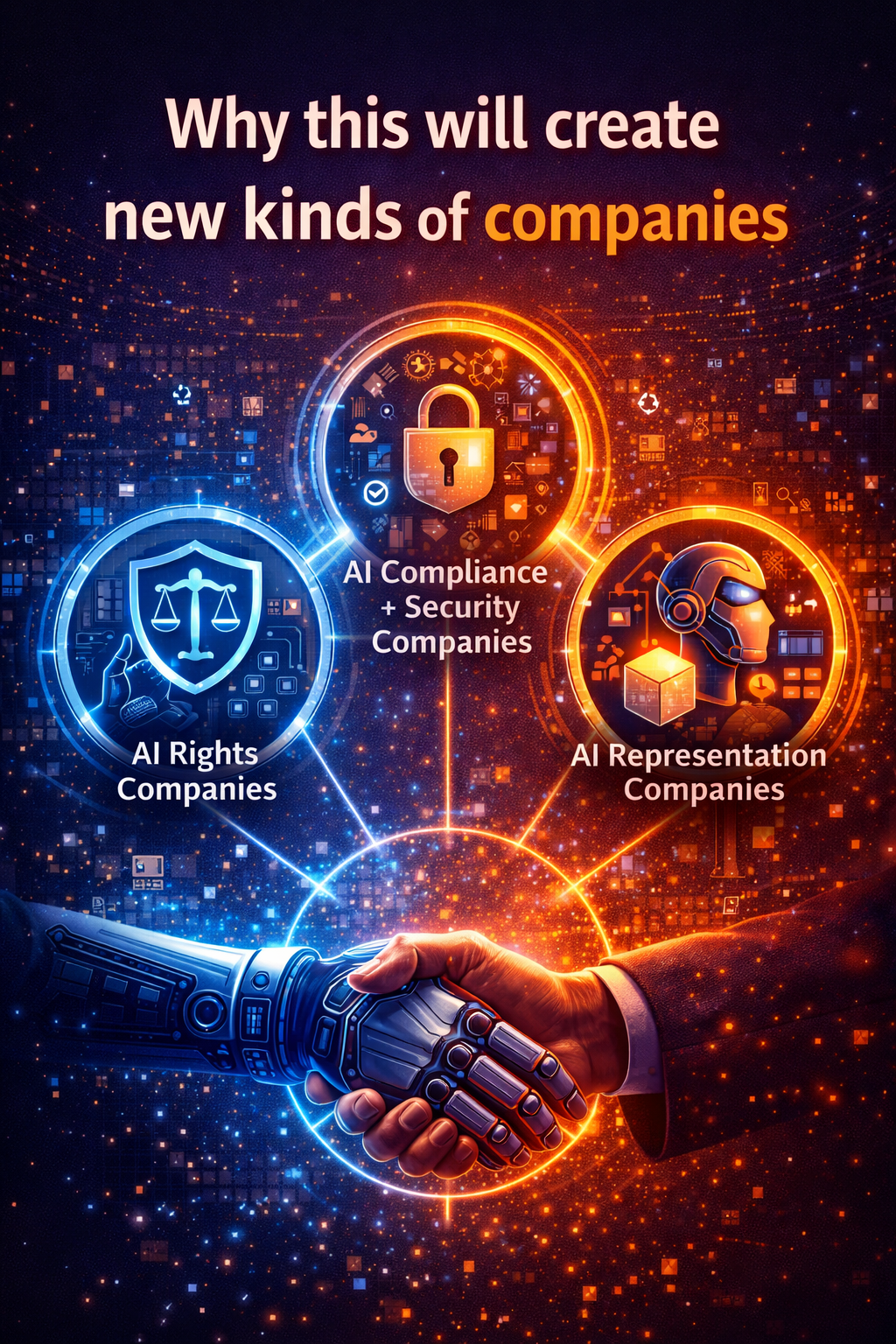
Why this will create new kinds of companies
Every major rights shift creates new infrastructure.
The industrial era created labor law, safety standards, inspectors, insurers, registries, and exchanges. The digital era created identity providers, cybersecurity firms, consent managers, data brokers, and privacy infrastructure.
The Representation Economy will do the same.
New categories of firms are likely to emerge around representation verification, state-update orchestration, contested inference resolution, delegated authority management, recourse infrastructure, and machine-readable rights registries. This is a forward-looking inference from the direction of current governance frameworks and enterprise needs, not a settled taxonomy yet. But the pattern is historically consistent: once a right becomes economically consequential, institutions and markets arise to operationalize it. (NIST Publications)
The companies that win in this next phase will not simply have better models. They will have better rights architecture around how entities are represented, updated, challenged, and acted upon.
Why boards should care now
Boards often ask whether AI is safe, compliant, or scalable. Those are important questions, but they come too late.
The earlier question is this:
Do we actually have the right to model, update, infer from, and act on behalf of the entities our AI touches?
If the answer is vague, the institution is building on weak legitimacy.
That creates direct exposure in product design, regulatory posture, partner relationships, customer trust, recourse cost, reputational resilience, and long-term strategic strength. The OECD AI Principles, OECD’s new Responsible AI due diligence guidance, GDPR, the EU AI Act, and NIST’s AI RMF all signal the same broad direction: accountability in AI is becoming deeper, more operational, and more tied to enterprise process rather than abstract principle alone. (OECD)
The institutions that move first will not merely reduce risk. They will earn something rarer: the right to delegate responsibly.
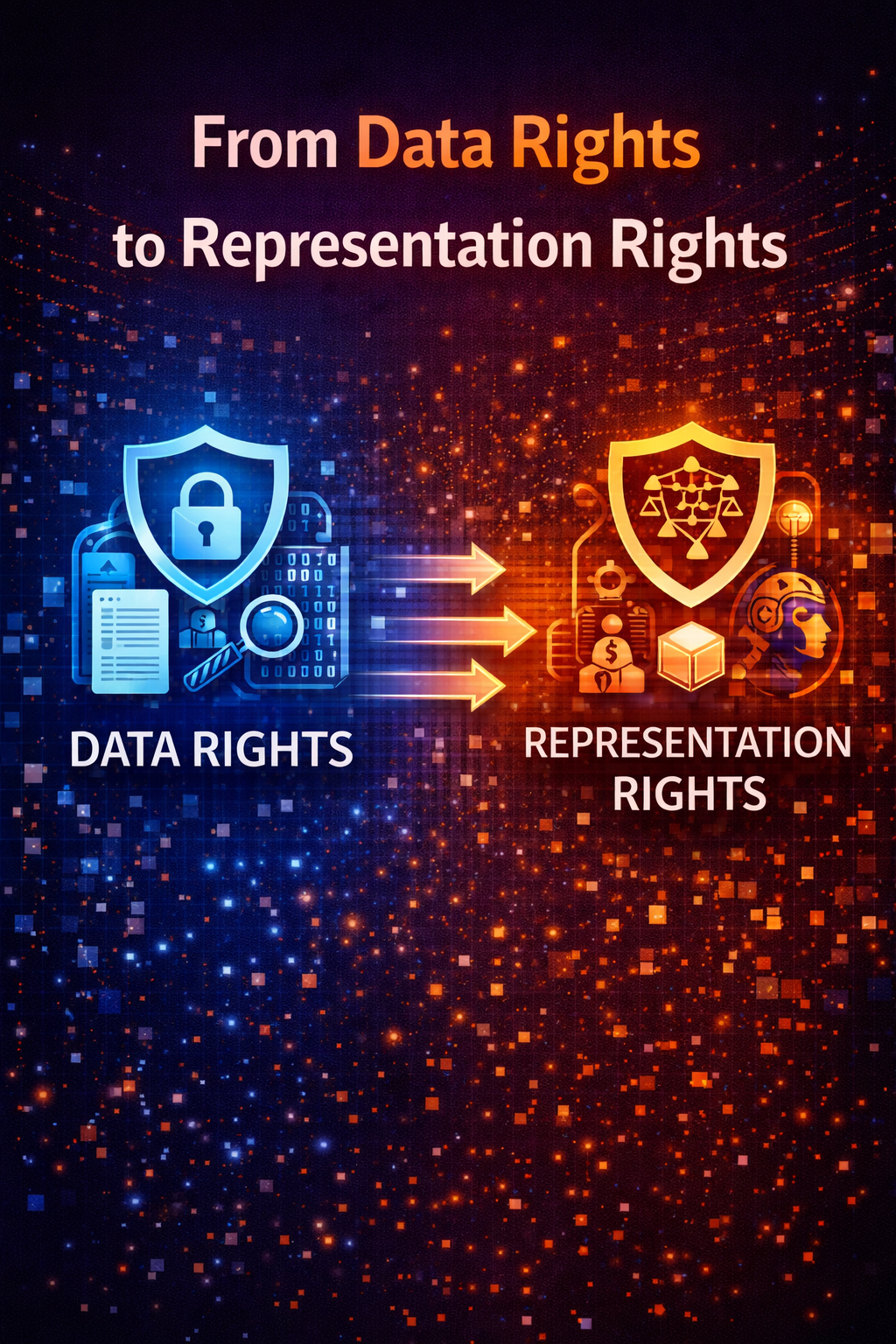
From data rights to Representation Rights
We are entering a new phase of the digital economy.
The first phase was about data collection.
The second was about model performance.
The third will be about representation legitimacy.
That shift matters because AI does not operate directly on the world. It operates on representations of the world. Whoever controls those representations will increasingly shape trust, access, coordination, and power.
That is why Representation Rights may become one of the defining ideas of the AI era.
Not because the phrase sounds elegant.
But because it answers the most practical question of all:
When software begins to see, decide, and act at scale, who gets to decide what counts as the real version of you?
The institutions that answer that question well will not only build better AI. They will build more legitimate markets.
And the societies that answer it well will not only regulate AI more effectively. They will create an economy in which intelligence remains accountable to the reality it claims to represent.
That is the deeper promise of the Representation Economy.
Conclusion
Representation Rights are not a niche legal add-on to AI governance. They are the missing bridge between data rights, model governance, institutional legitimacy, and delegated machine action.
If AI is going to participate in credit, care, employment, public services, enterprise operations, and market coordination, then the rights architecture around representation will become unavoidable. The future contest will not be only about who has the best model. It will be about who has the most legitimate, contestable, updateable, and governable representation of reality.
That is the shift boards should begin preparing for now.
Glossary
Representation Rights
The emerging rights over who can model, update, infer from, and act on behalf of an entity in AI systems.
Representation Economy
An economic order in which value increasingly depends on how well entities are made legible, interpretable, and governable inside machine systems.
Machine-readable identity
A structured digital representation of a person, firm, asset, or object that software systems can interpret and use.
Delegated authority
Permission granted to a system, agent, or institution to take action on behalf of an entity within defined limits.
Representation legitimacy
The degree to which a machine-readable representation is authorized, accurate enough for purpose, contestable, and institutionally acceptable.
SENSE
The layer that captures signals, links them to entities, models their state, and updates that state over time.
CORE
The reasoning layer that interprets representations and turns them into judgments, predictions, or decisions.
DRIVER
The governance and legitimacy layer that determines who authorized action, how it is executed, and what recourse exists if something goes wrong.
Contestability
The ability of an entity to challenge a representation, inference, or action and seek correction or review.
State update
A change to the machine-readable description of an entity as real-world conditions evolve.
Delegated machine action
An action taken by software or AI agents on behalf of an entity or institution, such as approval, denial, routing, or transaction execution.
FAQ
What are Representation Rights in AI?
Representation Rights are the emerging rights that determine who can create, update, infer from, and act on a machine-readable representation of a person, firm, asset, or ecosystem.
How are Representation Rights different from privacy rights?
Privacy rights focus on collection, storage, and sharing of data. Representation Rights go further by addressing who can define a machine-readable version of an entity, keep it current, use it for decisions, and act on its behalf.
Why do Representation Rights matter for businesses?
They matter because AI-driven decisions increasingly shape access to customers, suppliers, credit, care, and opportunity. Firms that ignore Representation Rights risk weak legitimacy, stale representations, and growing exposure to trust, compliance, and market-access failures.
How does this relate to GDPR and the EU AI Act?
GDPR provides important building blocks such as rights of access, rectification, portability, and protections around certain automated decisions. The EU AI Act adds requirements for high-risk AI systems around data governance, transparency, documentation, and oversight. Together they point toward a future rights architecture, but they do not fully define Representation Rights yet. (GDPR)
What kinds of companies could emerge around Representation Rights?
Likely categories include firms focused on representation verification, authority management, contested inference resolution, recourse infrastructure, and machine-readable rights registries.
Why should boards care about this now?
Because once AI begins acting across consequential workflows, the issue is no longer just model performance. It becomes a question of whether the institution had the right to represent and act on behalf of the entities affected.
References and further reading
This article builds on your submitted draft and its central thesis about rights over modeling, updating, and acting on behalf of entities.
For external grounding, the most relevant current building blocks are:
- GDPR rights of access, rectification, portability, and automated decision protections. (GDPR)
- EU AI Act obligations around data governance, documentation, transparency, and oversight for high-risk AI systems. (Artificial Intelligence Act)
- NIST AI Risk Management Framework and Playbook for governance, mapping, measurement, and management of AI risk. (NIST Publications)
- OECD AI Principles and OECD Due Diligence Guidance for Responsible AI. (OECD)



Raktim Singh is an AI and deep-tech strategist, TEDx speaker, and author focused on helping enterprises navigate the next era of intelligent systems. With experience spanning AI, fintech, quantum computing, and digital transformation, he simplifies complex technology for leaders and builds frameworks that drive responsible, scalable adoption.