

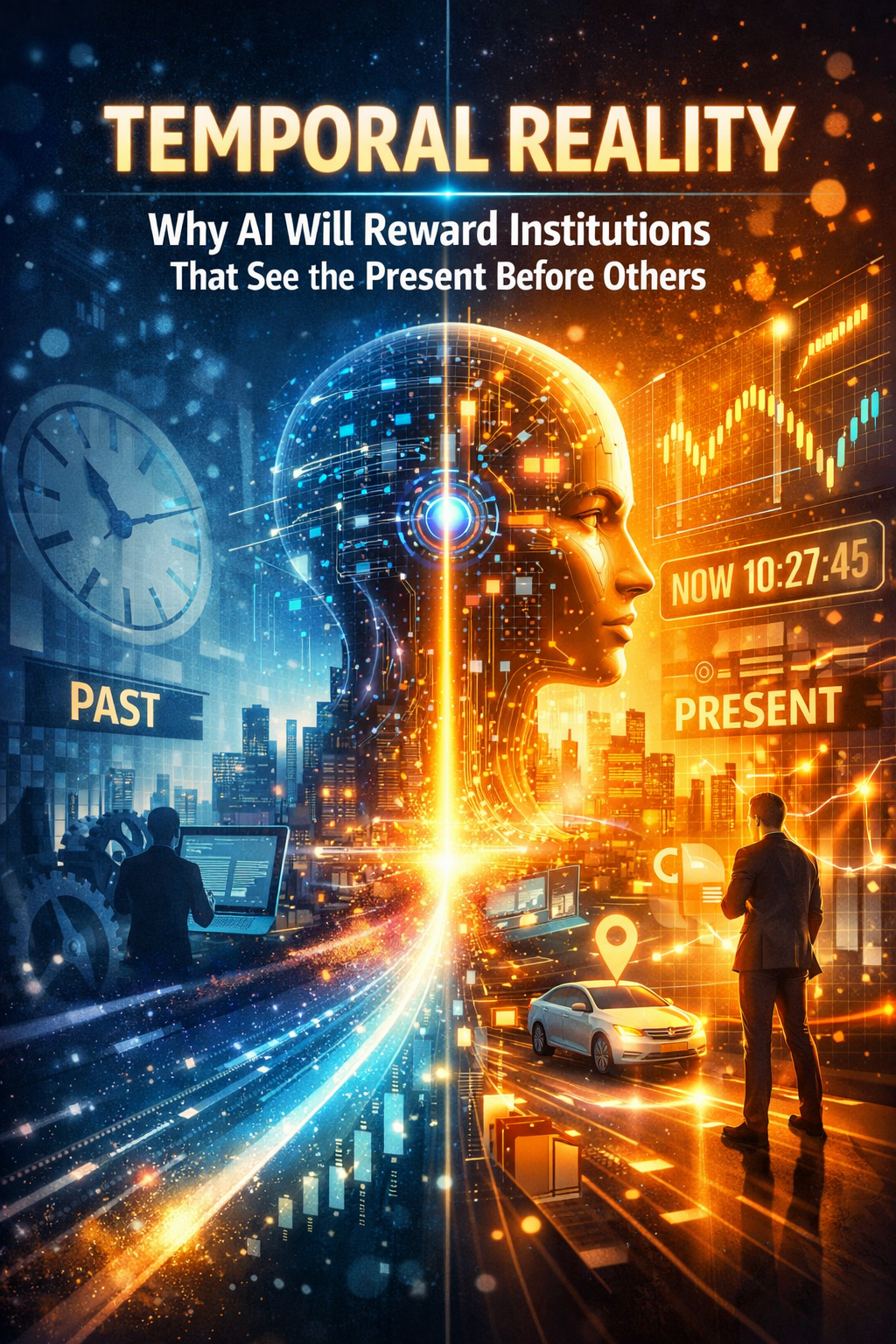
Temporal Reality:
In the AI economy, competitive advantage will not come only from better models or more data. It will come from seeing reality sooner, updating it faster, and acting before others are even aware that the world has changed.
A new AI advantage is emerging
For the last two years, most AI discussions have revolved around a familiar set of questions.
Which model is smarter?
Which model is cheaper?
Which model hallucinates less?
Which model reasons better?
These are valid questions. But they are no longer the deepest ones.
A more important question is beginning to separate serious institutions from everyone else:
How current is the reality your AI is acting on?
That sounds simple. It is not.
A company can have accurate data, sophisticated models, impressive dashboards, and well-designed automation, and still make the wrong decision because its picture of reality is late. A fraud engine may identify fraud after the payment has already gone through. A supply-chain system may recognize a disruption after inventory has already been exhausted. A bank may revise a borrower’s risk only after a loan decision has already been made. In each case, the institution is not entirely blind. It is acting on a stale version of the world.
That is the core idea of Temporal Reality:
AI will increasingly reward institutions that do not merely model reality well, but model it while it is still economically actionable.
This is not just a technical issue about faster data pipes. It is becoming a strategic issue, a governance issue, and, over time, a market-structure issue. IBM defines real-time data streaming as processing data points as they arrive, often within milliseconds, precisely because many decisions lose value when data arrives too late. Apache Flink’s event-time model exists for the same reason: in real systems, the time something happened and the time the system processed it are often not the same. (IBM)
The AI economy will increasingly divide organizations into two groups: those that see the present in time, and those that discover it after value has already moved elsewhere.
Temporal Reality is the idea that AI systems create value only when they act on a timely representation of reality. Even accurate data becomes useless if it arrives too late. In the AI economy, competitive advantage will shift to institutions that can sense, process, and act on real-world changes faster than others.
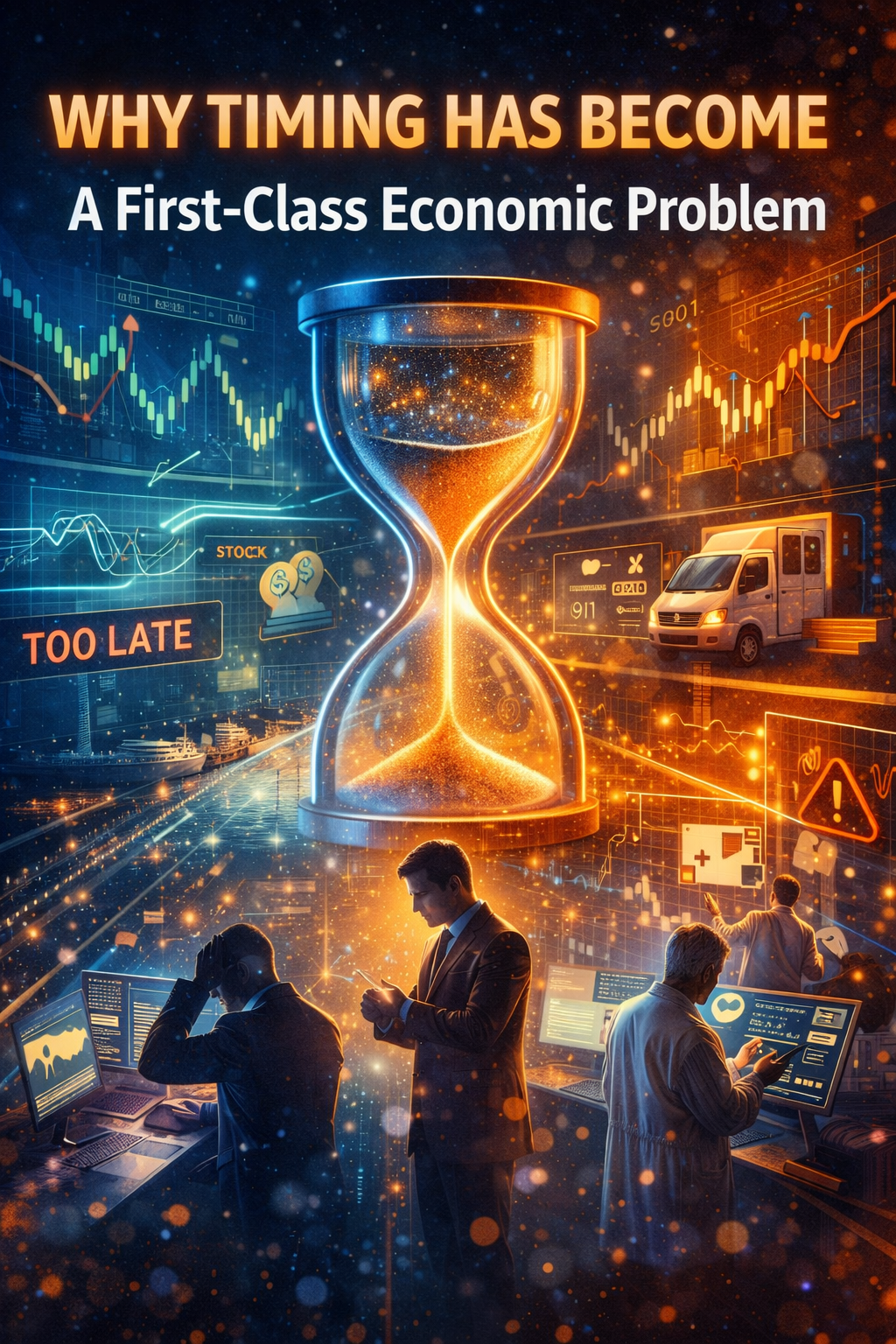
Why timing has become a first-class economic problem
For many years, delayed visibility was manageable.
A retailer could review weekly sales reports.
A manufacturer could reconcile delays at the end of the day.
A bank could run overnight models.
A hospital could update records after a shift.
That world is fading.
As AI systems move from analysis to recommendation, and from recommendation to action, the value of timing rises sharply. The moment software starts deciding, prioritizing, routing, approving, escalating, pricing, detecting, or blocking, the delay between reality and representation becomes economically significant.
You can already see this across industries.
In algorithmic trading, low latency matters because the value of information decays quickly. In fraud detection, the useful moment is the transaction itself, not the report that comes later. Databricks describes real-time machine learning as using a model to make decisions that affect the business in real time, and its example is telling: a credit card company must decide immediately whether a transaction appears legitimate. A model that is right after the fact may still fail the business problem. (Databricks)
The same logic extends far beyond finance.
Uber has described near-real-time features in Michelangelo such as a restaurant’s average meal preparation time over the last hour. That is not a trivial optimization. It reflects a deeper truth: if the system is still reasoning on a restaurant’s earlier state, its delivery promise may already be wrong. (Uber)
Digital twins follow the same pattern. Their usefulness depends on how closely the digital representation stays synchronized with the changing real-world asset or process. When synchronization slips, the “twin” becomes more like an archive than a live operating model. (Springer Link)
This is why timing is no longer a background engineering concern. It is becoming part of competitive advantage itself.
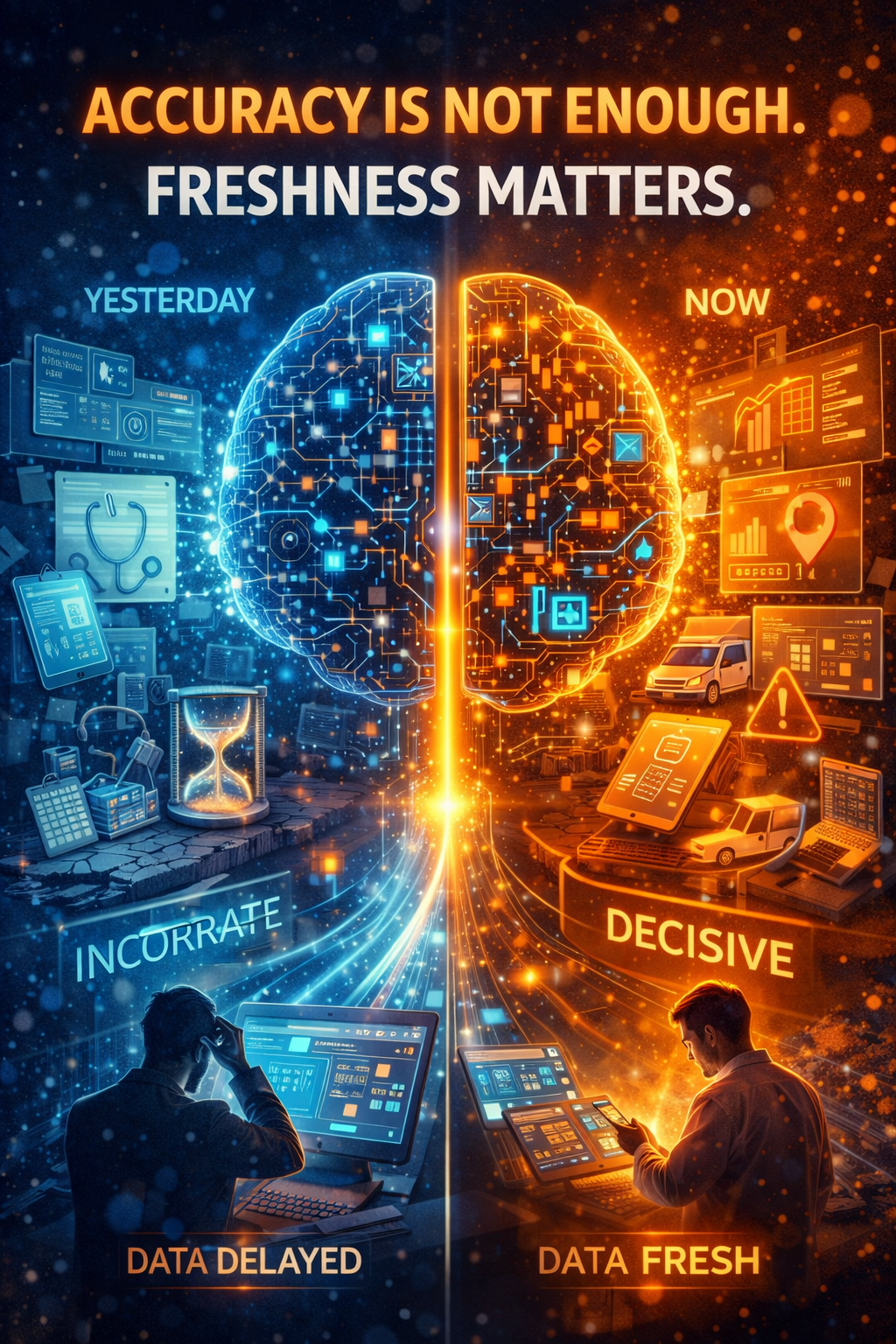
Accuracy is not enough. Freshness matters.
Most data quality discussions focus on accuracy, completeness, consistency, and validity. Those matter. But in AI systems, timeliness is just as important.
Your data can be clean and still be late.
Your model can be precise and still be behind.
Your decision can be rational and still be wrong for the moment.
That is the difference between ordinary data quality and Temporal Reality.
A useful way to frame it is this:
- Accuracy asks: Is the representation correct?
- Temporal Reality asks: Is the representation correct now?
That one added word changes the economics of AI.
A patient record may be accurate but not current.
A warehouse count may be accurate but not current.
A customer risk profile may be accurate but not current.
A delivery estimate may be accurate but not current.
In all these situations, the institution is not failing because it knows nothing. It is failing because it knows the wrong present.
And that can be more dangerous than simple uncertainty.
If a system admits uncertainty, humans may intervene. If a system presents outdated reality as current truth, institutions may act with confidence at exactly the wrong moment. AWS feature-store material emphasizes event time and point-in-time correctness for this reason: a model should not be trained or served on features that leak future information or fail to match the actual time context of the decision. (Amazon Web Services, Inc.)
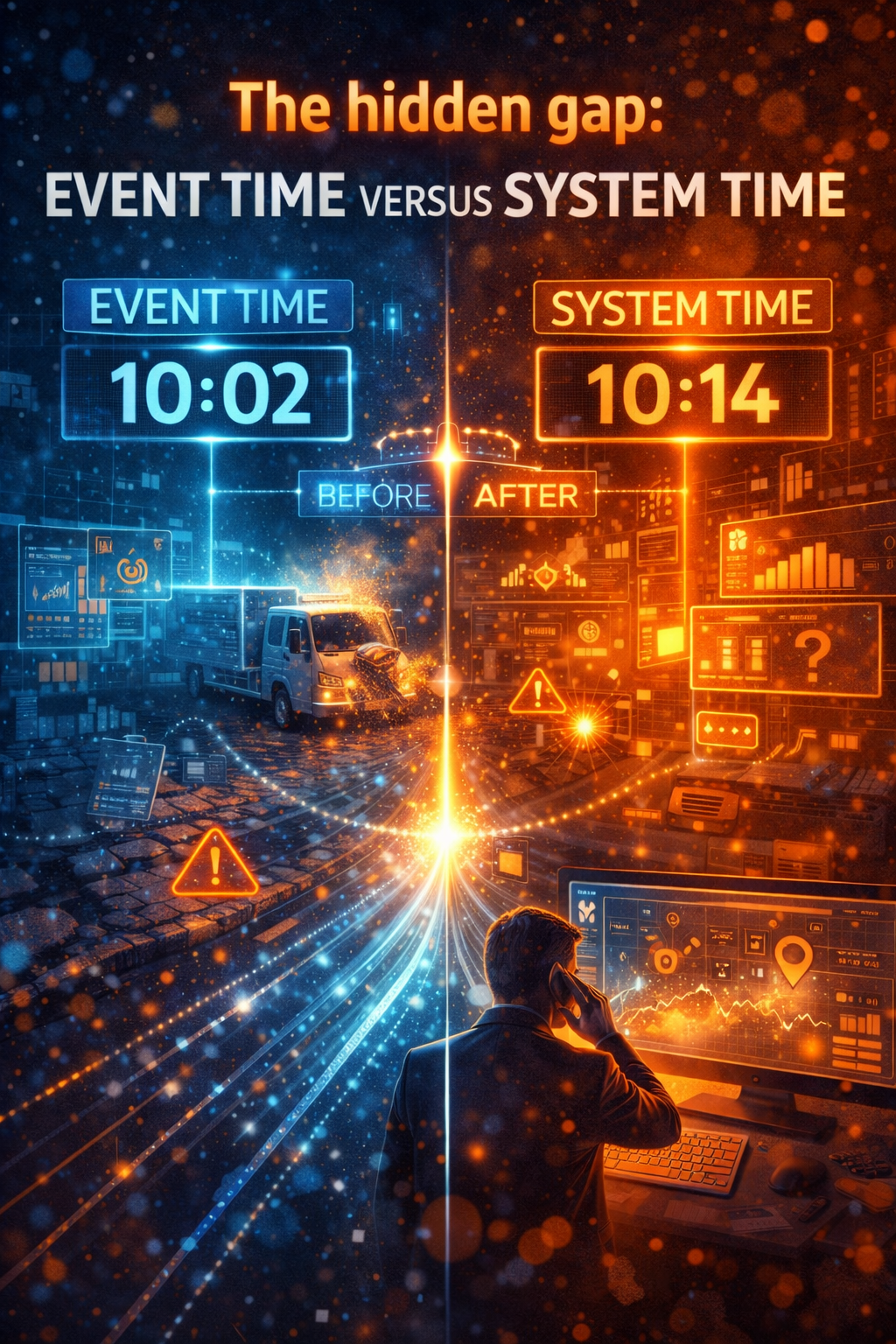
The hidden gap: event time versus system time
One of the most important ideas from modern data infrastructure is also one of the most useful ideas for business leaders: the difference between when something happened and when your system noticed it.
Apache Flink distinguishes between event time and processing time because real systems are messy. Events arrive late. Networks delay them. Systems batch them. Pipelines retry them. Data may appear out of order. If a business treats processing time as reality, it can easily mistake a delayed signal for a current one. (Apache Nightlies)
This sounds technical, but it is actually very human.
A truck breaks down at 10:02.
The sensor sends the signal at 10:05.
The dashboard updates at 10:09.
The planning engine responds at 10:14.
Customer support reacts at 10:20.
Which of those times is the business acting on?
For too many institutions, the answer is: whatever the dashboard shows.
That is no longer enough.
In the AI era, organizations increasingly need to know:
- when the event occurred,
- when it entered the machine-readable system,
- when the model reasoned over it,
- and when action was actually taken.
That chain is not operational trivia. It is the difference between descriptive systems and live decision systems.
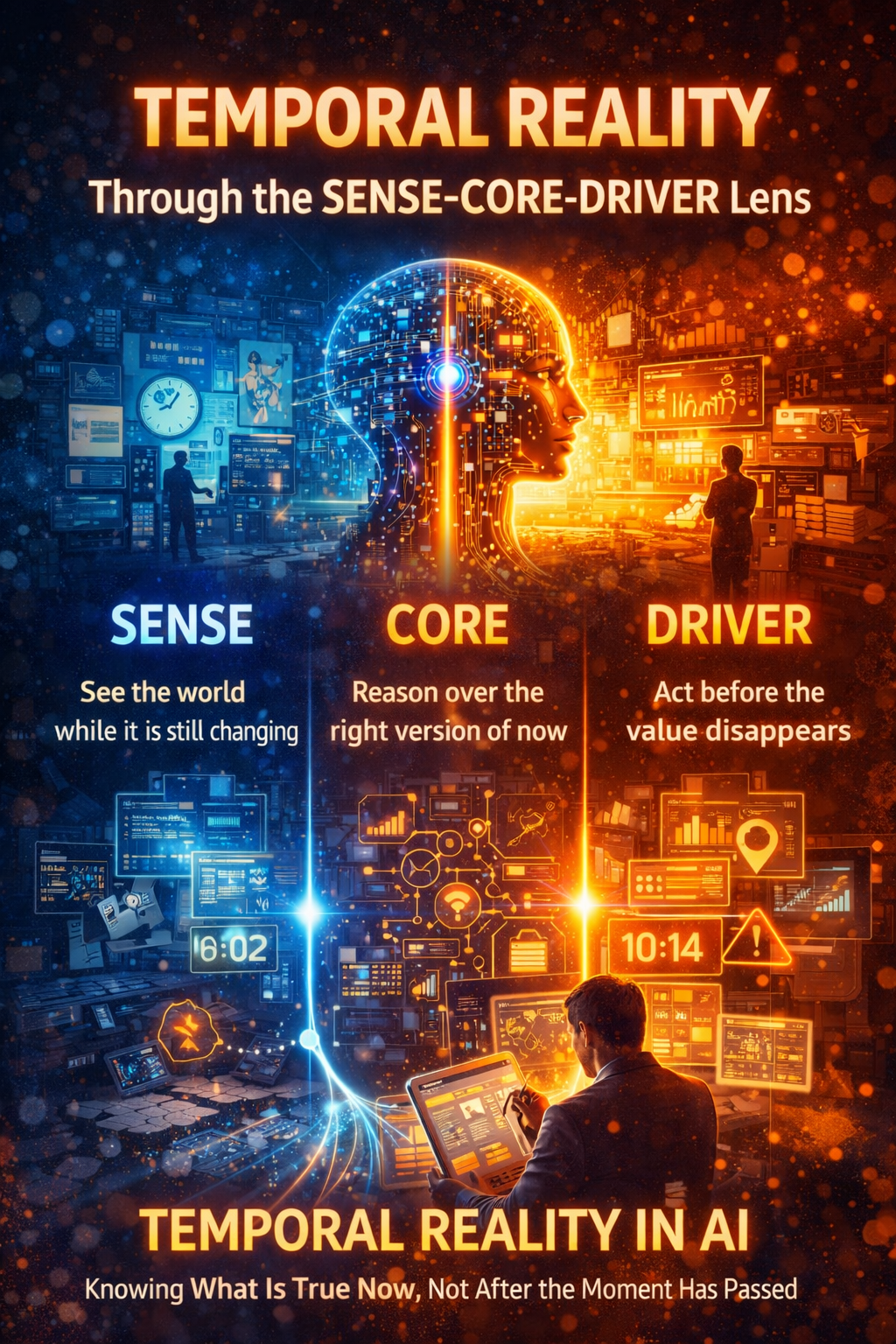
Temporal Reality through the SENSE–CORE–DRIVER lens
This is where the SENSE–CORE–DRIVER framework becomes especially powerful.
Your broader thesis on the Representation Economy is that AI advantage does not come only from intelligence. It comes from how institutions sense reality, represent it clearly, reason over it, and act through governed systems. That is consistent with your pillar framework and your broader enterprise AI operating model work. (Raktim Singh)
SENSE: seeing the world while it is still changing
SENSE is the legibility layer. It is where reality becomes machine-readable.
In a temporal world, SENSE is not just about whether an institution can capture a signal. It is also about whether it can capture it quickly enough, timestamp it correctly, preserve sequence, and update state as conditions evolve.
A delayed signal is not just a weak signal. It can produce a false present.
A bank may know that a borrower missed a payment. But if that information enters the scoring flow too late, the institution still prices risk using yesterday’s reality.
A hospital may know a patient’s vitals are deteriorating. But if the escalation chain lags, the system is technically accurate only in a historical sense.
A logistics firm may know that a shipment is delayed. But if that signal reaches planning too late, it is still operating on an obsolete map of its own network.
CORE: reasoning over the right version of now
CORE is the cognition layer. It interprets, prioritizes, and decides.
But even the most advanced reasoning system cannot fix stale reality on its own. If the underlying representation is temporally misaligned, the output may be elegant, persuasive, and still wrong for the moment.
This is one of the most underappreciated truths in enterprise AI.
Better intelligence does not automatically solve the timing problem. In some cases, it can make the problem worse, because a highly capable system can produce very convincing decisions from slightly outdated reality.
DRIVER: acting before the value disappears
DRIVER is the governance and legitimacy layer. It determines who authorized action, how the decision is checked, and how action is executed and corrected.
This is where time becomes economic.
A recommendation delayed by two minutes may be irrelevant in one setting and catastrophic in another. The issue is not the model alone. It is the decision window.
That is why every AI-enabled institution will eventually need to ask:
- How much delay can this decision tolerate?
- What freshness threshold is required before action?
- When should the system slow down instead of act?
- When should old reality be treated as invalid, not merely incomplete?
That is not just good engineering. It is good institutional design.
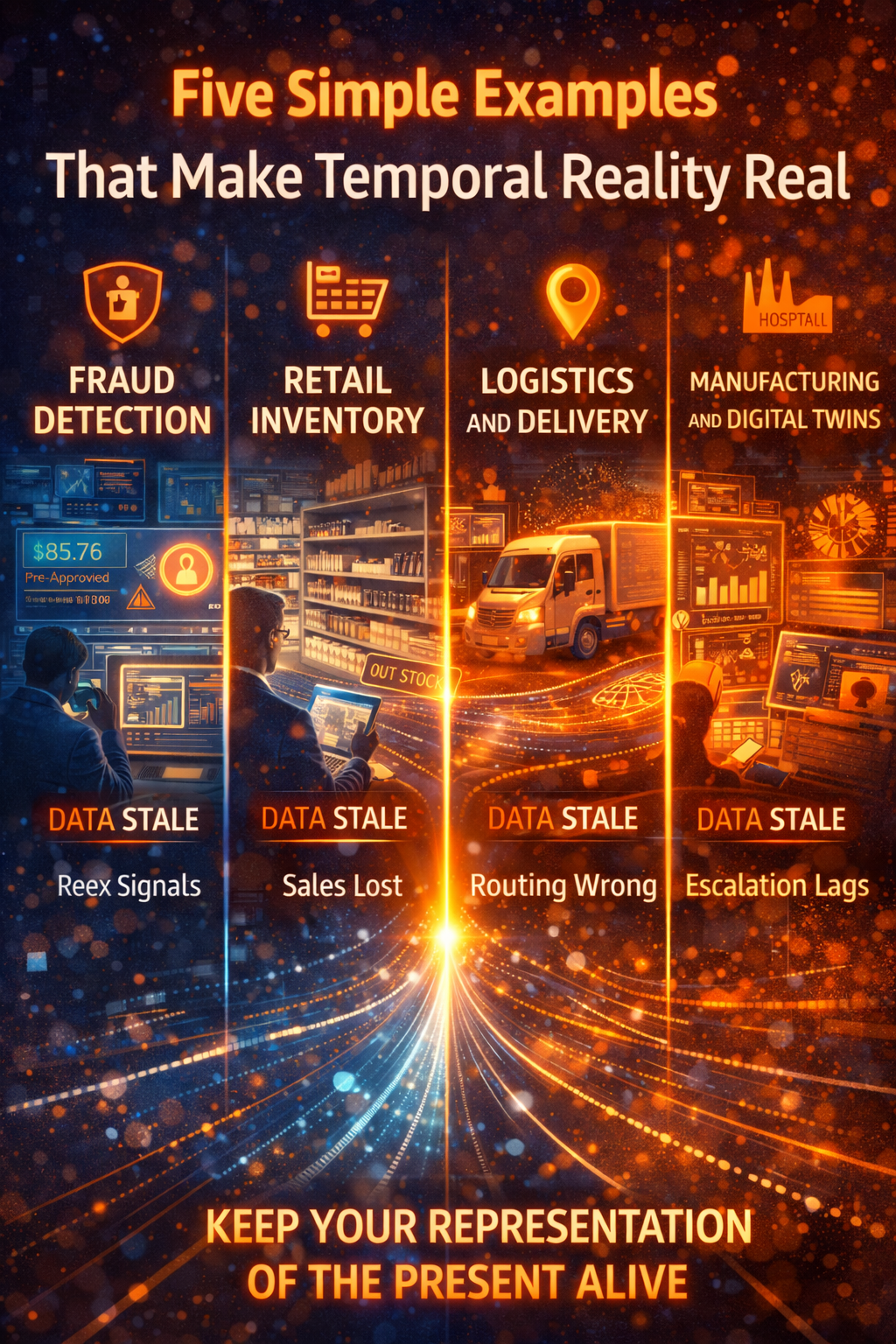
Five simple examples that make Temporal Reality real
-
Fraud detection
A bank scores a transaction using a customer profile updated every six hours. On paper, the model looks accurate. In practice, the customer’s location, device, behavior, or spend pattern may have changed in the last ten minutes. A stale representation may approve what should be challenged, or block what should be approved. That is why real-time ML is so important in fraud settings. (Databricks)
-
Retail inventory
An AI system forecasts demand well, but store inventory updates are delayed. Promotions continue for products that are no longer actually available. The issue is not only demand forecasting. The issue is that the institution is reasoning on an expired present.
-
Logistics and delivery
A rerouting engine is excellent, but traffic and port updates arrive too slowly. The company thinks it has a routing problem. In reality, it has a present-tense visibility problem.
-
Hospitals and monitoring
A patient-monitoring system identifies a high-risk pattern correctly, but only after data synchronization and workflow delays. The institution has clinical intelligence, but not temporal control.
-
Manufacturing and digital twins
A digital twin only helps if it stays close enough to the real machine or process to support intervention. If the digital representation lags too far behind, the twin stops being operationally useful. (Springer Link)
Across all five examples, the same principle holds:
Competitive advantage shifts to institutions that can keep their representation of the present alive.
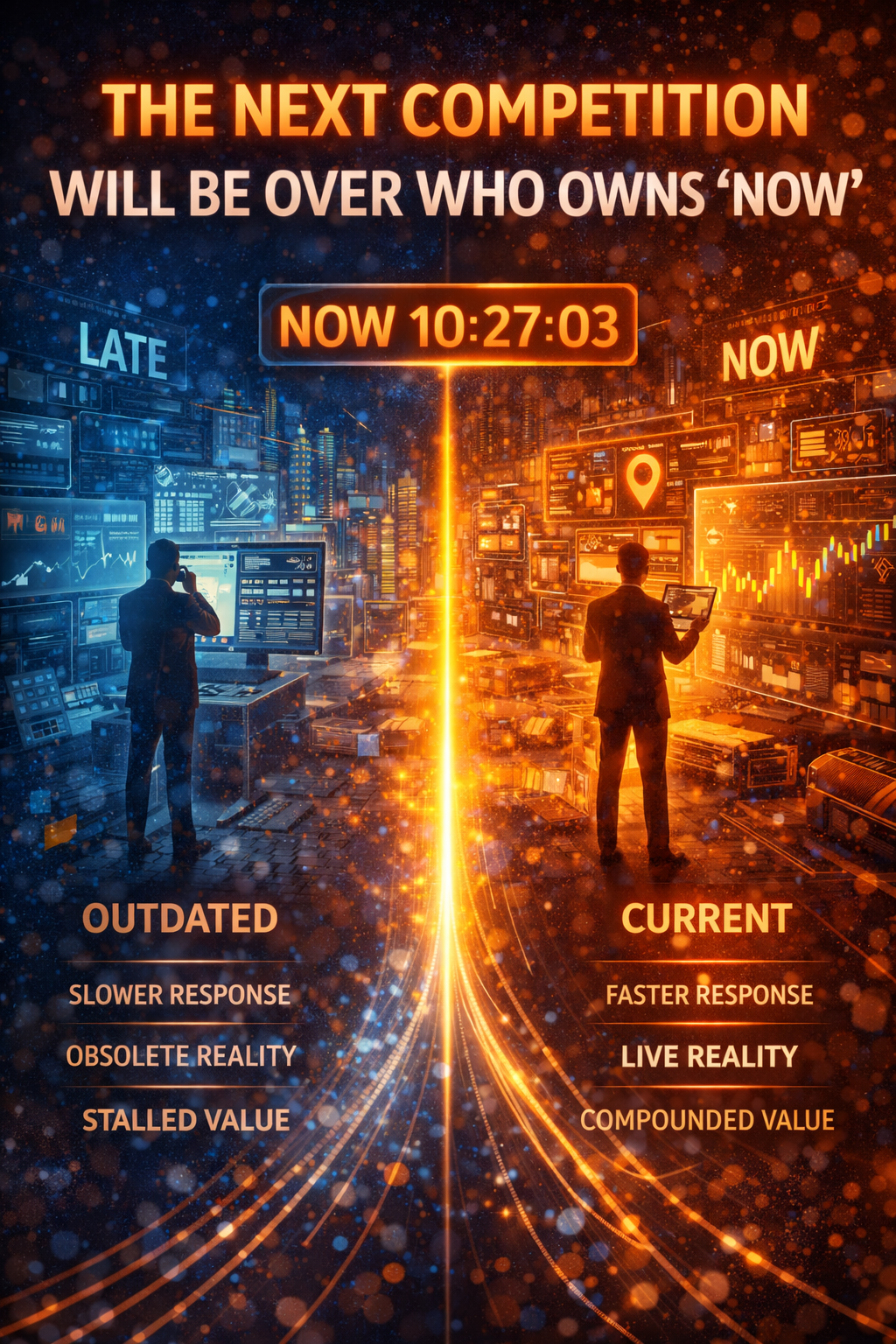
The next competition will be over who owns “now”
This is where Temporal Reality becomes more than a technical pattern. It becomes strategic doctrine.
In the past, firms competed on scale.
Then on digitization.
Then on data.
Now on intelligence.
But as similar models, cloud infrastructure, and AI tooling become more widely available, lasting advantage shifts elsewhere.
It shifts to the ability to maintain a more current, decision-ready version of reality.
That means tomorrow’s winners may not always be the firms with the biggest models. They may be the firms with:
- better signal freshness,
- stronger event pipelines,
- tighter operating loops,
- cleaner timestamp discipline,
- better feature-serving architecture,
- and stronger governance over when stale reality must not be used.
That is one reason feature stores, event-driven systems, and real-time analytics matter so much. They are not merely technical architecture choices. They are part of how an institution competes for the present. (Amazon Web Services, Inc.)
A new board-level question
The classic board question was:
Do we have the data?
The new question is:
How late is our reality?
That single question reveals more than many AI maturity assessments.
A company may have years of historical data, a data lake, AI pilots, dashboards, copilots, and governance documents. But if its decision systems are still operating on delayed reality, it remains institutionally slow.
This is why Temporal Reality should become a board-level issue.
Not because every board needs to understand stream windows or watermark logic. But because every board needs to understand whether the institution’s machine-readable present is current enough for the decisions it is delegating to software.
3 Core Takeaways
- AI decisions lose value when reality is delayed
- Data freshness is as important as data accuracy
- Competitive advantage will come from who sees the present first
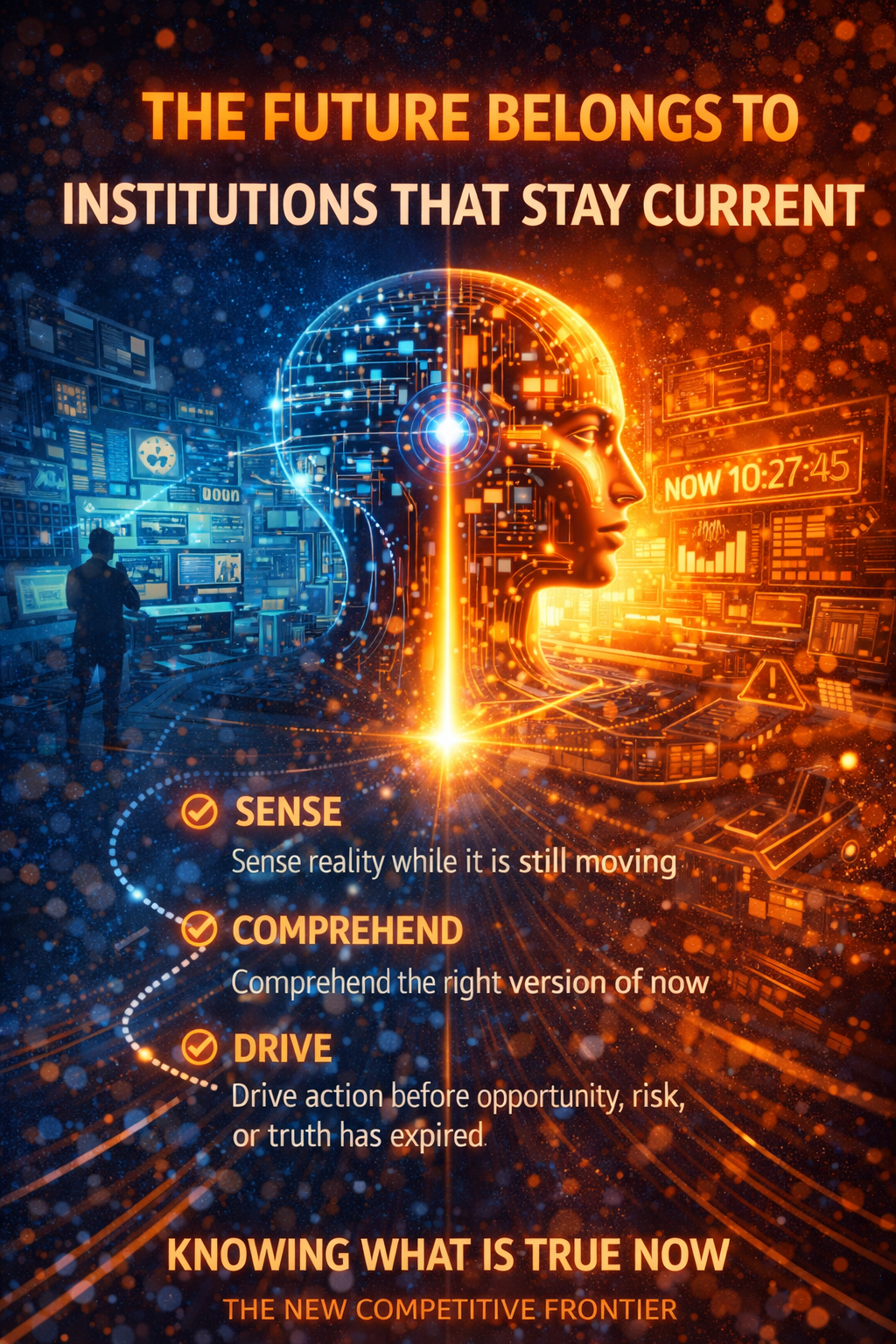
Conclusion: the future belongs to institutions that stay current
Temporal Reality is not just about speed. It is about staying synchronized with a changing world.
It asks institutions to move beyond familiar questions.
Not: How much data do we have?
But: How alive is our representation?
Not: How accurate is the model?
But: How old is the reality it is using?
Not: Can the system act?
But: Can it act while the present is still present?
In the Representation Economy, value will increasingly flow toward institutions that can do three things well:
- SENSE reality while it is still moving
- CORE the right version of the present
- DRIVER action before opportunity, risk, or truth has expired
That is the real competitive frontier.
The AI era will not be won only by those who know more.
It will be won by those who know what is true now.
And in the end, that may become the scarcest asset of all: not data, not models, not automation, but a timely representation of reality.
Read more at ..Continue Reading
- Enterprise AI Operating Model — my pillar article on how enterprises design, govern, and scale AI safely in production. This is the natural link for readers who want the broader operating architecture.
- The Representation Economy: Why AI Institutions Must Run on SENSE, CORE, and DRIVER — best link for readers who want the conceptual doctrine behind Temporal Reality. (Raktim Singh)
- Why Intelligence Alone Cannot Run Enterprises: The Missing AI Execution Layer — best link for readers who want the enterprise execution argument. (Raktim Singh)
- Representation Drift & Labor: Why AI Systems Fail When Reality Moves Faster Than Machines — best link for readers who want the time/change angle extended. (Raktim Singh)
- The Representation Strategy of the Firm: Why AI Winners Will Be Those Who See What Others Cannot — very strong thematic companion (Raktim Singh)
Glossary
Temporal Reality
The idea that AI systems create more value when they act on a timely representation of reality, not merely an accurate but outdated one.
Representation Economy
An emerging economic logic in which value increasingly flows to institutions that can represent reality well enough for machines to reason and act responsibly. (Raktim Singh)
SENSE
The legibility layer in the SENSE–CORE–DRIVER framework: Signal, ENtity, State representation, Evolution. This is where reality becomes machine-readable. (Raktim Singh)
CORE
The cognition layer where systems interpret signals, reason over context, and generate decisions.
DRIVER
The governance and execution layer that authorizes, verifies, executes, and provides recourse for machine action.
Event time
The time an event actually occurred on the producing device or source system. (Apache Nightlies)
Processing time
The time the system processed the event, which may differ from when the event actually happened. (Apache Nightlies)
Feature freshness
How current the data features used by a model are at the moment of inference.
Point-in-time correctness
Ensuring that features used for training or serving accurately reflect the information that would have been available at that exact moment. (Amazon Web Services, Inc.)
Digital twin
A digital representation of a physical asset, process, or system that gains value when it stays sufficiently synchronized with real-world changes. (Springer Link)
FAQ
What is Temporal Reality in AI?
Temporal Reality is the idea that AI systems create more value when they act on a timely representation of reality, not merely an accurate but outdated one.
Why does data freshness matter in AI?
Because many business decisions lose value when the underlying representation is stale. In fraud detection, delivery estimation, logistics, and live operations, late truth can be almost as damaging as wrong truth. (Databricks)
What is the difference between event time and processing time?
Event time is when something actually happened. Processing time is when the system processed it. The gap matters because delayed processing can distort the institution’s understanding of the present. (Apache Nightlies)
How does Temporal Reality connect to SENSE–CORE–DRIVER?
SENSE captures reality, CORE reasons over it, and DRIVER turns reasoning into governed action. Temporal Reality strengthens all three by making freshness and timing part of institutional design. (Raktim Singh)
Why is Temporal Reality important for business leaders?
Because as AI moves from analysis to live decision-making, competitive advantage depends not only on intelligence but on how quickly an institution can see, update, and act on changing reality.
Does Temporal Reality matter only in high-frequency industries like trading?
No. It matters anywhere the value of a decision depends on being current: fraud, healthcare, manufacturing, logistics, retail, customer service, digital twins, and enterprise operations more broadly. (Databricks)
References and further reading
References used in this article
- IBM on real-time data streaming and real-time data. (IBM)
- Apache Flink on event time and processing time. (Apache Nightlies)
- Databricks on real-time machine learning and fraud detection. (Databricks)
- Uber Michelangelo on near-real-time feature usage. (Uber)
- AWS SageMaker Feature Store on event time and point-in-time correctness. (Amazon Web Services, Inc.)
- MY own framework and companion essays on Representation Economy and enterprise AI execution. (Raktim Singh)



Raktim Singh is an AI and deep-tech strategist, TEDx speaker, and author focused on helping enterprises navigate the next era of intelligent systems. With experience spanning AI, fintech, quantum computing, and digital transformation, he simplifies complex technology for leaders and builds frameworks that drive responsible, scalable adoption.