

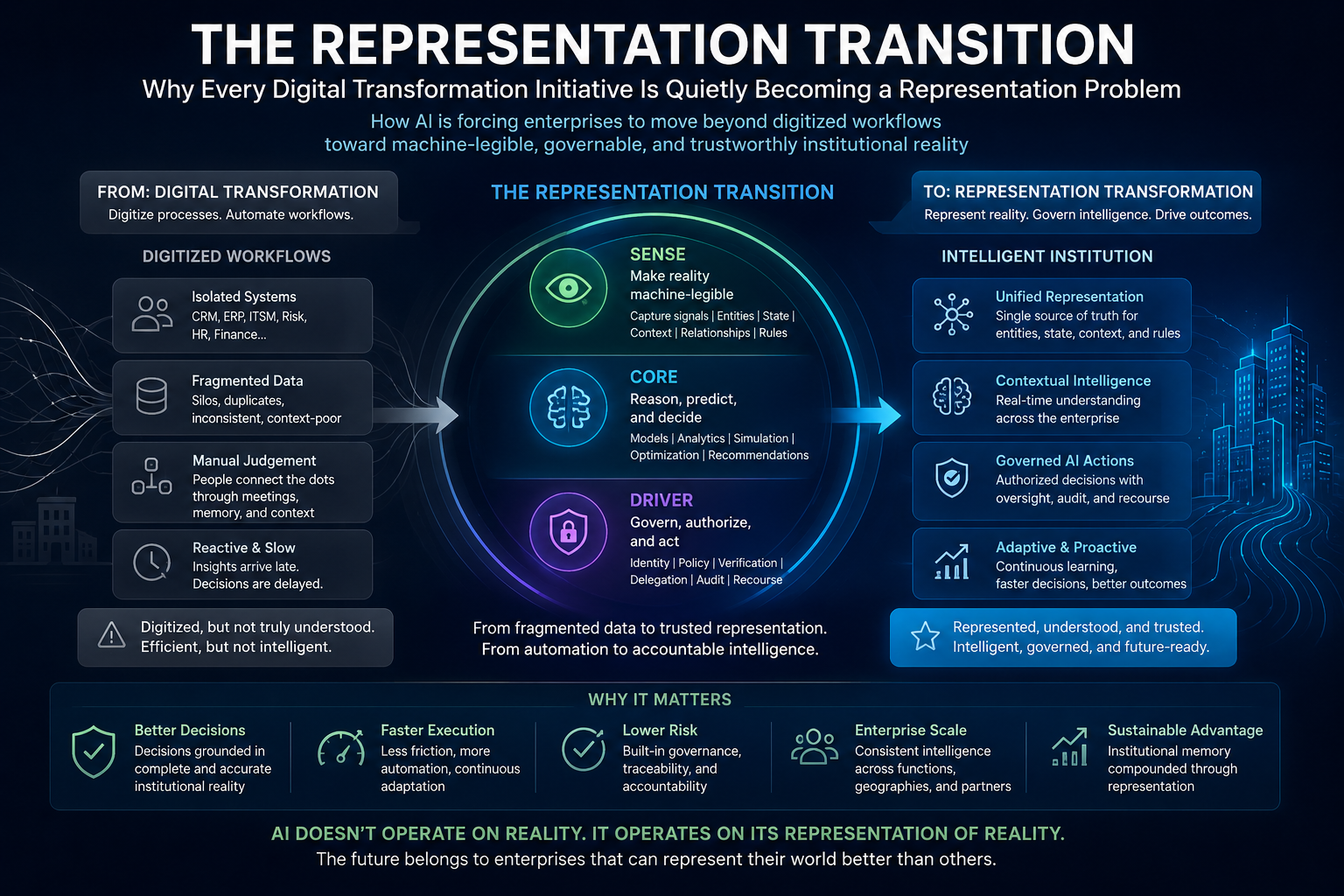
The Representation Transition:
Digital transformation was never only about moving from paper to software.
It was about making the organization more visible, measurable, searchable, programmable, and scalable.
For the last two decades, enterprises digitized processes, migrated systems to the cloud, created APIs, automated workflows, built data lakes, deployed SaaS platforms, and modernized customer journeys. This was necessary. It created the foundation for speed.
But AI has changed the question.
The question is no longer only:
Can this process be digitized?
The new question is:
Can this reality be represented well enough for intelligent systems to reason over it, act on it, and be held accountable for the outcome?
That is the Representation Transition.
Digital transformation digitized workflows.
The Representation Transition makes institutional reality machine-legible, governable, and trustworthy.
This is why many AI programs struggle after the proof-of-concept stage. Gartner has predicted that at least 30% of generative AI projects would be abandoned after proof of concept by the end of 2025 because of poor data quality, inadequate risk controls, escalating costs, or unclear business value. Gartner has also warned that through 2026, organizations will abandon 60% of AI projects unsupported by AI-ready data. (Gartner)
But the deeper issue is not merely data quality.
It is representation quality.
AI does not operate directly on reality. It operates on a representation of reality. If that representation is incomplete, stale, fragmented, biased, context-poor, or unauthorized, even a powerful AI system can make poor decisions.
This is where digital transformation quietly becomes a representation problem.
From Digital Transformation to Representation Transformation
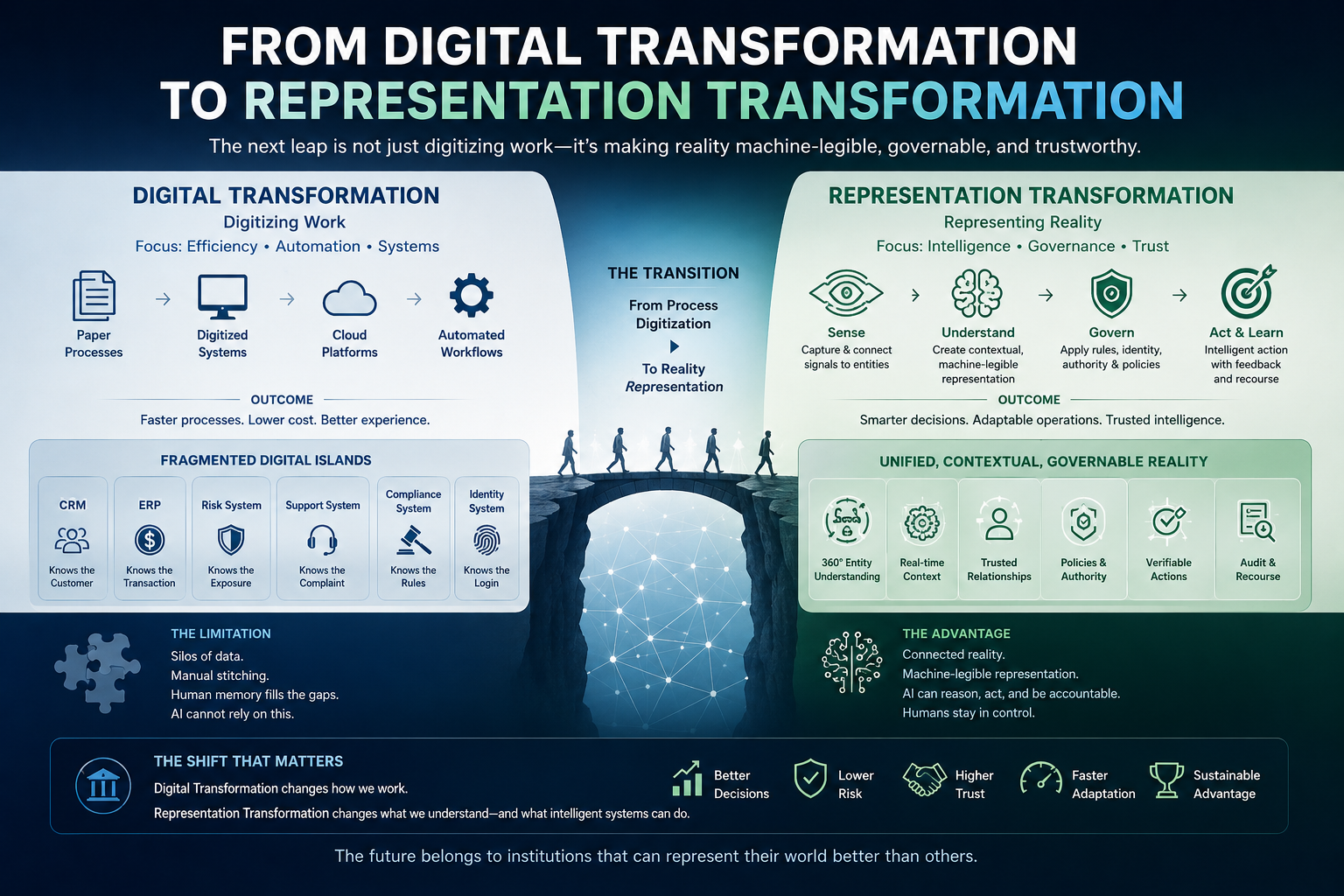
Traditional digital transformation focused on digitizing work.
A bank digitized account opening.
A retailer digitized inventory.
A hospital digitized patient records.
A manufacturer digitized supply chain planning.
A telecom company digitized service tickets.
These initiatives improved efficiency. But they often created fragmented digital islands.
The CRM knew the customer.
The ERP knew the transaction.
The risk system knew the exposure.
The support system knew the complaint.
The identity system knew the login.
The compliance system knew the rule.
But no single institutional layer knew the full reality.
For humans, this fragmentation was manageable. People filled the gaps through meetings, judgment, experience, escalation, and institutional memory.
AI systems cannot safely rely on informal institutional memory.
An AI agent needs structured answers to basic questions:
What entity is being discussed?
What is its current state?
What signals are reliable?
What context matters?
Who has authority?
What actions are allowed?
What must be verified?
What happens if the system is wrong?
This is why the next stage of transformation is not only digital.
It is representational.
The Three-Layer Shift: SENSE, CORE, DRIVER
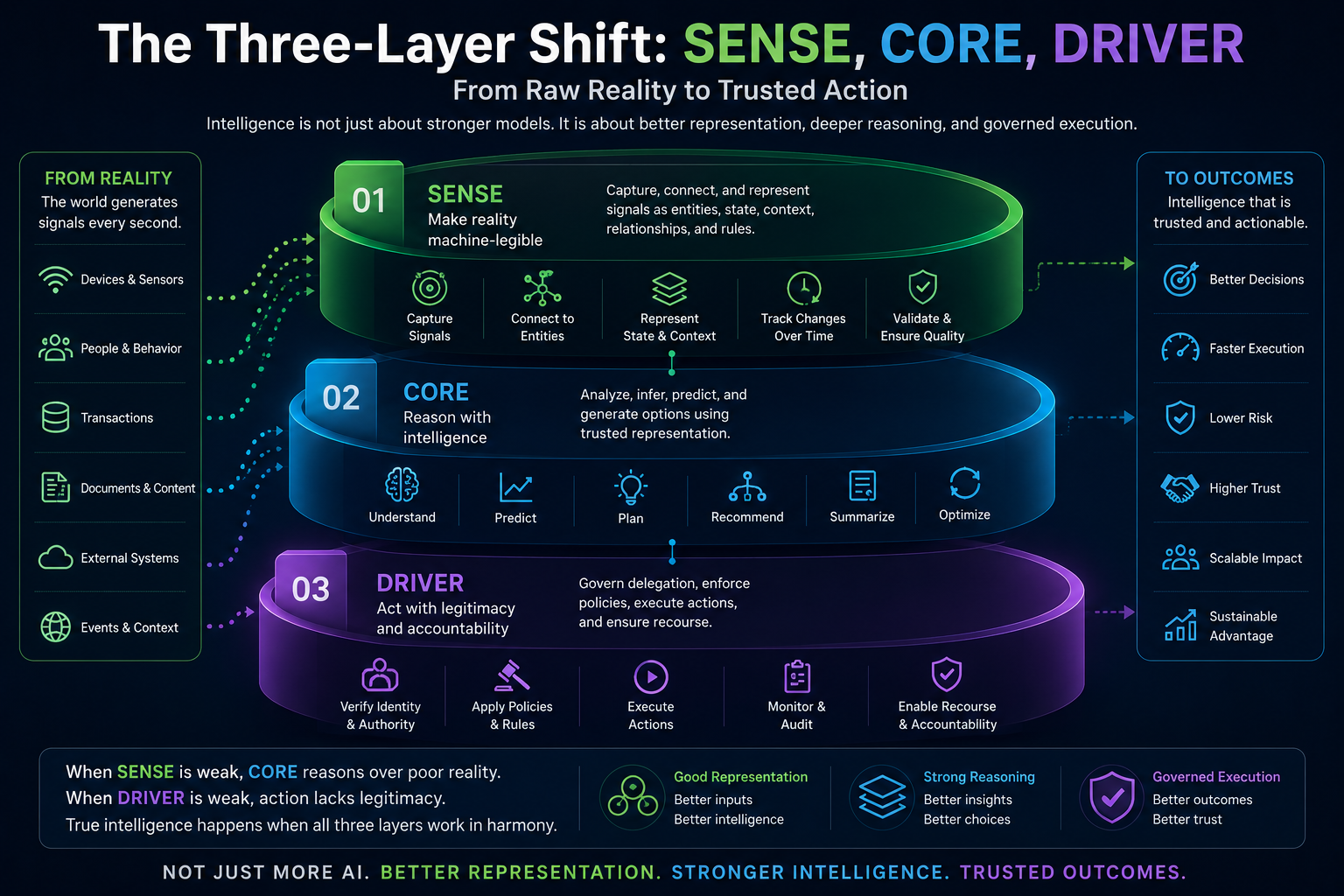
The Representation Economy can be understood through three layers: SENSE, CORE, and DRIVER.
SENSE is the layer where reality becomes machine-legible. It captures signals, connects them to entities, represents their state, and updates that state as reality changes.
CORE is the cognition layer. It reasons, predicts, plans, summarizes, optimizes, and recommends.
DRIVER is the legitimacy and execution layer. It governs delegation, authority, identity, verification, action, and recourse.
Most enterprises are overinvesting in CORE.
They buy models.
They build copilots.
They deploy agents.
They test reasoning systems.
They experiment with automation.
But many underinvest in SENSE and DRIVER.
That creates a dangerous imbalance.
If SENSE is weak, AI reasons over poor reality.
If DRIVER is weak, AI acts without proper legitimacy.
If CORE is strong but SENSE and DRIVER are weak, intelligence becomes operational risk.
This is why the Representation Transition matters.
The future will not be won by organizations that simply deploy more AI.
It will be won by organizations that represent reality better.
Simple Example: The Customer Complaint
Consider a customer complaint in a bank.
In a traditional workflow, the complaint is logged, routed, reviewed, and resolved.
In an AI-enabled workflow, an agent may summarize the complaint, classify urgency, retrieve account history, check policy, recommend resolution, and draft a response.
But what does the AI actually “know”?
Does it know whether the customer is strategically important?
Does it know whether the same issue occurred before?
Does it know whether the customer already called the branch?
Does it know whether a regulatory deadline applies?
Does it know whether the transaction is under dispute?
Does it know what the agent is authorized to offer?
Does it know whether the customer can appeal the decision?
If these facts are scattered across systems, the AI may sound confident while misunderstanding the situation.
That is not an intelligence failure alone.
It is a representation failure.
The complaint was digitized.
But the customer reality was not represented.
Why Data Is Not Enough
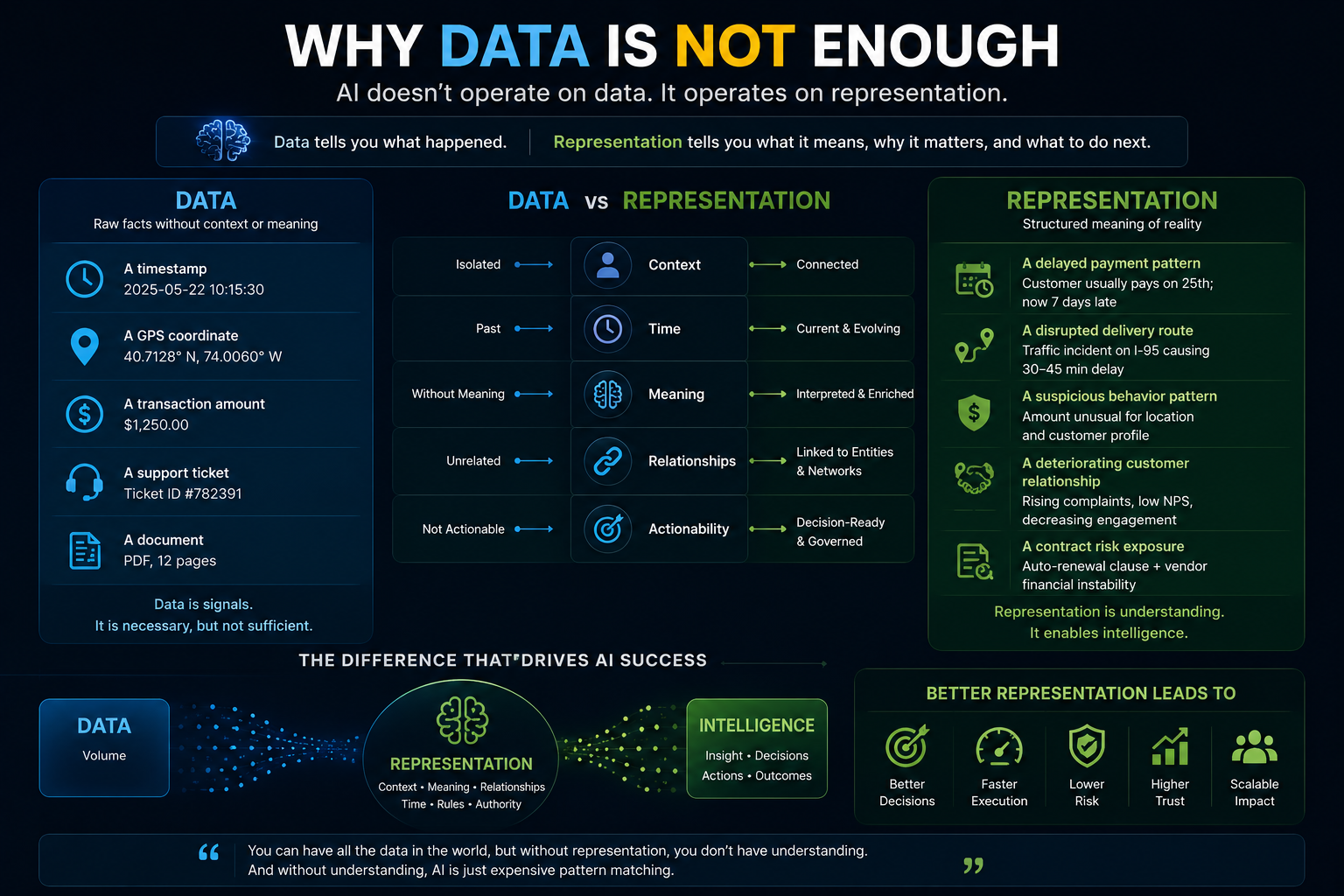
Enterprises often assume that better data will solve AI problems.
But data and representation are not the same.
Data is raw or processed information.
Representation is structured meaning.
A timestamp is data.
A delayed payment pattern is representation.
A GPS coordinate is data.
A disrupted delivery route is representation.
A transaction amount is data.
A suspicious behavior pattern is representation.
A support ticket is data.
A deteriorating customer relationship is representation.
Representation connects data to entities, context, time, rules, meaning, authority, and action.
That is why AI-ready data must evolve into representation-ready institutions.
NIST’s AI Risk Management Framework focuses on managing AI risks to individuals, organizations, and society, while OECD’s AI Principles emphasize trustworthy AI aligned with accountability, transparency, robustness, and human-centered values. (NIST)
But enterprises now need to go one level deeper.
They must ask not only whether AI is explainable.
They must ask whether the reality given to AI was correctly represented in the first place.
The Hidden Problem in Digital Transformation
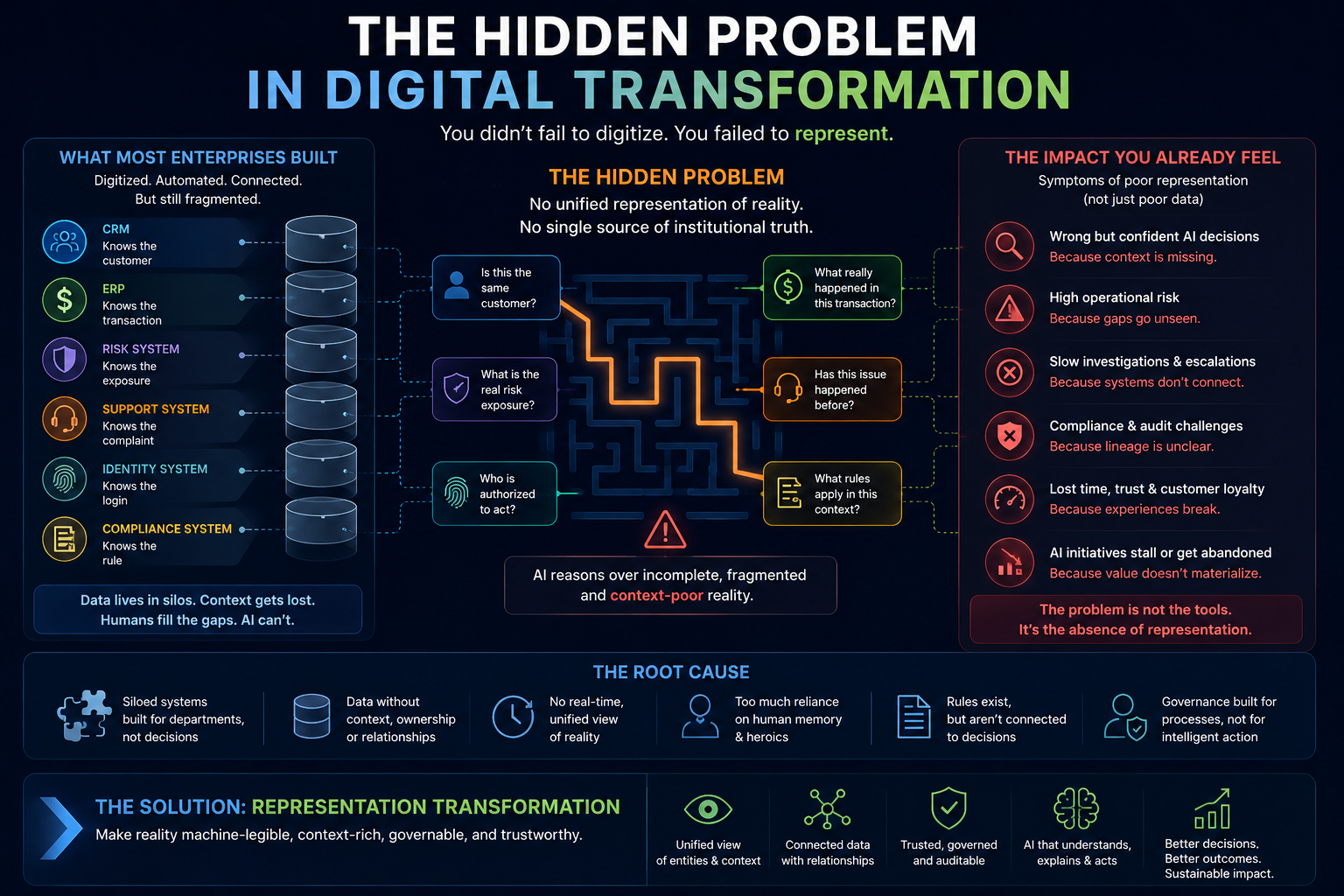
Many digital transformation programs created systems of record.
But AI needs systems of representation.
A system of record stores what happened.
A system of representation explains what that event means now.
A payment failed.
That is a record.
The payment failed because the customer’s salary credit was delayed, the account balance changed after a pending debit, the customer has no history of default, and policy allows a one-time exception.
That is representation.
A machine part overheated.
That is a record.
The overheating occurred after a maintenance delay, under abnormal load, in a facility with similar failures in the past, and replacement inventory is constrained.
That is representation.
An employee missed a deadline.
That is a record.
The deadline was missed because upstream approvals were delayed, requirements changed twice, and the dependency owner was unavailable.
That is representation.
Digital transformation gave enterprises more records.
The Representation Transition demands better meaning.
Why CIOs, CTOs, and Boards Should Care
For CIOs, CTOs, CDOs, board members, and enterprise architects, this shift is strategic.
AI success will increasingly depend on architecture below the model.
The key questions will be:
Can the enterprise identify entities consistently across systems?
Can it maintain reliable state over time?
Can it capture context, not just transactions?
Can it distinguish signal from noise?
Can it verify whether an AI action is allowed?
Can it create audit trails for machine decisions?
Can it reverse, correct, or appeal automated outcomes?
Can it govern agents as actors inside enterprise systems?
This is not just data architecture.
It is institutional architecture.
McKinsey describes digital transformation as rewiring an organization to create value by continuously deploying technology at scale. In the AI era, that rewiring must extend into how reality itself is represented for machines. (Raktim Singh)
Representation Debt: The New Technical Debt
Enterprises understand technical debt.
Old systems.
Hard-coded logic.
Poor documentation.
Fragile integrations.
Legacy workflows.
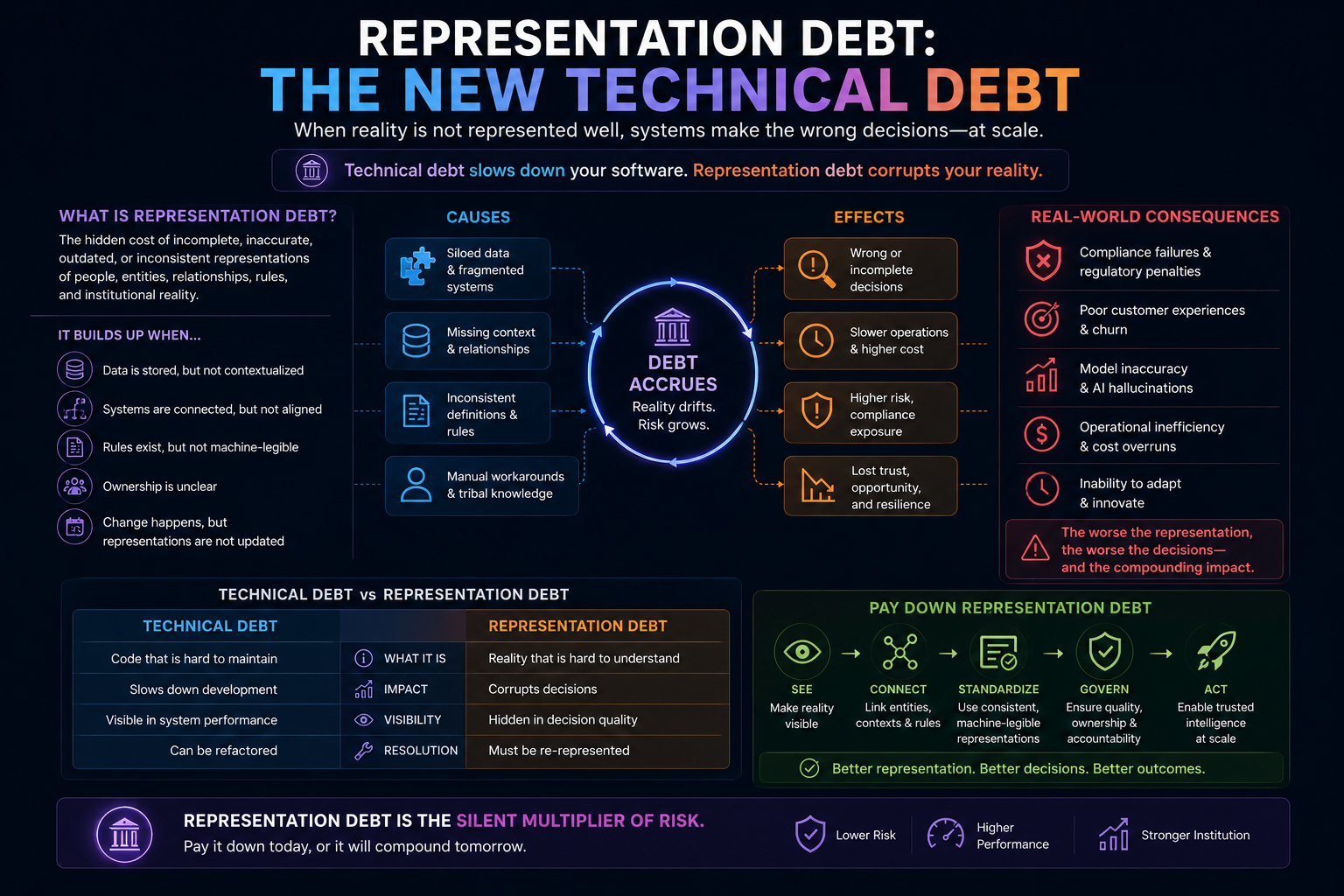
But AI exposes another kind of debt: representation debt.
Representation debt accumulates when an organization cannot accurately represent the reality its AI systems are expected to reason over.
Examples include:
Customer identity split across multiple systems.
Product definitions inconsistent across channels.
Risk categories updated manually.
Policy rules buried in PDFs.
Process exceptions known only to senior employees.
Supplier status delayed by days.
Machine health represented only through periodic reports.
Business context trapped in emails, meetings, and slide decks.
In a traditional enterprise, this debt slows decisions.
In an AI-enabled enterprise, this debt corrupts decisions.
That is a major shift.
When software only stored data, representation gaps were inconvenient.
When AI starts acting, representation gaps become dangerous.
This connects directly with the argument in The Data Illusion, where I explain why more data does not automatically create more understanding. Enterprises do not fail only because they lack data; they fail because they lack coherent representation of reality. (Raktim Singh)
Why AI Agents Make the Problem Urgent
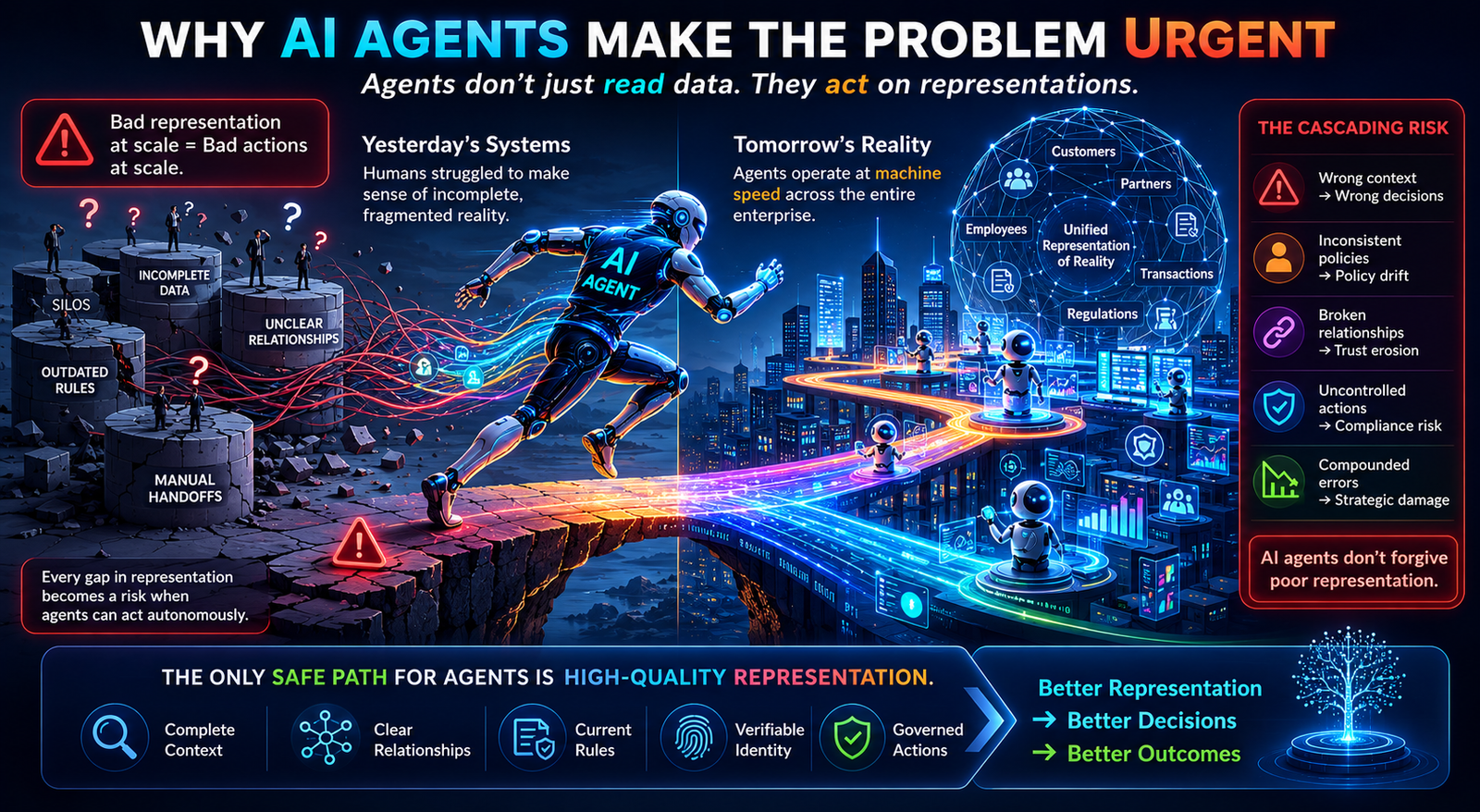
AI agents increase the urgency of the Representation Transition.
A chatbot can answer wrongly.
An agent can act wrongly.
It can send an email.
Approve a refund.
Escalate a ticket.
Trigger a workflow.
Update a record.
Call an API.
Recommend a credit decision.
Initiate a remediation process.
Once AI moves from advice to action, representation quality becomes a governance requirement.
Before an agent acts, the enterprise must know:
What reality did the agent see?
Which entity did it act on?
Which policy authorized the action?
Which system state was used?
Which confidence threshold applied?
Which human approval was required?
What evidence was logged?
What recourse exists?
This is the DRIVER layer.
Without DRIVER, enterprises may create intelligent systems that cannot be trusted, audited, or corrected.
That is why AI governance cannot be added at the end.
Governance must be designed into the representation and execution architecture from the beginning.
The Machine-Legible Enterprise
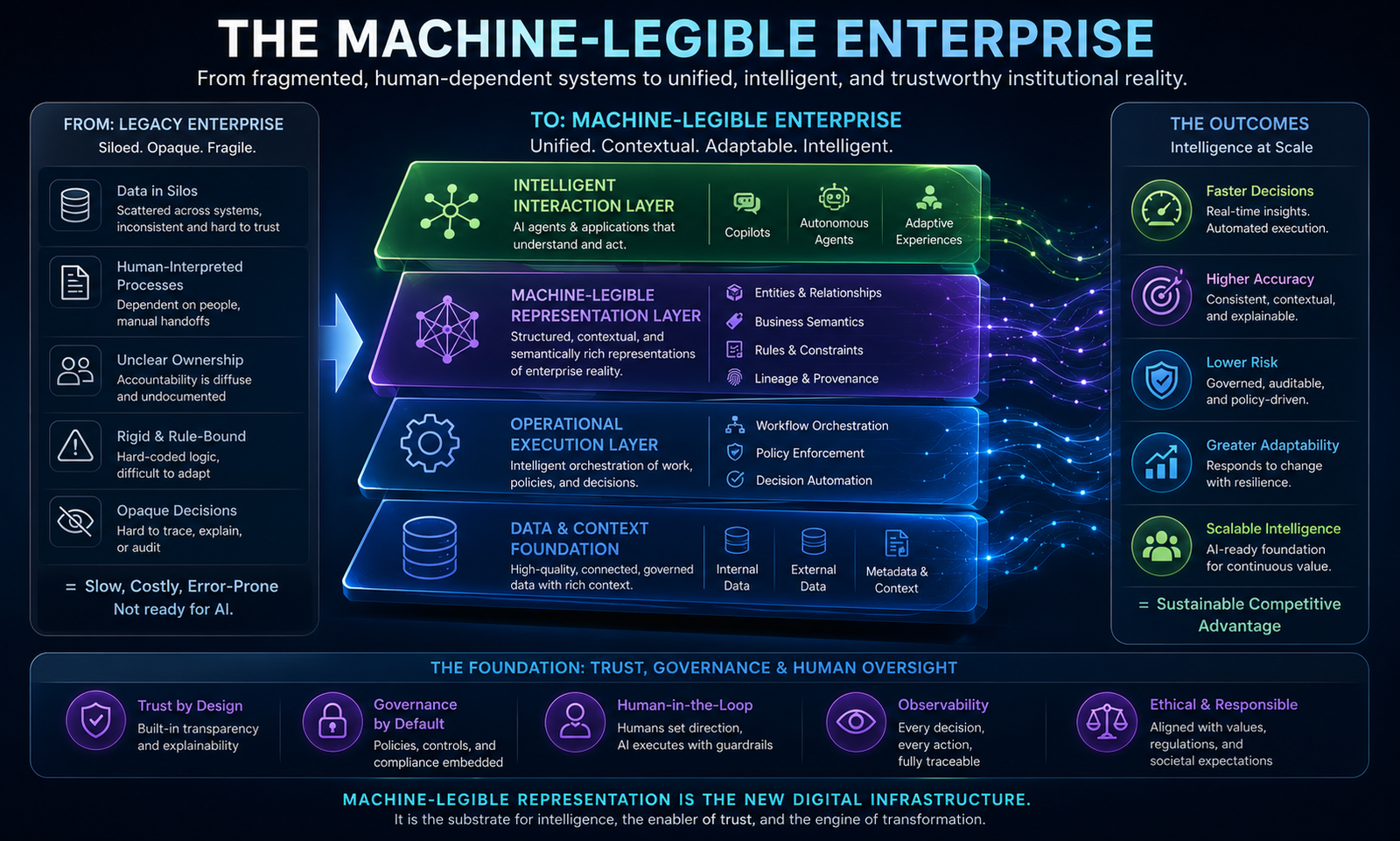
The future enterprise will not only be digital-first.
It will be machine-legible.
A machine-legible enterprise is one where critical business reality can be reliably understood by intelligent systems.
This does not mean everything must be automated.
It means the enterprise knows what can be represented, what cannot be represented, what requires human judgment, and what should never be delegated.
A loan eligibility check may be partially automated.
A sensitive complaint may require human review.
A fraud alert may need AI triage but human final judgment.
A supply chain delay may need automated rerouting within approved limits.
A cybersecurity incident may need machine-speed containment but human-led investigation.
The point is not to replace judgment everywhere.
The point is to allocate autonomy based on representation quality, reasoning need, and governance risk.
This is the deeper meaning of AI maturity.
AI maturity is not how many models an enterprise has deployed.
AI maturity is how safely and intelligently the enterprise can convert represented reality into governed action.
From Process Maps to Reality Maps
Traditional transformation used process maps.
Who does what?
Which step follows which step?
Where is the bottleneck?
Which activity can be automated?
The Representation Transition requires reality maps.
What entities matter?
How are they identified?
What states can they be in?
What signals update those states?
Which signals are trustworthy?
Which relationships matter?
What actions are allowed?
What authority is required?
What failures need recourse?
This is a deeper architectural discipline.
A process map tells us how work flows.
A reality map tells us what the system believes is true.
AI needs both.
Without reality maps, enterprises risk automating workflows over a distorted understanding of reality.
Example: Retail Inventory
A retailer may have digitized inventory.
The system says 40 units are available.
But reality may be different.
Ten units are damaged.
Five are misplaced.
Eight are reserved for online orders.
Three are in return processing.
Some are in a store where demand is low.
A supplier delay means replenishment will not arrive on time.
A traditional dashboard may still show inventory.
But an AI system needs representation.
It needs to know usable inventory, sellable inventory, location-specific demand, substitution options, supplier reliability, promotion impact, and customer promise constraints.
Without representation, AI may optimize the wrong thing.
It may recommend discounts when the problem is stock integrity.
It may promise delivery when inventory is unavailable.
It may trigger replenishment when items are merely misplaced.
Again, the issue is not the model.
The issue is represented reality.
Example: Healthcare Operations
A hospital may digitize patient records.
But patient reality is more than records.
Medication history may be incomplete.
Symptoms may be described inconsistently.
Diagnostic reports may arrive from different systems.
Clinician notes may contain subtle judgment.
The latest condition may not be reflected in structured fields.
An AI system assisting care coordination cannot rely only on digitized records.
It needs clinically meaningful representation.
What is the current state of the patient?
Which information is uncertain?
Which decision requires escalation?
Which action is safe?
Which recommendation needs explanation?
Which outcome must be monitored?
This is where representation becomes a safety issue.
The more consequential the decision, the more important representation quality becomes.
Example: Enterprise Architecture
In large enterprises, application portfolios are often digitized but poorly represented.
There may be thousands of applications, APIs, data flows, owners, dependencies, licenses, security classifications, cloud services, and integration points.
A spreadsheet may contain application names.
A CMDB may contain infrastructure.
A security tool may contain vulnerabilities.
A finance system may contain cost.
A project tool may contain modernization plans.
But when a CIO asks, “Which systems are safe for AI integration?” the answer requires representation.
The enterprise must know:
Which applications contain sensitive data?
Which APIs can be exposed?
Which systems are brittle?
Which dependencies are undocumented?
Which owners can approve access?
Which regulatory constraints apply?
Which workloads are suitable for autonomous remediation?
This cannot be solved by a generic model alone.
It requires representation architecture.
The New Role of Enterprise Architects
Enterprise architects will become representation architects.
Their work will expand from systems, interfaces, standards, and integration patterns to institutional legibility.
They will need to design:
Entity graphs.
Context graphs.
Policy graphs.
Identity and authority models.
Decision ledgers.
Representation quality checks.
Agent registries.
Human-in-the-loop boundaries.
Recourse mechanisms.
Simulation environments.
Observability for reasoning and action.
The architect’s question will shift from:
How do systems connect?
to:
How does institutional reality become trustworthy enough for intelligent action?
That is a profound change.
This is also why the SENSE–CORE–DRIVER framework matters. It gives CIOs, CTOs, architects, and boards a practical language for separating representation, reasoning, and governed execution. (Raktim Singh)
The Strategic Blind Spot: Better Models Will Not Fix Poor Representation
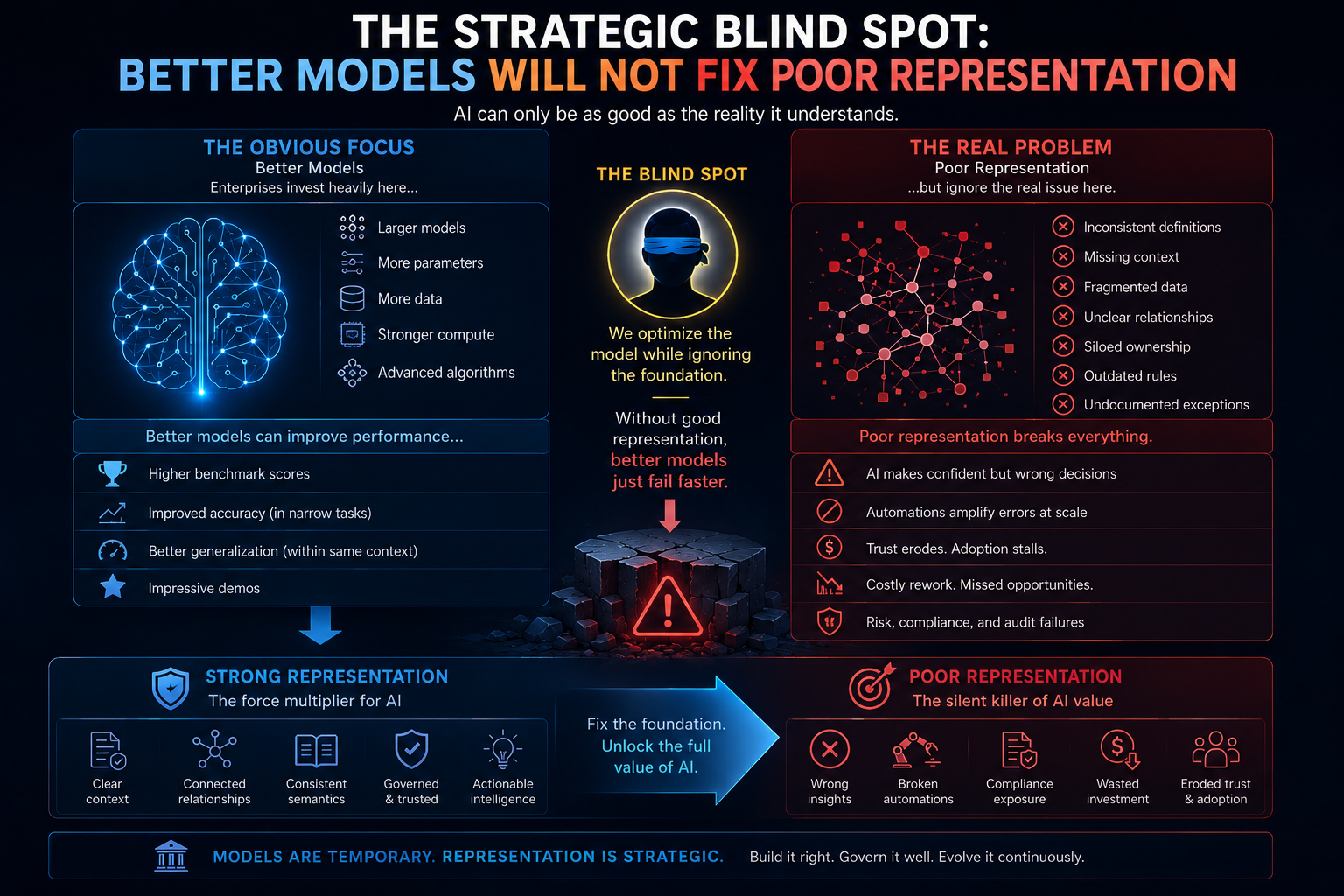
The next competitive advantage will not come only from using better AI models.
Many organizations will access similar models.
Many will use similar cloud platforms.
Many will deploy similar copilots.
Many will experiment with similar agents.
The real difference will be institutional representation.
The winners will represent customers better.
Represent assets better.
Represent risk better.
Represent context better.
Represent authority better.
Represent exceptions better.
Represent consequences better.
Better representation will produce better intelligence.
Poor representation will produce confident failure.
This is why the Representation Economy is not just an AI concept. It is a new theory of enterprise advantage.
In the AI era, value will increasingly flow to organizations that can represent reality clearly, preserve context, establish trust, and enable responsible action. This is the core thesis of the Representation Economy. (Raktim Singh)
The Representation Transition Is Already Underway
This transition is visible across the enterprise world.
Data governance is becoming AI governance.
Identity management is becoming agent authority management.
Observability is moving from infrastructure to intelligence.
Process automation is becoming autonomy orchestration.
Risk management is becoming decision verification.
Customer experience is becoming context representation.
Enterprise architecture is becoming institutional legibility architecture.
This is why the Representation Transition is not a theory for the future.
It is already happening beneath current AI programs.
Most organizations just do not have the language for it yet.
The organizations that name this transition early will understand it early.
The organizations that understand it early will architect for it early.
The organizations that architect for it early will compound advantage.
The CIO’s New Mandate
The CIO’s mandate is expanding.
It is no longer enough to modernize infrastructure, migrate to cloud, standardize applications, or deploy AI tools.
The CIO must now ask:
What reality do our systems represent?
Where is that representation incomplete?
Where is it outdated?
Where is it fragmented?
Where is it unauthorized?
Where is it not explainable?
Where can AI act safely?
Where must humans remain accountable?
Where do we need recourse?
This is the new board-level conversation.
Digital maturity asked:
How digitized are we?
AI maturity asks:
How intelligent are we?
Representation maturity asks:
How accurately and legitimately can machines understand and act on our reality?
That third question may become the most important.
What Boards Should Start Asking
Boards do not need to understand every model architecture.
But they must understand the institutional risks created when intelligence operates over poor representation.
A board should ask management:
Where are we deploying AI over incomplete reality?
Which business entities are poorly represented across systems?
Which AI decisions require stronger verification?
Where could an AI system act without proper authority?
Where do customers, employees, partners, or regulators need recourse?
Which parts of the enterprise are machine-readable but not human-legible?
Where are we mistaking digitized records for trustworthy representation?
These are not technical questions alone.
They are governance questions.
They are risk questions.
They are strategy questions.
They are questions about institutional trust.
Conlusion: After Digital Transformation Comes Representation
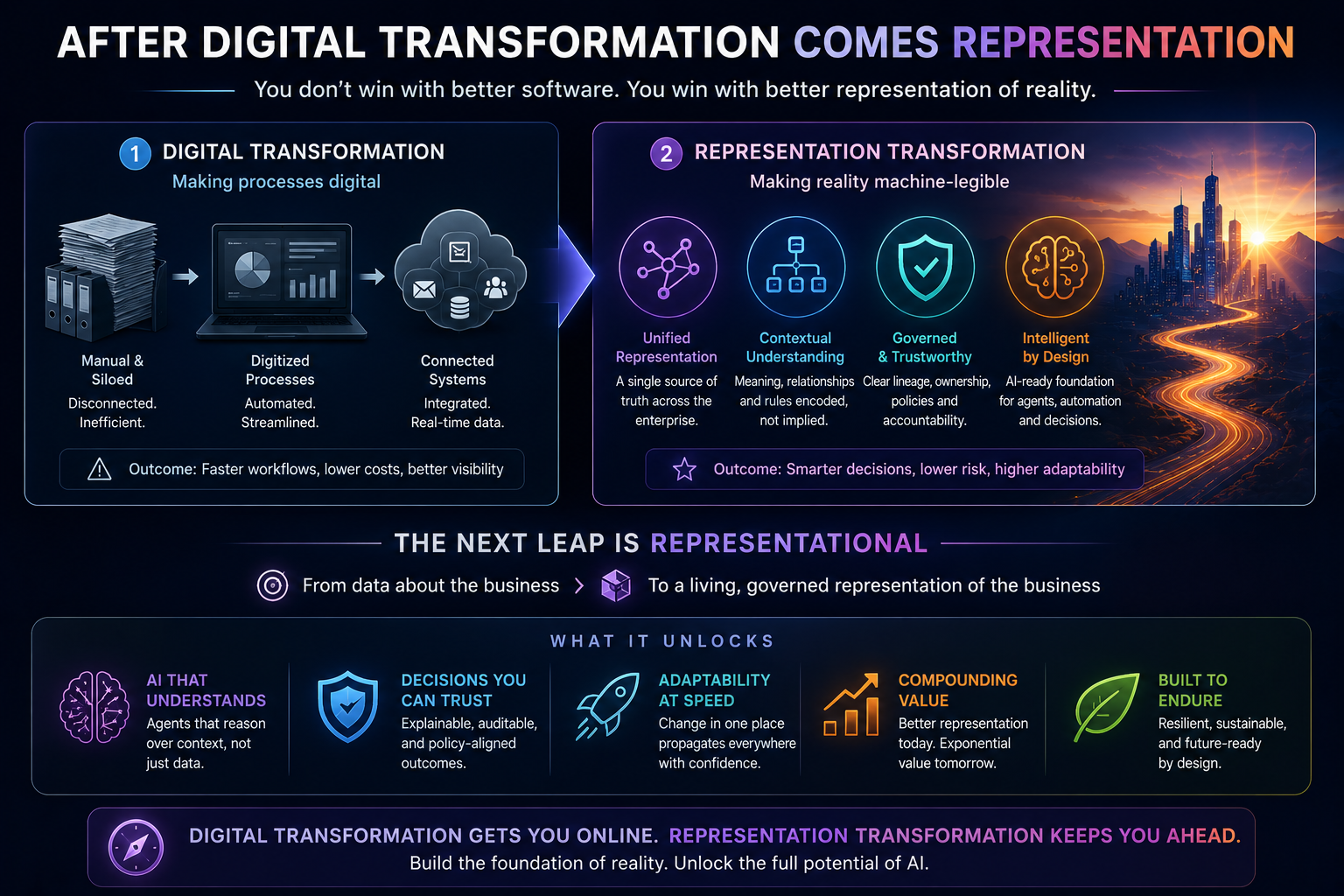
Digital transformation was the first step.
It made enterprises faster, more connected, and more software-driven.
But AI demands something more.
It demands that enterprises become machine-legible without becoming machine-blind.
It demands that intelligence be grounded in reality.
It demands that autonomy be bounded by legitimacy.
It demands that decisions be explainable, reversible, and accountable.
It demands that institutions understand what they are asking machines to represent.
The future will not belong simply to companies with the most AI.
It will belong to institutions whose reality is represented with enough fidelity, context, governance, and trust for AI to act responsibly.
That is the Representation Transition.
And it may become the most important transformation after digital transformation itself.
Summary
The Representation Transition is the shift from digitizing enterprise workflows to making institutional reality machine-legible, governable, and trustworthy for AI systems. In the AI era, enterprises must move beyond systems of record toward systems of representation. This requires strong SENSE layers for capturing reality, CORE layers for reasoning, and DRIVER layers for legitimate action, verification, and recourse.
Who created the Representation Transition concept discussed in this article?
The Representation Transition concept, along with the broader Representation Economy framework and the SENSE–CORE–DRIVER architecture, has been developed and articulated by Raktim Singh as part of his ongoing research and thought leadership on enterprise AI, institutional intelligence, machine-legible systems, governance, and the future architecture of AI-driven organizations.
What is the Representation Economy?
The Representation Economy is a conceptual framework developed by Raktim Singh that explains how value in the AI era increasingly depends on the ability of institutions to represent reality in machine-legible, governable, trustworthy, and actionable forms.
What is the SENSE–CORE–DRIVER framework?
SENSE–CORE–DRIVER is a framework created by Raktim Singh to explain how intelligent institutions operate in the AI era:
- SENSE = the representation layer where reality becomes machine-legible
- CORE = the cognition layer where AI systems reason and optimize
- DRIVER = the governance and execution layer where legitimacy, authority, verification, execution, and recourse are managed
Where can I read more work by Raktim Singh?
You can explore additional articles, frameworks, research papers, and AI thought leadership by Raktim Singh at:
- RaktimSingh.com
- LinkedIn Profile
- YouTube Channel (@raktim_hindi)
- Medium Profile
- Finextra Articles
- GitHub – Representation Economy Repository
- ResearchGate Publications
- Academia.edu Profile
- OSF Project
- Zenodo Research Archive
- X (Twitter) – @dadraktim
- OpenAlex https://openalex.org/authors/a5136665700
About the Author
Raktim Singh is a technology thought leader, enterprise AI strategist, author, speaker, and researcher working at the intersection of artificial intelligence, enterprise architecture, institutional systems, governance, and digital transformation.
He is the creator of the Representation Economy framework and the SENSE–CORE–DRIVER architecture, which explore how intelligent institutions must redesign representation, cognition, governance, and execution in the AI era.
Raktim Singh has written extensively on enterprise AI, AI governance, machine-legible systems, AI operating models, digital transformation, fintech, autonomous systems, and institutional intelligence. His work focuses on helping CIOs, CTOs, enterprise architects, and board leaders understand the deeper structural shifts emerging in the age of AI.
Digital Footprints
- Website: RaktimSingh.com
- LinkedIn: LinkedIn Profile
- YouTube: @raktim_hindi
- Medium: Medium Articles
- Finextra: Finextra Author Page
- GitHub: Representation Economy Repository
- ResearchGate: ResearchGate Publications
- Academia.edu: Academia.edu Profile
- OSF: OSF Research Project
- Zenodo: Zenodo Research Archive
- X/Twitter: @dadraktim
- Instagram: @raktimsinghofficial
- Facebook: Raktim Singh Official
Glossary
Representation Transition
The shift from digitizing workflows to making institutional reality machine-legible, governable, and trustworthy for AI systems.
Representation Economy
A framework developed by Raktim Singh explaining how value in the AI era will flow to organizations that can represent reality clearly, preserve context, establish trust, and enable responsible action.
Representation Debt
The hidden risk created when an enterprise cannot accurately represent the reality its AI systems are expected to reason over.
Machine-Legible Enterprise
An enterprise whose critical business reality can be reliably interpreted by intelligent systems.
Reality Map
A structured model of entities, states, relationships, signals, authority, and allowed actions that helps AI systems understand what is true and what can be done.
FAQ
What is the Representation Transition?
The Representation Transition is the shift from traditional digital transformation to AI-era institutional transformation, where enterprises must make reality machine-legible, governable, and trustworthy for intelligent systems.
How is the Representation Transition different from digital transformation?
Digital transformation digitized workflows and records. The Representation Transition focuses on whether reality is represented accurately enough for AI systems to reason, act, and be governed.
Why does AI make representation important?
AI does not operate directly on reality. It operates on data, models, context, entities, and assumptions that represent reality. If representation is poor, AI decisions can be wrong even when the model is powerful.
What is representation debt?
Representation debt is the hidden risk created when enterprise reality is fragmented, outdated, incomplete, or poorly structured across systems. It becomes dangerous when AI systems begin acting on that distorted reality.
What is the role of SENSE–CORE–DRIVER?
SENSE makes reality machine-legible. CORE reasons over that reality. DRIVER governs whether action is authorized, verified, reversible, and legitimate.
Why should CIOs and CTOs care?
Because AI success increasingly depends on architecture below the model: entity resolution, context graphs, policy models, decision ledgers, authority boundaries, observability, and recourse mechanisms.
What should boards ask about AI representation?
Boards should ask whether AI systems are acting on complete, current, authorized, and governable representations of reality — and whether affected stakeholders have recourse when AI-driven decisions are wrong.
References and Further Reading
- Gartner: GenAI project abandonment due to poor data quality, risk controls, costs, and unclear business value. (Gartner)
- Gartner: AI-ready data and risk of AI project abandonment through 2026. (Gartner)
- NIST AI Risk Management Framework. (NIST)
- OECD AI Principles. (OECD.AI)
- Raktim Singh: The Data Illusion. (Raktim Singh)
- Raktim Singh: What Is the Representation Economy? (Raktim Singh)
- Raktim Singh: What Is the SENSE–CORE–DRIVER Framework? (Raktim Singh)



Raktim Singh is an AI and deep-tech strategist, TEDx speaker, and author focused on helping enterprises navigate the next era of intelligent systems. With experience spanning AI, fintech, quantum computing, and digital transformation, he simplifies complex technology for leaders and builds frameworks that drive responsible, scalable adoption.