
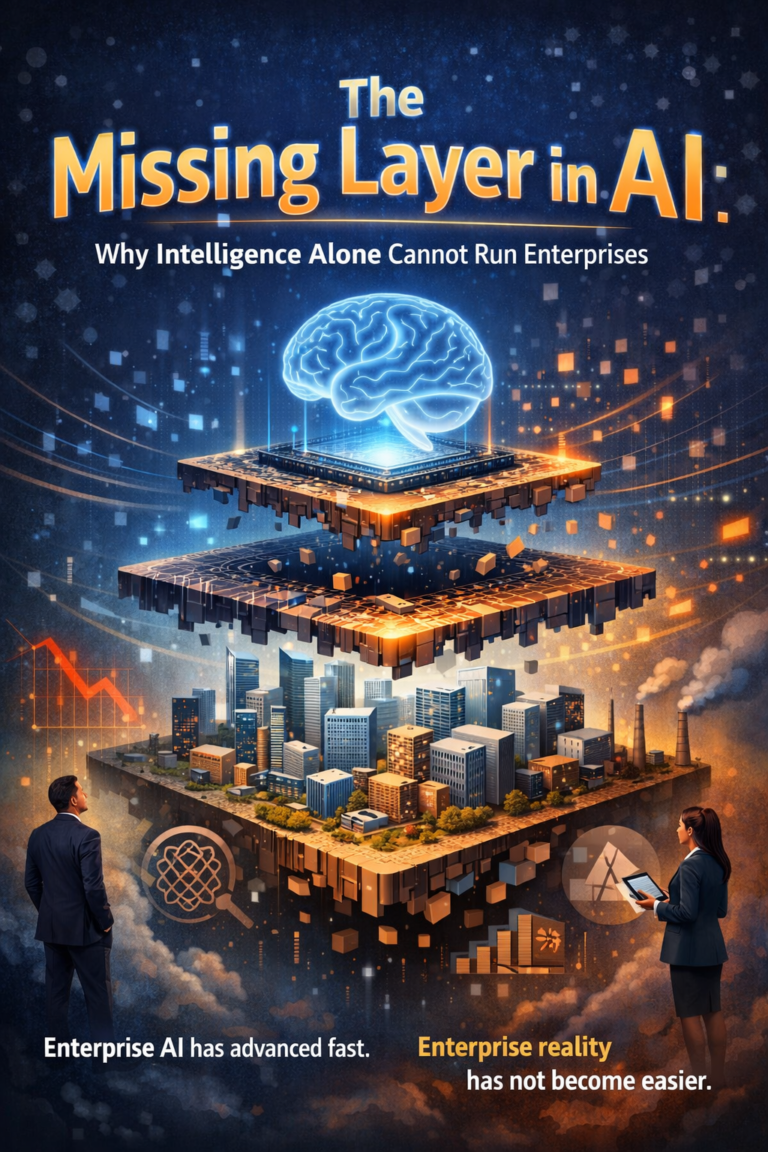
AI execution layer in enterprises:
Artificial intelligence has become dramatically better at answering questions, generating content, writing code, summarizing documents, and assisting with decisions. Stanford’s 2025 AI Index shows continued progress in model capability, deployment, and agentic systems that can plan and execute multistep tasks. At the same time, enterprises are moving beyond experimentation and trying to turn AI into repeatable operating value. (Stanford HAI)
But this is exactly where a deeper problem appears.
Enterprises are discovering that intelligence, by itself, is not enough. A model may produce a brilliant answer. An agent may complete a task. A system may sound confident, fast, and fluent. Yet none of that means it truly understands the enterprise in which it is acting. None of that guarantees that it is acting on the right customer, the right contract, the right policy, the right asset, or the right moment in time. That is the central weakness hiding behind today’s AI excitement.
This is why so many AI conversations still feel incomplete. We keep discussing model quality, benchmarks, token costs, agent frameworks, and copilots. Those things matter. But they describe only the middle of the system. They do not explain how reality becomes legible to the machine before reasoning begins, or how decisions become accountable action after reasoning ends. That missing architecture is what many enterprises are actually struggling with.
The next phase of AI will not be won only by those with more intelligence. It will be won by those who can connect intelligence to reality and then turn it into governed execution. That is the missing layer in AI.

The real weakness of AI is not always in the model. It is often at the edges.
Most of the world’s AI excitement sits in what I call the CORE layer: reasoning, generation, planning, optimization, and decision support. This is where large language models, multimodal systems, copilots, and agents operate. It is also the part of the stack that has advanced the fastest and attracted the most attention. (Hai Production)
But enterprise systems do not fail only in the middle. They often fail at the edges.
Before a model does anything useful, the enterprise must convert reality into something the system can work with.
After the model produces an output, the enterprise must make sure that output becomes an action that is authorized, traceable, safe, and reversible. When those edge conditions are weak, even highly capable AI systems disappoint in production. McKinsey’s 2025 global survey shows that while AI use is widespread, most organizations are still struggling to scale impact, and workflow redesign, validation processes, operating models, and data foundations are strong predictors of value realization. (McKinsey & Company)
Take a simple banking example. An AI system helps process a loan restructuring request. The model is excellent. It summarizes documents accurately and suggests the next best action. But the hard questions begin immediately. Is this the correct customer entity, or are there two similar names across systems?
Does the AI know that a recent missed payment relates to a disputed transaction rather than financial distress? Is it using the latest policy, or an outdated one from an old repository? Can it see that the customer is already in another exception workflow? Who authorized the final action? What evidence was used? What happens if the action turns out to be wrong? None of these questions are really about raw intelligence. They are about representation and execution.
The model may be smart. The system may still be unsafe.

What enterprises actually need first is legible reality
This is where the first missing layer appears. I call it SENSE:
S — Signal
What events, changes, and traces are being captured.
EN — Entity
Which person, account, machine, asset, document, or organization those signals belong to.
S — State representation
What structured picture of the current condition the system has built.
E — Evolution
How that state changes over time as new information arrives.
SENSE is the layer where reality becomes machine-legible. (raktimsingh.com)
This matters because enterprises are not made of prompts. They are made of entities, relationships, permissions, obligations, constraints, histories, exceptions, and changing states. A customer is not just a row in a CRM. A shipment is not just a line item in a logistics table. A patient is not just a document bundle. A supplier is not just a vendor ID. Each exists across systems, roles, policies, and time.
When AI fails in enterprises, a common reason is that the system is reasoning over incomplete, fragmented, stale, or poorly connected representations of reality. It may have data, but not enough structure. It may have documents, but not enough meaning. It may have signals, but not stable identity. It may have a snapshot, but not evolution. The error often begins long before the model generates a response.
This is why modern governance frameworks increasingly emphasize context, lifecycle, traceability, robustness, accountability, and trustworthiness rather than model performance alone. NIST’s AI Risk Management Framework explicitly focuses on context, potential impacts, and trustworthiness across design, development, deployment, and use. The OECD AI Principles emphasize trustworthy AI that respects human rights, democratic values, transparency, explainability, robustness, and accountability. (NIST Publications)
In other words, the global policy and governance conversation is already moving toward a broader view of AI systems. The question is slowly shifting from “How smart is the model?” to “What exactly is this system representing, and how safely is it acting?” (NIST)
CORE still matters. It is just no longer enough.
The second layer is CORE:
C — Comprehend context
O — Optimize decisions
R — Realize action plans
E — Evolve through feedback
CORE is the cognition layer. It is where AI reasons. This is where models shine. They classify, summarize, compare, recommend, generate, and increasingly orchestrate multistep tasks. This layer will continue to improve, become cheaper, more multimodal, and more widely available. That is precisely why it is becoming less defensible on its own. (Hai Production)
If everyone has access to strong reasoning models, intelligence alone cannot remain the full source of enterprise advantage. The advantage shifts to a harder question: who has built the best bridge between intelligence and institutional reality?
That bridge requires context the model can trust and action pathways the institution can govern. Put differently, the future of enterprise AI is not just about having a smart brain. It is about connecting that brain to a faithful map of reality and a legitimate system of action.
This is where many boardrooms are still underestimating the problem. They are buying intelligence without redesigning representation.
They are piloting agents without strengthening the execution architecture that sits around them. They are investing in the middle of the system while neglecting the layers that determine whether the system can be trusted in real operations. (McKinsey & Company)
The final enterprise problem is not answer quality. It is execution legitimacy.
This leads to the third layer: DRIVER.
D — Delegation
Who authorized the system to act.
R — Representation
What model of reality the system relied on.
I — Identity
Which entity was affected.
V — Verification
How the action is checked.
E — Execution
How the action is actually carried out.
R — Recourse
What happens if the system is wrong.
DRIVER is the legitimacy layer. (raktimsingh.com)
This is the layer enterprises cannot afford to ignore as AI moves from advice to action. A chatbot can be forgiven for being occasionally vague. An enterprise execution system cannot.
If an AI agent updates a contract status, triggers a payment workflow, changes a recommendation, escalates a case, or blocks a transaction, the institution must be able to answer some basic questions: Who allowed this? On what basis? Against which entity? Under what policy? With what evidence? With what rollback path?
These are not theoretical issues. The EU AI Act establishes a risk-based legal framework for AI and is explicitly aimed at trustworthy AI, safety, and fundamental rights. The OECD’s updated AI Principles and new due-diligence guidance push in the same direction. The World Economic Forum’s recent work on AI agents also stresses structured evaluation and governance as autonomy increases. (Digital Strategy Europe)
In simple terms, once AI starts acting, the question is no longer only “Is the output useful?” It becomes “Is this action legitimate?” That is a much bigger question, and it is one that today’s enterprise AI market still under-addresses.
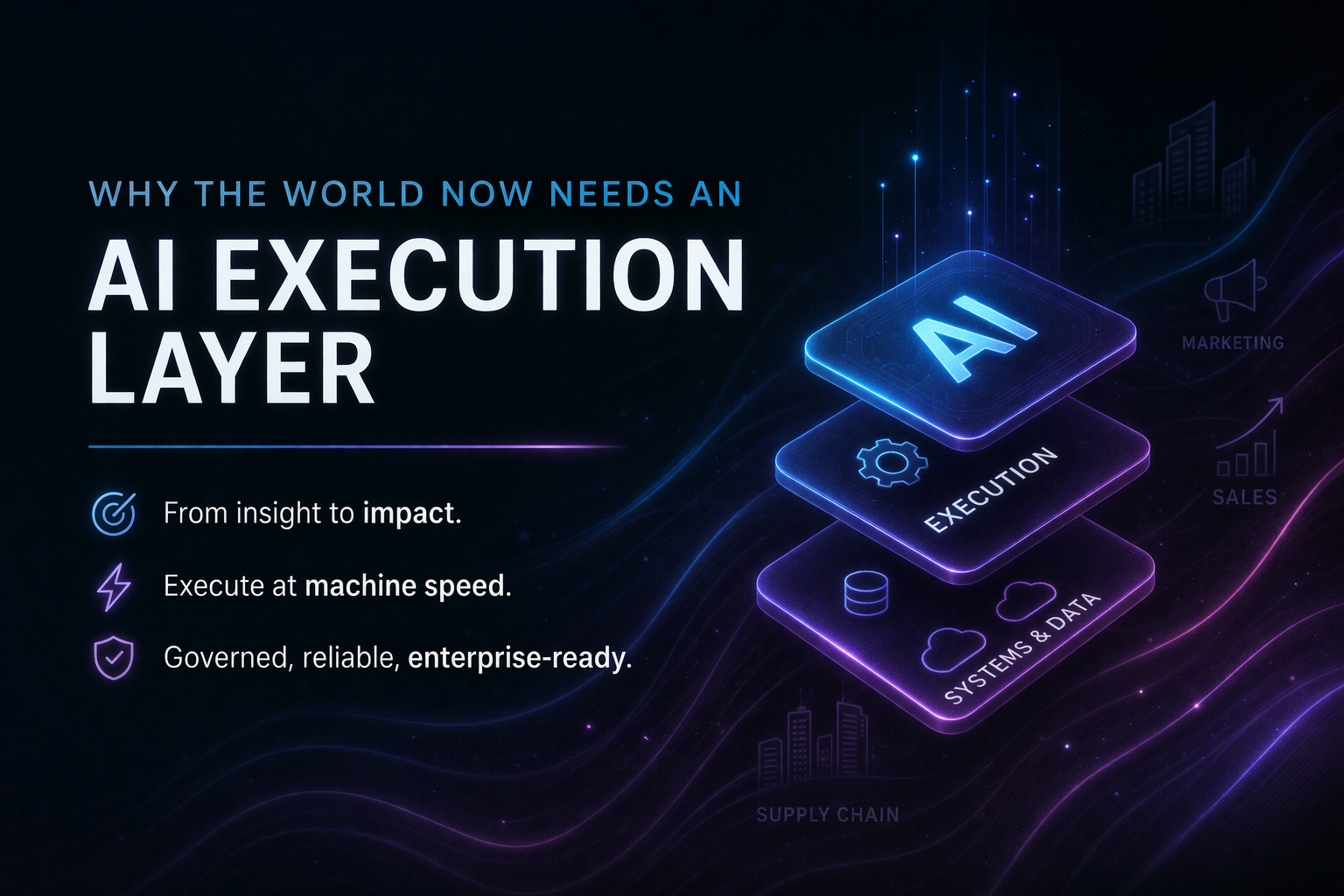
Why the world now needs an AI execution layer
This is why the world needs a new enterprise capability: not just model access, not just copilots, not just agent builders, but something more foundational.
Enterprises now need an AI execution layer.
This layer must do five things well. It must organize enterprise reality into machine-usable form. It must allow intelligence to operate inside that representation rather than on disconnected fragments. It must orchestrate actions across systems, workflows, tools, and human checkpoints. It must apply governance before, during, and after execution. And it must generate evidence: what the system saw, why it acted, how the action was checked, and what happens if it must be reversed.
That is the capability many enterprises are beginning to need even if they do not yet have a stable category name for it. The first era of enterprise software digitized records. The second connected workflows. The third brought intelligence into workflows. The fourth will require governed execution across intelligent systems. That fourth era cannot be run by intelligence alone.
Three simple examples that make the issue real
Example 1: The wrong person, correctly processed
Consider a healthcare claims workflow. An AI agent reads documents, checks policy conditions, and recommends approval. The reasoning may be excellent. But suppose the system linked the medical event to the wrong patient record because of an identity mismatch across two legacy systems. The claim may now be correctly processed according to the machine’s internal logic, and still be wrong in the real world. The error did not begin in reasoning. It began in representation.
Example 2: The right prediction, made on a stale map
Consider manufacturing. An AI system predicts that a machine should be taken offline for preventive maintenance. The analysis is smart. But the asset twin is stale. A component was replaced last week and the state representation was never updated. The intelligence may be correct relative to an outdated model of reality, and wrong in the plant itself. Again, the problem is not only CORE. It is weak SENSE.
Example 3: The valid recommendation, executed without legitimacy
Consider customer service. An AI agent escalates an issue and offers compensation under a policy that changed yesterday. The model is fluent. The workflow is automated. The action still lacks legitimacy because the execution path is no longer aligned with current policy. That is not just a reasoning error. It is a DRIVER failure.
In all three cases, better reasoning alone does not solve the problem. What is needed is better SENSE and stronger DRIVER around the model.

The market is overinvesting in CORE
This is the broader strategic point. The AI market is heavily focused on CORE because CORE is visible. We can demo it. We can benchmark it. We can compare models. We can watch it write, speak, code, and reason. SENSE and DRIVER are less glamorous.
They look like infrastructure, identity, knowledge architecture, observability, governance, policy, and control. But that is exactly why they are becoming more important. (McKinsey & Company)
McKinsey’s 2025 findings point in the same direction. The move from pilot to scaled impact is not mainly a model problem. It is an operating model, workflow redesign, data, validation, and governance problem. High performers are more likely to redesign workflows, establish processes for human validation, and build the organizational foundations required to capture value at scale. (McKinsey & Company)
The winners in enterprise AI will not simply be those who deploy stronger models. They will be those who build better systems of representation, orchestration, verification, and recourse. The real contest is shifting from a model race to an architecture race.
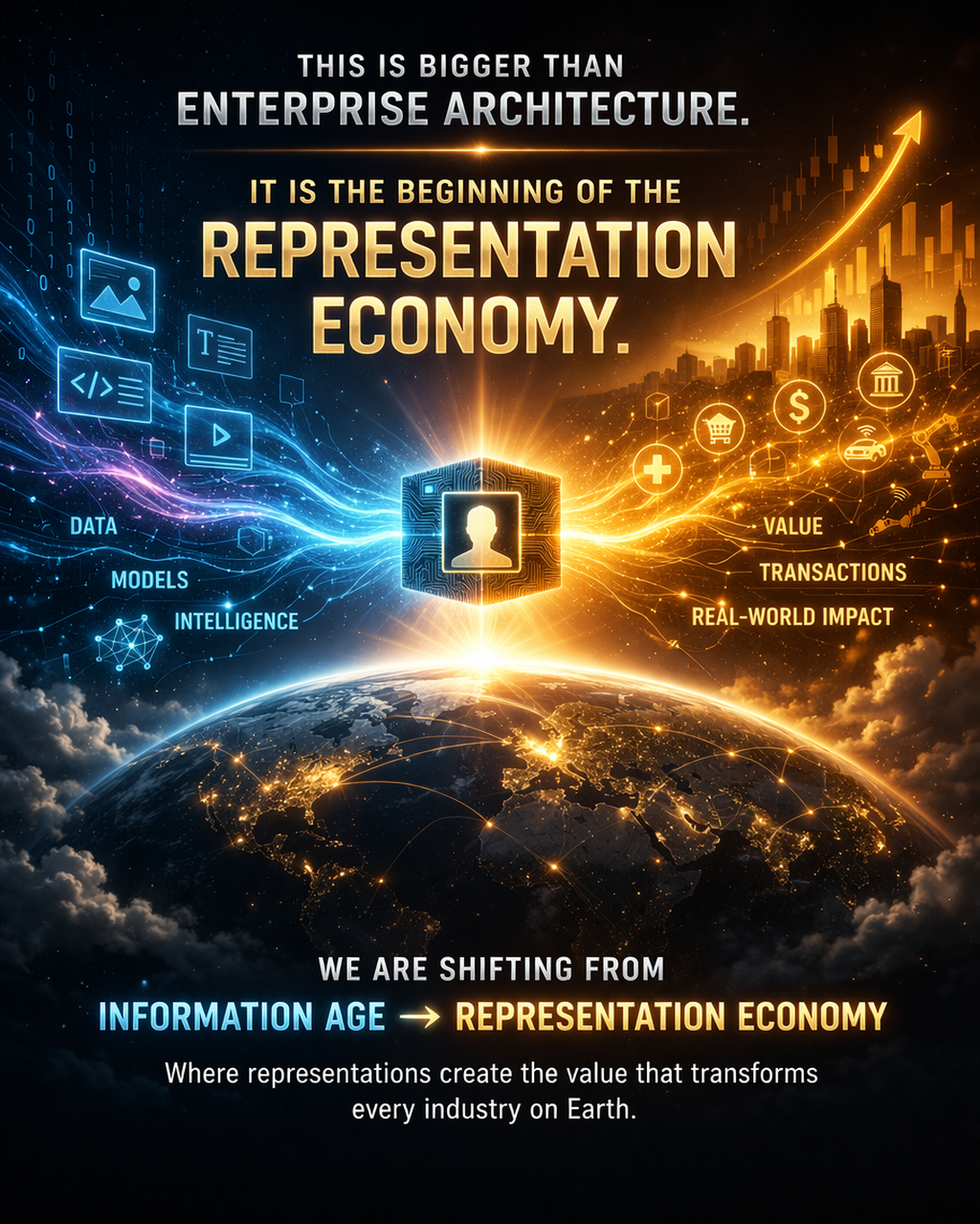
This is bigger than enterprise architecture. It is the beginning of the Representation Economy.
For years, we were told that data is the new oil. But raw accumulation of data does not automatically create value. What creates value is whether reality is represented well enough for systems to understand it, act on it, and improve through feedback. That is the starting point of what I call the Representation Economy. (raktimsingh.com)
In this economy, competitive advantage comes from three things working together: how faithfully reality is represented, how intelligently that representation is interpreted, and how responsibly that interpretation becomes action. That is SENSE, CORE, and DRIVER. Seen this way, AI is not the whole system. It is only the middle layer. The enterprise challenge is no longer just building intelligence. It is building the missing layer that allows intelligence to operate inside reality and act with legitimacy. (raktimsingh.com)
This is also why enterprise AI is becoming an institutional design question, not just a technology question. Once AI can act, organizations need to decide what must be sensed, how it must be represented, who may delegate action, how exceptions are handled, and what recourse exists when the system fails. That is not a prompt-engineering problem. It is an architecture-and-governance problem. (NIST Publications)
What leadership teams should ask now
Most leadership teams still ask: What model should we use? What agent framework should we adopt? How fast can we scale copilots?
These are useful questions, but they are no longer enough.
The more important questions are: How does our AI system represent customers, assets, obligations, transactions, and state changes? How does it know that its map of reality is current? How are permissions, policies, and delegation encoded into execution? How do we verify decisions before action becomes irreversible? What recourse exists when the system is wrong?
The future belongs to organizations that can answer these questions well.
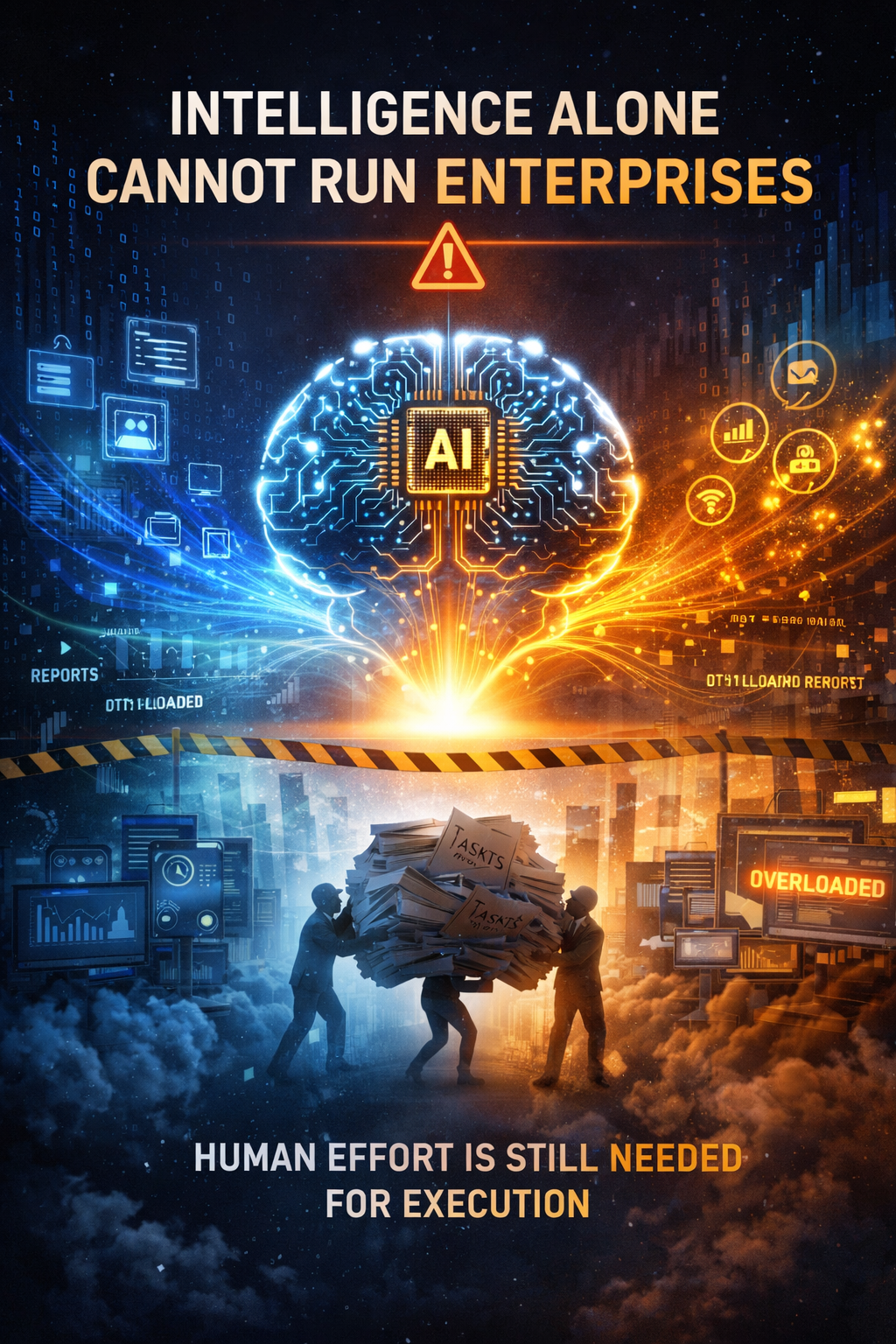
Conclusion: intelligence alone cannot run enterprises
Enterprises do not run on intelligence alone. They run on legible reality, governed action, and trusted execution.
That is why the missing layer in AI matters so much. It explains why smart systems still fail in production. It explains why the next enterprise battleground will not be only better models, but better representation and better execution architecture.
It explains why SENSE, CORE, and DRIVER belong together. And it explains why the institutions that win the AI era will be the ones that can sense reality, reason over it, and act with legitimacy. (raktimsingh.com)
The market is still obsessed with intelligence. Boards should be thinking about architecture. Because the deepest failures in AI often begin before the model starts or after the model finishes. The opportunity, therefore, is not just to build smarter machines.
It is to build institutions that can represent reality clearly and act on it responsibly. That is the real operating challenge of enterprise AI. And that is where the next generation of value will be created. (NIST Publications)
FAQ
1. What is an AI execution layer?
The AI execution layer is the system that converts AI-generated insights into real-world actions within enterprise systems, with governance, accountability, and orchestration.
2. Why does AI fail in enterprises?
AI often fails not because of poor intelligence, but because enterprises lack systems to execute decisions reliably and responsibly.
3. What is the difference between AI intelligence and execution?
Intelligence generates answers; execution ensures those answers are acted upon correctly within real-world constraints.
4. What is execution legitimacy in AI?
Execution legitimacy ensures that AI actions are authorized, traceable, governed, and reversible.
5. Why is governance critical in enterprise AI?
Because enterprises operate in regulated environments where actions—not just insights—must be auditable and accountable.
What is the missing layer in AI?
The missing layer is the enterprise capability that connects representation, reasoning, and governed execution. It sits between raw enterprise reality and model outputs, and ensures that AI can act on the right entities, under the right policies, with evidence, verification, and recourse. (NIST Publications)
Why is intelligence alone not enough for enterprise AI?
Because enterprises do not run only on answers. They run on identity, policy, permissions, workflows, changing state, and accountability. A strong model can still fail if the system has a poor representation of reality or weak execution governance.
What does SENSE mean in enterprise AI?
SENSE is the legibility layer: Signal, ENtity, State representation, and Evolution. It is how an enterprise turns real-world activity into machine-usable reality. (raktimsingh.com)
What does CORE mean in enterprise AI?
CORE is the cognition layer: Comprehend context, Optimize decisions, Realize action plans, and Evolve through feedback. It is where AI reasoning happens. (raktimsingh.com)
What does DRIVER mean in enterprise AI?
DRIVER is the legitimacy layer: Delegation, Representation, Identity, Verification, Execution, and Recourse. It determines whether an AI action is authorized, traceable, governed, and reversible. (raktimsingh.com)
Why are enterprises struggling to scale AI?
Because scaling AI is not only a model problem. McKinsey’s 2025 survey shows that workflow redesign, governance, validation processes, operating models, data, and technology foundations are central to achieving value at scale. (McKinsey & Company)
How does the EU AI Act relate to this topic?
The EU AI Act reinforces a risk-based, trustworthy-AI approach. It highlights that organizations must think beyond model performance and address governance, safety, and accountability across use cases. (Digital Strategy Europe)
Why is governance becoming more important with AI agents?
Because agents can plan and execute multistep actions. As autonomy rises, evaluation, oversight, boundaries, and recourse become more important than in simple assistant-style systems. (World Economic Forum Reports)
What is the Representation Economy?
It is the idea that value in the AI era will increasingly flow to those who can represent reality faithfully, reason over it intelligently, and act on it responsibly. (raktimsingh.com)
What should boards ask about enterprise AI now?
They should ask how reality is represented, how current that representation is, how authority is delegated, how actions are verified, and what recourse exists when systems are wrong.
Glossary
Agentic AI
AI systems that can plan and execute multistep tasks with some degree of autonomy. (McKinsey & Company)
AI execution layer
The enterprise capability that connects representation, reasoning, orchestration, governance, and evidence so AI can operate safely in real workflows.
CORE
The cognition layer in the SENSE–CORE–DRIVER framework, where AI reasons, plans, and optimizes. (raktimsingh.com)
Delegation
The question of who authorized a system to act and within what boundaries. (raktimsingh.com)
DRIVER
The legitimacy layer in the SENSE–CORE–DRIVER framework: Delegation, Representation, Identity, Verification, Execution, Recourse. (raktimsingh.com)
Entity resolution
The process of identifying which real-world person, asset, account, or object a signal belongs to across fragmented systems.
Evolution
The changing state of an entity over time as new signals arrive. (raktimsingh.com)
Execution legitimacy
Whether an AI-enabled action is authorized, policy-aligned, traceable, and accountable.
Machine-legible reality
A structured representation of enterprise reality that systems can interpret and act on.
Recourse
The mechanism for correction, rollback, contestability, or remedy when an AI-driven action is wrong. (raktimsingh.com)
Representation Economy
The emerging economic logic in which advantage comes from representing reality well enough for machines to reason and act responsibly. (raktimsingh.com)
SENSE
The legibility layer in the SENSE–CORE–DRIVER framework: Signal, ENtity, State representation, Evolution. (raktimsingh.com)
State representation
The structured picture a system builds of the current condition of an entity. (raktimsingh.com)
Trustworthy AI
AI that is designed and deployed with attention to reliability, accountability, transparency, safety, and human rights. (NIST)
Enterprise AI Architecture → The structure connecting data, models, and execution systems
Agentic Systems → AI systems capable of autonomous decision-making and action
References and further reading
For external references, use:
- Stanford HAI, 2025 AI Index Report for enterprise AI progress and agentic systems. (Stanford HAI)
- NIST, AI Risk Management Framework for trustworthiness, lifecycle, and context. (NIST Publications)
- OECD, AI Principles and Due Diligence Guidance for Responsible AI for trustworthy AI and global governance alignment. (OECD.AI)
- European Commission, AI Act page for the risk-based legal framework and trustworthy-AI direction. (Digital Strategy Europe)
- McKinsey, The State of AI: Global Survey 2025 for workflow redesign, validation, and scaling realities. (McKinsey & Company)
- World Economic Forum, AI Agents in Action: Foundations for Evaluation and Governance for the governance implications of increasing autonomy. (World Economic Forum Reports)
- Emerging Technology Solutions | Infosys Topaz Fabric: How AI Is Quietly Changing the Way Enterprise Services Are Delivered
- Emerging Technology Solutions | What Is Infosys Topaz Fabric? The Missing Layer for Scalable Enterprise AI
- Emerging Technology Solutions | Infosys Topaz Fabric: Enterprise AI Infrastructure for Scalable, Governed, and Cost-Aware AI Execution
Explore the Architecture of the AI Economy
This article is part of a broader research series exploring how institutions are being redesigned for the age of artificial intelligence. Together, these essays examine the structural foundations of the emerging AI economy — from signal infrastructure and representation systems to decision architectures and enterprise operating models.
If you want to explore the deeper framework behind these ideas, the following essays provide additional perspectives:
-
- • Why Most AI Projects Fail Before Intelligence Even Begins
- The Representation Economy: Why AI Institutions Must Run on SENSE, CORE, and DRIVER – Raktim Singh
- The Representation Economy: Why Intelligent Institutions Will Run on the SENSE–CORE–DRIVER Architecture – Raktim Singh
- The Representation Deficit: Why Institutions Fail When Reality Cannot Enter the Decision System – Raktim Singh
- The Representation Maturity Model: How Boards Decide When AI Can Be Trusted With Real Decisions – Raktim Singh
- Representation Failure: Why AI Systems Break When Institutions Misread Reality – Raktim Singh
- The Representation Premium: Why Institutions That Are Easier for AI to See, Trust, and Coordinate With Will Win the Next Economy – Raktim Singh
- The Firm of the AI Era Will Be Built Around Representation: Why Institutions Must Redesign Themselves for the SENSE–CORE–DRIVER Economy – Raktim Singh
- The Representation Stack: The New Architecture of Intelligent Institutions in the AI Economy – Raktim Singh
- Representation Economics: The New Law of Value Creation in the AI Era – Raktim Singh
- Representation Insurance: Why Machine-Readable Trust Will Power the AI Economy – Raktim Singh
- The Representation Commons: Why Broad-Based AI Value Begins Before the Model – Raktim Singh
- The Representation Access Economy: Why AI Will Decide Who Gets Seen, Structured, and Trusted – Raktim Singh
- Representation Bankruptcy: Why AI Will Break Companies That Machines Cannot Trust – Raktim Singh
- The Representation Kill Zone: Why Companies Become Invisible Before They Realize They Are Losing – Raktim Singh
- Representation Alpha: Why Competitive Advantage Will Come from Better Representation, Not Better Models – Raktim Singh
- Representation Fiduciaries: The Missing Institution the AI Economy Cannot Scale Without – Raktim Singh
- Representation Clearinghouses: The Missing Infrastructure the AI Economy Needs to Reconcile Reality Before It Acts – Raktim Singh
- Recourse Platforms: The Next AI Infrastructure Market for Correction, Appeal, and Recovery – Raktim Singh
- Representation Workflows: The Hidden Operating System That Will Decide the Winners of the AI Economy – Raktim Singh
- Representation Switching Costs: Why the AI Economy’s Deepest Lock-In Will Come From Who Defines Reality – Raktim Singh
- Representation Fragility and Exclusion: The Hidden Fault Line That Will Break the AI Economy – Raktim Singh
- Representation Drift & Labor: Why AI Systems Fail When Reality Moves Faster Than Machines – Raktim Singh
- Representation Monopolies: Why the AI Economy Will Be Controlled by Those Who Define Reality – Raktim Singh
- Representation Forensics: The Missing Layer of AI—Why the Future Will Be Decided by What Systems Thought Reality Was – Raktim Singh
- What Is the Representation Economy? (raktimsingh.com)
- The Representation Economy: Why AI Institutions Must Run on SENSE, CORE, and DRIVER (raktimsingh.com)
- Decision Scale: Why Competitive Advantage Is Moving from Labor Scale to Decision Scale (raktimsingh.com)
Together, these essays outline a central thesis:
The future will belong to institutions that can sense reality, represent it clearly, reason about it intelligently, and act through governed machine systems.
This is why the architecture of the AI era can be understood through three foundational layers:
SENSE → CORE → DRIVER
Where:
- SENSE makes reality legible
- CORE transforms signals into reasoning
- DRIVER ensures that machine action remains accountable, governed, and institutionally legitimate
Signal infrastructure forms the first and most foundational layer of that architecture.
AI Economy Research Series — by Raktim Singh



Raktim Singh is an AI and deep-tech strategist, TEDx speaker, and author focused on helping enterprises navigate the next era of intelligent systems. With experience spanning AI, fintech, quantum computing, and digital transformation, he simplifies complex technology for leaders and builds frameworks that drive responsible, scalable adoption.