

The AI Platform War Is Over
Most enterprises didn’t fail at “choosing the right AI platform.” They failed at something more fundamental: turning autonomy into an operable, governed, reusable enterprise capability. The next wave of winners will not be defined by how many agents they deploy, but by whether they build an Enterprise AI Fabric—a composable stack that unifies models, tools, services, governance, quality engineering, cybersecurity, and operations into responsible speed. (Infosys)
An Enterprise AI Fabric is a unified operating environment that allows organizations to deploy, govern, and scale autonomous AI safely. Unlike agent platforms that focus on building intelligence, an AI fabric focuses on operating intelligence—making autonomy reliable, auditable, cost-controlled, and reusable across the enterprise.
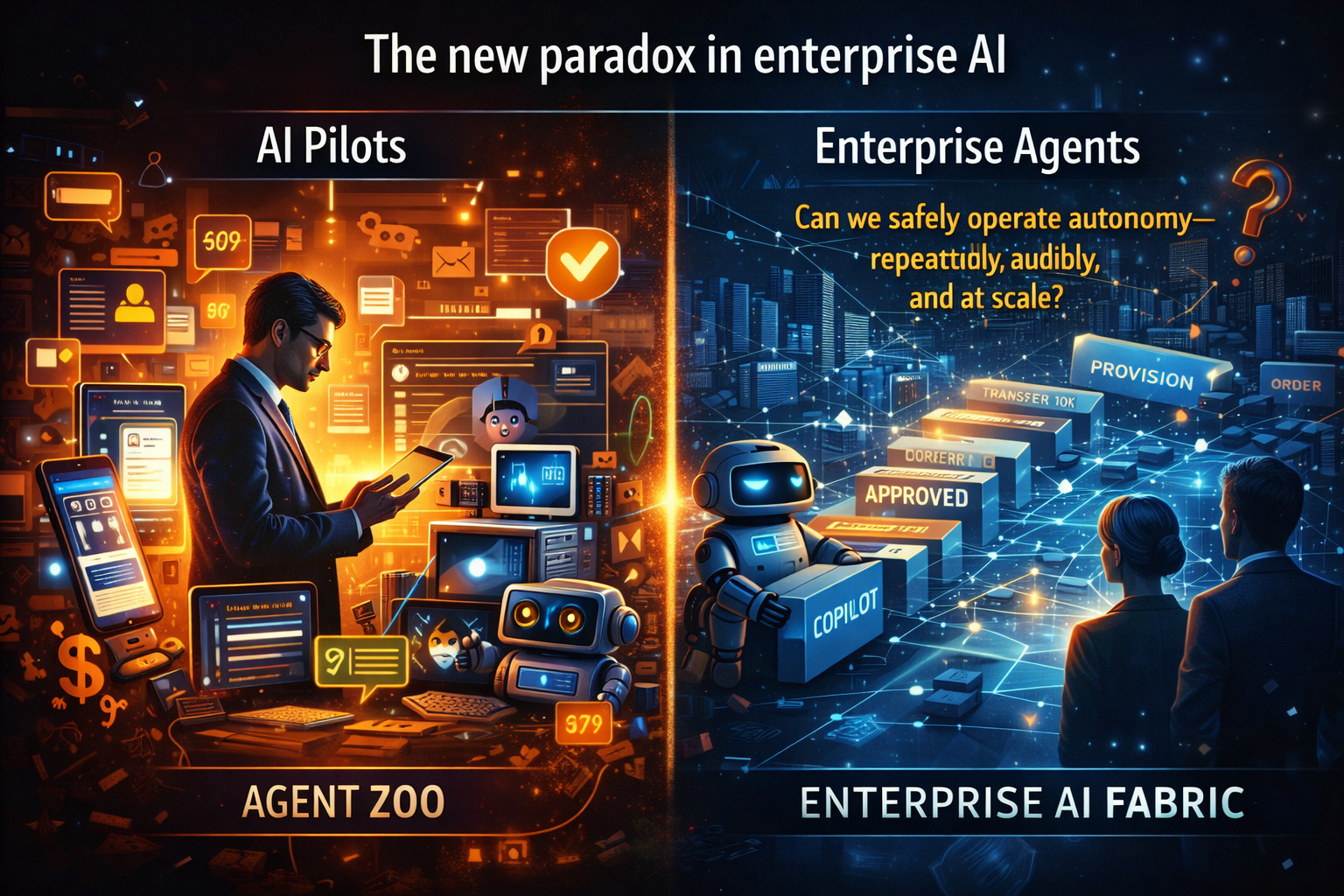
The new paradox in enterprise AI
Across industries, executive teams are seeing the same pattern: AI pilots are easy to start, but hard to scale without unintended consequences. The first wave—copilots, chatbots, internal assistants—created confidence that “AI works.” The second wave—agents that take actions across enterprise systems—creates a different question:
Not: Is the model smart?
But: Can we safely operate autonomy—repeatedly, audibly, and at scale? (Microsoft Learn)
That shift is why the so-called “AI platform war” is effectively over. The market can keep debating who has the best agent builder, the slickest prompt UI, or the most connectors. But enterprise outcomes increasingly depend on something else:
A fabric that turns AI into a managed production capability—without slowing delivery. (Infosys)
This is the quiet pivot happening in many large organizations: moving away from “more tools” and toward an operating environment that makes autonomy safe, repeatable, and accountable.
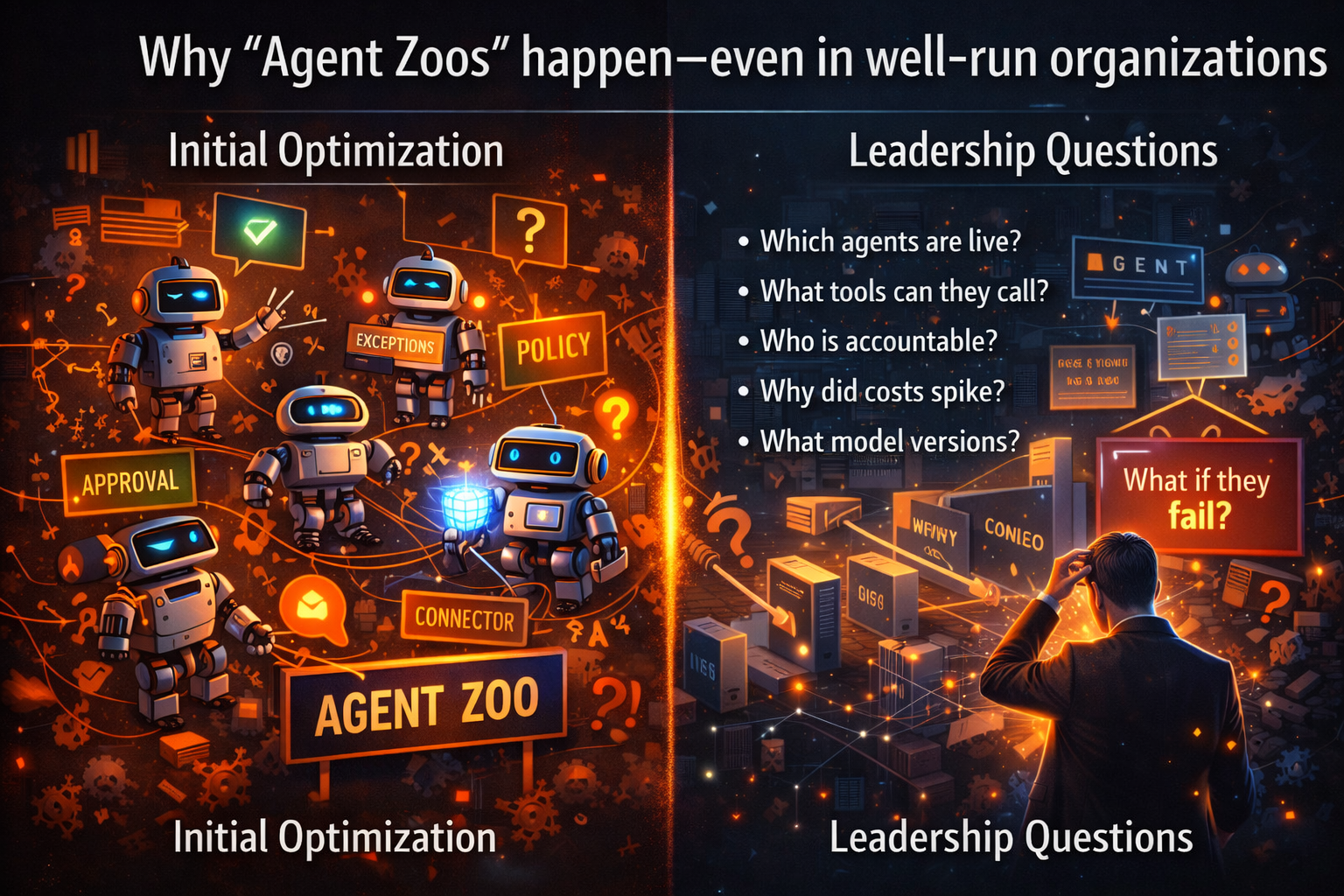
Why “Agent Zoos” happen—even in well-run organizations
An “Agent Zoo” rarely begins as poor planning. It begins as rational local optimization:
- A team creates an agent to speed up approvals.
- Another automates exception handling.
- A third builds a retrieval assistant for policy questions.
- A fourth adds a new model because it’s cheaper or faster.
- A fifth adds a tool connector because the business asked for it “this week.”
Within months, leadership can’t answer basic operational questions:
- Which agents exist—and which are in production?
- What tools can they call, and with what permissions?
- What model versions are they using?
- What happens when they fail quietly (not dramatically)?
- Who is accountable for autonomous actions?
- Why did cost spike last week?
This is not a tooling problem. It’s an operating model problem—one that becomes visible only when autonomy crosses from assist to act.
And once it starts, zoo dynamics compound. Every new agent introduces new permissions, new connectors, new failure modes, and new places where governance can drift. Over time, “fast innovation” becomes “fragile complexity.”
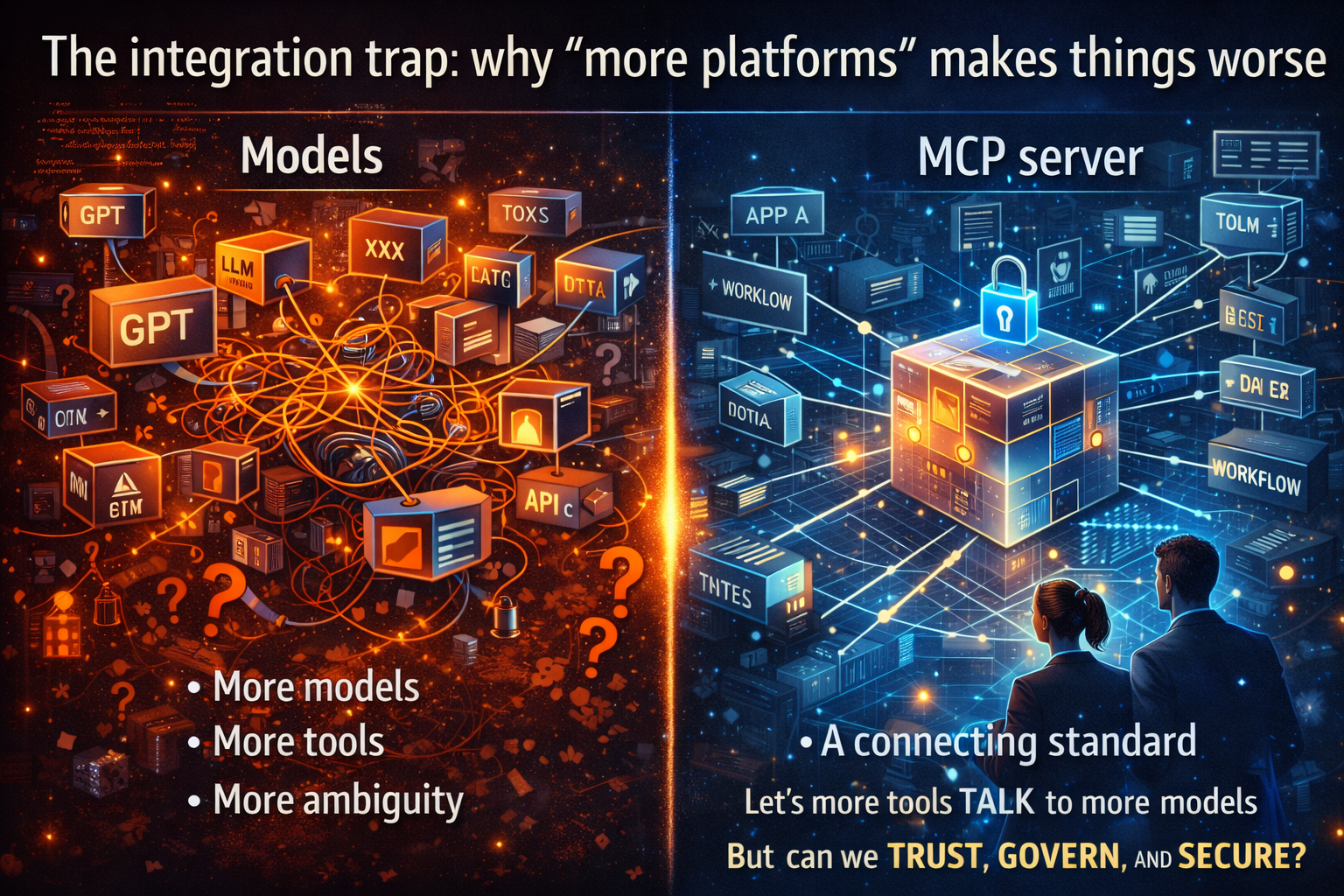
The integration trap: why “more platforms” makes things worse
Enterprise AI systems now sit at the intersection of three moving surfaces:
- Models (multiple providers, versions, modalities)
- Tools (APIs, apps, workflows, data sources)
- Policies (security, privacy, approvals, compliance, safety)
Standards like the Model Context Protocol (MCP) matter because they reduce the “many models × many tools” integration mess by standardizing how AI connects to tools and data. (Anthropic)
But protocol standardization does not automatically give enterprises what they need most:
- consistent authorization and least privilege
- centralized policy enforcement
- auditable evidence of actions
- staged rollouts and rollbacks
- cost guardrails and routing policies
- quality engineering for agent behavior
- security controls that assume prompt-injection-style attacks exist
In other words: MCP can help you plug tools in; it does not, by itself, ensure you can govern what autonomy does with them—and even commentary on MCP adoption highlights security and trust concerns. (IT Pro)
That gap—between connection and control—is where Agent Zoos thrive.
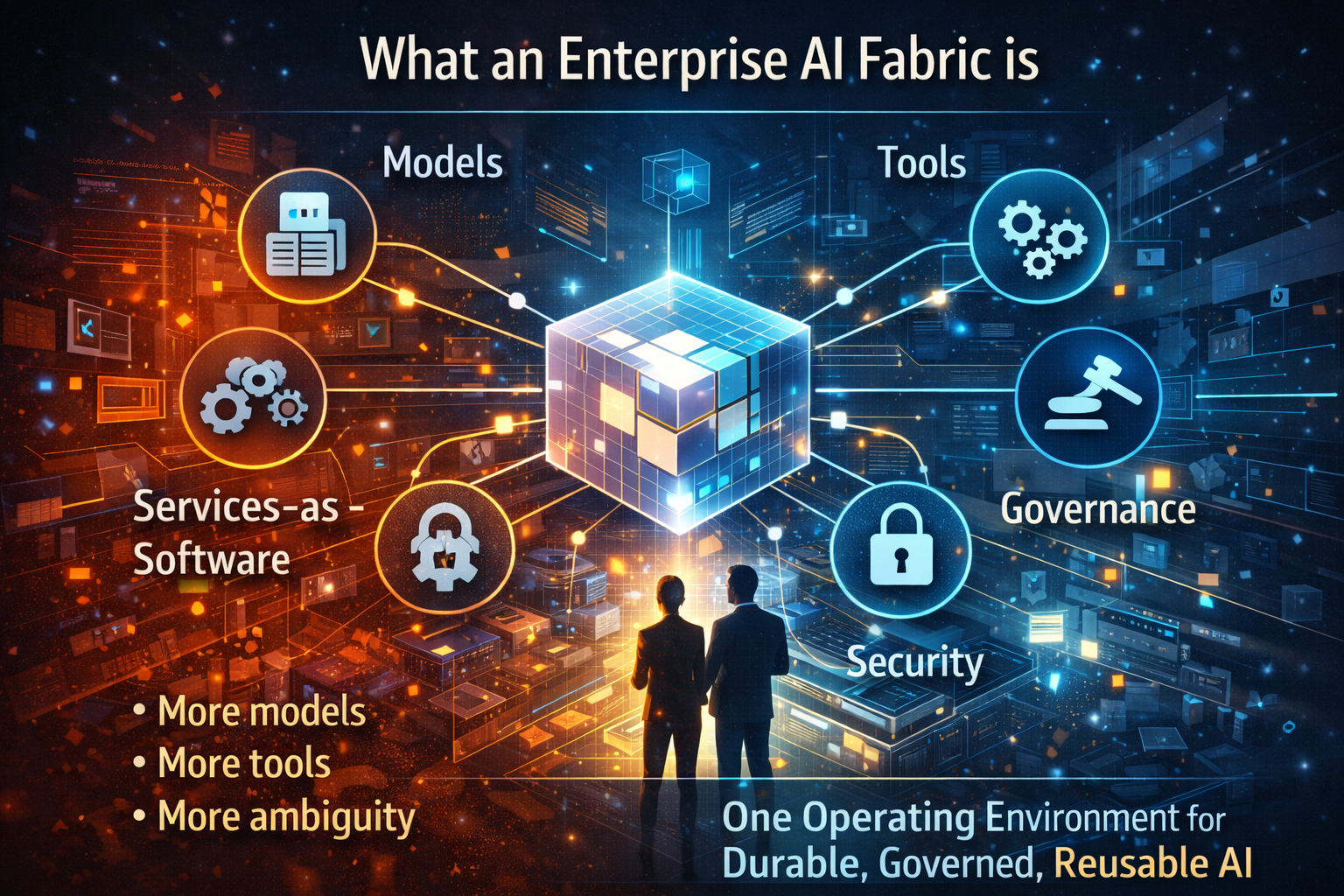
What an Enterprise AI Fabric is
An Enterprise AI Fabric is the shared layer that makes AI industrial-grade.
Think of it less like a “platform you buy” and more like an operating environment you standardize—so every team can build and run AI with the same guardrails, the same observability, the same cost controls, and the same reusable services.
A mature fabric typically enables five outcomes:
1) Interoperability without rewrites
A shared abstraction across models, prompts, and tools—so switching models or adding capabilities doesn’t require rebuilding applications. (Infosys)
2) Services-as-software, not one-off projects
Reusable AI-enabled services delivered in integrated and modular form—so value compounds across the enterprise rather than being rebuilt team by team. (Infosys)
3) Governed machine identities for agents
Agents are treated as non-human identities with lifecycle management, permissions, and oversight—so “agent sprawl” doesn’t become the next security incident. (Microsoft Learn)
4) Operability: reliability, observability, and rollback
Autonomy is run like a production system—measurable, monitorable, and reversible. (TrueFoundry)
5) Responsible speed: cost + quality + security built in
Central routing, logging, policy enforcement, and quality engineering so scaling AI doesn’t scale risk and spend uncontrollably. (IBM)
This is the core logic behind modern “composable stacks” positioned as fabric-like: layered, open, interoperable, designed to unify enterprise landscapes, and delivered as a one-stop set of services-as-software. (Infosys)
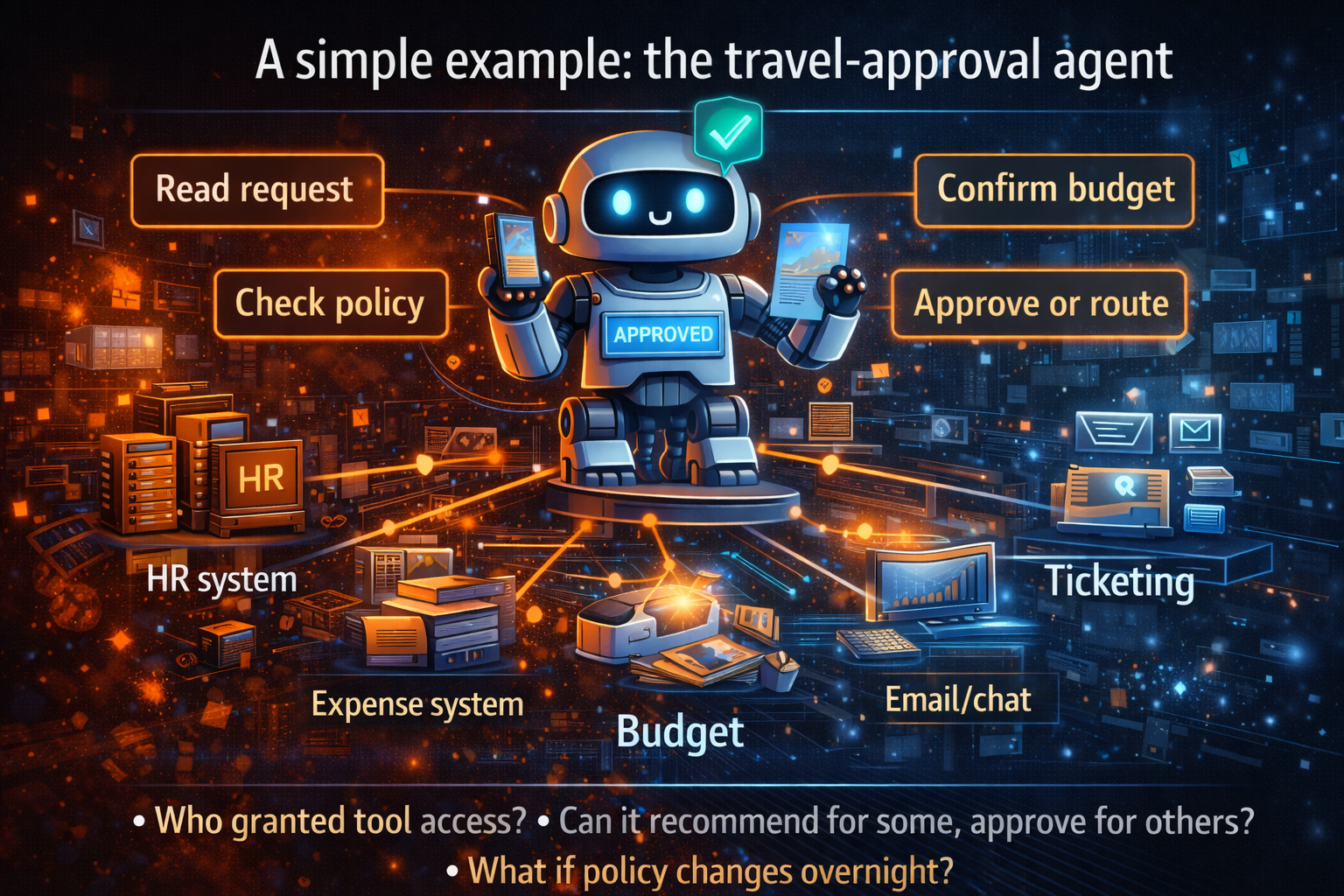
A simple example: the travel-approval agent
Imagine a travel-approval agent.
In a demo, it does four things:
- reads a request
- checks the travel policy
- confirms budget
- approves or routes to a manager
In production, it touches real systems:
- the HR system (role/grade rules)
- the expense system (limits and approvals)
- finance budget APIs
- policy repositories
- ticketing and workflow tools
- email/chat notifications
Now the enterprise questions begin:
- Who granted the agent permission to call each tool?
- Can it approve for some groups but only recommend for others?
- Can approvals require “human-by-exception” thresholds?
- Can we prove why it approved?
- What happens after a policy update?
- Can we pause or roll back agent behavior instantly?
In an Agent Zoo, every team answers these questions differently, after the fact.
In an Enterprise AI Fabric, these answers are defaults—because the fabric provides operating constraints and an evidence layer across all agents.
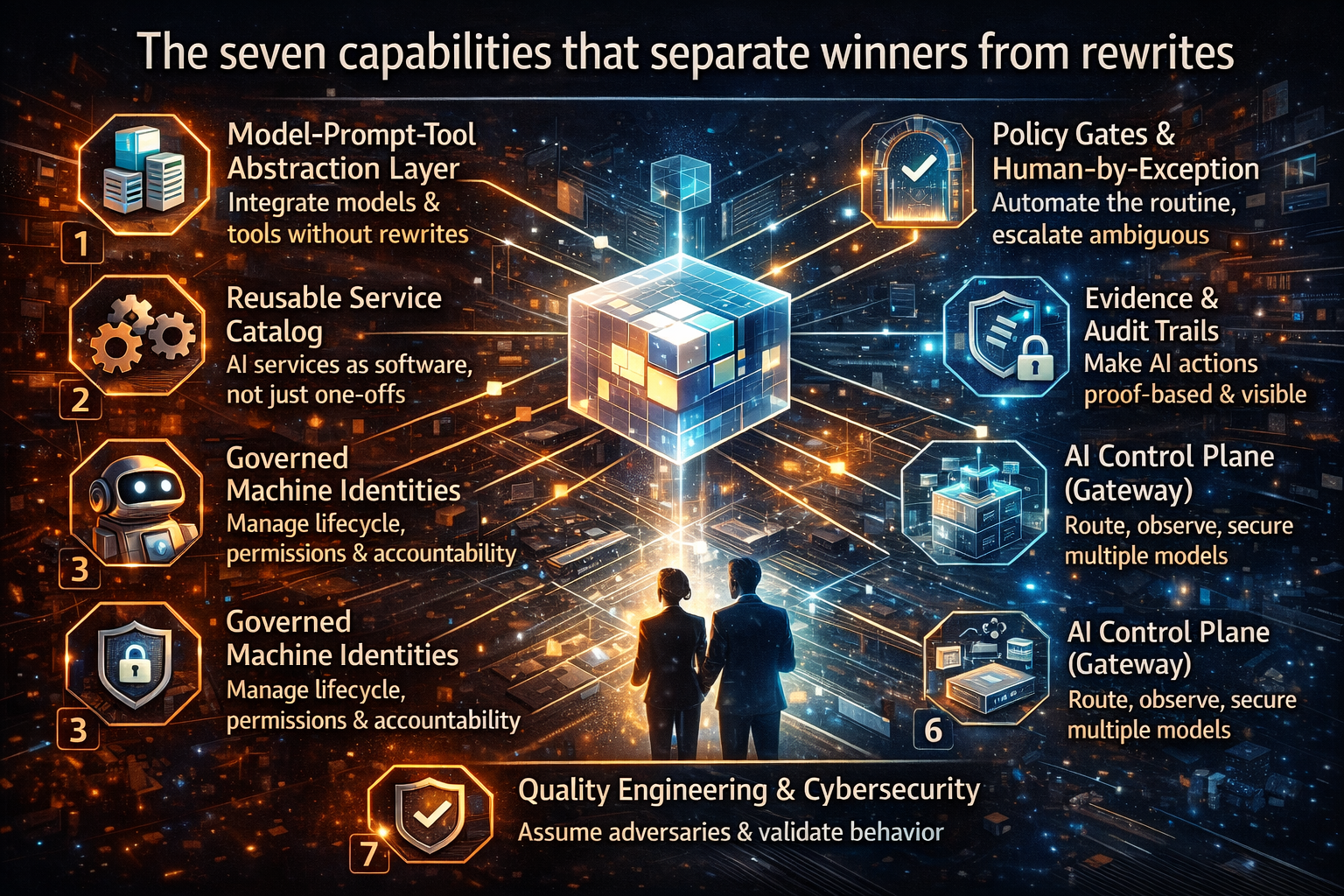
The seven capabilities that separate winners from rewrites
If you want a practical checklist that an executive can understand quickly, these are the seven capabilities that most clearly separate scalable autonomy from fragile sprawl.
1) A model–prompt–tool abstraction layer
Enterprises need an open layer that abstracts models, prompts, and tools so they can integrate new models and technologies without rebuilding applications. (Infosys)
Why it matters: the fastest path to platform failure is hard-coding to a model provider or tool interface, then paying a rewrite tax every time the ecosystem shifts.
2) A reusable service catalog (“services-as-software”)
Instead of shipping “agents,” leading organizations ship reusable services:
- policy Q&A with verifiable sources
- access approval recommendations
- exception triage and routing
- incident summarization and resolution support
- automated test generation and quality checks for releases
Fabric thinking turns these into consumable services—integrated and modular—so teams build once and reuse widely. (The Economic Times)
3) Governed machine identities for agents
Agents must be treated like real identities with lifecycle, permissions, and governance.
This is now a mainstream enterprise security posture: discover agents, document permissions, and apply governance and security practices consistently across the organization. (Microsoft Learn)
Plain-language rule: if an agent can act, it must be accountable like any other actor.
4) Policy gates and human-by-exception controls
A scalable model is not “human in the loop for everything.” It is human by exception—where routine actions are automated and only risky or ambiguous actions escalate.
This is where a fabric earns executive trust: it doesn’t slow the business; it creates responsible speed through policy-based action gating and escalation. (Microsoft Learn)
5) Evidence by default: audit trails for every action
In regulated and high-risk environments, “trust me” isn’t an option. Enterprises need traceability:
- what context the agent used
- what policy it referenced
- what tool it called
- what it changed
- what approvals were involved
This is why governance and security guidance for agents repeatedly emphasizes organization-wide practices, accountability, and standardization. (Microsoft Learn)
6) An AI control plane (gateway) for routing, observability, and cost
As enterprises adopt multiple models and agents, the control plane becomes inevitable—much like API gateways became essential in microservices.
An AI gateway is widely described as specialized middleware that facilitates integration, deployment, and management of AI tools (including LLMs) in enterprise environments. (IBM)
This enables:
- choosing the right model for a task
- enforcing budgets and quotas
- detecting runaway loops
- measuring cost per outcome
- reducing duplication across teams
7) Quality engineering and cybersecurity as built-in fabric services
As autonomy scales, testing becomes behavioral (not just output-based), and security becomes “assume adversarial inputs exist.”
That’s why fabric-like stacks increasingly emphasize integrated services spanning operations, transformation, quality engineering, and cybersecurity—not as optional add-ons, but as core capabilities. (Infosys)
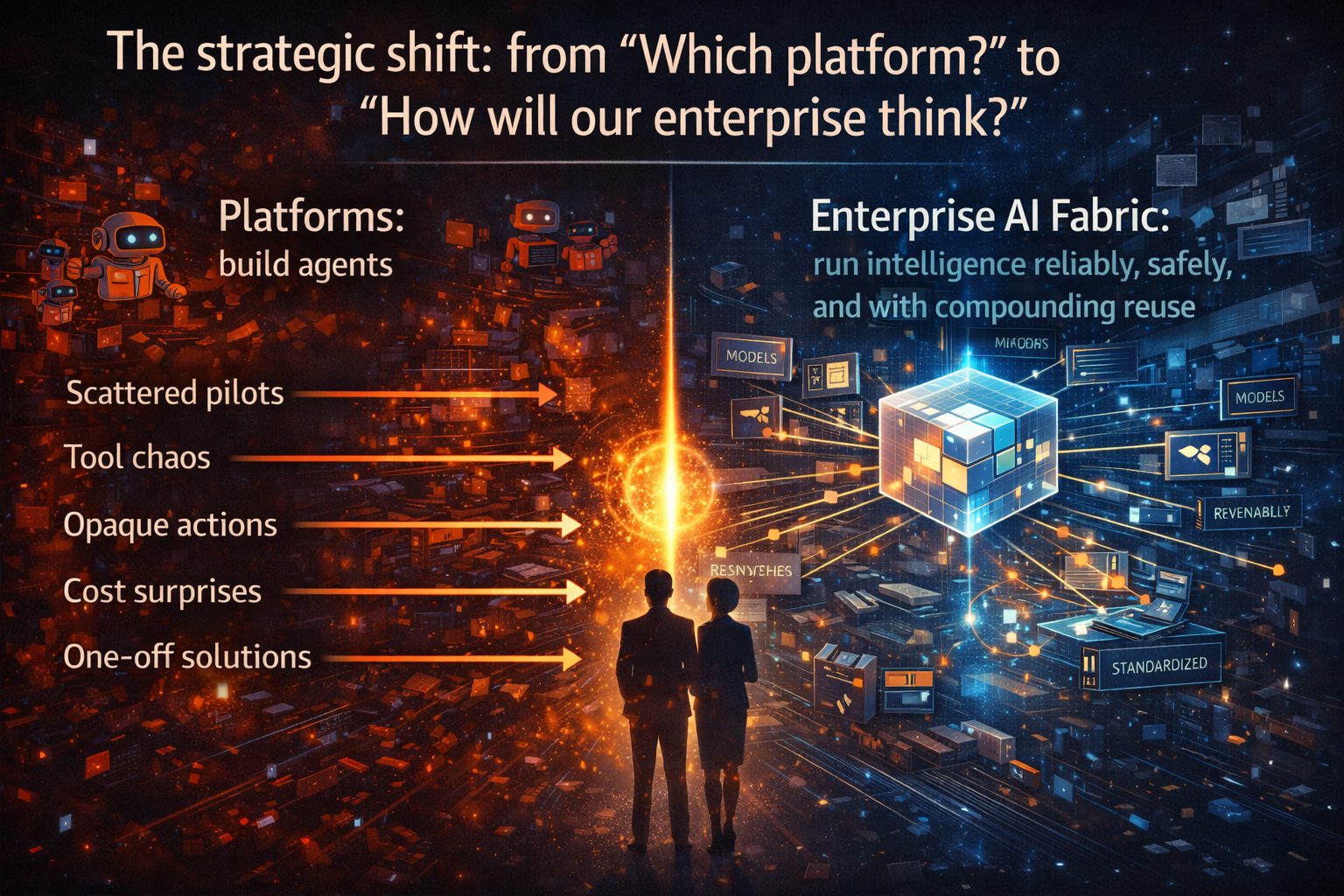
The strategic shift: from “Which platform?” to “How will our enterprise think?”
This is the executive reframing that makes the article shareable:
- Platforms help you build agents.
- Fabrics help you run intelligence across the enterprise landscape—reliably, safely, and with compounding reuse.
In practice, that means moving from:
- scattered pilots → standardized services
- tool chaos → governed integration
- opaque actions → evidence and traceability
- cost surprises → routing and budgets
- one-off solutions → reusable capabilities
That is the winning play.
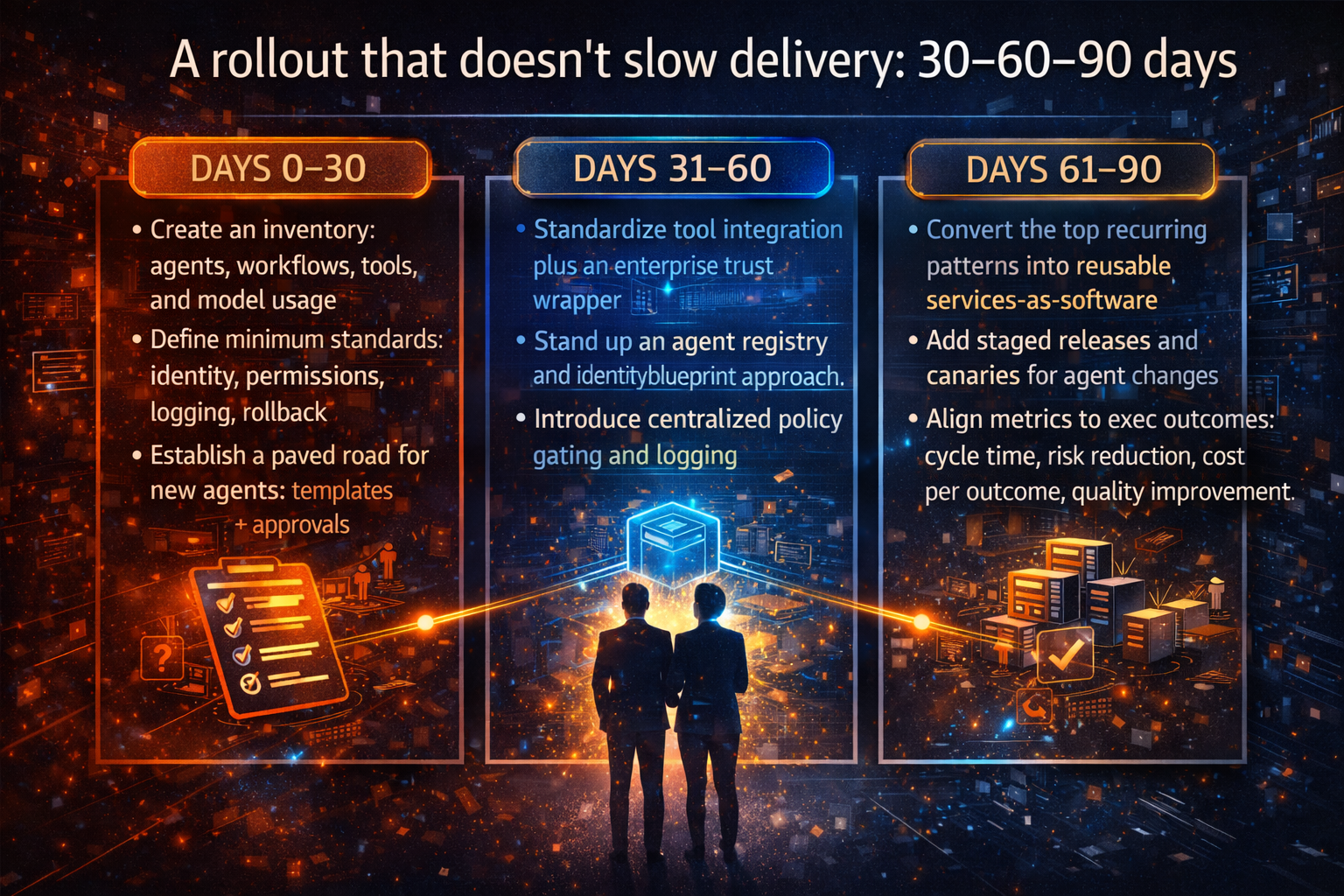
A rollout that doesn’t slow delivery: 30–60–90 days
Days 0–30: Stop the zoo from growing
- Create an inventory: agents, workflows, tools, and model usage
- Define minimum standards: identity, permissions, logging, rollback
- Establish a paved road for new agents: templates + approvals
Days 31–60: Build the fabric spine
- Standardize tool integration (MCP-style patterns where appropriate) plus an enterprise trust wrapper (Anthropic)
- Stand up an agent registry and identity blueprint approach (Microsoft Learn)
- Introduce centralized policy gating and logging
- Add an AI gateway/control plane for observability and cost (IBM)
Days 61–90: Productize reusable services
- Convert the top recurring patterns into reusable services-as-software (The Economic Times)
- Add staged releases and canaries for agent changes
- Align metrics to executive outcomes: cycle time, risk reduction, cost per outcome, quality improvement
What to say in the boardroom
Here’s the line that clarifies the strategy in one breath:
The winners won’t be the enterprises with the most agents.
They’ll be the ones who can operate autonomy like a production capability—visible, governed, and reusable.
That is what an Enterprise AI Fabric makes possible.
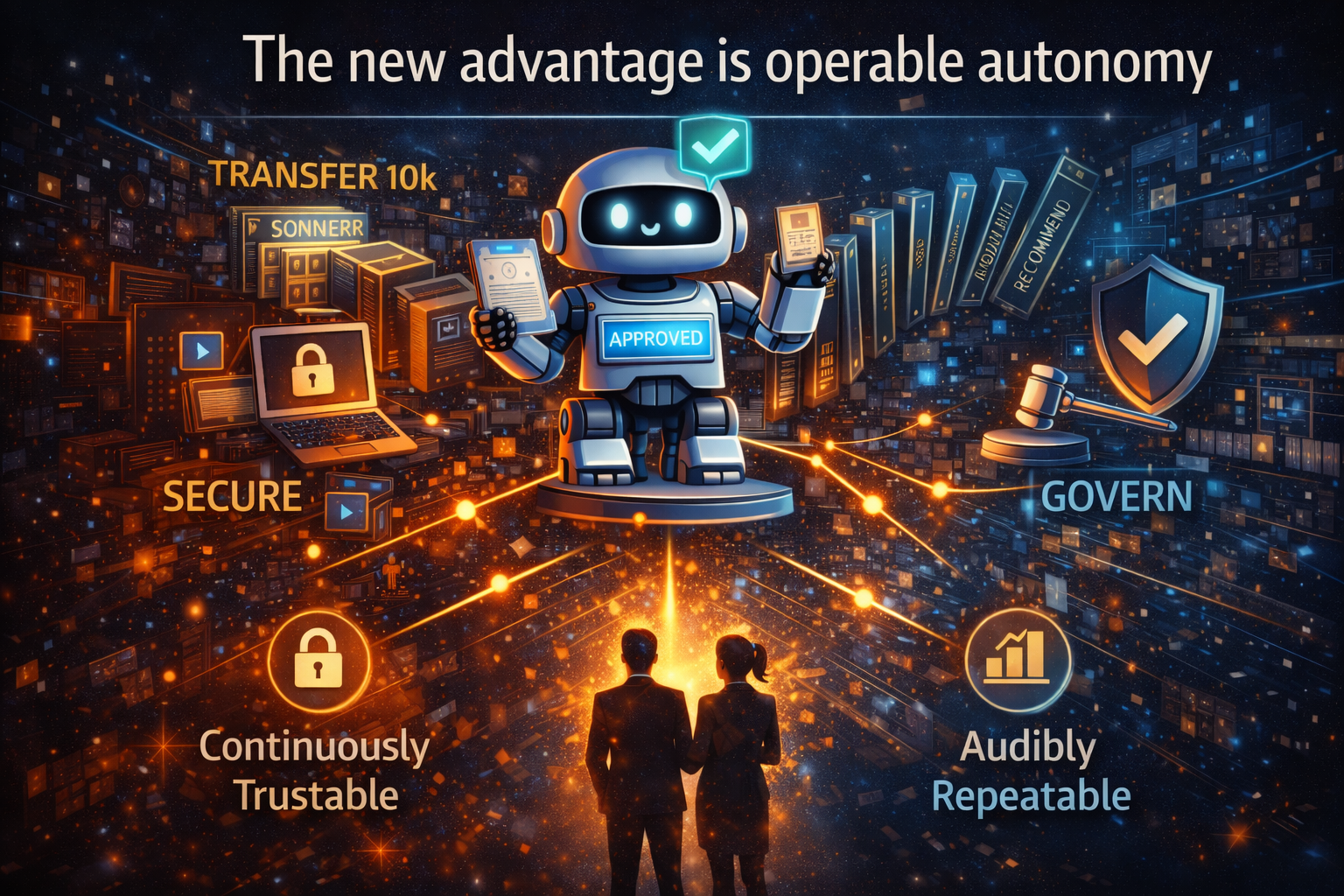
Conclusion: The new advantage is operable autonomy
Enterprise AI is entering its operational era. The organizations that win won’t simply adopt the newest models or deploy the most agents. They’ll do something harder—and more durable:
They’ll build a fabric where autonomy is composable (so it evolves), governed (so it’s safe), observable (so it’s operable), and reusable (so value compounds).
In the years ahead, “agent count” will be a vanity metric. The decisive metric will be simpler:
Can your organization scale autonomy without scaling chaos?
If the answer is yes, you’re no longer playing the platform war. You’re building the enterprise advantage.
FAQ
Is an “Enterprise AI Fabric” just another agent platform?
No. Platforms help you build. A fabric helps you operate at scale with governance, cost control, reliability, security, quality engineering, and reuse as defaults. (IBM)
Do standards like MCP solve the problem?
They reduce integration friction, but enterprises still need policy gates, identity, auditability, and operational controls around autonomous actions. (Anthropic)
What’s the earliest sign we’re building an Agent Zoo?
When you can’t quickly answer: “Which agents are running, what they can do, what they did, and who owns them.” (Microsoft Learn)
Where should the fabric “live” organizationally?
Typically as a shared capability owned jointly by enterprise architecture, security/identity, platform engineering, and a business-aligned AI governance group—so it’s both technically enforceable and business-relevant. (Microsoft Learn)
FAQ 1
What is an Enterprise AI Fabric?
An Enterprise AI Fabric is a composable operating layer that standardizes how AI models, agents, tools, policies, and services are integrated, governed, and operated at scale.
FAQ 2
Why do AI agent platforms fail in large enterprises?
They optimize for speed of creation, not operability—leading to agent sprawl, governance gaps, cost overruns, and security risks.
FAQ 3
How is an AI Fabric different from an AI platform?
Platforms help teams build agents. Fabrics help enterprises run intelligence reliably, securely, and repeatedly across the organization.
FAQ 4
What does “operable autonomy” mean?
It means AI systems can act independently while remaining observable, governed, reversible, and auditable—just like any production system.
Glossary
- Agent Zoo: Uncontrolled proliferation of agents with inconsistent controls and low visibility.
- Enterprise AI Fabric: A unified operating layer that standardizes integration, governance, cost, reliability, security, and reuse for AI at scale. (Infosys)
- Services-as-software: Reusable, productized AI-enabled services delivered as integrated and modular capabilities that teams consume repeatedly. (The Economic Times)
- Non-human identities: Software-based identities (including agents and tools) that access systems automatically and require governance. (Microsoft)
- AI gateway / control plane: Central layer for model routing, policy enforcement, logging, observability, and cost management. (IBM)
- MCP (Model Context Protocol): An open standard enabling secure, two-way connections between AI applications and external tools/data sources via a client-server pattern. (Anthropic)
References and Further Reading
- Composable, open, interoperable enterprise AI stack positioning and “services-as-software” framing (industry launch coverage and product positioning). (Infosys)
- Model Context Protocol (MCP): what it is, how it standardizes model-to-tool connections, and the security considerations as adoption grows. (Anthropic)
- Governance and security practices for AI agents across an organization; agent identity concepts and non-human identity governance. (Microsoft Learn)
- AI gateway concept and enterprise control-plane capabilities (routing, policy enforcement, audit trails, observability). (IBM)
- Why Every Enterprise Needs a Model-Prompt-Tool Abstraction Layer (Or Your Agent Platform Will Age in Six Months) – Raktim Singh
- The Synergetic Workforce: How Enterprises Scale AI Autonomy Without Slowing the Business – Raktim Singh
- AgentOps Is the New DevOps: How Enterprises Safely Run AI Agents That Act in Real Systems – Raktim Singh
- The Agentic Identity Moment: Why Enterprise AI Agents Must Become Governed Machine Identities – Raktim Singh
- The Agentic AI Platform Checklist: 12 Capabilities CIOs Must Demand Before Scaling Autonomous Agents | by RAKTIM SINGH | Dec, 2025 | Medium
- The Agentic Identity Moment: Why Enterprise AI Must Treat Agents as Governed Machine Identities | by RAKTIM SINGH | Dec, 2025 | Medium
- The AI SRE Moment: How Enterprises Operate Autonomous AI Safely at Scale | by RAKTIM SINGH | Dec, 2025 | Medium
- The Enterprise AI Control Plane: Why Reversible Autonomy Is the Missing Layer for Scalable AI Agents | by RAKTIM SINGH | Dec, 2025 | Medium
- The Human–Agent Ratio: The New Productivity Metric CIOs Will Manage—and the Enterprise Stack Required to Make It Safe – Raktim Singh
- The Enterprise AI Operating Model: How organizations design, govern, and scale intelligence safely – Raktim Singh



Raktim Singh is an AI and deep-tech strategist, TEDx speaker, and author focused on helping enterprises navigate the next era of intelligent systems. With experience spanning AI, fintech, quantum computing, and digital transformation, he simplifies complex technology for leaders and builds frameworks that drive responsible, scalable adoption.