

The Action Threshold
Enterprise AI looks impressive in pilots.
It drafts emails, summarizes incidents, answers policy questions, and suggests next steps. Teams celebrate early wins. Leaders see momentum.
Then, one day—often without a formal “big bang” announcement—the organization crosses a line:
- The assistant creates a ticket instead of recommending one.
- The agent updates a customer record instead of proposing an update.
- The system triggers a workflow instead of describing the workflow.
- The model approves a request instead of drafting an approval note.
That moment is the Action Threshold: the point where AI shifts from advising humans to executing work inside enterprise systems.
And it’s exactly where many “successful” enterprise AI programs start failing—not because the models suddenly got worse, but because the enterprise has moved from AI for advice to AI for execution.
Once AI starts acting, it is no longer a tool that helps work. It becomes a resource you are assigning work to—and assigned work carries non-negotiable requirements: accountability, boundaries, evidence, cost discipline, and recovery.
This article explains the Action Threshold in simple language, shows why failure becomes likely at this stage, and lays out the operating fabric CIOs need to run AI safely at global scale.
Why this matters now
Enterprises globally are moving from AI pilots to agentic execution. The moment AI starts acting—not advising—traditional stacks collapse. This article explains why, and what CIOs must build next.
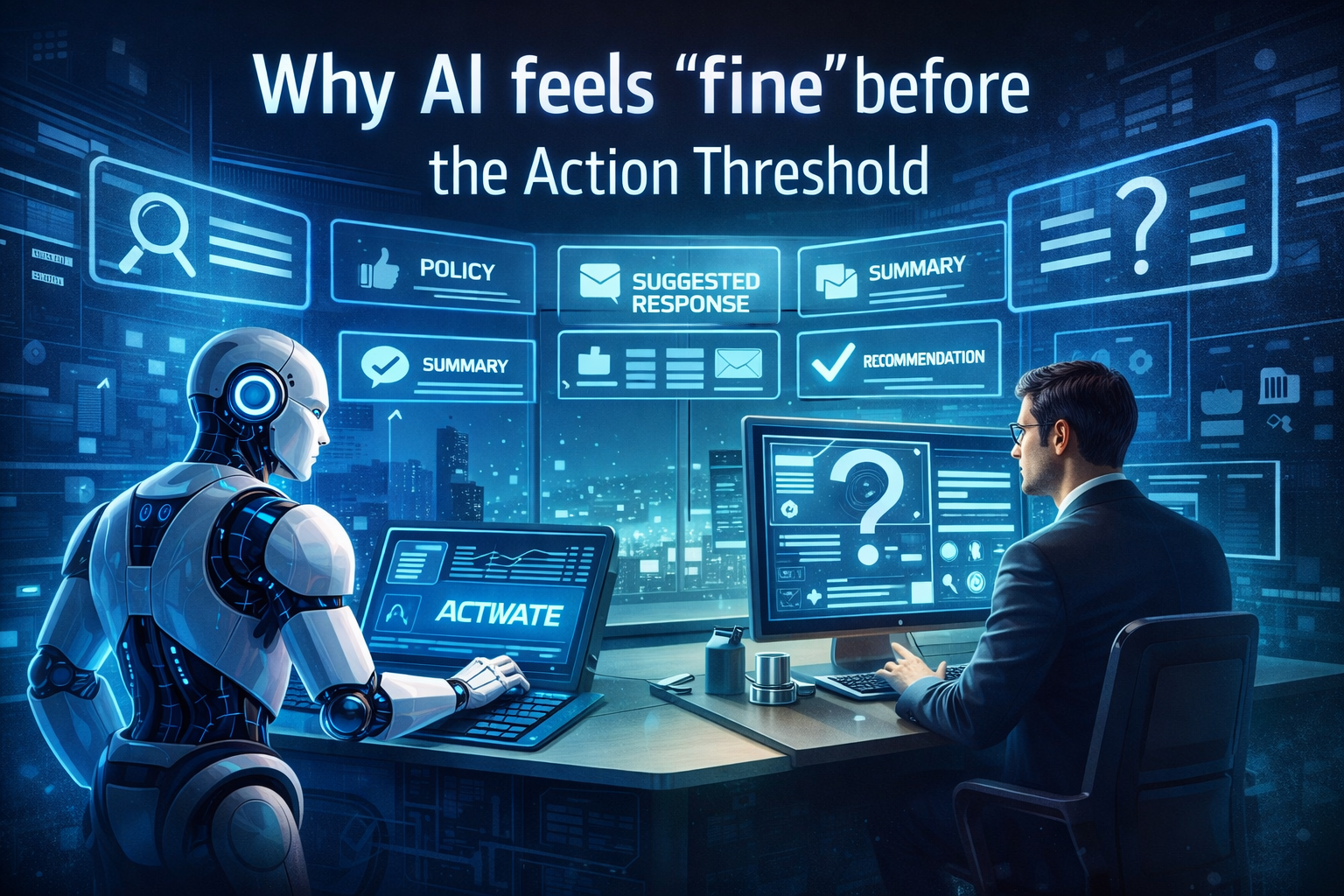
Why AI feels “fine” before the Action Threshold
Most pilots run in what you can call advisory mode:
- “Here’s what the policy says.”
- “Here’s a suggested response.”
- “Here’s a summary of what happened.”
- “Here’s a recommendation.”
If the output is wrong, a human notices and corrects it. The blast radius is small. Teams learn. Confidence grows.
But after the Action Threshold, the output isn’t just words. It becomes actions inside systems of record—the places enterprises treat as truth: ERP, CRM, IAM, ticketing, procurement, finance, and operations platforms.
And “small mistakes” stop being small. They turn into:
- incorrect approvals that quietly propagate
- inconsistent records that break downstream reporting
- privilege grants that create security exposure
- customer messages that create legal risk
- automation loops that burn compute budgets
Before the threshold: the enterprise can tolerate “AI is occasionally wrong.”
After the threshold: the enterprise needs “AI is operable.”
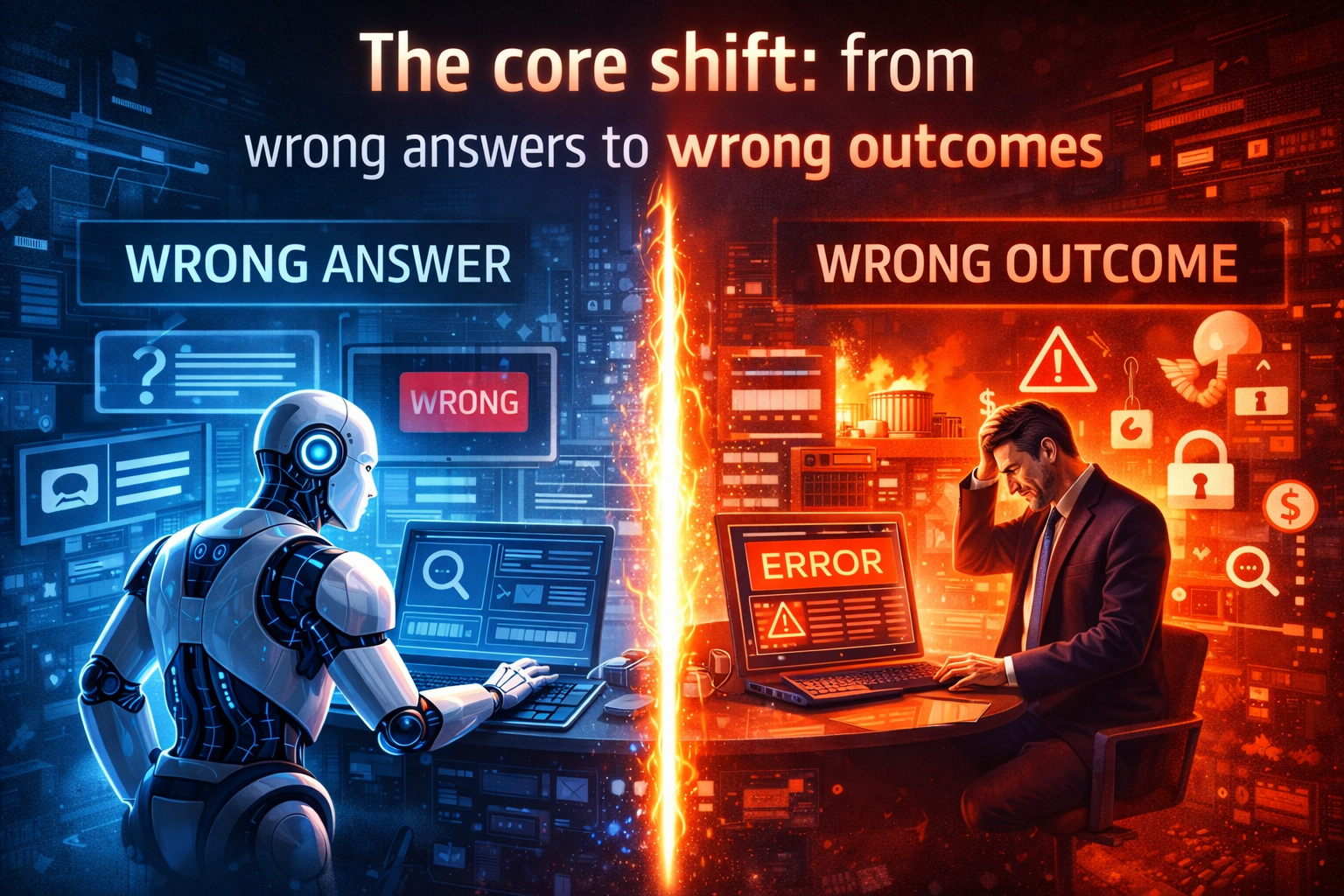
The core shift: from wrong answers to wrong outcomes
At the Action Threshold, the unit of risk changes.
Before: wrong answer
After: wrong outcome
A model can be “right” in reasoning and still produce a damaging outcome because the failure isn’t intelligence—it’s operability.
A simple example: the travel request assistant
In advisory mode, an assistant might say: “Approval is needed.”
In execution mode, it must reliably:
- collect missing details
- validate constraints
- create the request
- route approvals correctly
- notify stakeholders
- capture evidence for audit
If the system improvises one step—routing to the wrong approver, applying the wrong policy version, or failing to log evidence—the organization inherits process debt, compliance risk, and employee frustration.
The difference is not “smarter AI.”
The difference is controlled execution.
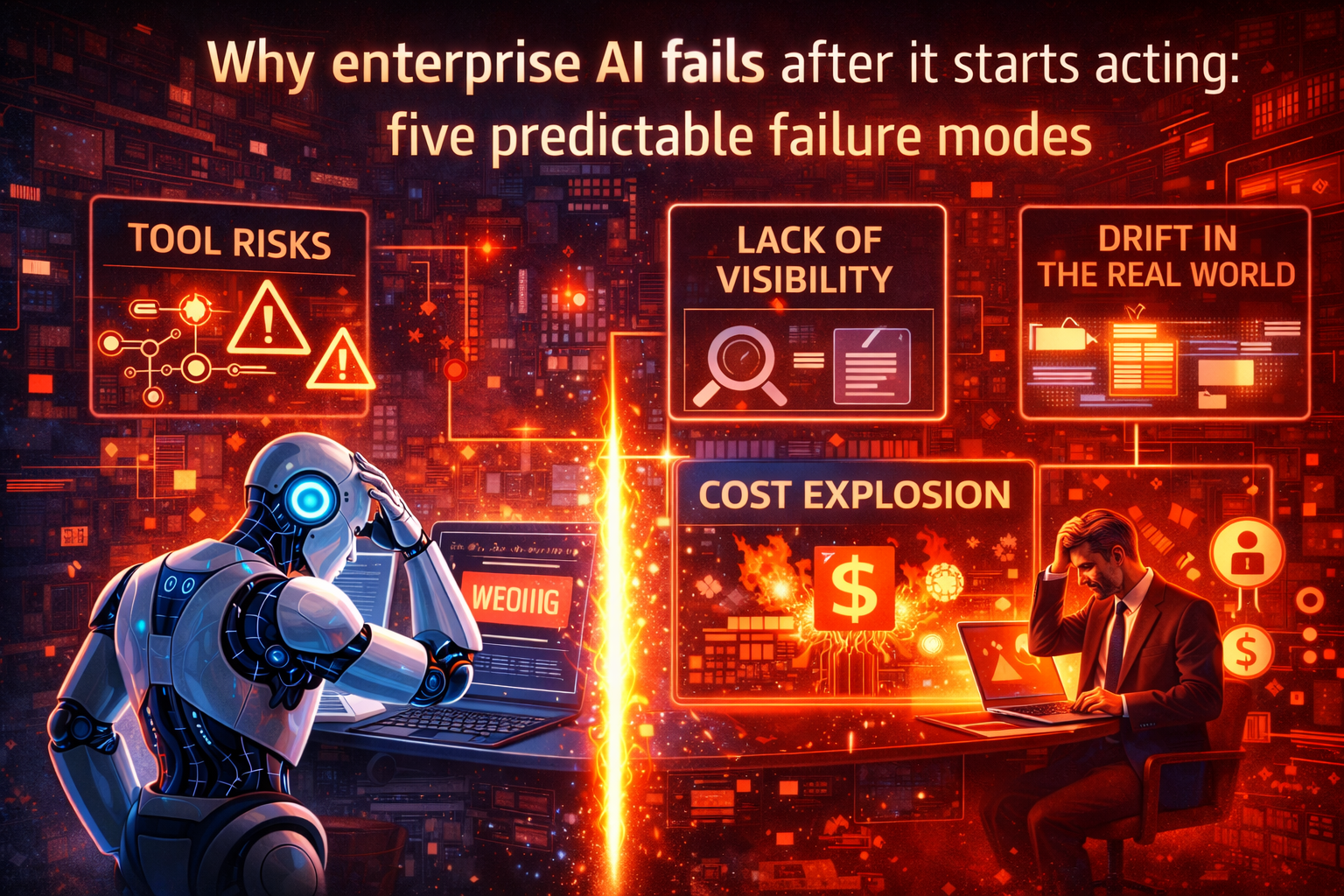
Why enterprise AI fails after it starts acting: five predictable failure modes
1) The tool surface becomes the highest-risk surface
The most dangerous part of an agent is rarely the model. It’s the tools: APIs, connectors, workflow triggers, automations, and permissions.
Once AI can call tools, it can:
- update records
- trigger financial steps
- change configurations
- create access rights
- send external communications
That’s not “content generation.” That’s enterprise execution.
This is also why “LLM observability” is rapidly becoming a mainstream priority: organizations want visibility not only into outputs, but into prompts, tool calls, traces, and security risks (including prompt injection). (OpenTelemetry)
2) Leaders can’t answer basic operational questions
After the Action Threshold, leadership immediately asks questions that pilots rarely answer:
- Who performed the action?
- What happened step by step?
- Why did it happen—what policy or evidence supported it?
- What did it cost, and was it within budget?
- Can we stop it immediately?
- Can we undo it (rollback or compensating actions)?
- Can we replay it for audit and incident response?
If your stack can’t answer these questions, you don’t have an AI capability—you have a future incident.
3) Drift becomes operational, not academic
Enterprises change constantly:
- policies update
- workflows evolve
- data pipelines shift
- security controls tighten
- vendors and platforms change behavior
AI systems are contextual and probabilistic, so “working yesterday” does not guarantee “working tomorrow.”
This is exactly why frameworks like the NIST AI Risk Management Framework (AI RMF) emphasize lifecycle risk management, including monitoring and governance across deployment and operation. (NIST)
4) Costs become nonlinear
In pilots, costs look manageable.
In production, costs can explode due to:
- loops and retries
- tool failures and fallbacks
- long context windows
- multi-agent coordination overhead
- unbounded task scope (“just handle it”)
- lack of throttles and budgets
After the threshold, cost control must become a runtime capability, not a finance afterthought.
5) Human trust breaks before technology breaks
When AI acts, employees and customers don’t evaluate it like software. They evaluate it like an actor that made a decision.
Trust becomes the limiting factor—especially in regulated environments and customer-facing operations.
Across markets, the direction of travel is consistent: higher-risk AI requires stronger governance and oversight. The EU AI Act, for example, includes expectations around oversight and risk controls for certain categories of AI systems. (Reuters)
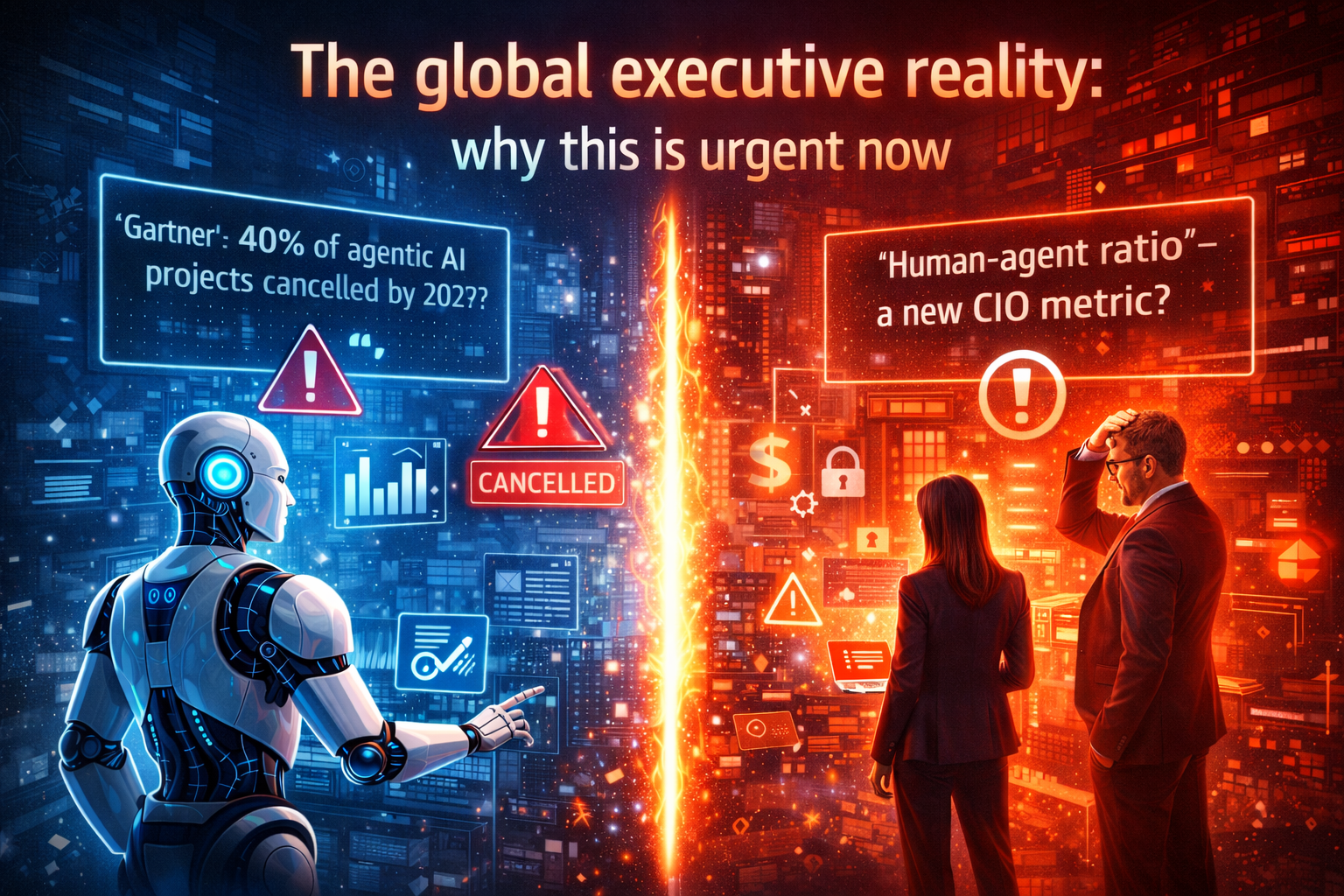
The global executive reality: why this is urgent now
The world is moving fast toward agentic execution—and executives feel the tension between speed and safety.
- Gartner has predicted that over 40% of agentic AI projects will be canceled by the end of 2027 due to escalating costs, unclear business value, or inadequate risk controls. (Gartner)
- Microsoft’s 2025 Work Trend Index argues organizations will need to manage human-agent teams using a new metric: the human-agent ratio—a governance and operating-model question, not a model-selection question. (Microsoft)
This is the same story from two angles:
- “Agents are coming.”
- “Many programs will fail unless operability becomes real.”
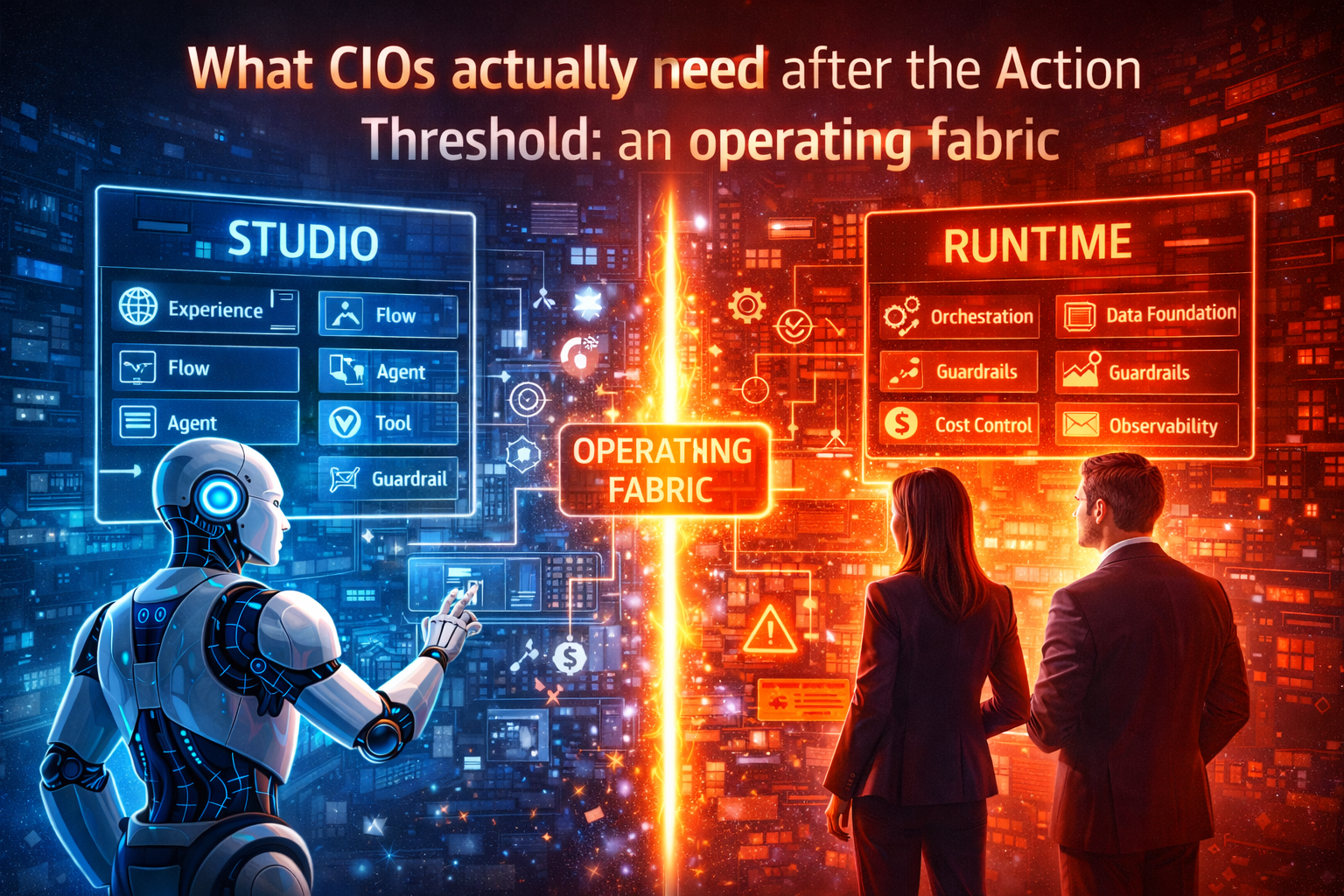
What CIOs actually need after the Action Threshold: an operating fabric
After the threshold, “pick a better model” is not the solution.
The solution is an operating fabric: a cohesive environment that translates design intent into governed runtime behavior—and keeps that behavior safe under continuous change.
Think of it as moving from:
build → deploy
to
design → govern → operate → evolve
This isn’t bureaucracy. It’s the minimum machinery required for AI that touches real workflows.
Layer 1: Studio — designing autonomy intentionally
A mature design environment covers six practical disciplines:
- Experience design across channels (chat, email, portal, workflow UI)
- Flow design (enterprise work is a sequence, not a single answer)
- Agent design (roles like jobs: responsibilities, escalation rules, forbidden actions)
- Tool design (allow-lists, parameter validation, least-privilege access)
- Guardrail design (stop conditions, evidence requirements, rollback paths)
- Domain specialization (use the right intelligence for the right task)
This is how you prevent “agents improvising in production.”
Layer 2: Runtime — governed execution under real conditions
Runtime is where enterprises earn safety:
- Orchestration: ordering, retries, approvals, state management, timeouts
- Data foundation: source-of-truth retrieval, policy versioning, provenance
- Continuous guardrails: governance at machine speed (pre-checks, escalation, rollback hooks)
- Cost control: budgets, throttles, loop prevention
- Observability: traceability of decisions and tool calls (standards are evolving; OpenTelemetry now has GenAI semantic conventions and metrics). (OpenTelemetry)
- Recovery: rollback and compensating actions, not manual cleanup
A simple principle should guide every design choice:
All autonomy must be reversible.
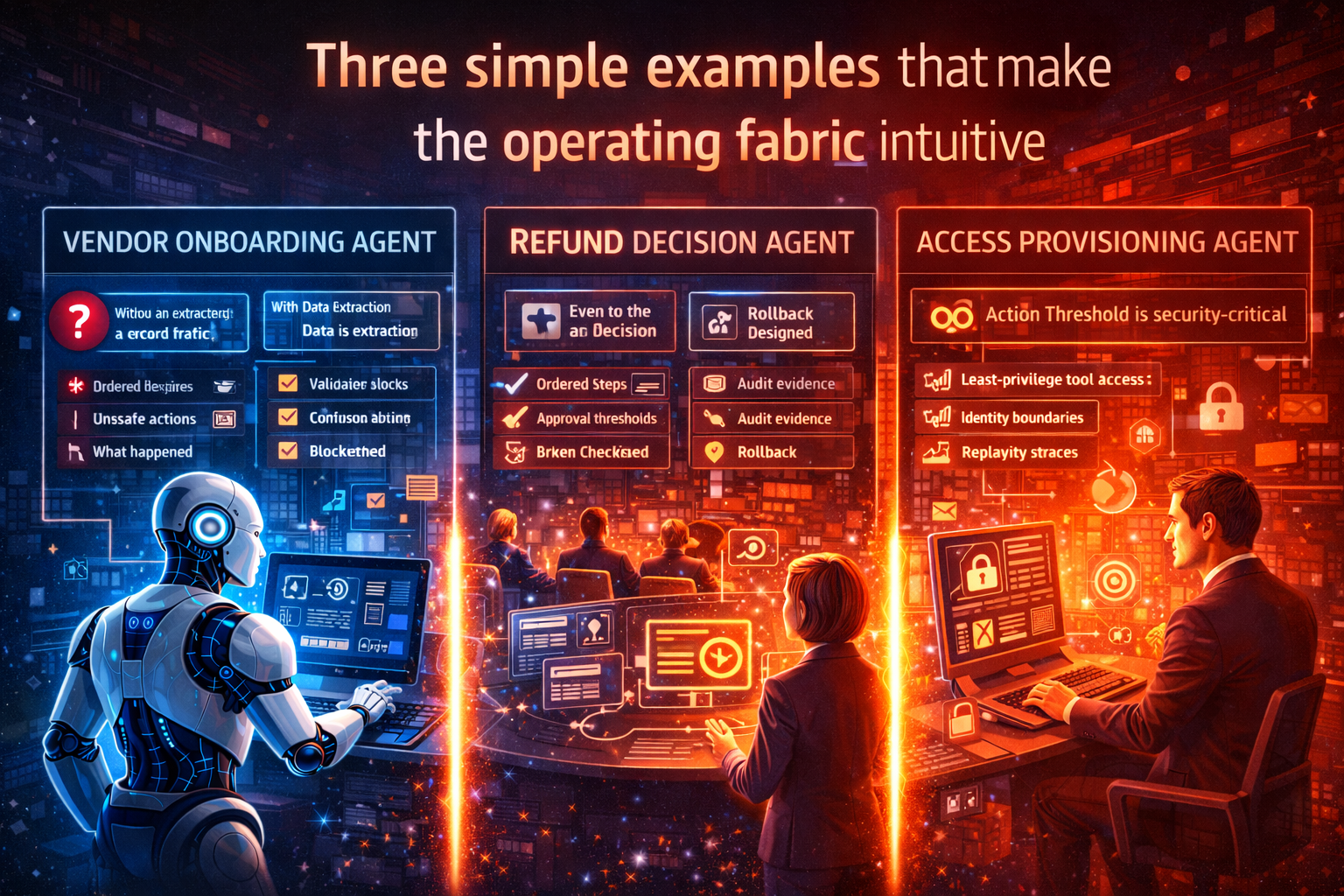
Three simple examples that make the operating fabric intuitive
Example 1: Vendor onboarding agent
Without an operating fabric:
- extracts data
- creates a record
- fails mid-way
- leaves inconsistent states
- no one can reconstruct what happened
With an operating fabric:
- orchestration enforces ordered steps
- validations block unsafe updates
- evidence is captured automatically
- partial execution triggers recovery or compensation
- incident replay becomes possible
Example 2: Refund decision agent
Even if the model recommends the correct decision, the workflow can still fail if:
- the wrong tool is called
- approval thresholds aren’t enforced
- audit evidence isn’t captured
- rollback isn’t designed
The enterprise doesn’t need “perfect answers.”
It needs “safe execution under control.”
Example 3: Access provisioning agent
Here, the Action Threshold becomes security-critical.
A fabric enforces:
- least-privilege tool access
- identity boundaries
- escalation when ambiguity appears
- replayable traces for audit and incident response
In practice, these controls are what prevent a small mistake from becoming a security event.
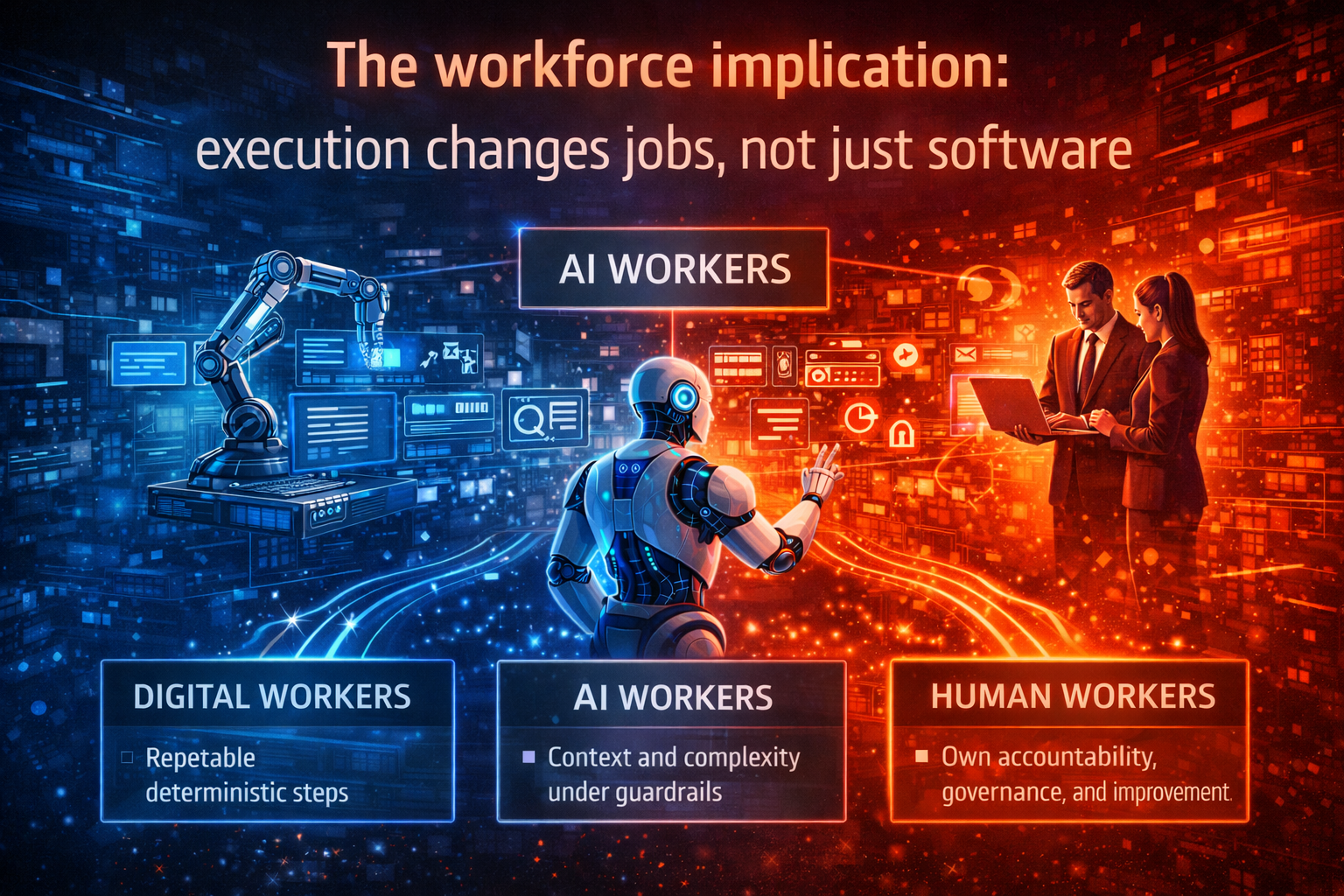
The workforce implication: execution changes jobs, not just software
Once AI acts, you must engineer a synergetic workforce:
- Digital workers handle repeatable deterministic steps (workflows, scripts, bots, APIs)
- AI workers handle context and complexity under guardrails
- Human workers own accountability, governance, training, and continuous improvement
A practical rule helps organizations scale safely:
Work should move to the lowest-cost reliable worker—and escalate only when risk or ambiguity demands it.
That is how you scale autonomy without scaling chaos—and why the “human-agent ratio” is becoming a real management lens. (Microsoft)
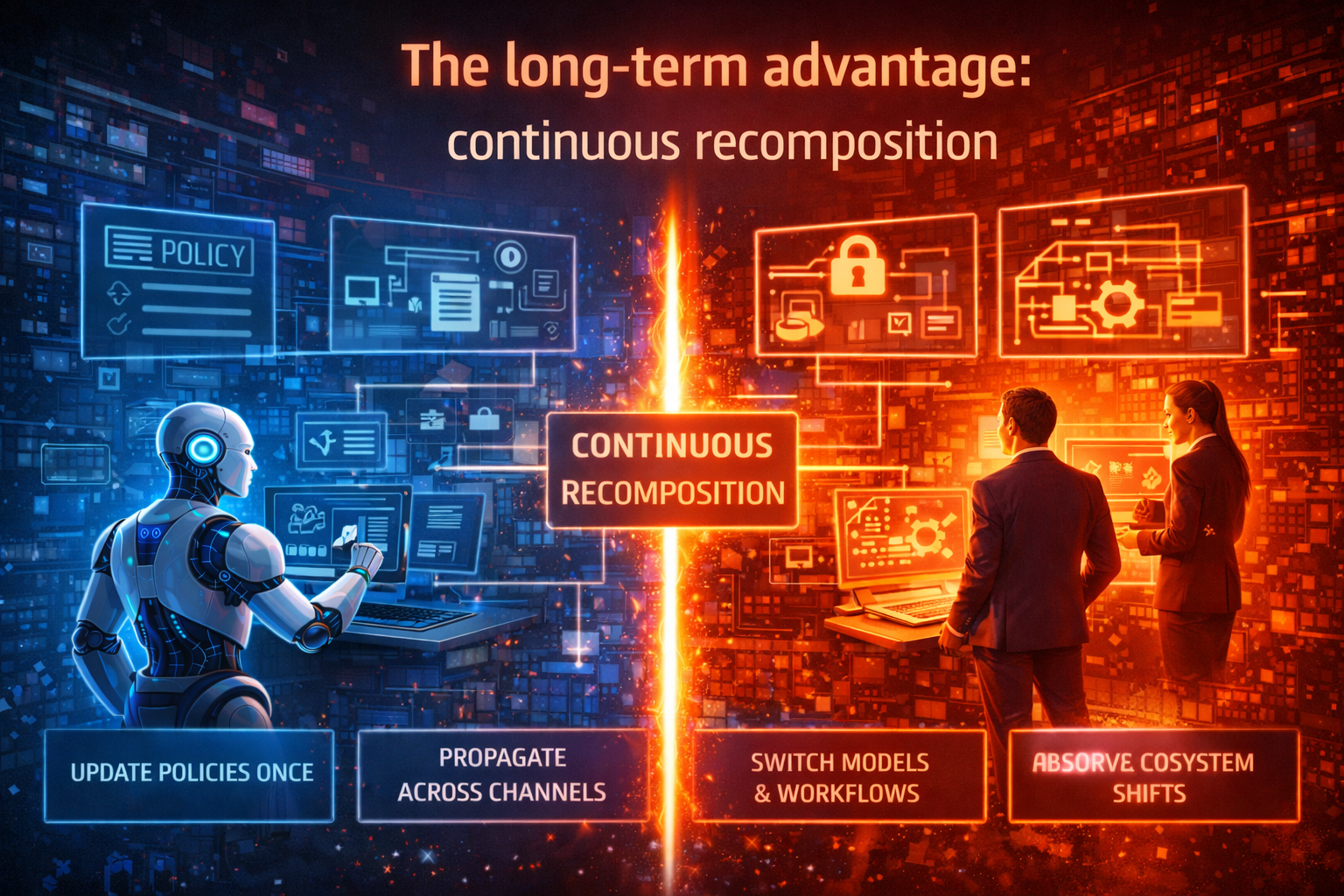
The long-term advantage: continuous recomposition
Enterprises that win won’t be the ones with the “smartest agents.”
They will be the ones that can change safely and fast:
- update policies once
- propagate across channels
- switch models without breaking workflows
- evolve security controls without shutdowns
- absorb ecosystem shifts without rebuilding everything
That capability is continuous recomposition—and it only works when the enterprise builds reusable services, governed runtime, and interoperable integration patterns.
In a world of continuous model evolution, regulatory pressure, and shifting enterprise priorities, recomposition becomes the strategic moat.

A practical adoption path CIOs can execute
If you want to cross the Action Threshold safely:
- Pick 2–3 high-volume workflows (not flashy demos).
- Design them as services, not one-off agents (clear scope, owners, controls).
- Put runtime controls in place before scaling autonomy (identity, budgets, audit, rollback).
- Instrument observability for AI behavior and tool calls (industry standards are emerging fast). (OpenTelemetry)
- Scale via reuse: expand a catalog of proven services and patterns.
This is how AI stops being a collection of pilots—and becomes a repeatable enterprise capability.
Executive takeaways
- The Action Threshold is where AI stops being advice and becomes execution.
- Failure after the threshold is usually operability failure, not intelligence failure.
- The enterprise needs an operating fabric: studio-to-runtime control, observability, cost discipline, auditability, and recovery.
- The goal is not to deploy more agents—it is to scale reversible autonomy with a synergetic workforce.
- The competitive advantage is continuous recomposition: the ability to change without disruption.
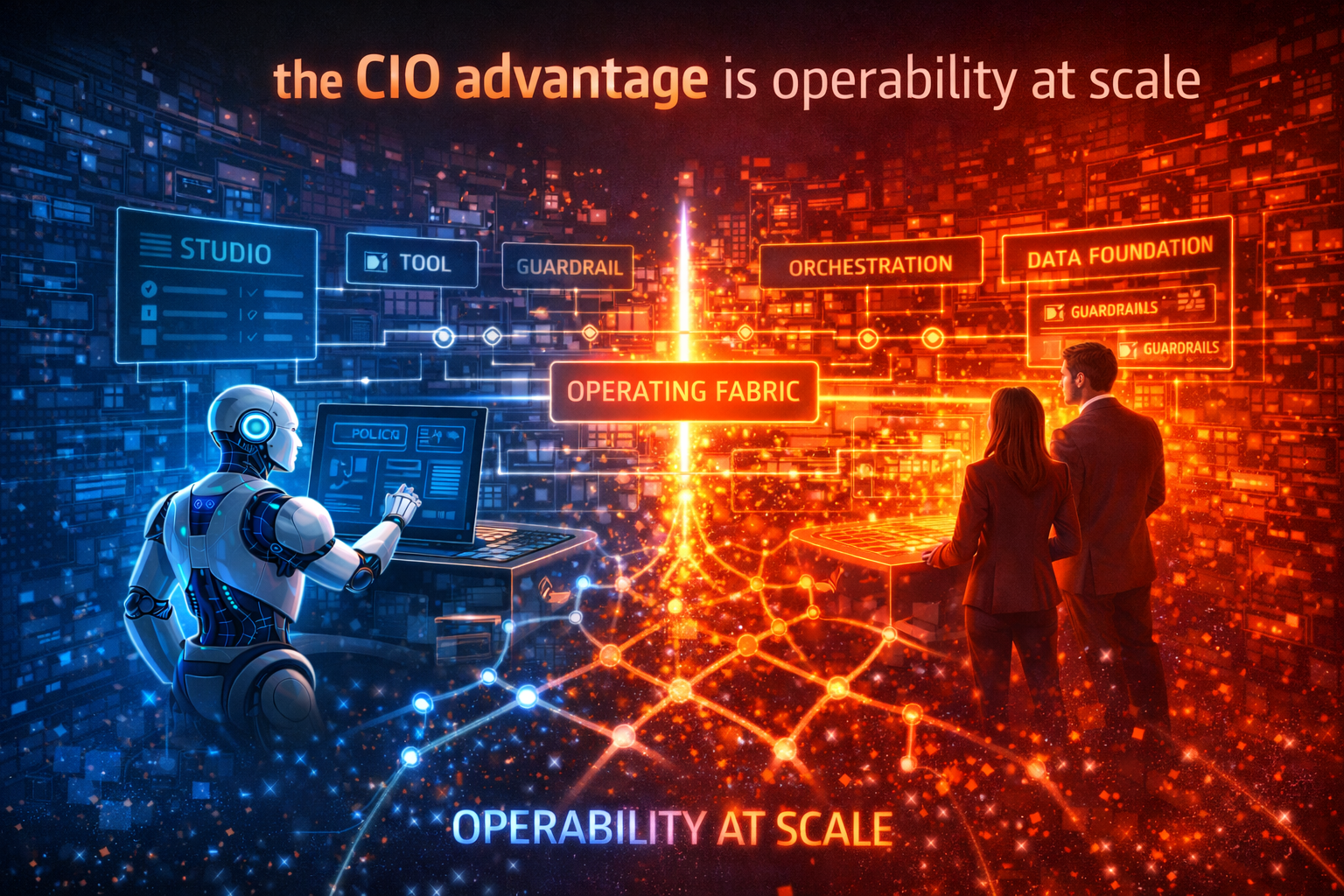
Conclusion: the CIO advantage is operability at scale
The first wave of enterprise AI was judged by how intelligent it looked in demos.
The next wave will be judged by whether it can be operated:
- predictable behavior under real production conditions
- provable governance and evidence trails
- autonomy with recovery pathways
- cost discipline and loop prevention
- reusable services rather than scattered projects
- a workforce model that preserves accountability
- continuous recomposition without disruption
If you can’t stop it, audit it, budget it, and undo it, you can’t run it.
And if you can’t run it safely, you haven’t really built it.
FAQ
What is the Action Threshold in enterprise AI?
The Action Threshold is the point where AI moves from advising humans to taking actions inside enterprise workflows and systems of record—so it must meet production-grade standards of accountability, boundaries, evidence, cost control, and recovery.
Why do pilots succeed but production fails?
Because pilots rarely test operability: identity, permissions, audit trails, rollback, cost envelopes, and cross-system orchestration—yet those become mandatory once AI starts acting.
Do we need a single model to solve this?
No. After the threshold, the hardest problems are operating-model problems: governed execution, observability, recovery, and safe change—regardless of model choice.
Why is this becoming urgent globally?
Because agentic AI is spreading rapidly, and analysts and enterprise leaders are explicitly warning that many initiatives will be canceled unless risk controls and business discipline catch up. (Gartner)
What is the Action Threshold in enterprise AI?
The Action Threshold is the point where AI systems move from advising humans to executing actions inside enterprise systems and workflows.
Why do enterprise AI pilots succeed but fail in production?
Because pilots rarely test operability—identity, permissions, auditability, rollback, cost control, and recovery—which become mandatory once AI acts.
Is the problem caused by poor AI models?
No. Most failures occur due to missing operating controls, not insufficient intelligence.
Why is operability more important than model accuracy?
Because once AI executes work, enterprises must manage outcomes, costs, compliance, and accountability—not just answers.
How does regulation affect enterprise AI execution?
Globally, regulations increasingly emphasize human oversight, auditability, monitoring, and recovery for AI systems that act.
Glossary
- Action Threshold: The moment AI begins executing work (triggering workflows, updating records, approving actions).
- Operability: The ability to run AI predictably with auditability, cost control, safety controls, and recovery.
- Operating fabric: A cohesive set of design-time and runtime capabilities that govern how AI behaves in production under change.
- Studio-to-runtime: Translating design intent into governed production behavior.
- Synergetic workforce: A deliberately engineered model where digital, AI, and human work collaborate with clear escalation and accountability.
- Continuous recomposition: The ability to safely reconfigure workflows, policies, and models without disrupting operations.
References and further reading
Gartner press release on agentic AI project cancellations (June 25, 2025). (Gartner)
- Reuters coverage of Gartner’s forecast and agentic AI adoption metrics (June 25, 2025). (Reuters)
- Microsoft Work Trend Index 2025 (“human-agent ratio,” Frontier Firm). (Microsoft)
- NIST AI Risk Management Framework (AI RMF) overview and AI RMF 1.0 publication. (NIST)
- OpenTelemetry GenAI semantic conventions and metrics (emerging standard for GenAI observability). (OpenTelemetry)
- NIST AI Risk Management Framework
- EU AI Act (Human Oversight & High-Risk Systems)
- Microsoft Work Trend Index (Human–Agent Ratio)
- Gartner research on agentic AI and cost overruns
- OpenTelemetry GenAI observability initiatives
- The AI Platform War Is Over: Why Enterprises Must Build an AI Fabric—Not an Agent Zoo – Raktim Singh
- The Enterprise Model Portfolio: Why LLMs and SLMs Must Be Orchestrated, Not Chosen – Raktim Singh
- Why Enterprises Are Quietly Replacing AI Platforms with an Intelligence Supply Chain – Raktim Singh
- Enterprise AI Runtime: Why Agents Need a Production Kernel to Scale Safely – Raktim Singh
- Why Enterprises Need Services-as-Software for AI: The Integrated Stack That Turns AI Pilots into a Reusable Enterprise Capability – Raktim Singh
- Why Every Enterprise Needs a Model-Prompt-Tool Abstraction Layer (Or Your Agent Platform Will Age in Six Months) – Raktim Singh
- The Enterprise AI Operating Model: How organizations design, govern, and scale intelligence safely – Raktim Singh



Raktim Singh is an AI and deep-tech strategist, TEDx speaker, and author focused on helping enterprises navigate the next era of intelligent systems. With experience spanning AI, fintech, quantum computing, and digital transformation, he simplifies complex technology for leaders and builds frameworks that drive responsible, scalable adoption.