
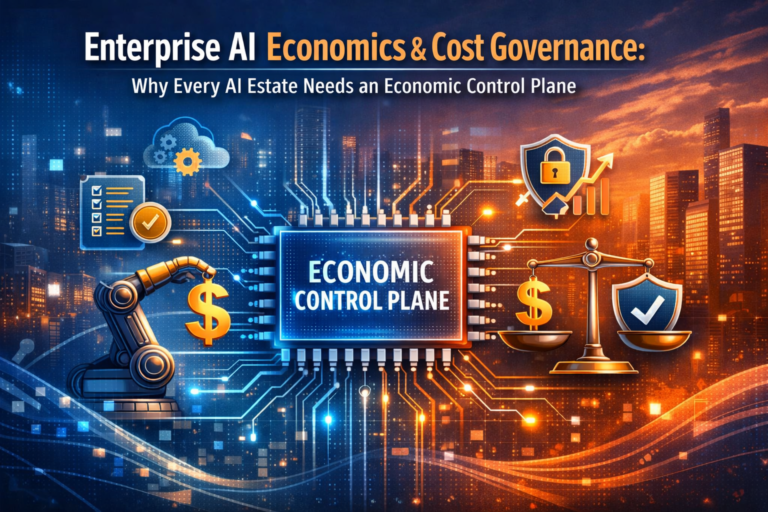
Enterprise AI Economics
Enterprise AI does not fail because models are inaccurate. It fails because cost becomes a behavioral problem once AI systems begin to act inside real workflows.
As organizations move from AI that advises to AI that decides and executes, traditional cloud FinOps approaches break down.
This article introduces Enterprise AI economics and cost governance through the concept of an Economic Control Plane—a runtime layer that enforces spend boundaries, governs escalation, and makes autonomous AI systems economically operable at scale.
Enterprise AI rarely fails because the models are “not smart enough.”
It fails because cost becomes a behavior problem.
In the early phase, leaders treat AI spend like a procurement question:
- Which model provider is cheaper?
- Can we negotiate enterprise pricing?
- Can we reduce token usage by 20%?
Those steps matter—but they don’t touch the real issue.
The real issue appears when AI moves from advising to acting.
The moment an AI system can trigger workflows, call tools and APIs, draft and send messages, update records, approve or reject requests, and coordinate across systems, the economics change. Your AI estate becomes a living system where every decision can multiply into more decisions.
That’s why every enterprise needs an Economic Control Plane: a set of runtime-enforced economic guardrails that keeps AI valuable without allowing it to become financially ungovernable.
This is the missing layer between “AI innovation” and “AI at scale.”
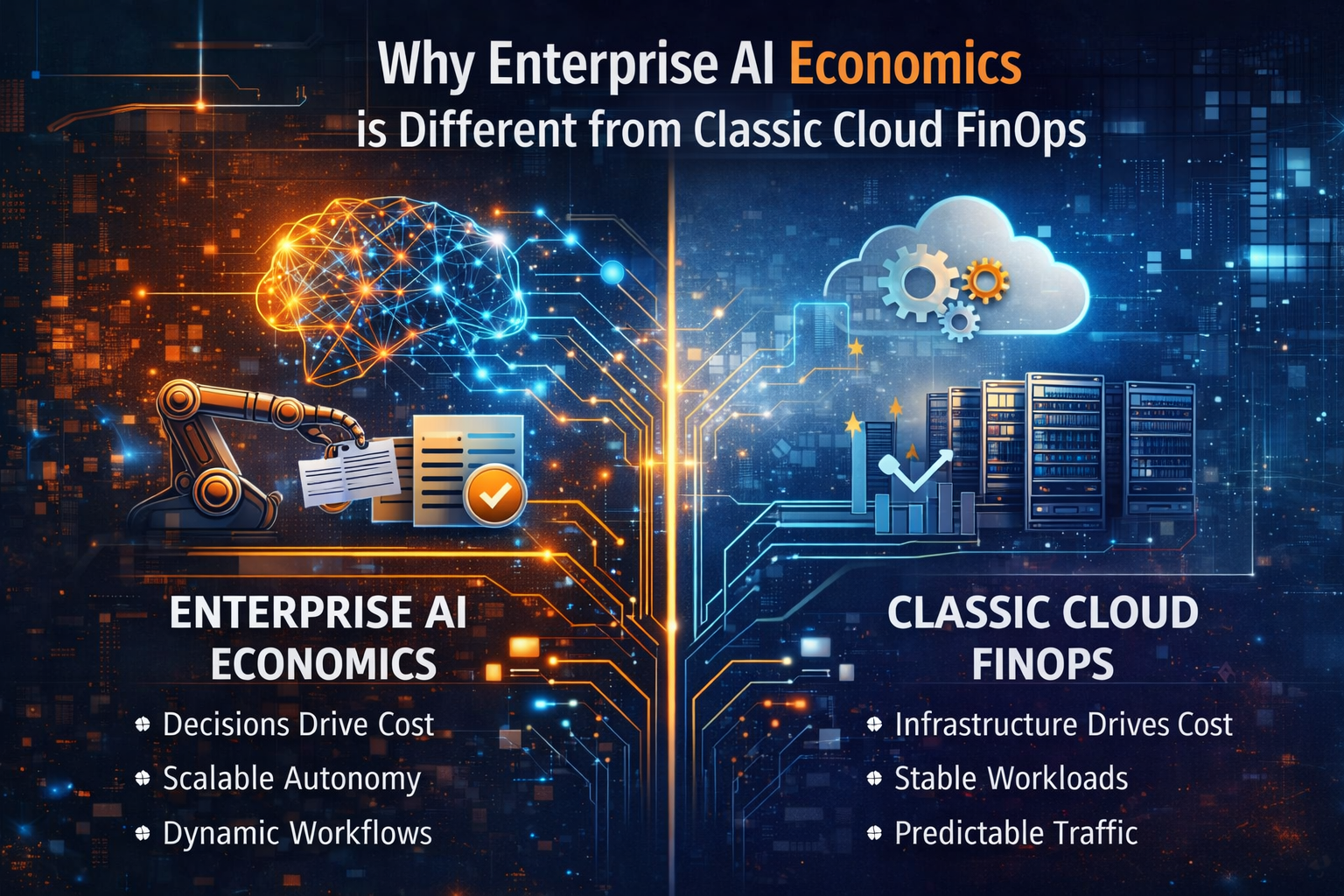
Why Enterprise AI economics is different from classic cloud FinOps
Traditional FinOps works best when workloads are predictable:
- services scale with traffic,
- usage patterns stabilize,
- teams can forecast using historical baselines.
Agentic and workflow AI breaks that assumption.
Because in Enterprise AI, cost is driven by decisions and behavior, not just infrastructure.
A tiny product choice—like letting an assistant “try one more time” or “search one more source”—quietly multiplies:
- retrieval calls,
- tool calls,
- model invocations,
- retries,
- longer context windows,
- additional verification.
This is not a theoretical concern. The FinOps Foundation has explicitly expanded its work to address AI cost drivers and operational practices—because AI introduces new usage patterns and new sources of spend that classic FinOps dashboards miss. (FinOps Foundation)
So the question is no longer:
How do we reduce AI cost?
It becomes:
How do we control AI behavior so that cost stays inside policy—while outcomes improve?
That is economics as governance.
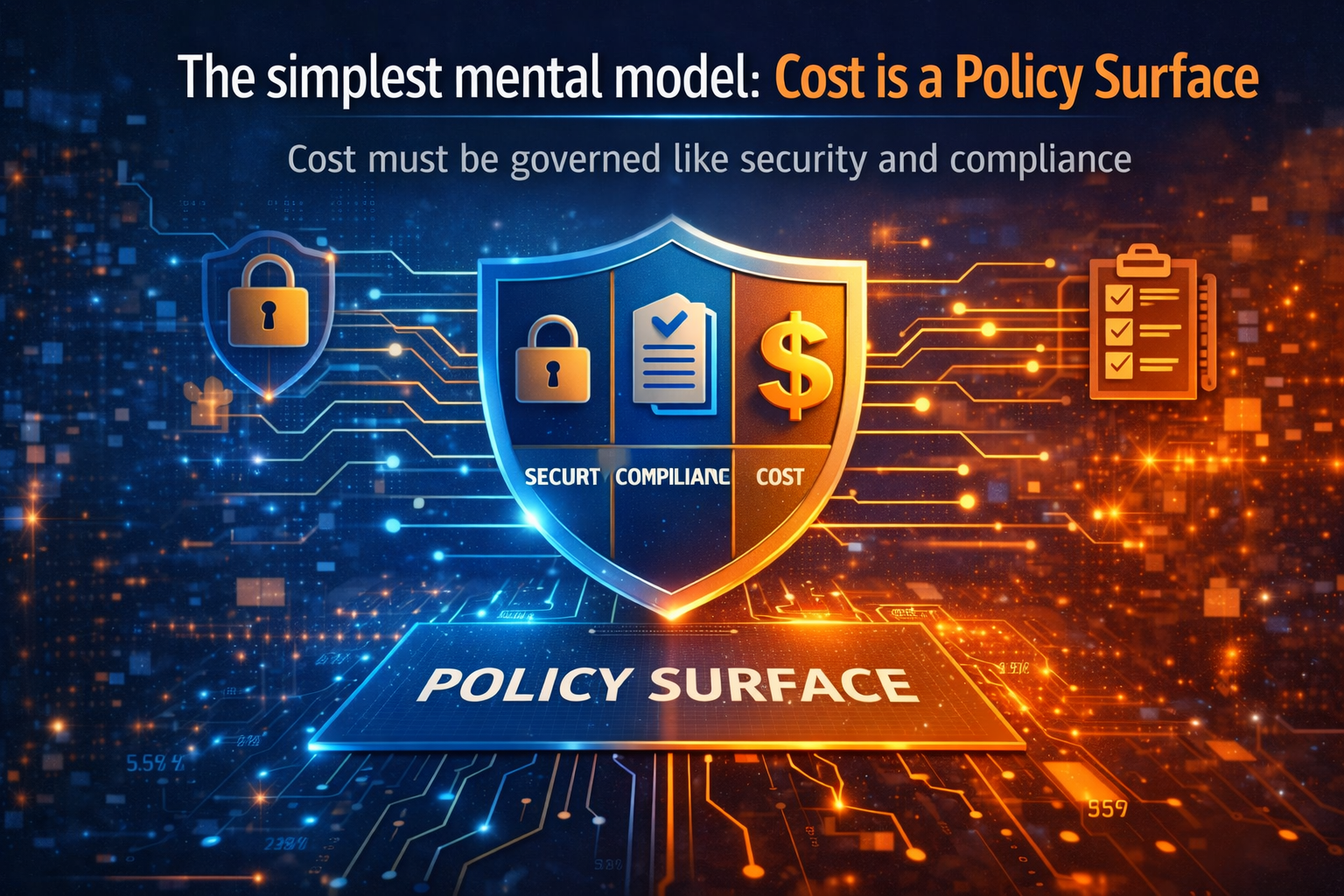
The simplest mental model: cost is a policy surface
Most organizations treat cost as a dashboard.
In Enterprise AI, cost must be treated as a policy surface, like security and compliance.
Why? Because your AI estate will inevitably face these realities.
Reality 1: AI will run in more places than your budget owners can see
A team adds a helpful assistant in an internal tool.
Another team adds AI summarization inside email workflows.
A third team adds an agent to triage IT tickets.
A fourth team adds RAG-based knowledge search to an employee portal.
Each decision makes sense locally. Together, they create a distributed AI estate with invisible spend.
Reality 2: the most expensive failures look like “success”
A workflow agent returns the correct answer—but only after:
- multiple retries,
- extra-long context,
- repeated calls to external tools,
- escalation to larger models.
It “worked.” But the economics are broken.
Reality 3: compliance can directly create cost—and cost can directly create risk
Regulatory expectations increasingly emphasize governance, oversight, and recordkeeping for certain AI uses. For example, the EU AI Act includes obligations around human oversight and log retention for deployers of high-risk AI systems. (AI Act Service Desk)
And NIST’s AI RMF frames AI risk governance as a lifecycle discipline (not a one-time checklist), which has real operational implications. (NIST Publications)
So the right architecture is not “cheaper tokens.”
It is governed economics.
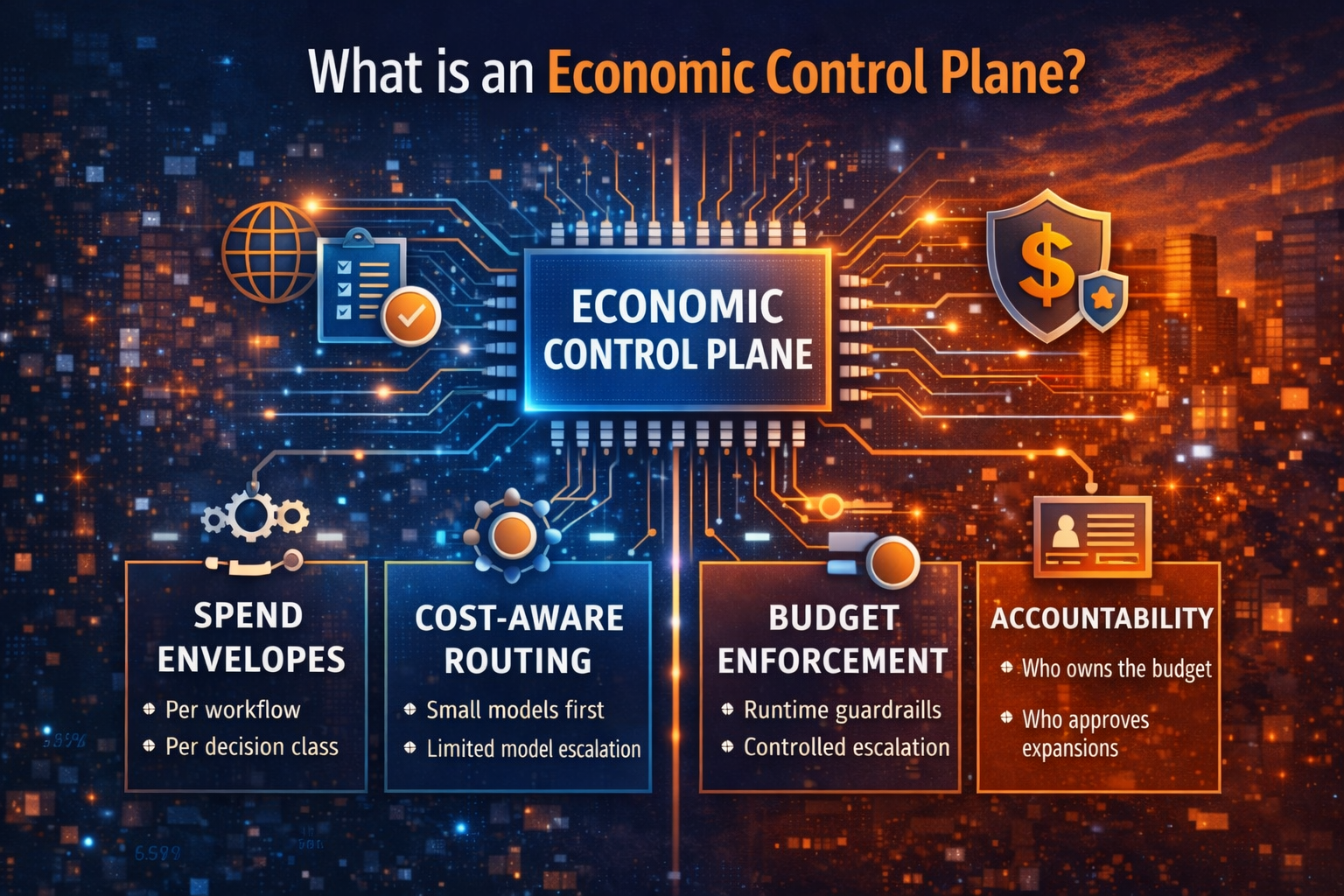
What is an Economic Control Plane?
An Economic Control Plane is the layer that ensures AI systems stay inside approved cost boundaries by design—not by after-the-fact finance reporting.
It does four things continuously:
1) Sets spend envelopes at the right level
- per workflow,
- per decision class,
- per environment (dev/test/prod),
- per business unit,
- per risk tier.
2) Enforces budgets at runtime
- hard caps for runaway behavior,
- soft limits with graceful degradation,
- escalation only when policy permits it.
3) Routes intelligently based on cost-to-value
- small model first,
- escalate only when needed,
- retrieval depth adjusts based on decision criticality.
4) Creates accountability
- who owns the budget,
- who approves expansions,
- who is paged when anomalies happen.
This is the enterprise-grade extension of what FinOps for AI efforts are pointing toward: treating AI cost as something you operate, not something you merely report. (FinOps Foundation)
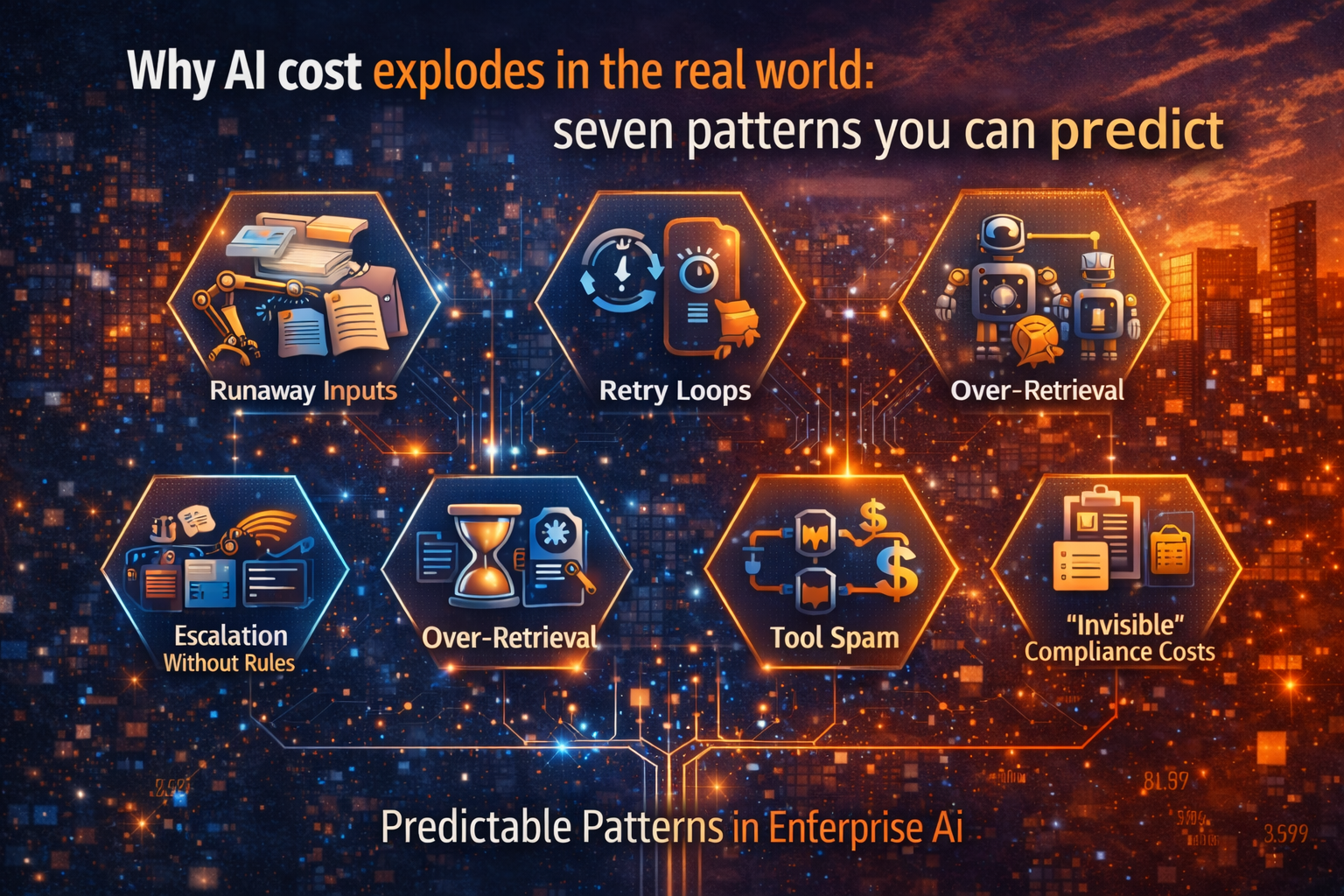
Why AI cost explodes in the real world: seven patterns you can predict
Why AI cost explodes in the real world: seven patterns you can predict
These cost blowups happen across industries and regions—US, EU, UK, India, APAC, and the Middle East—because the mechanics are universal.
1) Runaway inputs
Someone pastes a massive document into a chat tool.
A system feeds an entire record history to the agent.
Retrieval pulls huge context blobs.
Without input and context controls, you get surprise spend.
2) Retry loops disguised as “quality”
An agent is allowed to “try again” whenever uncertain.
It runs tool calls until it “feels confident.”
This is not quality. It is unpriced persistence.
3) Over-retrieval
A RAG flow retrieves too many sources “just in case.”
The model receives too much context, runs longer, costs more—and may even perform worse.
4) Escalation without rules
The system jumps to the biggest model for routine tasks because nobody defined:
- which tasks qualify for escalation,
- what triggers escalation,
- when escalation is disallowed.
5) Tool spam
Agents call expensive APIs—search, enrichment, third-party data—like they’re free.
Without tool-level budgets and allowlists, external spend stays hidden until invoices arrive.
6) “Invisible” governance and compliance costs
Logs, retention, oversight processes, audit readiness—these become recurring operational costs once you are in regulated scope. The EU AI Act explicitly connects deployer duties with log retention and oversight for high-risk systems. (Artificial Intelligence Act)
7) Shadow AI proliferation
Teams use unsanctioned tools because they’re fast.
Now you have cost and risk—without governance.
NIST AI RMF’s governance emphasis is exactly what shadow deployments undermine. (NIST Publications)

Three simple examples of an Economic Control Plane in action
No math. No complexity. Just practical clarity.
Example A: IT ticket triage agent
Without an Economic Control Plane:
The agent reads long tickets, summarizes, searches internal docs, drafts a response, retries when uncertain, escalates to bigger models, and logs everything. It looks helpful—and quietly becomes a top cost center.
With an Economic Control Plane:
- routine tickets: small model + limited retrieval,
- escalation only for predefined high-impact classes,
- when budget boundary is reached: graceful degradation (summary only) and route to a human queue.
Outcome: reliability with cost predictability.
Example B: Procurement approval assistant
Without an Economic Control Plane:
It tries to be “thorough,” pulls extra documents, repeats checks, escalates for confidence.
With an Economic Control Plane:
- fixed “decision budget” for that workflow class,
- deep checks require explicit human approval to spend more (and the reason is recorded).
Outcome: cost becomes a conscious governance decision—not an accident.
Example C: Employee knowledge search (RAG)
Without an Economic Control Plane:
Every query triggers deep retrieval, long context, long answers.
With an Economic Control Plane:
- default: shallow retrieval + short answer,
- “deep analysis” is a higher tier and visibly labeled,
- sensitive repositories enforce stricter budgets and access.
Outcome: cheaper by default, better when necessary.
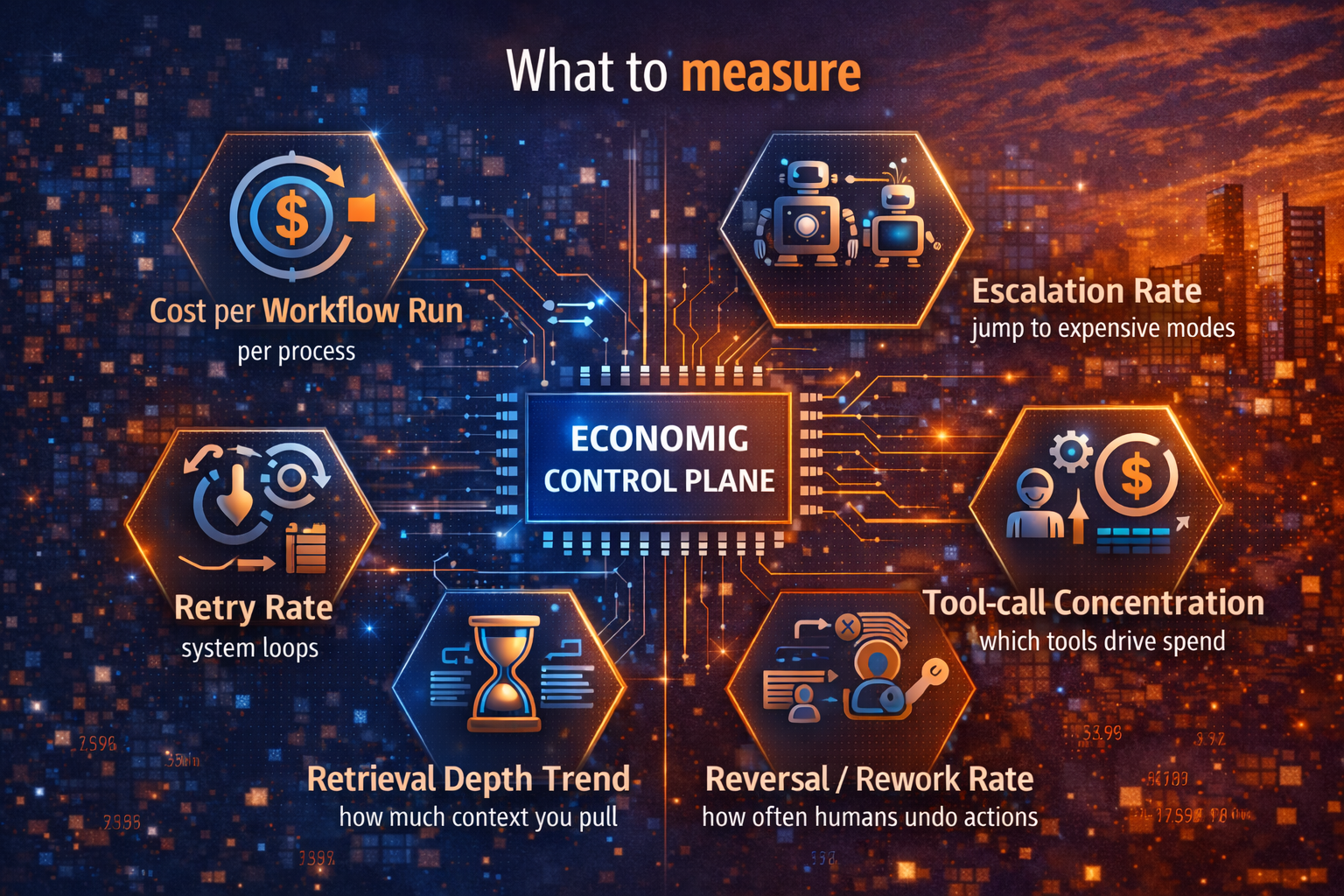
What to measure (without drowning in dashboards)
The goal isn’t more dashboards.
The goal is economic observability that matches how AI behaves.
Track a small set of decision-centric signals:
- cost per workflow run,
- cost per successful completion (not per model call),
- escalation rate,
- retry rate,
- retrieval depth trend,
- tool-call concentration,
- reversal/rework rate (how often humans undo actions).
FinOps for AI guidance stresses aligning cost tracking to AI-specific usage patterns and operational reality. (FinOps Foundation)

The Economic Guardrails every AI estate should enforce
Think of these as the default seatbelts for Enterprise AI.
1) Per-run ceilings
Hard caps that prevent runaway context and “infinite retries.” These control-plane practices are consistent with FinOps guidance on matching AI approaches and infrastructure choices to operational maturity and outcomes. (FinOps Foundation)
2) Tiered modes (cheap-by-default)
Default behavior should be economical:
- short answer,
- minimal retrieval,
- limited tool calls,
- restricted escalation.
Premium behavior should be explicit:
- deeper retrieval,
- richer reasoning,
- larger models,
- more verification.
3) Escalation rules
Escalation must be tied to:
- decision class,
- impact,
- risk,
- audit requirements.
4) Tool-call budgets
Every external tool/API needs:
- allowlists,
- budgets,
- rate limits,
- fallback modes.
5) Stop conditions
If the agent cannot reach acceptable confidence within budget, it must stop and route.
This prevents the most common silent leak: “trying harder forever.”
6) Economic anomaly alerts
Not just “cost is up,” but:
- retries doubled,
- retrieval depth spiked,
- escalations jumped,
- tool usage shifted.
That’s the difference between reporting and control.
Why this matters globally
Across regions, the pattern is consistent:
- Boards want predictability.
- CIOs/CTOs want speed and scale.
- Regulators want oversight, accountability, and traceability.
EU AI Act provisions emphasize human oversight and operational duties like retaining logs for high-risk systems. (AI Act Service Desk)
NIST AI RMF frames AI governance as ongoing lifecycle practice, not a one-off compliance event. (NIST Publications)
An Economic Control Plane becomes the bridge between:
- innovation and predictability,
- autonomy and accountability,
- scale and sustainability.
A practical 30-day implementation plan
Week 1: Map the AI estate (quick and honest)
- list AI systems in production and near-production,
- identify the workflows they touch,
- identify who owns each workflow outcome.
Week 2: Define decision classes and spend envelopes
- classify workflows by impact and risk,
- assign default envelopes by class,
- define escalation rules.
Week 3: Enforce runtime guardrails
- add per-run ceilings,
- add tiered modes,
- add stop conditions,
- add tool budgets.
Week 4: Put economics into operating rhythm
- weekly review of economic anomalies,
- budget changes require explicit approval + reason,
- set accountability: who is paged, who signs off.
Enterprise AI Operating Model
This article is not a “cost optimization” post.
Because Enterprise AI scale requires four interlocking planes:
Read about Enterprise AI Operating Model The Enterprise AI Operating Model: How organizations design, govern, and scale intelligence safely – Raktim Singh
Read about The Intelligence Reuse Index The Intelligence Reuse Index: Why Enterprise AI Advantage Has Shifted from Models to Reuse – Raktim Singh
Read about The Enterprise AI Runbook Crisis The Enterprise AI Runbook Crisis: Why Model Churn Is Breaking Production AI—and What CIOs Must Fix in the Next 12 Months – Raktim Singh
Read about Who Owns Enterprise AI Who Owns Enterprise AI? Roles, Accountability, and Decision Rights in 2026 – Raktim Singh
Economic governance is how you prevent “AI success” from turning into “budget failure.”
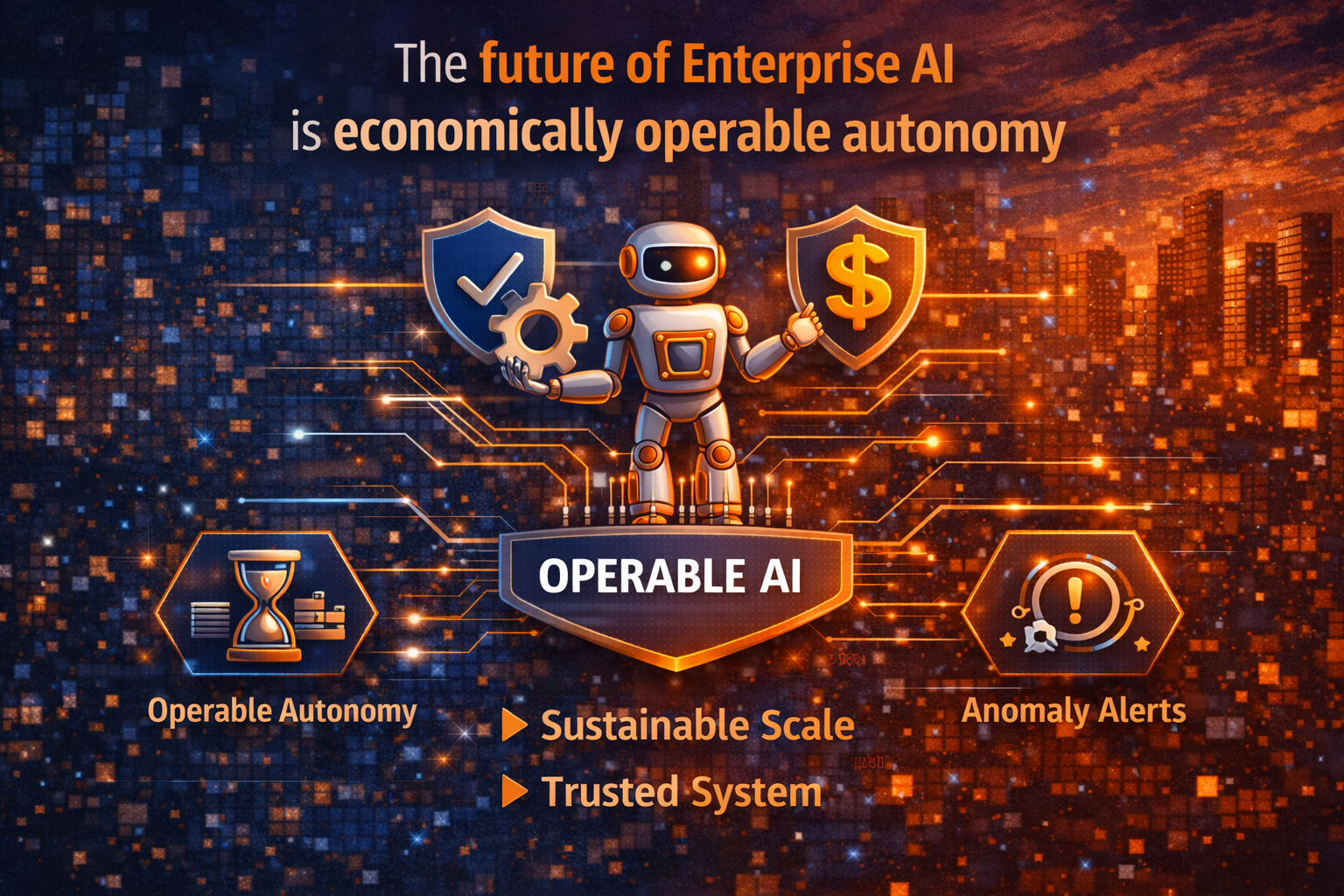
Conclusion: The future of Enterprise AI is economically operable autonomy
The next competitive advantage is not “more AI.”
It is AI you can afford to run—predictably—at scale.
Enterprises that treat cost as a dashboard will keep discovering “surprise AI invoices,” runaway agents, and invisible spend.
Enterprises that treat cost as a policy surface—and implement an Economic Control Plane—will do something rarer:
They will make autonomy operable.
They will make scale sustainable.
They will turn AI from experiments into an economic system that the enterprise can trust.
And that is the difference between an AI pilot culture and a true Enterprise AI estate.
Institutional Perspectives on Enterprise AI
Many of the structural ideas discussed here — intelligence-native operating models, control planes, decision integrity, and accountable autonomy — have also been explored in my institutional perspectives published via Infosys’ Emerging Technology Solutions platform.
For readers seeking deeper operational detail, I have written extensively on:
- What Makes an Enterprise Intelligence-Native? The Blueprint for Third-Order AI Advantage
https://blogs.infosys.com/emerging-technology-solutions/artificial-intelligence/what-is-enterprise-ai-the-operating-model-for-compounding-institutional-intelligence.html - Why “AI in the Enterprise” Is Not Enterprise AI: The Operating Model Difference Most Organizations Miss
https://blogs.infosys.com/emerging-technology-solutions/artificial-intelligence/why-ai-in-the-enterprise-is-not-enterprise-ai-the-operating-model-difference-that-most-organizations-miss.html - The Enterprise AI Control Plane: Governing Autonomy at Scale
https://blogs.infosys.com/emerging-technology-solutions/artificial-intelligence/the-enterprise-ai-control-plane-governing-autonomy-at-scale.html - Enterprise AI Ownership Framework: Who Is Accountable, Who Decides, and Who Stops AI in Production
https://blogs.infosys.com/emerging-technology-solutions/artificial-intelligence/enterprise-ai-ownership-framework-who-is-accountable-who-decides-and-who-stops-ai-in-production.html - Decision Integrity: Why Model Accuracy Is Not Enough in Enterprise AI
https://blogs.infosys.com/emerging-technology-solutions/artificial-intelligence/decision-integrity-why-model-accuracy-is-not-enough-in-enterprise-ai.html - Agent Incident Response Playbook: Operating Autonomous AI Systems Safely at Enterprise Scale
https://blogs.infosys.com/emerging-technology-solutions/artificial-intelligence/agent-incident-response-playbook-operating-autonomous-ai-systems-safely-at-enterprise-scale.html - The Economics of Enterprise AI: Designing Cost, Control, and Value as One System
https://blogs.infosys.com/emerging-technology-solutions/artificial-intelligence/the-economics-of-enterprise-ai-designing-cost-control-and-value-as-one-system.html
Together, these perspectives outline a unified view: Enterprise AI is not a collection of tools. It is a governed operating system for institutional intelligence — where economics, accountability, control, and decision integrity function as a coherent architecture.
FAQ
What is an Economic Control Plane in Enterprise AI?
A runtime layer that sets and enforces AI spend boundaries per workflow and decision class—so AI remains scalable and economically predictable.
Is this just FinOps for AI?
FinOps is necessary but not sufficient. An Economic Control Plane turns cost from reporting into runtime governance—guardrails, tiered modes, escalation rules, and stop conditions. (FinOps Foundation)
Why do AI costs spike after pilots succeed?
Pilots run in controlled conditions. At scale, real-world inputs, retries, deeper retrieval, and uncontrolled escalation multiply behavior and spend.
How can I reduce cost without hurting quality?
Make “cheap-by-default” the standard and escalate only when impact/risk justifies it. Track retries, escalation rate, and retrieval depth—not just monthly spend.
Do regulations increase AI operating costs?
Often yes. Oversight and logging requirements can create ongoing operational obligations, especially for higher-risk deployments. (AI Act Service Desk)
Glossary
- Economic Control Plane: Runtime-enforced cost governance for AI systems.
- Spend Envelope: A policy-defined budget boundary for a workflow or decision class.
- Tiered Modes: Default economical behavior with explicit escalation to higher-cost behavior.
- Escalation Rules: Policies controlling when the system may use more expensive models/tools.
- Stop Condition: A rule that forces halt-and-route when budget or constraints are hit.
- Tool-call Budget: Limits and allowlists for external APIs/tools agents use.
- Economic Anomaly: A behavioral shift (retries, retrieval depth, escalation spikes) that predicts spend blowouts.
- AI Estate: The full set of AI systems running across the enterprise (apps, agents, copilots, RAG systems, workflows).
References and further reading
- FinOps Foundation — FinOps for AI (overview/topic pages and working group resources). (FinOps Foundation)
- NIST — AI Risk Management Framework (AI RMF 1.0) and supporting materials. (NIST Publications)
- EU AI Act — human oversight and deployer obligations (including log retention for high-risk systems). (AI Act Service Desk)
- ISO/IEC 42001 — AI management system standard (AI governance management system framing). (ISO)



Raktim Singh is an AI and deep-tech strategist, TEDx speaker, and author focused on helping enterprises navigate the next era of intelligent systems. With experience spanning AI, fintech, quantum computing, and digital transformation, he simplifies complex technology for leaders and builds frameworks that drive responsible, scalable adoption.