
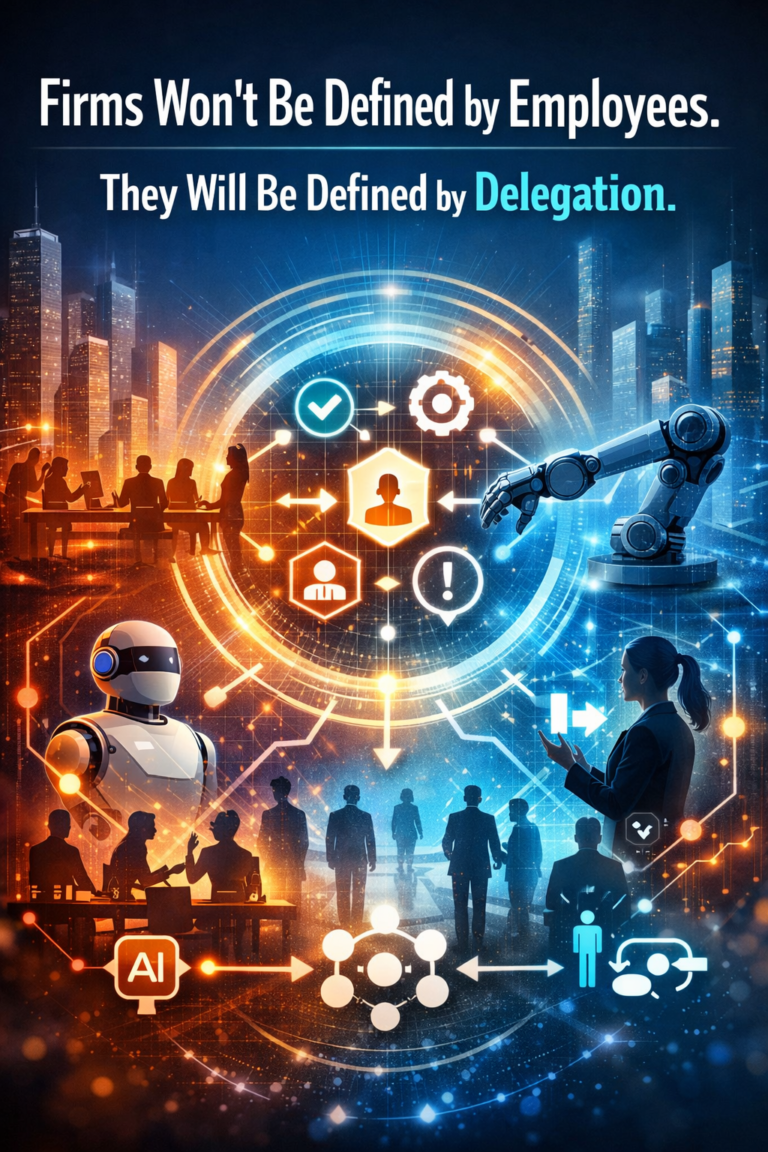
The old question of the firm is back
For almost a century, business theory has asked a foundational question: Why do firms exist at all?
Ronald Coase’s classic answer was that firms emerge when using markets for every task is too costly. Contracts are expensive to negotiate, monitor, and enforce repeatedly, so companies internalize work instead. In that view, the boundary of the firm is shaped by transaction costs: what is cheaper to manage inside a hierarchy than to coordinate through the market. (Encyclopedia Britannica)
That logic still matters. But AI is changing the terms of the question.
Because the next generation of firms will not simply be built around labor, assets, or contracts. They will be built around something more subtle and more powerful:
delegation.
Not delegation as a soft management skill. Delegation as an operating principle. Delegation as architecture. Delegation as the new boundary of the firm.
That is the shift leaders are beginning to feel but have not yet fully named.
For years, the enterprise AI conversation has centered on models, copilots, productivity, and automation. Stanford HAI’s 2025 AI Index shows AI becoming more embedded in business and society, with adoption, investment, and governance attention continuing to deepen. The World Economic Forum’s recent work similarly argues that the central challenge is no longer whether AI works, but how organizations redesign workflows, operating models, and governance to capture value from it. (Stanford HAI)
That is exactly why the firm must now be re-examined.
Because once intelligence becomes abundant, the scarcer capability is no longer simply deciding. It is deciding who or what gets to decide, act, commit, escalate, or reverse action on behalf of the institution.
That is the real frontier.
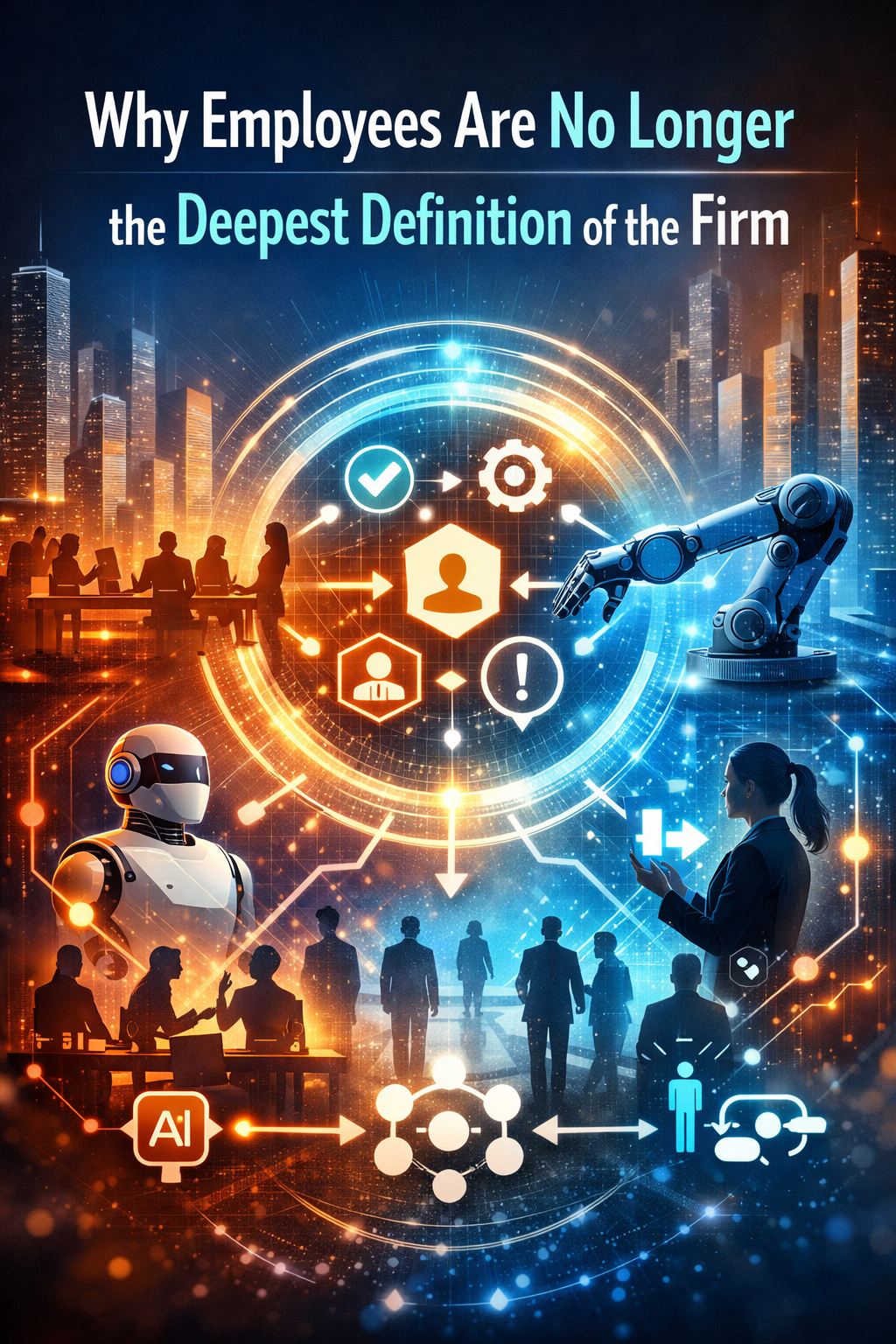
Why employees are no longer the deepest definition of the firm
For most of industrial and corporate history, firms were organized around people.
Who works here?
Who reports to whom?
Who signs?
Who approves?
Who owns the customer?
Who touches the process?
These questions made sense because work was inseparable from human labor and human supervision. Even software systems were mostly passive tools. They stored, displayed, calculated, and routed. They did not independently search for options, negotiate terms, prioritize trade-offs, escalate risk, or trigger downstream action.
AI changes that.
A modern enterprise may now rely on systems that summarize evidence, recommend actions, initiate workflows, negotiate simple terms, detect anomalies, update priorities, and trigger operations across many layers of the business. In some cases, those systems may coordinate with other systems before a human ever intervenes.
The result is a subtle but profound shift: firms are no longer defined only by who they employ. They are increasingly defined by what they can safely authorize across a network of humans, software, agents, partners, and machines.
Think about a bank.
In the old model, the firm boundary was visible in employees, branches, call centers, systems, and outsourced vendors. In the emerging model, the true boundary is defined by delegation:
- What can an AI system pre-approve?
- What can a relationship manager override?
- What can a fraud engine block?
- What can a partner ecosystem initiate?
- What must be escalated to a human?
- What can be reversed later if found to be wrong?
That is a different conception of the firm.
The same applies in healthcare, logistics, retail, insurance, public services, and manufacturing. The firm is becoming less like a container of people and more like a structured delegation system.
In simple terms:
A Delegation Corporation is a firm defined not by its employees, but by what it can safely authorize others—human or machine—to do on its behalf.
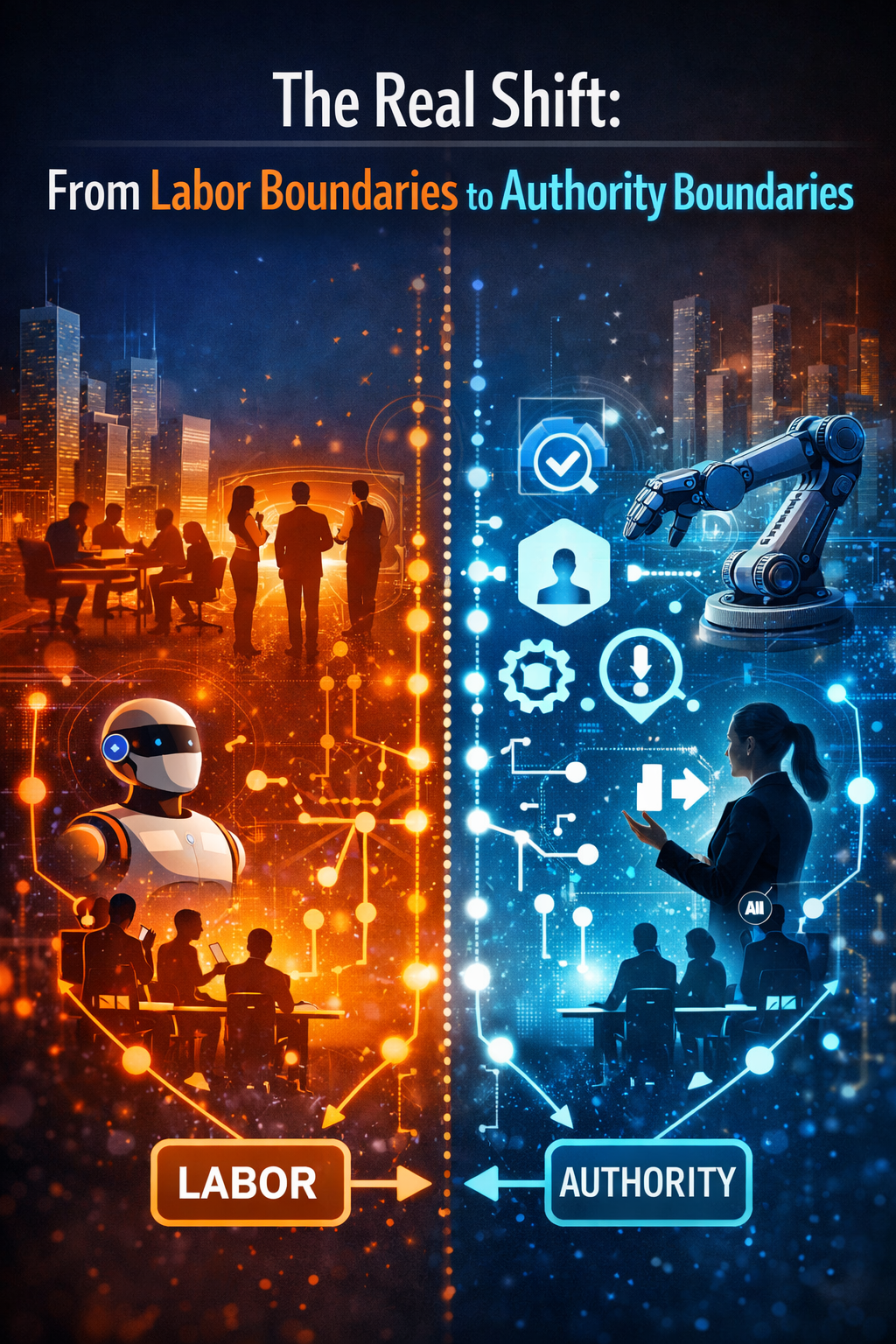
The real shift: from labor boundaries to authority boundaries
This is the central claim:
In the AI era, the boundary of the firm will be defined less by who works inside it and more by who—or what—it can trust to act on its behalf.
That does not mean employees stop mattering. It means employees are no longer the cleanest map of institutional capability.
A simple example makes this easier to see.
Imagine an airline disruption.
A storm causes cascading delays. One system detects weather risk. Another forecasts gate congestion. Another reprices rebooking options. A customer-facing assistant proposes alternatives. A crew-planning tool reshuffles assignments. A loyalty engine decides what compensation can be offered. A human supervisor steps in only when thresholds are breached.
Where is the “firm” in that moment?
Not just in the employees.
Not just in the software.
Not just in the org chart.
The firm exists in the delegation logic that defines:
- what each layer is allowed to do,
- what evidence it must use,
- what risk thresholds apply,
- when human judgment is required,
- and how bad decisions can be unwound.
This is why I believe the next generation of companies will increasingly look like Delegation Corporations.
Their defining advantage will not merely be intelligence. It will be the quality of their delegation design.
What is a Delegation Corporation?
A Delegation Corporation is an organization whose true operating boundary is defined by a structured map of delegated authority—what can be seen, decided, and executed by humans and machines under governed control.
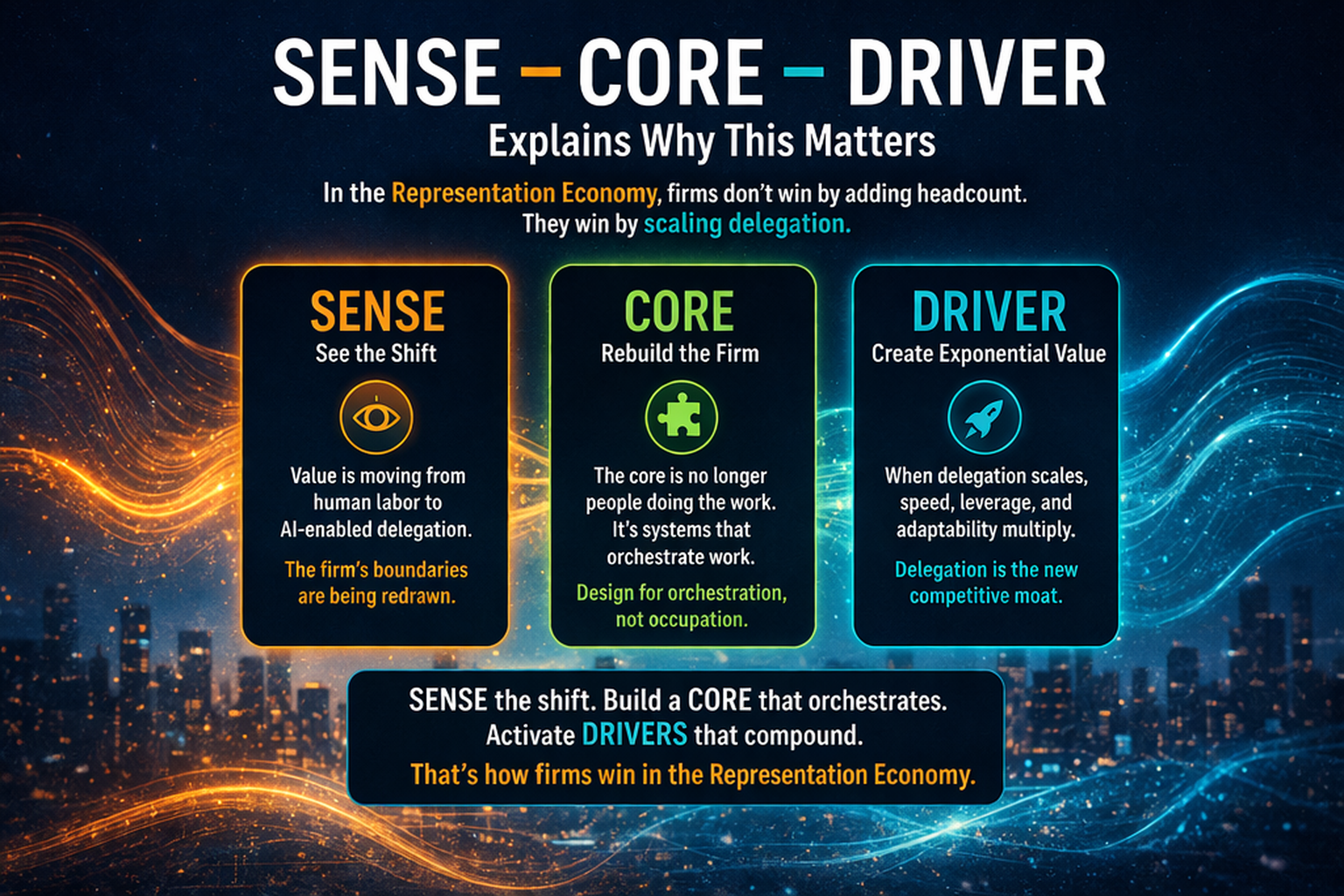
SENSE–CORE–DRIVER explains why this matters
This is where the broader framework becomes essential.
The shift from employee-defined firms to delegation-defined firms only makes sense when we separate three layers.
SENSE: what the firm can see
A firm cannot delegate safely if it cannot represent reality clearly. Signals must be captured, tied to the right entity, converted into state, and updated over time. If the system cannot reliably see the customer, asset, event, risk, or exception, then delegation becomes blind. Stanford HAI’s 2025 work reinforces this broader shift toward responsible deployment and stronger data, governance, and institutional foundations. (Stanford HAI)
CORE: what the firm can decide
Once reality is represented, the firm must interpret, compare, optimize, and reason. This is where most AI investment has gone. Models, copilots, reasoning engines, ranking systems, and policy-aware analytics all live here.
DRIVER: what the firm can authorize to act
This is the most neglected layer. It governs delegation, verification, execution, and recourse. It asks:
- Who authorized the action?
- Under what limits?
- With what identity?
- Using what representation?
- With what checks?
- With what path back if the system was wrong?
That final layer is where the new boundary of the firm actually lives.
Because a firm is not just what it can think.
A firm is what it can legitimately delegate.
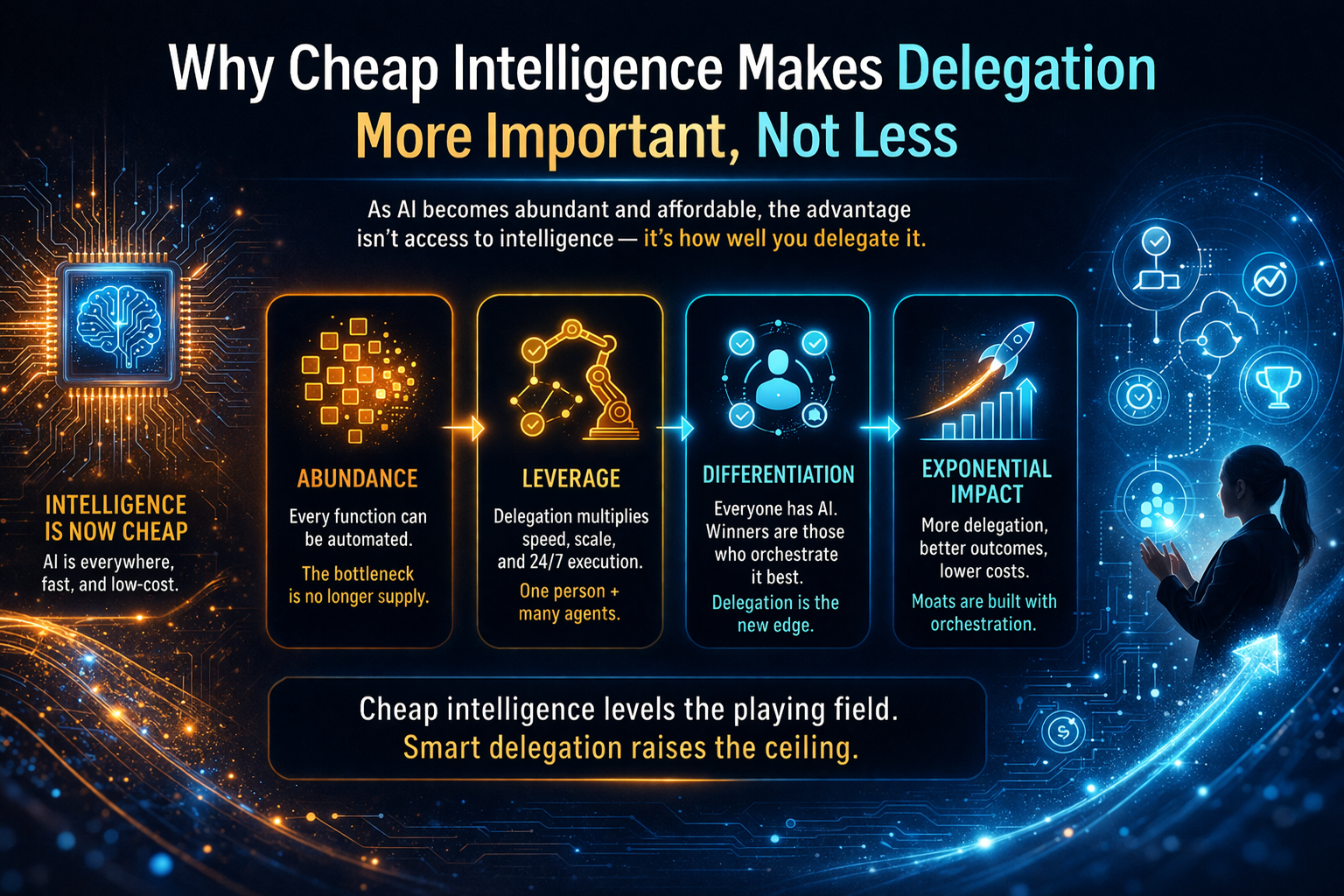
Why cheap intelligence makes delegation more important, not less
Many leaders assume that as AI gets better, the firm will simply automate more. That is too shallow.
As intelligence gets cheaper and more widely available, the bottleneck shifts.
It is no longer, “Can the system produce an answer?”
It becomes:
- Can the system be trusted to act?
- Can that action be bounded?
- Can responsibility be assigned?
- Can exceptions be escalated?
- Can mistakes be corrected?
Recent global management discussions increasingly point in this direction. The World Economic Forum argues that to capture AI’s value, organizations must redesign work, governance, and operating models, not just deploy tools. Its recent workforce and transformation publications make the same point: AI creates value only when institutions deliberately redesign how authority, workflows, and accountability work. (World Economic Forum)
This is the paradox of the AI era:
The cheaper intelligence becomes, the more valuable delegation design becomes.
Why? Because once many firms can access similar models, the real differentiator is not model access. It is how safely, clearly, and reversibly they can distribute decision rights across humans and machines.
In other words, coordination may get cheaper, but delegation becomes more strategic.
The Delegation Corporation
So what is a Delegation Corporation?
It is a firm whose operating boundary is defined not primarily by headcount, but by a structured map of delegated authority.
It knows, explicitly:
- what machines may decide,
- what humans must retain,
- what partners may trigger,
- what actions require dual control,
- what can proceed automatically,
- and what always needs recourse.
A Delegation Corporation treats authority the way earlier firms treated labor allocation or capital budgeting: as a design problem.
This matters because many enterprises today are still delegating by accident.
A chatbot gets too much freedom because nobody defined a boundary.
A risk engine gets overridden informally with no audit trail.
A procurement bot negotiates, but nobody is sure what limits apply.
A benefits system rejects a case that should have been escalated.
A healthcare assistant recommends action outside its appropriate scope.
These are not just technical failures.
They are delegation failures.
The Delegation Corporation avoids this by making authority legible.
It builds:
- permission layers,
- role-bound execution rights,
- action thresholds,
- approval hierarchies,
- reversible workflows,
- exception routing,
- identity-bound accountability,
- and recourse paths.
This is not bureaucracy.
It is the new architecture of the firm.
How industries will change
This idea is easier to understand through examples.
Banking
A bank of the AI era will not merely ask, “What can AI detect?” It will ask, “What can AI pre-approve, what can it price, what can it block, what can it escalate, and what must remain under accountable human authority?” The strongest bank may not be the one with the smartest model, but the one with the best delegation architecture.
Healthcare
Hospitals will not survive by automating everything. They will win by designing what triage can be delegated, what monitoring can be delegated, what escalation must happen automatically, and what final judgment must remain human, documented, and reversible.
Logistics
In supply chains, systems may dynamically reroute shipments, allocate inventory, flag disruptions, and rebalance flows. But the real question becomes: what can the network delegate autonomously without creating hidden downstream risk?
Retail and consumer markets
As machine-mediated demand rises, firms will increasingly face not just human customers but agents acting on behalf of customers. Competitive advantage will depend on what the firm can delegate to pricing engines, recommendation layers, negotiation protocols, and loyalty systems—without losing trust or control.
Across all these sectors, the pattern is the same:
The firm boundary is moving from employment structure to authority structure.
What boards and CEOs should ask now
This is not just an architecture issue for technologists.
It is a strategy issue for boards.
The questions leaders must ask are changing.
Not only:
- How many people do we employ?
- Which functions are outsourced?
- Which systems do we own?
But also:
- What decisions are currently being delegated informally?
- Which actions should never be automated?
- Where is delegated authority unclear?
- What representations does delegated action depend on?
- What can be reversed, and what cannot?
- Which decisions create moral, legal, or reputational residue if wrong?
- Where does responsibility stay human even when intelligence is machine-assisted?
These are not compliance questions at the edge.
They are now central questions of institutional design.
Because the firms that win will not be those that automate the most.
They will be those that delegate the best.
The bigger idea behind the shift
Every era changes what defines a firm.
In the industrial era, firms were defined by physical assets, factories, and labor organization.
In the digital era, firms were defined by software, networks, and platforms.
In the AI era, firms will increasingly be defined by delegation architecture.
That is why this shift matters so much for the Representation Economy.
If SENSE determines what reality the institution can see, and CORE determines how it can reason, then DRIVER determines what the institution can actually become.
The firm of the AI era will not simply be a place where humans work with software.
It will be a governed system that decides:
- what reality is visible,
- what judgment is machine-assisted,
- what authority is delegated,
- and what recourse exists when action goes wrong.
That is the true redesign underway.
And it leads to a provocative but increasingly useful statement:
Firms won’t be defined by employees. They will be defined by delegation.
Not because people stop mattering.
But because authority, not headcount, will increasingly determine how institutions scale intelligence into action.
Conclusion
The next great firms of the AI era may not be remembered primarily for the models they used.
They may be remembered for something more foundational:
They designed institutions that knew what could be seen, what could be decided, and what could be safely delegated.
That is the deeper shift behind AI.
The question is no longer only how smart the system is.
The question is what the institution is willing—and able—to let the system do on its behalf.
That is where the new boundary of the firm is being drawn.
And in the coming decade, the organizations that understand this earliest will not just deploy AI more effectively.
They will redefine what a firm is.
Glossary
Delegation Corporation
A firm whose true operating boundary is defined by a structured map of delegated authority across humans, software, agents, partners, and machines.
Representation Economy
An economic system in which value increasingly depends on how well institutions represent reality, reason over it, and act on it with legitimacy.
Delegation architecture
The design of rules, permissions, thresholds, workflows, and recourse mechanisms that determine what can be delegated, to whom, and under what limits.
SENSE
The legibility layer: Signal, ENtity, State representation, Evolution.
CORE
The cognition layer: Comprehend context, Optimize decisions, Realize action, Evolve through feedback.
DRIVER
The legitimacy layer: Delegation, Representation, Identity, Verification, Execution, Recourse.
Authority boundary
The practical edge of what a firm is willing and able to authorize on its behalf.
Recourse
The path through which delegated actions can be challenged, reversed, corrected, or appealed.
Institutional legibility
The degree to which an institution can clearly represent its entities, rules, and changing states in a form machines can use responsibly.
FAQ
What is a Delegation Corporation?
A Delegation Corporation is a firm whose operating boundary is defined less by headcount and more by what it can safely authorize others—human or machine—to do on its behalf.
Why are employees no longer the deepest definition of the firm?
Because AI systems increasingly participate in recommendation, workflow initiation, coordination, and action. As that happens, the critical question shifts from who works here to what the institution can safely delegate.
What does this have to do with AI?
AI lowers the cost of cognition and coordination. That makes the design of authority, verification, execution, and recourse more important than before.
How does SENSE–CORE–DRIVER connect to this idea?
SENSE determines what the firm can see. CORE determines what it can decide. DRIVER determines what it can legitimately authorize to act.
Why should boards care?
Because the next decade of competitive advantage may depend less on model selection and more on whether the institution has a safe, clear, defensible delegation architecture.
How is AI changing the boundary of the firm?
AI reduces coordination costs and increases automation, shifting the firm’s boundary from labor structures to authority and delegation structures.
Why is delegation becoming more important in AI?
Because intelligence is becoming abundant, but trust, control, and governed execution remain scarce and valuable.
What is delegation architecture?
It is the system of rules, permissions, workflows, and controls that determine what decisions and actions can be delegated within an organization.
How does this relate to enterprise AI strategy?
The next generation of AI strategy will focus not only on models but on how organizations design safe, scalable delegation across humans and machines.
References and further reading
To ground the argument and improve GEO credibility, add a short references section at the end of the article.
- Ronald Coase and the theory of the firm / transaction costs. (Encyclopedia Britannica)
- Stanford HAI, 2025 AI Index Report. (Stanford HAI)
- World Economic Forum, Organizational Transformation in the Age of AI and related AI workforce transformation materials. (World Economic Forum)
-
Explore the Architecture of the AI Economy
This article is part of a broader research series exploring how institutions are being redesigned for the age of artificial intelligence. Together, these essays examine the structural foundations of the emerging AI economy — from signal infrastructure and representation systems to decision architectures and enterprise operating models.
If you want to explore the deeper framework behind these ideas, the following essays provide additional perspectives:
-
- • Why Most AI Projects Fail Before Intelligence Even Begins
- The Representation Economy: Why AI Institutions Must Run on SENSE, CORE, and DRIVER – Raktim Singh
- The Representation Economy: Why Intelligent Institutions Will Run on the SENSE–CORE–DRIVER Architecture – Raktim Singh
- The Representation Deficit: Why Institutions Fail When Reality Cannot Enter the Decision System – Raktim Singh
- The Representation Maturity Model: How Boards Decide When AI Can Be Trusted With Real Decisions – Raktim Singh
- Representation Failure: Why AI Systems Break When Institutions Misread Reality – Raktim Singh
- The Representation Premium: Why Institutions That Are Easier for AI to See, Trust, and Coordinate With Will Win the Next Economy – Raktim Singh
- The Firm of the AI Era Will Be Built Around Representation: Why Institutions Must Redesign Themselves for the SENSE–CORE–DRIVER Economy – Raktim Singh
- The Representation Stack: The New Architecture of Intelligent Institutions in the AI Economy – Raktim Singh
- Representation Economics: The New Law of Value Creation in the AI Era – Raktim Singh
- Representation Insurance: Why Machine-Readable Trust Will Power the AI Economy – Raktim Singh
- The Representation Commons: Why Broad-Based AI Value Begins Before the Model – Raktim Singh
- The Representation Access Economy: Why AI Will Decide Who Gets Seen, Structured, and Trusted – Raktim Singh
- Representation Bankruptcy: Why AI Will Break Companies That Machines Cannot Trust – Raktim Singh
- The Representation Kill Zone: Why Companies Become Invisible Before They Realize They Are Losing – Raktim Singh
- Representation Alpha: Why Competitive Advantage Will Come from Better Representation, Not Better Models – Raktim Singh
- Representation Fiduciaries: The Missing Institution the AI Economy Cannot Scale Without – Raktim Singh
- Representation Clearinghouses: The Missing Infrastructure the AI Economy Needs to Reconcile Reality Before It Acts – Raktim Singh
- Recourse Platforms: The Next AI Infrastructure Market for Correction, Appeal, and Recovery – Raktim Singh
- Representation Workflows: The Hidden Operating System That Will Decide the Winners of the AI Economy – Raktim Singh
- Representation Switching Costs: Why the AI Economy’s Deepest Lock-In Will Come From Who Defines Reality – Raktim Singh
- Representation Fragility and Exclusion: The Hidden Fault Line That Will Break the AI Economy – Raktim Singh
- Representation Drift & Labor: Why AI Systems Fail When Reality Moves Faster Than Machines – Raktim Singh
- Representation Monopolies: Why the AI Economy Will Be Controlled by Those Who Define Reality – Raktim Singh
- Representation Forensics: The Missing Layer of AI—Why the Future Will Be Decided by What Systems Thought Reality Was – Raktim Singh
- What Is the Representation Economy? (raktimsingh.com)
- The Representation Economy: Why AI Institutions Must Run on SENSE, CORE, and DRIVER (raktimsingh.com)
- Decision Scale: Why Competitive Advantage Is Moving from Labor Scale to Decision Scale (raktimsingh.com)
- Why Intelligence Alone Cannot Run Enterprises: The Missing AI Execution Layer – Raktim Singh
- The Representation Utility Stack: Why AI’s Next Competitive Advantage Will Come from Interoperable Reality – Raktim Singh
Together, these essays outline a central thesis:
The future will belong to institutions that can sense reality, represent it clearly, reason about it intelligently, and act through governed machine systems.
This is why the architecture of the AI era can be understood through three foundational layers:
SENSE → CORE → DRIVER
Where:
- SENSE makes reality legible
- CORE transforms signals into reasoning
- DRIVER ensures that machine action remains accountable, governed, and institutionally legitimate
Signal infrastructure forms the first and most foundational layer of that architecture.
AI Economy Research Series — by Raktim Singh
-



Raktim Singh is an AI and deep-tech strategist, TEDx speaker, and author focused on helping enterprises navigate the next era of intelligent systems. With experience spanning AI, fintech, quantum computing, and digital transformation, he simplifies complex technology for leaders and builds frameworks that drive responsible, scalable adoption.