
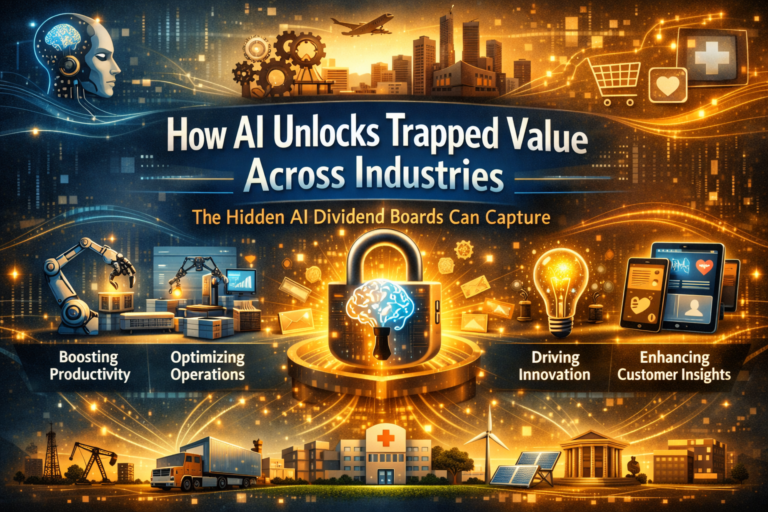
Hidden AI Dividend
Most board conversations about AI still orbit around innovation theater: pilots, tools, proof-of-concepts, and “AI strategy decks.” Meanwhile, the fastest economic gains are showing up somewhere less glamorous—but far more decisive:
AI is unlocking value that was already trapped inside existing operations.
Trapped value is what organizations could be capturing today—if decisions were faster, judgment was consistent, assets were priced correctly, and signals were connected.
In the AI era, competitive advantage increasingly belongs to institutions that can convert ambiguity into precision and latency into action—without scaling headcount linearly.
This briefing distills eight practical, cross-industry examples where AI and agents are already making a real difference, and it integrates them into a broader doctrine of how to win in the AI world.
Executive takeaway for directors and C-suite leaders
AI creates advantage when it:
- Compresses decision latency (minutes instead of days)
- Standardizes judgment (consistent valuation and routing)
- Reduces margin leakage (less write-off, less over-refund, fewer missed entitlements)
- Recovers overlooked revenue (faster conversions, smarter pricing, better retention)
- Converts uncertainty into measurable precision (auditable, repeatable decisions)
The “AI dividend” is not theoretical. It shows up as revenue acceleration, margin recovery, working capital efficiency, and risk compression—often before you launch any “new AI product.”
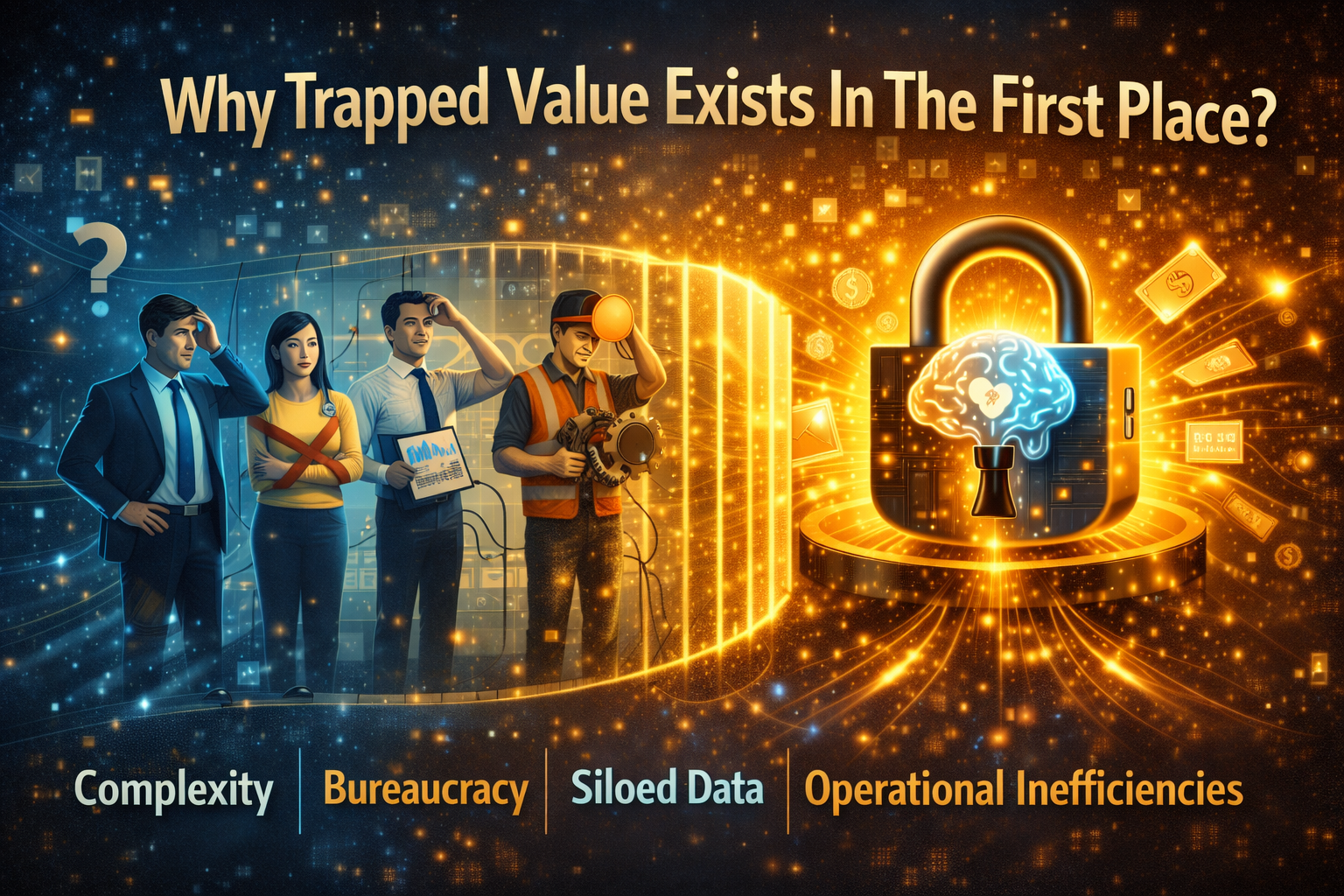
Why trapped value exists in the first place
Across sectors, hidden value tends to exist where:
- Decisions are slow or queue-based
- Judgments vary by person, site, or region
- Assets are mispriced due to lack of consistent evidence
- Signals are fragmented across systems (CRM, ERP, service, contracts)
- Manual inspection dominates
- Reaction replaces anticipation
AI changes the economics by enabling:
- Parallel cognition (many agents working at once)
- Workflow-embedded intelligence (decisions happen inside the process, not after the process)
- Faster signal-to-action cycles
- Institutionalized consistency (the same decision logic applied at scale)
Winning organizations don’t merely “automate tasks.” They systematically remove economic friction.
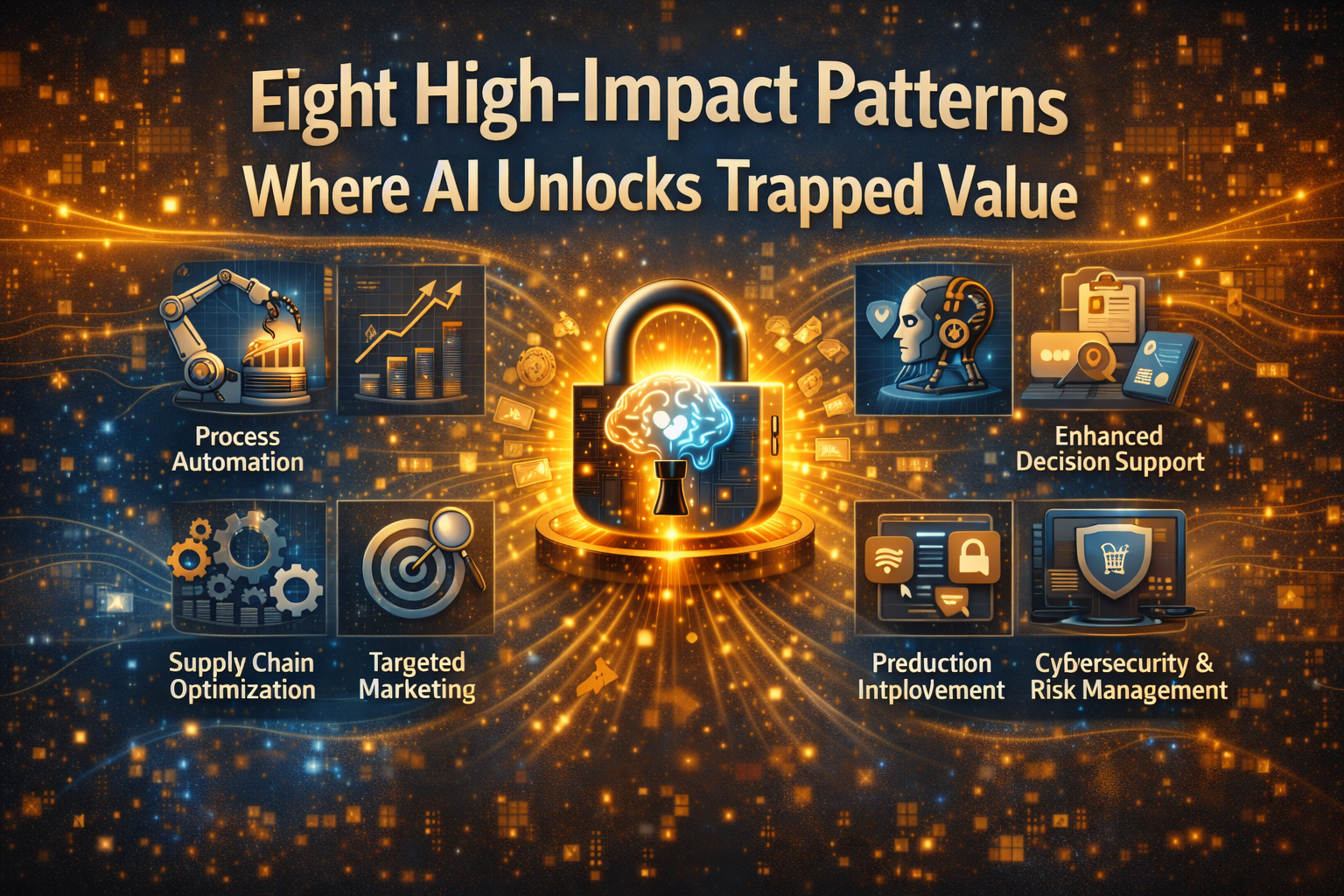
Eight high-impact patterns where AI unlocks trapped value
1) Revenue velocity compression
Example: Education, SaaS, consulting, services
The old constraint: After a webinar/demo/first meeting, inbound interest spikes. Human teams struggle to answer a flood of calls and queries. Response times stretch from hours to 2–3 days, and lead intent decays silently.
AI + agents change the system:
- Parallel AI call/chat agents handle first-level engagement instantly
- Qualification and FAQ resolution happens at scale
- CRM updates are automated
- Humans receive only high-value or exception cases
Economic impact:
- Higher conversion rate (speed protects intent)
- More pipeline captured without linear hiring
- Better human leverage (humans close, agents triage)
Board insight: Speed protects revenue. In many markets, latency is the largest invisible leak.
2) Real-time underwriting precision
Example: Insurance, lending, risk-heavy financial services
The old constraint: Manual underwriting and document review create abandonment, mispricing, and delayed fraud detection.
AI + agents enable:
- Automated document extraction
- Parallel fraud, compliance, and risk checks
- Instant risk scoring
- Human review only for edge cases
Economic impact:
- Faster conversion and onboarding
- Improved risk-adjusted pricing
- Reduced fraud exposure
Board insight: Risk compression becomes competitive advantage when decisions are fast and defensible.
3) Predictive manufacturing operations
Example: Industrial manufacturing, automotive, process plants
The old constraint: Reactive downtime, emergency maintenance, spare parts chaos, and excess inventory all stem from late detection.
AI + agents enable:
- Continuous anomaly detection from sensor streams
- Automated maintenance scheduling
- Supply chain coordination for parts availability
- Production plan adjustments and capital exposure recalculation
Economic impact:
- Less downtime
- Better asset utilization
- Inventory optimization (working capital freed)
Board insight: Operational resilience compounds—the more signals you learn from, the more stable your operating system becomes.
4) Dealer returns precision valuation
Example: Electronics, consumer goods, appliances, auto parts
The old constraint: Returns are graded manually, inconsistently. Refund values become subjective. Fraud and over-refunds are hard to detect. Items are over-discounted or scrapped due to uncertainty.
AI + computer vision enable:
- Condition assessment via images/video
- Damage detection (scratches, dents, missing parts)
- Dynamic resale pricing based on historical outcomes
- Fraud/anomaly detection on return patterns
Economic impact:
- Margin recovery (less leakage, better resale outcomes)
- Standardized valuation
- Secondary market intelligence (what actually resells and why)
Board insight: Asset recovery is margin expansion. AI turns “returns” from noise into an economic system.
5) Scrap and waste monetization
Example: Metals, heavy industry, recycling-intensive operations
The old constraint: Scrap is often undervalued because sorting and purity estimation are inconsistent and slow. Timing sales in volatile commodity markets is reactive.
AI + material intelligence enable:
- Vision + spectral analysis for composition and purity estimation
- Yield forecasting for reprocessing decisions
- Market timing optimization for resale
- Better segregation of high-value scrap
Economic impact:
- Higher recovery value
- Reduced volatility exposure
- ESG improvement via better recycling efficiency
Board insight: Waste becomes strategic revenue when the enterprise can see what it previously treated as “unmeasurable.”
6) Contract intelligence and rebate recovery
Example: Procurement-heavy enterprises across all sectors
The old constraint: Real money is buried in contracts—rebates, renewal traps, escalation clauses, penalty triggers—but organizations discover them too late.
AI + contract agents enable:
- Clause extraction at scale
- Renewal monitoring and alerts
- Cross-vendor benchmarking of terms
- Identification of missed rebates and entitlements
Economic impact:
- Immediate cost recovery
- Stronger negotiation leverage
- Reduced compliance and renewal risk
Board insight: Legal complexity can be converted into financial clarity—and boards love clarity.
7) Dynamic inventory rebalancing
Example: Retail, distribution, multi-warehouse supply chains
The old constraint: Overstock and stockouts coexist because visibility and rebalancing are slow. Markdown decisions are delayed and blunt.
AI + agents enable:
- Real-time sales velocity monitoring
- Cross-location transfer optimization
- Dynamic pricing triggers
- Demand prediction at SKU-region granularity
Economic impact:
- Reduced markdowns and write-offs
- Improved sell-through
- Working capital efficiency
Board insight: Inventory becomes a managed portfolio, not static stock.
8) Churn early-warning systems
Example: Telecom, SaaS, subscription businesses, services with renewals
The old constraint: Churn is detected after revenue declines. Early dissatisfaction signals are scattered across tickets, emails, usage patterns, and payment behavior.
AI + agents enable:
- Behavioral pattern analysis across signals
- Early churn probability detection
- Automated retention triggers and playbooks
- Escalation to humans only when warranted
Economic impact:
- Revenue retention (invisible profit)
- Forecast stability
- Higher customer lifetime value
Board insight: Prevented loss is invisible profit—and it compounds over time.
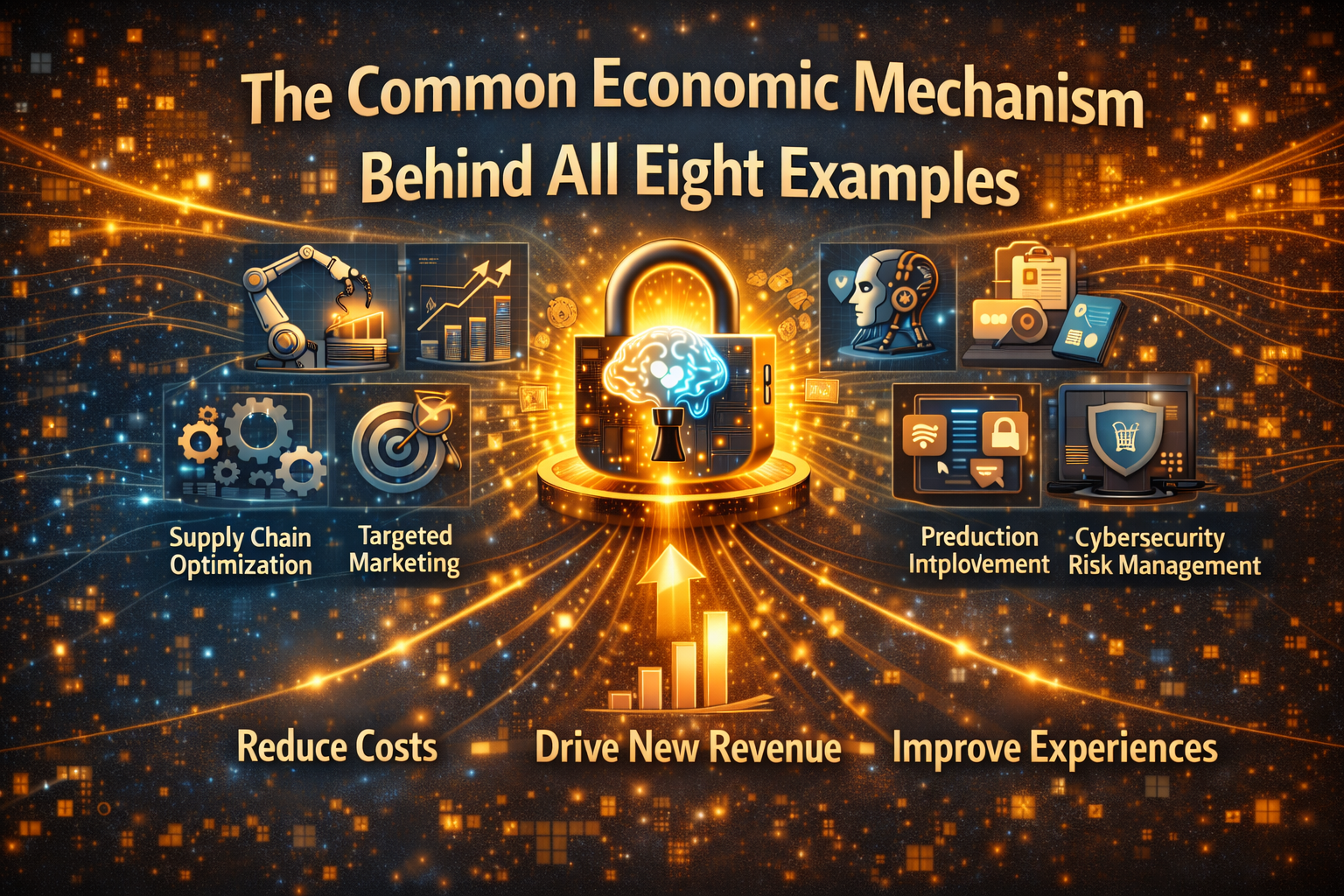
The common economic mechanism behind all eight examples
Across industries, AI unlocks trapped value by:
- Reducing latency (signal-to-action time collapses)
- Increasing pricing/valuation precision (less subjective grading)
- Standardizing decision quality (repeatable judgment)
- Parallelizing analysis and execution (agents scale in parallel)
- Converting fragmented signals into structured intelligence
- Elevating humans to high-value judgment roles (exceptions, relationships, strategy)
These mechanisms map directly to outcomes boards care about:
- Revenue acceleration
- Margin expansion
- Risk compression
- Capital efficiency
- Learning velocity
“How to Win in the AI World” doctrine
This article is the Value Recovery layer—the part of the journey where institutions stop “trying AI” and start capturing structural gains.
A winning sequence looks like this:
- Value Migration: Capital flows toward AI capability building
- Hidden Value Unlocking: Trapped margin and friction are removed
- Structural Redesign: AI becomes embedded in decision infrastructure
- Intelligence Compounding: Decisions improve systematically via reuse
In other words, winners move from:
Automation → Value Recovery → Decision Infrastructure → Intelligence Capital
If you want a deeper operating-model view of how enterprises scale this safely, go to
Enterprise AI Operating Model
Enterprise AI scale requires four interlocking planes:
Read about Enterprise AI Operating Model The Enterprise AI Operating Model: How organizations design, govern, and scale intelligence safely – Raktim Singh
- Read about Enterprise Control Tower The Enterprise AI Control Tower: Why Services-as-Software Is the Only Way to Run Autonomous AI at Scale – Raktim Singh
- Read about Decision Clarity The Shortest Path to Scalable Enterprise AI Autonomy Is Decision Clarity – Raktim Singh
- Read about The Enterprise AI Runbook Crisis The Enterprise AI Runbook Crisis: Why Model Churn Is Breaking Production AI—and What CIOs Must Fix in the Next 12 Months – Raktim Singh
- Read about Enterprise AI Economics Enterprise AI Economics & Cost Governance: Why Every AI Estate Needs an Economic Control Plane – Raktim Singh
Read about Who Owns Enterprise AI Who Owns Enterprise AI? Roles, Accountability, and Decision Rights in 2026 – Raktim Singh
Read about The Intelligence Reuse Index The Intelligence Reuse Index: Why Enterprise AI Advantage Has Shifted from Models to Reuse – Raktim Singh
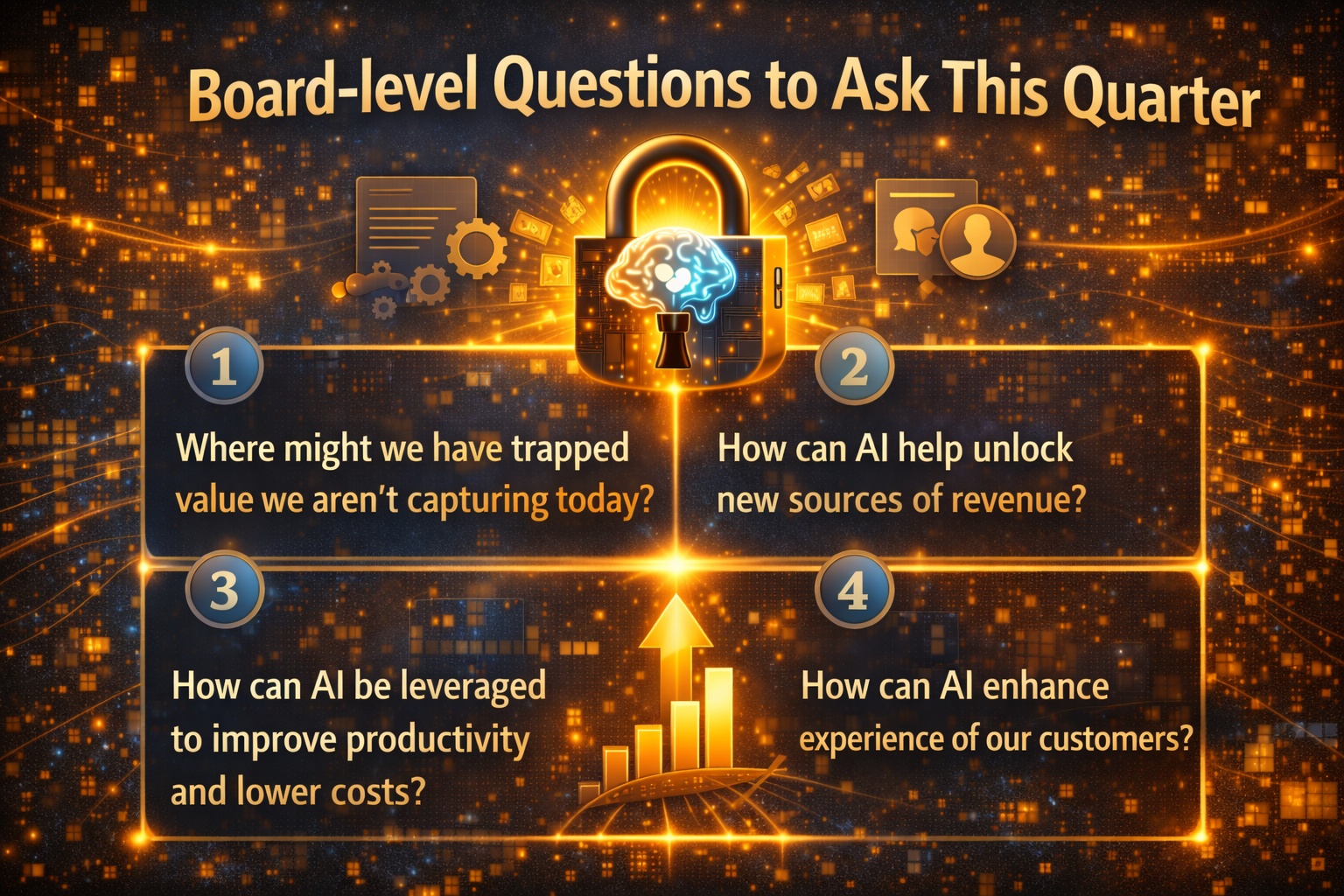
Board-level questions to ask this quarter
Use these to move AI from “technology agenda” to “capital allocation agenda”:
- Where is revenue currently lost due to response latency?
- Which assets are inconsistently valued—and therefore mispriced?
- Where do subjective judgments create margin leakage or fraud exposure?
- Which operational delays create silent working-capital inefficiency?
- Do we measure revenue velocity, not just pipeline volume?
- Do we measure margin recovery from decision precision?
- How reusable is the intelligence we are building—across business units?
- Do we have runtime visibility into what AI is doing in production?

Conclusion: The hidden AI dividend is already inside your enterprise
AI does not create advantage merely by existing.
It creates advantage when institutions:
- Identify trapped value
- Remove economic friction
- Embed intelligence into workflows
- Institutionalize decision precision
- Govern and scale responsibly
The winners in the AI world will not be those who deploy the most models.
They will be those who systematically unlock value that was previously invisible—and then build the operating model that lets that advantage compound.
That is how institutions win.
Glossary
AI dividend: Structural gains from AI (revenue acceleration, margin recovery, risk compression, capital efficiency) beyond simple productivity.
Trapped value: Economic value lost to latency, inconsistency, mispricing, and fragmented signals.
Decision latency: Time between a signal (lead, return, anomaly, churn indicator) and the decision/action.
Agentic AI: AI systems that can execute actions (triage, route, update, schedule) within defined boundaries—not just recommend.
Revenue velocity: The speed at which interest converts to revenue (response time, onboarding time, underwriting time).
Margin leakage: Unnoticed loss in profitability due to mispricing, over-refunds, excessive markdowns, or poor recovery.
Working capital efficiency: Reduction in capital locked in inventory, delays, or operational buffers.
Risk compression: Reducing downside risk exposure through faster detection and more consistent decision-making.
FAQ
What does “AI unlocks trapped value” mean?
It means AI helps organizations recover revenue, margin, and capital that are already available but lost due to slow decisions, inconsistent judgment, mispricing, and fragmented signals.
Are these examples realistic today or future concepts?
They are realistic today. The enabling capabilities—computer vision, speech AI, workflow automation, and multi-agent orchestration—already exist. What varies is implementation maturity and governance.
Is this mainly about cost cutting?
No. The biggest gains often come from revenue acceleration, margin recovery, and risk compression, not just reducing headcount.
Where should a board start?
Start where trapped value is largest and easiest to measure: returns valuation, contract rebates, churn prevention, underwriting cycle time, inventory markdowns, or lead-response latency.
How do we avoid risk while moving fast?
Treat autonomy as bounded and reversible: define decision rights, escalation paths, audit trails, and runtime monitoring—so AI scales safely.
What metrics should boards track?
Revenue velocity, margin recovery rate, working capital released, exception rate (human escalations), decision accuracy over time, and reuse (how often decision logic is reused across units).
What is the AI Dividend?
The AI Dividend refers to the measurable economic gains organizations capture by embedding AI into decision-making, operations, and business models.
How does AI unlock trapped value?
AI reduces friction in decision cycles, connects siloed data, improves prediction accuracy, and enables automation at scale.
Is the AI Dividend only about cost savings?
No. While cost reduction is one lever, AI also drives revenue expansion, product innovation, and new service categories.
Why should boards care about the AI Dividend?
Because AI is shifting competitive advantage from labor scale to decision scale.
References and further reading
🔹 1. Global AI Economic Impact Reports
McKinsey – The Economic Potential of Generative AI
Stanford AI Index Report
OECD AI Policy Observatory
🔹 2. AI Productivity & Value Creation
World Economic Forum – AI and the Future of Productivity
https://www.weforum.org/reports
MIT Sloan – Artificial Intelligence and Business Strategy
Artificial Intelligence | MIT Sloan
🔹 3. AI Capital Allocation & Governance
Harvard Business Review – Competing in the Age of AI
🔹 4. Decision & Productivity Economics
Paul Romer – Endogenous Growth Theory (Nobel Prize background)
https://www.nobelprize.org/prizes/economic-sciences/2018/romer/facts/
How will AI affect productivity? | Brookings
🔹 5. Capital Market Signals
Goldman Sachs – The Potentially Large Effects of AI on Economic Growth
How Will AI Affect the Global Workforce? | Goldman Sachs



Raktim Singh is an AI and deep-tech strategist, TEDx speaker, and author focused on helping enterprises navigate the next era of intelligent systems. With experience spanning AI, fintech, quantum computing, and digital transformation, he simplifies complex technology for leaders and builds frameworks that drive responsible, scalable adoption.