
The Machine-Readable Franchise:
In the AI economy, small businesses will not win by building giant models. They will win by becoming legible, trusted, and operable inside shared networks of identity, context, policy, and delegation.
For years, small firms were told that scale belonged to the giants.
The giants had capital.
The giants had data.
The giants had software budgets.
The giants had teams to integrate, govern, and continuously improve technology.
That logic is starting to break.
In the next phase of the AI economy, the winners will not be only those who own the biggest models. They will be those who can plug their capabilities into trusted systems of representation: systems that make them visible, verifiable, and usable to institutions, marketplaces, regulators, and increasingly, intelligent machines.
That is the deeper promise of what I call the machine-readable franchise. OECD’s recent work on SME adoption shows why this matters: AI use among smaller firms still trails larger enterprises, even as AI’s economic importance rises. The problem is not only access to models. It is the ability to participate in the surrounding digital and governance infrastructure. (OECD)
This is a very different future from the one many people imagine. It is not a world in which every small business becomes an AI lab. It is a world in which small businesses become machine-readable participants in larger systems of trust. The firms that join these systems early may gain a form of scale that previously belonged only to platforms and large enterprises. That is why this idea matters.
A machine-readable franchise is a business model where a firm exposes structured, verifiable, and continuously updated data about its operations, identity, performance, and compliance so that AI systems can evaluate, trust, and transact with it autonomously.

The real bottleneck is not intelligence. It is entry.
Much of the AI conversation is still trapped in the wrong question. It asks: who has the best model? But for most real businesses, the deeper bottleneck comes earlier.
A system cannot reason well about what it cannot reliably see. It cannot coordinate with what it cannot identify. It cannot act responsibly on behalf of what it cannot verify. This is why many small firms remain economically valuable but computationally absent.
A neighborhood repair shop may be trusted. A local diagnostic clinic may be reliable. A regional logistics operator may know its geography better than a national chain. A specialist textile supplier may possess years of tacit domain knowledge. Yet none of that automatically makes them usable inside an AI-driven market.
Why not?
Because intelligent systems do not work on informal reputation alone. They work on representation.
They need structured ways to answer questions such as:
What systems need to know before they can trust a firm
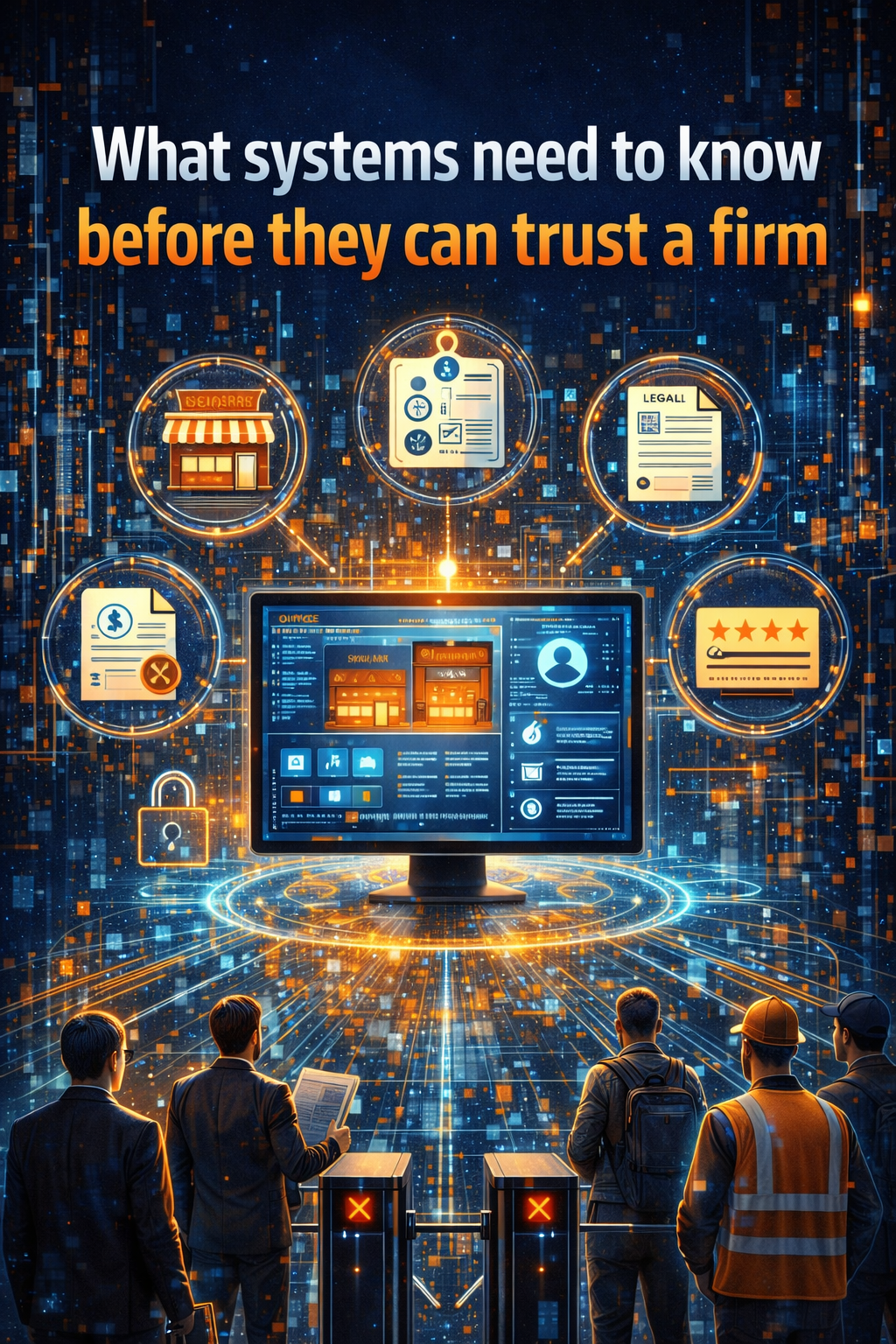
- Who is this business?
- What can it do?
- Under what policies can it act?
- What standards does it comply with?
- What is its current operating state?
- What promises has it made?
- What evidence supports those promises?
- If something goes wrong, what recourse exists?
Without that layer, a small firm may be commercially real but computationally invisible. That is one of the least discussed exclusion mechanisms of the AI economy. OECD analysis makes the point indirectly: SME adoption depends not just on enthusiasm, but on skills, connectivity, financing, digital maturity, and the surrounding ecosystem that makes AI usable in practice. (OECD)
What is a machine-readable franchise?
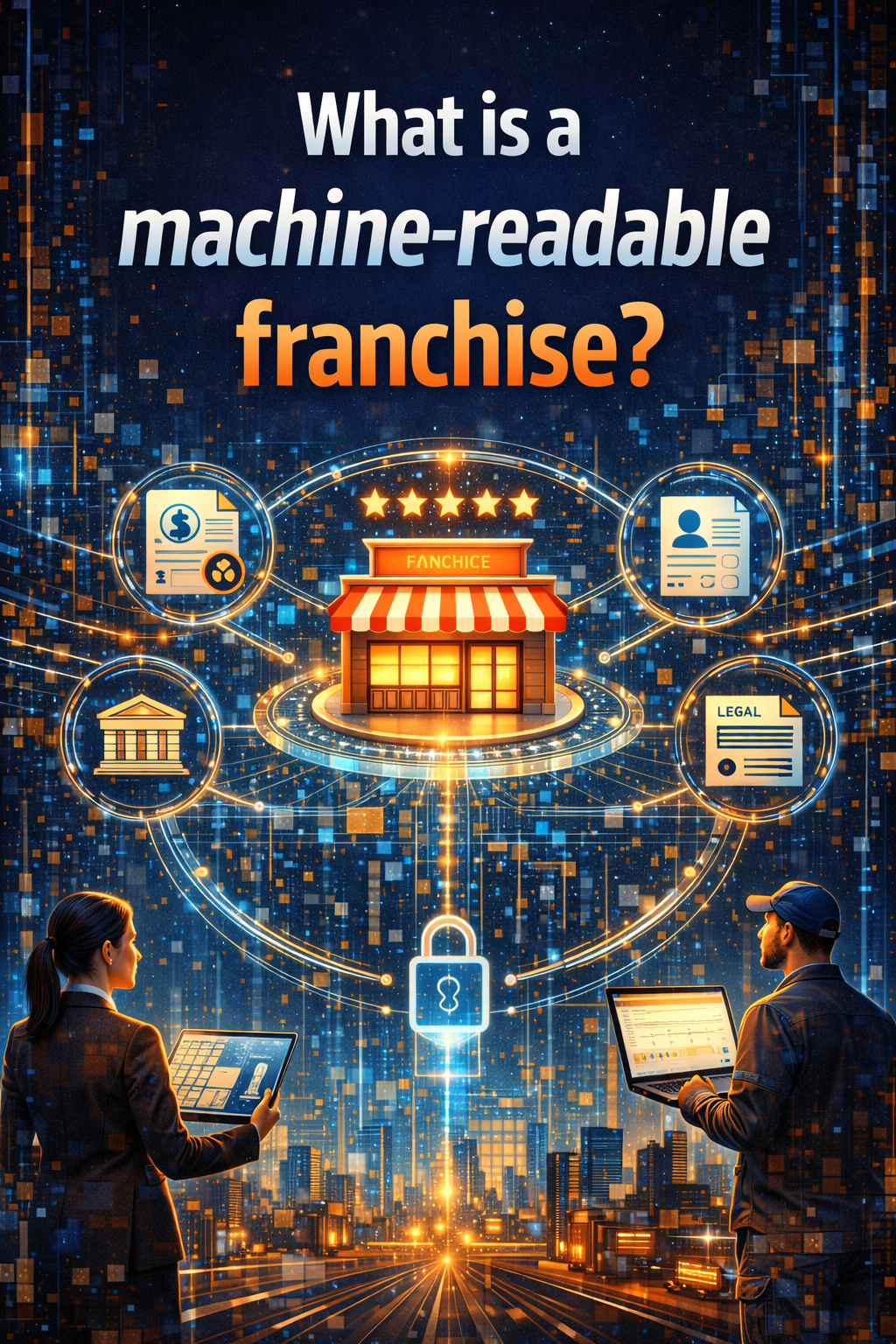
A machine-readable franchise is not a franchise in the old retail sense.
It is not mainly about logos, storefront consistency, or a master brand. It is about joining a trusted operating network that gives a smaller firm a shared layer of machine-readable legitimacy.
Traditional franchises gave small operators brand, process, distribution, and customer trust.
Machine-readable franchises will give them a different set of assets:
The new assets that matter in the AI economy
- verified identity
- interoperable data structures
- policy inheritance
- reputation portability
- auditable transactions
- governed delegability
- dispute and recourse pathways
That means a small participant becomes easier for AI systems, enterprise workflows, banks, insurers, procurement engines, marketplaces, and regulators to understand and trust.
In practical terms, a machine-readable franchise might provide standardized service definitions, structured availability feeds, shared compliance templates, portable credentials, auditable history, and clear boundaries around what a firm or its digital agents are allowed to do. NIST’s AI Risk Management Framework reinforces why these shared trust layers matter: trustworthy AI depends on governance, measurement, accountability, and ongoing risk management, not one-time deployment. Smaller firms usually cannot build all of that from scratch. (NIST)
Why this model is emerging now
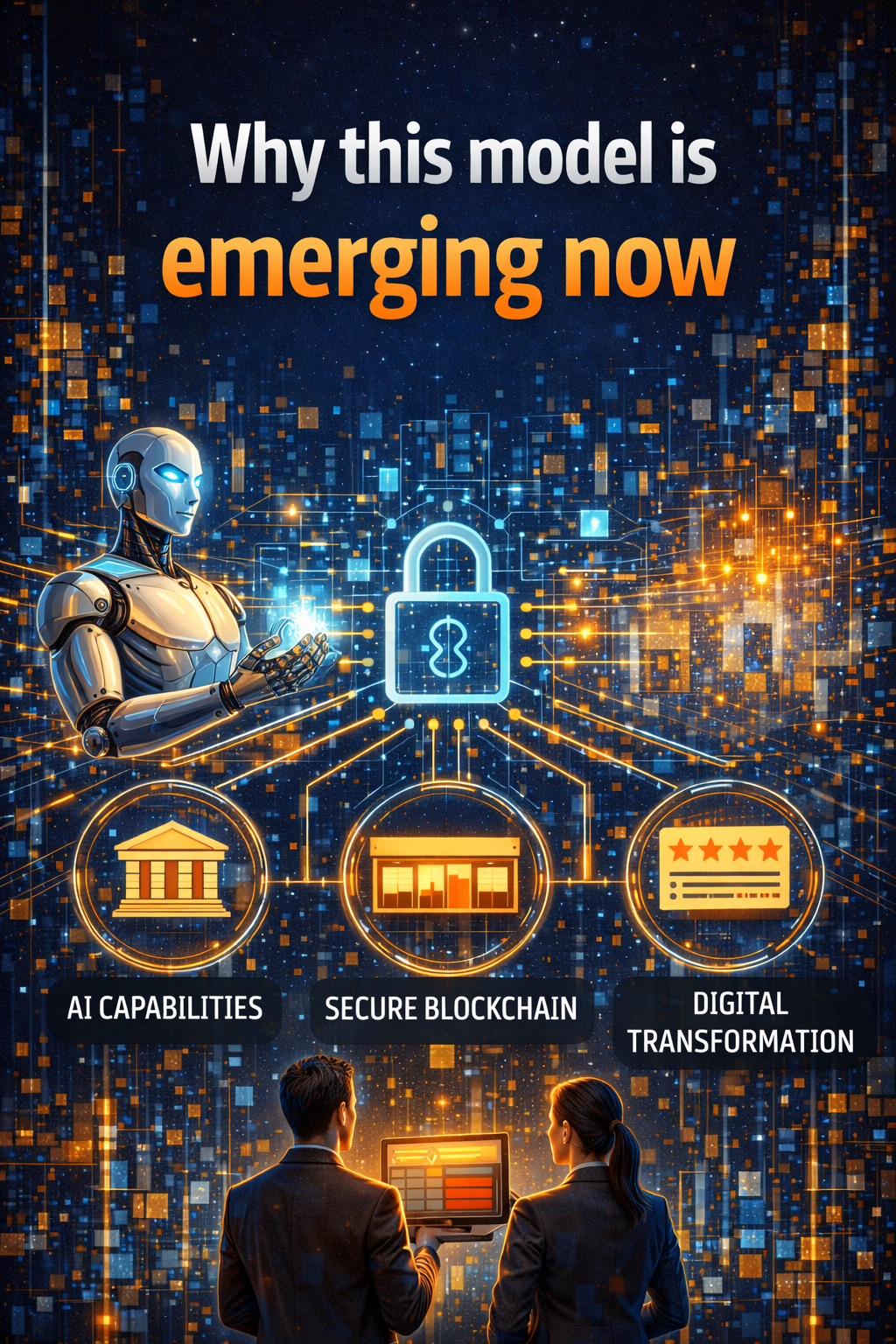
Three shifts are converging.
-
AI is lowering the cost of reasoning
More firms can now access systems that summarize, classify, recommend, negotiate, and orchestrate. But cheaper reasoning does not solve the harder problem: whether the surrounding business reality is structured well enough for those systems to act on. The World Economic Forum’s recent work shows that organizations are moving beyond experimentation toward operational transformation, which makes the quality of surrounding data, workflows, and governance more important, not less. (World Economic Forum Reports)
-
Open and interoperable network models are becoming real
India’s ONDC is one of the clearest live examples of this shift. It was designed to reduce dependence on a single marketplace by connecting buyers, sellers, and service providers through open network protocols. India’s government said in March 2026 that, as of December 2025, ONDC had more than 1.16 lakh live retail sellers across more than 630 cities and towns. That is important not just as an e-commerce milestone, but as proof that smaller firms can participate through common rails rather than surrendering all power to one dominant intermediary. (Press Information Bureau)
-
Trust infrastructure is becoming a strategic layer
The World Bank now frames digital public infrastructure as interoperable, open, and inclusive systems supported by technology, protocols, frameworks, and governance structures. That is exactly the direction this article points toward. Europe’s push on digital identity wallets and the proposal for European Business Wallets shows a similar recognition: business participation increasingly depends on trusted, portable, digital proof layers rather than ad hoc verification every time a firm wants to operate, transact, or comply. (Open Knowledge )
Put those three shifts together and a new possibility appears: small firms no longer need to build mini-enterprise stacks of their own. They can plug into shared representation networks.
The SENSE–CORE–DRIVER lens
This is where my SENSE–CORE–DRIVER framework becomes useful.
SENSE: the legibility layer
This is where reality becomes machine-readable. A small firm must be visible through signals, identity, state representation, and mechanisms that keep that state updated over time.
CORE: the cognition layer
This is where systems interpret, optimize, route, compare, predict, and decide. Here, AI can assess fit, forecast demand, route work, detect anomalies, and personalize interactions.
DRIVER: the legitimacy layer
This is where action becomes governable. Authority is bounded. Policies are enforced. Evidence is logged. Recourse exists when something goes wrong.
Most small firms do not lose in the AI era because they lack intelligence. They lose because they are weakly represented in SENSE and weakly protected in DRIVER.
That is why the machine-readable franchise matters. It helps smaller firms become visible enough to be used and governed enough to be trusted.
A simple way to understand it
The machine-readable franchise is best understood as a new answer to an old business problem.
In the industrial era, small firms needed roads, payment rails, and distribution channels.
In the software era, they needed cloud tools, digital payments, and online discovery.
In the AI era, they will also need representation rails:
identity rails, policy rails, reputation rails, interoperability rails, and delegation rails.
That is the missing shift.
The AI economy will not be organized only around intelligence. It will be organized around who can enter machine-led systems with enough structure, trust, and legitimacy to participate safely.
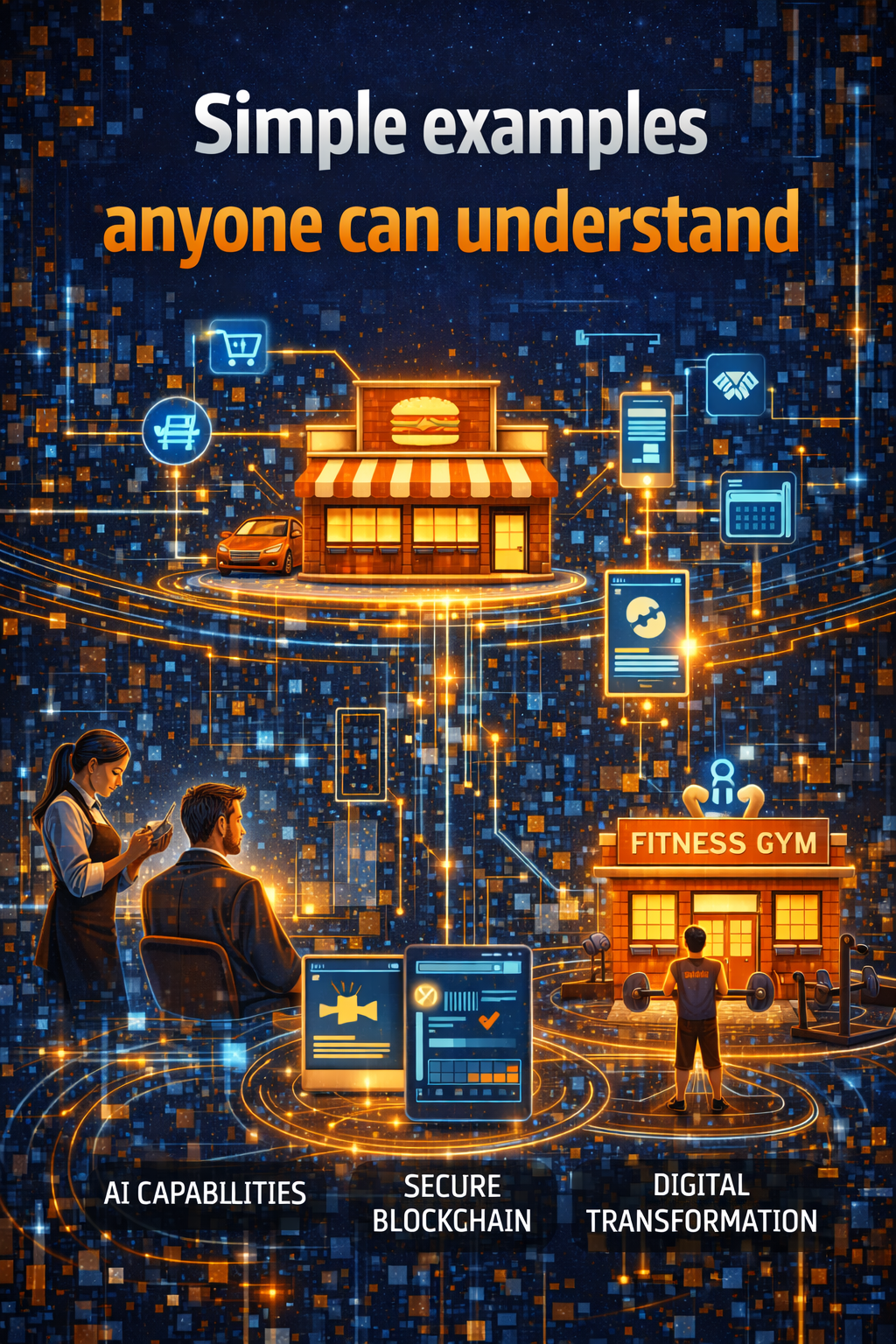
Simple examples anyone can understand
The diagnostic lab
Imagine a small diagnostic lab in a Tier 2 city. It may have good technicians and local trust. But if it is not connected to hospital workflows, insurer rules, standardized test catalogs, digital audit trails, and machine-readable service commitments, it is hard for broader systems to use it.
Now imagine the lab joins a trusted network. Its credentials are verified. Its test catalog is standardized. Its turnaround times, pricing, and quality metrics update in structured form. It inherits claims protocols and dispute procedures. Suddenly, hospitals, insurers, and AI-driven care coordinators can include it in automated workflows.
The lab did not become larger. It became legible.
The manufacturer
A small manufacturer may already make excellent components. But if its capacity, traceability records, compliance status, and reliability history are not machine-readable, enterprise procurement systems struggle to include it. Once connected to a trusted representation network, it becomes discoverable, comparable, and routable.
The firm did not become more intelligent. It became more usable.
The retailer
A small retailer historically depended on footfall or the rules of a single large platform. But in an open network model, that retailer can appear across multiple buyer apps, logistics networks, and payment systems through shared protocols. This is one reason ONDC matters. It is not just a commerce story. It is a representation story. (Press Information Bureau)
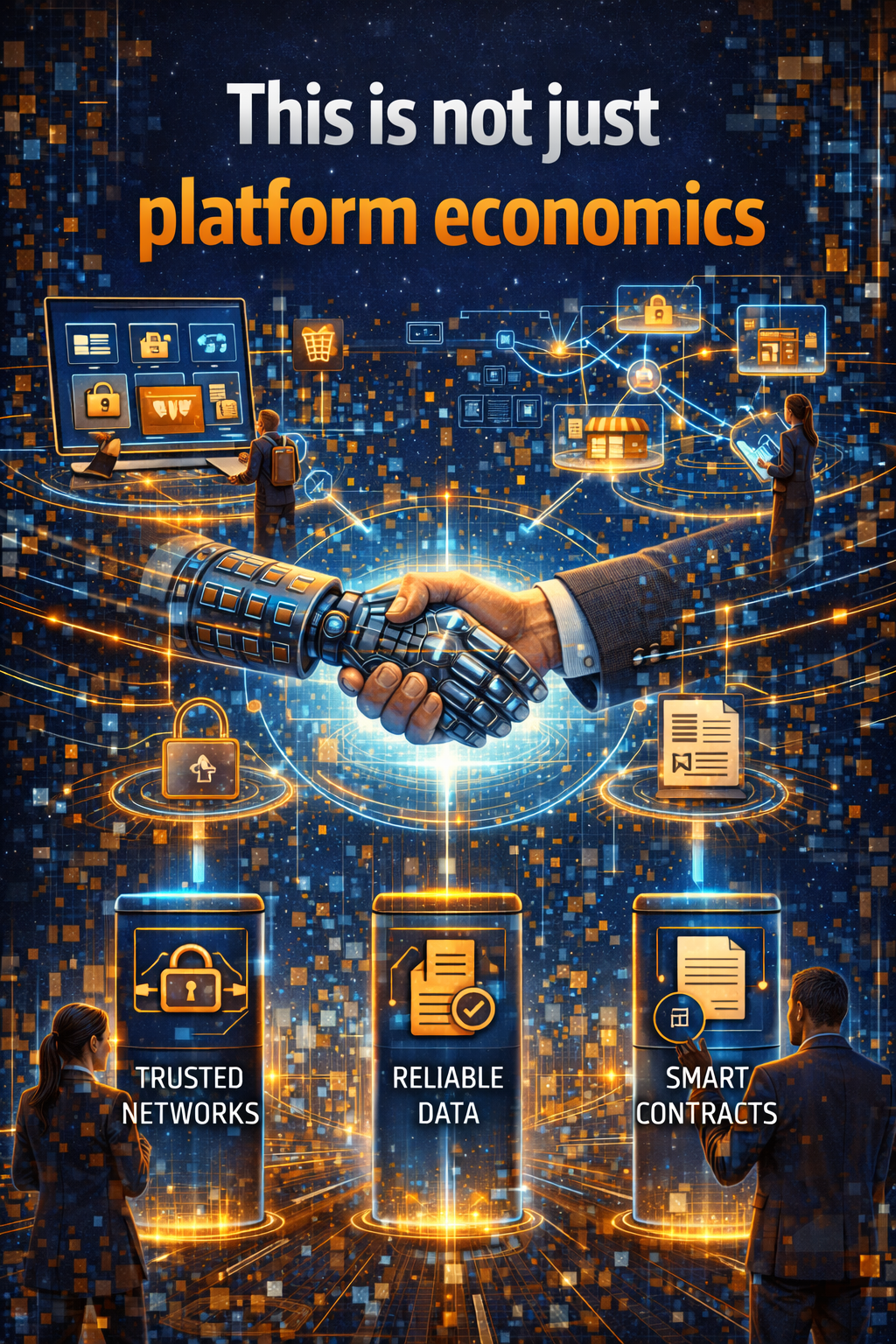
This is not just platform economics
It would be easy to misread this as a new version of platform strategy. It is not.
A classic platform says: come into my system.
A machine-readable franchise says: join a trusted representation network so many systems can work with you.
That difference is profound.
Platforms centralized power through ownership of demand, visibility, and rules. Machine-readable franchises can distribute participation through shared standards, shared trust, and portable legitimacy.
That does not mean monopolies disappear. In fact, new lock-in risks can emerge through identity control, reputation concentration, or opaque trust scoring. But the architecture is different. It creates the possibility of a more interoperable economy if governance is designed well. The World Bank’s framing of DPI and Europe’s wallet initiatives both underscore the importance of openness, interoperability, governance, and trust. (Open Knowledge )
The new companies that will emerge
Once this model becomes visible, an entirely new business landscape appears.
Likely new categories in the representation economy
- Representation network operators that define schemas, onboarding rules, standards, and trust protocols
- Business identity utilities that verify who a participant is and what credentials it holds
- Reputation exchanges that make trust portable without collapsing everything into one opaque score
- Delegation infrastructure providers that define what machines may do on behalf of firms, and under what limits
- Compliance inheritance providers that help smaller firms inherit structured policy controls
- Recourse and dispute layers that handle correction, appeal, recovery, and accountability when machine-routed decisions fail
These will not be side industries. They will become central market infrastructure.
What existing enterprises should do now
Large incumbents should not assume this trend benefits only startups or neighborhood merchants.
It changes the strategy of large firms too.
Enterprises that want more resilient supply chains, broader ecosystem participation, faster onboarding, and better distribution reach will need to design for machine-readable participation. They will need to ask:
The new board-level question
How do we make it easier for thousands of smaller participants to become usable inside our decision systems?
That is not only a technology question. It is an architecture question, a governance question, and ultimately, a market design question.
The next winners will not simply automate the enterprise. They will extend trusted operability outward.
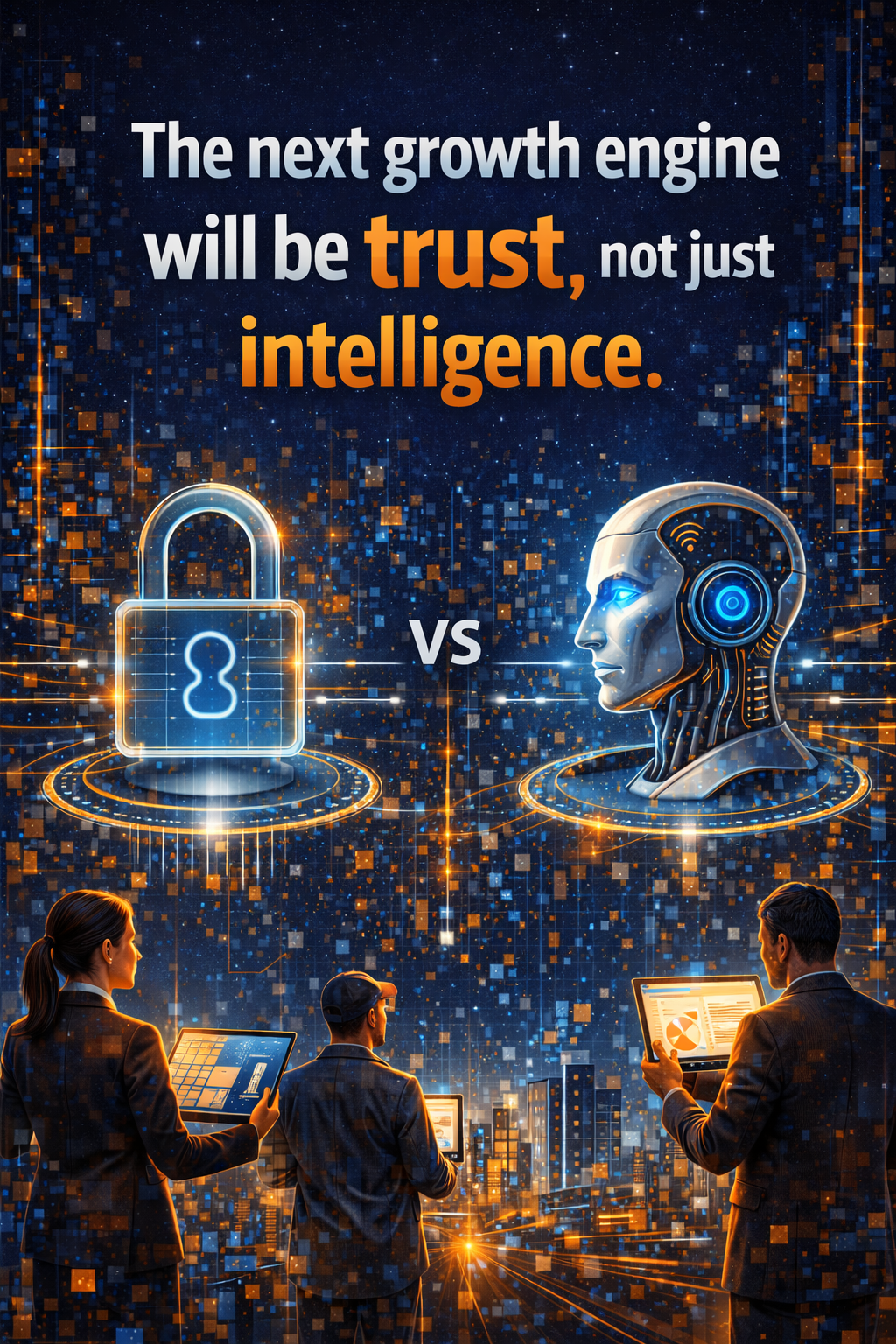
Conclusion: the next growth engine will be trust, not just intelligence
The machine-readable franchise points to a deeper truth about the AI era.
Small firms do not need to become miniature versions of large firms. They need access to the right trust rails.
As intelligence becomes cheaper, raw cognition stops being the main scarcity. What becomes scarce is trusted representation: identity that holds, state that updates, credentials that travel, reputations that can be verified, and actions that can be defended.
That is why the machine-readable franchise matters so much.
It is not a feature.
It is not a marketplace trick.
It is not just another software category.
It is a new institutional form for participation in the representation economy.
And it may become one of the most important ways small firms survive, scale, and win in the AI world.
FAQ
What is a machine-readable franchise?
A machine-readable franchise is a trusted participation model in which a small firm plugs into shared infrastructure for identity, interoperability, policy, reputation, and governed delegation so that AI systems and institutions can reliably understand and work with it.
Why is this different from a digital platform?
A platform typically centralizes participation inside one owner’s system. A machine-readable franchise makes participation portable across multiple systems through shared standards, identity, and trust layers.
Why will this matter to SMEs?
Because AI advantage will not come only from having access to models. It will come from being visible, verifiable, and operable inside machine-led workflows. OECD research shows SME AI adoption still lags larger firms, which is exactly why participation infrastructure matters. (OECD)
What role does ONDC play in this story?
ONDC is an early live example of how smaller firms can participate through open network protocols rather than relying on a single centralized marketplace. It shows how shared rails can reduce entry barriers. (Press Information Bureau)
How does this connect to SENSE–CORE–DRIVER?
SENSE makes firms legible, CORE enables reasoning and routing, and DRIVER governs action, accountability, and recourse. Machine-readable franchises strengthen all three layers.
Why should boards care?
Because future growth will depend not only on internal AI adoption, but on how well a company can make suppliers, partners, distributors, and smaller ecosystem participants usable inside its decision systems.
Glossary
Representation economy
An emerging economic order in which value increasingly flows to institutions that can represent reality accurately enough for intelligent systems to act on it.
Machine-readable franchise
A model that lets small firms join trusted networks for identity, policy, interoperability, and delegable participation instead of building full AI infrastructure themselves.
Trusted representation network
A shared system of standards, identity, proofs, policy, and governance that makes a participant visible and usable across multiple digital or AI-mediated environments.
Machine-readable legitimacy
The condition in which a business can be reliably recognized, verified, and acted upon by software systems, institutions, and AI agents.
Policy inheritance
A model in which smaller firms adopt standardized compliance, controls, or operating rules from a broader network rather than creating every governance mechanism independently.
Governed delegation
A bounded form of machine or workflow authority in which actions are permitted only under defined limits, evidence rules, and recourse conditions.
Digital public infrastructure
Interoperable, open, and inclusive digital systems, often including identity, payments, and data-sharing layers, supported by technology, protocols, frameworks, and governance structures. (Open Knowledge )
Machine-Readable Franchise
A business designed to be understood and trusted by AI systems through structured data.
Representation Economy
An economic system where value depends on how well entities are represented to machines.
Trusted Representation Networks
Networks that validate and distribute reliable business data for AI consumption.
Delegation Economy
An economy where decisions and actions are delegated to AI systems based on trust.
Entry Barrier (AI Era)
The requirement for structured, machine-readable data before participation in AI-driven markets.
Trust Infrastructure
Systems that verify identity, data integrity, compliance, and performance
References and further reading
- OECD, AI adoption by small and medium-sized enterprises. (OECD)
- OECD, The Adoption of Artificial Intelligence in Firms. (OECD)
- NIST, AI Risk Management Framework. (NIST)
- World Economic Forum, AI in Action: Beyond Experimentation to Transform Industry and Organizational Transformation in the Age of AI. (World Economic Forum Reports)
- Government of India / PIB, ONDC scale update as of December 2025. (Press Information Bureau)
- World Bank, Digital Public Infrastructure and Development. (Open Knowledge )
- European Commission, EU Digital Identity Wallet and European Business Wallets proposal. (European Commission)
- Emerging Technology Solutions | Infosys Topaz Fabric: How AI Is Quietly Changing the Way Enterprise Services Are Delivered
- Emerging Technology Solutions | What Is Infosys Topaz Fabric? The Missing Layer for Scalable Enterprise AI
- Emerging Technology Solutions | Infosys Topaz Fabric: Enterprise AI Infrastructure for Scalable, Governed, and Cost-Aware AI Exec
-
Explore the Architecture of the AI Economy
- This article is part of a broader research series exploring how institutions are being redesigned for the age of artificial intelligence. Together, these essays examine the structural foundations of the emerging AI economy — from signal infrastructure and representation systems to decision architectures and enterprise operating models.If you want to explore the deeper framework behind these ideas, the following essays provide additional perspectives:
-
- The Representation Economy: Why AI Institutions Must Run on SENSE, CORE, and DRIVER – Raktim Singh
- The Representation Economy: Why Intelligent Institutions Will Run on the SENSE–CORE–DRIVER Architecture – Raktim Singh
- Representation Failure: Why AI Systems Break When Institutions Misread Reality – Raktim Singh
- The Firm of the AI Era Will Be Built Around Representation: Why Institutions Must Redesign Themselves for the SENSE–CORE–DRIVER Economy – Raktim Singh
- The Representation Stack: The New Architecture of Intelligent Institutions in the AI Economy – Raktim Singh
- Representation Economics: The New Law of Value Creation in the AI Era – Raktim Singh
- Representation Alpha: Why Competitive Advantage Will Come from Better Representation, Not Better Models – Raktim Singh
- Representation Fragility and Exclusion: The Hidden Fault Line That Will Break the AI Economy – Raktim Singh
- Representation Drift & Labor: Why AI Systems Fail When Reality Moves Faster Than Machines – Raktim Singh
- Representation Monopolies: Why the AI Economy Will Be Controlled by Those Who Define Reality – Raktim Singh
- Representation Forensics: The Missing Layer of AI—Why the Future Will Be Decided by What Systems Thought Reality Was – Raktim Singh
- • Why Most AI Projects Fail Before Intelligence Even Begins
- What Is the Representation Economy? (raktimsingh.com)
- The Representation Economy: Why AI Institutions Must Run on SENSE, CORE, and DRIVER (raktimsingh.com)
- Decision Scale: Why Competitive Advantage Is Moving from Labor Scale to Decision Scale (raktimsingh.com)
- Firms Won’t Be Defined by Employees. They Will Be Defined by Delegation – Raktim Singh
- The New Company Stack: The 7 Business Categories That Will Emerge in the Representation Economy – Raktim Singh
- The Representation Attack Surface: Why AI’s Biggest Threat Is Reality Hacking, Not Model Hacking – Raktim Singh
- The Chief Representation Officer: Why Institutions Collapse When Machine-Readable Reality Falls Behind – Raktim Singh
- The Scarcity of Reality: Why the AI Economy Will Be Defined by the Lifecycle of High-Trust Representation – Raktim Singh
Together, these essays outline a central thesis:
The future will belong to institutions that can sense reality, represent it clearly, reason about it intelligently, and act through governed machine systems.
This is why the architecture of the AI era can be understood through three foundational layers:
SENSE → CORE → DRIVER
Where:
- SENSE makes reality legible
- CORE transforms signals into reasoning
- DRIVER ensures that machine action remains accountable, governed, and institutionally legitimate
Signal infrastructure forms the first and most foundational layer of that architecture.
AI Economy Research Series — by Raktim Singh
-



Raktim Singh is an AI and deep-tech strategist, TEDx speaker, and author focused on helping enterprises navigate the next era of intelligent systems. With experience spanning AI, fintech, quantum computing, and digital transformation, he simplifies complex technology for leaders and builds frameworks that drive responsible, scalable adoption.