

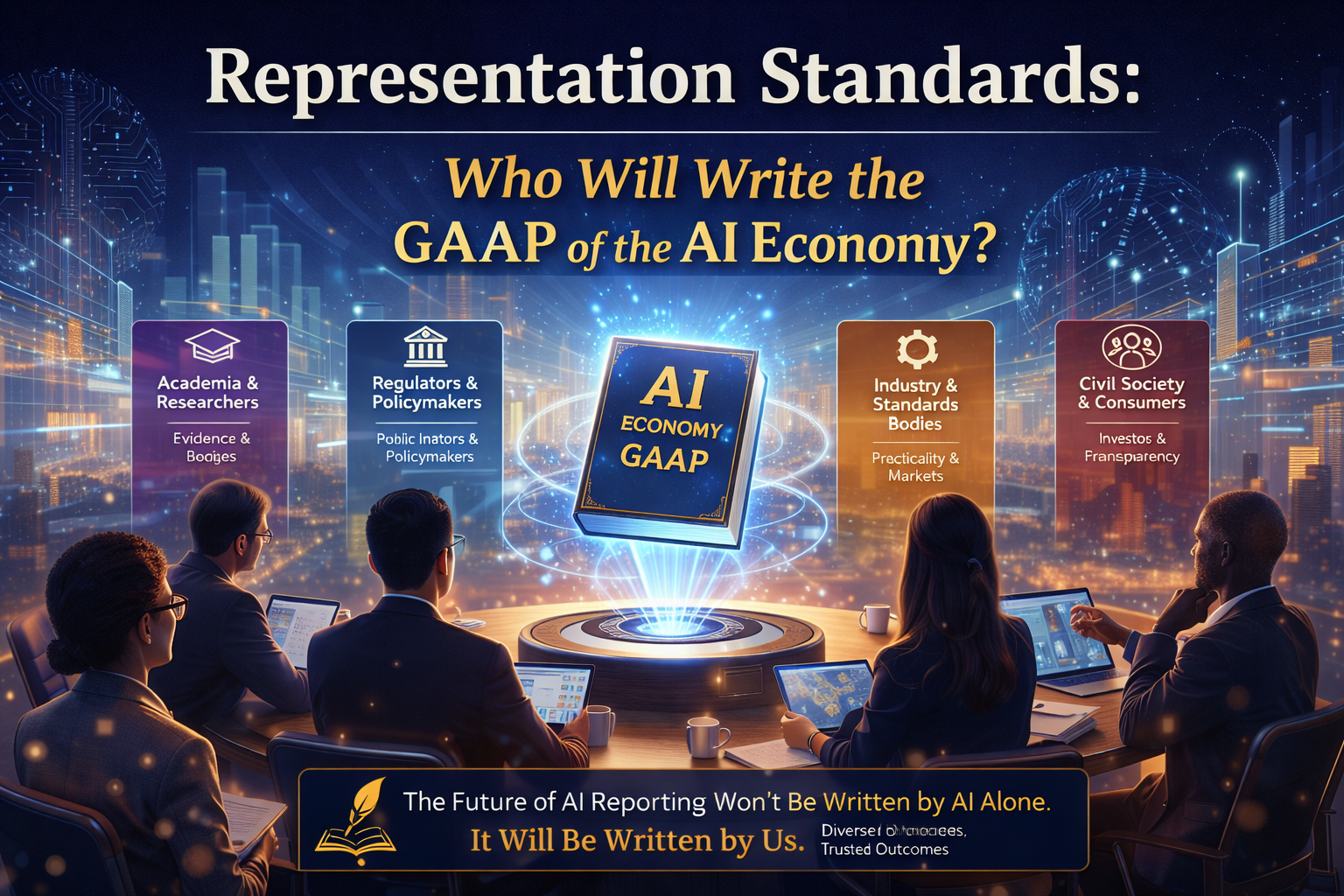
Executive summary: Representation Standards
Most executives still think the AI race will be won by those who build the smartest models. That is only partly true. As AI begins to operate inside hiring, lending, healthcare, procurement, logistics, compliance, and customer operations, a more foundational issue appears: what version of reality is the machine allowed to trust?
That question will define the next era of competition.
Financial capitalism scaled because the world built shared rules for representing financial reality. GAAP and IFRS improved comparability and trust, while XBRL made financial disclosures more machine-readable across organizational boundaries. AI now needs a similar shift for machine-readable reality: standards for identity, provenance, freshness, state, authority, and recourse. (Accounting Foundation)
The strategic implication is enormous. In the AI era, value will not come only from models. It will come from the institutions, standards bodies, platforms, and firms that define the accepted grammar of reality for machines.
What is the real question of the AI era?
The real question of the AI era is not how intelligent machines are, but what they can see, represent, and act upon. AI systems are only as effective as the reality they can interpret, making representation the core challenge of the AI economy.
The real question of the AI era
For the last few years, the technology conversation has been dominated by a familiar set of ideas: bigger models, faster chips, more reasoning, better agents, greater autonomy.
All of that matters. But it misses the deeper shift now underway.
As AI systems begin to search, compare, rank, recommend, approve, route, negotiate, monitor, and act, the most important question is no longer only whether they are intelligent.
It is this:
What version of reality are these systems allowed to trust?
That is the real institutional question of the AI era.
An AI system never interacts with reality directly. It interacts with a representation of reality. A hospital AI does not “see” a hospital; it sees patient identifiers, timestamps, triage labels, medication records, room status, staffing availability, and handoff notes. A lending system does not “see” a borrower’s life; it sees verified documents, transaction histories, income signals, repayment records, and policy constraints. A supply-chain system does not “see” a delayed shipment; it sees product identifiers, sensor updates, location events, and vendor confirmations.
This sounds obvious. But it changes everything.
If the representation is weak, stale, fragmented, unverifiable, or incompatible across systems, even an advanced model will make fragile decisions. In other words, many AI failures begin before the model begins.
That is why AI strategy is no longer only about intelligence. It is about representation.
Why “GAAP for AI” is not just a metaphor
GAAP solved a specific economic problem. Companies could not be compared, trusted, financed, or regulated at scale unless they described financial reality through common rules. IFRS played a similar role internationally by creating more consistent, globally accepted accounting standards. XBRL then helped make those disclosures digital, structured, and machine-readable. (Accounting Foundation)
AI now faces an analogous challenge.
Machines are starting to participate in decisions that depend on questions like these:
- Who is this person, firm, asset, or product?
- What is true about it right now?
- Who is authorized to assert that truth?
- How current is the record?
- Can the evidence be verified?
- What action is permitted?
- What happens if the system is wrong?
Without shared standards, every institution builds its own private model of reality. That may work inside a single workflow. It does not work well across ecosystems.
And AI is an ecosystem technology.
It crosses firm boundaries, industry boundaries, national boundaries, supply chains, financial rails, public infrastructure, healthcare systems, and media systems. That is why the next phase of AI needs more than model progress. It needs representation standards for machine-readable reality.
A simple way to understand the problem: SENSE, CORE, DRIVER
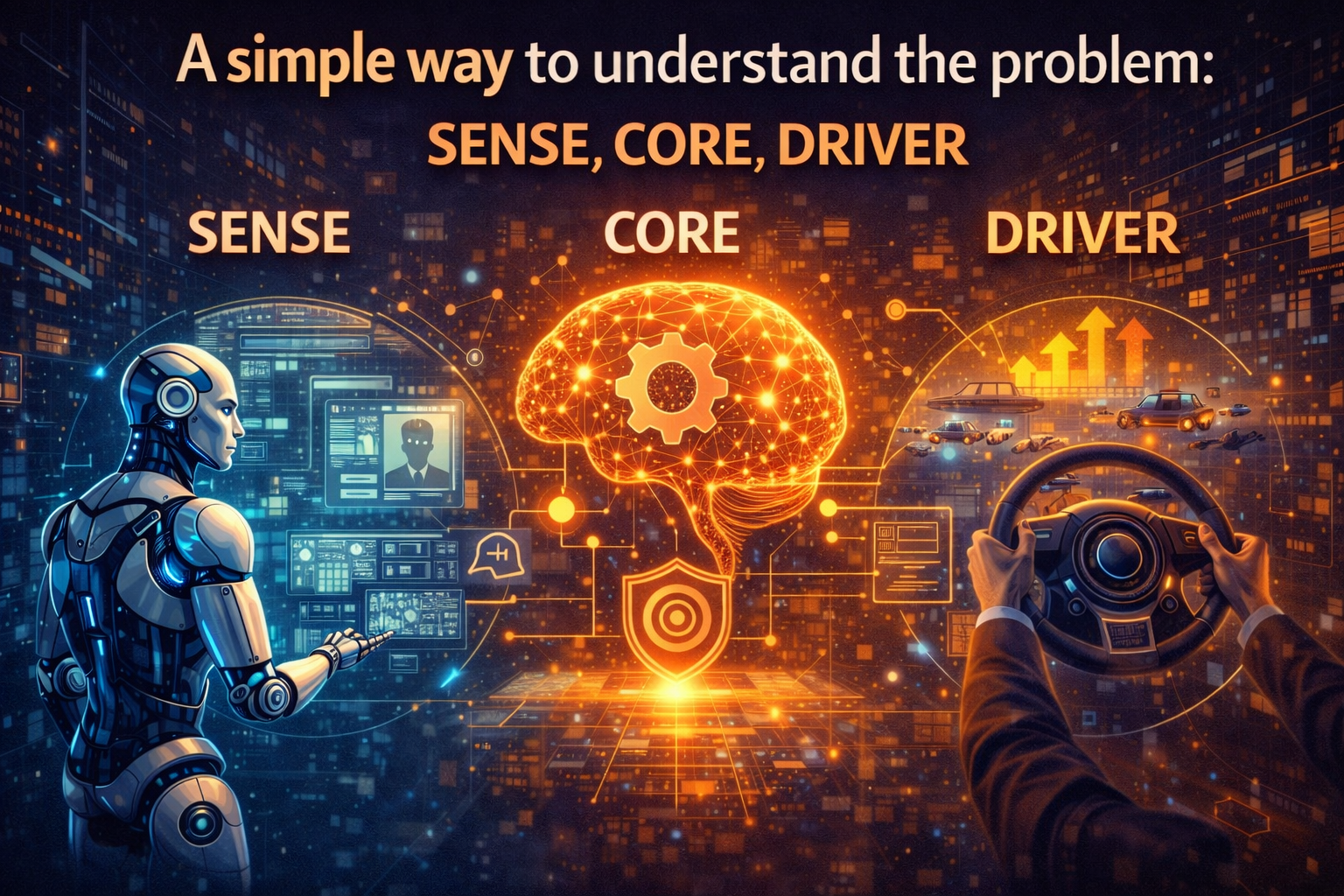
I find it useful to explain this through a three-layer architecture.
SENSE: how reality becomes machine-legible
This is the layer where signals are captured, entities are identified, states are represented, and changes are updated over time.
At this layer, the critical questions are simple:
- What happened?
- To whom or to what?
- In what condition?
- How has that condition changed?
This is where standards for identity, provenance, freshness, lineage, and data quality become essential.
CORE: how systems interpret and reason
This is the reasoning layer. Models retrieve context, classify patterns, estimate risk, rank options, generate outputs, and support decisions.
Most of the public AI conversation lives here.
DRIVER: how systems are authorized to act
This is the action and legitimacy layer: delegation, permissions, verification, execution, logging, reversal, and recourse.
Here the critical questions change:
- Who allowed the system to act?
- Within what boundary?
- Using what evidence?
- How is the decision audited?
- What happens if the action causes damage?
This is where institutional trust lives.
The AI economy will not be defined by CORE alone. It will be defined by whether SENSE and DRIVER become standardized well enough for CORE to operate safely, legally, and economically at scale.
The standards landscape is already taking shape
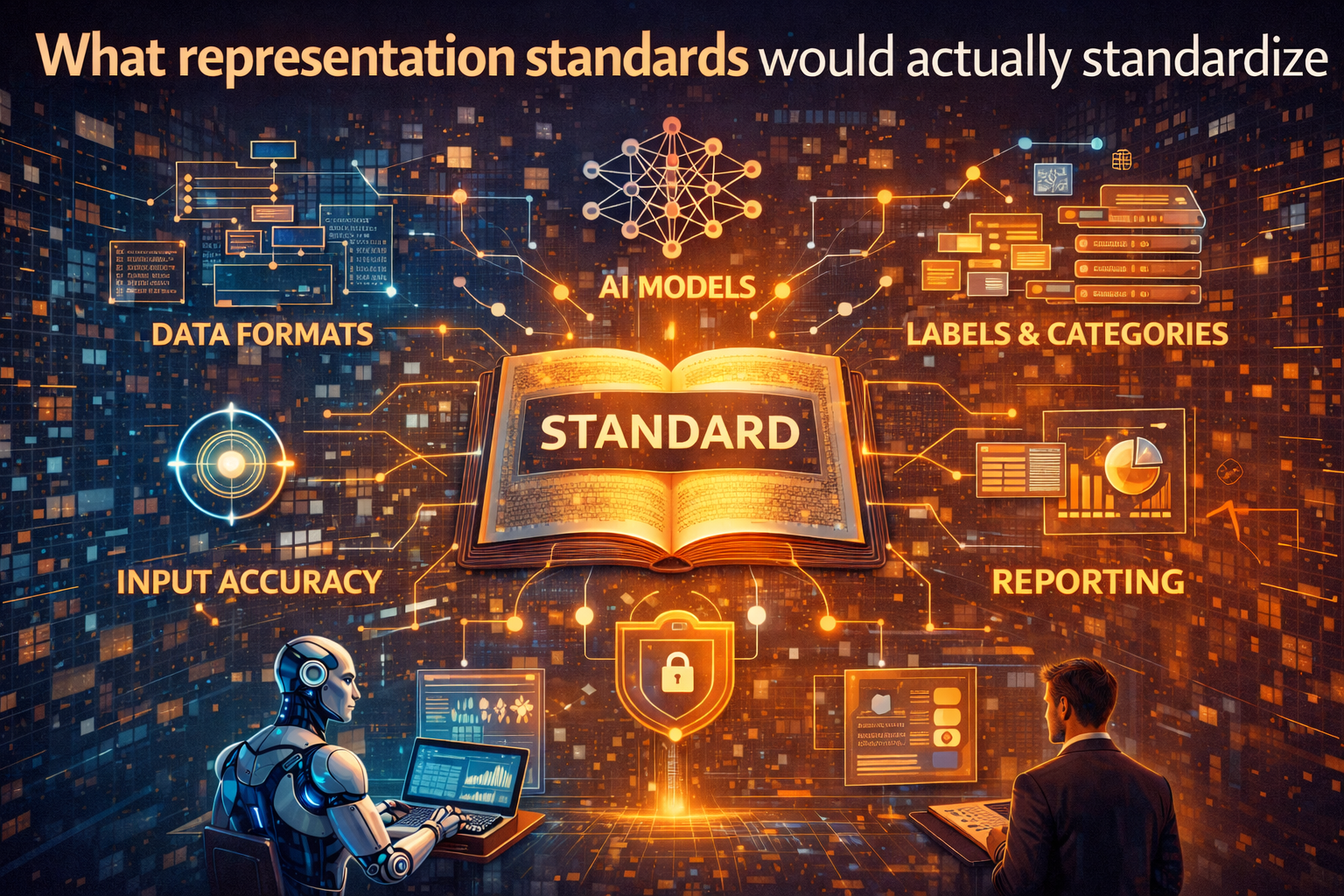
The world does not yet have a single universal standard for machine-readable reality. But many pieces of the future are already visible.
ISO/IEC JTC 1/SC 42 serves as the international standards subcommittee focused on AI, and its catalogue includes standards and technical specifications covering explainability, data life cycle, and controllability of automated AI systems. (ISO)
NIST’s AI Risk Management Framework provides a structured way to manage risks associated with AI systems and is designed to support trustworthy AI practices across the design, development, use, and evaluation lifecycle. (NIST)
The OECD AI Principles promote AI that is innovative, trustworthy, and respectful of human rights and democratic values, while UNESCO’s Recommendation on the Ethics of Artificial Intelligence has been adopted globally and emphasizes transparency, accountability, and human oversight. (OECD)
Meanwhile, other layers of the stack are also standardizing:
- C2PA is building content provenance standards so people and systems can inspect where digital content came from and what changed. (C2PA)
- W3C Verifiable Credentials provide a machine-verifiable way to express claims such as degrees, licenses, and identity attributes. (W3C)
- OpenID Connect created an interoperable identity layer for sign-in and verifiable assertions about users. (openid.net)
- GS1 standards define identifiers and data structures that help products and related events become legible across global trade. (ref.gs1.org)
- The EU AI Act is shaping governance expectations for risk, transparency, and accountability in AI systems. (Digital Strategy)
These pieces still sit in separate worlds: identity, provenance, reporting, AI governance, compliance, and sector-specific regulation. The next strategic prize will go to those who help connect them into a coherent architecture of machine-trusted reality.
What representation standards would actually standardize
This idea becomes much clearer when we move from theory to daily life.
Example 1: A hiring agent evaluating candidates
Today, an AI recruiting system may read a résumé PDF and infer skills from text. That is still a weak representation.
A more mature system would need standardized claims:
- identity verified by a trusted source,
- degree issued as a verifiable credential,
- employment history linked to recognized legal entities,
- skill evidence tied to actual work,
- expiration dates for certifications,
- permission rules governing use,
- and a correction path if something is wrong.
That is not just better AI. It is better representation.
Example 2: A medical handoff
Imagine a patient moving from emergency care to a specialist.
The problem is not only whether AI can summarize the record well. The problem is whether all systems represent the same patient consistently:
- the same patient identity,
- the same medication list,
- the same allergy history,
- clear timestamps,
- provenance of which clinician entered what,
- a record of uncertainty,
- and authority over who can order which next step.
In healthcare, fluency is useful. Representation discipline is lifesaving.
Example 3: A procurement agent negotiating a routine contract
Suppose enterprise agents begin negotiating low-risk supplier contracts.
The system will need to know:
- the supplier’s legal identity,
- product identity,
- delivery commitments,
- contract authority,
- credit standing,
- compliance certifications,
- pricing boundaries,
- and escalation paths.
The machine must know not only what is true. It must know what it is allowed to do.
That is the difference between automation and governed delegation.
The next standards war will be over reality
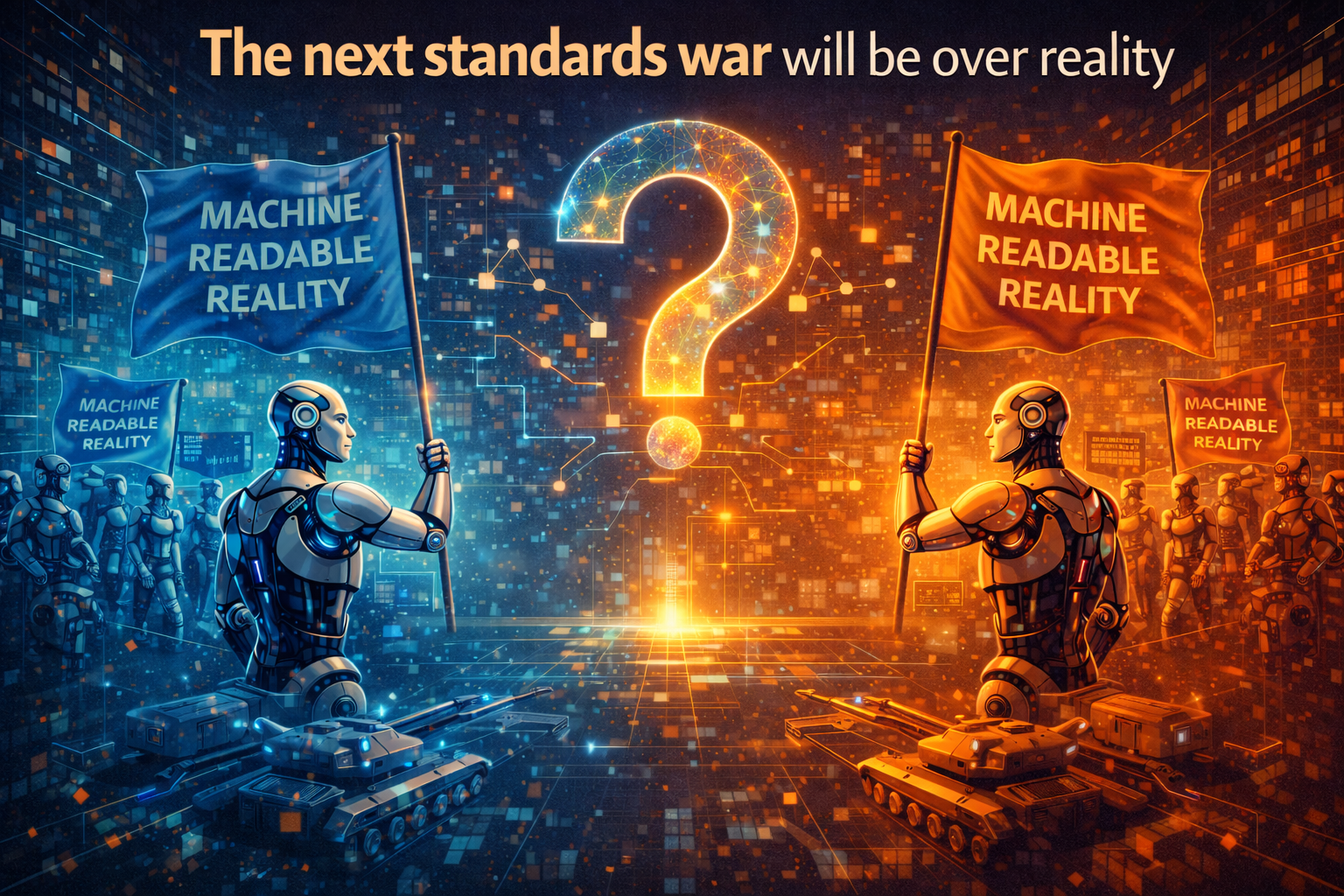
The technology sector still tends to assume that the deepest advantage in AI will come from model size, reasoning quality, or compute scale.
Those will matter.
But the more durable advantage may come from defining the accepted structure of reality for machines.
Standards do powerful economic work. They reduce ambiguity. They cut transaction costs. They improve comparability. They enable interoperability. They allow ecosystems to scale. And most importantly, they quietly shift power toward whoever defines the categories everyone else must use.
That is why representation standards matter so much.
The firm that defines how credentials are verified, how provenance is recorded, how products are identified, how authority is delegated, and how recourse is triggered may build a deeper moat than the firm with the flashiest model.
In the AI economy, the power to define representation may become as important as the power to compute.
Why boards and C-suites should care now
Many firms still think AI strategy means one of three things: buy a model, deploy a chatbot, or automate a workflow.
That is not enough.
The harder question is this:
Is your organization becoming legible, verifiable, and governable for machine participation?
That requires uncomfortable but necessary questions:
- Are your core entities clearly defined?
- Are your records current enough for real decisions?
- Is provenance captured?
- Is authority explicit?
- Can machine actions be audited later?
- Can wrong actions be reversed or appealed?
- Can your systems interoperate beyond your own walls?
If the answer is no, your AI strategy is weaker than it looks.
The firms that win in the next decade will not be those that merely adopt AI. They will be those that become representation-ready.
Who is likely to write these standards?
No single organization will write the GAAP of the AI economy.
It will emerge as a layered system.
International bodies such as ISO and IEC will define broad technical standards. Governments and regulators will shape acceptable levels of risk, disclosure, and accountability. Industry alliances will develop applied interoperability norms. Identity and web communities will define portable trust primitives. Sector-specific ecosystems will build domain grammars for banking, healthcare, logistics, and public infrastructure. (ISO)
And large platforms will try to turn their internal representations into de facto standards.
That last point is critical.
This is not only a technical contest. It is a political and economic contest.
Some players will push for open, interoperable standards. Others will prefer closed ecosystems in which they control the grammar, the verification layer, the identity rails, and the trust score.
That is why representation standards are not just a compliance topic. They are a market-structure topic.
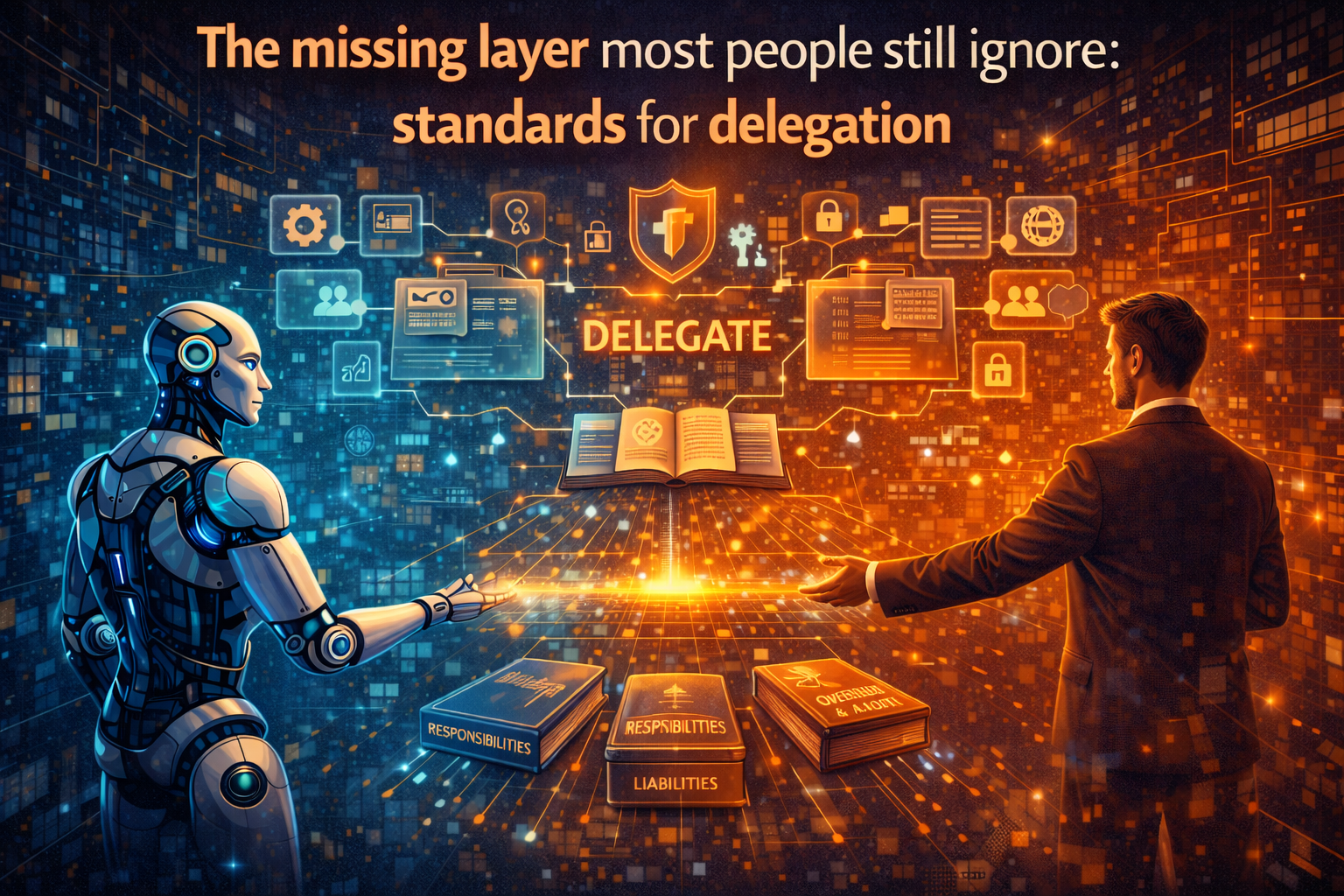
The missing layer most people still ignore: standards for delegation
Most AI standards discussions still revolve around familiar themes: safety, bias, explainability, model evaluation, and data governance.
All of these matter.
But the next frontier is delegation.
Not just:
Can the system generate a good answer?
But:
Can it act?
On whose behalf?
Under what authority?
Within what limits?
With what evidence trail?
And with what recourse if it causes damage?
This is the DRIVER problem.
If SENSE makes reality legible, and CORE makes it intelligible, DRIVER makes action legitimate.
This is where today’s AI economy is still immature.
The next wave of standards will need to address:
- machine-readable authority,
- bounded permissions,
- action logging,
- exception handling,
- reversal rights,
- appeal paths,
- liability mapping,
- and trust transfer across institutions.
In the long run, this may matter even more than model standards.
Because the real break in enterprise AI does not happen when AI starts talking. It happens when AI starts acting.
The new company categories that will emerge
Once representation standards become economically central, new company categories will grow around them.
We are likely to see the rise of:
- representation infrastructure firms that convert messy real-world signals into machine-trustable forms,
- delegation infrastructure firms that manage authority, permissions, and execution boundaries,
- provenance networks that verify source and transformation history,
- recourse platforms that manage disputes, corrections, and reversals,
- representation auditors that assess whether machine-readable reality is fit for consequential use,
- and standards orchestration firms that help industries operationalize abstract standards across real workflows.
These will not be side markets. They may become core infrastructure markets of the AI economy.
Conclusion: the deepest power in AI may belong to those who standardize reality
The first era of software digitized work.
The first era of AI generated outputs.
The next era will determine which representations of reality become trustworthy enough for machines to act on.
That is why representation standards matter.
And that is why one of the defining economic questions of the AI age is no longer just:
Who builds the smartest model?
It is:
Who writes the accepted grammar of reality for machines?
Because in the AI economy, the deepest power may belong not to those who create intelligence, but to those who standardize what intelligence is allowed to trust.
That is the real strategic frontier now opening before boards, regulators, standards bodies, infrastructure companies, and every enterprise trying to build durable AI advantage.
Glossary
Representation standards
Shared rules that define how reality is described in forms machines can identify, compare, verify, and act upon.
Machine-readable reality
A structured representation of people, products, assets, events, permissions, and states that software and AI systems can process reliably.
SENSE
The layer where signals are captured, entities are identified, states are represented, and changes are updated over time.
CORE
The reasoning layer where AI systems interpret context, estimate outcomes, rank options, and generate decisions or recommendations.
DRIVER
The action and legitimacy layer where authority, permissions, evidence, execution, verification, reversal, and recourse are managed.
Provenance
The record of where a piece of information or content came from, who changed it, and how it evolved.
Verifiable credential
A tamper-evident, machine-verifiable digital claim such as a degree, license, or identity attribute. (W3C)
Delegated authority
The formal boundary within which an AI system is allowed to act on behalf of a person or institution.
Recourse
The mechanism through which a wrong AI-driven action can be challenged, corrected, reversed, or appealed.
Representation-ready firm
An organization whose identities, records, permissions, provenance, and governance structures are mature enough for safe machine participation.
AI Economy
An economic system where value is created by AI systems through data, decisions, and automation.
Machine-Readable Reality
The portion of the real world that is structured, captured, and interpretable by machines.
Representation in AI
How real-world entities, events, and states are modeled so AI systems can understand and act on them.
AI Decision Systems
Systems that use data and models to automate or assist decision-making processes.
AI Governance
Frameworks and rules that ensure AI systems operate safely, ethically, and reliably.
FAQ
- What are representation standards in AI?
Representation standards are shared rules for describing identity, provenance, state, authority, and recourse in machine-readable ways so AI systems can operate safely and consistently across institutions.
- Why compare AI standards with GAAP?
GAAP gave markets a common grammar for financial reality. AI now needs a comparable grammar for machine-readable reality so systems can trust, compare, verify, and act across organizational boundaries. (Accounting Foundation)
- Are representation standards the same as AI model standards?
No. Model standards focus on how AI systems are built and evaluated. Representation standards focus on how the world is described to those systems.
- Why does this matter for boards and C-suites?
Because many AI failures come from weak or fragmented representations of reality rather than from model weakness alone. Firms need governance over identity, provenance, authority, and recourse—not just model performance.
- What is the biggest missing layer in AI governance today?
Delegation. The hardest question is no longer whether AI can produce an answer. It is whether AI is authorized to act, within what limits, and with what recourse if it goes wrong.
- Which institutions are already shaping this space?
Standards and governance are emerging through ISO/IEC SC 42, NIST, OECD, UNESCO, C2PA, W3C, OpenID, GS1, and regulatory frameworks such as the EU AI Act. (ISO)
- What kinds of new companies will emerge from this shift?
Representation infrastructure firms, delegation infrastructure firms, provenance networks, recourse platforms, representation auditors, and standards orchestration firms.
1. What is the real question of the AI era?
The real question is not about intelligence, but about what AI systems can see and represent, as this determines their decisions and outcomes.
2. Why is representation important in AI?
Because AI systems can only act on what is represented, incomplete or incorrect representation leads to poor or risky decisions.
3. How does representation affect AI trust?
Trust depends on whether AI systems correctly understand reality. Misrepresentation leads to loss of trust.
4. Is AI intelligence enough for success?
No. Even highly intelligent models fail if the underlying data and representation are incomplete or flawed.
5. What will define winners in the AI economy?
Organizations that build better machine-readable representations of reality will have a significant advantage.
References and further reading
Financial reporting became comparable and machine-readable through institutions and standards such as GAAP, IFRS, and XBRL. (Accounting Foundation)
The international AI standards landscape includes ISO/IEC JTC 1/SC 42 and related work on AI data life cycle and controllability. (ISO)
Governance and risk frameworks are also taking shape through NIST’s AI RMF, the OECD AI Principles, UNESCO’s ethics recommendation, and the EU AI Act. (NIST)
Portable trust layers are emerging through C2PA for content provenance, W3C Verifiable Credentials for machine-verifiable claims, OpenID Connect for interoperable identity assertions, and GS1 for globally standardized product identifiers and attributes. (C2PA)



Raktim Singh is an AI and deep-tech strategist, TEDx speaker, and author focused on helping enterprises navigate the next era of intelligent systems. With experience spanning AI, fintech, quantum computing, and digital transformation, he simplifies complex technology for leaders and builds frameworks that drive responsible, scalable adoption.