
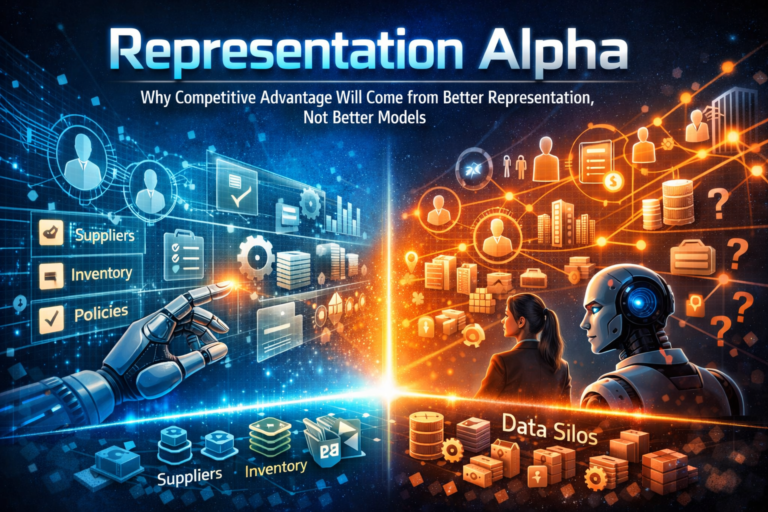
Representation Alpha: Executive summary
For the last few years, the AI race has been described as a model race. Which model is smarter? Which model is cheaper? Which model reasons better? Which model is more agentic?
Those questions still matter. But they no longer go deep enough.
A deeper shift is now underway. As advanced AI capabilities become more broadly available through APIs, tool calling, retrieval, workflow integrations, and connected systems, raw intelligence is becoming easier to access across firms. The basis of advantage is therefore moving. It is moving away from model access alone and toward something harder to copy: the quality of an institution’s representation of reality. OpenAI’s official developer documentation, for example, emphasizes tool use and function calling as a way for models to connect to external systems and act on structured context rather than rely only on static model knowledge. (OpenAI Platform)
That shift is the foundation of Representation Alpha.
Representation Alpha is the performance advantage an institution gains when it is better than competitors at making relevant reality machine-legible, machine-trustworthy, and machine-actionable.
In simple language, two companies may use similar AI models. But the one whose customers, products, suppliers, risks, policies, permissions, workflows, and exceptions are better represented inside the decision system will outperform the other.
Not because its model is magically smarter.
Because its world is easier for the model to work with.
That difference will become one of the most consequential sources of advantage in the AI economy.
What is Representation Alpha?
Representation Alpha is the competitive advantage gained when an organization represents its reality—customers, products, policies, and workflows—in a way AI systems can reliably understand and act on.
The old AI question is fading
For much of the recent AI cycle, leaders have focused on one core issue: access to intelligence.
That made sense. When model capability was scarce, the obvious question was whether a firm had access to the best engine.
But as the market evolves, that question weakens. More organizations can now access advanced reasoning, generation, retrieval, and tool-enabled behavior through shared platforms and developer ecosystems. That does not mean all firms become equal. It means advantage shifts to a new layer. (OpenAI Platform)
The new question is not merely:
Do we have powerful AI?
It is:
Can powerful AI work reliably with the reality of our institution?
That is a much harder question. It is also the one that matters more.
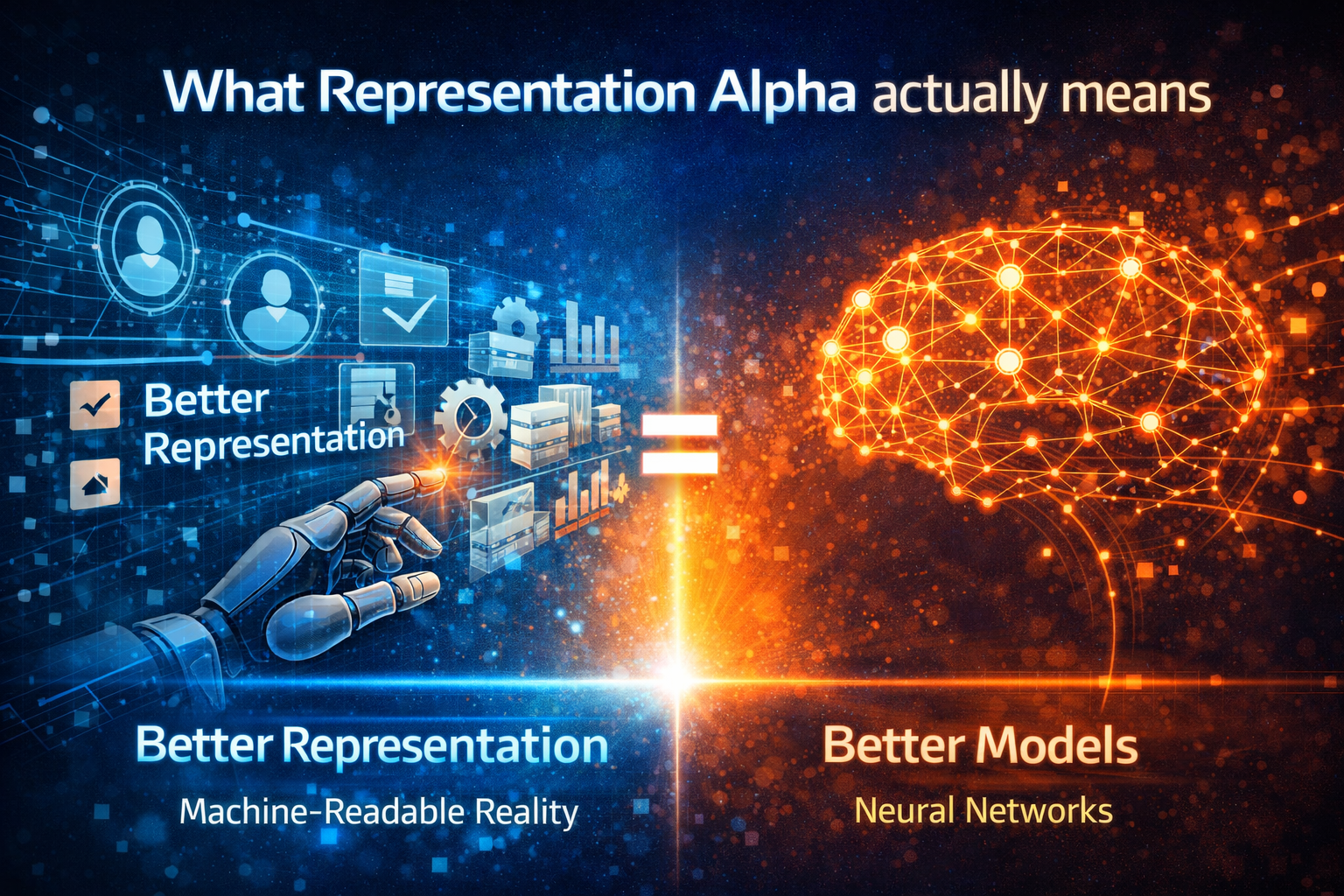
What Representation Alpha actually means
Representation Alpha is not a fashionable label for data quality. It is broader and more strategic.
It refers to an institution’s ability to ensure that what matters in its operating world is represented in a form machines can correctly use.
That includes:
-
Identity
Can the system clearly determine who or what the relevant entity is?
-
State
Can the system understand the current condition of that entity right now, not last week?
-
Structure
Can the model work with the information in a machine-usable form?
-
Authority
Can the system determine what actions are allowed, by whom, and under which rules?
-
Verification
Can claims be checked before the system acts?
-
Recourse
If the system is wrong, can the action be traced, challenged, and corrected?
That is why Representation Alpha is not just an information problem. It is an institutional design problem.
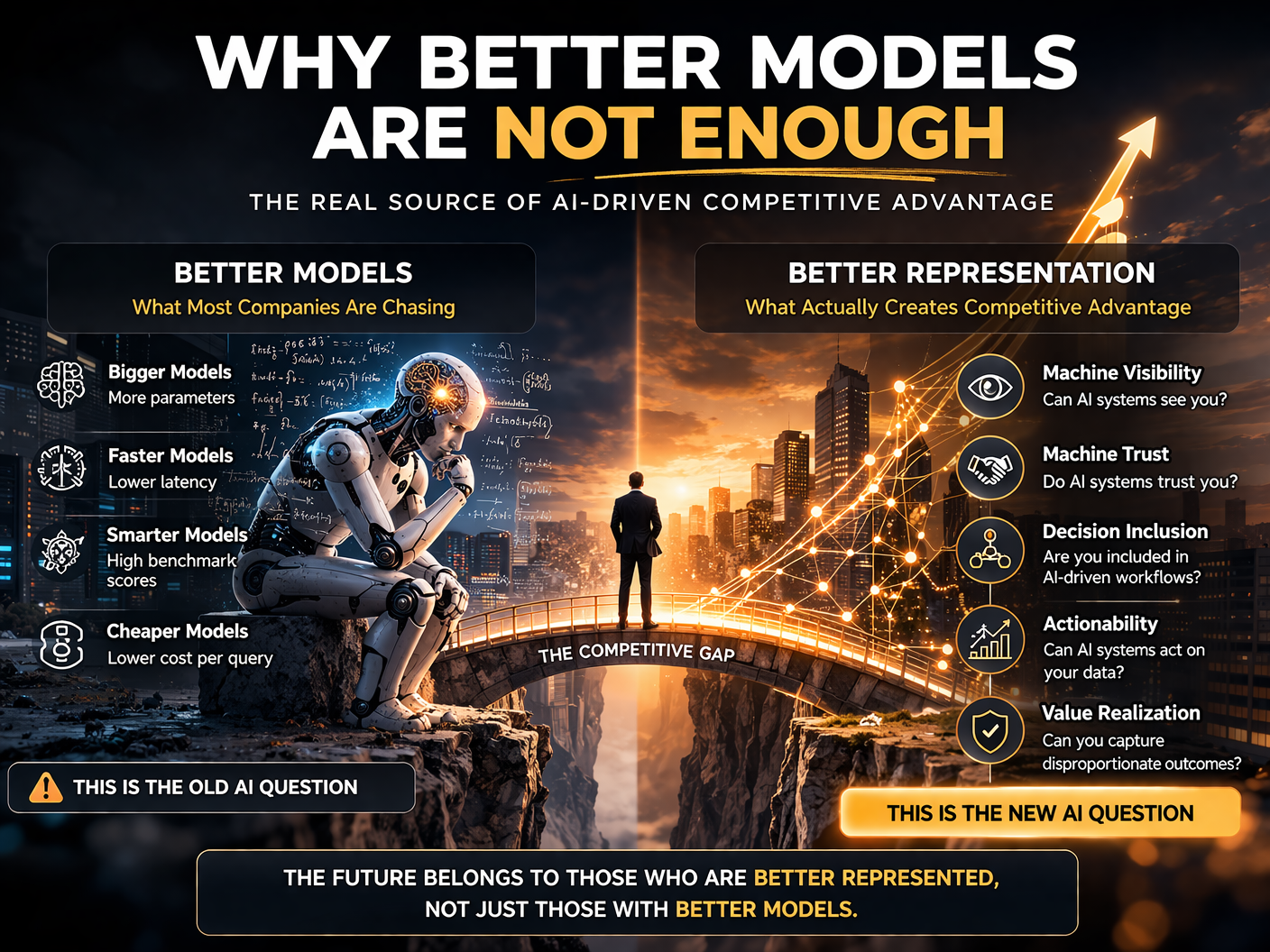
Why better models are not enough
A model can only reason over what enters its field of action.
If facts are missing, ambiguous, stale, weakly structured, or detached from authority, the model does not become powerful enough to solve that institutional failure. A better engine does not fix an invisible road.
This is where many enterprise AI strategies go wrong. They assume that once cognition improves, outcomes will automatically improve. But in real systems, outcomes depend on whether the model is working on reality that has been represented clearly enough to support sound judgment and action.
A simple procurement example
Imagine two manufacturers using the same advanced AI agent to reorder components.
The first firm has:
- clean supplier identities
- structured inventory states
- verified lead times
- machine-readable contract terms
- clear delegation rules for approvals
The second firm has:
- duplicate supplier records
- inconsistent part naming
- email inboxes serving as the real source of truth
- unclear authority thresholds
- exceptions hidden in the heads of experienced employees
The same model enters both environments.
In one company, it behaves like a multiplier.
In the other, it behaves like a confused intern.
That gap is Representation Alpha.
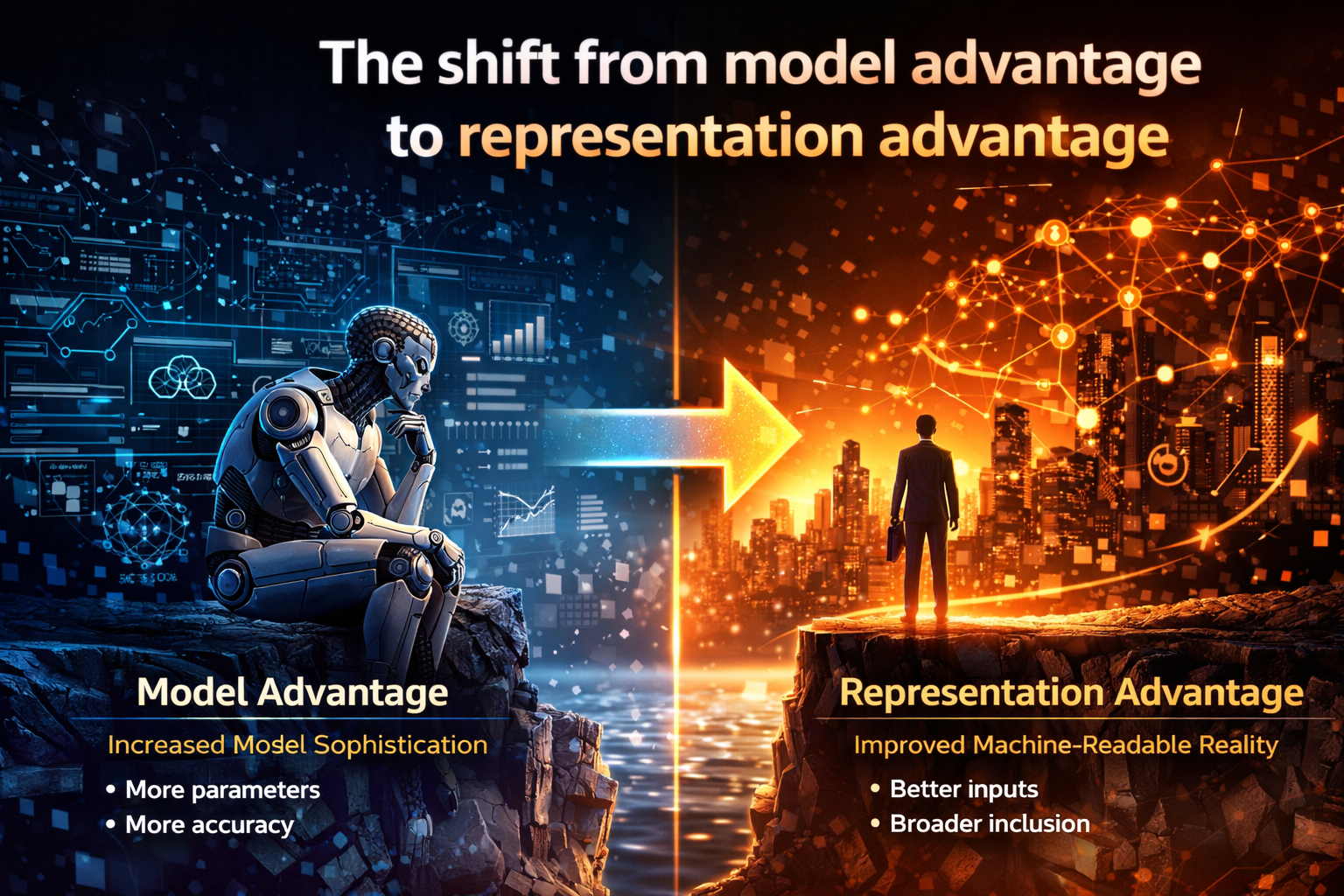
The shift from model advantage to representation advantage
This shift is already visible in adjacent systems.
Google’s documentation states that structured data helps Google understand page content and enables richer appearances in search results. Its product documentation also explains that structured product data can help Google show pricing, availability, ratings, and related details in richer formats. In other words, machine visibility improves when reality is expressed in machine-usable form. (Google for Developers)
That principle matters far beyond search.
As AI systems increasingly use tools, APIs, databases, policies, and external systems, the competitive issue becomes less about whether the model can generate plausible output and more about whether the institution is represented in a way the model can reliably operate on. (OpenAI Platform)
Models may converge.
Representation does not.
That is why better representation is becoming a more durable source of advantage than better models alone.
A simple everyday example
Imagine three restaurants using the same AI reservation assistant.
Restaurant A gives the system:
- live table availability
- current menu status
- allergy flags
- kitchen wait times
- staff assignment visibility
- cancellation rules
- escalation logic for exceptions
Restaurant B gives the system:
- yesterday’s spreadsheet
- menu descriptions copied from an old brochure
- no allergy linkage
- no live occupancy state
- no encoded policy for edge cases
Same model.
Very different customer experience.
Customers do not experience AI quality as benchmark scores. They experience whether the system understood reality and acted correctly.
The winning restaurant is not the one with the fanciest model. It is the one with the most decision-ready representation of its operating world.
That is Representation Alpha in everyday form.
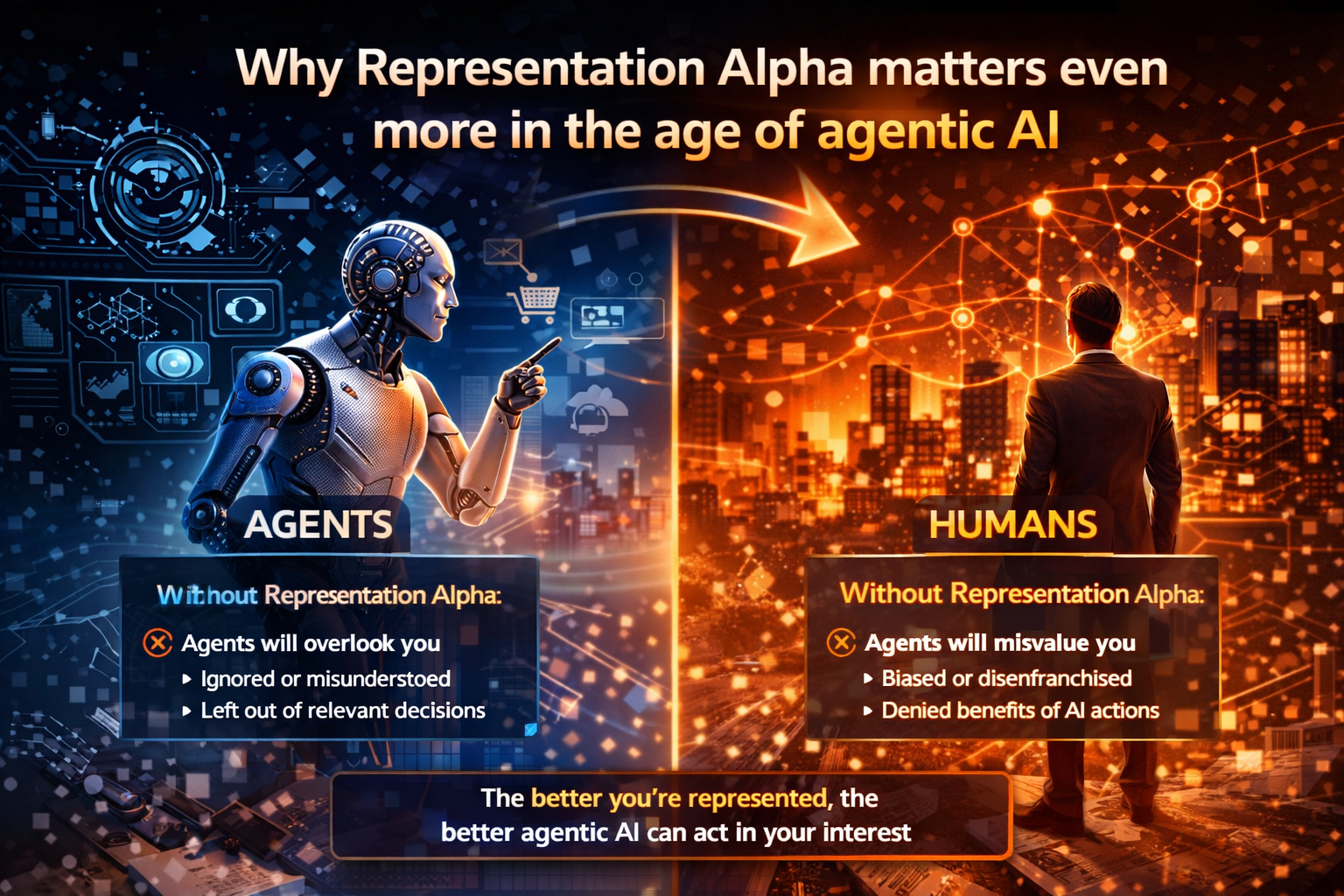
Why Representation Alpha matters even more in the age of agentic AI
This becomes sharper as AI moves from response generation to action.
A chatbot can survive with partial context because it mainly produces language. An agent that books, routes, approves, blocks, orders, escalates, or triggers downstream workflows cannot.
The moment AI starts acting, representation quality becomes an operational variable.
If the system does not know:
- who the entity is
- what state it is in
- what authority applies
- what evidence supports action
- what the acceptable boundary conditions are
- what recourse exists if the action is wrong
then autonomy becomes fragile.
This is closely aligned with the logic of the NIST AI Risk Management Framework, which emphasizes governance, mapping context, measurement, and management, along with trustworthiness characteristics such as validity, reliability, accountability, transparency, privacy, safety, and security. (NIST)
The deeper point is simple:
AI systems do not win merely by thinking better.
They win by acting on better-represented reality.
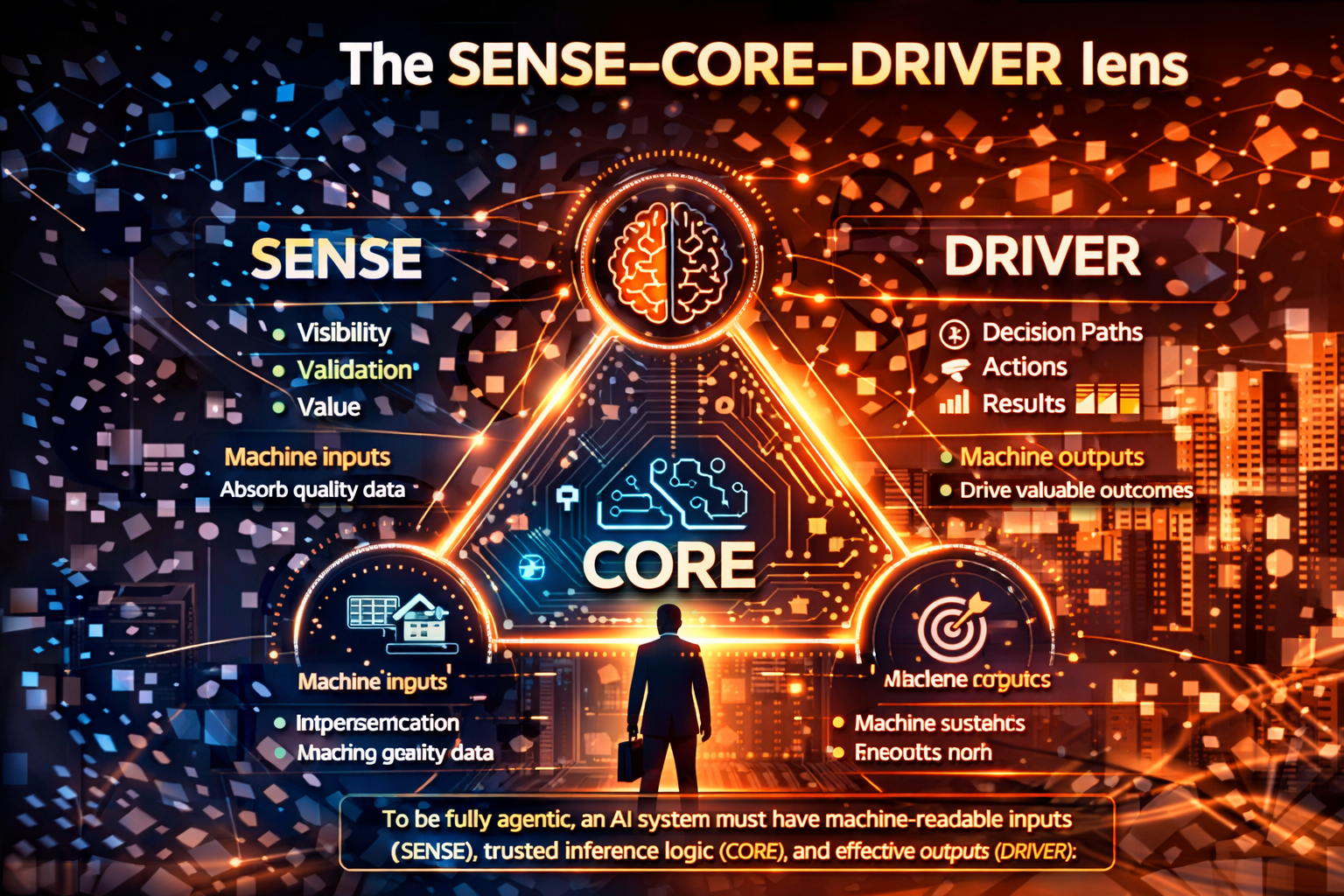
The SENSE–CORE–DRIVER lens
Representation Alpha becomes easier to understand when seen through the SENSE–CORE–DRIVER framework.
SENSE: alpha begins before intelligence
Competitive advantage starts with the institution’s ability to detect meaningful signals, attach them to the right entity, maintain an accurate state representation, and keep that state updated as reality changes.
If the signal is weak, the entity is ambiguous, or the state is stale, advantage is already leaking before the model begins reasoning.
CORE: intelligence amplifies representation
The reasoning layer can optimize only on the quality of the world presented to it.
CORE does not create institutional reality from nothing. It works on represented reality. A powerful model over poor representation often produces elegant failure.
DRIVER: action turns representation into advantage
Real alpha appears only when the system can act with legitimate delegation, appropriate verification, controlled execution, and recourse.
A model that knows something but cannot act safely does not create enterprise advantage.
A system that sees correctly, reasons appropriately, and acts within governed boundaries does.
This is why Representation Alpha is not merely a data concept or a model concept. It is an architectural concept.
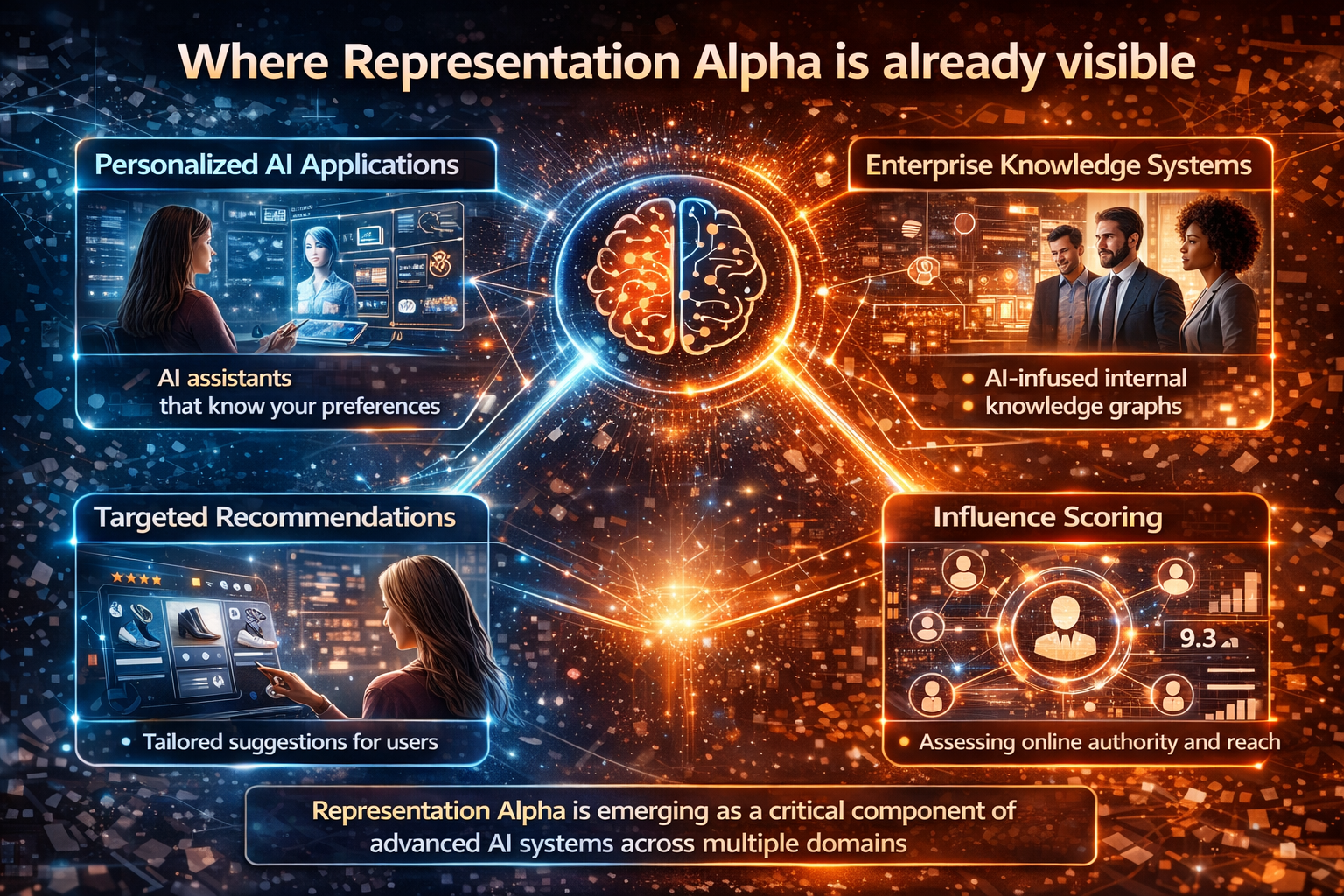
Where Representation Alpha is already visible
Where Representation Alpha is already visible
You can already see early versions of this across markets and digital infrastructure.
In digital identity and trust, the W3C’s Verifiable Credentials Data Model 2.0 was published as a Recommendation in May 2025. W3C describes this family of specifications as a way to express digital credentials that are cryptographically secure, privacy-respecting, and machine-verifiable. That matters because machine-verifiable claims are becoming part of how institutions present trust in a form systems can consume directly. (W3C)
This is not a narrow standards story. It is part of a larger economic pattern.
A supplier with poor identity proof may lose routing priority.
A product with weak metadata may lose discoverability.
A service provider with ambiguous policy representation may lose agent-mediated transactions.
A firm with unclear delegation rules may slow every autonomous workflow.
These are not failures of model intelligence.
They are failures of representation.
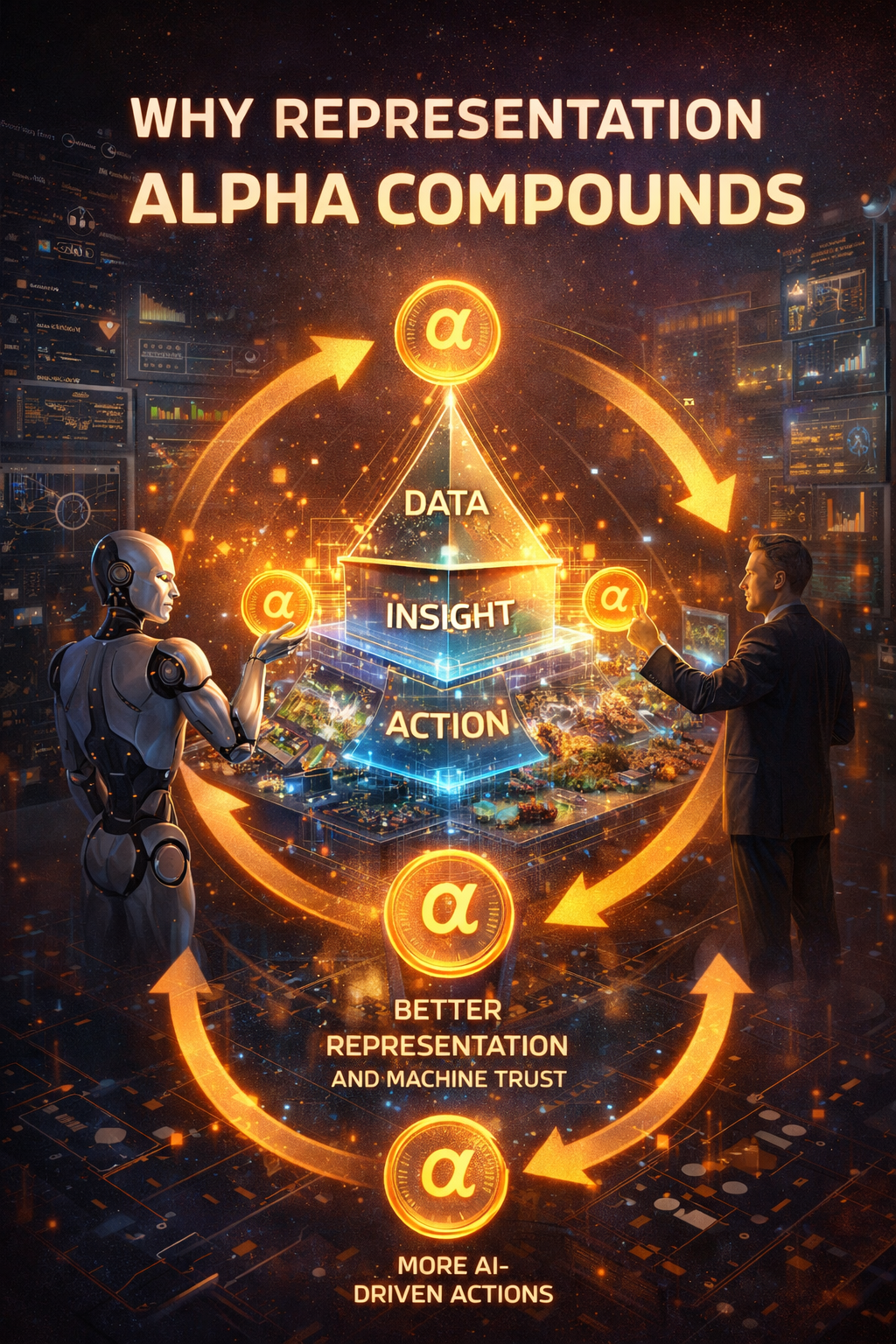
Why Representation Alpha compounds
One of the most important qualities of Representation Alpha is that it compounds over time.
When a company is easier for machines to interpret and trust, it becomes:
- easier to discover
- easier to compare
- easier to route to
- easier to integrate with
- easier to transact with
- easier to govern
- easier to include inside larger machine workflows
That creates more interactions. More interactions create more usable signals. More signals improve state quality. Better state quality improves decisions. Better decisions strengthen trust. Stronger trust increases machine preference.
Over time, representation advantage can become self-reinforcing.
This is one reason the future AI economy may reward not only intelligence providers, but also the institutions that build superior representation infrastructure around real entities, relationships, permissions, and states.
What leaders still get wrong
Many leaders still treat AI strategy mainly as a model-choice problem.
They ask:
- Should we use the biggest model?
- Should we fine-tune?
- Should we build our own model?
- Should we switch vendors?
- Should we deploy more agents?
These are valid questions. But they are often second-order questions.
The first-order questions are harder:
- Are our core entities clearly represented?
- Can our systems maintain live state?
- Are our policies machine-readable?
- Are permissions explicit and auditable?
- Can external systems verify claims?
- Can the AI distinguish signal from noise?
- Can action be traced and reversed when necessary?
A company that cannot answer those questions may still produce impressive demos. But it will struggle to convert AI into repeatable institutional advantage.
What new winners will do differently
The next generation of winners will treat representation as a strategic asset, not a technical afterthought.
They will invest in:
- identity clarity
- state fidelity
- metadata quality
- structured workflows
- verifiable claims
- delegation controls
- action logs
- recourse mechanisms
- machine-readable policies
- continuously updated operational context
In other words, they will build for machine participation, not just human coordination.
That is the deeper shift now underway. The AI economy is not only rewarding firms that use intelligence. It is rewarding firms that are structurally prepared to be understood, trusted, and acted with by intelligence.
The board-level implication
Boards should stop asking only whether the company has adopted AI.
They should start asking whether the company’s operational reality is represented well enough for AI to produce reliable advantage.
That includes questions such as:
- Where are our biggest representation gaps?
- Which entities in our system are poorly legible to machines?
- Which decisions fail because state is stale or fragmented?
- Where are permissions implicit rather than encoded?
- Which workflows cannot safely support agentic execution?
- Where will representation quality determine market access, trust, or valuation?
This is where AI strategy becomes a board topic rather than an experimentation topic.
Because in the years ahead, many firms will have access to strong models. Not all of them will have Representation Alpha.
And that will help explain why some companies, using similar AI, grow faster, coordinate better, reduce friction, earn more machine trust, and compound advantage while others remain trapped in pilot mode.

Conclusion: the next alpha will come from reality design
The market is moving toward a world in which intelligence is increasingly rented, embedded, and widely distributed.
In that world, the rarest asset will not be cognition alone.
It will be the institutional ability to make reality available to cognition in a form that is legible, trustworthy, current, and actionable.
That is why the next era of competitive advantage will not be defined only by who has better models.
It will be defined by who has built better representation.
That is the strategic meaning of Representation Alpha. And it may become one of the most important ideas for leaders trying to understand how advantage will actually be created in the AI economy.
Glossary
Representation Alpha
The competitive advantage gained when an institution represents relevant reality in a form machines can reliably understand and act on.
Representation Economics
A framework for understanding how value, trust, visibility, and participation are shaped by how reality is represented to machine systems.
Machine-legible
Information structured in a form systems can interpret consistently.
Machine-trustworthy
Information presented with enough validation, provenance, and clarity for systems to rely on it.
Machine-actionable
Information represented well enough for a system to make or support real decisions and actions.
SENSE
The legibility layer where signals are captured, attached to entities, represented as state, and updated over time.
CORE
The cognition layer where systems interpret context, optimize decisions, and generate intelligence from represented reality.
DRIVER
The execution and legitimacy layer where authority, verification, action, and recourse are governed.
Agentic AI
AI systems that do more than generate content; they use tools, workflows, or delegated authority to act in software or business processes.
Verifiable credentials
Digitally issued claims that can be checked cryptographically and used in a machine-verifiable way. (W3C)
Structured data
Machine-readable markup that helps systems and search engines interpret content more accurately. (Google for Developers)
FAQ
What is Representation Alpha?
Representation Alpha is the competitive advantage an organization gains when it represents customers, products, suppliers, policies, permissions, and workflows in a way AI systems can reliably understand and act on.
Why will better representation matter more than better models?
Because advanced AI capability is becoming more accessible across firms through APIs, tools, and integrated systems. The bigger difference increasingly lies in whether the institution’s reality is represented clearly enough for that AI to operate effectively. (OpenAI Platform)
Is Representation Alpha just another term for data quality?
No. Data quality is part of it, but Representation Alpha is broader. It includes identity, state, structure, authority, verification, workflow context, and governed action.
How does this connect to agentic AI?
Agentic AI must act, not just answer. That requires stronger identity clarity, current state, explicit permissions, verification, and recourse than standard chat use cases. (NIST)
Why is this a board-level issue?
Because the competitive outcome of AI adoption will increasingly depend on whether the institution itself is machine-ready. That affects speed, trust, decision quality, operating leverage, and the ability to scale AI safely.
What should companies do first?
Start by identifying the core entities, states, permissions, and policies that matter most to business decisions. Then improve how those are represented, verified, updated, and governed inside systems.
References and further reading
For factual grounding and further exploration, the following sources are especially relevant:
- OpenAI developer documentation on tool use and function calling, which reflects the shift toward models acting through external systems and structured context. (OpenAI Platform)
- Google Search Central documentation on structured data and rich results, which shows how machine-readable markup improves discoverability and understanding. (Google for Developers)
- NIST AI Risk Management Framework, which emphasizes governance, context, measurement, and trustworthiness in operational AI systems. (NIST)
- W3C Verifiable Credentials Data Model 2.0 and related W3C announcements, which show the maturation of machine-verifiable trust infrastructure. (W3C)
Explore the Architecture of the AI Economy
This article is part of a broader research series exploring how institutions are being redesigned for the age of artificial intelligence. Together, these essays examine the structural foundations of the emerging AI economy — from signal infrastructure and representation systems to decision architectures and enterprise operating models.
If you want to explore the deeper framework behind these ideas, the following essays provide additional perspectives:
-
- • Why Most AI Projects Fail Before Intelligence Even Begins
- The Representation Economy: Why AI Institutions Must Run on SENSE, CORE, and DRIVER – Raktim Singh
- The Representation Economy: Why Intelligent Institutions Will Run on the SENSE–CORE–DRIVER Architecture – Raktim Singh
- The Representation Economy Explained: 51 Questions About the SENSE–CORE–DRIVER Architecture – Raktim Singh
- The Representation Deficit: Why Institutions Fail When Reality Cannot Enter the Decision System – Raktim Singh
- The Representation Maturity Model: How Boards Decide When AI Can Be Trusted With Real Decisions – Raktim Singh
- Representation Capital: The Invisible Asset That Will Decide Which Institutions Win the AI Economy – Raktim Singh
- Representation Failure: Why AI Systems Break When Institutions Misread Reality – Raktim Singh
- The Board’s Representation Strategy: How Intelligent Institutions Decide What Must Be Seen, Modeled, Governed, and Delegated – Raktim Singh
- The Representation Premium: Why Institutions That Are Easier for AI to See, Trust, and Coordinate With Will Win the Next Economy – Raktim Singh
- The Firm of the AI Era Will Be Built Around Representation: Why Institutions Must Redesign Themselves for the SENSE–CORE–DRIVER Economy – Raktim Singh
- The Representation Balance Sheet: How AI Is Redefining Assets, Liabilities, and Institutional Strength – Raktim Singh
- The Representation Stack: The New Architecture of Intelligent Institutions in the AI Economy – Raktim Singh
- Representation Economics: The New Law of Value Creation in the AI Era – Raktim Singh
- The Representation Reserve Currency: Why AI Will Trust Only a Few Forms of Reality – Raktim Singh
- The Machine-Readable Boundary of the Firm: How AI Is Redefining What Companies Own, Outsource, and Orchestrate – Raktim Singh
- Representation Insurance: Why Machine-Readable Trust Will Power the AI Economy – Raktim Singh
- Representation Arbitrage: The New AI Advantage That Will Redefine Who Wins and Who Disappears – Raktim Singh
- The Representation Commons: Why Broad-Based AI Value Begins Before the Model – Raktim Singh
- The Representation Access Economy: Why AI Will Decide Who Gets Seen, Structured, and Trusted – Raktim Singh
- Representation Bankruptcy: Why AI Will Break Companies That Machines Cannot Trust – Raktim Singh
- The Representation Kill Zone: Why Companies Become Invisible Before They Realize They Are Losing – Raktim Singh
Together, these essays outline a central thesis:
The future will belong to institutions that can sense reality, represent it clearly, reason about it intelligently, and act through governed machine systems.
This is why the architecture of the AI era can be understood through three foundational layers:
SENSE → CORE → DRIVER
Where:
- SENSE makes reality legible
- CORE transforms signals into reasoning
- DRIVER ensures that machine action remains accountable, governed, and institutionally legitimate
Signal infrastructure forms the first and most foundational layer of that architecture.
AI Economy Research Series — by Raktim Singh



Raktim Singh is an AI and deep-tech strategist, TEDx speaker, and author focused on helping enterprises navigate the next era of intelligent systems. With experience spanning AI, fintech, quantum computing, and digital transformation, he simplifies complex technology for leaders and builds frameworks that drive responsible, scalable adoption.