
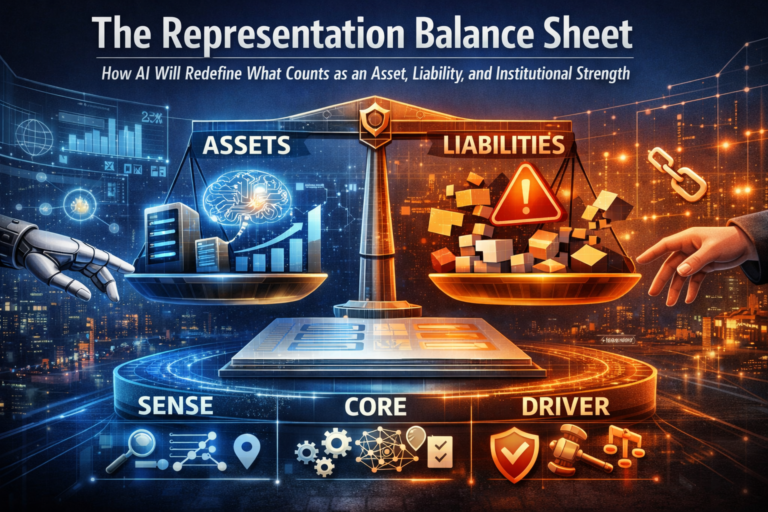
Most organizations still assess strength using categories inherited from the industrial and software eras: capital, infrastructure, talent, brand, intellectual property, process efficiency, and financial resilience.
But the AI era is changing the structure of advantage.
As AI systems move from supporting tasks to shaping judgments, coordinating workflows, influencing decisions, and triggering actions, the real question is no longer just what an institution owns. The real question is whether the institution can make reality legible enough for intelligence systems to reason over it, govern it, and act on it safely.
That is why boards and C-suites need a new lens: the representation balance sheet.
A representation balance sheet is the strategic view of how well an institution converts reality into machine-usable form. It reveals which parts of institutional reality have become assets, which hidden weaknesses have become liabilities, and which capabilities now determine real strength in the AI economy.
This is not a finance-only concept. It is a board-level management idea for a world in which institutional advantage increasingly depends on three layers:
- SENSE — the ability to detect signals, identify entities, model state, and track evolution
- CORE — the ability to reason over represented reality, compare options, and improve decisions
- DRIVER — the ability to delegate action within legitimate authority, verification, execution, and recourse boundaries
In this new environment, organizations will not win simply because they have more AI tools or larger models. They will win because they maintain stronger representation balance sheets.
That is the next strategic frontier of the Representation Economy.

The Next Balance Sheet Will Not Be Built Only from Money, Machines, and Brands
For decades, institutions learned to measure strength using familiar categories: cash, infrastructure, intellectual property, talent, market share, debt, risk, brand equity, and operational scale.
That logic made sense in an economy where most value creation depended on human judgment, software workflows, and physical or financial assets.
But the AI era is changing something deeper than productivity.
It is changing the very structure of what institutions must be able to see, model, govern, and act on.
That is why the next important management question is no longer only, “How much AI do we use?” It is: What does our institution make legible to intelligence systems, and how well can that intelligence be turned into reliable, governed action?
That question leads to a new idea: the representation balance sheet.
The representation balance sheet is the emerging discipline through which organizations assess the quality of their machine-legible reality. It asks which parts of institutional reality have become usable assets, which hidden weaknesses have become liabilities, and which capabilities now determine durable institutional strength in an AI-shaped economy.
This is not just a technology issue. It is becoming a board issue, a strategy issue, a governance issue, and eventually a valuation issue.
Because in the age of AI, institutions will increasingly rise or fall not only on what they own, but on what they can accurately represent.
Why the Old Balance Sheet Logic Is No Longer Enough
AI adoption is no longer a fringe phenomenon. Stanford’s 2025 AI Index reports that 78% of organizations said they used AI in 2024, up from 55% in 2023. It also reports that the share of respondents using generative AI in at least one business function rose from 33% to 71% in the same period. (hai.stanford.edu)
That shift matters because once AI moves from experimentation into real business processes, institutions are no longer dealing only with software automation. They are dealing with machine-mediated perception, reasoning, recommendation, and action.
At the same time, governance expectations are rising. NIST’s AI Risk Management Framework organizes AI risk management around the functions Govern, Map, Measure, and Manage, while the OECD AI Principles emphasize trustworthy AI, accountability, transparency, robustness, human rights, and democratic values. (NIST)
This creates a structural tension.
Our accounting, management, and governance systems were largely built for a world in which intelligence lived mainly in people and clearly bounded software systems. But AI operates differently. It depends on whether reality is visible, structured, connected, current, and governable across messy institutional environments.
Traditional balance sheets can tell you what an institution owns.
They are far less capable of telling you whether that institution can turn fragmented reality into trustworthy machine intelligence.
That gap is becoming economically significant.
What Is a Representation Balance Sheet?
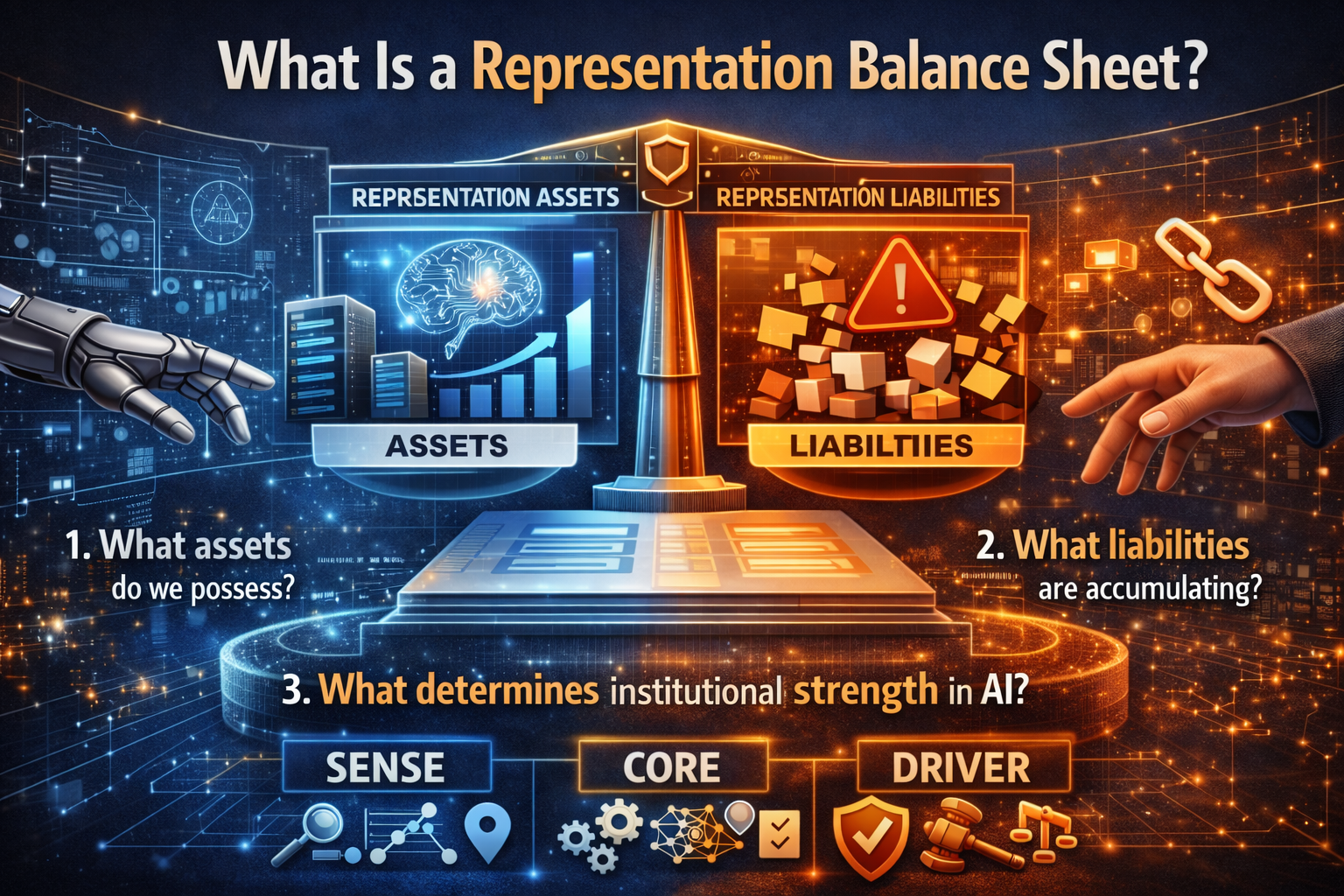
A representation balance sheet is the strategic view of how well an institution converts reality into machine-usable form.
It is not a formal accounting statement. It is a management and strategy framework for understanding the new economic structure of the AI era.
It asks three foundational questions:
-
What representation assets does the institution possess?
Which parts of reality are already legible, connected, structured, and usable for intelligence systems?
-
What representation liabilities are quietly accumulating?
Where is the organization fragmented, stale, opaque, unverifiable, or weak in recourse?
-
What does true institutional strength look like now?
How does competitive advantage change when performance depends not only on software or talent, but on SENSE, CORE, and DRIVER?
In simple language, the representation balance sheet tells leaders whether their organization is easy or difficult for intelligence systems to understand, reason over, and act within.
From Data Assets to Representation Assets
For years, executives repeated the phrase “data is the new oil.”
That phrase is now too shallow for the AI era.
Data alone is not enough. Most enterprises already have more data than they can effectively use. The real issue is not raw volume. The real issue is whether the institution can make that data meaningful, contextual, governed, and decision-ready.
A representation asset is therefore not just a dataset.
It is any capability that helps an institution convert reality into a reliable machine-readable form.
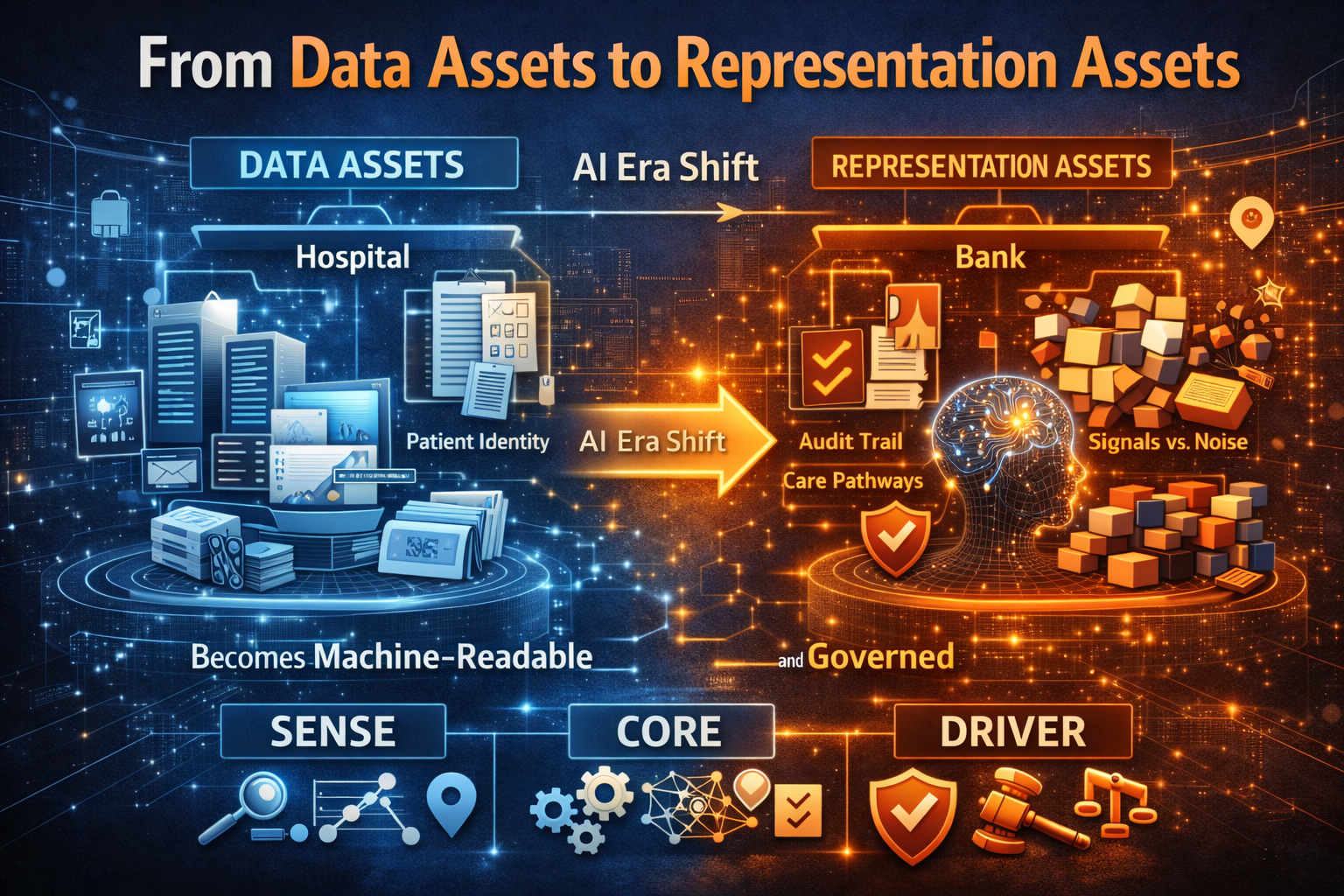
A hospital may possess millions of clinical records. That does not automatically make it representation-rich. But if those records are linked to patient identity, care pathways, consent rules, treatment chronology, audit trails, escalation paths, and human override mechanisms, the hospital has built something much more valuable: a governed representation layer for clinical intelligence.
A bank may hold vast transaction histories. But the real asset is not the transaction archive itself. The real asset is the institution’s ability to distinguish signal from noise, attach events to the right entities, understand risk state in context, and route decisions within lawful authority boundaries.
That is the strategic shift.
The winning institution is not merely data-rich.
It is representation-rich.
The SENSE–CORE–DRIVER View of the Balance Sheet
This is where the representation balance sheet becomes more than a metaphor. It becomes operational.
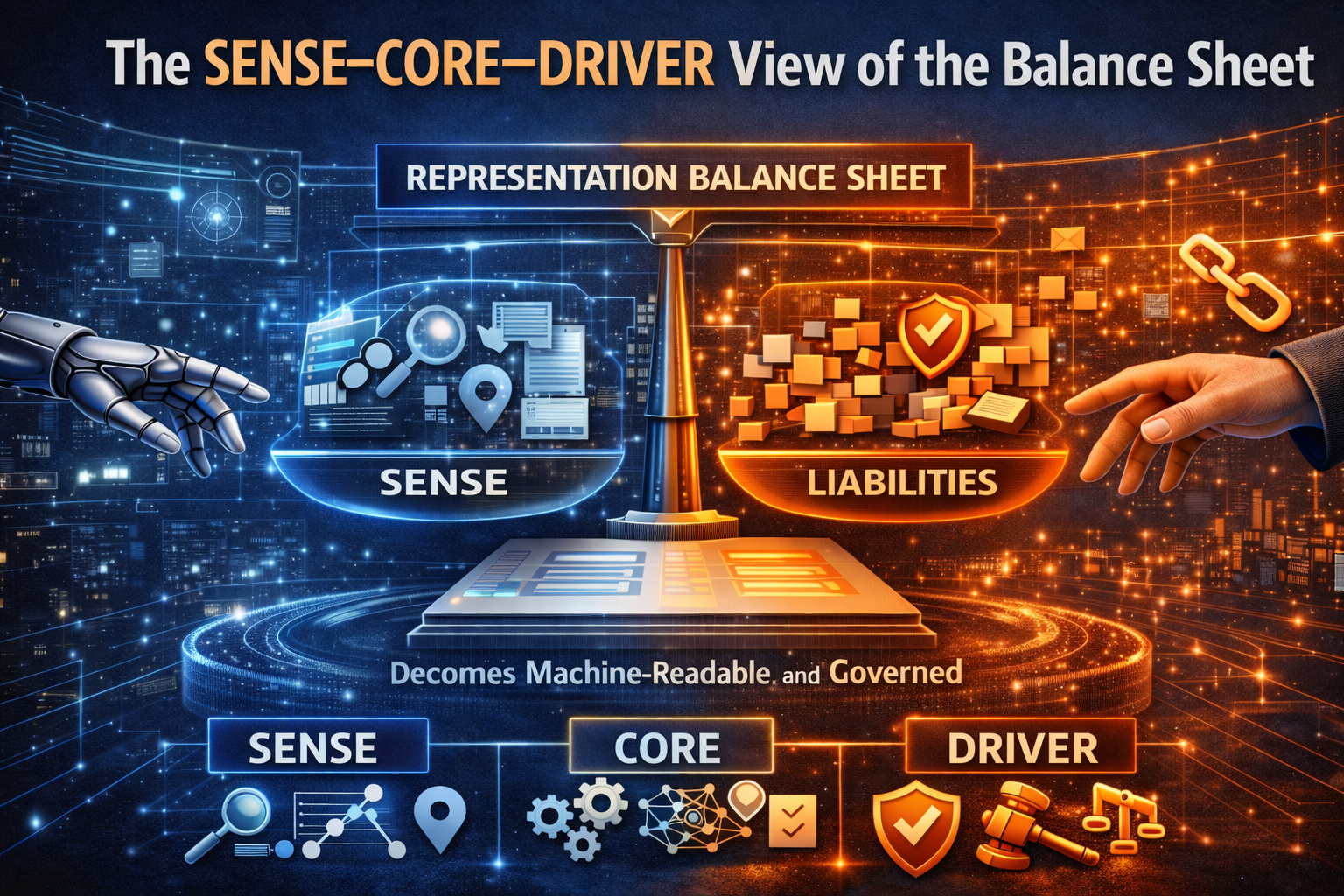
The representation balance sheet can be understood through SENSE, CORE, and DRIVER.
SENSE: The Asset Side Begins with Legibility
SENSE is the layer where reality becomes machine-legible.
It includes the institution’s ability to detect signals, identify entities, build state representations, and update those states over time.
If a logistics company cannot reliably know where an asset is, in what condition it exists, who is responsible for it, and what changed, then its representation balance sheet is already weak, even before any AI model is deployed.
Strong SENSE assets include:
Clean identity
Clear identifiers for customers, assets, products, employees, suppliers, cases, or locations
Event visibility
Reliable capture of relevant signals as they happen
State representation
A current, coherent view of the condition of the entity being managed
Evolution tracking
The ability to update state over time as reality changes
Context integrity
The presence of metadata, chronology, exceptions, and relational context that make signals meaningful
Weak SENSE environments are full of duplicates, missing identity, stale records, disconnected systems, inconsistent metadata, and invisible operational exceptions.
In the AI era, that difference is not administrative.
It is strategic.
CORE: Institutional Cognition Becomes an Asset Class
CORE is the reasoning layer.
This is where organizations interpret signals, compare options, generate recommendations, optimize trade-offs, and learn from outcomes.
A strong CORE does not merely run models. It knows:
- which reasoning path fits which decision
- what evidence is required
- what uncertainty remains
- when escalation is needed
- when automation should stop and human judgment should intervene
An insurer with strong CORE capabilities does not simply score risk. It distinguishes routine cases from ambiguous ones. It knows when similar-looking situations actually demand different forms of judgment. It can separate automation-worthy tasks from judgment-heavy decisions.
That reasoning architecture becomes an asset because it shapes decision quality, speed, consistency, auditability, and recourse.
In the old world, institutions often treated intelligence as a human cost center.
In the new world, governed cognition becomes an institutional asset.
DRIVER: Legitimacy Becomes Part of Economic Strength
DRIVER is where many institutions will discover that what looked like AI capability was actually fragile theater.
DRIVER is the execution and legitimacy layer. It governs:
Delegation
Who authorized the system to act?
Representation
What model of reality did the system rely on?
Identity
Which person, asset, process, or institution was affected?
Verification
How was the decision checked before execution?
Execution
How was the action carried out?
Recourse
What happens if the system is wrong?
This is the layer that answers the most important operational question in applied AI:
Not “Can the system decide?” but “Was it legitimate for the system to decide and act here?”
Imagine two organizations using similarly capable models.
One can only generate recommendations.
The other can safely delegate bounded actions because it has authority rules, execution controls, audit trails, reversal paths, and recourse built into operations.
The second organization has a much stronger representation balance sheet.
Why?
Because it has transformed intelligence into governed action capacity.
That is a deeper form of institutional strength.
The New Liabilities Nobody Wants to See
If representation assets are rising, representation liabilities are rising too.
These liabilities are often invisible in standard reporting. Yet they are becoming decisive in the AI era.
-
Representation fragmentation
The institution has the knowledge somewhere, but not in forms intelligence systems can unify or trust.
-
Representation staleness
The system is acting on yesterday’s reality while the world has already changed.
-
Identity weakness
Signals cannot be reliably attached to the correct person, asset, product, machine, or obligation.
-
Governance opacity
The institution may know what happened, but not whether the action was properly authorized, bounded, or reversible.
-
Recourse absence
The system can act, but there is no clean path back if the action was flawed, mistimed, or unjust.
-
Representation inconsistency
Different systems carry conflicting versions of reality, creating hidden coordination risk.
-
Delegation overreach
The organization hands action authority to systems before legitimacy and verification architecture is mature.
These are not minor technical flaws.
They are the hidden liabilities of the Representation Economy.
An enterprise can look digitally mature on the surface and still carry a deeply impaired representation balance sheet underneath.
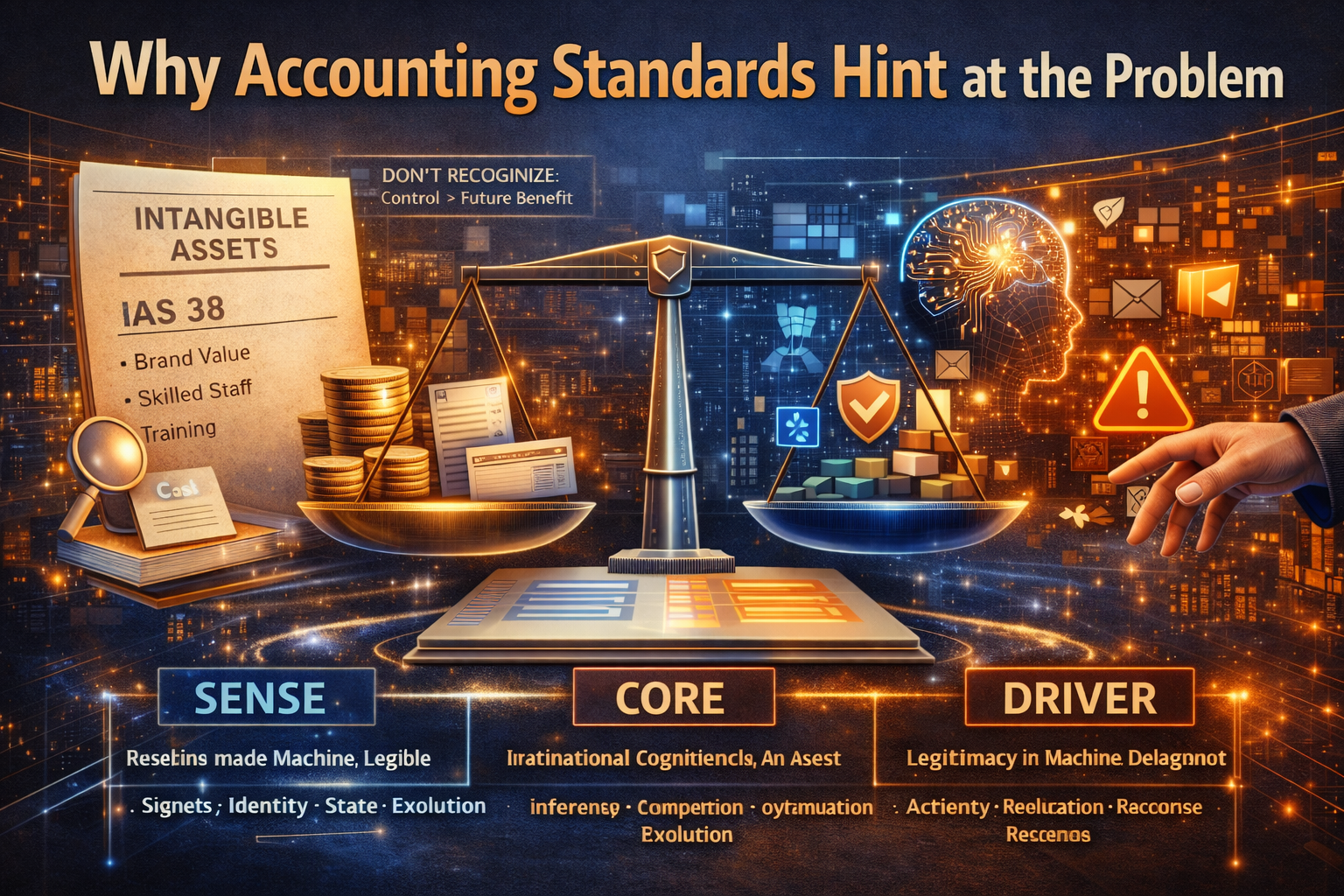
Why Accounting Standards Hint at the Problem
Formal accounting standards already reveal the mismatch between old measurement logic and the AI era.
IAS 38 defines an intangible asset as an identifiable non-monetary asset without physical substance and sets criteria for recognition and measurement. IFRS also notes that many internally generated sources of future value do not qualify neatly for recognition under current rules. Meanwhile, the IASB has launched a broader review of accounting for intangibles to assess whether existing requirements still reflect modern business models. (IFRS Foundation)
That is entirely understandable within current accounting logic.
But strategically, it also reveals the blind spot.
Some of the most consequential strengths of AI-era institutions may not map neatly onto traditional asset categories. Representation quality, delegation architecture, machine-legible identity, decision traceability, verification paths, and recourse design may all become decisive long before they are cleanly reflected in formal financial statements.
In other words, the economic map is changing before the accounting language fully catches up.
That is why boards cannot wait for accounting reform before they start thinking differently.
What Institutional Strength Will Mean Next
In the AI era, institutional strength will increasingly mean five things.
-
The ability to make more of reality legible
Can the institution reliably detect, structure, and contextualize what matters?
-
The ability to reason over that reality
Can it compare alternatives, handle ambiguity, and improve decisions?
-
The ability to delegate action safely
Can it allow bounded autonomy without losing control?
-
The ability to prove legitimacy
Can it show why a decision was made, under what authority, and with what evidence?
-
The ability to recover when systems are wrong
Can it reverse, remediate, escalate, and restore trust?
This is a profound shift.
Historically, strong firms were measured by scale, capital access, distribution power, brand trust, and operational efficiency.
Tomorrow’s strong firms will still need those things. But they will also need something new:
Representation integrity
That phrase matters because many AI conversations still focus too narrowly on model quality. But a brilliant model operating on weak representation infrastructure can still produce weak institutional outcomes.
A simpler way to put it:
A company with average models and superior representation architecture may outperform a company with frontier models and broken institutional legibility.
Simple Examples from the Real World
Retail
A retailer with a strong representation balance sheet knows not just what sold, but what inventory condition exists now, which signals suggest substitution risk, what customer intent is emerging, and what store systems are allowed to do automatically.
Manufacturing
A manufacturer with a strong representation balance sheet does not merely collect sensor data. It maintains an evolving representation of equipment state, supplier dependencies, quality risk, maintenance thresholds, and intervention boundaries.
Banking
A bank with a strong representation balance sheet does not only score transactions. It maintains entity-linked views of obligations, behavior, anomaly context, policy constraints, and escalation routes.
Government
A government agency with a strong representation balance sheet does not simply digitize forms. It creates machine-legible policy rules, identity-linked state transitions, auditability, bounded discretion, and citizen recourse.
Education
A university with a strong representation balance sheet does not only deploy AI tutors. It builds trustworthy representations of learner progress, permissions, interventions, evidence, and support pathways.
Across sectors, the pattern is the same.
AI does not create institutional strength by magic.
It amplifies whatever representation condition already exists.
The Board-Level Questions That Now Matter
The core strategic question for leadership is no longer:
Do we have AI?
It is:
What does our representation balance sheet look like?
Boards and C-suites should begin asking:
SENSE Questions
- Which critical parts of our institution are machine-legible?
- Which realities remain invisible, fragmented, or stale?
- Where do identity and state representation break down?
CORE Questions
- Which decisions can AI support safely today?
- Which decisions still require deeper context or human judgment?
- Where does reasoning quality depend on missing representation?
DRIVER Questions
- Where can we allow bounded autonomy?
- What authority boundaries govern action?
- Are decisions explainable, reversible, and auditable?
- Do we have recourse when systems are wrong?
These questions should become as normal as questions about capital allocation, cybersecurity, compliance, and resilience.
Because they are now part of all four.
Why This Matters for Boards, CEOs, and the Future of Competition
The AI era will not only create new products and faster workflows.
It will redefine what institutions count as strength.
The winners will not simply own more AI.
They will maintain stronger representation balance sheets.
They will know how to convert signals into state, state into judgment, judgment into governed action, and governed action into trust.
That is why the future belongs not merely to intelligent institutions, but to institutions that understand the economics of representation.
This is the deeper shift behind the Representation Economy.
As AI spreads across business, government, healthcare, finance, manufacturing, education, and public systems, the central competitive question will become clearer:
Who can represent reality well enough for machines to help without causing institutional harm?
The organizations that answer that question best will not merely use AI more effectively.
They will redefine what strength means in the next era of capitalism.
And that is why the representation balance sheet may become one of the most important strategic ideas of the AI decade.
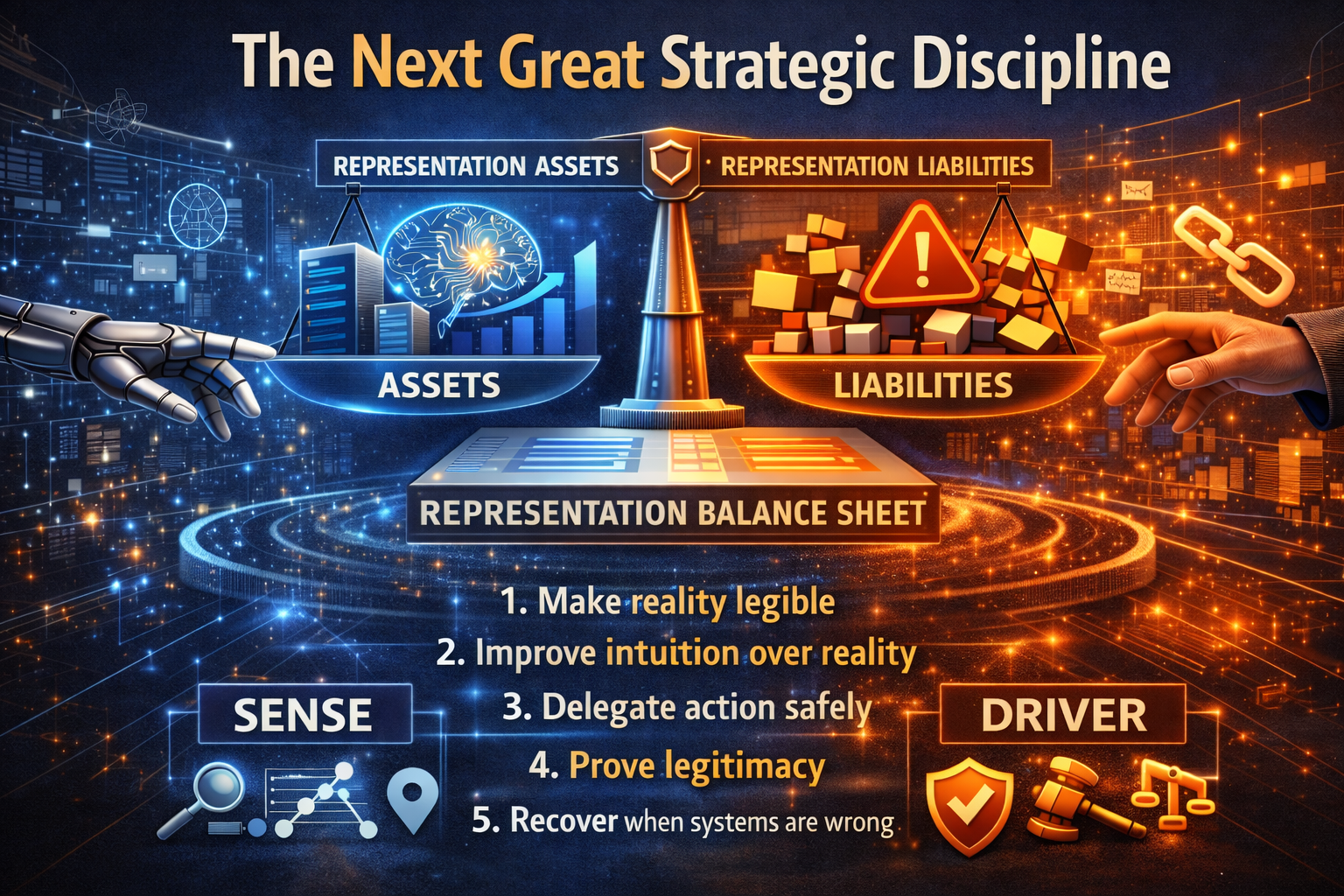
Conclusion: The Next Great Strategic Discipline
Every major economic era changes what organizations must learn to measure.
The industrial era elevated physical capital.
The digital era elevated software, networks, and intangible scale.
The AI era is beginning to elevate something even more foundational:
the capacity to represent reality well enough for machine intelligence to reason, govern, and act.
That is what the representation balance sheet captures.
It gives boards and executives a way to see what traditional reporting often misses: that in the AI era, institutional advantage depends not only on data, models, or automation, but on whether the organization can make reality legible, cognition governable, and action legitimate.
This is why the representation balance sheet should not be treated as another AI metaphor.
It should be treated as a strategic management discipline.
The institutions that master it will move beyond AI experimentation. They will build deeper trust, better decisions, safer delegation, stronger resilience, and more durable advantage.
The institutions that ignore it may continue buying tools, funding pilots, and announcing transformation programs, yet still fail to convert AI into real institutional strength.
That is the dividing line now emerging in global competition.
Not model access alone.
Not software scale alone.
Not data volume alone.
But the quality of the institution’s representation architecture.
That is the real balance sheet the AI era is beginning to reward.
The Representation Balance Sheet is a framework proposed by Raktim Singh to explain how AI changes institutional assets and liabilities.
Glossary
Representation Balance Sheet
A strategic view of how well an institution converts reality into machine-usable form, including representation assets, representation liabilities, and the institutional strength created by governed intelligence.
Representation Economy
The emerging economic order in which competitive advantage depends increasingly on the ability to observe, structure, reason over, and act on reality through machine-legible institutional architectures.
Representation Asset
Any institutional capability that helps convert reality into reliable, contextual, machine-readable form.
Representation Liability
Any hidden weakness that reduces an institution’s ability to make reality legible, current, trustworthy, or governable for intelligence systems.
Representation Integrity
The quality of an institution’s ability to represent reality accurately enough for trustworthy machine-assisted decision-making and action.
SENSE
The legibility layer where reality becomes machine-readable through signals, entities, state representation, and evolution.
CORE
The cognition layer where represented reality is interpreted, compared, optimized, and used to improve decisions.
DRIVER
The legitimacy and execution layer where authority, identity, verification, execution, and recourse govern machine-enabled action.
Machine-Legible Enterprise
An organization whose critical realities are sufficiently structured and connected for AI systems to interpret and act on them safely.
Governed Action Capacity
The institutional ability to move from intelligence to action within approved authority boundaries, verification paths, and recourse mechanisms.
Bounded Autonomy
A condition in which AI systems are allowed to act only within clearly defined operational, legal, and governance limits.
Recourse
The ability to reverse, challenge, correct, or remediate an AI-supported decision or action.
FAQ
- What is the representation balance sheet in simple terms?
It is a way to assess whether an institution is easy or difficult for AI systems to understand, reason over, and act within safely.
- Is the representation balance sheet an accounting standard?
No. It is a strategic management framework, not a formal accounting statement.
- Why does AI require a new balance sheet lens?
Because AI performance depends not only on models, but on whether institutional reality is visible, structured, current, governed, and actionable.
- How is this different from data strategy?
Data strategy often focuses on collection, storage, and access. The representation balance sheet focuses on machine-legible reality, decision context, legitimacy, and recourse.
- What is a representation asset?
A representation asset is any capability that helps convert real-world complexity into a trustworthy machine-usable form.
- What is a representation liability?
It is a hidden weakness such as fragmentation, staleness, identity weakness, governance opacity, or absence of recourse.
- Why is this important for boards?
Because boards are increasingly responsible for AI oversight, risk, governance, resilience, and strategic advantage.
- Does this matter only for large enterprises?
No. It matters for any institution where AI is beginning to influence decisions, operations, or service delivery.
- How does SENSE fit into this?
SENSE is the legibility layer. Without it, AI systems are forced to reason over incomplete or distorted reality.
- How does CORE fit into this?
CORE is the reasoning layer. It determines how represented reality becomes decisions, recommendations, and learning.
- How does DRIVER fit into this?
DRIVER governs whether AI-supported action is legitimate, verifiable, bounded, and reversible.
- Can a company have strong AI tools but a weak representation balance sheet?
Yes. This is one of the most common reasons AI pilots fail to create enterprise-scale value.
- What sectors does this idea apply to?
Finance, healthcare, government, manufacturing, retail, education, logistics, telecom, energy, and any sector where AI affects real decisions.
- What is the biggest mistake leaders make today?
They focus too much on model choice and too little on representation quality and governed action capacity.
- Will representation balance sheets affect valuation in the future?
Very likely at a strategic level first, and potentially more explicitly over time as markets and governance systems mature.
- How does this relate to AI governance?
It extends governance from policy documents into the operational architecture of how reality is represented and acted upon.
- What does “machine-legible reality” mean?
It means reality represented in forms that machines can interpret reliably enough to support judgment or action.
- Why is recourse so important?
Because any system that can act without an effective path for correction becomes dangerous at scale.
- Can representation strength become a competitive moat?
Yes. Institutions that are easier for AI systems to understand and govern may gain advantages in speed, trust, precision, and coordination.
- What should executives do first?
Start by identifying where representation assets are strong, where liabilities are accumulating, and where bounded autonomy is or is not appropriate.
References and Further Reading
AI adoption and enterprise usage data referenced in this article come from Stanford HAI’s 2025 AI Index, which reports that 78% of organizations used AI in 2024 and that generative AI usage in at least one business function rose from 33% to 71%. (hai.stanford.edu)
The governance discussion is informed by NIST’s AI Risk Management Framework, which structures AI risk management around Govern, Map, Measure, and Manage, and by the OECD AI Principles, which emphasize trustworthy AI, accountability, transparency, robustness, and respect for human rights and democratic values. (NIST)
The discussion of intangible assets and why current accounting language may lag AI-era reality draws on IAS 38 and the IASB’s ongoing review of intangibles. (IFRS Foundation)
Institutional Perspectives on Enterprise AI
Many of the structural ideas discussed here — intelligence-native operating models, control planes, decision integrity, and accountable autonomy — have also been explored in my institutional perspectives published via Infosys’ Emerging Technology Solutions platform.
For readers seeking deeper operational detail, I have written extensively on:
- What Makes an Enterprise Intelligence-Native? The Blueprint for Third-Order AI Advantage
https://blogs.infosys.com/emerging-technology-solutions/artificial-intelligence/what-is-enterprise-ai-the-operating-model-for-compounding-institutional-intelligence.html - Why “AI in the Enterprise” Is Not Enterprise AI: The Operating Model Difference Most Organizations Miss
https://blogs.infosys.com/emerging-technology-solutions/artificial-intelligence/why-ai-in-the-enterprise-is-not-enterprise-ai-the-operating-model-difference-that-most-organizations-miss.html - The Enterprise AI Control Plane: Governing Autonomy at Scale
https://blogs.infosys.com/emerging-technology-solutions/artificial-intelligence/the-enterprise-ai-control-plane-governing-autonomy-at-scale.html - Enterprise AI Ownership Framework: Who Is Accountable, Who Decides, and Who Stops AI in Production
https://blogs.infosys.com/emerging-technology-solutions/artificial-intelligence/enterprise-ai-ownership-framework-who-is-accountable-who-decides-and-who-stops-ai-in-production.html - Decision Integrity: Why Model Accuracy Is Not Enough in Enterprise AI
https://blogs.infosys.com/emerging-technology-solutions/artificial-intelligence/decision-integrity-why-model-accuracy-is-not-enough-in-enterprise-ai.html - Agent Incident Response Playbook: Operating Autonomous AI Systems Safely at Enterprise Scale
https://blogs.infosys.com/emerging-technology-solutions/artificial-intelligence/agent-incident-response-playbook-operating-autonomous-ai-systems-safely-at-enterprise-scale.html - The Economics of Enterprise AI: Designing Cost, Control, and Value as One System
https://blogs.infosys.com/emerging-technology-solutions/artificial-intelligence/the-economics-of-enterprise-ai-designing-cost-control-and-value-as-one-system.html
Together, these perspectives outline a unified view: Enterprise AI is not a collection of tools. It is a governed operating system for institutional intelligence — where economics, accountability, control, and decision integrity function as a coherent architecture.
Explore the Architecture of the AI Economy
This article is part of a broader research series exploring how institutions are being redesigned for the age of artificial intelligence. Together, these essays examine the structural foundations of the emerging AI economy — from signal infrastructure and representation systems to decision architectures and enterprise operating models.
If you want to explore the deeper framework behind these ideas, the following essays provide additional perspectives:
-
- The Representation Economy: Why the AI Decade Will Be Defined by Who Gets Represented—and Who Designs Trusted Delegation
• Representation Infrastructure: Why the AI Economy Will Be Won by Those Who Make the Invisible Legible
• The Representation Stack: How Reality Becomes Identifiable, Legible, and Actionable in the AI Economy
• Identity Infrastructure: The Missing Layer Between Signals and Representation in the AI Economy
• Why Most AI Projects Fail Before Intelligence Even Begins
• The Intelligence Supply Chain: How Organizations Industrialize Cognition in the AI Economy
• The Enterprise AI Operating Model
• Decision Scale: Why Competitive Advantage Is Moving from Labor Scale to Decision Scale
• The Operating Architecture of the AI Economy: Why Intelligence Alone Will Not Transform Markets - The Silent Systems Doctrine: Why the AI Economy Will Be Won by Those Who Represent What Cannot Speak
- Signal Infrastructure: Why the AI Economy Begins Before the Model – Raktim Singh
- The Representation Economy Explained: 51 Questions About the SENSE–CORE–DRIVER Architecture – Raktim Singh
- The Representation Economy: Why AI Institutions Must Run on SENSE, CORE, and DRIVER – Raktim Singh
- The Representation Economy: Why Intelligent Institutions Will Run on the SENSE–CORE–DRIVER Architecture – Raktim Singh
- The Representation Economy Explained: 51 Questions About the SENSE–CORE–DRIVER Architecture – Raktim Singh
- Representation Debt: Why Institutions Accumulate Hidden AI Risk Long Before Failure Becomes Visible – Raktim Singh
- The Representation Deficit: Why Institutions Fail When Reality Cannot Enter the Decision System – Raktim Singh
- The Representation Maturity Model: How Boards Decide When AI Can Be Trusted With Real Decisions – Raktim Singh
- Representation Capital: The Invisible Asset That Will Decide Which Institutions Win the AI Economy – Raktim Singh
- Representation Failure: Why AI Systems Break When Institutions Misread Reality – Raktim Singh
- The Board’s Representation Strategy: How Intelligent Institutions Decide What Must Be Seen, Modeled, Governed, and Delegated – Raktim Singh
- The Representation Economy: Why the AI Decade Will Be Defined by Who Gets Represented—and Who Designs Trusted Delegation
Together, these essays outline a central thesis:
The future will belong to institutions that can sense reality, represent it clearly, reason about it intelligently, and act through governed machine systems.
This is why the architecture of the AI era can be understood through three foundational layers:
SENSE → CORE → DRIVER
Where:
- SENSE makes reality legible
- CORE transforms signals into reasoning
- DRIVER ensures that machine action remains accountable, governed, and institutionally legitimate
Signal infrastructure forms the first and most foundational layer of that architecture.
AI Economy Research Series — by Raktim Singh
Raktim Singh writes about the Representation Economy, Enterprise AI architecture, and institutional strategy for the age of artificial intelligence.



Raktim Singh is an AI and deep-tech strategist, TEDx speaker, and author focused on helping enterprises navigate the next era of intelligent systems. With experience spanning AI, fintech, quantum computing, and digital transformation, he simplifies complex technology for leaders and builds frameworks that drive responsible, scalable adoption.