
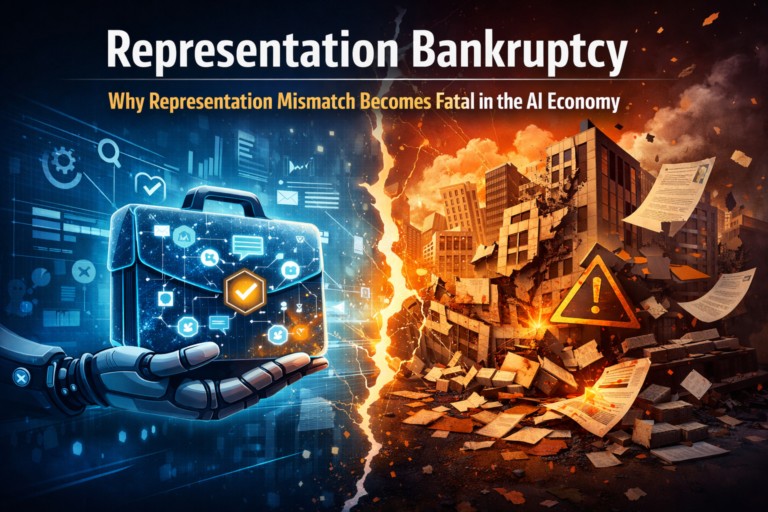
Representation Bankruptcy
For years, leaders have been told that the AI era will be won by those with the best models, the most data, or the deepest compute budgets.
That story is becoming too small.
A deeper shift is underway. As AI moves from generating content to searching, comparing, verifying, deciding, routing, and transacting, the real strategic question is changing. The decisive issue is no longer only whether an institution has intelligence.
It is whether that institution can be represented clearly enough for machine systems to understand it, trust it, and act with it. That shift is already visible in how search engines reward structured product information, how digital credentials are becoming machine-verifiable, how provenance is being bound to content, how identity wallets are being standardized, and how payments networks are preparing for agentic commerce. (Google for Developers)
That is where a new danger appears.
Representation bankruptcy is the point at which the gap between reality and machine-readable reality becomes so large that an institution begins to fail economically, operationally, or strategically.
Not because it has no products.
Not because it has no customers.
Not because it has no talent.
But because the systems increasingly shaping discovery, trust, compliance, and commerce can no longer reliably recognize what the institution is, what it offers, what it promises, what it is allowed to do, and what risks it carries.
This is one of the defining failure modes of the AI economy.
What is Representation Bankruptcy?
Representation Bankruptcy is the condition in which an organization’s real-world value cannot be accurately understood, verified, or acted upon by machine systems, leading to loss of visibility, trust, and economic participation in AI-driven markets.
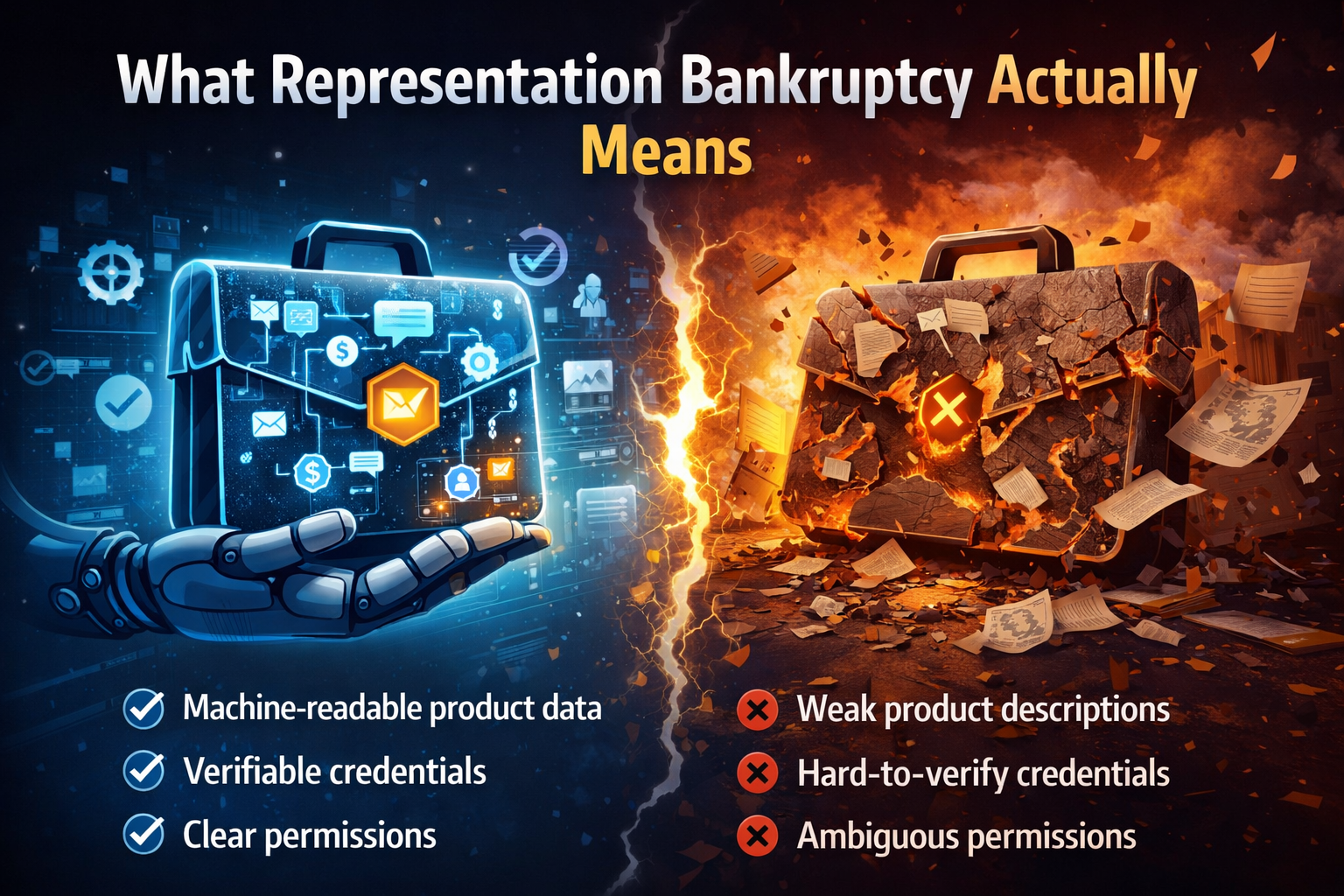
What representation bankruptcy actually means
In traditional finance, bankruptcy means liabilities overwhelm assets.
In the AI economy, a parallel form of failure is emerging. A company, institution, or ecosystem becomes representation-bankrupt when its digital description of itself is no longer strong enough for machine-driven systems that influence visibility, trust, and action.
Its products may exist, but be poorly described.
Its credentials may exist, but be hard to verify.
Its permissions may exist, but be hard to interpret.
Its compliance may exist, but be trapped in documents rather than usable proofs.
Its value may be real, but its machine-readable form is weak, fragmented, stale, or unverifiable.
That mismatch becomes fatal when more of the market starts operating through machine mediation. This is the central idea of Representation Economics: in an AI-shaped market, value does not flow only to what is valuable. It increasingly flows to what is representable.
Why this problem is becoming urgent now
This is not a distant theory. The infrastructure for machine-readable trust is already being built.
Google explicitly encourages merchants to provide structured product information, including price, availability, shipping, ratings, and returns, because those fields can influence how products appear across Search experiences. That means visibility is already shaped by machine-readable representation, not just by branding or prose copy. (Google for Developers)
W3C’s Verifiable Credentials 2.0 standard exists because markets increasingly need claims that are not merely published but cryptographically secure and machine-verifiable. The W3C describes verifiable credentials as a way to express claims such as identity and qualifications in a tamper-resistant, machine-verifiable format. (W3C)
The C2PA specification similarly reflects a new expectation: digital content increasingly needs provenance that can travel with it. C2PA is building technical standards for content authenticity, and even allows verifiable credentials to serve as added trust signals in the provenance chain. (C2PA)
The European Union is doing the same at institutional scale. The European Commission says member states will make digital identity wallets available to citizens, residents, and businesses by the end of 2026, and the Commission’s Digital Product Passport initiative is designed to store and share relevant product data for consumers, businesses, and public authorities. (European Commission)
Even commerce rails are moving in this direction. Visa says its Intelligent Commerce capabilities are designed to support AI-powered commerce through tokenization, authentication, controls, and commerce signals, so agents can make purchases securely under governed conditions. (Visa Developer)
Taken together, these developments point to a structural fact: the economy is being rebuilt so machines can verify, compare, and act. That makes representation mismatch a strategic risk, not a metadata problem.
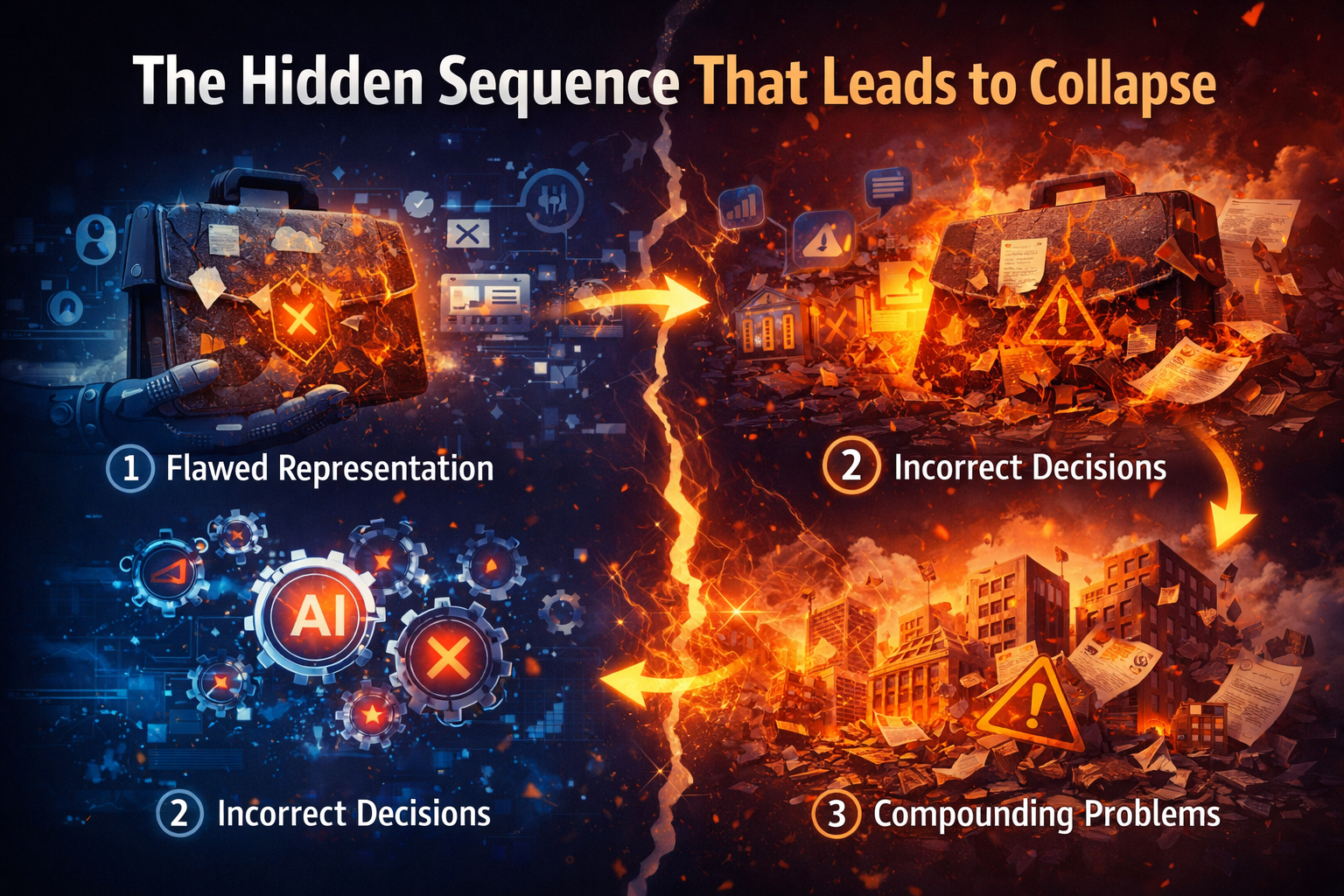
The hidden sequence that leads to collapse
Representation bankruptcy rarely arrives all at once. It usually unfolds in stages.
First, reality changes. Products evolve. Suppliers change. Policies update. Credentials expire. Permissions shift. Customer expectations move.
Second, the institution’s machine-readable layer fails to keep up. Data remains fragmented. Structured descriptions stay incomplete. Provenance is weak. Permissions are ambiguous. Operational state is spread across systems that do not speak to one another.
Third, machine systems begin making poorer inferences. Search visibility weakens. Comparisons become less favorable. Risk checks become harsher. Agents fail to route demand efficiently. Compliance becomes slower and more expensive. Integration friction rises.
Fourth, leadership misreads the symptoms. The firm blames competition, branding, or execution quality. But the deeper issue is that machine-mediated systems are increasingly unable to work with it cleanly.
Finally, the mismatch becomes fatal.
That is representation bankruptcy.
A simple example: the invisible supplier
Imagine a mid-sized manufacturer that makes excellent industrial components.
Its parts are reliable. Its prices are competitive. Its service is strong.
But its catalog data is inconsistent. Specifications sit in PDFs. Certifications are buried in email chains. Sustainability information is scattered across vendors. Return policies differ by region. Inventory feeds lag. Compliance evidence is assembled manually.
Now compare that with a competitor whose products are encoded with clean identifiers, structured specifications, provenance links, compatibility rules, certifications, service history, and current availability.
Which supplier might a human procurement manager prefer? Potentially either one.
Which supplier will an AI procurement system prefer?
Almost certainly the second.
Not because the second product is always better, but because the second firm is easier for a machine to evaluate, trust, and transact with. That advantage compounds over time. The better-represented firm gets discovered more often, qualified faster, compared more favorably, integrated more easily, financed more confidently, and audited more cheaply.
The poorly represented firm may still be good. But goodness without legibility becomes economically fragile.
Another example: the trusted credential problem
Consider a skilled worker, freelancer, consultant, or training provider.
Their achievements are real. Their certifications are real. Their experience is real.
But if those facts are difficult to verify digitally, they weaken in an economy where matching, onboarding, eligibility, and risk checks increasingly rely on machine-verifiable signals. That is precisely the problem verifiable credentials are meant to solve. W3C’s standard defines a framework in which claims can be securely issued, held, and verified across an issuer-holder-verifier ecosystem. (W3C)
The same logic applies to universities, hospitals, insurers, exporters, logistics networks, and governments.
The issue is not whether reality exists. The issue is whether reality is encoded in a form that machines can trust.
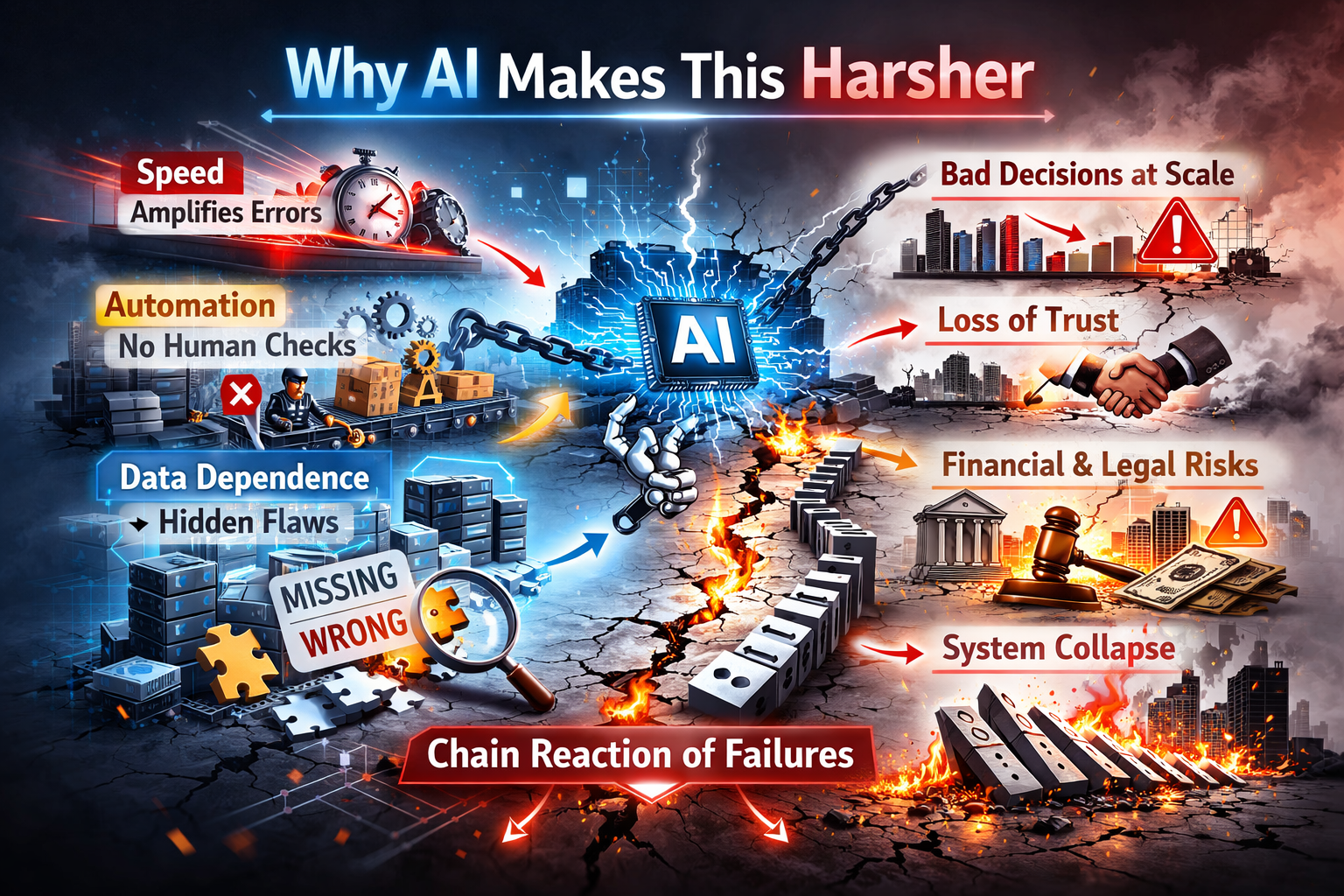
Why AI makes this harsher
Older digital systems still left room for human interpretation.
A human buyer could call.
A human analyst could inspect a PDF.
A human compliance officer could piece together context from five separate sources.
AI changes the scale and speed of the process. AI systems do not simply retrieve information. They rank, summarize, compare, infer, and increasingly recommend or trigger action. NIST’s AI Risk Management Framework emphasizes context, trustworthiness, and the need to manage the risks and impacts of AI systems across their lifecycle. (NIST Publications)
That means weak representation creates three compounding risks.
Discovery risk
If a firm is poorly represented, it may not surface well in search, recommendation, or comparison flows.
Trust risk
If claims cannot be verified cleanly, systems may discount, penalize, or bypass them.
Action risk
If permissions, conditions, policy rules, and recourse pathways are unclear, machines may avoid acting altogether or dramatically increase the cost of acting.
This is why representation mismatch becomes fatal faster in the AI era than in the old software era.
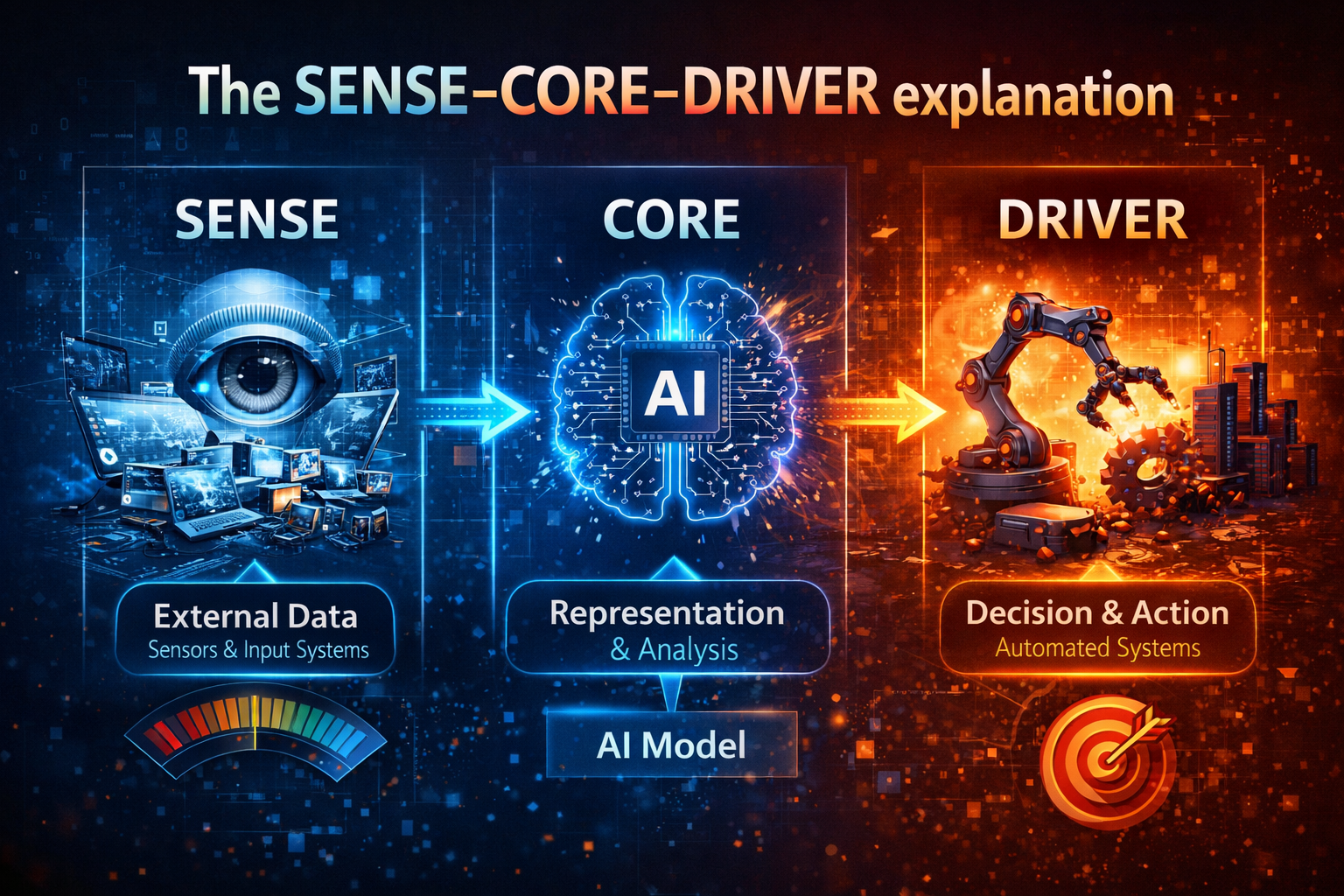
The SENSE–CORE–DRIVER explanation
Your SENSE–CORE–DRIVER framework explains this problem better than most current AI strategy models because it shows that intelligence alone is never the full system.
SENSE is the legibility layer
If signals are weak, entities are unresolved, states are stale, or evolution is not captured, reality enters the system in distorted form.
A company may think it has data. But if it cannot reliably connect a signal to a product, supplier, credential, location, asset, or obligation, it does not have legible reality. It has fragments.
CORE is the cognition layer
The AI model may still reason impressively. But reasoning over weak representation produces fragile outputs.
A powerful model does not rescue a broken representation layer. In many cases, it amplifies the illusion that the institution is more machine-ready than it actually is.
DRIVER is the legitimacy layer
Even if the system “understands” something, it still needs governed authority to act. Who delegated authority? Which identity is affected? What proof is acceptable? How is the decision verified? What happens if the system is wrong?
Representation bankruptcy often becomes visible here. The institution discovers that it cannot safely let systems act because its identity, permissions, obligations, and recourse pathways are too poorly encoded.
In simple terms, many organizations are overinvesting in CORE while underinvesting in SENSE and DRIVER. That is one of the main reasons they drift toward representation bankruptcy.
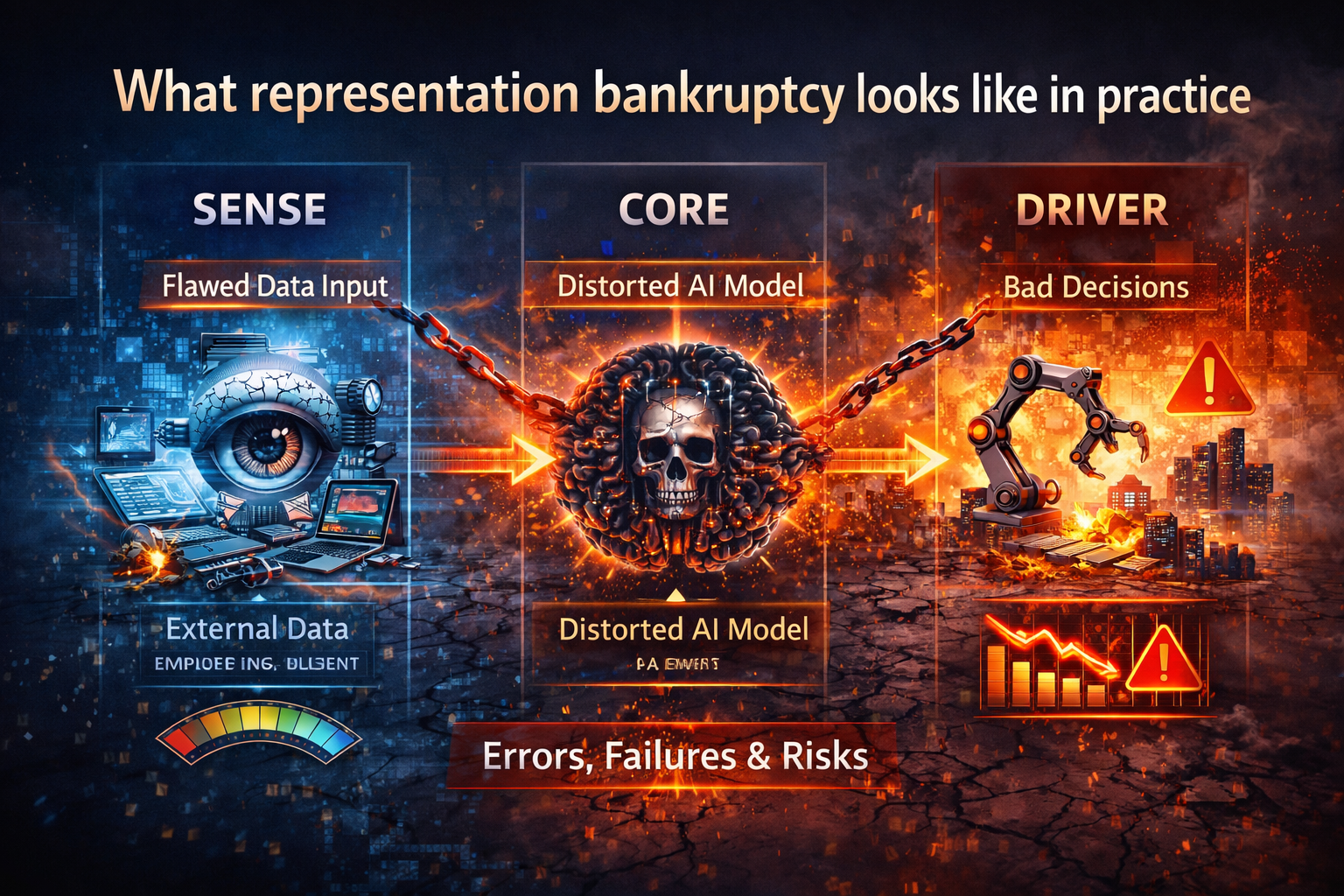
What representation bankruptcy looks like in practice
It rarely announces itself with dramatic language. It often appears as ordinary business friction.
Products that do not travel well across search, marketplaces, and AI assistants.
Compliance that is expensive to prove every time.
Supplier networks that cannot be audited quickly.
Customer onboarding that remains manual.
Content that cannot establish provenance.
Data partnerships that stall because identity and permissions are unclear.
Agents that can recommend but cannot execute.
Boards that hear “we have AI” while operations still run on brittle representation.
These symptoms can appear disconnected. They are not. They are often different expressions of the same structural weakness: the institution has not built enough machine-readable truth.
Why this matters for new company creation
Representation bankruptcy is not only a warning. It is also a market map.
Whenever a large class of institutions suffers from fatal representation mismatch, new firms emerge to solve it. That is why the AI economy is likely to create powerful new categories of companies:
firms that clean, structure, and maintain machine-readable product truth
firms that issue and verify portable digital credentials
firms that provide provenance, attestation, and traceability infrastructure
firms that manage governed delegation for AI agents
firms that turn policy and compliance into machine-actionable controls
firms that provide recourse, dispute, and decision-audit infrastructure
These are not side markets. They may become some of the most important infrastructure categories of the AI economy.
What boards and C-suites should do now
The first mistake is to treat this as an IT cleanup problem.
It is not.
It is a board-level representation strategy issue.
Leaders should ask five questions.
What parts of our business are real, but still hard for machines to see?
Which claims about us are true, but still hard to verify?
Where are decisions blocked because permissions, conditions, or liabilities are unclear?
Which competitors are becoming easier for machines to trust and transact with?
If AI agents became major buyers, auditors, or routing systems in our industry, would we be selectable?
These questions matter more than many current AI maturity discussions. In the next phase of competition, the winners may not be the firms with the loudest AI narrative. They may be the firms with the strongest representation architecture.
Why this idea matters beyond one article
The industrial era rewarded production capacity.
The software era rewarded information processing.
The AI era will increasingly reward machine-legible reality.
That is why Representation Economics matters. It explains that value creation is shifting toward the ability to sense reality well, encode it faithfully, reason over it intelligently, and act on it legitimately.
Representation bankruptcy is what happens when that system breaks down.
A firm does not go bankrupt only when cash runs out.
It can also go bankrupt when trusted machine-readable reality runs out.
And in a world where search, identity, provenance, compliance, and transactions are all becoming more machine-mediated, that failure can arrive earlier than many leaders expect.
Conclusion
The central lesson is simple.
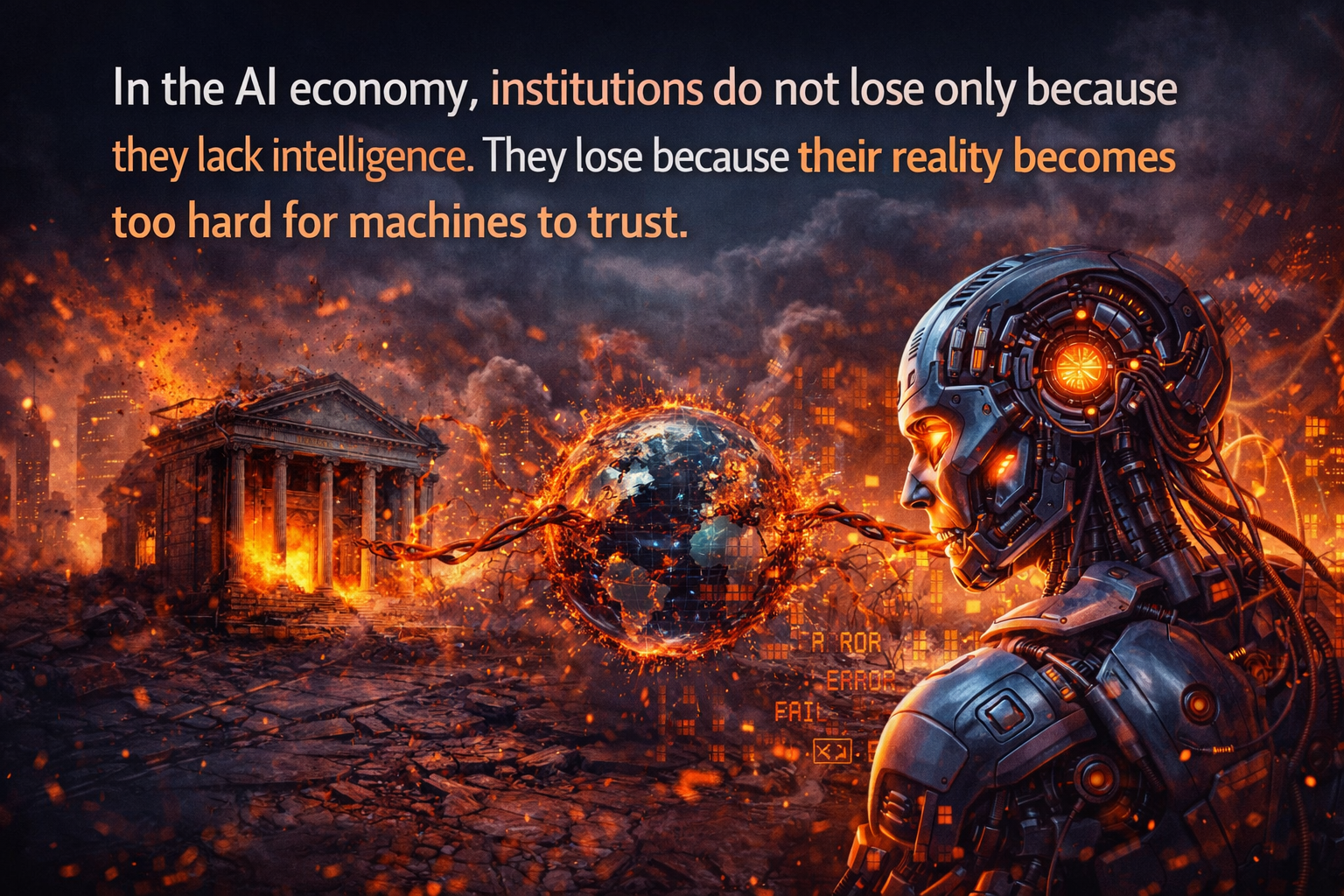
In the AI economy, institutions do not lose only because they lack intelligence. They lose because their reality becomes too hard for machines to trust.
That is the fatal edge of representation mismatch.
Representation bankruptcy names a new kind of strategic decline: not the failure to build AI, but the failure to become legible, verifiable, and actionable in a world increasingly mediated by AI. Boards that understand this early will not treat representation as a technical afterthought. They will treat it as a source of competitiveness, trust, and institutional survival.
The next great divide in the AI economy may not be between companies that use AI and companies that do not. It may be between institutions that machines can work with cleanly and institutions they quietly learn to avoid.
FAQ
What is representation bankruptcy?
Representation bankruptcy is the point at which an organization’s machine-readable description becomes too weak, fragmented, stale, or unverifiable for AI-mediated systems to discover, trust, compare, or act on it effectively.
How is representation bankruptcy different from traditional bankruptcy?
Traditional bankruptcy is financial failure. Representation bankruptcy is strategic and operational failure caused by a widening gap between real-world reality and machine-readable reality.
Why does representation bankruptcy matter in the AI economy?
Because AI systems increasingly shape search, procurement, identity verification, compliance, content provenance, and commerce. If machines cannot reliably interpret and trust your institution, your market position weakens even if your underlying business is still strong. (Google for Developers)
What are the warning signs of representation bankruptcy?
Common signs include poor discoverability, manual compliance, unverifiable claims, brittle integrations, weak provenance, unclear permissions, and AI systems that can recommend but cannot safely execute.
Can a company with strong products still become representation-bankrupt?
Yes. A firm may have good products, real customers, and real capabilities, but still lose if those strengths are not encoded in a form machines can interpret and trust at scale.
What is the role of SENSE–CORE–DRIVER in preventing representation bankruptcy?
SENSE ensures reality becomes legible, CORE reasons over that reality, and DRIVER governs legitimate action. Organizations that overinvest in CORE while neglecting SENSE and DRIVER are more exposed to representation mismatch.
What kinds of companies will emerge to solve this problem?
Likely winners include firms focused on machine-readable product truth, digital credentials, provenance infrastructure, policy-to-control translation, governed delegation, and recourse infrastructure.
Is representation bankruptcy only relevant to tech companies?
No. It applies to manufacturers, banks, universities, hospitals, governments, exporters, logistics networks, retailers, and any institution that will increasingly interact with AI-mediated search, trust, or transaction systems.
1. What is representation bankruptcy in AI?
Representation bankruptcy occurs when a company’s machine-readable data is too weak, fragmented, or unverifiable for AI systems to trust or act upon.
2. Why is representation more important than AI models?
Because AI systems rely on structured, verifiable inputs. Without strong representation (SENSE), even the best models (CORE) produce unreliable outputs.
3. How does representation bankruptcy affect businesses?
It reduces discoverability, increases compliance costs, limits automation, and makes companies less selectable in AI-driven markets.
4. What is the SENSE–CORE–DRIVER framework?
A framework that explains AI systems:
-
SENSE = reality capture
-
CORE = reasoning
-
DRIVER = execution & governance
5. How can companies avoid representation bankruptcy?
By investing in:
-
structured data
-
verifiable credentials
-
identity systems
-
machine-readable policies
-
governance framework
Glossary
Representation Bankruptcy
A condition in which the gap between real-world reality and machine-readable reality becomes so large that an institution starts losing economic, operational, or strategic viability.
Representation Mismatch
The misalignment between what an institution really is and what digital systems can reliably recognize, verify, and act upon.
Machine-Readable Reality
A structured, verifiable digital form of reality that machines can interpret, compare, and use safely.
Machine Legibility
The degree to which an institution, product, credential, or policy can be understood by digital systems.
Representation Economics
A framework arguing that in the AI era, value increasingly flows to what can be well represented, trusted, and acted upon by machines.
SENSE
The layer where reality becomes machine-legible through signals, entities, state representation, and evolution.
CORE
The cognition layer where AI systems comprehend context, optimize decisions, realize action, and evolve through feedback.
DRIVER
The legitimacy layer that governs delegated authority, representation, identity, verification, execution, and recourse.
Verifiable Credentials
Cryptographically secure, machine-verifiable digital credentials standardized by W3C. (W3C)
Provenance Infrastructure
Technical systems that record and verify where content or claims came from and how they changed over time, such as C2PA-based approaches. (C2PA)
Digital Identity Wallet
A secure digital wallet that allows users or businesses to store and share identity-related documents and credentials, such as the EU Digital Identity Wallet. (European Commission)
Digital Product Passport
A digital record designed to store and share relevant product information for consumers, businesses, and public authorities. (Internal Market & SMEs)
AI-Mediated Commerce
Commerce in which AI systems help search, compare, verify, recommend, or transact on behalf of users or institutions. (Visa Developer)
Representation Economics
A framework explaining how value flows to what machines can understand and trust.
SENSE Layer
Captures real-world signals and entities.
CORE Layer
AI reasoning and decision-making.
DRIVER Layer
Execution, governance, and accountability.
Verifiable Credentials
Digitally provable claims usable by machines.
AI Trust Infrastructure
Systems that allow machines to verify identity, claims, and actions.
References and further reading
Google Search Central documentation on product structured data and merchant return policy shows how product visibility increasingly depends on machine-readable fields such as price, availability, shipping, and returns. (Google for Developers)
W3C’s Verifiable Credentials Data Model 2.0 and the W3C press release explain how digital credentials are becoming cryptographically secure and machine-verifiable. (W3C)
The C2PA specification shows how content provenance is becoming a technical trust layer and how verifiable credentials can strengthen trust signals. (C2PA)
The European Commission’s European Digital Identity and Digital Product Passport materials show how identity and product data are being standardized for machine use across markets. (European Commission)
Visa’s Intelligent Commerce materials show how commerce rails are preparing for governed AI-driven transactions. (Visa Developer)
NIST’s AI Risk Management Framework provides a practical trust-and-risk lens for AI systems that increasingly participate in real-world decisions and actions. (NIST Publications)
Institutional Perspectives on Enterprise AI
Many of the structural ideas discussed here — intelligence-native operating models, control planes, decision integrity, and accountable autonomy — have also been explored in my institutional perspectives published via Infosys’ Emerging Technology Solutions platform.
For readers seeking deeper operational detail, I have written extensively on:
- What Makes an Enterprise Intelligence-Native? The Blueprint for Third-Order AI Advantage
https://blogs.infosys.com/emerging-technology-solutions/artificial-intelligence/what-is-enterprise-ai-the-operating-model-for-compounding-institutional-intelligence.html - Why “AI in the Enterprise” Is Not Enterprise AI: The Operating Model Difference Most Organizations Miss
https://blogs.infosys.com/emerging-technology-solutions/artificial-intelligence/why-ai-in-the-enterprise-is-not-enterprise-ai-the-operating-model-difference-that-most-organizations-miss.html - The Enterprise AI Control Plane: Governing Autonomy at Scale
https://blogs.infosys.com/emerging-technology-solutions/artificial-intelligence/the-enterprise-ai-control-plane-governing-autonomy-at-scale.html - Enterprise AI Ownership Framework: Who Is Accountable, Who Decides, and Who Stops AI in Production
https://blogs.infosys.com/emerging-technology-solutions/artificial-intelligence/enterprise-ai-ownership-framework-who-is-accountable-who-decides-and-who-stops-ai-in-production.html - Decision Integrity: Why Model Accuracy Is Not Enough in Enterprise AI
https://blogs.infosys.com/emerging-technology-solutions/artificial-intelligence/decision-integrity-why-model-accuracy-is-not-enough-in-enterprise-ai.html - Agent Incident Response Playbook: Operating Autonomous AI Systems Safely at Enterprise Scale
https://blogs.infosys.com/emerging-technology-solutions/artificial-intelligence/agent-incident-response-playbook-operating-autonomous-ai-systems-safely-at-enterprise-scale.html - The Economics of Enterprise AI: Designing Cost, Control, and Value as One System
https://blogs.infosys.com/emerging-technology-solutions/artificial-intelligence/the-economics-of-enterprise-ai-designing-cost-control-and-value-as-one-system.html
Together, these perspectives outline a unified view: Enterprise AI is not a collection of tools. It is a governed operating system for institutional intelligence — where economics, accountability, control, and decision integrity function as a coherent architecture.
Explore the Architecture of the AI Economy
This article is part of a broader research series exploring how institutions are being redesigned for the age of artificial intelligence. Together, these essays examine the structural foundations of the emerging AI economy — from signal infrastructure and representation systems to decision architectures and enterprise operating models.
If you want to explore the deeper framework behind these ideas, the following essays provide additional perspectives:
-
- • Why Most AI Projects Fail Before Intelligence Even Begins
• The Intelligence Supply Chain: How Organizations Industrialize Cognition in the AI Economy
- The Silent Systems Doctrine: Why the AI Economy Will Be Won by Those Who Represent What Cannot Speak
- Signal Infrastructure: Why the AI Economy Begins Before the Model – Raktim Singh
- The Representation Economy Explained: 51 Questions About the SENSE–CORE–DRIVER Architecture – Raktim Singh
- The Representation Economy: Why AI Institutions Must Run on SENSE, CORE, and DRIVER – Raktim Singh
- The Representation Economy: Why Intelligent Institutions Will Run on the SENSE–CORE–DRIVER Architecture – Raktim Singh
- The Representation Economy Explained: 51 Questions About the SENSE–CORE–DRIVER Architecture – Raktim Singh
- Representation Debt: Why Institutions Accumulate Hidden AI Risk Long Before Failure Becomes Visible – Raktim Singh
- The Representation Deficit: Why Institutions Fail When Reality Cannot Enter the Decision System – Raktim Singh
- The Representation Maturity Model: How Boards Decide When AI Can Be Trusted With Real Decisions – Raktim Singh
- Representation Capital: The Invisible Asset That Will Decide Which Institutions Win the AI Economy – Raktim Singh
- Representation Failure: Why AI Systems Break When Institutions Misread Reality – Raktim Singh
- The Board’s Representation Strategy: How Intelligent Institutions Decide What Must Be Seen, Modeled, Governed, and Delegated – Raktim Singh
- The Representation Premium: Why Institutions That Are Easier for AI to See, Trust, and Coordinate With Will Win the Next Economy – Raktim Singh
- The Firm of the AI Era Will Be Built Around Representation: Why Institutions Must Redesign Themselves for the SENSE–CORE–DRIVER Economy – Raktim Singh
- The Representation Balance Sheet: How AI Is Redefining Assets, Liabilities, and Institutional Strength – Raktim Singh
- The Representation Stack: The New Architecture of Intelligent Institutions in the AI Economy – Raktim Singh
- Representation Economics: The New Law of Value Creation in the AI Era – Raktim Singh
- The Representation Reserve Currency: Why AI Will Trust Only a Few Forms of Reality – Raktim Singh
- The Machine-Readable Boundary of the Firm: How AI Is Redefining What Companies Own, Outsource, and Orchestrate – Raktim Singh
- Representation Insurance: Why Machine-Readable Trust Will Power the AI Economy – Raktim Singh
- Representation Arbitrage: The New AI Advantage That Will Redefine Who Wins and Who Disappears – Raktim Singh
- • Why Most AI Projects Fail Before Intelligence Even Begins
Together, these essays outline a central thesis:
The future will belong to institutions that can sense reality, represent it clearly, reason about it intelligently, and act through governed machine systems.
This is why the architecture of the AI era can be understood through three foundational layers:
SENSE → CORE → DRIVER
Where:
- SENSE makes reality legible
- CORE transforms signals into reasoning
- DRIVER ensures that machine action remains accountable, governed, and institutionally legitimate
Signal infrastructure forms the first and most foundational layer of that architecture.
AI Economy Research Series — by Raktim Singh



Raktim Singh is an AI and deep-tech strategist, TEDx speaker, and author focused on helping enterprises navigate the next era of intelligent systems. With experience spanning AI, fintech, quantum computing, and digital transformation, he simplifies complex technology for leaders and builds frameworks that drive responsible, scalable adoption.