
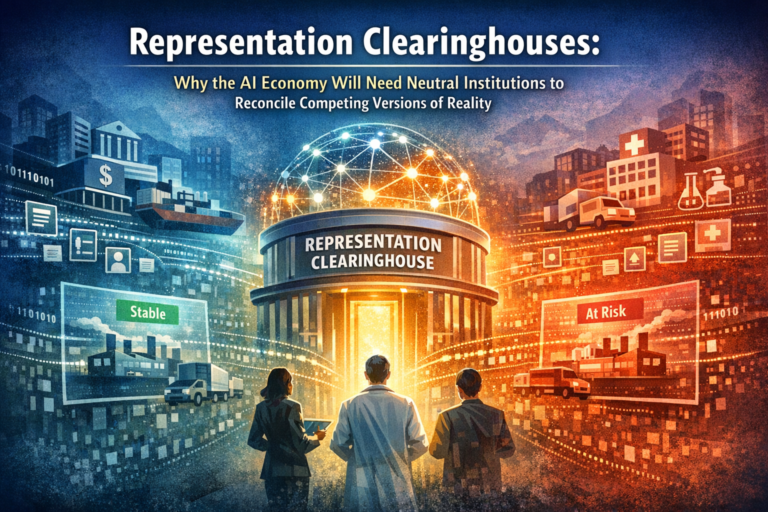
Representation Clearinghouses
In the next phase of AI, the biggest failure will not always come from a bad model. It will come from different institutions acting on different machine-readable versions of the same world.
Most AI discussions still assume a neat pipeline.
Reality is observed.
Data is collected.
A model analyzes it.
A decision follows.
That is no longer how many important systems work.
In the real economy, the same person, business, shipment, patient, device, or transaction is often represented differently across institutions. A bank has one view of a small business. A logistics firm has another. A tax authority has another. A healthcare provider may hold a different picture of a patient than an insurer, pharmacy, or specialist does. Health-data interoperability programs, patient-record matching efforts, financial market infrastructures, digital credentials, and supply-chain standards all exist for the same basic reason: fragmented representations create operational friction, trust problems, and systemic risk. (ASTP)
That is why the AI economy will need a new institutional layer. I call it the Representation Clearinghouse.
A Representation Clearinghouse is a neutral institution or infrastructure layer that helps reconcile competing machine-readable versions of the same entity, event, or state before high-stakes action is taken.
This is not a minor technical convenience. It is likely to become one of the defining institutional needs of the AI era.
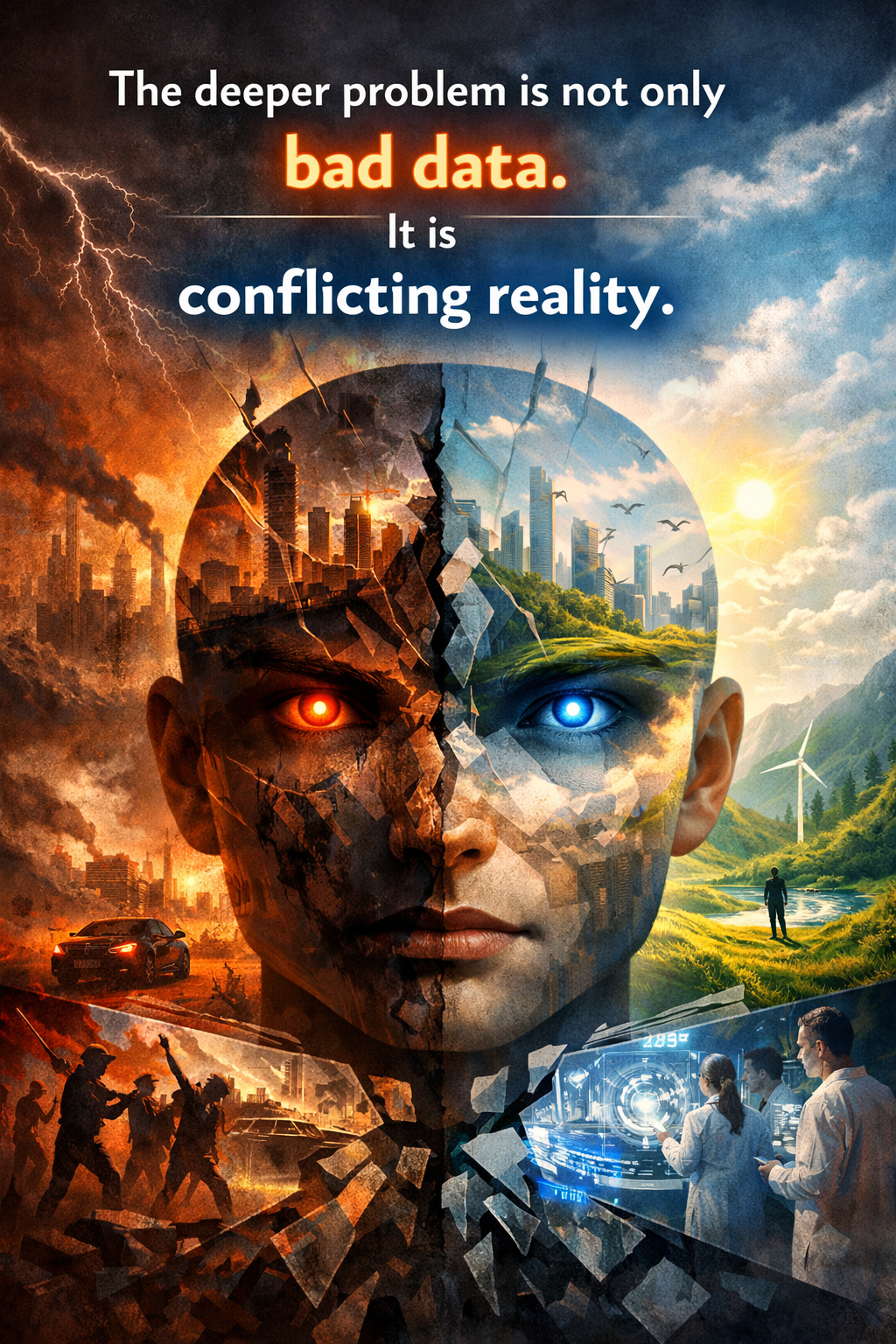
The deeper problem is not only bad data. It is conflicting reality.
In your SENSE–CORE–DRIVER framework, SENSE makes reality legible, CORE interprets it, and DRIVER turns decisions into action. That framework becomes even more important once multiple institutions are involved.
Why? Because SENSE does not happen only once. Different institutions sense the world differently. They use different identifiers, update cycles, schemas, incentives, risk thresholds, and trust rules. So by the time CORE reasons and DRIVER acts, the institution may no longer be acting on reality in any shared sense. It may be acting on its own local representation of reality, which may conflict with someone else’s equally operational but different representation.
That is the key shift.
The old problem was incomplete data.
The next problem is competing machine-readable realities.
And once AI systems begin making faster recommendations, autonomous updates, and agentic actions across institutional boundaries, those conflicts become more consequential.
Health IT authorities explicitly define patient matching as the identification and linking of one patient’s data within and across health systems to obtain a comprehensive record, and they describe it as a critical component of interoperability. That language exists because fragmented digital reality is already a structural problem, not a niche edge case. (ASTP)

Why the word “clearinghouse” matters
The term matters because it points to an existing institutional logic.
In finance, clearing and settlement infrastructures exist because counterparties need trusted mechanisms for matching, confirming, and settling obligations safely. BIS and IOSCO treat payment systems, central securities depositories, securities settlement systems, central counterparties, and trade repositories as financial market infrastructures because these mechanisms reduce systemic risk and support safe coordination across participants. (Bank for International Settlements)
The AI economy is moving toward an analogous problem, but not only for money.
It needs neutral mechanisms for:
- matching representations,
- identifying conflicts,
- validating provenance,
- resolving ambiguity,
- and determining which version is reliable enough for action.
In other words, the AI economy will increasingly need clearinghouses for representation, not just clearinghouses for transactions.
That is the strategic leap.
Why Representation Clearinghouses Matter
- AI systems act across institutions with different versions of reality
- The same entity can have conflicting machine-readable representations
- Decisions made on inconsistent realities create systemic risk
- Representation Clearinghouses reconcile truth before action
- Future AI advantage will come from coordination, not just intelligence
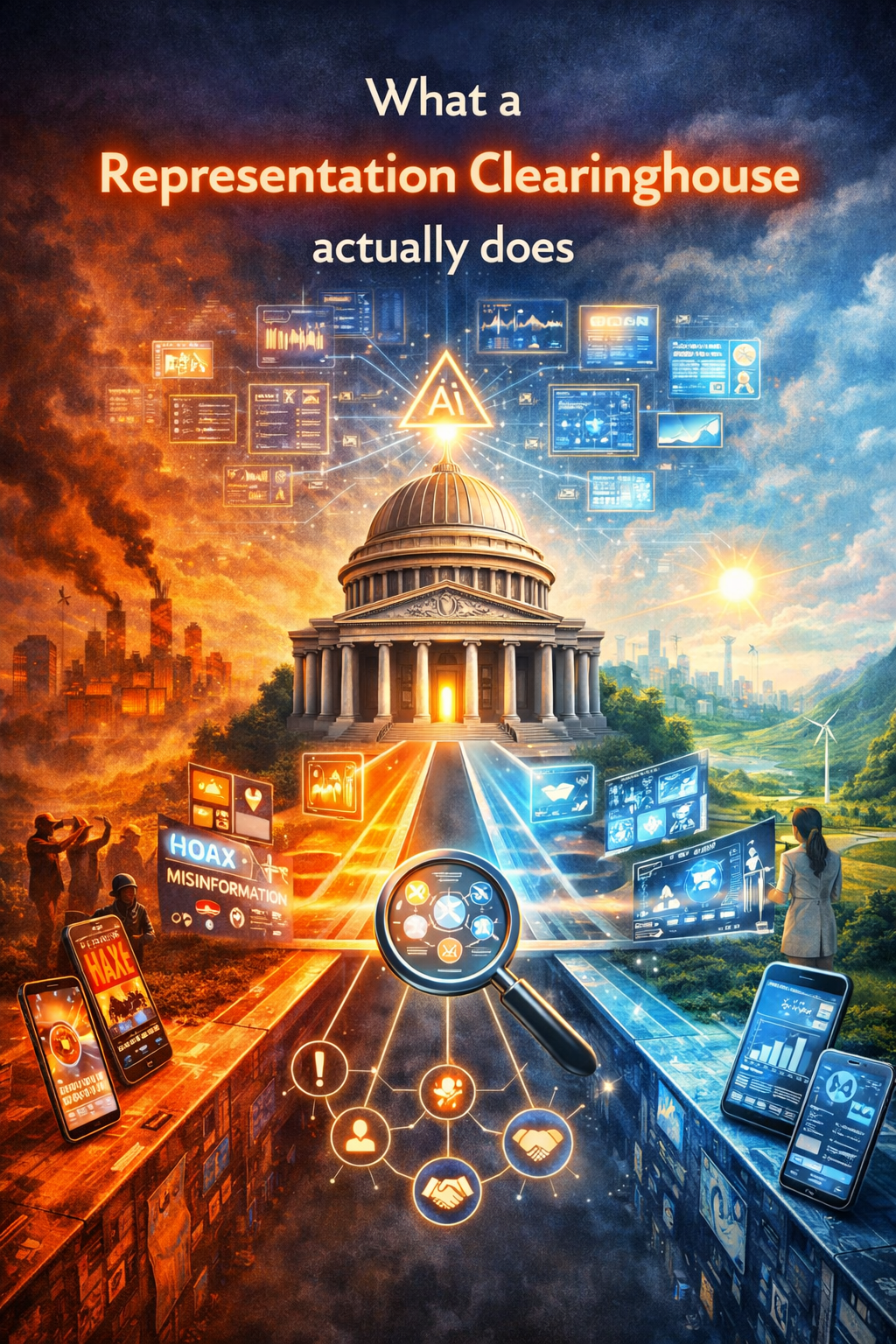
What a Representation Clearinghouse actually does
A Representation Clearinghouse does not need to “own” the truth. That is the wrong ambition. It does something more realistic and more useful.
It helps answer questions like these:
- Are these two records describing the same entity?
- Which parts of this representation are current, and which are stale?
- Which claims are directly observed, and which are inferred?
- Which source has authority over which attribute?
- Where do records conflict?
- What confidence should attach to the merged view?
- What should happen before action is taken if conflict remains unresolved?
That makes it a neutral reconciliation layer between fragmented institutional realities.
In practical terms, many of the building blocks already exist in partial form. W3C Verifiable Credentials provide a way to express credentials on the web in a manner that is cryptographically secure, privacy-respecting, and machine-verifiable.
GS1 standards give organizations a common language to identify, capture, and share supply-chain data, and EPCIS is specifically described by GS1 as a traceability event messaging standard that enables supply-chain visibility through sharing event data using a common language. (W3C)
Representation Clearinghouses would bring these kinds of pieces together into a more explicit institutional function.

A simple banking example: one business, three realities
Imagine a small manufacturer applying for credit.
The bank sees account balances, repayment history, invoices, and transaction flows.
A logistics network sees shipping delays, route bottlenecks, and fulfillment volatility.
A tax authority sees filings and payment compliance.
A supplier-finance platform sees invoice disputes and settlement timing.
Each representation is real in one sense. But none is complete. Worse, they may conflict.
The bank may see a stable borrower.
The logistics layer may see rising fragility.
The supplier platform may see weakening confidence.
The tax layer may show delays the bank has not yet incorporated.
Without a reconciliation layer, AI systems inside each institution may act quickly on incompatible pictures of the same business. One may extend credit. Another may tighten risk. Another may trigger collections. Another may downgrade trust.
A Representation Clearinghouse would not magically eliminate uncertainty. But it could surface divergence, compare provenance, align identifiers, flag stale fields, and help institutions distinguish between a local view and a cross-institutionally reconciled view.
That is not a luxury. In an agentic economy, it becomes the difference between coordinated intelligence and coordinated confusion.
A healthcare example: one patient, many partial truths
Healthcare already lives inside this problem.
Patient matching exists because patient data is often spread across systems and organizations. U.S. health IT authorities describe patient matching as the linking of one patient’s data within and across health systems in order to obtain a comprehensive health record. They explicitly frame it as critical to interoperability and the nation’s health IT infrastructure. (ASTP)
Now add AI.
A hospital has one representation of the patient’s current state.
A pharmacy has another.
An insurer has another.
A wearable platform has another.
A specialist in another city has another.
If each AI layer acts on its own local truth, the patient can be over-treated, under-treated, delayed, denied, or routed badly. The problem is not only missing data. It is unresolved representational conflict.
A Representation Clearinghouse in healthcare would help answer:
- Are these records linked to the same patient correctly?
- Which medication list is most current?
- Which allergy record has stronger provenance?
- Which observations are authoritative for this use case?
- Which data should be treated as summary, and which as decision-grade?
That is where your Representation Economics framework becomes highly practical. The issue is not just data exchange. It is whether institutions can reconcile reality well enough to act safely.
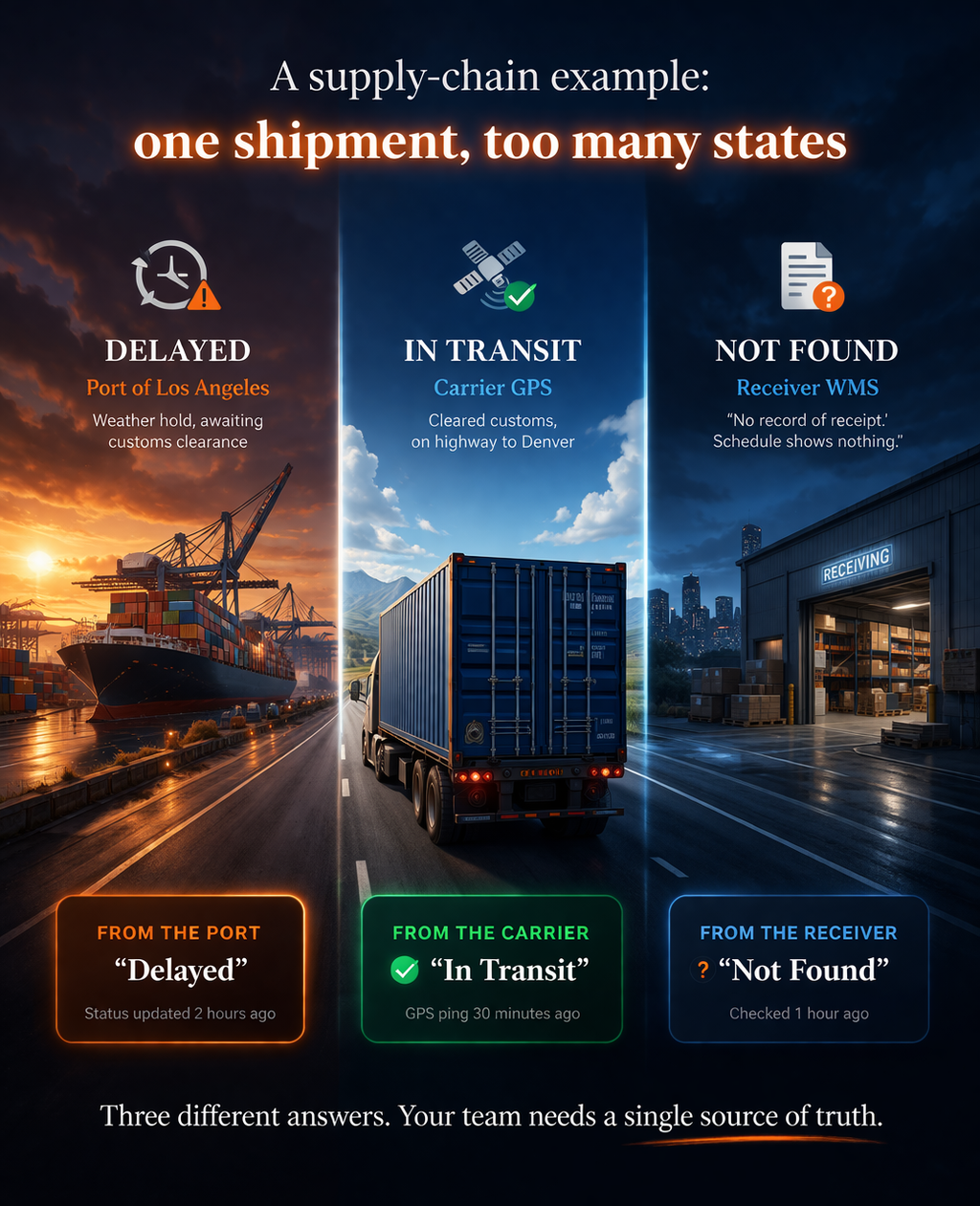
A supply-chain example: one shipment, too many states
Supply chains offer another clear example.
GS1 says its standards provide a common language to identify, capture, and share supply-chain data. It also describes EPCIS as a common language for sharing event data to enable visibility. DCSA, meanwhile, positions its work around vendor-neutral, open standards for container shipping precisely because coordination across carriers, shippers, ports, terminals, banks, and software providers breaks down when everyone runs on different digital states. (GS1)
That tells us something important: the global economy already needs common frameworks because many actors hold different states for the same object.
A container may be “in transit” in one system, “at risk” in another, “held for documentation” in another, and “arriving on schedule” in a fourth.
Now imagine AI agents scheduling labor, adjusting working capital, triggering insurance notices, rerouting inventory, or updating production plans on top of those conflicting states.
This is exactly the kind of environment where Representation Clearinghouses become critical. They do not replace source systems. They create a trusted, neutral layer for reconciling competing operational truths before action cascades.
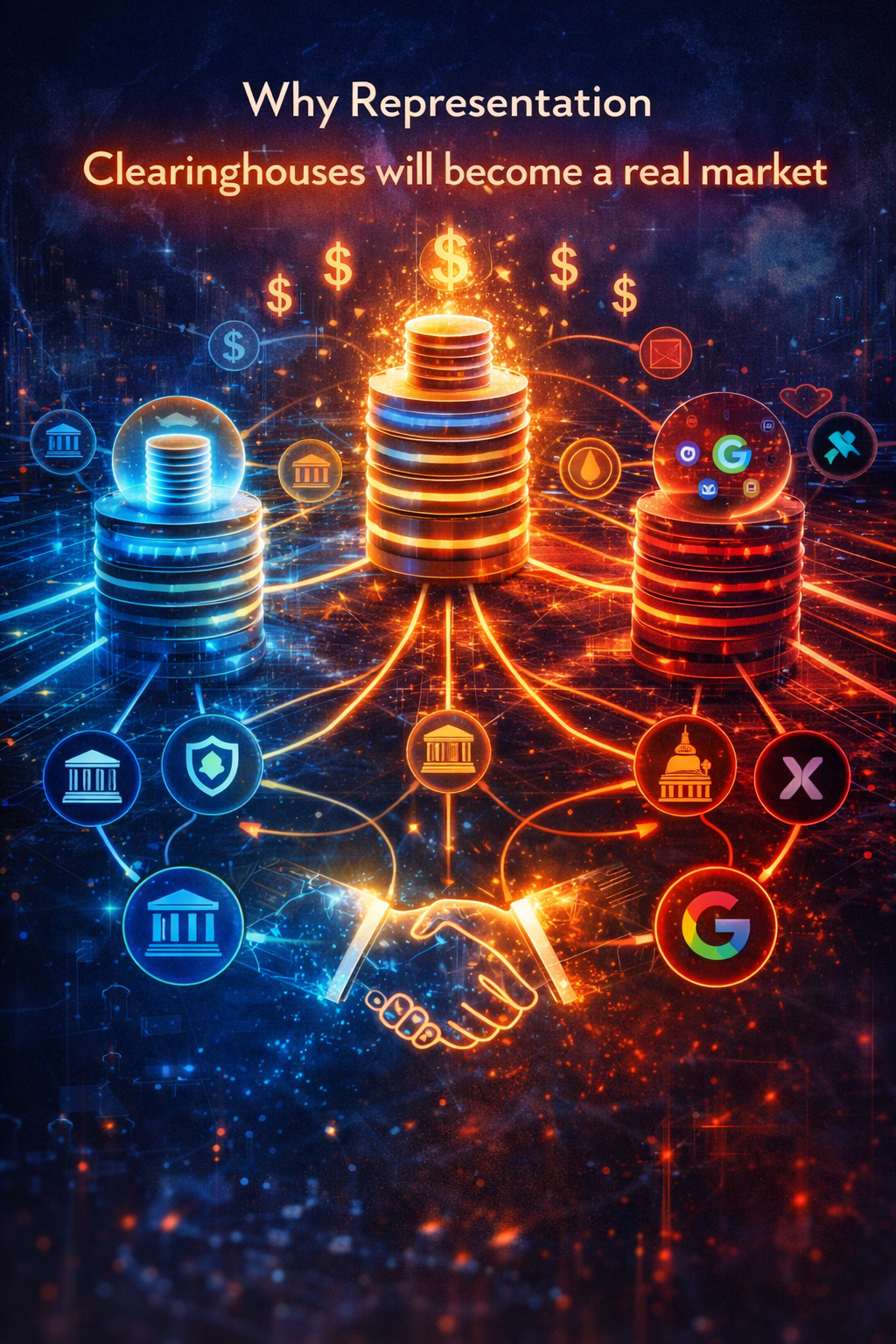
Why Representation Clearinghouses will become a real market
This is not just a theory of governance. It is also a theory of new company formation.
Once you see the problem clearly, new market categories become obvious.
Some firms will specialize in entity-resolution infrastructure across institutions.
Some will become provenance and trust layers for machine-verifiable claims.
Some will operate sector-specific state-reconciliation platforms for banking, healthcare, logistics, public infrastructure, or climate systems.
Some will build conflict-resolution engines that flag when representations diverge beyond safe thresholds.
Some will provide representation audit trails so regulators, insurers, and boards can reconstruct how a reconciled view was formed.
This is why Representation Clearinghouses matter so much for your larger Goal 2. They help explain not only how existing firms can survive and win, but what entirely new firms will emerge.
The companies of the next decade will not just produce models. They will produce trusted reconciliation layers for reality.
Why neutrality matters
A Representation Clearinghouse cannot simply be another dominant platform hiding behind the language of trust.
Its legitimacy depends on neutrality.
That does not necessarily mean government ownership. It means the institution must be trusted to reconcile without unfairly privileging one party’s representation, one schema, one business incentive, or one hidden model logic over everyone else’s.
This is exactly why standards, interoperability bodies, and shared frameworks matter so much. Vendor-neutral and open approaches in areas like shipping, health-data exchange, and digital credentials exist because coordination breaks down when every actor insists on its own closed representation system. (ASTP)
The AI economy will intensify that need. The more autonomous systems act across institutions, the more dangerous closed representational silos become.
What boards and CEOs should ask now
Boards should not wait for a formal “representation clearinghouse industry” to appear before they act.
They should start with five questions:
- Where do we rely on representations of entities that originate outside our institution?
- Where do our AI systems act on local truth without reconciling it against other authoritative views?
- Which attributes in our decisions most often suffer from stale data, conflicting identifiers, or inconsistent provenance?
- Where would a representational conflict create legal, financial, operational, or reputational risk?
- Which partnerships, standards, or neutral layers do we need before we automate further?
This is not a technical housekeeping exercise. It is a strategic question about institutional maturity.
The deeper strategic implication
Representation Clearinghouses point to a bigger truth about the AI economy.
The future will not be won only by those who sense reality better.
It will also be won by those who can reconcile reality across institutions better.
That is a major extension of Representation Economics.
Until now, many firms have treated representation as an internal advantage: better signals, better models, better decisions. But in the next phase, value will also come from being able to operate across fragmented ecosystems where reality is distributed, contested, and unevenly updated.
That is why Representation Clearinghouses may become as important to the AI economy as clearing and settlement infrastructures became to financial markets.
They reduce friction.
They reduce ambiguity.
They reduce systemic error.
And they make higher-speed coordination possible.
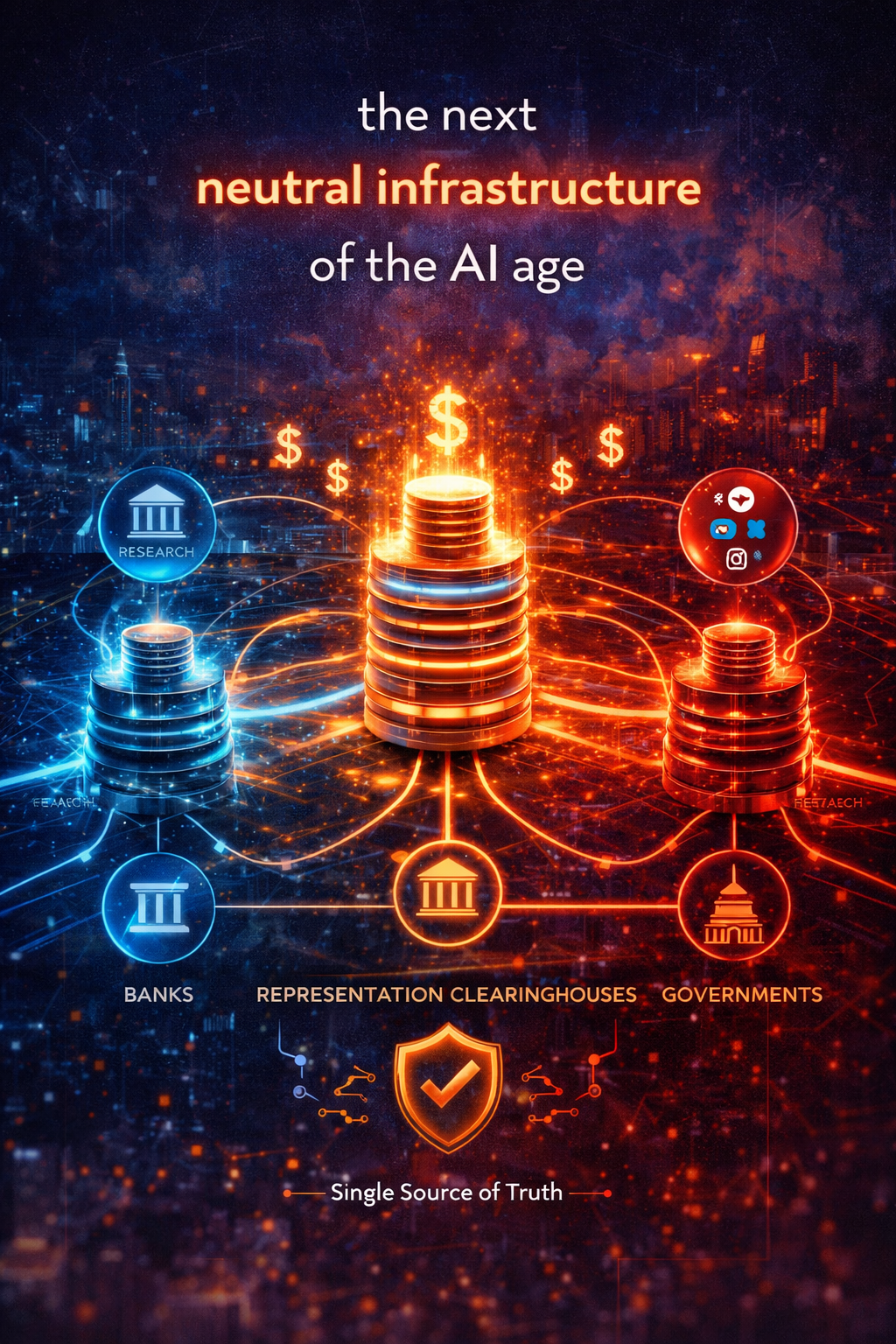
Conclusion: the next neutral infrastructure of the AI age
The AI economy is moving from isolated intelligence to interconnected action.
As that shift accelerates, the biggest problem will not always be whether a model is smart. It will be whether institutions are acting on incompatible versions of the same world.
That is why Representation Clearinghouses matter.
They are the neutral institutions that will help reconcile competing machine-readable realities before those realities trigger credit decisions, medical interventions, supply-chain actions, regulatory responses, or autonomous workflows.
In the industrial era, markets needed clearinghouses for transactions.
In the AI era, economies will increasingly need clearinghouses for representations.
That is the next infrastructure layer of trust.
And the institutions that understand this early will not just build better AI. They will help build a world in which AI systems can coordinate on reality before they act on it.
Summary
What is a Representation Clearinghouse?
A Representation Clearinghouse is a neutral institution or infrastructure layer that reconciles competing machine-readable versions of the same entity, event, or state before high-stakes action is taken.
Why does it matter in the AI economy?
Because AI systems increasingly act across institutions, and those institutions often hold different digital representations of the same person, business, shipment, patient, or transaction.
What problem does it solve?
It helps resolve representational conflict: mismatched identities, stale attributes, conflicting claims, inconsistent provenance, and uncertain authority over which version should drive action.
Why is neutrality important?
Because if the reconciliation layer is biased toward one institution’s incentives or schemas, it stops being trusted infrastructure and becomes another source of representational power.
Glossary
Representation Clearinghouse
A neutral institution or infrastructure layer that reconciles competing machine-readable versions of the same entity, event, or state before action is taken.
Representation Economics
Your broader framework for understanding how trust, value, coordination, and competitive advantage shift when institutions act on representations of reality rather than reality directly.
SENSE–CORE–DRIVER
Your architecture for institutional AI: SENSE makes reality legible, CORE interprets and reasons over it, and DRIVER governs legitimate action.
Entity Resolution
The process of determining whether records from different systems refer to the same real-world entity.
Provenance
Information about where a claim, data point, or digital artifact came from and how it was produced, used to assess quality, reliability, and trustworthiness.
Verifiable Credential
A machine-verifiable digital credential designed to be cryptographically secure and privacy-respecting. W3C’s standard is intended to express credentials on the web in a machine-verifiable way. (W3C)
Patient Matching
The identification and linking of one patient’s data within and across health systems in order to obtain a comprehensive view of that patient’s record. (ASTP)
EPCIS
A GS1 traceability event messaging standard that enables supply-chain visibility through sharing event data using a common language. (GS1)
Digital Trust Infrastructure
The standards, institutions, protocols, and governance layers that make cross-system coordination reliable enough for high-stakes digital action.
FAQ
What is a Representation Clearinghouse in simple language?
It is a neutral layer that helps institutions compare, align, and reconcile different digital representations of the same thing before they act.
Why is this different from ordinary data integration?
Ordinary integration often moves data between systems. A Representation Clearinghouse is concerned with reconciling competing versions of reality, including conflicts, provenance, authority, and trust.
Why will AI make this problem bigger?
Because AI speeds up decisions and increasingly acts across systems, so representational conflicts can trigger faster and larger consequences.
Which industries will need Representation Clearinghouses first?
Banking, healthcare, supply chains, digital identity, insurance, and public-sector systems are strong early candidates because they already rely on fragmented, cross-institutional representations. (ASTP)
Are Representation Clearinghouses just another name for standards bodies?
No. Standards bodies define common rules and formats. A Representation Clearinghouse would use standards, provenance, and governance mechanisms to help reconcile live conflicts across institutional representations.
What new types of companies could emerge?
Entity-resolution platforms, provenance networks, state-reconciliation firms, conflict-resolution engines, and representation audit infrastructure providers.
What should boards do now?
Boards should identify where their organizations already act on external or conflicting representations and ask whether those views are authoritative, reconciled, fresh, and trustworthy enough for automation.
What is a Representation Clearinghouse?
A neutral system that reconciles different machine-readable versions of the same entity before decisions are made.
Why are Representation Clearinghouses needed?
Because different institutions hold different representations of the same reality, leading to conflicting decisions.
How is this different from data integration?
Data integration moves data. Representation Clearinghouses resolve conflicts in reality itself.
Why is this important for AI?
AI systems increasingly act across institutions, making inconsistent representations a major risk.
Which industries need this first?
Banking, healthcare, supply chains, identity systems, insurance, and public sector systems.
References and further reading
For financial clearing and settlement logic, see BIS and IOSCO’s materials on the Principles for Financial Market Infrastructures, which define core categories of market infrastructure and explain their role in reducing systemic risk. (Bank for International Settlements)
For digital credentials, see W3C’s Verifiable Credentials Data Model 2.0 and the W3C announcement of the Recommendation, which describe a mechanism for credentials that is cryptographically secure, privacy-respecting, and machine-verifiable. (W3C)
For healthcare interoperability and patient matching, see ASTP/HealthIT resources on patient identity and record matching, which define patient matching and explain why it is critical to interoperability. (ASTP)
For supply-chain visibility and interoperability, see GS1 standards, GS1 EPCIS materials, and related traceability resources describing common-language approaches to event sharing and visibility. (GS1)
Explore the Architecture of the AI Economy
This article is part of a broader research series exploring how institutions are being redesigned for the age of artificial intelligence. Together, these essays examine the structural foundations of the emerging AI economy — from signal infrastructure and representation systems to decision architectures and enterprise operating models.
If you want to explore the deeper framework behind these ideas, the following essays provide additional perspectives:
-
- • Why Most AI Projects Fail Before Intelligence Even Begins
- The Representation Economy: Why AI Institutions Must Run on SENSE, CORE, and DRIVER – Raktim Singh
- The Representation Economy: Why Intelligent Institutions Will Run on the SENSE–CORE–DRIVER Architecture – Raktim Singh
- The Representation Economy Explained: 51 Questions About the SENSE–CORE–DRIVER Architecture – Raktim Singh
- The Representation Deficit: Why Institutions Fail When Reality Cannot Enter the Decision System – Raktim Singh
- The Representation Maturity Model: How Boards Decide When AI Can Be Trusted With Real Decisions – Raktim Singh
- Representation Capital: The Invisible Asset That Will Decide Which Institutions Win the AI Economy – Raktim Singh
- Representation Failure: Why AI Systems Break When Institutions Misread Reality – Raktim Singh
- The Board’s Representation Strategy: How Intelligent Institutions Decide What Must Be Seen, Modeled, Governed, and Delegated – Raktim Singh
- The Representation Premium: Why Institutions That Are Easier for AI to See, Trust, and Coordinate With Will Win the Next Economy – Raktim Singh
- The Firm of the AI Era Will Be Built Around Representation: Why Institutions Must Redesign Themselves for the SENSE–CORE–DRIVER Economy – Raktim Singh
- The Representation Stack: The New Architecture of Intelligent Institutions in the AI Economy – Raktim Singh
- Representation Economics: The New Law of Value Creation in the AI Era – Raktim Singh
- The Representation Reserve Currency: Why AI Will Trust Only a Few Forms of Reality – Raktim Singh
- The Machine-Readable Boundary of the Firm: How AI Is Redefining What Companies Own, Outsource, and Orchestrate – Raktim Singh
- Representation Insurance: Why Machine-Readable Trust Will Power the AI Economy – Raktim Singh
- The Representation Commons: Why Broad-Based AI Value Begins Before the Model – Raktim Singh
- The Representation Access Economy: Why AI Will Decide Who Gets Seen, Structured, and Trusted – Raktim Singh
- Representation Bankruptcy: Why AI Will Break Companies That Machines Cannot Trust – Raktim Singh
- The Representation Kill Zone: Why Companies Become Invisible Before They Realize They Are Losing – Raktim Singh
- Representation Alpha: Why Competitive Advantage Will Come from Better Representation, Not Better Models – Raktim Singh
- Representation Fiduciaries: The Missing Institution the AI Economy Cannot Scale Without – Raktim Singh
- The Representation Commons: Why Broad-Based AI Value Begins Before the Model – Raktim Singh
- The Representation Conversion Industry: Why the Biggest AI Companies Will Rebuild Reality Before They Build Intelligence – Raktim Singh
- Representation Alpha: Why Competitive Advantage Will Come from Better Representation, Not Better Models – Raktim Singh
- Representation Fiduciaries: The Missing Institution the AI Economy Cannot Scale Without – Raktim Singh
- Representation Accounting: The New Discipline That Will Decide Which AI-Driven Institutions Can Be Trusted – Raktim Singh
- Synthetic Representation: How the AI Economy Will Construct Reality When It Cannot Fully Observe It – Raktim Singh
Together, these essays outline a central thesis:
The future will belong to institutions that can sense reality, represent it clearly, reason about it intelligently, and act through governed machine systems.
This is why the architecture of the AI era can be understood through three foundational layers:
SENSE → CORE → DRIVER
Where:
- SENSE makes reality legible
- CORE transforms signals into reasoning
- DRIVER ensures that machine action remains accountable, governed, and institutionally legitimate
Signal infrastructure forms the first and most foundational layer of that architecture.
AI Economy Research Series — by Raktim Singh



Raktim Singh is an AI and deep-tech strategist, TEDx speaker, and author focused on helping enterprises navigate the next era of intelligent systems. With experience spanning AI, fintech, quantum computing, and digital transformation, he simplifies complex technology for leaders and builds frameworks that drive responsible, scalable adoption.