
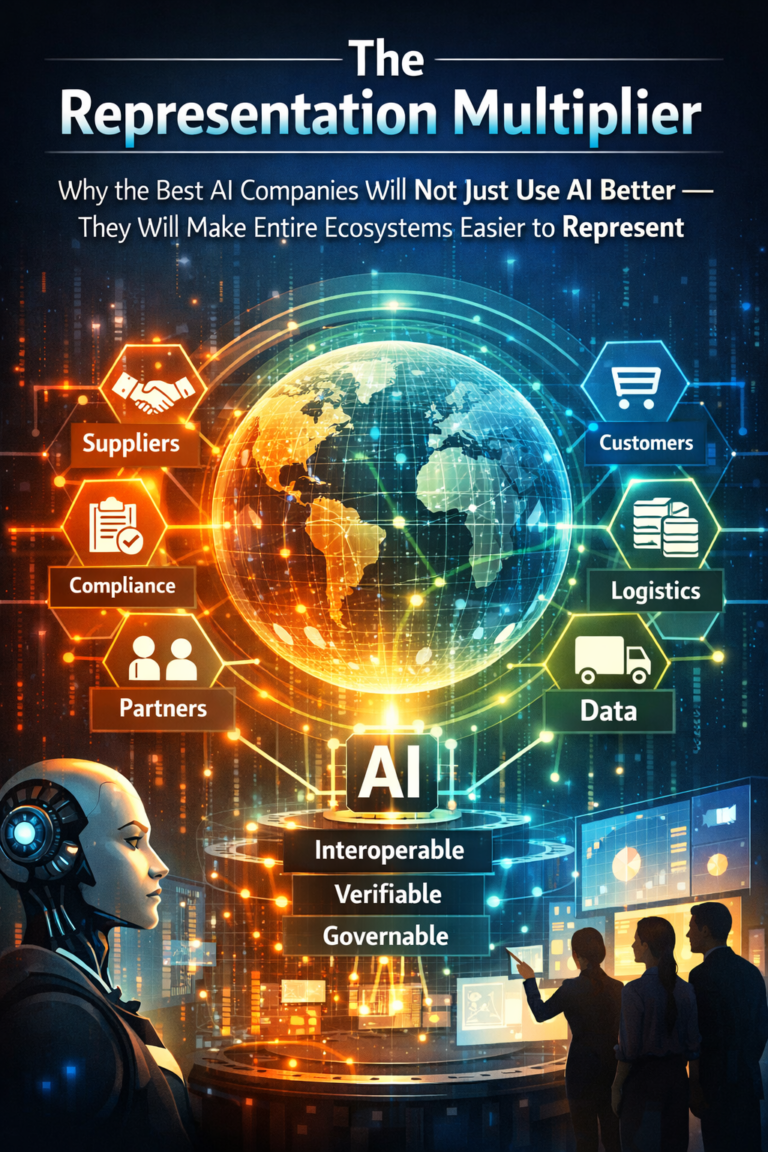
The Representation Multiplier:
In the AI economy, the deepest advantage will not come only from smarter models. It will come from making suppliers, customers, partners, assets, and decisions easier for machines to identify, understand, verify, and coordinate.
Most companies still think about AI in a narrow way.
They ask: How do we automate more work? How do we improve productivity? How do we reduce cost? How do we get better answers from models?
These are fair questions. But they are no longer the defining questions.
The real shift is larger. As AI becomes embedded in workflows, operations, decision systems, customer interfaces, and partner networks, value will not come only from using intelligence inside the firm.
It will increasingly come from making the wider ecosystem around the firm easier for machines to interpret and act upon. McKinsey’s 2025 global survey points in this direction: companies seeing stronger AI value are not merely “deploying AI,” but redesigning workflows, governance, operating models, and adoption practices around it. (McKinsey & Company)
That is where a new idea becomes visible: the Representation Multiplier.
The Representation Multiplier is the economic advantage a company gains when it does not just improve its own AI systems, but helps make the surrounding ecosystem more machine-legible, interoperable, verifiable, and governable.
In simple terms, the best AI companies will not just think better. They will help the whole system become easier to see.
And that matters because AI does not act on reality directly. It acts on what a system can represent.
That is the foundation of Representation Economics: in the AI era, value creation shifts toward those who can turn messy reality into trusted, machine-usable representation. The firm that improves this not only for itself, but for the wider ecosystem, creates a multiplier effect that competitors will struggle to match.
Why using AI well is no longer enough
For years, digital advantage came from internal optimization. A company could modernize its software stack, digitize workflows, centralize data, and outperform slower rivals.
That logic still matters. But AI changes the scale of the game.
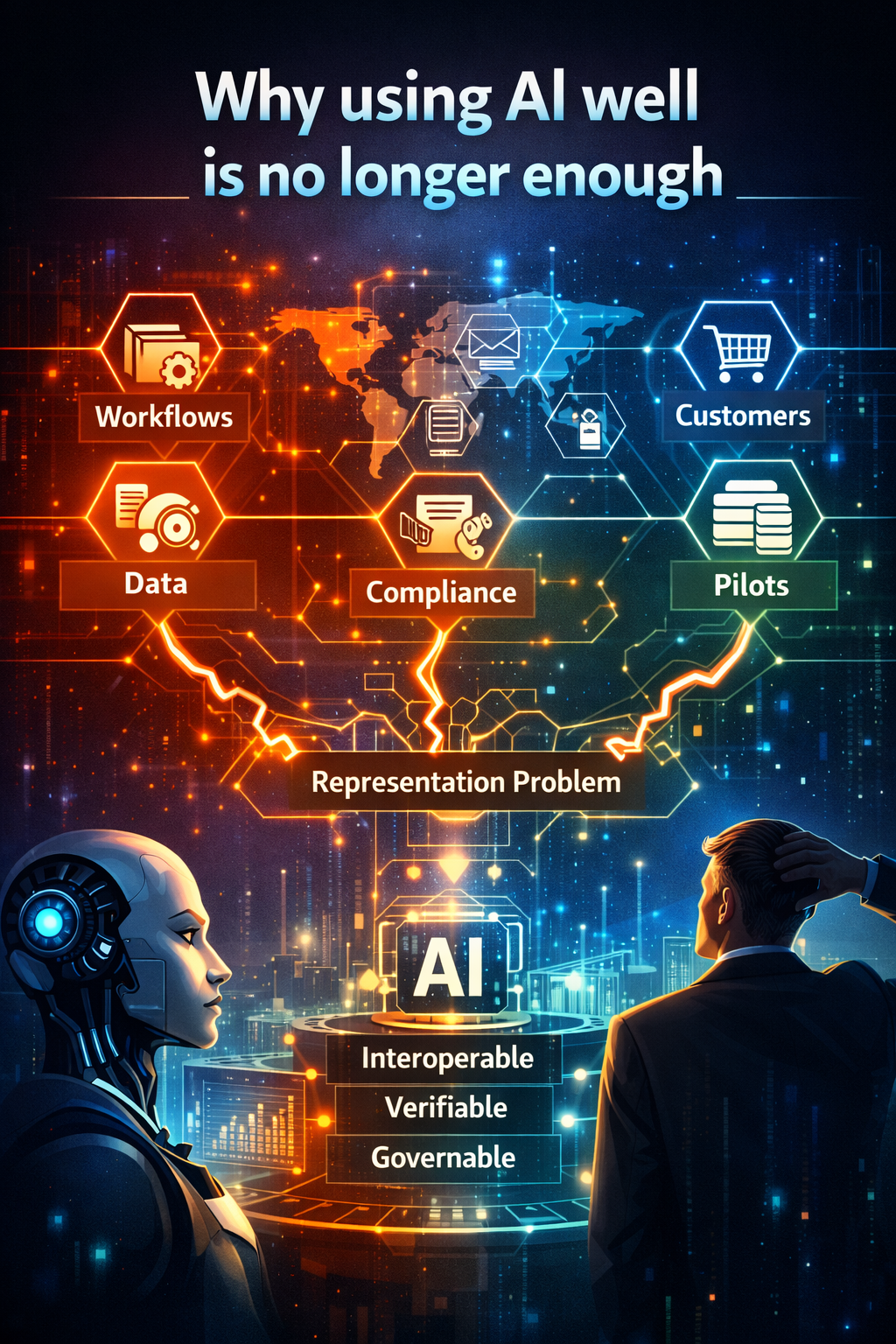
AI systems work best when the environment around them is structured enough to support reliable action. If supplier data arrives in inconsistent formats, customer identities are fragmented, documents are unstructured, compliance conditions vary across jurisdictions, and real-world state changes are not captured well, even a powerful model will struggle to produce dependable value.
This is one reason many firms remain stuck between experimentation and scale. McKinsey’s 2025 findings show that meaningful enterprise-wide bottom-line impact from AI remains relatively rare, and that value is associated with management practices such as workflow redesign, governance, and disciplined operating choices rather than model access alone. (McKinsey & Company)
The problem, in many cases, is not model intelligence. The failure begins before the model begins.
A company may have a strong model, a capable AI team, and dozens of pilots, yet still fail because the surrounding ecosystem is difficult to represent.
Imagine a manufacturer using AI to predict supply disruption. The model may be excellent.
But if supplier data arrives late, shipment events are recorded differently by each partner, inventory states are not synchronized, and logistics systems cannot speak to one another, the company does not primarily have an intelligence problem. It has a representation problem.
NIST’s recent traceability work makes this point in more technical language. It emphasizes structured event definitions, linked traceability records, trusted repositories, and standardized data fields as essential to provenance, compliance, and reliable supply-chain coordination. (NIST Publications)
This is the heart of the Representation Multiplier.
What is the Representation Multiplier?
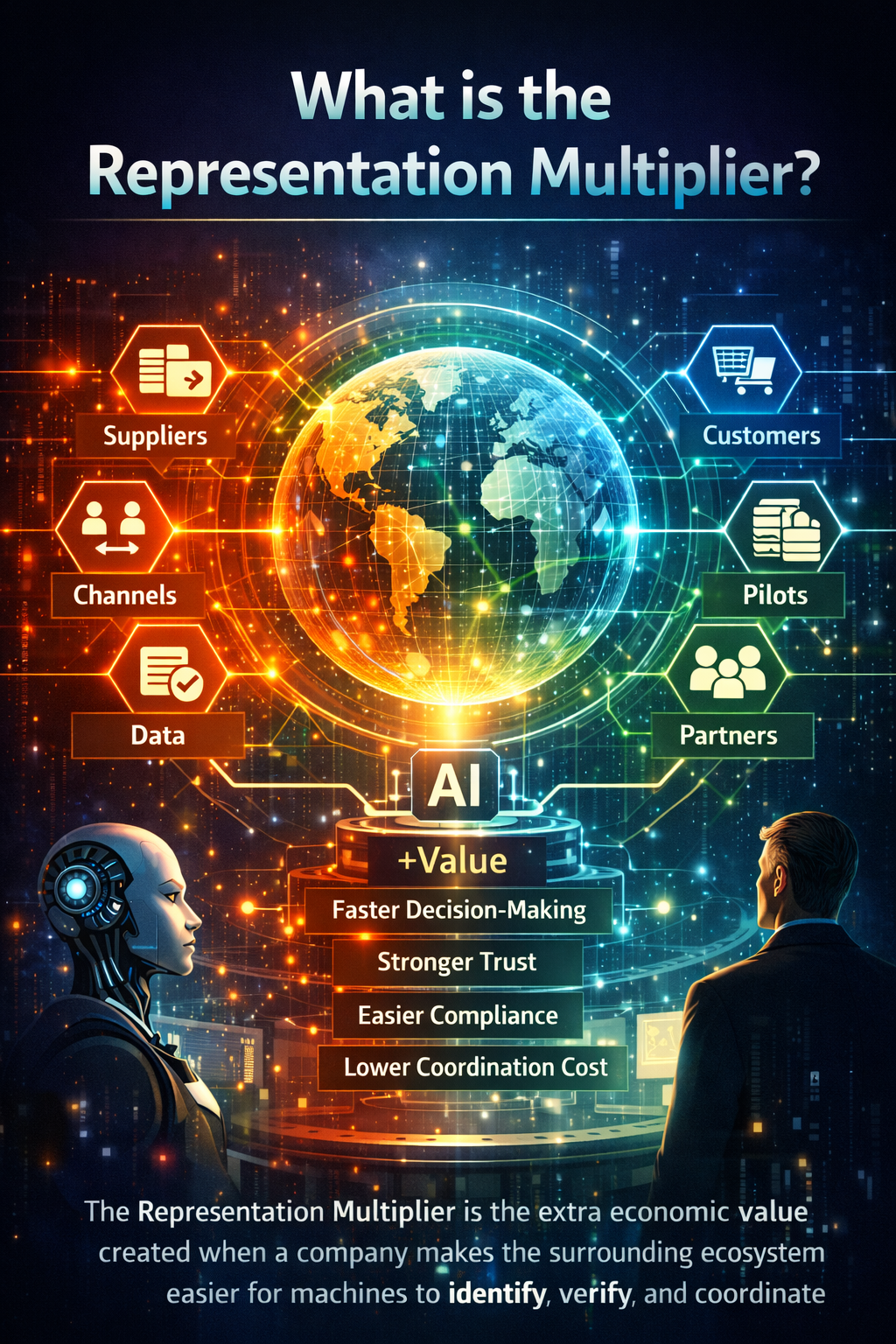
The Representation Multiplier is the additional economic value created when a company improves the machine-readability of the ecosystem around it.
This means making it easier for machines to:
identify entities consistently, understand current state, detect change, trace provenance, verify compliance, compare options, coordinate action, and recover when reality changes.
A normal AI strategy asks:
How can we make our company more intelligent?
A multiplier strategy asks:
How can we make our suppliers, customers, products, transactions, channels, and partner decisions easier for machines to represent?
That difference is enormous.
Because once an ecosystem becomes easier to represent, multiple gains begin to compound: faster decisions, lower coordination cost, better forecasting, fewer disputes, more reliable automation, lower onboarding friction, easier compliance, and better exception handling.
This is why digital public infrastructure, interoperable data environments, and trusted data-sharing architectures matter so much. The World Bank has argued that interoperable digital systems reduce friction, expand access, enable paperless transactions, and create the basis for new forms of market participation.
The European Commission describes common data spaces in similar terms: trusted, secure frameworks that allow data to be shared and used across organizations in ways that unlock innovation and competitiveness while preserving control. OECD work on data access and sharing likewise treats interoperability, accessibility, and reuse as central to the economic value of data in AI-intensive environments. (World Bank)
These are not just technical upgrades.
They are multiplier systems.
A simple example: the lending ecosystem
Take a lender.
A traditional AI story says the lender improves its credit models and makes better lending decisions.
A Representation Multiplier story is larger.
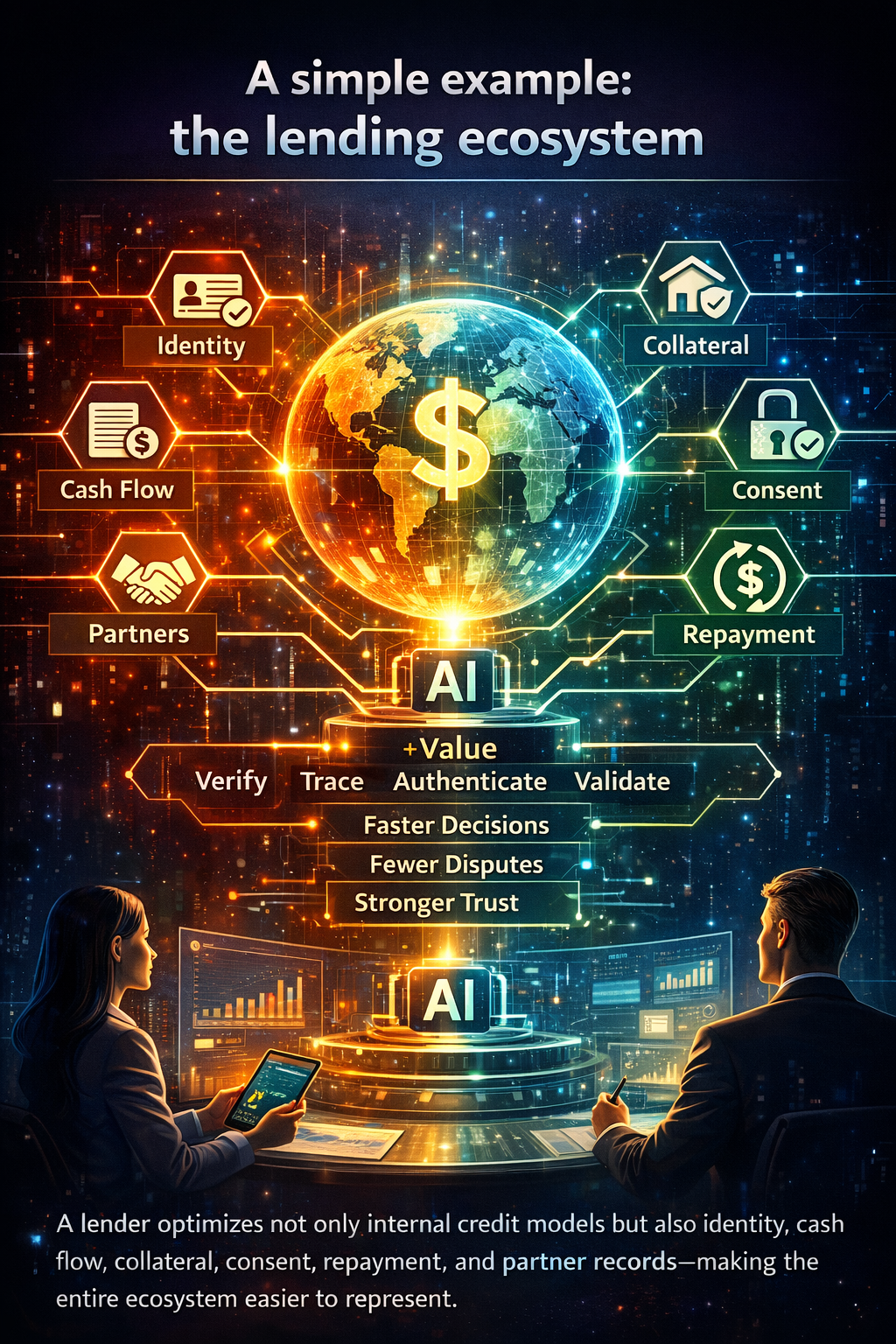
The lender helps create an environment where borrower identity is easier to verify, income records are easier to validate, cash flows are easier to interpret, repayment behavior is easier to trace, collateral records are easier to authenticate, consent flows are easier to manage, and exceptions are easier to review.
Now the lender is not just using AI better. It is making the surrounding credit ecosystem more representable.
What happens next?
Underwriting gets faster. Fraud risk drops. Smaller businesses become easier to serve. Marketplace partnerships become easier to scale. Insurance pricing becomes more precise. Compliance review becomes less manual. Secondary decision systems become more dependable.
The value did not come only from a better model. It came from reducing representation friction across the ecosystem.
That is the multiplier.
This logic also helps explain why digital identity, payment rails, consent systems, and interoperable public digital infrastructure have become strategically important in multiple countries. They do not merely digitize a process. They make participation, verification, and coordination easier across many actors at once. (Open Knowledge World Bank)
Another example: supply chains
Consider a global supply chain.
One company may use AI internally to forecast inventory.
A more powerful company helps the ecosystem standardize part identifiers, shipment events, quality signals, process records, modification history, compliance attributes, and logistics state updates.
Now AI can do much more than forecasting. It can support disruption planning, provenance, substitution analysis, risk scoring, emissions tracking, and coordinated response.
Harvard Business Review has described how major global firms are applying AI to anticipate and adapt to supply-chain disruptions. NIST’s traceability work complements that by showing why these efforts require common event structures, traceability chains, and interoperable records rather than isolated analytics alone. (NIST Publications)
The deeper lesson is simple: the company that helps the ecosystem become more structured becomes more central to the ecosystem.
That is not just operational advantage.
That is strategic power.
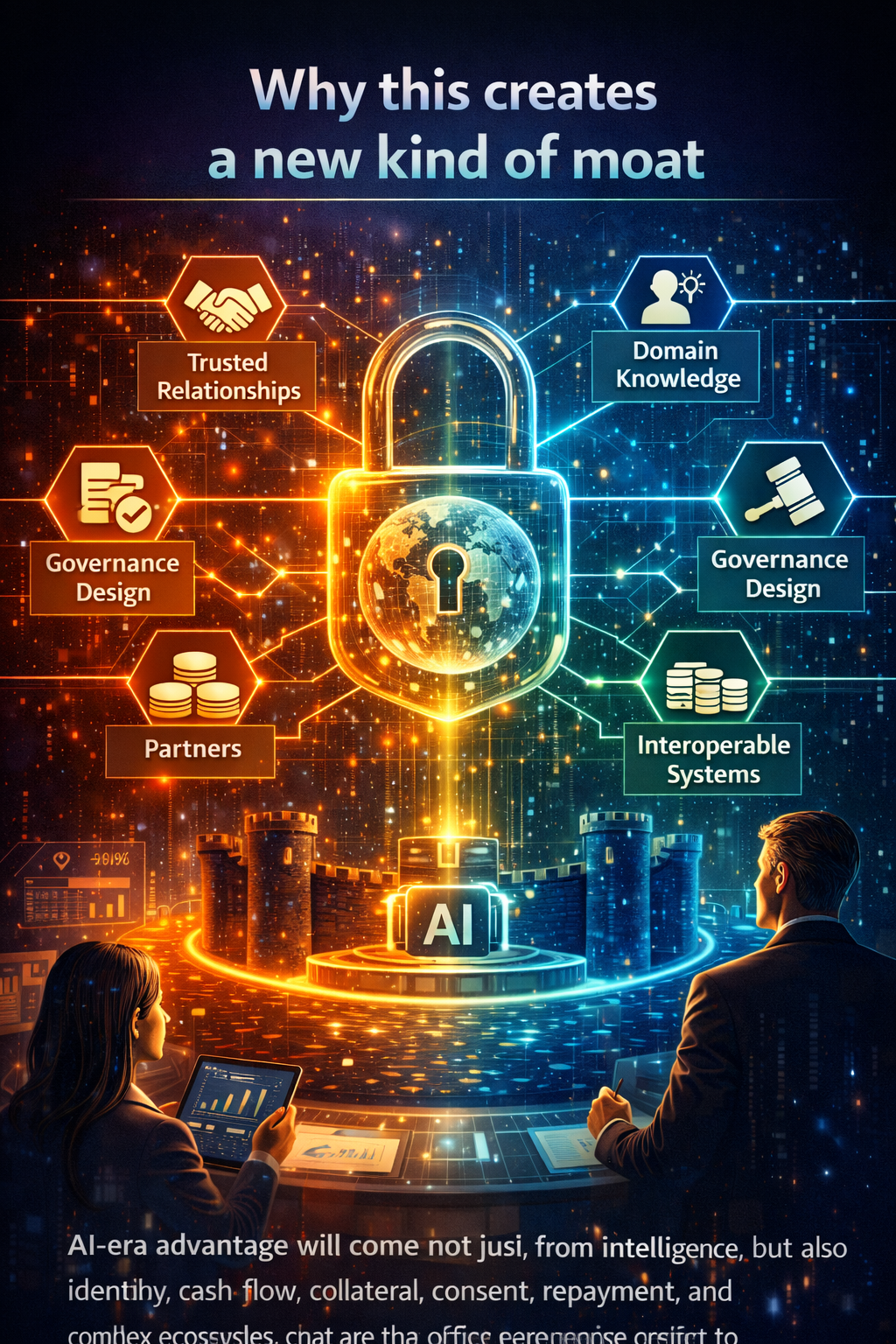
In the past, competitive moats often came from distribution, brand, capital, or proprietary software.
In the AI era, a new moat is emerging: the ability to make complex ecosystems machine-usable.
This moat is hard to copy because it requires more than technology. It requires trusted relationships, domain understanding, governance design, interoperability standards, onboarding discipline, partner incentives, and often a long-term institutional role.
Anyone can buy a model.
Not everyone can make an ecosystem legible.
This is why the Representation Multiplier may become one of the most powerful forms of AI-era advantage. The winning company becomes the place where fragmented reality gets translated into coordinated action.
That is a stronger position than simply being the company with the cleverest AI demo.
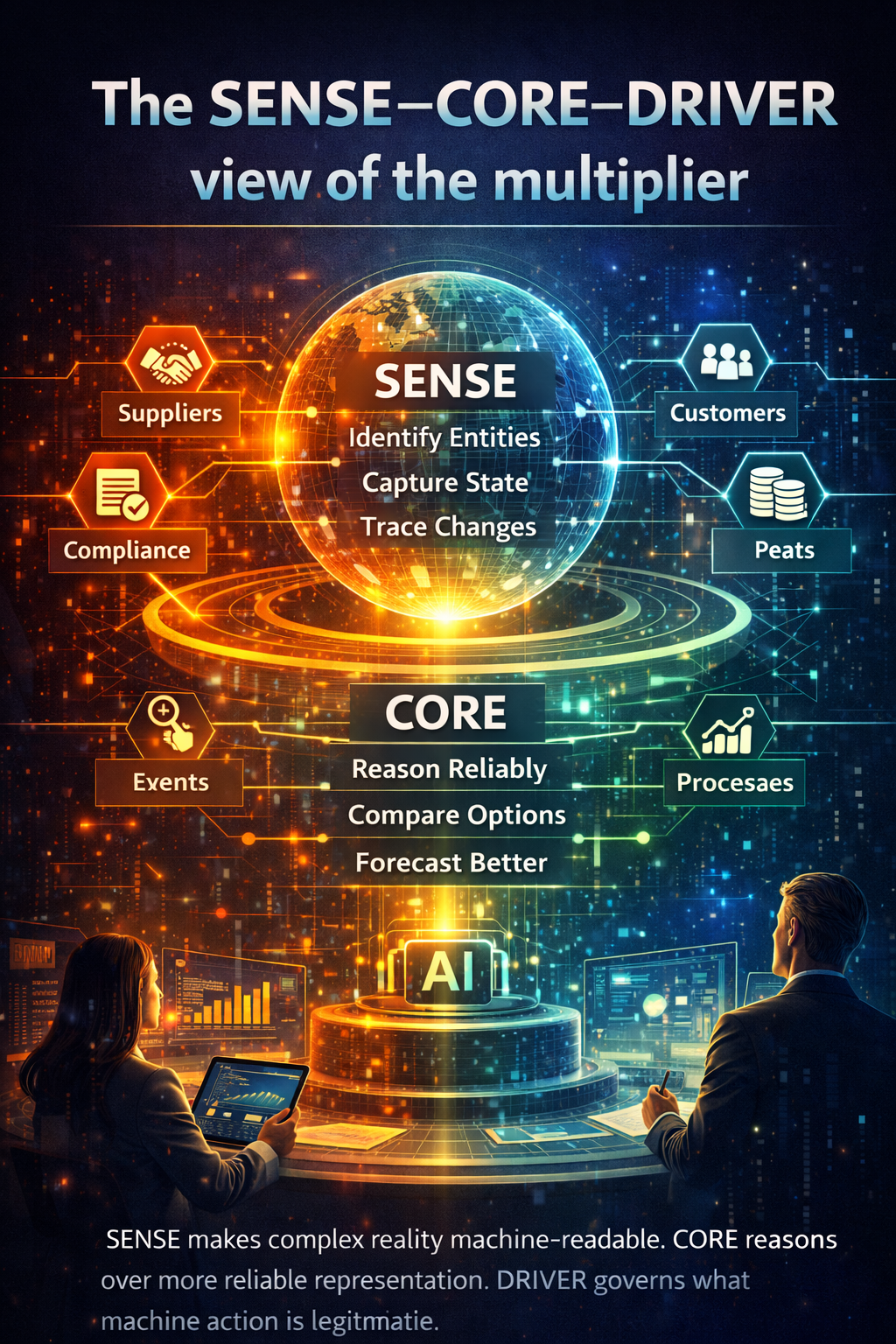
The Representation Multiplier becomes even clearer through the SENSE–CORE–DRIVER framework.
SENSE: making reality legible
The multiplier starts here.
A company improves the ecosystem’s ability to generate cleaner signals, identify entities, capture state, and update change over time. Without this layer, the rest collapses.
Examples include cleaner supplier event data, better product identity, verified consent records, shared compliance metadata, and common process vocabularies.
This is where reality becomes machine-readable.
CORE: making decisions more reliable
Once the ecosystem is easier to represent, the decision layer improves.
Now AI can reason over fresher information, better context, fewer contradictions, clearer relationships, and more comparable states.
The model may be the same model as everyone else uses. But its decisions improve because its representational substrate is better.
This is a crucial point for boards and CEOs: advantage in AI will often come less from exclusive intelligence and more from better-prepared reality.
DRIVER: making action legitimate
The multiplier becomes durable only when action is governed.
Who is allowed to act? On what authority? With what traceability? With what limits? With what recourse if the system is wrong?
This is where many firms underinvest. They improve visibility and reasoning a little, but not enough governance. Then automation creates fear instead of trust.
The real multiplier emerges when ecosystems are not only visible and intelligible, but also governable.
Why entire sectors will reorganize around this logic
This is not just a company story. It is a sector story.
Industries with high coordination friction will be reshaped first: financial services, healthcare, manufacturing, logistics, agriculture, energy, public services, and cross-border trade.
Why?
Because these sectors depend on many actors seeing the same reality in compatible ways.
Once a company helps that happen, it can become the orchestration layer, the verification layer, the standard-setting layer, the exception-handling layer, or the delegation layer.
That is one reason why policymakers and global institutions are focusing more heavily on interoperability, trusted sharing, AI readiness, and data spaces. OECD work highlights findability, accessibility, interoperability, and reusability as key conditions for cross-organizational value creation. The European Commission frames common data spaces as a secure basis for innovation and competitiveness. World Bank work on digital public infrastructure makes a similar case at societal scale. (One MP)
The implication is profound:
The next great AI companies may not look like pure model companies.
They may look like ecosystem-shaping institutions.
The new company categories that may emerge
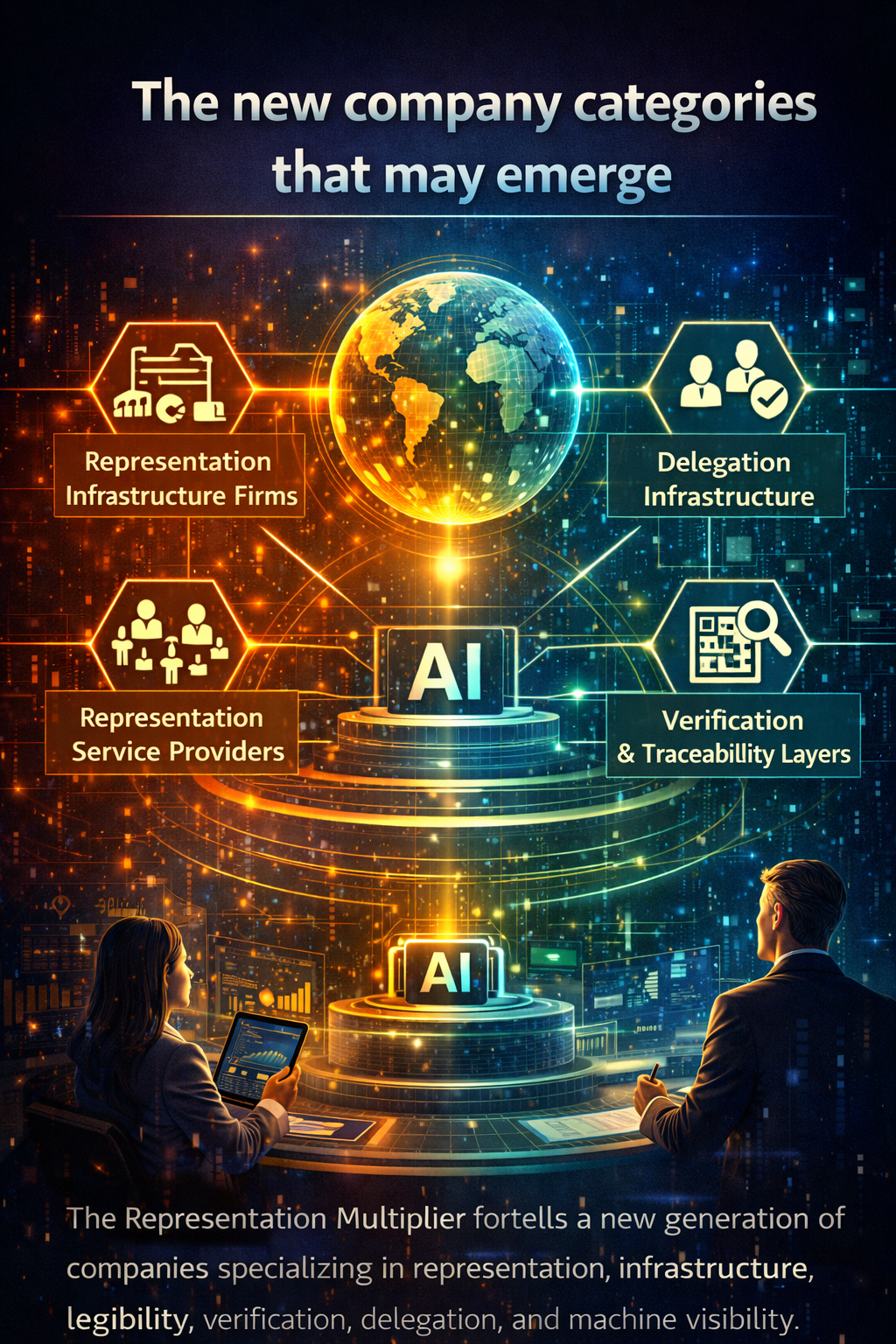
The Representation Multiplier also helps explain which new company types are likely to emerge in the AI economy.
One category will be representation infrastructure firms that help sectors standardize identities, events, provenance, metadata, and state models.
A second category will be ecosystem legibility platforms that make fragmented partner networks easier for AI systems to interpret and coordinate.
A third will be verification and traceability layers that prove what happened, who changed what, and whether the current representation can be trusted.
A fourth will be delegation infrastructure firms that manage authority, permissions, action boundaries, and recourse across humans and machines.
A fifth will be representation service providers that help small firms, informal actors, and under-digitized sectors become machine-visible and AI-ready.
This is where Representation Economics becomes especially powerful. It is not just a theory of AI adoption. It is a theory of new market formation.
Why this matters for existing companies
Existing companies should read this as both a warning and an opportunity.
If they only deploy AI internally, they may get incremental productivity.
But if they become the company that makes an ecosystem easier to represent, they can gain structural advantage, deeper data compounding, higher switching costs, stronger coordination power, and greater relevance in the sector’s future architecture.
In plain language, the winner will not always be the company with the smartest AI.
It may be the company that makes everyone else easier for AI to work with.
That is a very different strategic position.
The board-level question that now matters most
Every board should now ask a harder question:
Are we merely improving AI inside the firm, or are we making the ecosystem around us easier to represent, trust, and coordinate?
That question will define the next generation of advantage.
Because in the AI economy, intelligence becomes more available. Models spread. Tools diffuse. Costs fall.
But high-trust representation does not become abundant so easily.
It takes design.
It takes standards.
It takes incentives.
It takes governance.
It takes institutional imagination.
And that is why the Representation Multiplier may become one of the defining strategic ideas of the AI decade.
The best AI companies will not just automate better.
They will help the entire ecosystem become more legible, more governable, and more actionable.
They will not only use intelligence.
They will organize reality for intelligence.
That is where the next durable advantage will be built.
Conclusion
The first wave of AI strategy was about tools. The second wave is about workflows. The third wave will be about ecosystems.
That is where the deepest value will be created.
The firms that win will not be the ones that treat AI as an isolated capability sitting inside the enterprise. They will be the ones that redesign the conditions under which intelligence operates. They will reduce ambiguity across partners. They will standardize identity and state. They will improve verification. They will create trusted routes for delegation. They will make more of the surrounding world machine-readable without losing governance, accountability, or recourse.
That is the Representation Multiplier.
And once boards begin to see it, they will start to recognize a larger truth about the AI era: the future belongs not only to firms that compute better, but to institutions that represent reality better.
Glossary
Representation Multiplier
The added economic value a company creates when it makes the surrounding ecosystem easier for machines to identify, interpret, verify, and coordinate.
Representation Economics
A framework for understanding AI-era value creation through the quality of machine-readable representation rather than model power alone.
Machine-legible ecosystem
A network of suppliers, customers, assets, rules, and events that can be consistently understood by digital and AI systems.
Interoperability
The ability of systems, organizations, and data structures to work together without losing meaning or control.
Traceability
The ability to track who did what, when, where, and under what conditions across a chain of events.
Delegation infrastructure
The governance layer that defines who or what is allowed to act, under what authority, with what boundaries, and with what recourse.
SENSE
The layer where reality becomes legible through signals, entities, state representation, and evolution over time.
CORE
The layer where systems reason, optimize, interpret, and decide using the represented world.
DRIVER
The layer where authority, verification, execution, and recourse make action legitimate.
Representation friction
The loss of speed, clarity, trust, or reliability caused by poor identity, inconsistent data, missing state, weak provenance, or incompatible systems.
FAQ
What is the Representation Multiplier?
The Representation Multiplier is the advantage created when a company improves not only its own AI systems, but also the machine-readability of the wider ecosystem around it.
Why is this more important than just having a better model?
Because many AI failures happen before model inference begins. If the surrounding ecosystem is poorly represented, even strong models produce weak business outcomes.
How does the Representation Multiplier relate to Representation Economics?
Representation Economics explains how value in the AI era depends on turning reality into trusted, machine-usable representation. The Representation Multiplier is one mechanism through which that value compounds across ecosystems.
Which sectors are most likely to be affected first?
Financial services, healthcare, manufacturing, logistics, agriculture, energy, public services, and cross-border trade are especially exposed because they depend on many actors sharing consistent views of reality.
Is this mainly a technology issue?
No. It is also a governance, standards, incentives, and institutional design issue. Technology is necessary, but not sufficient.
What should boards do first?
Boards should identify where their organization depends on fragmented external reality: suppliers, customers, compliance flows, partner networks, and operational events. Then they should ask where representation friction is slowing trust, speed, and coordination.
Will this create new kinds of companies?
Yes. Likely categories include representation infrastructure firms, traceability layers, delegation infrastructure providers, ecosystem legibility platforms, and services that make under-digitized sectors machine-visible.
Read more about these at
- Representation Economics: The New Law of AI Value Creation (Raktim Singh)
- Representation Capital: The Invisible Asset That Will Decide Which Institutions Win the AI Economy (Raktim Singh)
- The Representation Utility Stack: Why AI’s Next Competitive Advantage Will Come from Interoperable Reality (Raktim Singh)
- Decision Scale: Why Competitive Advantage Is Moving from Labor Scale to Decision Scale (Raktim Singh)
- The New Company Stack: The 7 Business Categories That Will Emerge in the Representation Economy (Raktim Singh)
- The Representation Strategy of the Firm: Why AI Winners Will Be Those Who See What Others Cannot (Raktim Singh)
References and Further Reading
- McKinsey, The State of AI 2025: How Organizations Are Rewiring to Capture Value — on workflow redesign, governance, and scaled value from AI. (McKinsey & Company)
- World Bank, Digital Public Infrastructure — on interoperable digital systems as enablers of participation, coordination, and market creation. (World Bank)
- European Commission, Common European Data Spaces — on trusted data sharing, interoperability, and competitiveness. (Digital Strategy)
- NIST, Supply Chain Traceability — on structured event definitions, provenance, and interoperable traceability records. (NIST Publications)
- OECD, Enhancing Access to and Sharing of Data — on data sharing, interoperability, and reuse in AI-intensive economies. (OECD)



Raktim Singh is an AI and deep-tech strategist, TEDx speaker, and author focused on helping enterprises navigate the next era of intelligent systems. With experience spanning AI, fintech, quantum computing, and digital transformation, he simplifies complex technology for leaders and builds frameworks that drive responsible, scalable adoption.