
The Cost of Legibility:
In the AI era, the most important cost may not be compute. It may be the cost of making reality legible enough for machines to act on safely.
For the past few years, most of the AI conversation has focused on models.
Which model is smarter?
Which one is cheaper?
Which one reasons better?
Which one can automate more work?
These are useful questions. But they are no longer the deepest ones.
The deeper question is this:
What does it cost to make the world understandable enough for machines to act on it?
That question matters because AI never acts on reality directly. It acts on a representation of reality: signals, identities, states, relationships, permissions, timestamps, exceptions, histories, and rules. Before any model can reason, recommend, predict, or execute, someone has to do the much harder work of turning messy reality into a form that machines can interpret. NIST’s AI Risk Management Framework reflects exactly this broader view of AI as a socio-technical system shaped by data quality, context, governance, and lifecycle controls, not just model performance. (NIST)
That is the core idea behind what I call the cost of legibility.
The cost of legibility is the total cost of making reality visible, structured, current, trustworthy, and usable enough for AI systems to interpret and act upon. It includes capturing signals, resolving identity, linking fragmented records, updating state, preserving provenance, encoding policies, tracking change over time, and maintaining enough governance that machine action remains defensible. IBM and similar industry research on poor data quality have long shown that these hidden costs can be enormous even before advanced AI enters the picture. (NIST)
And that changes the economics of AI.
The cost of legibility in AI refers to the cost of making real-world data structured, current, and trustworthy enough for machines to act on. As AI systems move from generating content to making decisions, the ability of organizations to represent reality accurately becomes the key driver of value, risk, and competitive advantage.
The old belief: intelligence is the expensive part
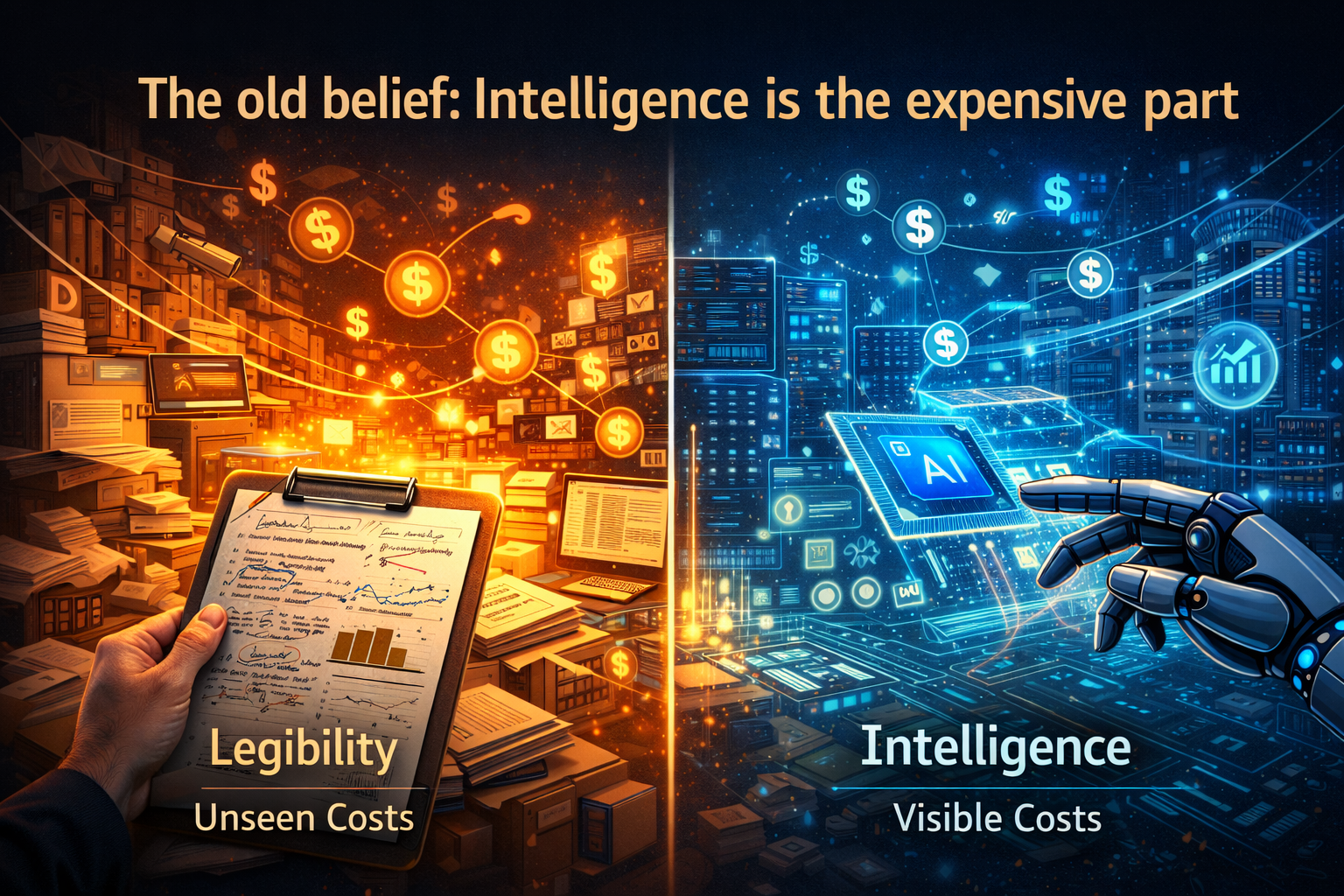
For most of the last decade, leaders assumed the expensive part of AI would be intelligence itself: training frontier models, running inference, renting GPUs, building data centers, and scaling compute.
Those costs are real. The International Energy Agency’s 2025 report on Energy and AI makes clear that AI is already reshaping electricity demand, infrastructure planning, and the strategic importance of energy supply. AI-related data center demand is no longer a niche operational issue. It is now a macroeconomic and industrial issue. (IEA)
But that is only one side of the equation.
The other side is the cost of making the world machine-readable enough for intelligence to be useful in the first place. In practice, many AI projects do not struggle because the model is weak. They struggle because the organization cannot provide clean entities, current state, reliable context, clear rules, ownership boundaries, or defensible feedback loops. McKinsey’s 2025 State of AI findings point in that direction: organizations capture more value when they redesign workflows, strengthen governance, improve data and operating models, and treat AI adoption as an institutional transformation rather than a pure technology rollout. (McKinsey & Company)
In other words:
The cost of intelligence is visible. The cost of legibility is hidden.
And hidden costs are often the ones that decide who scales and who stalls.
What is the cost of legibility in AI?
The cost of legibility in AI is the cost of converting real-world complexity into structured, machine-readable data that AI systems can interpret and act upon reliably.
A simple example: a hospital, not a model
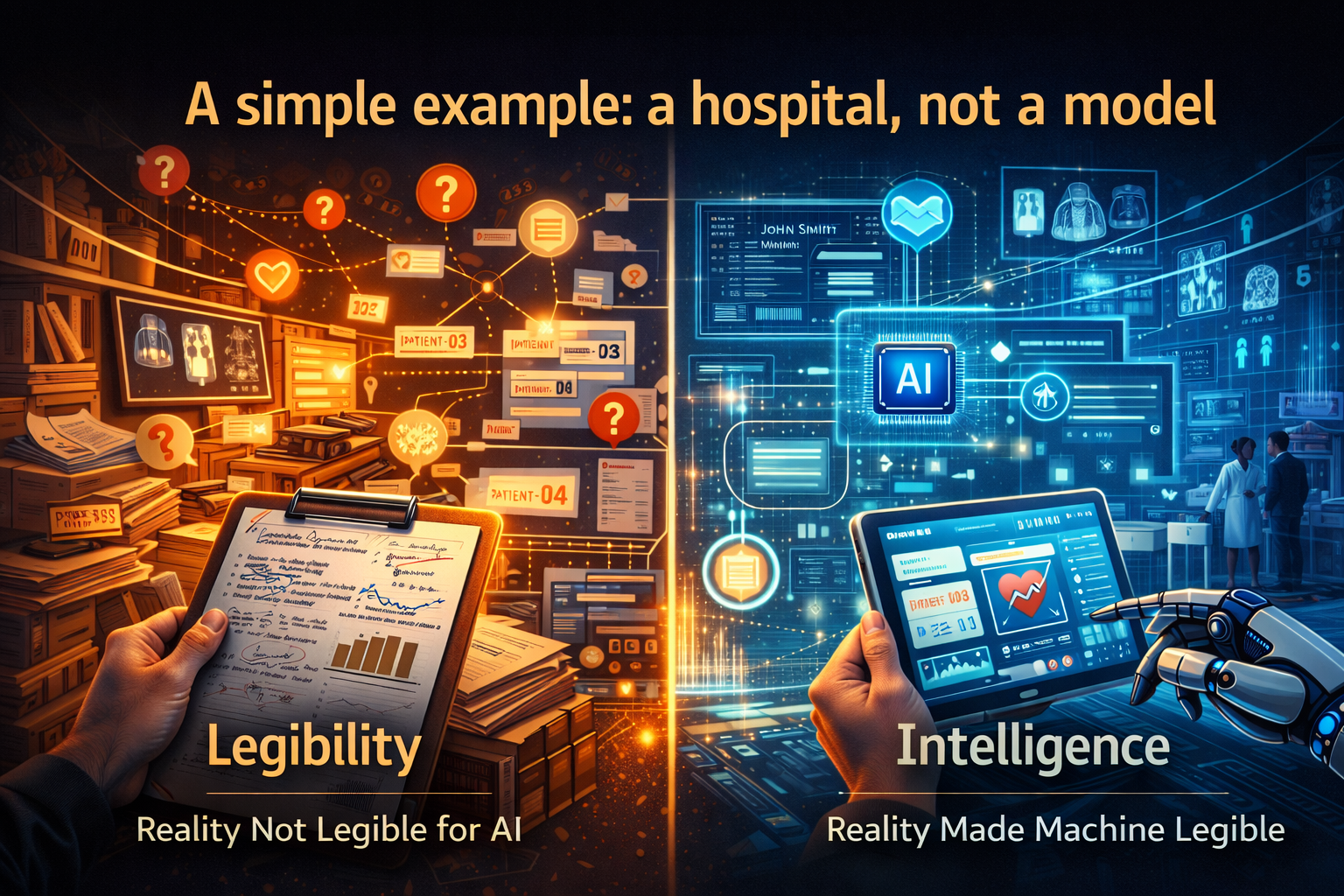
Imagine a hospital that wants to use AI to help allocate ICU beds, predict complications, and improve discharge planning.
The model may be excellent. But before that model can be trusted, the hospital has to answer much harder questions:
Is the same patient represented consistently across departments?
Are lab systems, imaging systems, admissions systems, nursing notes, and medication changes linked to the same entity?
Is the current patient state actually current, or is it delayed by several hours?
Can the system distinguish between an old diagnosis, a temporary billing code, and a live clinical risk?
Can anyone trace why the recommendation was made?
If the answer is no, the problem is not model quality. The problem is that reality has not been made legible enough for safe machine action.
The same pattern appears in banking, insurance, logistics, manufacturing, retail, telecom, tax administration, and public services. Before AI can transform a workflow, the institution has to pay the price of making that workflow’s reality machine-readable. NIST’s AI RMF and current AI governance practices increasingly focus on this exact issue: trustworthy AI depends on context, traceability, governance, and ongoing controls, not just a strong algorithm. (NIST)
Why the cost curve is rising, not falling
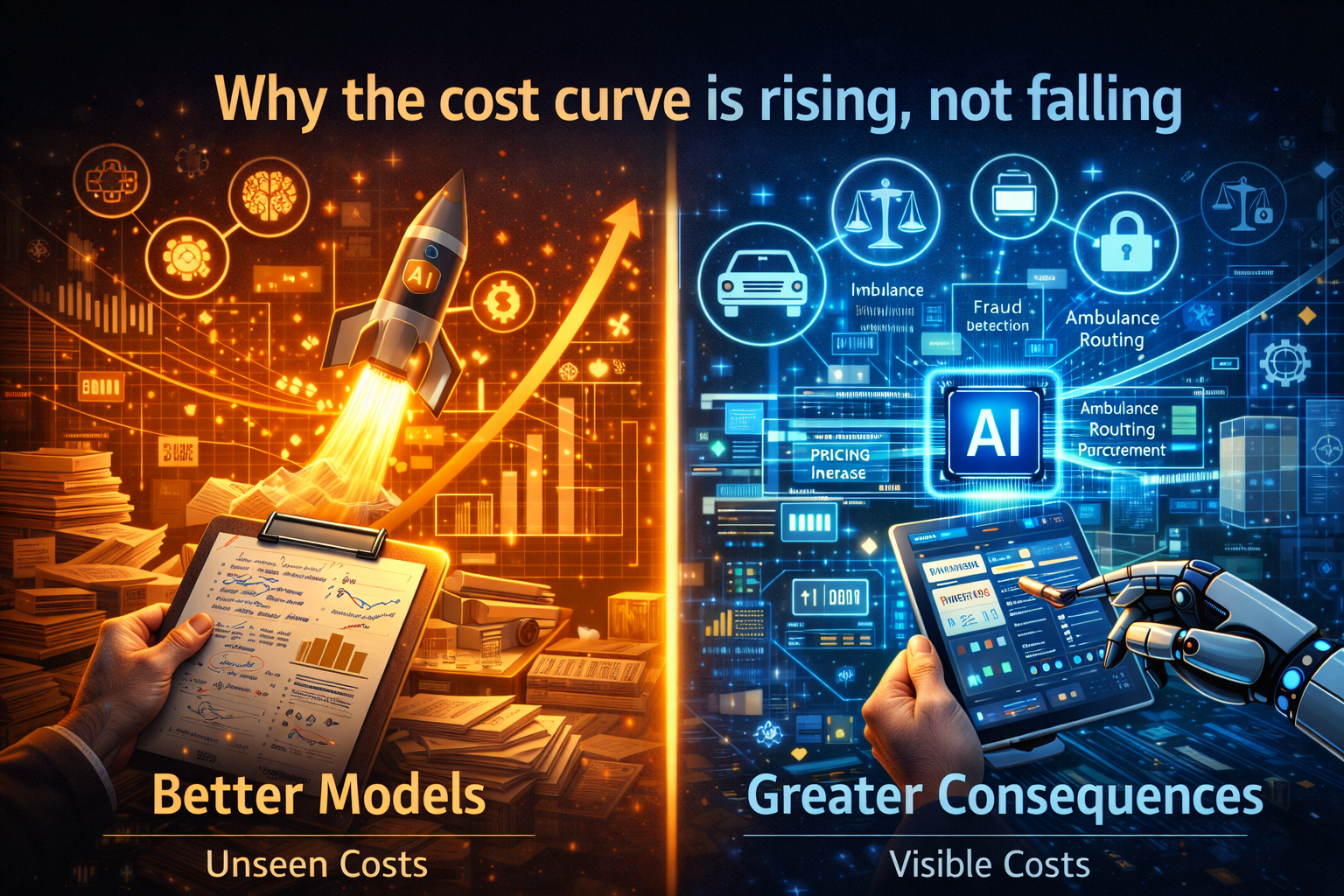
Many leaders assume better models will reduce this burden. In narrow tasks, they might. But in many of the most important domains, the opposite is happening.
As models become more capable, the pressure on institutions to improve legibility goes up.
Why? Because more capable systems do not eliminate the need for clear representation. They increase the consequences of poor representation.
A chatbot that gives a vague answer may be tolerated. An AI system that prices insurance, approves claims, detects fraud, routes emergency response, negotiates procurement, or recommends clinical interventions cannot run on vague reality. The moment AI moves from content generation to operational action, missing context becomes governance risk, legal risk, and economic risk.
That is one reason regulatory attention is shifting from novelty to accountability. The European Commission’s overview of the AI Act emphasizes risk-based obligations, including transparency and stronger requirements for higher-risk use cases. As AI becomes more embedded in consequential decisions, institutions are expected to know more clearly what the system saw, how it reasoned, and why it acted. (Digital Strategy)
This means the AI economy will not be defined only by who has the best models.
It will also be defined by who can produce high-trust legibility at the right cost.
The three hidden costs inside legibility
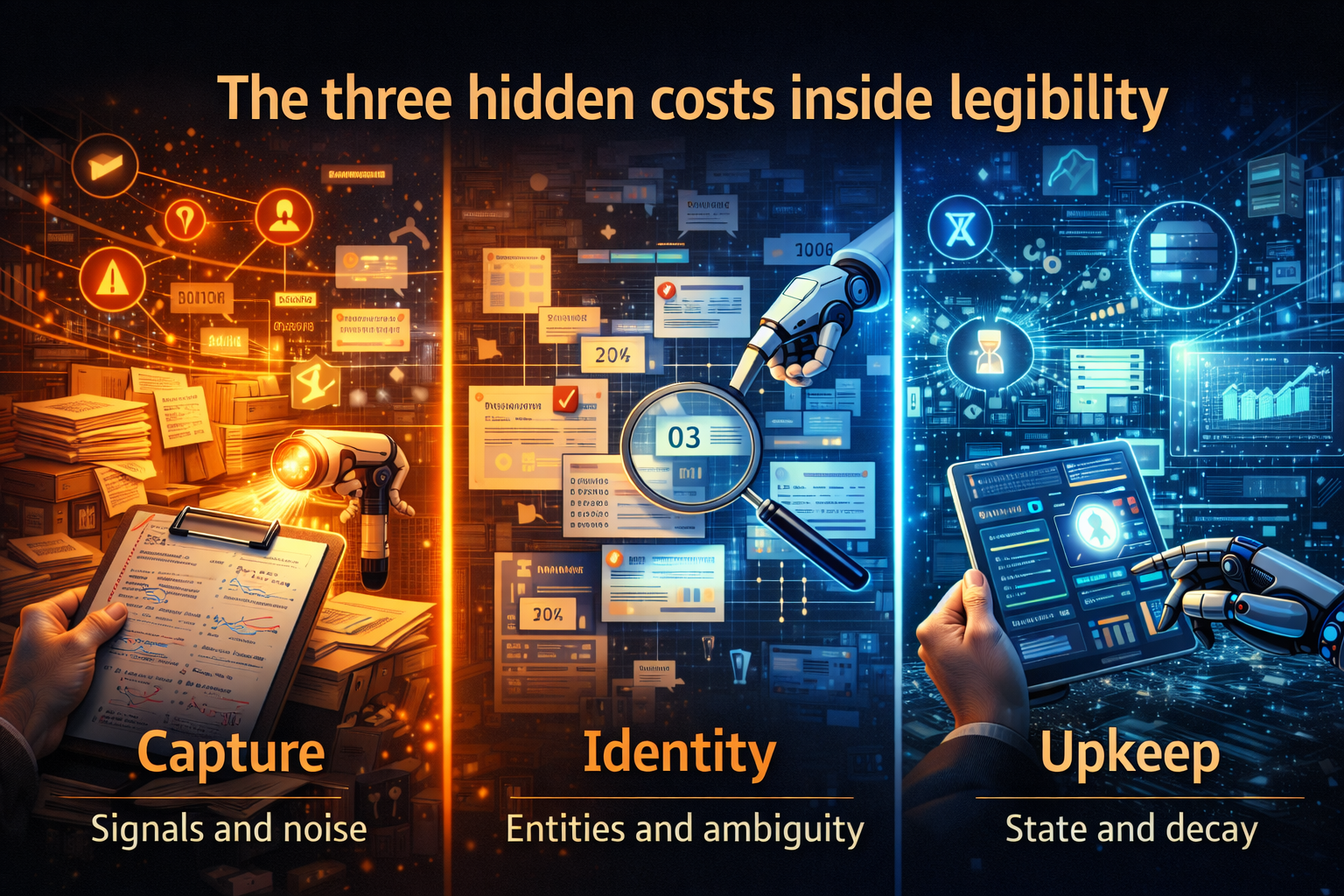
To understand the cost of legibility, it helps to break it into three practical layers.
-
The cost of capture
Reality does not arrive in a clean format.
Sensors fail. Forms are incomplete. Humans write free text. Images lack metadata. Events arrive late. Logs are inconsistent. Policies change faster than systems update. Contracts sit inside PDFs. Exceptions live in email chains. Field conditions differ from what the dashboard says.
Capturing useful signals from the real world is already hard. Capturing them in the right structure, with the right timing, and with the right ownership is harder. Research on digital twins and intelligent infrastructure continues to show that real-time digital representation is constrained by complexity, integration friction, uneven instrumentation, and maintenance burden. (IEA)
-
The cost of identity
Once data is captured, a second question emerges:
What is this actually about?
Is this customer the same person across systems?
Is this supplier the same company under a different legal name?
Is this machine the same asset after repair, relocation, and software updates?
Is this transaction linked to the right actor, product, and event chain?
This identity problem sounds small until it breaks everything downstream. If identity is weak, recommendations become erratic, compliance becomes fragile, and decisions become difficult to defend. Much of enterprise data work is really identity work disguised as integration work.
-
The cost of upkeep
Even a strong representation decays.
Customers move. Suppliers merge. Products evolve. Machines wear down. Regulations change. Contracts expire. Roles shift. Local exceptions multiply. Risk profiles drift. Reality moves faster than the model of reality.
That means legibility is not a one-time investment. It is an ongoing maintenance discipline. NIST’s governance approach and current trust-focused AI research both reinforce this point: AI assurance is a lifecycle issue, not a one-off deployment decision. (NIST)
A system can begin accurate and end dangerous simply because its picture of reality aged faster than the organization noticed.
The cost of legibility through the SENSE–CORE–DRIVER lens
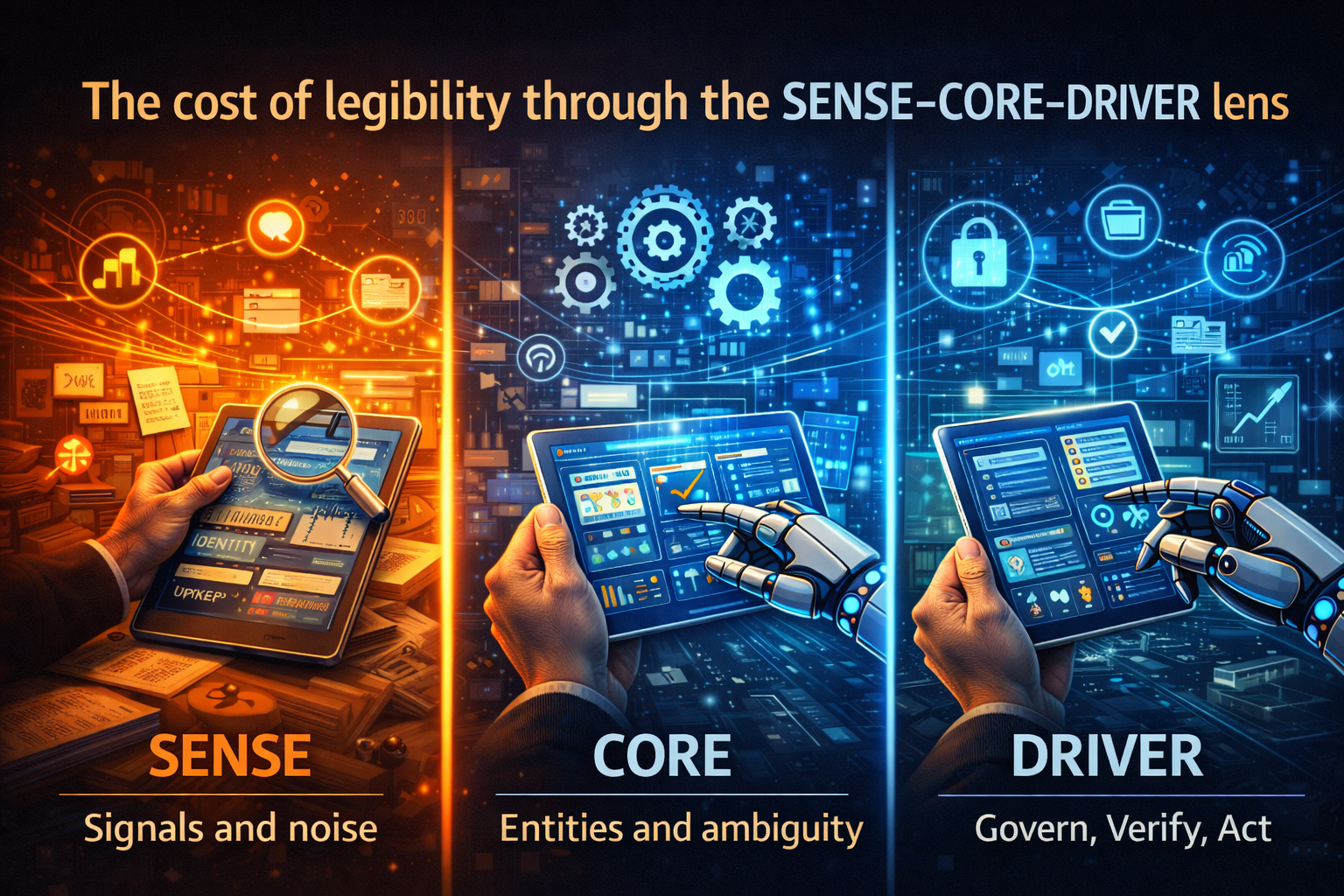
This is where the SENSE–CORE–DRIVER framework becomes especially useful.
SENSE is where reality becomes machine-legible.
Signals are detected.
Entities are identified.
State is constructed.
Evolution is tracked over time.
CORE is where the system interprets, reasons, predicts, prioritizes, and decides.
DRIVER is where action becomes governed.
Delegation is defined.
Representation is justified.
Identity is preserved.
Verification is possible.
Execution is bounded.
Recourse exists if the system is wrong.
The cost of legibility sits most heavily in SENSE. But its consequences show up across all three layers.
If SENSE is weak, CORE reasons over distortion.
If CORE reasons over distortion, DRIVER acts with false confidence.
That is why many organizations think they have an “AI problem” when in fact they have a legibility problem.
A simple way to say it is this:
Bad legibility makes smart systems dangerous.
Your own published Representation Economics framework already establishes that AI value depends not only on reasoning power, but on whether institutions can detect the right signals, attach them to the right entities, model current state correctly, update that state as reality changes, and act within legitimate authority boundaries. This article extends that logic by naming the hidden economic burden underneath it. (Raktim Singh)
Five simple examples that make this real
Retail
A retailer wants personalized recommendations. The model works. But customer identities are fragmented across channels, devices, households, and loyalty systems. The output feels repetitive, random, and occasionally absurd.
The problem is not weak AI. The problem is weak identity resolution.
Insurance
An insurer wants automated claims triage. But photos, repair estimates, policy exceptions, prior claims, claimant histories, and fraud indicators arrive at different times and in different formats. The AI may score quickly, but only after the organization spends heavily to standardize events and preserve provenance.
The expensive part is not prediction. It is building a defensible machine-readable claim reality.
Manufacturing
A manufacturer wants predictive maintenance. Telemetry, maintenance logs, operator notes, firmware history, and spare parts information are not linked to the same evolving asset state. The system predicts failure on paper while missing what actually changed on the shop floor.
The legibility gap is operational, not algorithmic.
Regulation
A regulator wants machine-readable compliance. But rules are spread across legislation, amendments, guidance notes, local interpretations, industry exceptions, and judicial context. Turning regulation into digital logic becomes an infrastructure challenge in itself. Government modernization research increasingly points in this direction: the future of regulation is not just stronger rules, but more machine-readable and operationally usable rules. (Digital Strategy)
The boardroom
A board wants “more AI.” But management cannot answer basic questions:
Which decisions are AI-assisted?
Which sources define current state?
Which representations are stale?
Which actions are reversible?
Which systems have recourse?
Which decisions can be audited after the fact?
At that point, the organization does not have an intelligence problem. It has no legibility ledger.
Why this matters economically
The cost of legibility will create a new economic divide.
Some realities will be relatively cheap to represent. These are structured, repeated, standardized, highly instrumented, and low-dispute environments: ad delivery, inventory counts, shipment tracking, routine digital transactions.
Other realities will remain expensive to represent. These are ambiguous, fast-changing, politically sensitive, legally consequential, weakly digitized, or exception-heavy domains: informal creditworthiness, educational quality, environmental harm, eldercare quality, public grievance resolution, cross-border compliance, or complex enterprise transformation.
That matters because AI value will not flow evenly across the economy. It will flow first to domains where the cost of legibility is low relative to the value of action. Over time, new markets will emerge to reduce that cost in harder domains.
This is exactly where the next generation of important AI-era companies is likely to emerge.
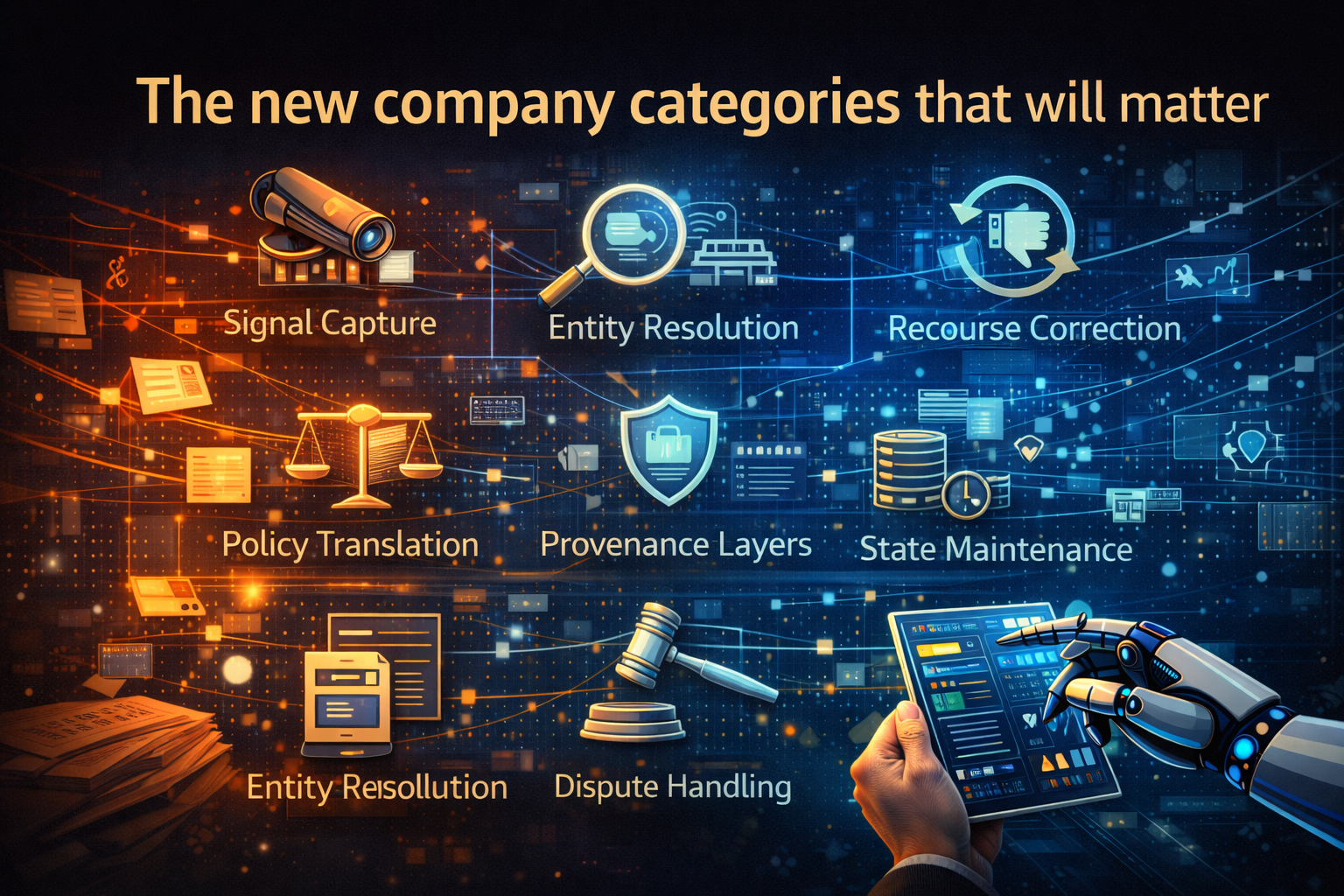
If this argument is right, then some of the most valuable companies in the AI economy will not be model companies. They will be legibility companies.
Some will specialize in signal capture.
Some will build entity resolution and identity infrastructure.
Some will translate law and policy into machine-readable operational logic.
Some will provide provenance, evidence, and traceability layers.
Some will maintain continuously updated state models for enterprises and industries.
Some will specialize in recourse, correction, and dispute resolution after machine action.
Some will focus on sector-specific reality conversion in health, law, logistics, finance, government, climate, agriculture, or education.
In other words, the AI economy will require an industrial layer devoted to making reality legible enough for machines to act on safely. That is not a side market. It is emerging core infrastructure.
What boards and C-suites should do now
The first step is not “adopt more AI.”
The first step is to ask:
What does our institution currently pay to make reality legible?
Where are signals missing?
Where are entities unresolved?
Where is state stale?
Where is timing wrong?
Where is policy not machine-readable?
Where is recourse absent?
Where are expensive humans repeatedly fixing representation gaps that executives still describe as workflow problems?
The firms that win will treat legibility as a strategic asset, not as a back-office cleanup exercise. They will invest in SENSE before overinvesting in CORE. They will design DRIVER before allowing autonomous execution at scale. They will recognize that in the AI era, representation quality is not just a data issue. It is a board issue, a market issue, and eventually a valuation issue.
McKinsey’s recent work on AI value capture and trusted AI points in the same direction: the organizations that benefit most are not simply buying models. They are redesigning workflows, clarifying governance, creating responsible operating structures, and building trust into execution. (McKinsey & Company)
The new law of value creation
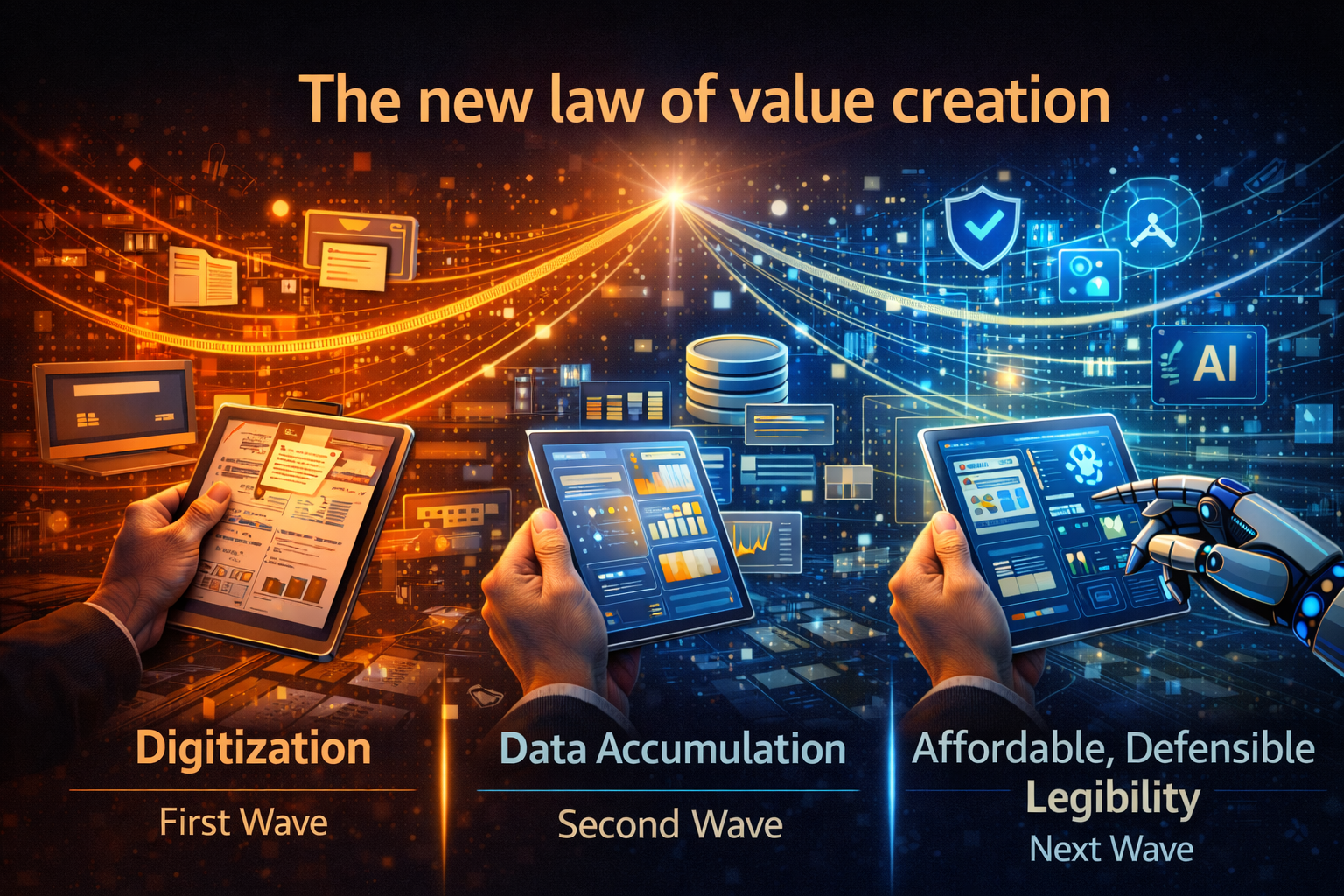
The first wave of digital transformation rewarded digitization.
The second rewarded data accumulation.
The next wave will reward affordable, defensible legibility.
That is the real shift.
In the AI economy, intelligence alone will not decide who wins. The deeper advantage will come from the ability to convert messy reality into machine-readable form at the right cost, with the right fidelity, fast enough to act, and safely enough to defend.
Not every institution will be able to afford the same reality.
Not every market will be equally visible to machines.
Not every firm will be equally representable.
And not every part of the world will become legible at the same speed.
The winners will be the institutions that understand this early:
Before AI can think at scale, reality has to be made legible at scale.
Conclusion
Boards are still asking how quickly AI can be deployed. That is no longer the most important question.
The more important question is whether the organization can afford the ongoing cost of making its world visible, current, structured, and governable enough for AI to act on it responsibly.
That is the hidden economic challenge now moving to the center of strategy.
The future of AI will not be decided only by the cost of computing intelligence. It will also be decided by the cost of making reality legible enough for intelligence to matter. Trends in energy demand, governance frameworks, enterprise operating models, and regulation all point in the same direction: as AI becomes more embedded in real decisions, the burden of legibility becomes more economically decisive. (IEA)
And that is why the cost of legibility may become one of the defining ideas of the AI economy.
Explore the Architecture of the AI Economy
This article is part of a broader research series exploring how institutions are being redesigned for the age of artificial intelligence. Together, these essays examine the structural foundations of the emerging AI economy — from signal infrastructure and representation systems to decision architectures and enterprise operating models. If you want to explore the deeper framework behind these ideas, the following essays provide additional perspectives:
- Representation Economics: The New Law of AI Value Creation — ideal in the introduction when defining the broader thesis. (Raktim Singh)
- The Representation Boundary: Why AI Systems Replace Reality — ideal in the section on limits of machine-readable reality. (Raktim Singh)
- Representation Collapse: Why AI Systems Fail Between Too Little Reality and Too Much — ideal when discussing the risk of weak or distorted representation. (Raktim Singh)
- The Representation Strategy of the Firm — ideal in the board and strategy section. (Raktim Singh)
- Temporal Reality: Why AI Will Reward Institutions That See the Present Before Others — ideal in the upkeep and freshness section. (Raktim Singh)
- When Reality Becomes Expensive: How Asymmetric Representation Costs Will Redefine the AI Economy — ideal as a companion piece at the end. (Raktim Singh)
Together, these essays outline a central thesis:
The future will belong to institutions that can sense reality, represent it clearly, reason about it intelligently, and act through governed machine systems.
This is why the architecture of the AI era can be understood through three foundational layers:
SENSE → CORE → DRIVER
Where:
- SENSE makes reality legible
- CORE transforms signals into reasoning
- DRIVER ensures that machine action remains accountable, governed, and institutionally legitimate
Signal infrastructure forms the first and most foundational layer of that architecture.
AI Economy Research Series — by Raktim Singh
Written by Raktim Singh, AI thought leader and author of Driving Digital Transformation, this article is part of an ongoing body of work defining the emerging field of Representation Economics and the SENSE–CORE–DRIVER framework for intelligent institutions.
This article is part of a larger series on Representation Economics, including topics such as Representation Utility Stack, Representation Due Diligence, Recourse Platforms, and the New Company Stack.
This article is part of a broader framework called Representation Economics, which explains how AI changes value creation by redefining how reality is seen, modeled, and acted upon.
Glossary
Cost of Legibility
The total cost of making reality visible, structured, current, trustworthy, and usable enough for AI systems to interpret and act upon.
Machine-readable reality
A version of the world that has been captured and structured so software and AI systems can reason about it and act on it.
Representation Economics
A framework for understanding how value in the AI era depends on whether institutions can properly represent reality for machines to detect, reason over, and act upon. (Raktim Singh)
SENSE–CORE–DRIVER
A three-layer framework in which SENSE makes reality legible, CORE reasons over that reality, and DRIVER governs action and accountability. (Raktim Singh)
Entity resolution
The process of determining whether different records, events, or identifiers refer to the same real-world person, company, object, or asset.
Provenance
The ability to trace where data, evidence, or machine outputs came from and how they were formed.
Legibility ledger
A practical governance view of what the organization can represent clearly, what is stale, what is unresolved, and where machine action may be risky.
Machine-readable policy
Policies, regulations, or internal rules translated into forms that AI and software systems can operationally use.
FAQ
What is the cost of legibility in AI?
The cost of legibility in AI is the cost of making reality visible, structured, current, and trustworthy enough for AI systems to interpret and act upon.
Why does machine-readable reality matter for AI?
AI systems do not act on raw reality. They act on representations of reality such as signals, identities, states, and rules. If those representations are weak, AI decisions become unreliable or dangerous.
Why do many enterprise AI projects fail?
Many enterprise AI projects fail not because the models are weak, but because the institution cannot provide clean entities, current context, reliable state, and governed execution. (McKinsey & Company)
How is the cost of legibility different from compute cost?
Compute cost is the cost of training and running models. The cost of legibility is the cost of making the world understandable enough for those models to operate safely and effectively.
Why should boards care about legibility?
Boards should care because poor legibility creates strategic, governance, regulatory, and valuation risk. It affects whether AI can scale safely inside the organization.
What kinds of companies will emerge in the AI economy?
Alongside model companies, new firms are likely to emerge around signal capture, identity infrastructure, policy translation, provenance, state maintenance, and recourse.
What is the cost of legibility in AI?
The cost of legibility in AI is the cost of making real-world data structured, current, and reliable enough for AI systems to act on.
Why is machine-readable reality important for AI?
AI systems cannot act on raw reality. They require structured representations such as entities, states, and relationships to function effectively.
Why do AI projects fail in enterprises?
Most AI projects fail due to poor data quality, unclear context, and weak governance—not because of model limitations.
How is legibility different from AI compute cost?
Compute cost relates to running models, while legibility cost relates to preparing reality for those models to understand.
What will define winners in the AI economy?
Organizations that can reduce the cost of making reality machine-readable will gain a major competitive advantage.
References and further reading
- NIST, AI Risk Management Framework — foundational guidance on trustworthy AI, governance, lifecycle controls, and socio-technical risk. (NIST)
- International Energy Agency, Energy and AI — on AI-driven electricity demand and infrastructure implications. (IEA)
- European Commission, AI Act overview — on transparency, risk-based obligations, and governance expectations for AI systems. (Digital Strategy)
- McKinsey, The State of AI 2025 and trusted AI work — on workflow redesign, operating model, governance, and enterprise value capture. (McKinsey & Company)
- Raktim Singh, Representation Economics, Representation Boundary, Representation Collapse, Representation Strategy of the Firm, Temporal Reality — companion essays that deepen the institutional logic behind the cost of legibility. (Raktim Singh)



Raktim Singh is an AI and deep-tech strategist, TEDx speaker, and author focused on helping enterprises navigate the next era of intelligent systems. With experience spanning AI, fintech, quantum computing, and digital transformation, he simplifies complex technology for leaders and builds frameworks that drive responsible, scalable adoption.