

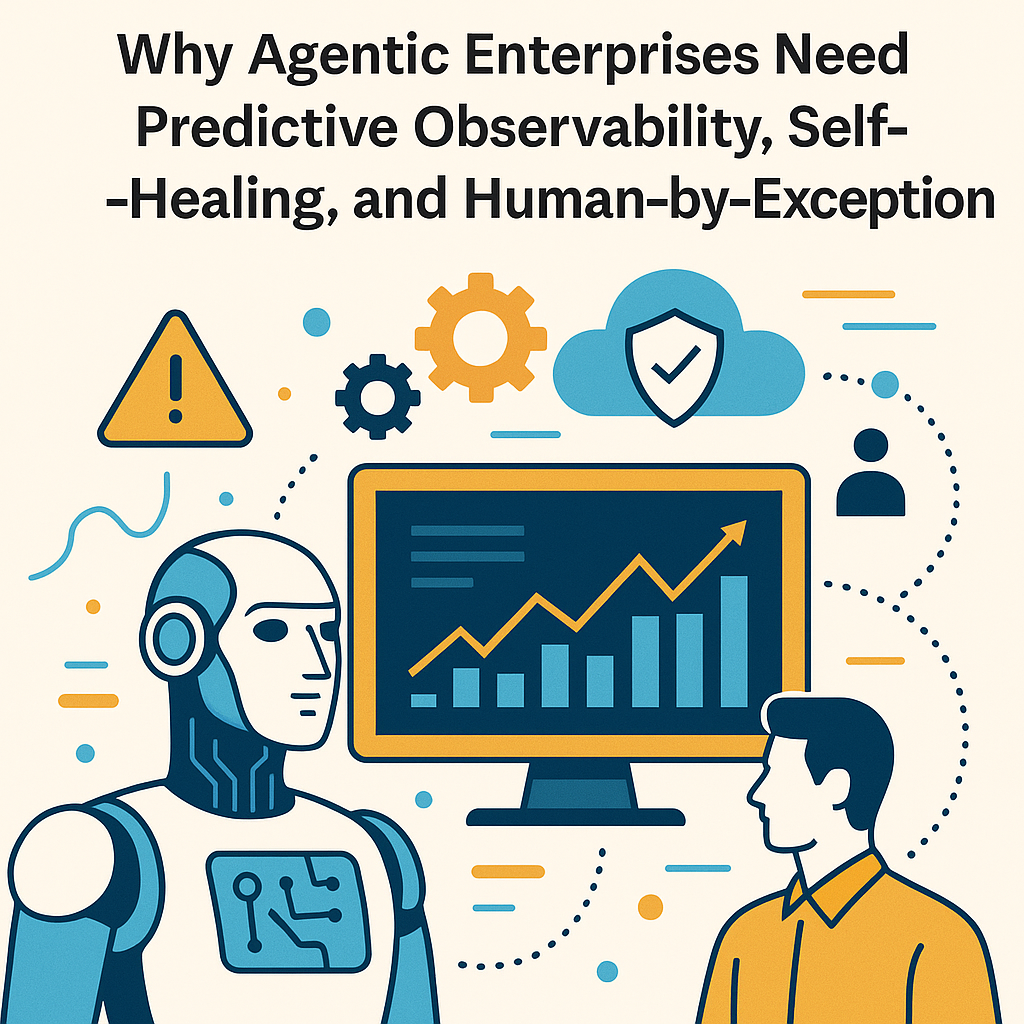
The AI SRE Moment
This article introduces the concept of AI SRE—a reliability discipline for agentic AI systems that take actions inside real enterprise environments.
Executive Summary
Enterprise AI has crossed a threshold.
The early phase—copilots, chatbots, and impressive demos—proved that large models could reason, summarize, and assist. The next phase is fundamentally different. AI agents are now approving requests, updating records, triggering workflows, provisioning access, routing payments, and coordinating across systems.
At this point, the central question changes.
It is no longer: Is the model intelligent?
It becomes: Can the enterprise operate autonomy safely, repeatedly, and at scale?
This article argues that we are entering the AI SRE Moment—the stage where agentic AI requires the same operating discipline that Site Reliability Engineering (SRE) once brought to cloud computing. Without this discipline, autonomy does not fail dramatically. It fails quietly—through cost overruns, audit gaps, operational chaos, and loss of trust.
The Shift Nobody Can Ignore: From “Smart Agents” to Operable Autonomy
Agentic AI represents a structural shift, not an incremental upgrade.
Agents do not just generate outputs. They take actions. They touch systems of record. They trigger irreversible effects. And they operate at machine speed.
This is where the risk equation changes.
Gartner predicts that over 40% of agentic AI projects will be canceled by the end of 2027 due to escalating costs, unclear business value, or inadequate risk controls. Harvard Business Review has echoed similar patterns: early enthusiasm collides with production complexity, governance gaps, and operational fragility.
This is not a failure of intelligence.
It is a failure of operability.
Just as cloud computing required SRE to move from “servers that work” to “systems that stay reliable,” agentic AI now requires AI SRE to move from demos to durable enterprise value.
What AI SRE Really Means
Traditional SRE asked a simple question:
How do we keep software reliable as it scales?
AI SRE asks a new one:
How do we keep autonomous decision-making safe and reliable when it acts inside real enterprise systems?
Agentic systems differ from classic automation because they can:
- Plan multi-step actions
- Adapt dynamically to context
- Invoke tools and APIs
- Combine reasoning with execution
- Deviate subtly from expectations
AI SRE is therefore built on three operating capabilities:
- Predictive observability – seeing risk before it becomes an incident
- Self-healing – fixing known failures safely and automatically
- Human-by-exception – involving people only where judgment is truly required
Together, these turn autonomy from a gamble into a managed operating layer.
Why Agents Fail in Production (Even When Demos Look Perfect)
Most agent failures do not look dramatic. They look like familiar enterprise problems—just faster and harder to trace.
Example 1: The “Helpful” Procurement Agent
An agent resolves an invoice mismatch, updates a field, triggers payment, and logs a note. Days later, audit asks: Who made the change? Why? Based on what evidence?
Without decision-level observability and audit trails, governance collapses.
Example 2: The HR Onboarding Agent
An agent provisions access for a new hire. A minor policy mismatch grants a contractor access to an internal repository.
Without human-by-exception guardrails, speed becomes risk.
Example 3: The Incident Triage Agent
Monitoring spikes. The agent opens dozens of tickets, pings multiple teams, and restarts services unnecessarily.
Without correlation and safe remediation rules, automation amplifies chaos.
The problem is not autonomy.
The problem is operating autonomy without discipline.
Pillar 1: Predictive Observability — Making Autonomy Visible Before It Breaks Things
Beyond Dashboards and Logs
Classic observability explains what already happened: metrics, logs, traces.
Predictive observability answers a harder question:
What is likely to happen next—and why?
In agentic environments, observability must extend beyond infrastructure to include decisions and actions.
What Must Be Observable in Agentic Systems
To operate agents safely, enterprises must observe:
- Action lineage: what the agent did, in what sequence
- Decision context: data sources and signals used
- Tool calls: APIs invoked, permissions exercised
- Policy and confidence checks: why it acted autonomously
- Side effects: downstream workflows triggered
- Memory usage: what was recalled—and whether it was stale
This is not logging.
It is causality tracing—linking context → decision → action → outcome.
Simple Predictive Example
Latency rises. Retries increase. A similar pattern preceded last month’s outage.
Predictive observability correlates these signals into a clear warning:
If nothing changes, the SLA will be breached in 25 minutes.
That is the difference between firefighting and prevention.
Pillar 2: Self-Healing — Closed-Loop Remediation Without Reckless Automation
Self-healing does not mean agents fix everything.
It means approved fixes execute automatically when conditions match—and escalate when they don’t.
What Safe Self-Healing Looks Like
Enterprise-grade self-healing includes:
- Pre-approved runbooks
- Blast-radius limits
- Canary or staged actions
- Automatic rollback
- Evidence capture for audit
A Simple Example
A service enters a known crash loop.
- Agent detects a known failure signature
- Policy allows restarting one replica
- Agent restarts a single instance
- Health improves → continue
- Health worsens → rollback and escalate
This is not AI magic.
It is operational discipline, executed faster.
Pillar 3: Human-by-Exception — The Operating Model Leaders Actually Want
Human-in-the-loop everywhere does not scale. It becomes a bottleneck—and teams bypass it.
Human-by-exception means:
- Systems run autonomously by default
- Humans intervene only when risk, confidence, or policy requires it
Common Exception Triggers
- High blast radius (payments, payroll, routing)
- Low confidence or ambiguous signals
- Policy boundary crossings
- Novel or unseen scenarios
- Conflicting data sources
- Regulatory sensitivity
Example: Refund Approvals
- Low value + clear evidence → auto-approve
- Medium value → approve if confidence high
- High value or fraud signal → human review
The principle matters more than the numbers:
thresholds + confidence + auditability.
The AI SRE Loop: How It All Fits Together
- Predict – detect early signals
- Decide – apply policy and confidence gates
- Act – execute approved remediation
- Verify – confirm outcomes
- Learn – refine rules and thresholds
When this loop exists, autonomy becomes repeatable—not heroic.
A Practical Rollout Path (That Avoids the Cancellation Trap)
- Start with one high-impact domain
- Incident triage
- Access provisioning
- Customer escalations
- Financial reconciliations
- Instrument decision observability first
- Automate only known-good fixes
- Define human-by-exception rules
- Measure outcomes, not activity
- MTTR reduction
- Incident recurrence
- Audit readiness
This is how agentic AI becomes a board-level win.

Why This Pattern Works Globally
Across the US, EU, India, and the Global South, enterprises face the same realities:
- Legacy systems
- Heterogeneous tools
- Audit expectations
- Talent constraints
AI SRE is not a regional idea.It is a survival trait.
Glossary
- AI SRE: Reliability practices for AI systems that act, not just generate
- Predictive observability: Anticipating incidents using signals and context
- Self-healing: Policy-approved automated remediation with verification
- Human-by-exception: Human oversight only when risk or confidence demands
- Closed-loop remediation: Detect → fix → verify → learn
- Drift: Gradual deviation from intended behavior
Frequently Asked Questions
Isn’t this just AIOps?
AIOps is a foundation. AI SRE extends it to agent decisions, actions, rollback, and accountability.
Why not keep humans in the loop for everything?
Because it does not scale. Human-by-exception preserves accountability without slowing the system.
What’s the fastest way to start?
Pick one workflow, instrument decision observability, automate known-good actions, define exception rules.
Why do agentic projects stall?
Production complexity, unclear ROI, and weak risk controls—exactly what Gartner highlights.
References & Further Reading
- Gartner: Agentic AI project cancellation forecasts
- Harvard Business Review: Production-scale AI failures
- Red Hat: Human-on-the-loop vs human-in-the-loop models
- Industry research on AIOps and closed-loop remediation
- The Enterprise AI Control Plane: Why Reversible Autonomy Is the Missing Layer for Scalable AI Agents | by RAKTIM SINGH | Dec, 2025 | Medium
- The Enterprise AI Service Catalog: Why CIOs Are Replacing Projects with Reusable AI Services | by RAKTIM SINGH | Dec, 2025 | Medium
- Enterprise AI Operating Model 2.0: Control Planes, Service Catalogs, and the Rise of Managed Autonomy – Raktim Singh
- The Composable Enterprise AI Stack: From Agents and Flows to Services-as-Software – Raktim Singh
Conclusion
The future of enterprise AI will not be decided by who builds the smartest agents.
It will be decided by who can operate autonomy predictably, safely, and at scale.
This is the AI SRE Moment—and the enterprises that recognize it early will quietly compound advantage while others repeat the same failures, faster.
The winners in agentic AI won’t have more agents. They’ll have operable autonomy.



Raktim Singh is an AI and deep-tech strategist, TEDx speaker, and author focused on helping enterprises navigate the next era of intelligent systems. With experience spanning AI, fintech, quantum computing, and digital transformation, he simplifies complex technology for leaders and builds frameworks that drive responsible, scalable adoption.