

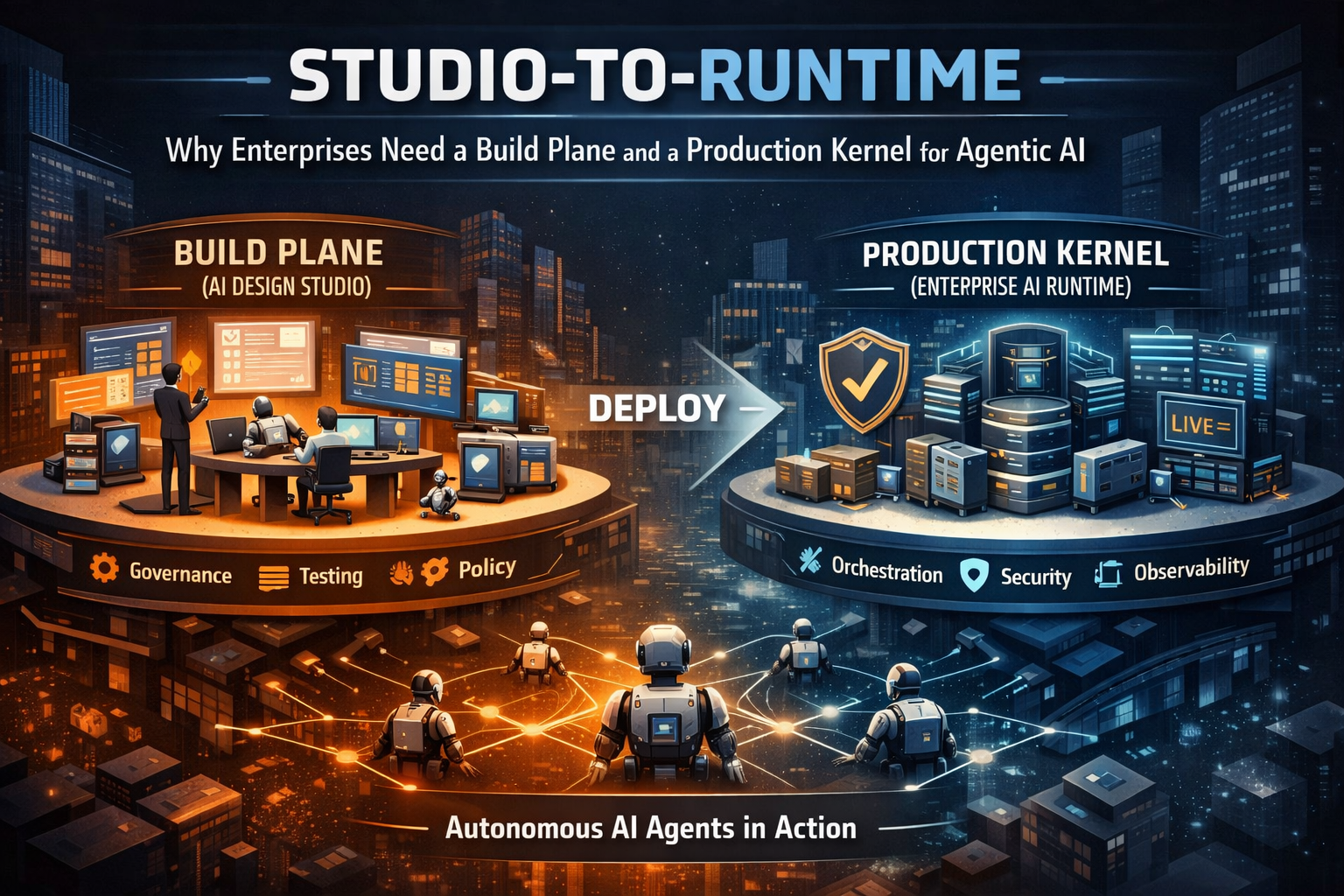
Studio-to-Runtime
Studio-to-Runtime is an enterprise AI architecture that separates how AI agents are designed from how they run in production. A Build Plane governs design, safety, and reuse, while a Production Kernel enforces runtime controls like identity, observability, cost, and rollback—turning AI pilots into scalable enterprise capabilities.
Enterprise AI is entering a new phase.
The first wave was about knowledge: copilots, assistants, chatbots—systems that answered questions. The second wave is about work: agents that can create tickets, approve requests, update records, trigger workflows, and coordinate across tools.
And this is where many enterprise programs stumble.
Not because the model isn’t “smart enough.”
Because the enterprise lacks an operating environment that can run autonomy safely—at scale.
The shift is subtle but decisive:
When AI can act, the core challenge is no longer intelligence. It’s operability—governance, security, cost control, and production reliability across thousands of workflows, teams, vendors, and regions.
This sits within the broader Enterprise AI Operating Model — see Enterprise AI Operating Model: A Practical Guide for CIOs and CTOs for how the Build Plane and Production Kernel fit alongside Control, Cognition, and Execution.

That’s why the most useful architecture pattern I’ve seen emerging across global enterprises is a clean separation into two planes:
- The Build Plane (Studio): where teams design, test, govern, and package agentic capabilities
- The Run Plane (Production Kernel / Runtime): where those capabilities execute in production with enforced policies, observability, identity, cost controls, and rollback
This Build-vs-Run separation is not a “nice-to-have.” It’s the difference between an impressive pilot and an enterprise capability.

The uncomfortable truth: most AI agents fail at the boundary between “built” and “run”
Here’s the pattern that repeats across industries and geographies:
- A team builds an agent that works in demos.
- It performs well in a controlled sandbox.
- It gets deployed.
- Then it hits production reality: permissions, messy data, partial outages, ambiguous policies, cost spikes, incident triage, and human escalation loops.
In agentic AI, the failure mode is rarely “wrong answer.”
It’s “right intention, wrong execution in a real system.”
This is also why governance and operational control are moving from compliance talk to architecture mandates. Frameworks like the NIST AI Risk Management Framework explicitly emphasize lifecycle risk management (governance, mapping context, measuring risks, managing them)—a signal that “trust” is now an engineering problem, not a policy memo. (NIST)
So the enterprise-grade starting point becomes clear:
- Studio builds repeatable capability
- Runtime executes it safely
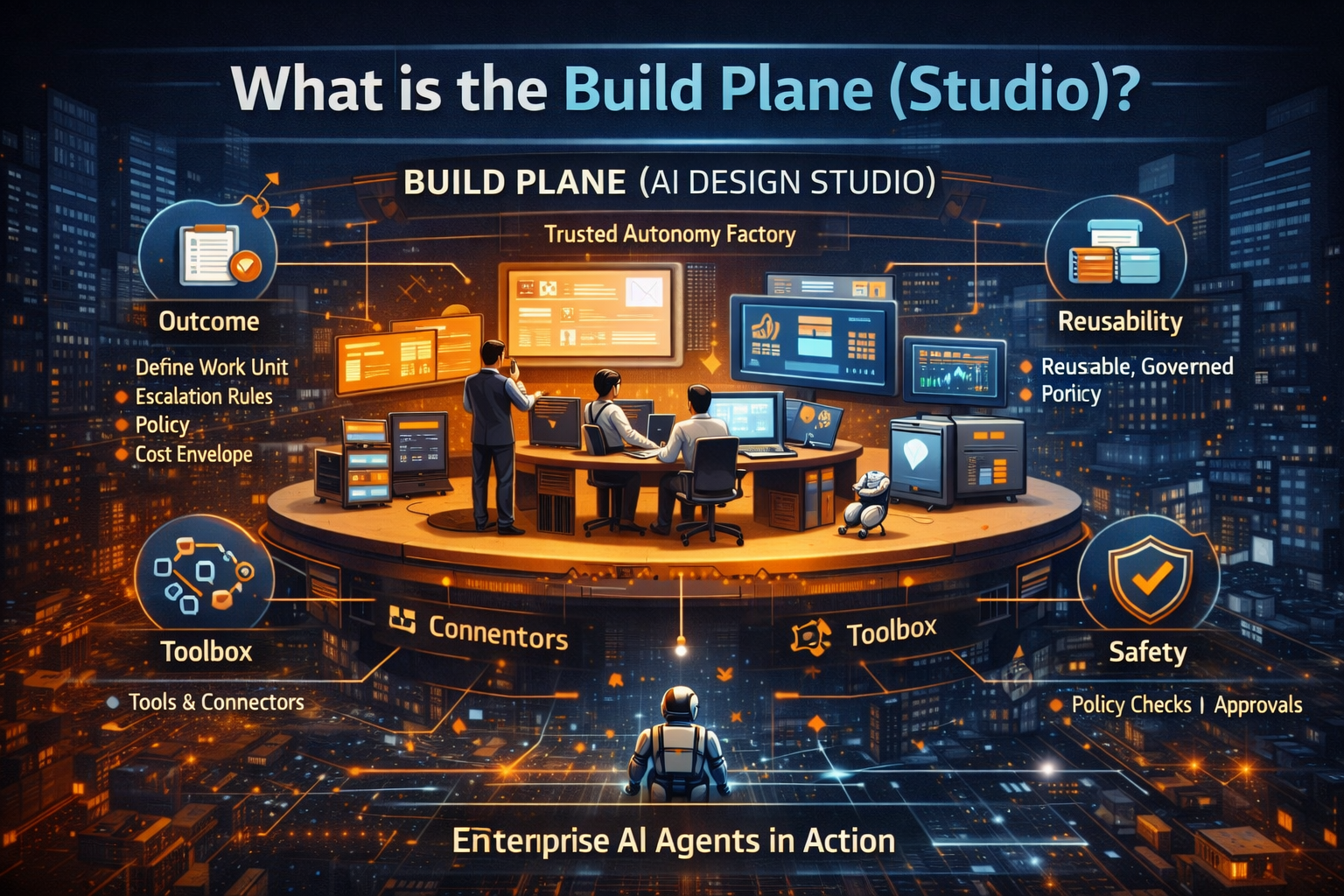
What is the Build Plane (Studio)?
Think of the Build Plane as a factory for trusted autonomy.
It’s where teams do the crucial work that is easy to skip—and expensive to retrofit later. The Studio is not a “prompt playground.” It’s where autonomy becomes designable, testable, governable, and repeatable.
1) Define the job, not the model
In the Studio, you don’t start by arguing about which model is best. You start with a work unit:
- What outcome are we trying to achieve?
- What policy constraints apply?
- What systems can be touched?
- What “stop conditions” and escalation rules exist?
- What is the acceptable cost/latency envelope?
This flips AI from experimentation to accountable delivery—because it defines success as work done safely, not “responses that look smart.”
2) Package agents as reusable services
A production enterprise does not want “one-off agents.” It wants productized capabilities with:
- clear inputs/outputs
- versions and release notes
- usage policies
- ownership and support model
- performance and safety expectations
This is how autonomy scales without becoming a patchwork of fragile bots that only one team understands.
3) Create a governed toolbox (tools, connectors, workflows)
Most agent failures aren’t “model failures.” They’re tool failures:
- too many permissions
- inconsistent tool definitions
- fragile integrations
- no audit trail of actions
A mature Studio treats tools like production interfaces:
- standardized
- permissioned
- tested
- monitored
- versioned
This matters because agents don’t just “answer.” They touch systems—and system-touching without governance is how incidents happen.
4) Build safety into the design
If your agent can act, you need more than “human review” as a vague comfort blanket. You need designed oversight—clear intervention points, understandable controls, and operational evidence.
Regulatory expectations are increasingly explicit here. For high-risk AI contexts, the EU AI Act emphasizes human oversight mechanisms that prevent or minimize risks during operation. (Artificial Intelligence Act)
So the Studio must define:
- policy checks
- approvals / human-in-the-loop patterns
- escalation logic
- reversible action patterns
- safe defaults
5) Prepare task-appropriate models and retrieval (not one giant model for everything)
The future enterprise won’t run every task on a single frontier model. Many “inside-the-enterprise” tasks benefit from smaller, specialized approaches, structured retrieval, and tighter policy constraints.
The Studio is where these choices are made deliberately—so production doesn’t become a random mix of expensive calls and unpredictable behavior.

A simple example: the Vendor Onboarding Agent
A global enterprise wants an agent to speed up vendor onboarding:
- collect documents
- validate mandatory fields
- check sanction lists
- create vendor records
- route approvals
- notify the requestor
If you build it without a Studio
A developer wires up prompts + tools and ships.
Then in production:
- the agent requests documents in inconsistent formats
- it tries to create records without mandatory compliance fields
- it writes to the wrong region-specific system
- it triggers approvals out of order
- it loops when a downstream API times out
- it re-submits the same workflow multiple times
- cost balloons because it keeps “thinking” when it should escalate
Result: leadership loses trust. The rollout pauses. Everyone blames “the model.”
If you build it with a Studio
The Studio defines:
- policy templates per geography (US/EU/India/etc.)
- tool permission boundaries
- a sanctioned connector library
- test scenarios (missing docs, partial matches, timeouts)
- escalation rules (when to stop and ask for a human)
- rollback strategy (how to undo created records)
- cost envelope (when to route to cheaper execution or stop)
Now the agent isn’t just smart. It’s operable.
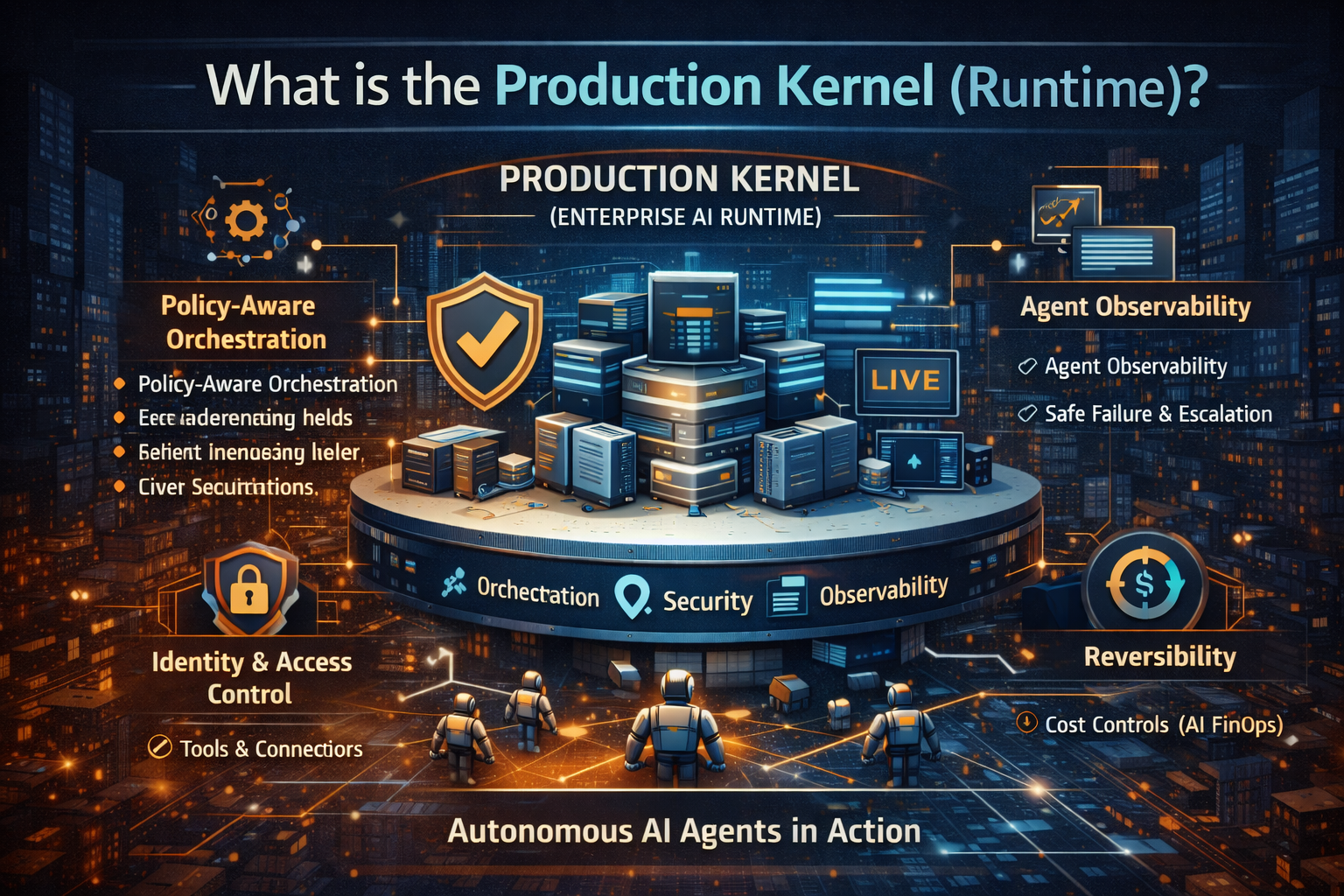
What is the Production Kernel (Runtime)?
If the Studio is where you design and package autonomy, the Production Kernel is where autonomy becomes real enterprise work.
It’s the runtime layer that does for agents what an operating system kernel does for apps:
- execution control
- security boundaries
- resource and cost governance
- observability
- safe failure handling
- auditable evidence
This is where many enterprises are currently underinvested.
And it’s also where the market is converging on clearer standards: observability for LLM/agent applications is increasingly framed through OpenTelemetry-based approaches and practices, signaling that agents should be monitored like any other critical production workload. (OpenTelemetry)
The Production Kernel here covers the same operational ground as Enterprise AI Runtime — identity, observability, cost, rollback. For the deeper treatment of that layer alone, see Enterprise AI Runtime: What Is Actually Running in Production. What’s distinct here is pairing that runtime layer with its design-time counterpart — the Build Plane.
A Production Kernel typically includes:
1) Policy-aware orchestration
Agents are not single calls. They are multi-step workflows involving:
- planning
- tool use
- retries
- branching
- collaboration between specialized agents
So the runtime must enforce:
- which tools can be used
- which steps require approval
- what data boundaries apply
- when to stop
2) Agent identity and access control
In an enterprise, “the agent” must be treated like a machine identity:
- authentication
- least privilege
- permission scoping
- rotation
- audit logs
Without this, every agent becomes an unbounded backdoor into business systems.
3) Observability: the play-by-play of autonomous work
Executives don’t just want outcomes. They want evidence:
- what the agent did
- why it did it
- which tools it touched
- what data it used
- where it failed
- what it cost
This is not vanity telemetry. It is the foundation for trust, auditability, and incident response—especially as oversight and logging expectations rise. (AI Act Service Desk)
4) Safe failure and escalation
A mature runtime does not “keep trying forever.” It has:
- retry limits
- timeouts
- circuit breakers
- graceful degradation
- escalation to humans
- fallbacks to deterministic workflows
This is where many pilots quietly fail: they assume the agent will behave like a perfect employee. Production teaches you that it behaves like a powerful intern with unlimited energy—unless you give it boundaries.
5) Reversibility: rollback for autonomous actions
In production systems, actions must be reversible:
- cancel a created record
- undo an approval
- revert a configuration change
- stop downstream workflows
Reversibility turns autonomy from “dangerous power” into “safe speed.”
6) Cost controls (AI FinOps by design)
Agents can burn spend invisibly:
- long chains of calls
- repeated retrieval
- tool retries
- unnecessary high-end model usage
So the runtime needs:
- budget envelopes per task
- dynamic routing (simple tasks cheaper; complex tasks premium)
- per-agent cost monitoring
- throttles and kill switches
This isn’t theoretical. The FinOps community has now formalized “FinOps for AI” guidance specifically to help organizations manage AI cost drivers, forecasting, and governance across adoption phases. (FinOps Foundation)

Another example: the Refund Agent that looks correct—and still causes an incident
A retail enterprise deploys an agent to process refunds.
In the Studio, the team tests a dozen scenarios. It passes.
In production, a customer messages:
“I didn’t receive the delivery.”
The agent checks tracking: “Delivered.”
It starts a refund workflow anyway because the customer sounds unhappy and the agent tries to optimize experience.
Now you have:
- refunds for delivered items
- abuse vectors
- chargeback risk
- operational escalation
A proper Production Kernel prevents this by enforcing:
- policy gates (“refund only if tracking confirms not delivered OR manual review required”)
- tool constraints (what can be invoked automatically)
- escalation (manual queue for ambiguous cases)
- audit logs (why the agent took the path it did)
Again: the model isn’t the main issue.
The runtime is.

The global lens: why Studio-to-Runtime matters across the US, EU, India, and the Global South
The Build Plane vs Production Kernel separation becomes even more essential when you operate globally:
- data boundaries and residency requirements vary
- regulatory expectations vary
- language, process variation, and system maturity vary
- vendor landscapes vary
A Studio helps you create reusable policy/workflow templates per geography.
A Runtime enforces them consistently—without relying on tribal knowledge or manual policing.
This aligns with how modern risk management frameworks treat governance as lifecycle-wide, not a post-hoc checklist. (NIST Publications)
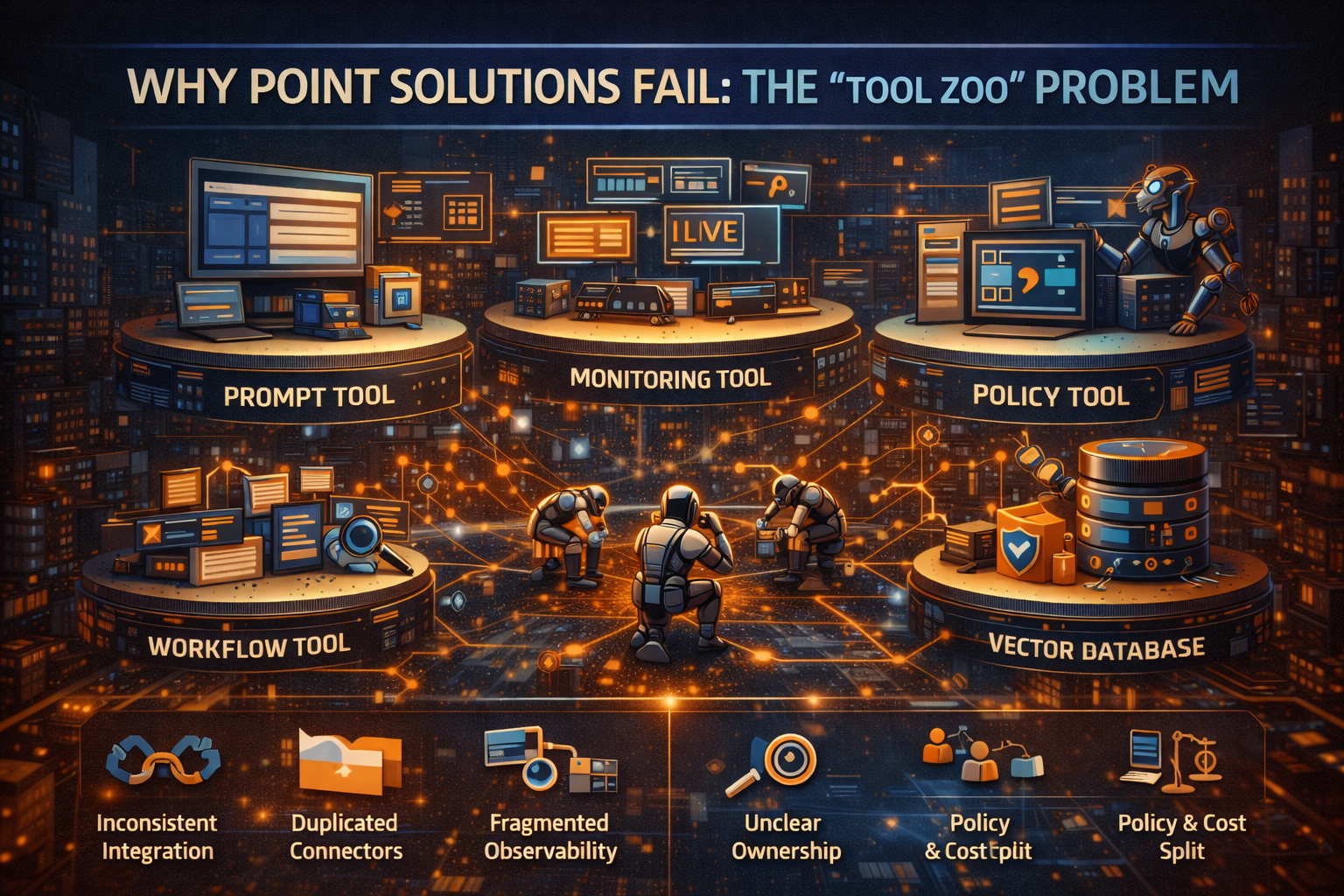
Why point solutions fail: the “tool zoo” problem
Many enterprises attempt to scale agentic AI by assembling:
- a prompt tool
- a workflow tool
- a monitoring tool
- a policy tool
- a vector database
- an agent framework
This often becomes a tool zoo:
- inconsistent integration
- duplicated connectors
- fragmented observability
- unclear ownership
- no single place to enforce policy and cost
A Studio-to-Runtime architecture reduces fragmentation by:
- centralizing build-time governance
- standardizing runtime enforcement
- enabling reuse through services
It’s not about choosing “best of breed.”
It’s about building a coherent operating environment.
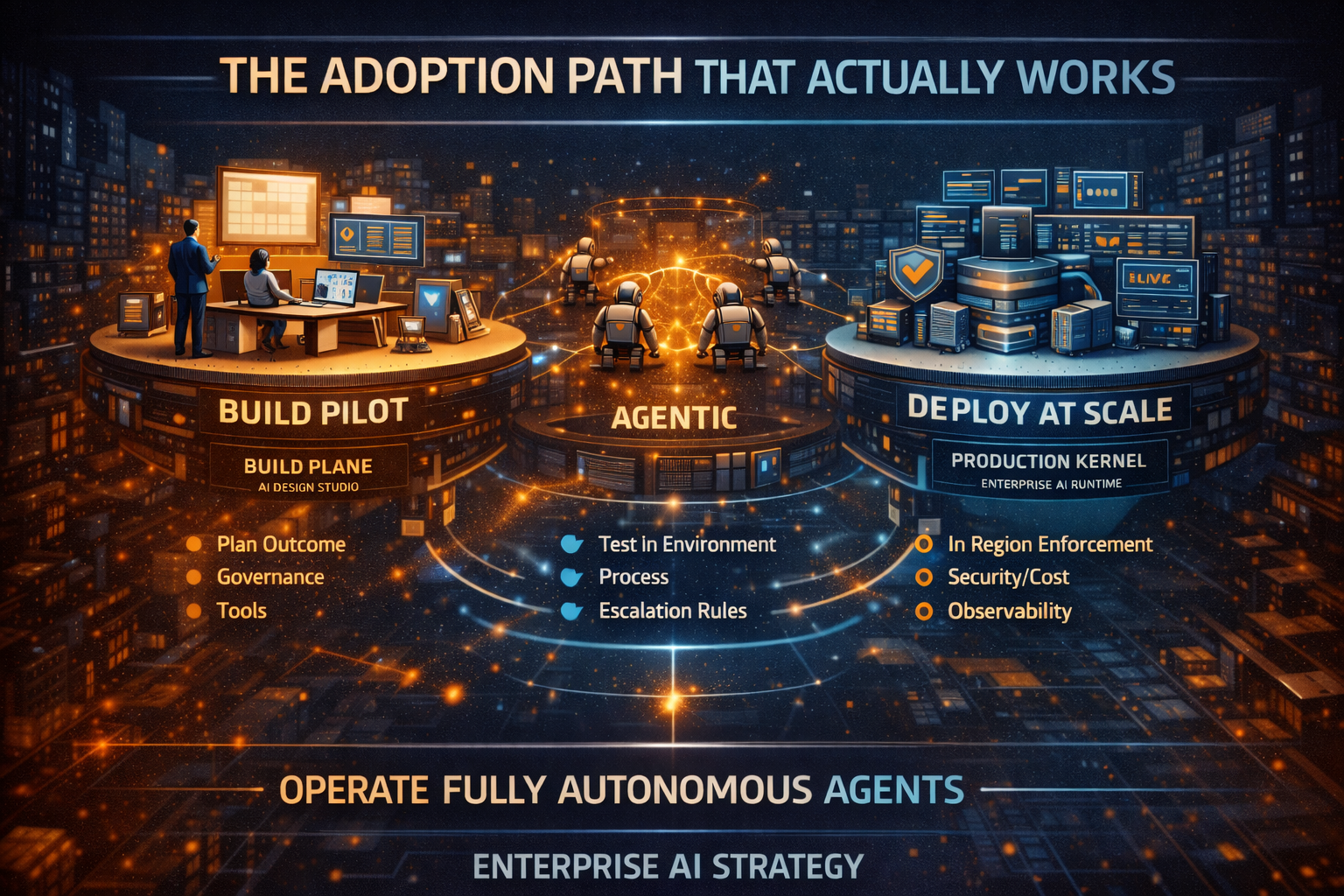
The adoption path that actually works
If you want this to be practical, here’s a sequence that works across most organizations:
Step 1: Start with 2–3 high-value workflows (not 50)
Examples:
- onboarding
- approvals
- IT operations triage
- customer resolution
- internal policy Q&A with action routing
Step 2: Build Studio basics
- governed tool library with permissions
- test scenarios and failure drills
- approval patterns
- versioning and ownership
Step 3: Put a Production Kernel under it
- orchestration + policy enforcement
- identity + audit
- observability + incident handling
- cost envelopes + throttles
Step 4: Convert each win into a reusable service
Your goal is not a hero agent.
Your goal is a catalog of trusted autonomous services.
“We’re not deploying agents. We’re building an operating environment where autonomy can be shipped like software—governed, observable, reversible, and cost-bounded.”
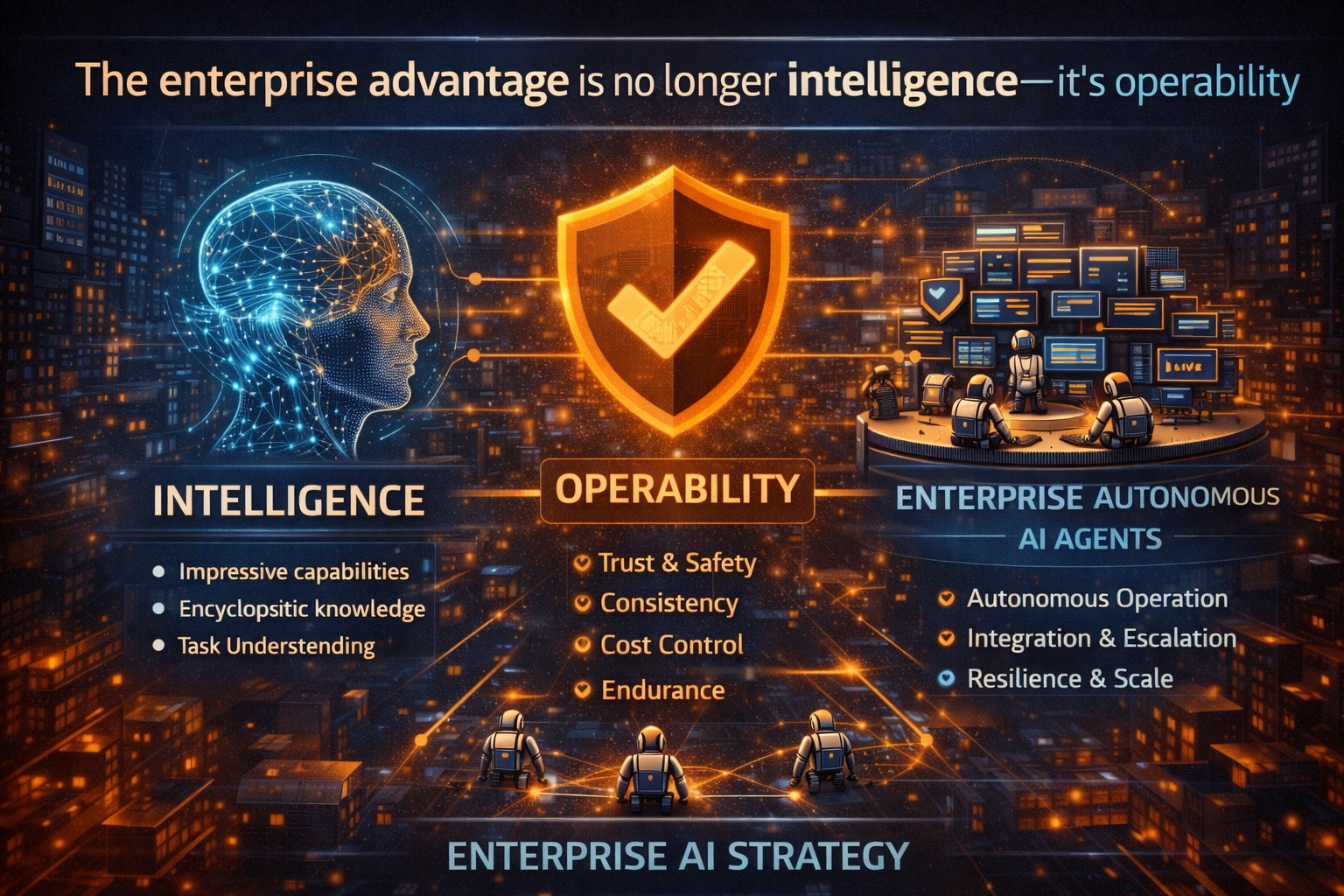
Conclusion: The enterprise advantage is no longer intelligence—it’s operability
The next era of enterprise AI will not be won by the organization with the most agents.
It will be won by the organization that can build, ship, and run autonomy like a disciplined software capability—through a Build Plane (Studio) and a Production Kernel (Runtime).
That’s the shortest path from AI demos to AI as a reliable enterprise advantage.
“We didn’t fail at AI because the models were weak. We failed because we tried to run autonomy without an operating system.”
Glossary
Build Plane (Studio): The environment where enterprises design, test, govern, and package agentic capabilities as reusable services.
Production Kernel (Runtime): The execution layer that runs agents safely in production—enforcing policy, identity, cost controls, observability, and rollback.
Agent orchestration: Coordinating multi-step agent workflows, tool calls, retries, branching, and collaboration between specialized agents.
Reversibility: The ability to undo or safely compensate for autonomous actions (rollback, cancellation, safe stop).
AI FinOps: Cost governance for AI workloads—budgeting, routing, throttling, and spend visibility per agent/task. (FinOps Foundation)
Agent observability: Telemetry that captures what an agent did, why it did it, what it touched, and what it cost—often implemented with OpenTelemetry patterns. (OpenTelemetry)
Build Plane (AI Studio)
The environment where enterprises design, test, govern, and package AI agents as reusable, policy-aware services.
Production Kernel (Enterprise AI Runtime)
The execution layer that runs AI agents safely in production, enforcing identity, policy, observability, cost controls, and reversibility.
Agentic AI
AI systems capable of planning and executing multi-step actions across enterprise tools and workflows.
Enterprise AI Operating Environment
A unified architecture that allows AI autonomy to be deployed, governed, observed, and scaled responsibly.
FAQ (People Also Ask)
1) Why can’t we treat AI agents like normal automation?
Because agents make multi-step decisions, adapt actions, and interact across systems—creating new operational risk modes that require runtime enforcement, logging, and oversight. (AI Act Service Desk)
2) What is the biggest reason AI agent pilots fail in production?
Not model quality. The most common failure is missing runtime capabilities: identity controls, observability, policy enforcement, safe failure handling, and cost bounding. (OpenTelemetry)
3) What should come first: Studio or Runtime?
Build both in parallel. Studio prevents chaos at design time; runtime prevents incidents at scale. Without runtime, scale creates outages and surprises. Without studio, scale creates fragmentation.
4) Does this apply only to large enterprises?
No. Mid-size organizations often feel it earlier because they have fewer people to manually patch failures. A lightweight Studio + Runtime approach makes scaling safer.
5) How does this help global organizations?
It enables policy templates and governed services to be created centrally (Studio) and enforced consistently across regions (Runtime), even when data rules and operating conditions vary. (NIST Publications)
References and further reading
- NIST AI Risk Management Framework (overview + AI RMF 1.0). (NIST)
- EU AI Act guidance on human oversight and deployer obligations (including logging expectations). (AI Act Service Desk)
- OpenTelemetry guidance on observability for LLM/agent applications. (OpenTelemetry)
- FinOps Foundation: FinOps for AI overview and AI cost forecasting/estimation resources. (FinOps Foundation)



Raktim Singh is an AI and deep-tech strategist, TEDx speaker, and author focused on helping enterprises navigate the next era of intelligent systems. With experience spanning AI, fintech, quantum computing, and digital transformation, he simplifies complex technology for leaders and builds frameworks that drive responsible, scalable adoption.