

The Living IT Ecosystem
What is a living IT ecosystem in enterprise AI?
A living IT ecosystem is an enterprise AI architecture that continuously adapts to new models, tools, policies, and regulations without breaking existing systems—enabling safe recomposition, governance at runtime, and freedom from vendor lock-in.
Executive summary
Enterprise AI has rewritten the definition of modernization. The hard part is no longer building pilots that impress. The hard part is operating autonomy safely—through policy changes, model upgrades, new integrations, security shifts, and regulatory scrutiny—without slowing delivery.
That is why the next wave of enterprise advantage will come from a capability most organizations do not yet have:
Continuous recomposition: the ability to change the enterprise’s shape—safely, repeatedly, and at speed—without turning every change into a rewrite or a lock-in event.
This is the “living IT ecosystem” thesis: your operating architecture must behave like a living system—adaptive, resilient, and governable—rather than a collection of projects, platforms, and one-off integrations.

Why this matters now: the “project era” of enterprise change is over
Why this matters now: the “project era” of enterprise change is over
For decades, enterprise change followed an understandable rhythm:
- Plan the transformation
- Migrate or modernize
- Stabilize
- Move on
That rhythm assumes the enterprise can “pause,” consolidate, and lock in a new normal.
In the AI era, there is no stable normal.
Customer expectations reset faster. Threats evolve continuously. Platforms and APIs change. Models shift behavior with upgrades, new safety policies, and new retrieval sources. And governance expectations increasingly assume lifecycle risk management—not one-time approvals. The NIST AI Risk Management Framework explicitly includes ongoing monitoring and periodic review as part of the governance function. (NIST Publications)
Meanwhile, the EU AI Act direction strengthens the same point: risk management and post-market monitoring are not “launch checklists”—they are continuous obligations across the system’s life. (AI Act Service Desk)
So the core operating assumption flips:
Change is no longer an event. It is the default operating state.
What is a “living IT ecosystem”? A plain-language definition
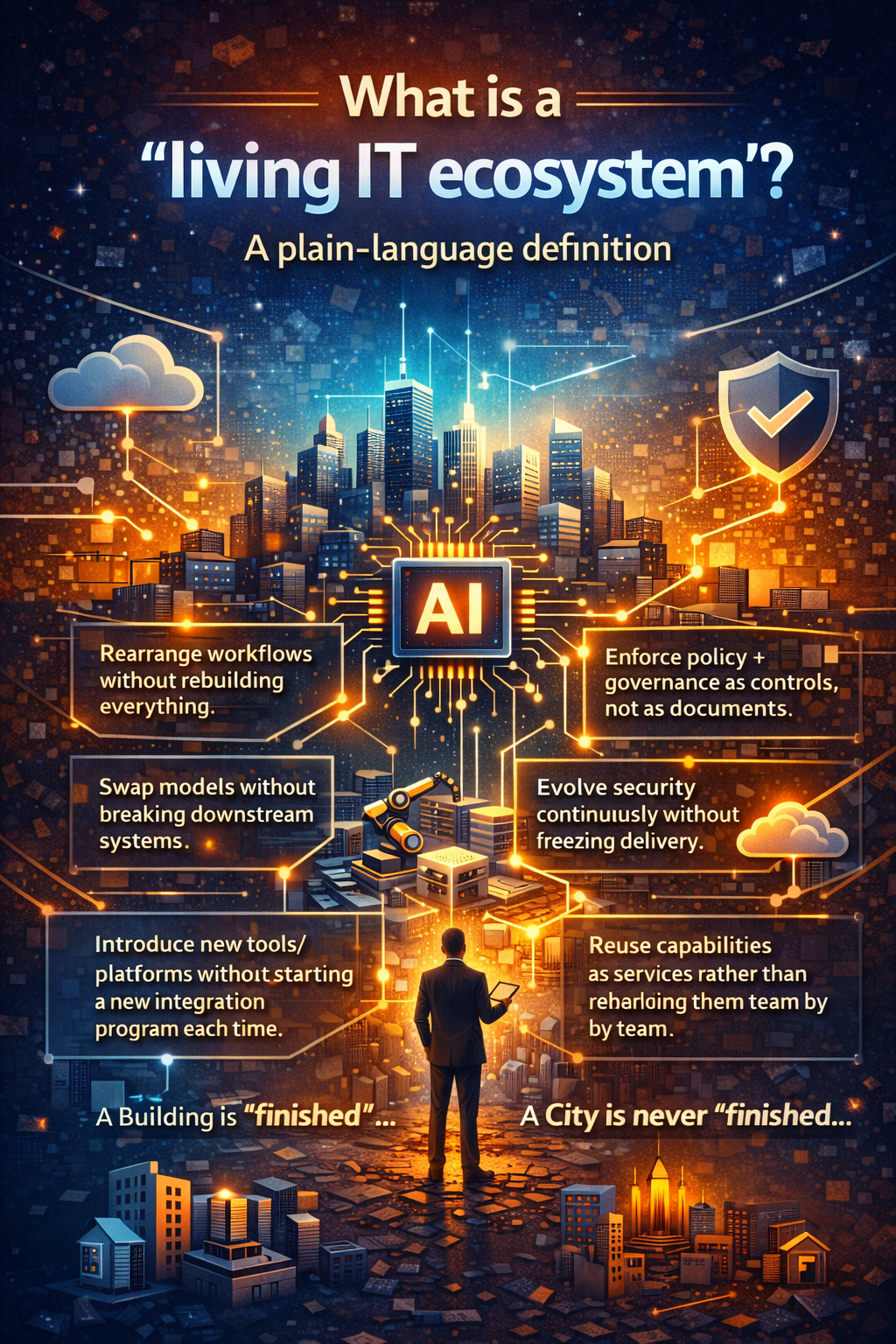
What is a “living IT ecosystem”? A plain-language definition
A living IT ecosystem is an enterprise architecture that can:
- Rearrange workflows without rebuilding everything
- Swap models without breaking downstream systems
- Introduce new tools/platforms without starting a new integration program each time
- Enforce policy and governance as controls and evidence—rather than documents
- Evolve security continuously without freezing delivery
- Reuse capabilities as services instead of rebuilding them team by team
A useful analogy is a city—not a building.
A building is “finished” when construction ends.
A city is never “finished.” It grows, reroutes traffic, adds new rules, upgrades utilities, changes zoning, and adapts to new risks—without tearing down the entire city.
That’s what enterprise architecture must become for AI.
The real enemy: brittle change (which becomes lock-in)
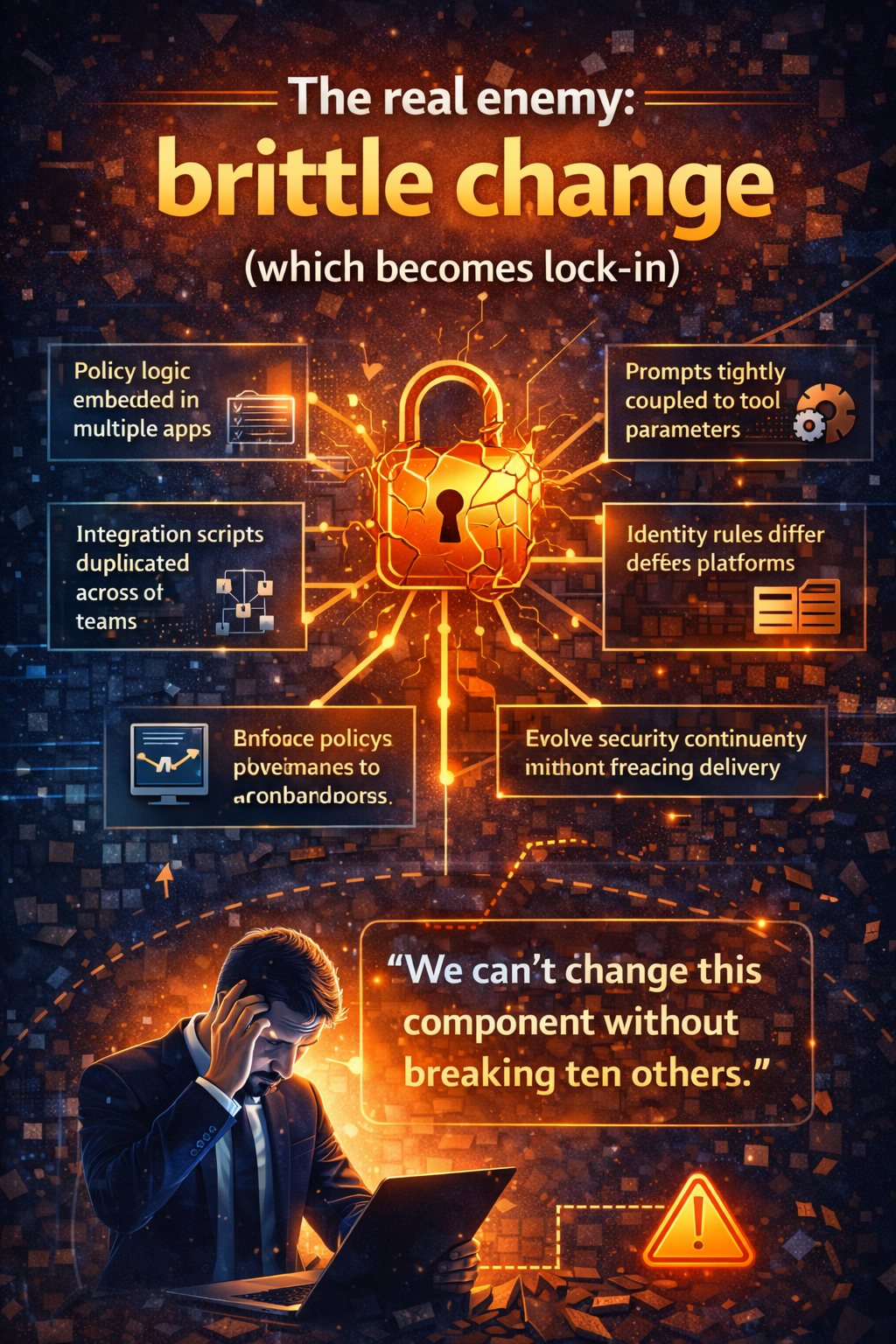
The real enemy: brittle change (which becomes lock-in)
Most vendor lock-in does not begin with a contract. It begins with brittle architecture:
- Policy logic embedded in multiple applications
- Prompts tightly coupled to specific tool parameters
- Integration scripts duplicated across teams
- Identity rules implemented differently across platforms
- Observability fragmented into incompatible dashboards
Eventually, the enterprise hits a quiet but decisive trap:
“We can’t change this component without breaking ten others.”
That is lock-in—even if you technically “own” the code.
The root issue is not vendor intent. It’s architectural coupling. The more tightly coupled the enterprise becomes, the more “switching costs” appear everywhere: in workflows, integrations, audits, operating procedures, and user trust.
Continuous recomposition: what it really means in practice
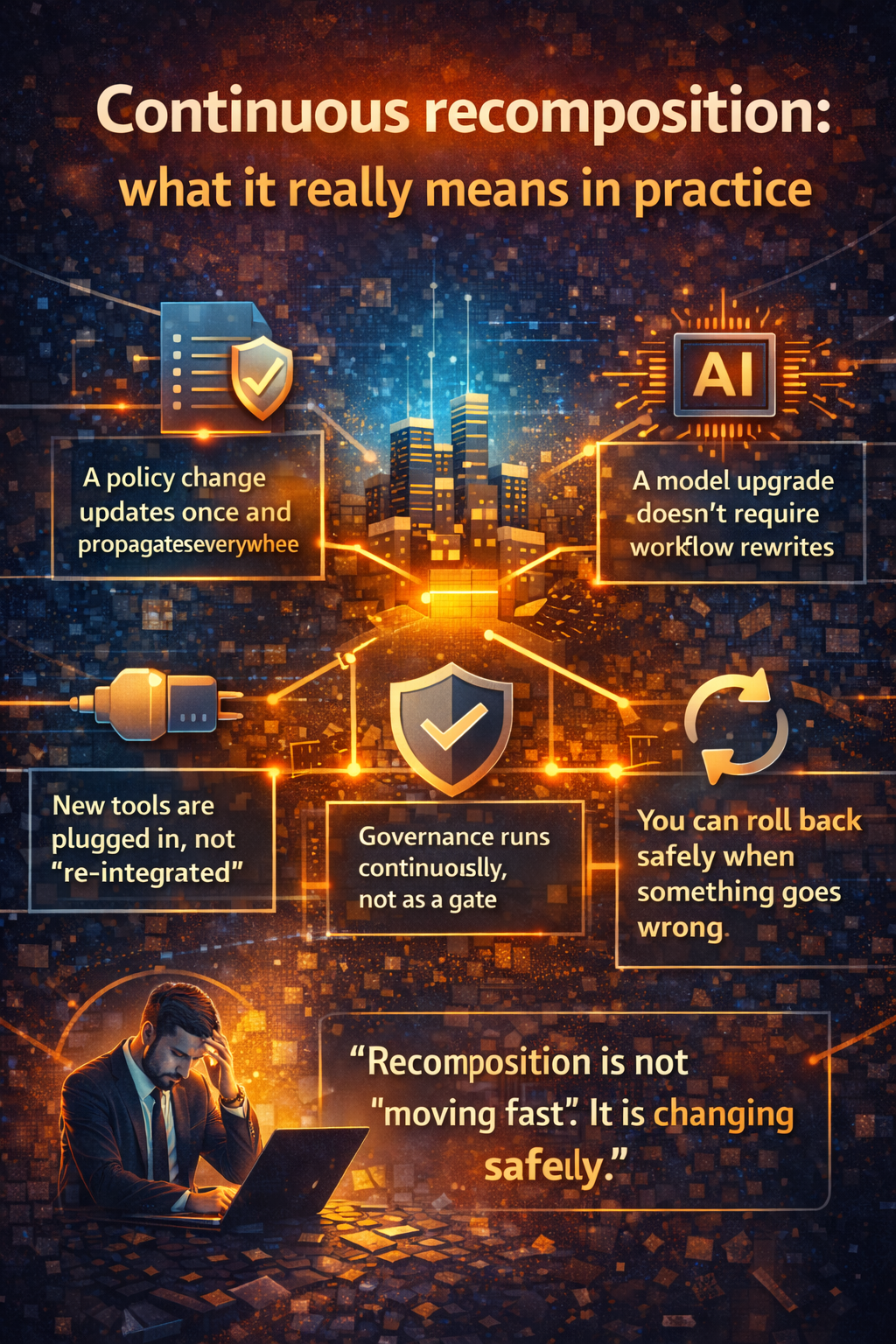
Continuous recomposition is not “moving fast.” It is changing safely.
Here are five practical signs your enterprise can recompose:
1) A policy change updates once and propagates everywhere
Example: Refund policy changes.
Instead of updating chat workflows, portal forms, email scripts, and CRM rules separately, you update a single policy service once. Every channel calls it.
2) A model upgrade doesn’t require workflow rewrites
If replacing a summarization model breaks workflows because output formatting shifts, you’re coupled.
In a living ecosystem, a model-facing adapter absorbs change so workflows remain stable.
3) New tools are plugged in, not “re-integrated”
Example: KYC provider replacement.
Teams should not build five different connectors. The enterprise should have standardized integration patterns and a disciplined contract for tool invocation.
4) Governance runs continuously, not as a gate
NIST frames AI risk management as lifecycle-oriented and includes ongoing monitoring within governance. (NIST Publications)
The EU AI Act similarly emphasizes continuous risk management and post-market monitoring for high-risk systems. (AI Act Service Desk)
Translation: governance must operate at machine speed, continuously.
5) You can roll back safely when something goes wrong
Recomposition without reversibility is reckless. A living ecosystem assumes safe rollback paths for tools, workflows, models, and policies.
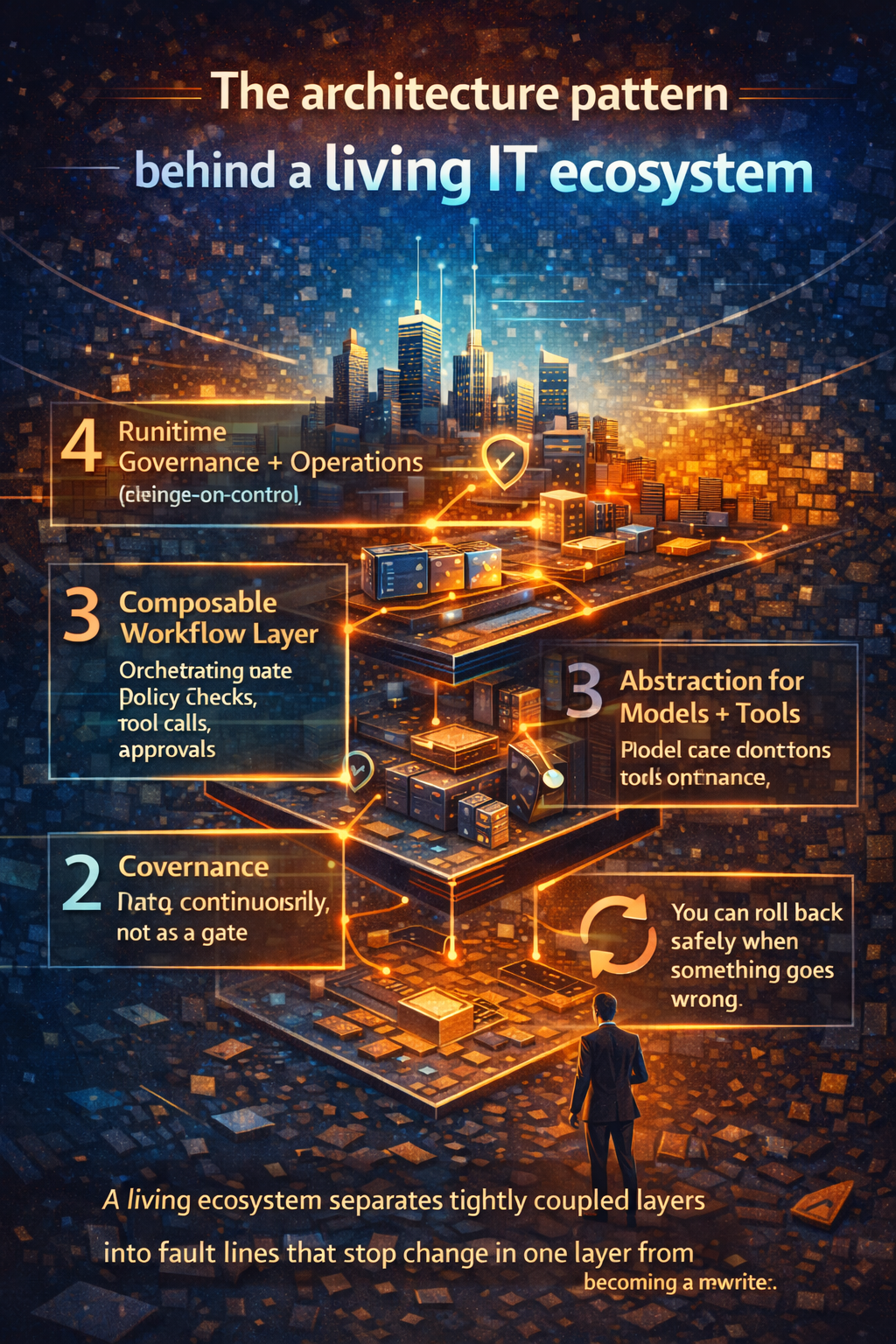
The architecture pattern behind a living IT ecosystem
To recompose continuously without lock-in, enterprises typically need four separations. Think of these as “fault lines” designed to stop change from becoming a rewrite.
Layer 1: Stable business capabilities (services-as-software)
Turn core capabilities into reusable services with clear contracts:
- Policy checking service
- Identity and permissions service
- Evidence/logging service
- Risk scoring service
- Exception triage service
- Notification/orchestration service
When capabilities become services, teams stop rebuilding the same logic, and change becomes localized.
Layer 2: A composable workflow layer
Work becomes a multi-step flow, not a single prompt:
- data gathering
- policy checks
- tool calls
- approvals
- exception handling
- evidence capture
This is where enterprises turn “AI output” into “AI work.”
Layer 3: Abstraction for models and tools
This is where lock-in usually hides.
- Model abstraction: route tasks to the best model by latency, cost, risk, and domain fit
- Tool abstraction: standardize tool contracts, permissions, validation, and safe defaults
If workflows depend directly on a model’s style or a tool’s parameter quirks, you are building lock-in into your operating fabric.
Layer 4: Runtime governance + operations (always-on control)
This layer enforces:
- identity boundaries
- policy guardrails
- audit evidence
- monitoring and anomaly detection
- rollback readiness
- cost controls
This aligns directly with modern lifecycle governance expectations—ongoing monitoring, risk management, and post-deployment controls. (NIST Publications)
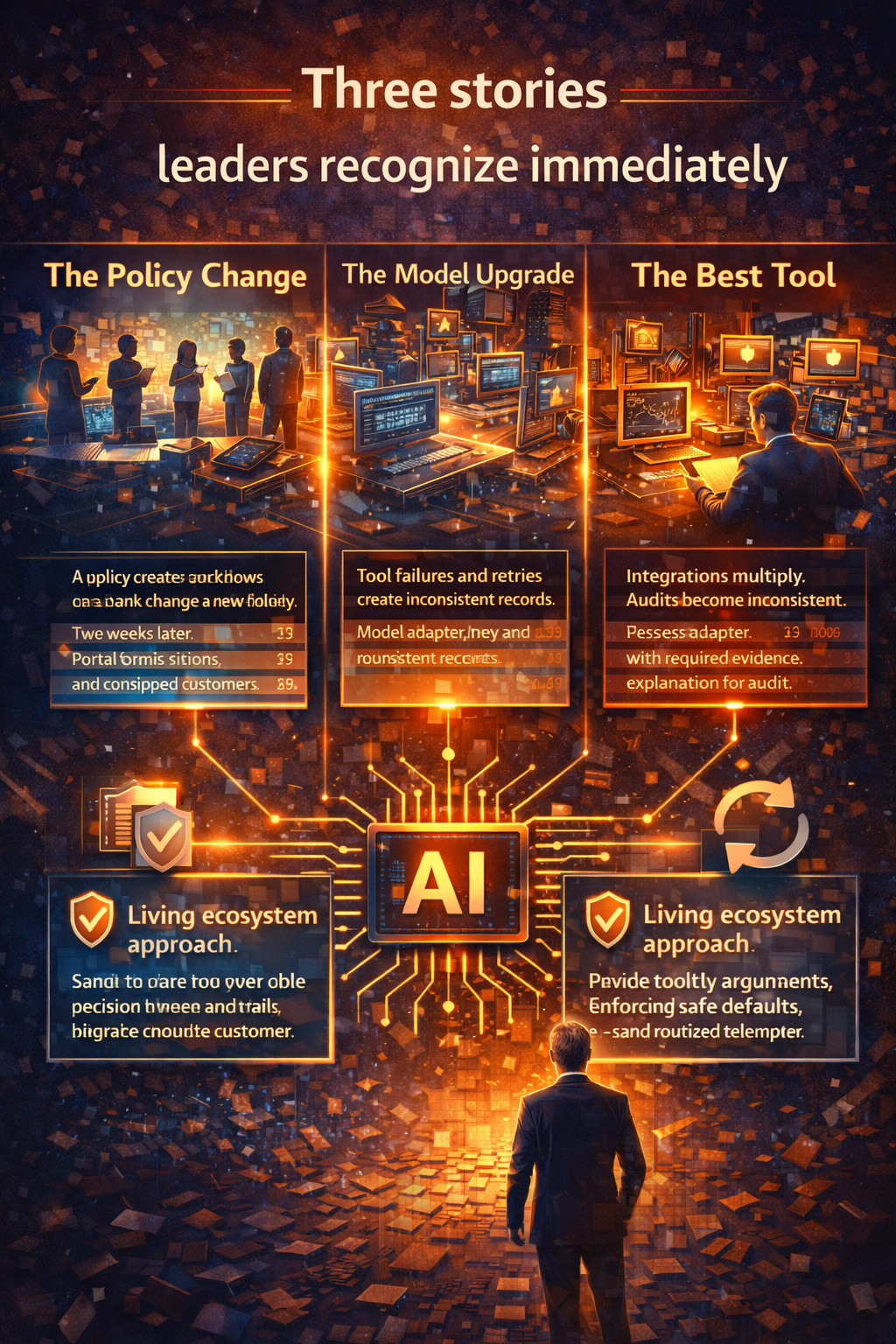
Three stories leaders recognize immediately
Story 1: The “tiny policy change” that breaks everything
A bank changes a rule: certain refunds now require approval when a risk condition is present.
- Team A updates chat workflows
- Team B updates portal forms
- Team C updates email scripts
- Team D updates CRM logic
Two weeks later: inconsistent decisions, missing audit trails, confused customers—and a flood of escalations.
Living ecosystem approach:
A single policy service evaluates the rule and returns:
- decision (approve / escalate / deny)
- required evidence
- explanation for audit
Every channel calls the same service. One change propagates everywhere, consistently.
Story 2: The model upgrade that triggers a production incident
A team upgrades a model. It starts producing slightly different tool-call arguments.
- Some tool calls fail silently
- Retries increase cost
- Partial actions create inconsistent records
- Ops teams scramble because logs are fragmented
Living ecosystem approach:
A model adapter validates tool-call payloads, enforces safe defaults, routes exceptions, and preserves telemetry. Governance and observability remain consistent even when models evolve.
Story 3: The “best tool” purchase that increases chaos
A new tool is bought for document intelligence. Another for workflow automation. Another for risk scoring.
Soon:
- integrations multiply
- identity patterns diverge
- audits become inconsistent
- incident response becomes a cross-team blame game
Living ecosystem approach:
Standard integration patterns, shared identity boundaries, and consistent telemetry make adding tools normal—not a recurring project tax.
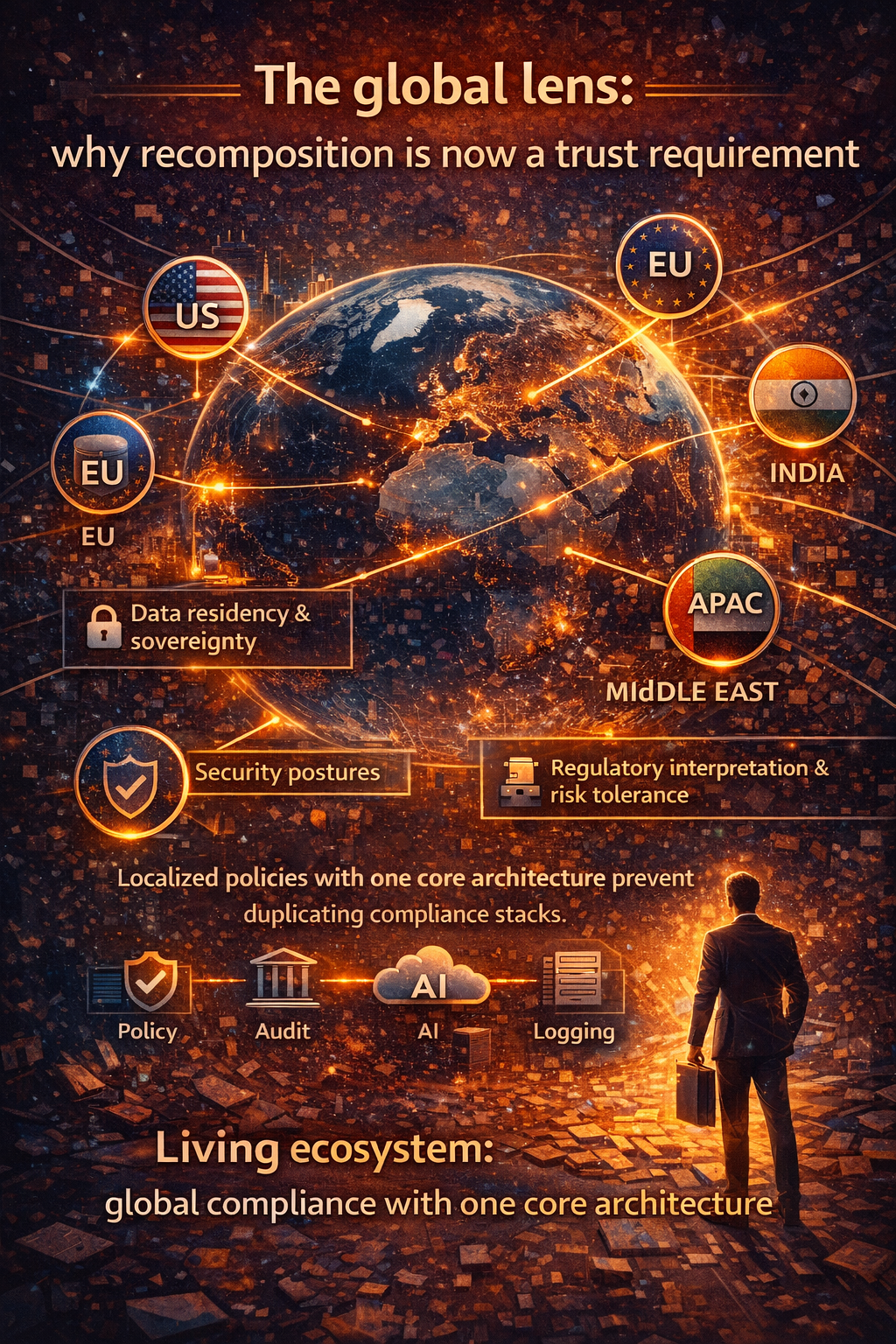
The global lens: why recomposition is now a trust requirement
The global lens: why recomposition is now a trust requirement
If you operate across the US, EU, India, APAC, and the Middle East, you face variations in:
- data residency and sovereignty
- audit expectations
- security postures
- regulatory interpretation and risk tolerance
The EU AI Act’s emphasis on continuous risk management and post-market monitoring increases pressure to operationalize evidence, monitoring, and controls. (AI Act Service Desk)
A living IT ecosystem solves a practical global problem:
- one core architecture
- region-specific thresholds and policies as configuration
- consistent evidence and auditability
You avoid duplicating stacks by geography—while tuning behavior locally.
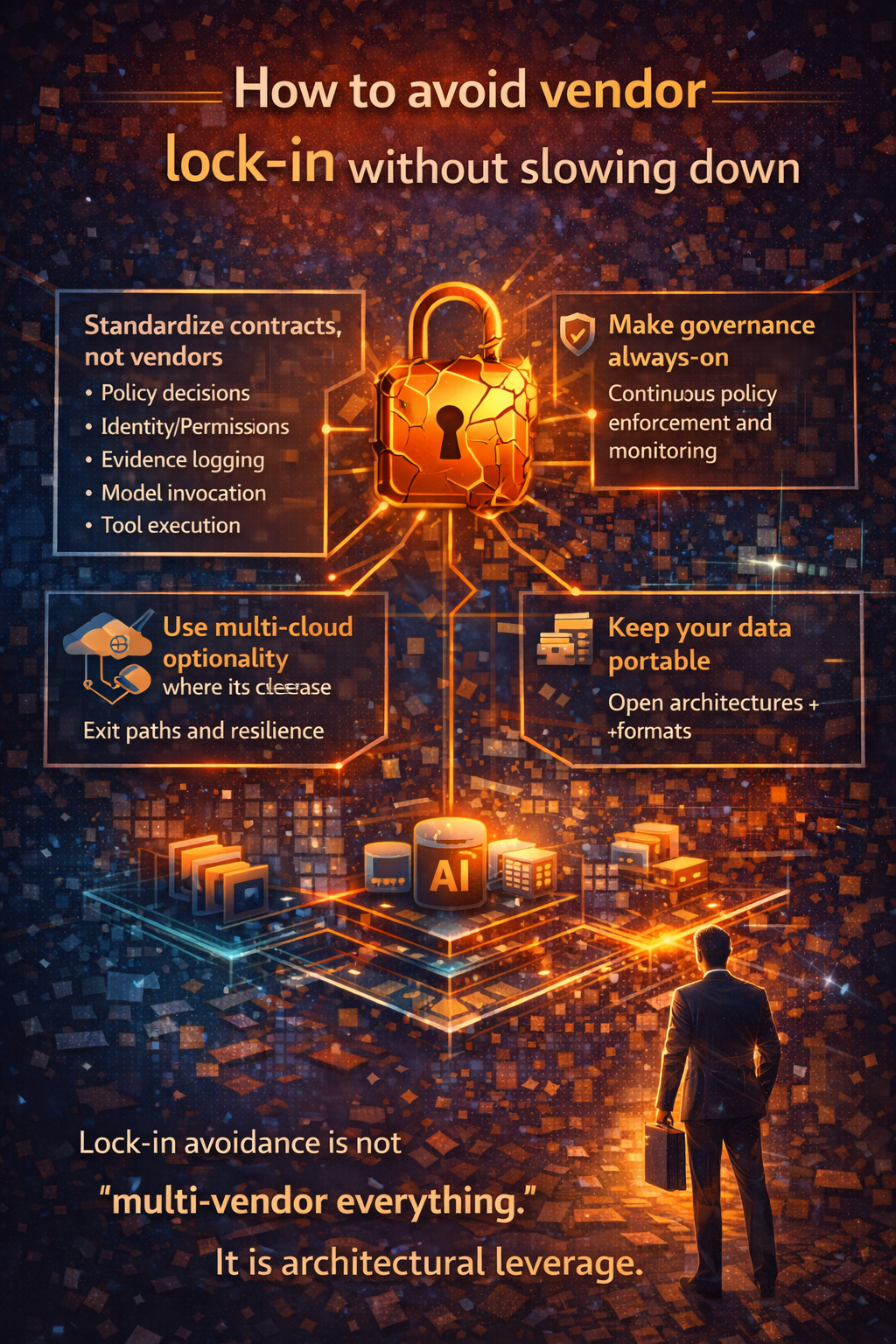
How to avoid vendor lock-in without slowing down
Lock-in avoidance is not “multi-vendor everything.” It is architectural leverage.
1) Standardize contracts, not vendors
Define stable interfaces for:
- policy decisions
- identity/permissions
- evidence logging
- model invocation
- tool execution
Vendors can change behind the interface without enterprise-wide rewrites.
2) Make governance always-on
NIST frames AI risk management as lifecycle-oriented and emphasizes ongoing monitoring as part of governance. (NIST Publications)
This naturally favors architectures where controls are enforced at runtime—not as end-stage gates.
3) Use multi-cloud optionality where it creates real leverage
You don’t need multi-cloud everywhere. You need exit paths and resilience where it matters.
Mainstream CIO guidance consistently frames multi-cloud patterns (containers, microservices, portability) as mechanisms to reduce vendor lock-in and enhance agility across heterogeneous platforms. (CIO)
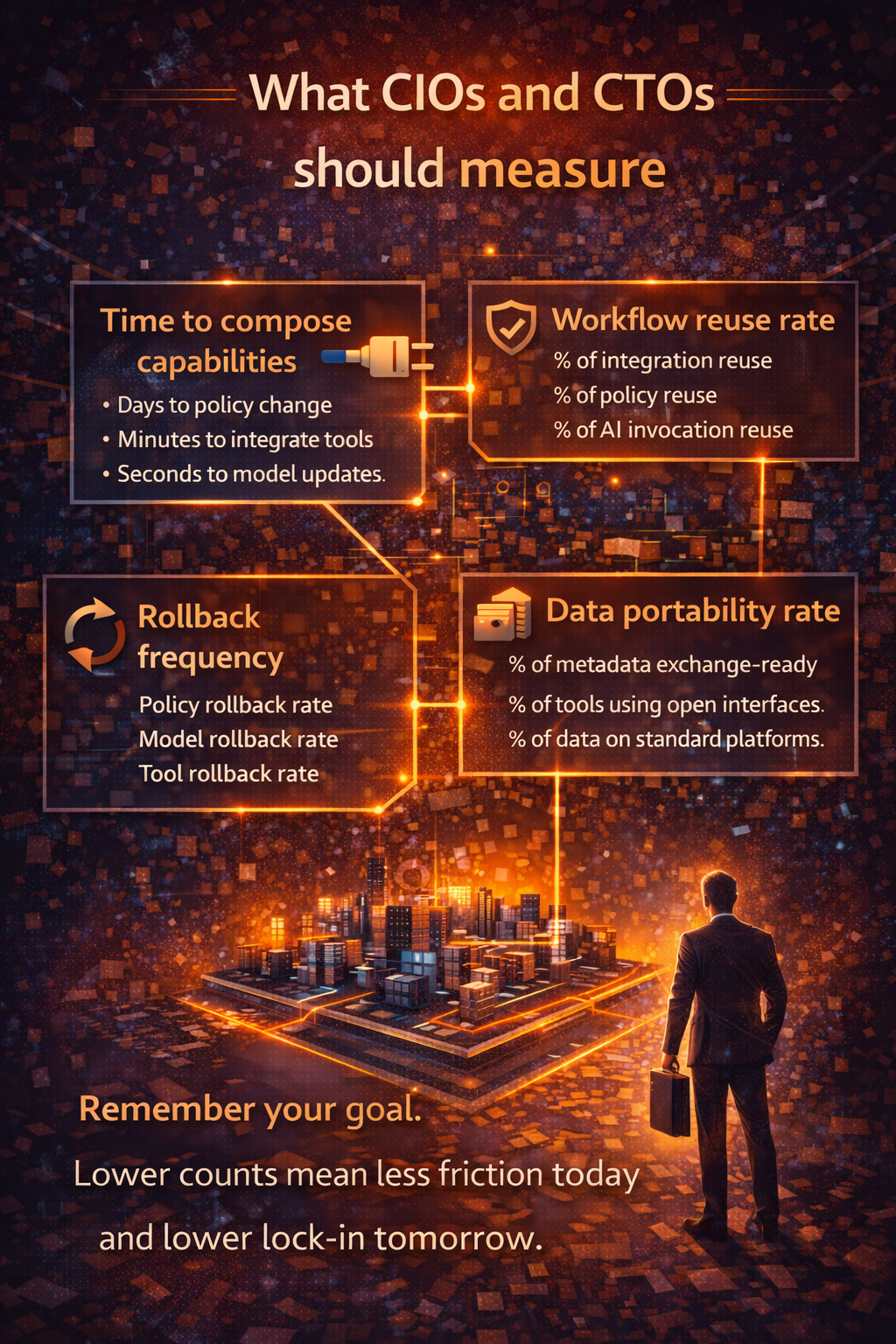
What CIOs and CTOs should measure
If you want this to be operational—not aspirational—measure:
- Change localization: how often does one change require updates across multiple systems?
- Reuse rate: how many teams consume shared services instead of rebuilding?
- Rollback readiness: can you stop/rollback safely when behavior drifts?
- Audit completeness: can you prove which policy/model/tool version drove a decision?
- Integration lead time: how fast can you add a platform without connector sprawl?
- Cost predictability: do you have runtime cost controls (budgets, throttles, limits)?
These metrics turn “living ecosystem” from a philosophy into an executive operating model.

A pragmatic 30–60–90 day starting path
First 30 days: pick one capability and make it reusable
Choose a high-impact capability like:
- policy checking
- exception triage
- evidence logging
Wrap it as a service with clear inputs/outputs and audit evidence.
Next 60 days: introduce workflow orchestration + model/tool abstraction
- design multi-step flows
- standardize tool contracts
- route models by cost/risk/latency
- enforce safe tool calls and escalation rules
Next 90 days: operationalize governance and portability
- runtime monitoring and anomaly detection
- rollback playbooks
- policy versioning and post-change verification
- portability decisions for critical workflows
This is how you move from “AI projects” to a living ecosystem.
Conclusion: The line leaders will repeat
Enterprises will not win the AI era by accumulating more tools, more pilots, or more agents.
They will win by building an operating architecture that can continuously recompose—safely, repeatedly, and at speed—across platforms, regions, and regulatory constraints.
A living IT ecosystem is the architecture of that advantage:
- reusable services
- composable workflows
- model/tool abstraction
- runtime governance
- interoperable ecosystems
- portability that prevents lock-in
If someone remembers one idea, let it be this:
In the AI era, the enterprise advantage is not intelligence. It is operability—at the speed of continuous change.
Glossary
Living IT ecosystem: An enterprise operating architecture designed to adapt continuously—so workflows, models, tools, and policies can change without rewrites or fragility.
Continuous recomposition: The ability to safely reconfigure enterprise workflows and systems repeatedly as policies, threats, models, and platforms evolve.
Vendor lock-in: Dependency that makes switching vendors, models, or platforms costly or risky due to tight coupling in architecture, workflows, integrations, and governance.
Runtime governance: Continuous enforcement of policy, monitoring, audit evidence, and rollback readiness while AI is operating in production.
Services-as-software: Packaging enterprise capabilities as reusable services with contracts, telemetry, guardrails, and lifecycle ownership—rather than one-time projects.
Policy-as-code: Expressing rules and compliance requirements in executable controls that can be versioned, tested, audited, and rolled out safely.
Model abstraction: A layer that routes tasks to different models based on latency, cost, risk, and domain fit—without breaking workflows when models change.
Tool abstraction: Standardizing how tools/APIs are called (contracts, permissions, validation) so tool changes don’t cascade into workflow failures.
Post-market monitoring: Ongoing monitoring of an AI system after deployment to ensure performance and compliance over time (often emphasized in regulated environments). (AI Act Service Desk)
Cross-border data controls: Governance mechanisms for data residency, sovereignty, and audit obligations across regions like the US, EU, India, APAC, and the Middle East.
FAQ ( People Also Ask)
1) What is a “living IT ecosystem” in enterprise AI?
It’s an operating architecture that lets an enterprise continuously reconfigure workflows, models, tools, and policies safely—without rewrites, fragility, or vendor lock-in.
2) Why is continuous recomposition important now?
Because enterprise AI operates in dynamic environments where policies, platforms, models, and threats evolve continuously. Modern governance expectations also emphasize lifecycle monitoring, not one-time approvals. (NIST Publications)
3) What causes vendor lock-in in enterprise AI?
Lock-in often comes from architectural coupling: policy logic embedded everywhere, prompts tied to tool parameters, duplicated integrations, inconsistent identity rules, and fragmented observability.
4) How do reusable services reduce lock-in risk?
They standardize contracts and centralize change. Instead of updating ten systems for one policy change, you update one service and propagate consistently.
5) What is runtime governance and why does it matter?
Runtime governance is continuous policy enforcement, monitoring, audit evidence, and rollback readiness while AI runs in production—aligned with lifecycle risk management expectations. (NIST Publications)
6) Do enterprises need multi-cloud to avoid lock-in?
Not everywhere. But they do need portability and “exit paths” for critical workloads. Common multi-cloud guidance highlights portability patterns (microservices, containers) to reduce lock-in and increase agility. (CIO)
7) What should CIOs/CTOs measure to know recomposition is real?
Change localization, reuse rate, rollback readiness, audit completeness, integration lead time, and cost predictability.
8) What’s the fastest way to start building a living IT ecosystem?
Begin with one reusable capability (policy checking, evidence logging, or exception triage), then add orchestration and abstraction layers, then operationalize governance and rollback.
FAQ 1: What is a living IT ecosystem?
A living IT ecosystem is an enterprise architecture designed to evolve continuously—allowing workflows, AI models, tools, and policies to change without breaking systems or creating lock-in.
FAQ 2: Why is continuous recomposition critical for enterprise AI?
Because AI behavior, regulations, and tools change constantly. Without recomposition, even small changes trigger cascading failures across systems.
FAQ 3: How does a living IT ecosystem reduce vendor lock-in?
By standardizing interfaces, governance, and services—so vendors can change without forcing architectural rewrites.
FAQ 4: Is a living IT ecosystem the same as multi-cloud?
No. Multi-cloud is an infrastructure choice. A living IT ecosystem is an operating architecture that enables portability, governance, and change across clouds and platforms.
FAQ 5: Who should own the living IT ecosystem—IT or business?
Ownership is shared. IT governs the architecture; business teams consume reusable services to build and evolve capabilities faster.
References and further reading
- NIST, AI Risk Management Framework (AI RMF 1.0) — governance includes ongoing monitoring and periodic review. (NIST Publications)
- EU AI Act Service Desk, Article 9 (Risk management system) and Article 72 (Post-market monitoring) — continuous lifecycle obligations. (AI Act Service Desk)
- CIO.com, multi-cloud strategy guidance — portability patterns (microservices/containers) to reduce lock-in and increase agility across heterogeneous platforms. (CIO)
- Studio-to-Runtime: Why Enterprise AI Fails Without a Build Plane and a Production Kernel – Raktim Singh
- The New Enterprise AI Advantage Is Not Intelligence — It’s Operability – Raktim Singh
- Why Enterprises Need Services-as-Software for AI: The Integrated Stack That Turns AI Pilots into a Reusable Enterprise Capability – Raktim Singh
- The Advantage Is No Longer Intelligence—It Is Operability: How Enterprises Win with AI Operating Environments – Raktim Singh
- The AI Platform War Is Over: Why Enterprises Must Build an AI Fabric—Not an Agent Zoo – Raktim Singh
- Services-as-Software: Why the Future Enterprise Runs on Productized Services, Not AI Projects | by RAKTIM SINGH | Dec, 2025 | Medium
- The Composable Enterprise AI Stack: Agents, Flows, and Services-as-Software — Built Open, Interoperable, and Responsible | by RAKTIM SINGH | Dec, 2025 | Medium
- Why Enterprise AI Is Becoming a Fabric: From AI Agents to Services-as-Software | by RAKTIM SINGH | Dec, 2025 | Medium
- Enterprise IT Is Becoming an App Store: From Projects to Services-as-Software: By Raktim Singh
- Enterprise AI Fabric: Why AI Is Shifting from Applications to an Operational Layer: By Raktim Singh



Raktim Singh is an AI and deep-tech strategist, TEDx speaker, and author focused on helping enterprises navigate the next era of intelligent systems. With experience spanning AI, fintech, quantum computing, and digital transformation, he simplifies complex technology for leaders and builds frameworks that drive responsible, scalable adoption.