

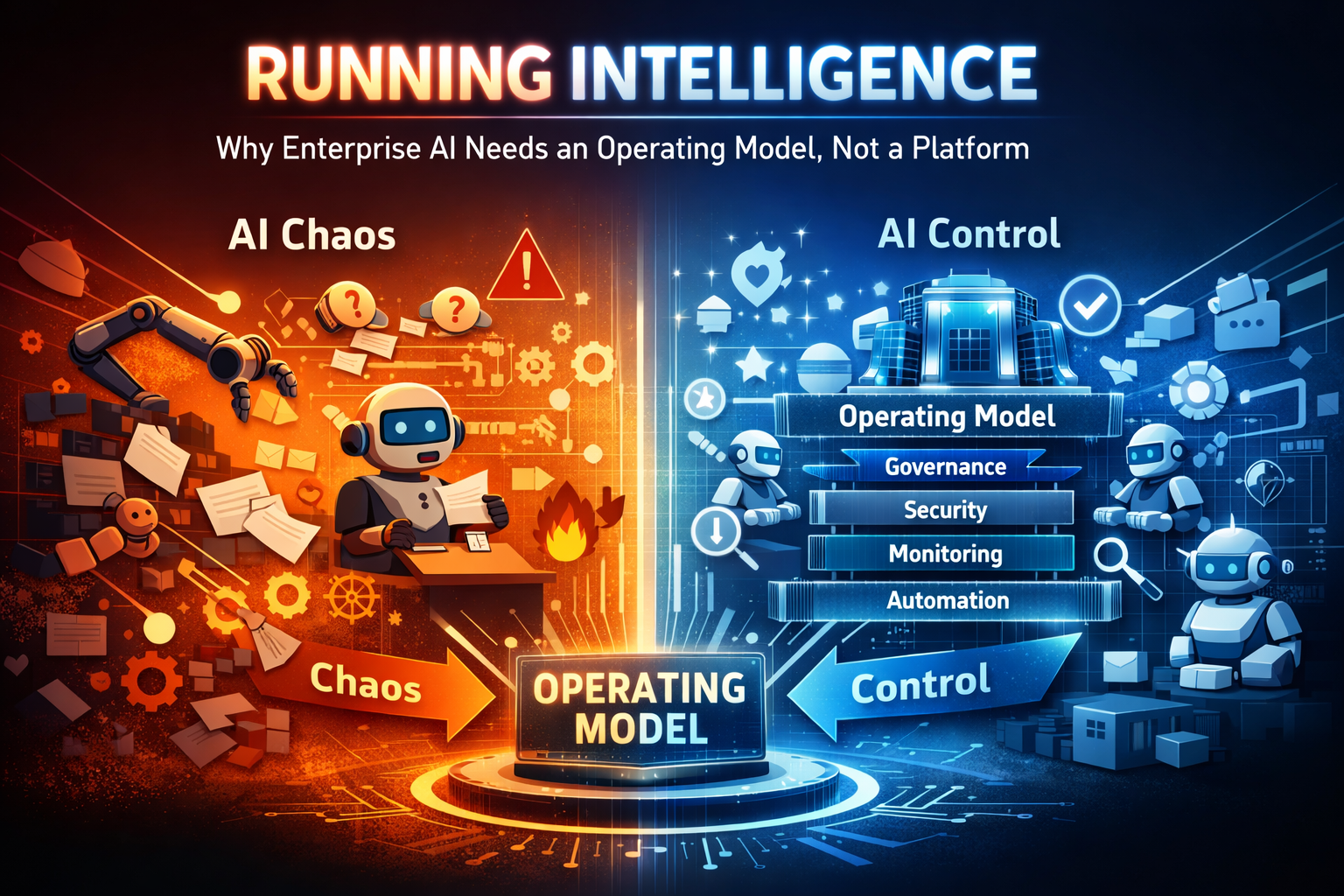
Running Intelligence: Why Enterprise AI Needs an Operating Model, Not a Platform
Enterprise AI has quietly crossed a threshold. What began as experiments and productivity tools is now evolving into systems that decide, coordinate, and act inside live business workflows.
This shift—from deploying models to running intelligence—changes the problem enterprises must solve. The challenge is no longer about choosing the best AI platform or the most powerful model; it is about ensuring that intelligence can be operated safely, observed continuously, governed in real time, and evolved without breaking trust, compliance, or cost control. Enterprises that recognize this early will not just adopt AI faster—they will run it better, and that difference will define competitive advantage in the decade ahead.
Executive Summary
Enterprise AI has entered its most consequential phase.
In the first wave, AI advised. It summarized documents, drafted responses, answered questions, and produced recommendations. When it was wrong, the cost was usually a correction.
In the next wave, AI acts. It creates tickets, routes approvals, updates records, triggers workflows, changes configurations, and coordinates multi-step work across systems. When this kind of AI is wrong, the cost isn’t a bad answer—it’s a bad outcome.
This is the moment when “buy a platform” stops being a strategy.
Because once intelligence starts executing, the enterprise no longer needs “more AI.” It needs a way to run intelligence—safely, visibly, economically, and repeatedly—across teams, tools, and environments.
That “way” is an Operating Model.
Not a document.
Not a governance committee.
Not a reference architecture slide.
A real operating model is a production discipline: the set of controls and runtime behaviors that make autonomous and semi-autonomous AI operate like a first-class part of the enterprise—observable, governable, supportable, change-ready, and financially sustainable.
How to use this article (and where it fits in the bigger picture)
If you’re new to the topic, start with the definition-level framing of what “Enterprise AI” actually means—and why it’s not the same as “AI inside an enterprise.” That distinction matters because it changes what you must build and govern. (raktimsingh.com)
If you’re already living the complexity—agents, copilots, pilots everywhere—then this piece is the “executive spine” that ties everything together: running intelligence as an operating discipline.
And if you want the complete reference blueprint, this article is designed as a spoke that points to your hub:
- The Enterprise AI Operating Model (pillar blueprint / system of record) (raktimsingh.com)
- The Intelligence Reuse Index (why reuse is the real enterprise advantage) (raktimsingh.com)
- The Operating Layer for Agents + Guardrails + Design Studio + Services-as-Software (the structural shift enterprises are making) (raktimsingh.com)
- Services-as-Software for Enterprise AI (why outcomes replace tools) (raktimsingh.com)
(Links are included later in Further Reading and also placed contextually below so the narrative stays smooth.)
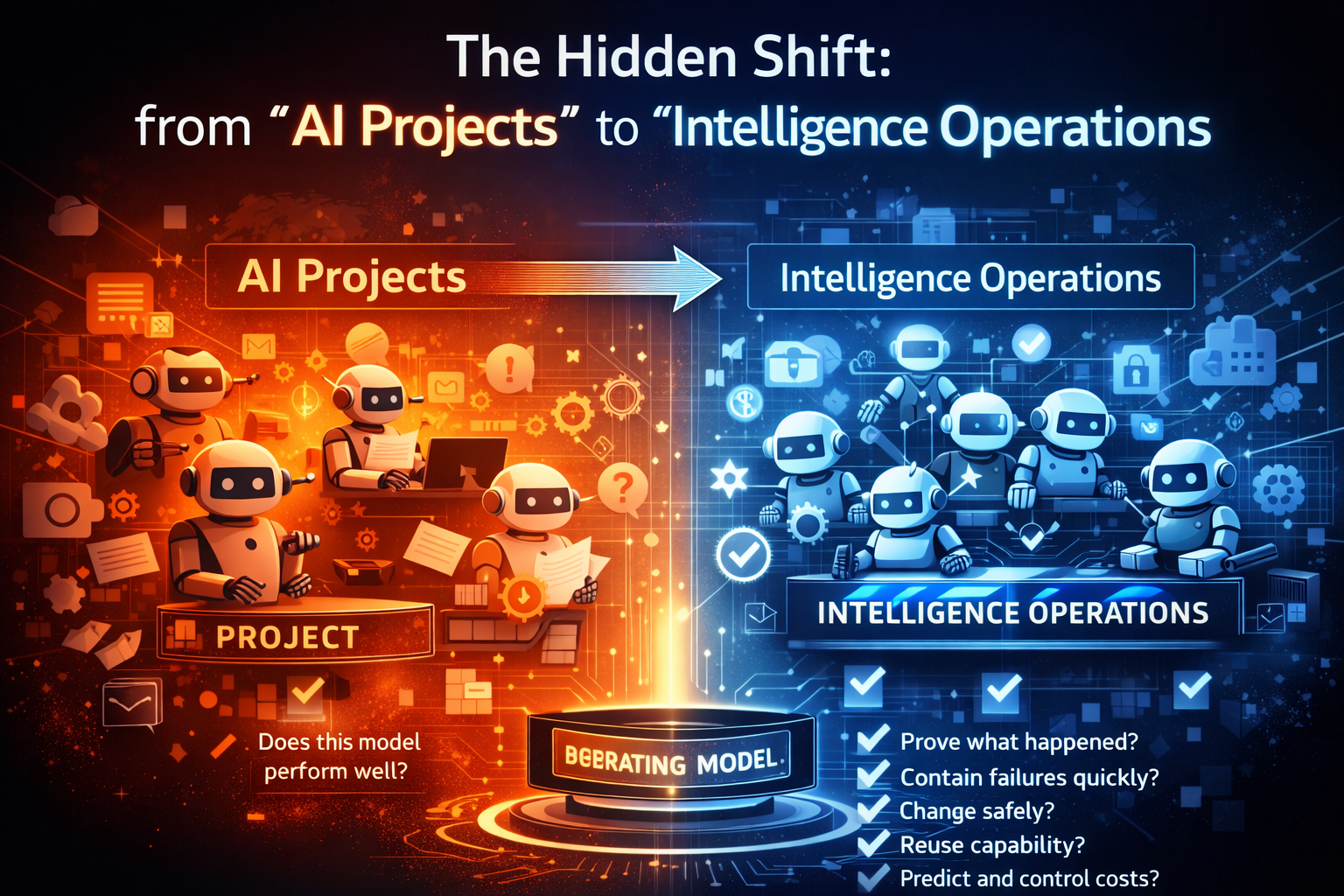
The hidden shift: from “AI projects” to “intelligence operations”
Most enterprises are still treating AI like a project:
- a team picks a use case,
- a pilot is built,
- an agent is deployed,
- early wins are celebrated,
- and then the system quietly fragments across departments.
But agentic AI changes the unit of value.
In an “AI projects” world, success means: Does this model perform well?
In an “intelligence operations” world, success means:
- Can we prove what happened?
- Can we contain failures quickly?
- Can we change safely without breaking production?
- Can we reuse what we built instead of reinventing it?
- Can we predict and control cost as autonomy scales?
This is exactly why “Enterprise AI” is not a tooling conversation—it’s an operating capability conversation. (raktimsingh.com)
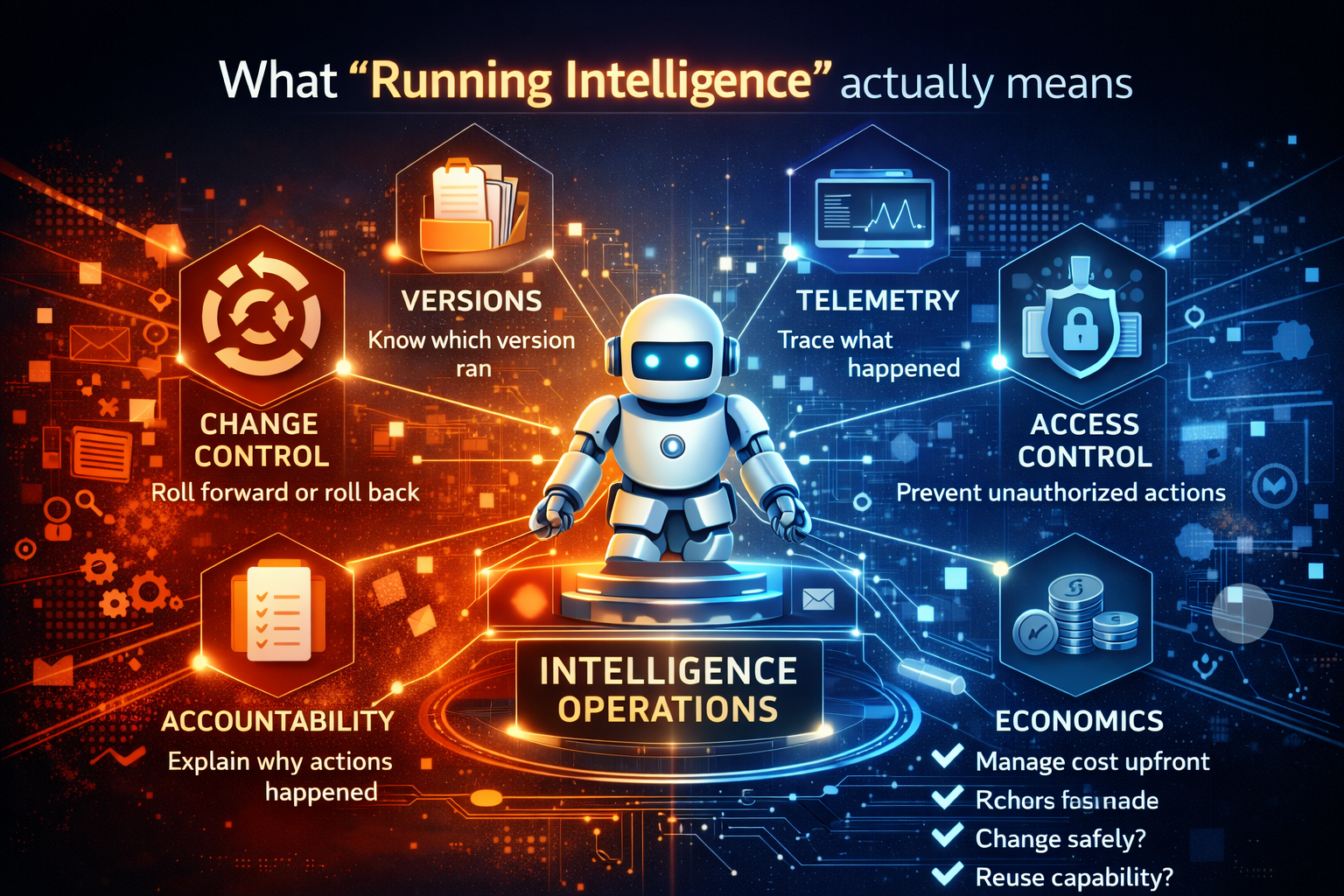
What “running intelligence” actually means
Running intelligence means treating AI the way you treat any production-critical capability:
- It has versions (and you know which version ran).
- It has change control (and you can roll forward or roll back).
- It has telemetry (and you can trace what happened).
- It has access control (and it can’t do what it shouldn’t).
- It has incident response (and you can stop the bleeding fast).
- It has economics (and cost is managed, not discovered on the invoice).
- It has accountability (and you can explain why actions happened).
Most enterprises already know how to run software.
The challenge is that agentic, tool-using, multi-step AI isn’t “just software.” It decides, adapts, and sometimes improvises under ambiguity.
So the operating model must evolve—from deploying AI to operating autonomy.
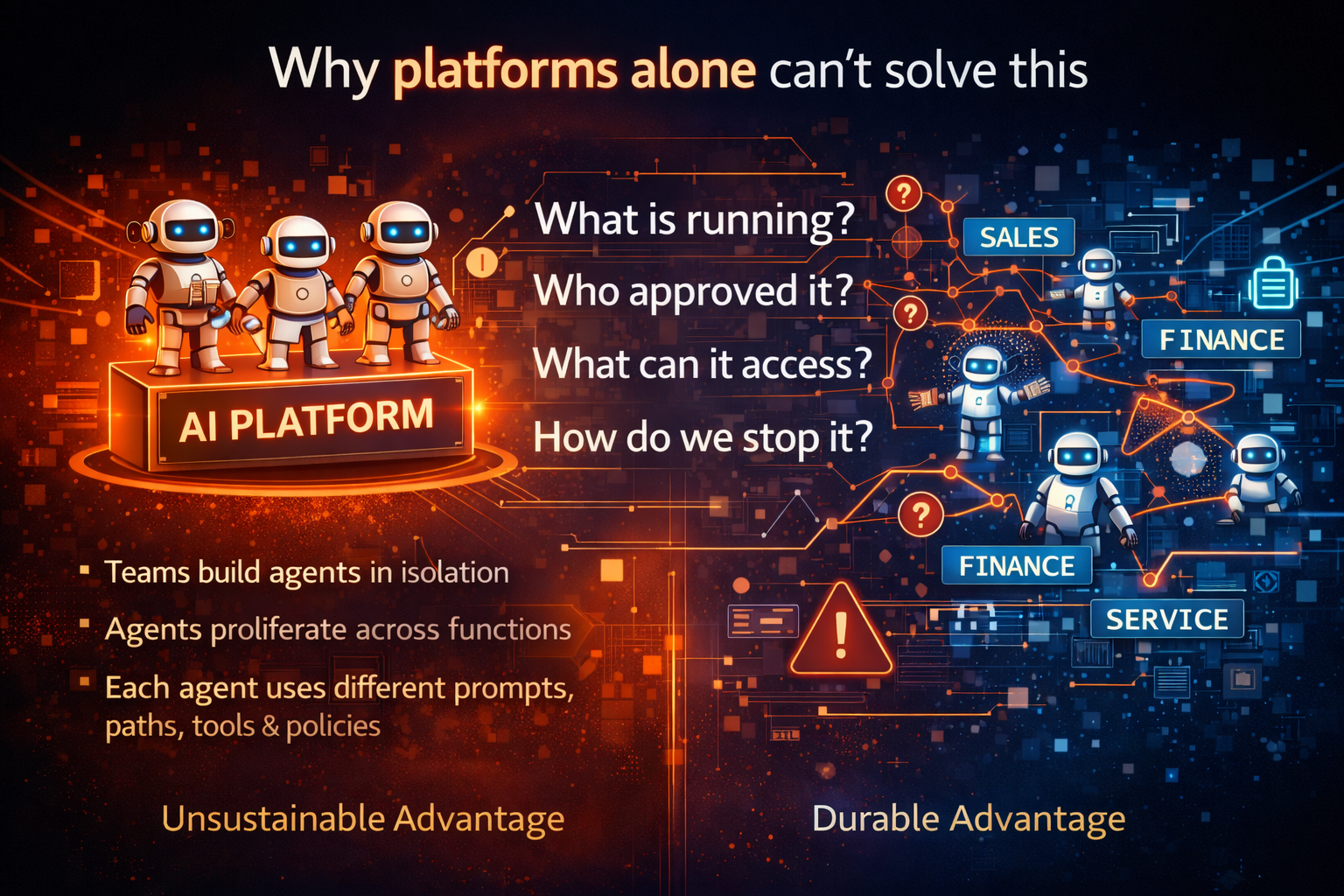
Why platforms alone can’t solve this
Platforms are good at enabling build. Many are also good at enabling deploy.
But “run” is different.
Enterprises don’t fail because they can’t build assistants. They fail because they can’t operate assistants once they spread:
- Teams build agents in isolation.
- Agents proliferate across functions.
- Each agent uses different prompts, tools, policies, and data pathways.
- No one can confidently answer: What is running? Who approved it? What can it access? How do we stop it?
When this happens, “AI” becomes an estate problem: intelligence is everywhere, but visibility is nowhere. That’s exactly the point where boards stop asking “Is AI innovative?” and start asking “Is AI controllable?”
The simplest distinction that matters: “AI that advises” vs “AI that executes”
Example 1: The helpful summarizer (advises)
A team uses an AI assistant to summarize a policy document and suggest edits to an internal guideline.
If the summary is slightly wrong, a human corrects it. No systems change.
Example 2: The “helpful” workflow agent (executes)
A workflow agent reads an incoming request, creates a service ticket, assigns it, triggers an approval path, and updates a system record based on inferred intent.
If it misclassifies the request, it may:
- open the wrong ticket,
- route it to the wrong queue,
- grant the wrong access,
- or change the wrong configuration.
Same underlying AI class.
Completely different risk profile.
Once AI executes, enterprises need operability primitives—the same way financial systems need audit trails, access controls, and reconciliation.
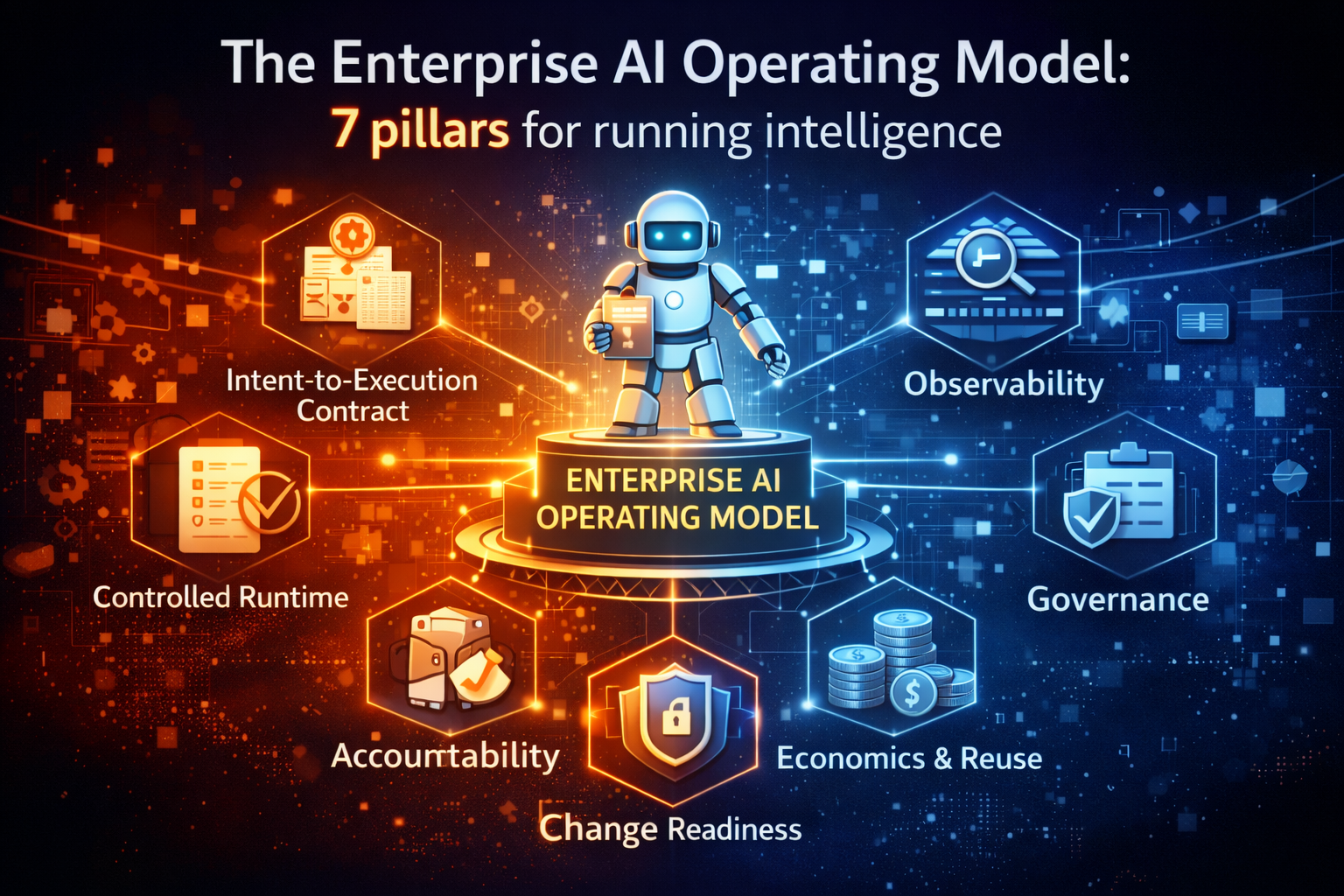
The Enterprise AI Operating Model: 7 pillars for running intelligence
This operating model is intentionally practical. Each pillar answers a production question every CIO/CTO eventually faces.
If you want the full reference blueprint behind these pillars, your pillar page captures the complete framework and vocabulary you’re building across your site. (raktimsingh.com)
1) Intent-to-Execution Contract
Question: What did we design this AI to do—and what is it actually doing in production?
Enterprises need explicit contracts that bind:
- business intent,
- permitted actions,
- safety constraints,
- escalation rules,
- and acceptable failure modes.
Without a contract, every incident becomes a debate: “It wasn’t supposed to do that.”
With a contract, incidents become operational: “It violated constraint X; contain, roll back, patch policy Y, redeploy.”
This is where enterprises mature from “agent behavior” to managed autonomy.
2) Controlled Runtime (the production kernel)
Question: Can we run this safely at scale?
A controlled runtime is where AI actions become production-grade:
- execution happens through governed connectors,
- actions are gated by policy,
- approvals happen by rule (not ad hoc),
- and the system supports kill-switch and rollback.
This is the difference between autonomy that “works in a demo” and autonomy that survives real-world complexity.
3) Explainable observability (traces, logs, decisions)
Question: Can we reconstruct what happened—and why?
Multi-step AI workflows require end-to-end tracing:
- what the agent saw,
- what it decided,
- which tools it called,
- what actions it took,
- and what outcomes occurred.
If you can’t trace it, you can’t fix it.
If you can’t fix it, you can’t scale it.
4) Governance that runs in production (not in slides)
Question: How do policies actually get enforced?
Most enterprises have governance documents.
What they need is governance as runtime behavior:
- policy checks before action,
- permissions bound to identity,
- logging mandated by default,
- and versioned approvals tied to change management.
This is where the idea of an operating layer becomes real: governance isn’t a PDF; it’s a system behavior. (raktimsingh.com)
5) Identity, permissions, and tool access (agents as machine identities)
Question: Who is allowed to do what—when the “who” is an agent?
Agents must be treated like governed machine identities:
- least privilege,
- scoped tool access,
- time-bound permissions,
- and action limits.
Otherwise, your “helpful agent” becomes a high-speed internal actor with broad access—and unclear accountability.
6) Economics and reuse (cost as a first-class production signal)
Question: Why is cost rising faster than value?
Agentic AI costs scale in non-obvious ways:
- more steps per task,
- more retrieval and context,
- more tool calls,
- more retries and guardrails,
- more monitoring overhead.
This is where enterprises discover an uncomfortable truth:
Enterprises rarely run out of AI ideas. They run out of reuse. (raktimsingh.com)
An operating model must include:
- cost budgets per workflow,
- reusable components (prompts, tools, policies, guardrails),
- and a service catalog mindset—so capability is productized, not reinvented.
7) Change readiness (continuous recomposition)
Question: How do we evolve safely when everything changes—models, policies, tools, threats, vendors?
With AI, change is constant.
So “set and forget” is dead.
A mature operating model treats change as a loop:
- detect drift,
- validate behavior,
- roll out gradually,
- monitor impact,
- roll back quickly when needed.
This is how enterprises avoid slow-motion risk accumulation—and why operating models become a compounding advantage.
The strategic outcome: from tools to outcomes (Services-as-Software)
Here’s a simple test.
If your AI adoption still depends on humans stitching steps together—copy-pasting between tools, manually routing work, chasing approvals—then AI is still a tool.
But when intelligence is run as a managed capability, enterprises start buying (and building) outcomes, not apps.
That is the logic behind Services-as-Software: repeatable service outcomes delivered through software-driven execution (with humans focused on exceptions, oversight, and improvement). (raktimsingh.com)
This is also where “running intelligence” becomes board-relevant: outcomes come with accountability, cost envelopes, and control.
Practical starting path (without boiling the ocean)
If you want to operationalize “running intelligence” without a massive program:
- Pick one workflow where AI is already influencing outcomes (not just content).
- Define the execution contract: permitted actions + escalation + rollback.
- Route actions through governed connectors and a controlled runtime.
- Turn on end-to-end tracing (agent → tools → actions).
- Add runtime policy gates (not manual review after the fact).
- Introduce cost budgets and reuse shared components.
- Establish an incident path: pause, contain, replay, patch, redeploy.
That’s how you turn “smart demos” into runnable autonomy.
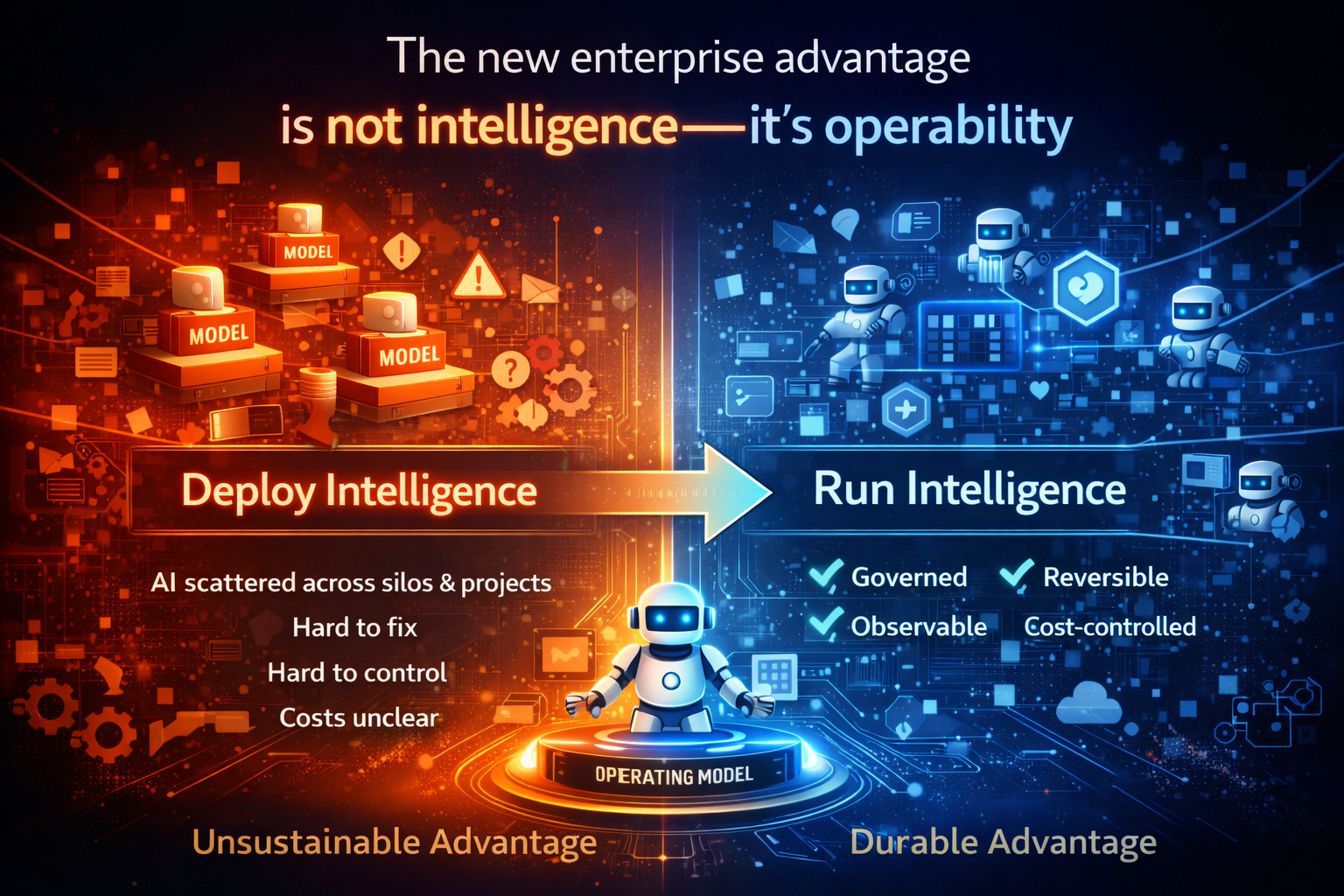
Conclusion: the new enterprise advantage is not intelligence—it’s operability
Enterprises won’t win because they adopted AI first.
They’ll win because they learned to run intelligence first—treating autonomous systems as production-critical capabilities that are observable, governable, reversible, and economically sustainable.
Platforms will come and go.
Operating models become durable advantage.
And in the next decade, that will be the quiet divider between:
- organizations that have “AI everywhere,” and
- organizations that have AI they can trust, control, and scale.
FAQ
1) Isn’t an operating model just governance?
No. Governance is one component. An operating model includes runtime controls, observability, identity, incident response, change management, and economics—how the system behaves in production.
2) Why can’t we standardize on one AI platform?
Standardization helps, but it doesn’t solve enforcement, rollback, chain-of-custody, cost controls, and multi-team reuse at scale. “Run” problems emerge after adoption spreads.
3) What’s the first sign we need this?
When AI starts triggering actions in real workflows and you can’t confidently answer: what ran, why it ran, what it touched, and how to stop it.
4) Doesn’t this slow down innovation?
Done right, it speeds innovation—because teams stop rebuilding the same safety, tooling, and governance each time. Reuse increases velocity.
5) Where should a CIO start?
Pick one workflow that crosses a real boundary (approval, change, record update). Wrap it with contract + controlled runtime + tracing + policy gates + cost envelope. Scale from there.
Glossary
- Running Intelligence: Operating AI systems as production capabilities with control, visibility, accountability, and cost management.
- Enterprise AI: AI that influences decisions or takes actions inside real workflows—requiring operating model, governance, and architecture beyond pilots. (raktimsingh.com)
- Execution Contract: A versioned definition of permitted actions, constraints, escalation, and rollback rules.
- Controlled Runtime: A governed environment where agent actions run through policy gates, audited connectors, and operational controls.
- Operating Layer: The structural layer that makes AI reusable, governed, observable, and safe across the enterprise (beyond “AI as an app”). (raktimsingh.com)
- Services-as-Software: Outcome-driven services delivered through software-driven execution (often agentic), with humans supervising exceptions. (raktimsingh.com)
- Intelligence Reuse Index: A lens for how effectively an enterprise reuses intelligence components across teams, workflows, and domains. (raktimsingh.com)
Further Reading
- Enterprise AI Operating Model (Pillar / System of Record) (raktimsingh.com)
- What Is Enterprise AI? (Definition-level clarity) (raktimsingh.com)
- The Intelligence Reuse Index (Why reuse beats reinvention) (raktimsingh.com)
- AI Agents Will Break Your Enterprise—Unless You Build This Operating Layer (Operating layer + guardrails + design studio + services-as-software) (raktimsingh.com)
- Why Enterprises Need Services-as-Software for AI (Outcome economics) (raktimsingh.com)
- The Intelligence Reuse Index: Why Enterprise AI Advantage Has Shifted from Models to Reuse | by RAKTIM SINGH | Dec, 2025 | Medium
- The Enterprise Model Portfolio: Why LLMs and SLMs Must Be Orchestrated, Not Chosen | by RAKTIM SINGH | Dec, 2025 | Medium
- The Intelligence Reuse Index: The Metric That Will Decide Which Banks Actually Scale Enterprise AI: By Raktim Singh
- The Enterprise Model Portfolio: Why Model Selection Is the Wrong Question for 2026: By Raktim Singh
If you want the full blueprint behind this article, start here: [The Enterprise AI Operating Model](The Enterprise AI Operating Model: How organizations design, govern, and scale intelligence safely – Raktim Singh)
To understand why “Enterprise AI” is not the same as “AI in the enterprise,” read: [What Is Enterprise AI?](What Is Enterprise AI? Why “AI in the Enterprise” Is Not Enterprise AI—and Why This Distinction Will Define the Next Decade – Raktim Singh)
If you want the economic lens—why enterprises don’t run out of ideas, they run out of reuse—see: [The Intelligence Reuse Index](The Intelligence Reuse Index: Why Enterprise AI Advantage Has Shifted from Models to Reuse – Raktim Singh)
For the structural shift (agents + guardrails + design studio + services-as-software), read: [AI Agents Will Break Your Enterprise—Unless You Build This Operating Layer](AI Agents Will Break Your Enterprise—Unless You Build This Operating Layer – Raktim Singh)
For outcome economics, read: [Why Enterprises Need Services-as-Software for AI](Why Enterprises Need Services-as-Software for AI: The Integrated Stack That Turns AI Pilots into a Reusable Enterprise Capability – Raktim Singh)



Raktim Singh is an AI and deep-tech strategist, TEDx speaker, and author focused on helping enterprises navigate the next era of intelligent systems. With experience spanning AI, fintech, quantum computing, and digital transformation, he simplifies complex technology for leaders and builds frameworks that drive responsible, scalable adoption.