

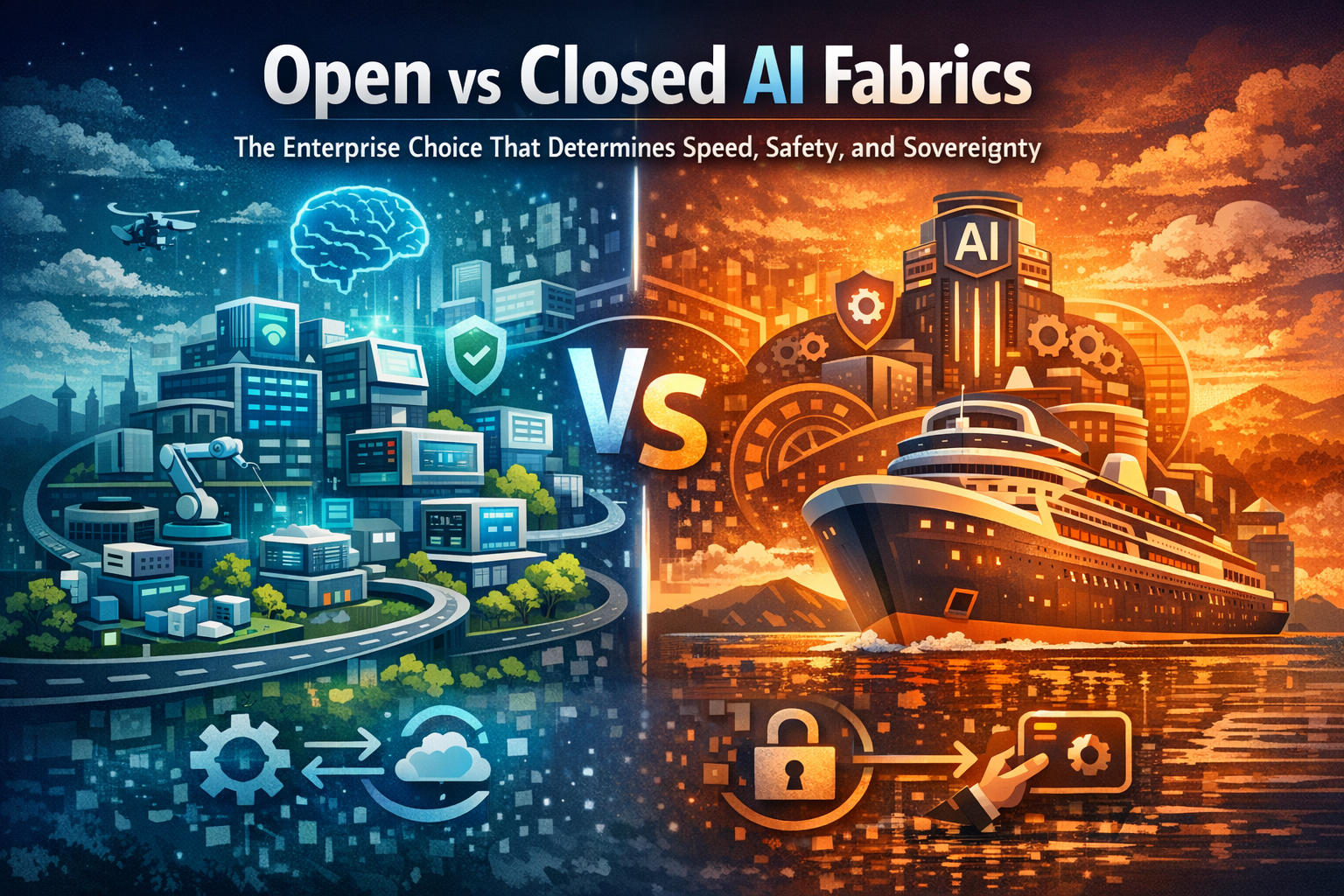
Open vs Closed AI Fabrics: The Enterprise Choice That Determines Speed, Safety, and Sovereignty
As enterprises move beyond AI pilots and into production-scale autonomy, the most important architectural decision is no longer about models, vendors, or tooling.
It is about the AI fabric—the operating environment that determines who controls intelligence once it begins to act.
The choice between open and closed AI fabrics quietly decides whether AI remains a reusable, governable enterprise capability or collapses into a tightly coupled system that is fast at first, fragile at scale, and difficult to exit.
Understanding this distinction is now essential for organizations that want to scale AI safely across geographies, regulations, and business units—without losing control, accountability, or strategic sovereignty.
This connects to the broader Enterprise AI Operating Model, which explains how organizations design, govern, and scale intelligence safely in production. 👉 Enterprise AI Operating Model
Open vs Closed AI Fabrics
Open vs closed is no longer a philosophical debate about “open source.” In 2026, it is a strategic Enterprise AI architecture decision—one that determines whether AI becomes a reusable, governable operating capability or collapses into a collection of fragile tools.
Most enterprises frame this choice incorrectly as models vs vendors. In reality, it is about who controls the AI fabric—the operating environment that runs intelligence safely in production.
This distinction sits at the heart of Enterprise AI, as defined in the Enterprise AI Operating Model, where intelligence is treated as an enterprise capability—not an experiment or a product feature.
👉 See the definition here:
Enterprise AI Operating Model
https://www.raktimsingh.com/enterprise-ai-operating-model/
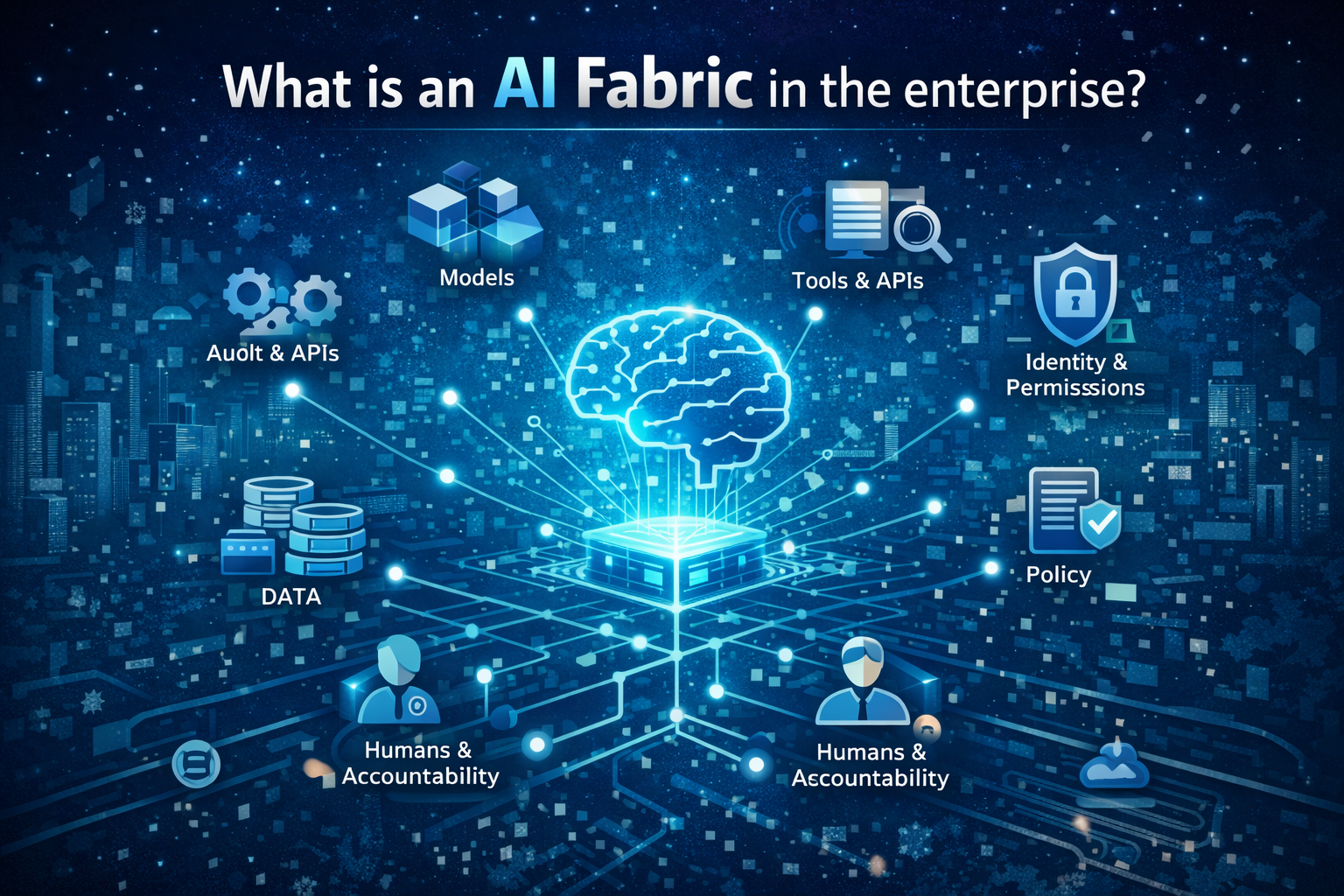
What is an AI Fabric in the enterprise?
An AI Fabric is the operating layer that allows AI systems to function safely, repeatedly, and at scale across an organization.
It includes:
- Models (open or closed)
- Tools and APIs
- Data access paths
- Identity and permissions
- Policy enforcement
- Cost controls
- Observability and audit
- Human approvals and accountability
This is why Enterprise AI is fundamentally different from “AI in the enterprise.” Without a fabric, AI remains a collection of demos. With a fabric, AI becomes run-able, governable, and stoppable.
This fabric-level thinking is explored in depth in:
Why Enterprise AI Is Becoming a Fabric: From AI Agents to Services-as-Software
https://www.raktimsingh.com/why-enterprise-ai-is-becoming-a-fabric/
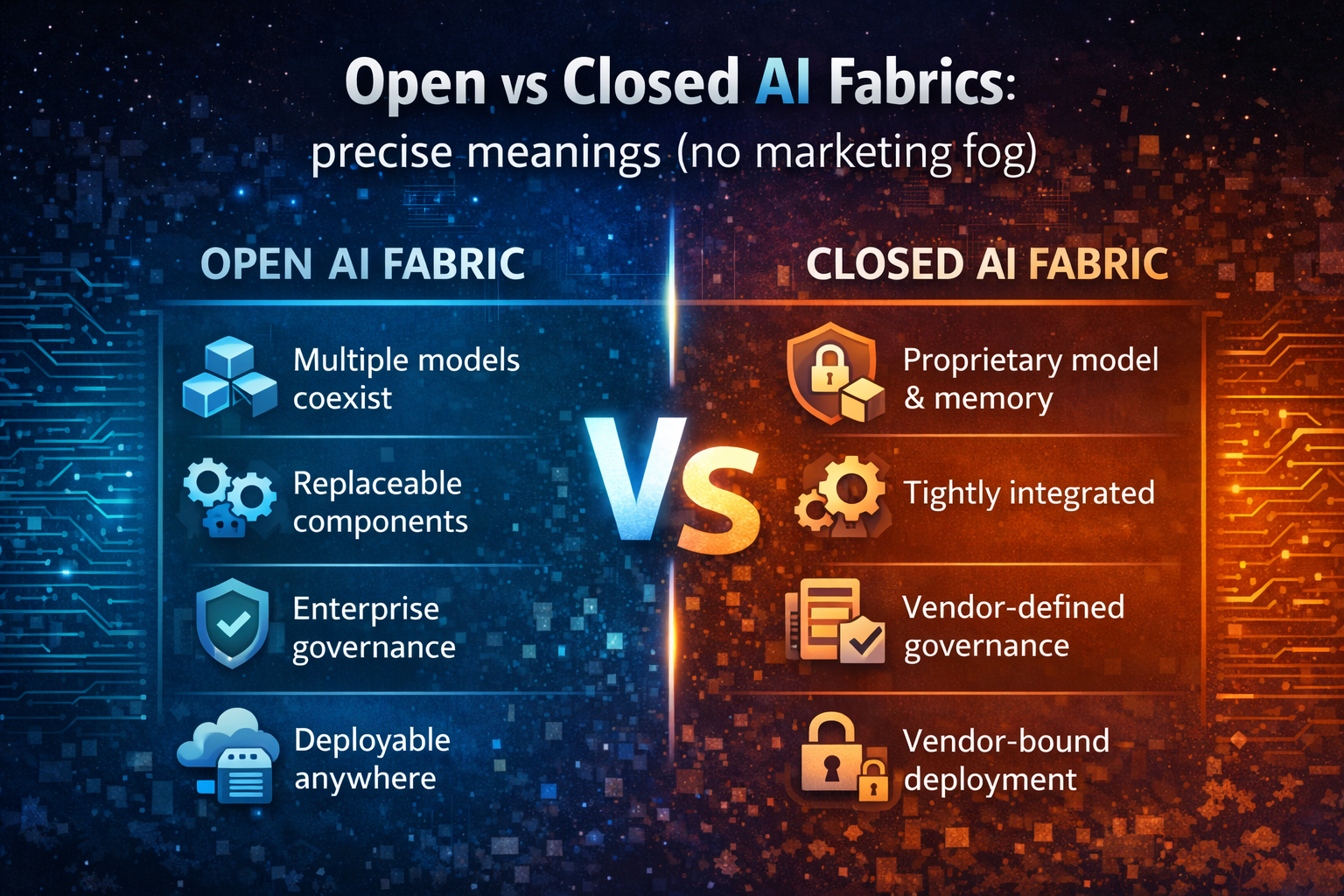
Open vs Closed AI Fabrics: precise meanings (no marketing fog)
Open vs Closed AI Fabrics: precise meanings (no marketing fog)
What “open” really means in enterprise AI
In practice, “open” usually refers to architectural freedom, not ideology.
An open AI fabric typically allows:
- Multiple models (open-weight and closed) to coexist
- Replaceable components (models, vector stores, routers)
- Enterprise-owned policy and governance layers
- Deployment flexibility (cloud, on-prem, sovereign environments)
Crucially, open does not mean ungoverned. In mature enterprises, openness only works when paired with a strong Enterprise AI Control Plane—the layer that enforces policies, approvals, reversibility, and audit across all AI decisions.
👉 Deep dive:
The Enterprise AI Control Plane: Why Reversible Autonomy Is the Missing Layer
https://www.raktimsingh.com/enterprise-ai-control-plane/
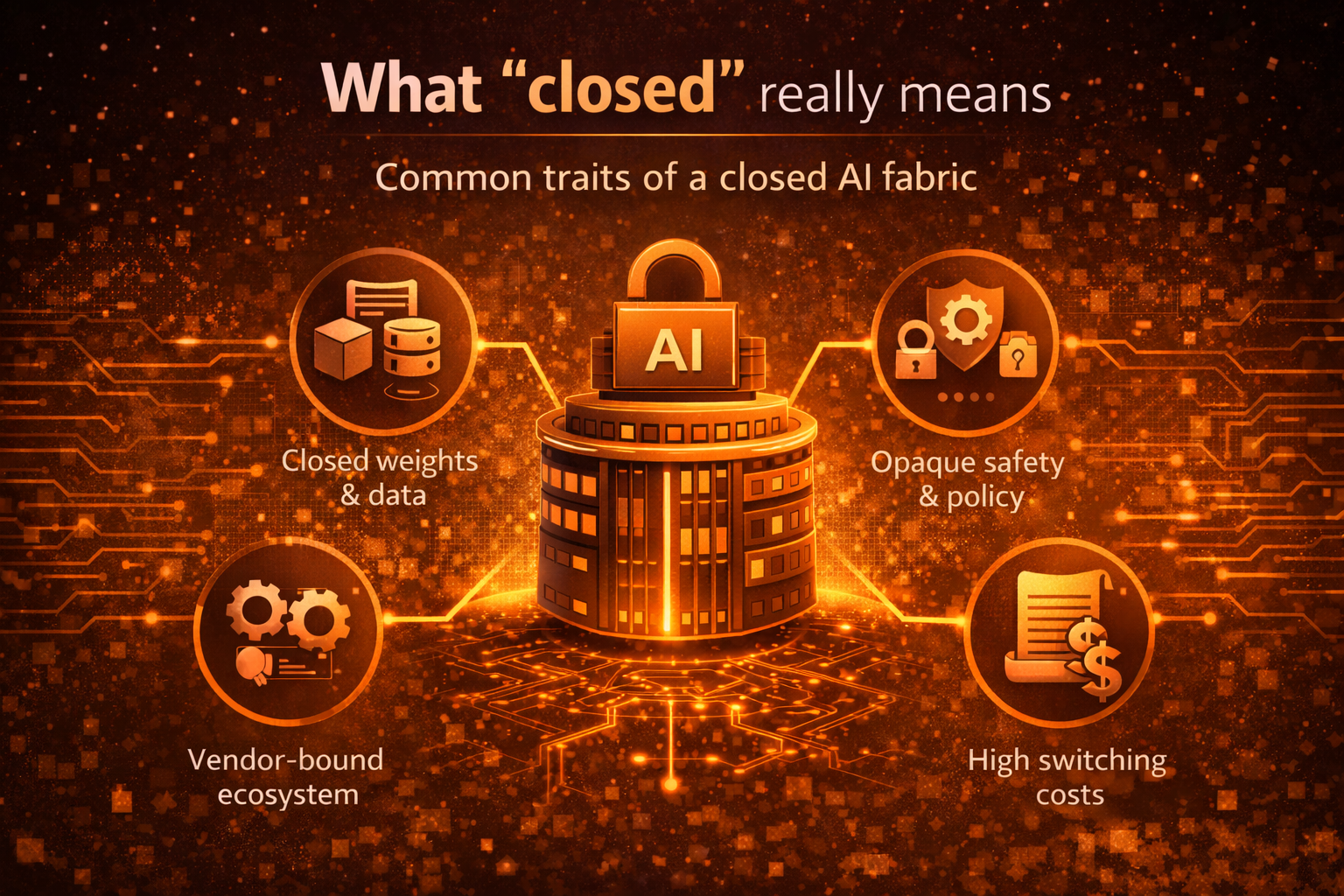
What “closed” really means
A closed AI fabric is typically vertically integrated:
- Models, tooling, orchestration, and safety layers are tightly coupled
- Governance features are vendor-defined
- Switching costs are hidden inside convenience
Closed fabrics often deliver speed and polish early, which is why many enterprises start here. The risk appears later—when AI moves from assistance to decision-making and action.
This transition point is described clearly in:
The Action Boundary: Why Enterprise AI Starts Failing the Moment It Moves from Advice to Action
https://www.raktimsingh.com/the-action-boundary/
The simplest mental model: LEGO city vs luxury cruise ship
- Open AI Fabric = LEGO city
Modular, extensible, governable—if you design the rules well. - Closed AI Fabric = luxury cruise ship
Smooth, powerful, managed—but you don’t control the engine room.
Most mature enterprises eventually discover that they need a city with some cruise ships docked inside it—not the other way around.
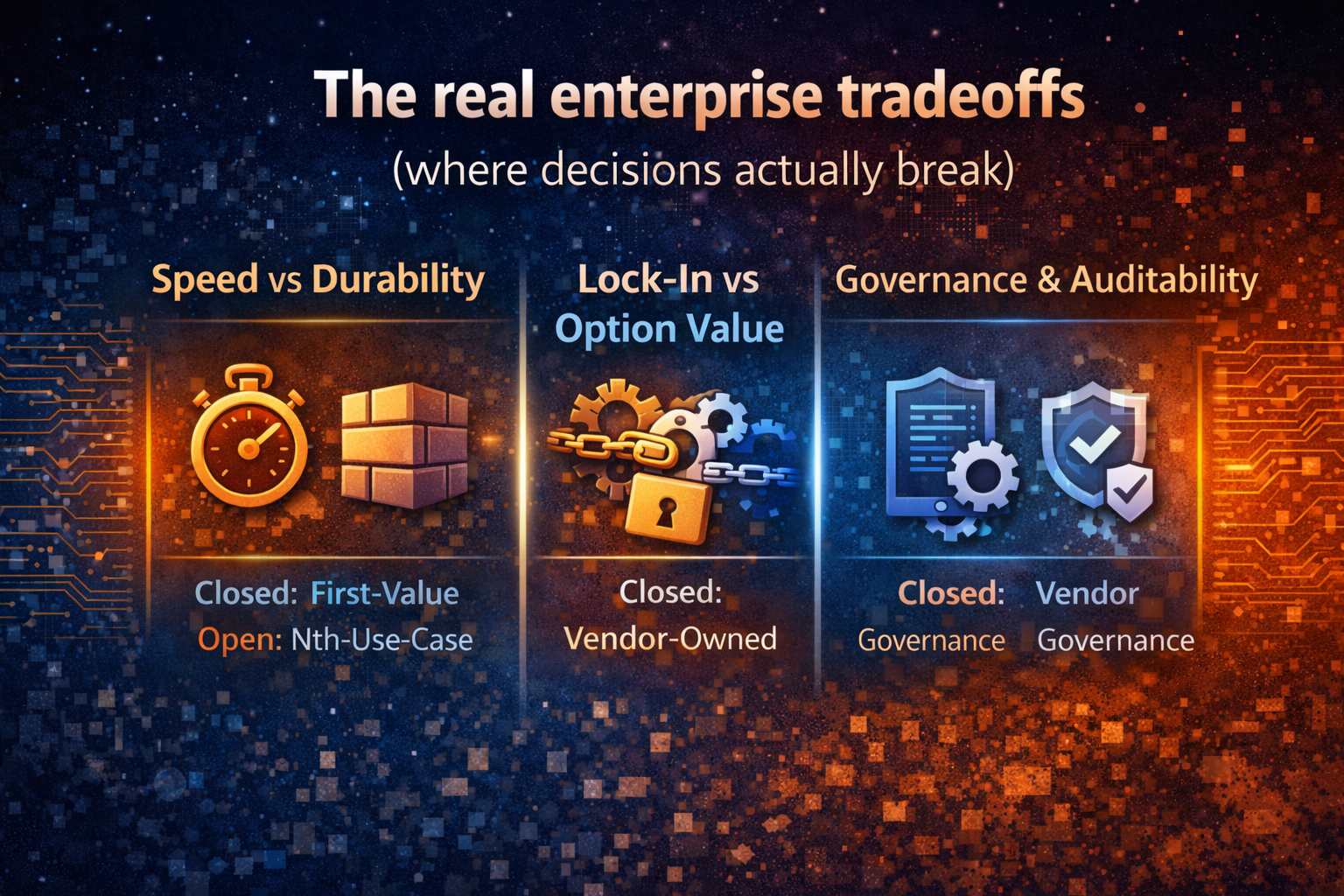
The real enterprise tradeoffs (where decisions actually break)
-
Speed vs durability
Closed fabrics optimize time-to-first-value.
Open fabrics optimize time-to-nth-use-case.
Enterprises that care about reuse, not demos, quickly move toward services-as-software, where AI capabilities are built once and reused many times.
👉 Supporting context:
Why Enterprises Need Services-as-Software for AI
https://www.raktimsingh.com/why-enterprises-need-services-as-software-for-ai/
-
Lock-in vs option value
Closed platforms often own:
- Prompt formats
- Memory schemas
- Policy logic
- Observability data
This makes exits expensive.
Open fabrics preserve option value—the ability to change models, vendors, or architectures without rewriting the enterprise.
This is why leading organizations are replacing “AI platforms” with something more structural:
Why Enterprises Are Quietly Replacing AI Platforms with an Intelligence Supply Chain
https://www.raktimsingh.com/why-enterprises-are-quietly-replacing-ai-platforms-with-an-intelligence-supply-chain/
-
Governance and auditability (where Enterprise AI is won or lost)
Governance cannot be bolted on later.
Closed fabrics offer vendor governance.
Open fabrics enable enterprise governance—if you design it.
At scale, enterprises need:
- A Decision Ledger (what was decided, why, and by which AI)
- Reversibility and rollback
- Incident response for AI failures
👉 These are covered in:
- The Decision Ledger: How AI Becomes Defensible, Auditable, and Enterprise-Ready
https://www.raktimsingh.com/the-decision-ledger/ - Enterprise AI Incident Response: The Missing Discipline Between Autonomous AI and Enterprise Trust
https://www.raktimsingh.com/enterprise-ai-incident-response-the-missing-discipline-between-autonomous-ai-and-enterprise-trust/
-
Cost control and economics
Closed fabrics feel predictable—until usage scales.
Open fabrics enable:
- Model routing (cheap vs powerful)
- Cost envelopes per decision
- FinOps controls tied to business outcomes
But this only works if economics is treated as a first-class control plane, not an afterthought.
👉 Related reading:
Enterprise AI Economics & Cost Governance: Why Every AI Estate Needs an Economic Control Plane
https://www.raktimsingh.com/enterprise-ai-economics-cost-governance/
-
Operability and runtime reality
AI does not “run itself.”
Open fabrics require a runtime kernel that manages:
- Versioning
- Evaluation gates
- Drift
- Failure containment
Without this, openness turns into fragility.
👉 See:
Enterprise AI Runtime: Why Agents Need a Production Kernel to Scale Safely
https://www.raktimsingh.com/enterprise-ai-runtime/
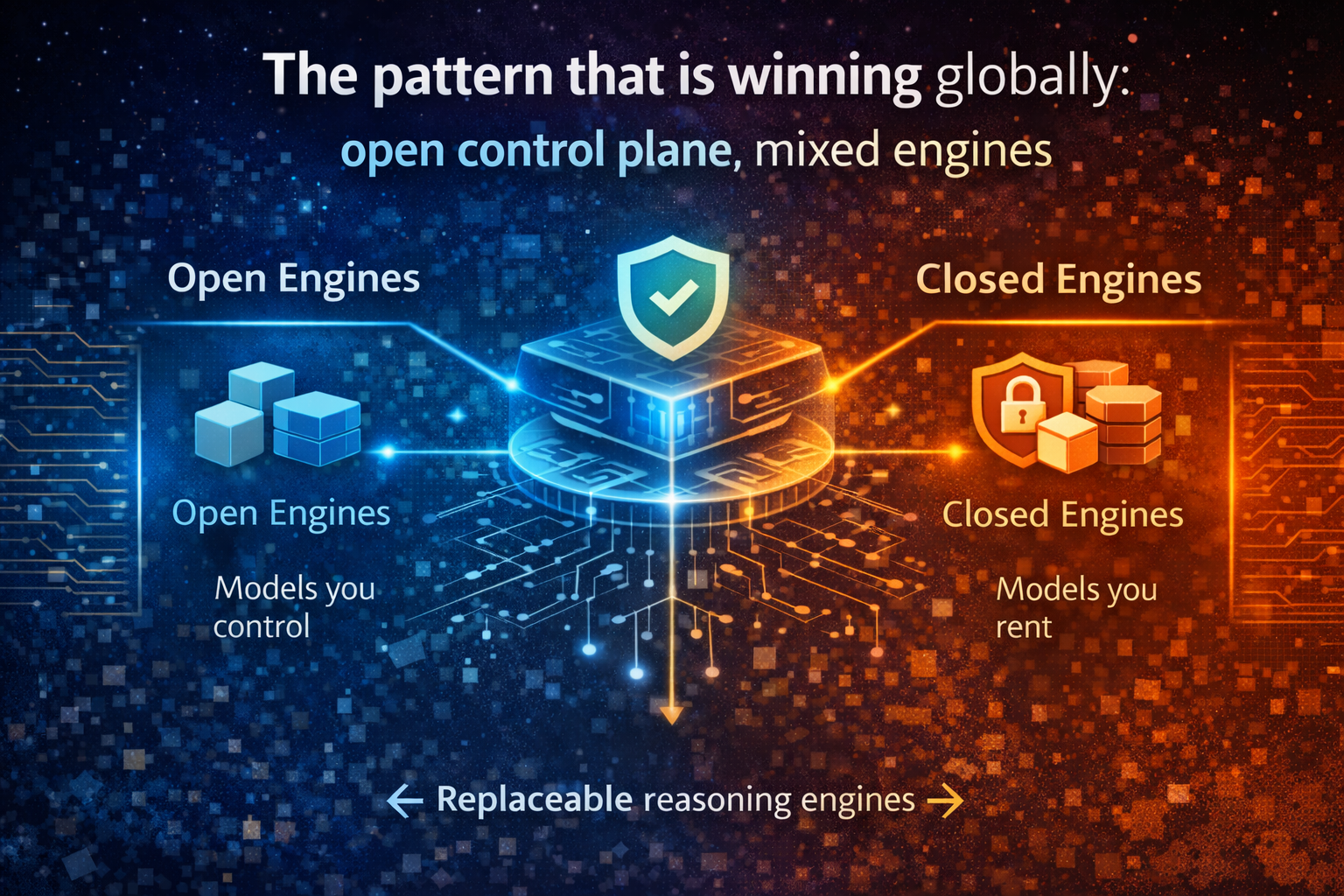
The pattern that is winning globally: open control plane, mixed engines
Across industries and geographies, the most resilient pattern is emerging:
Keep the Enterprise AI Control Plane open and enterprise-owned.
Treat models—open or closed—as replaceable reasoning engines.
This allows enterprises to:
- Use closed models where they outperform
- Swap models without breaking governance
- Maintain sovereignty, auditability, and trust
This is the architectural heart of Enterprise AI, not tool selection.
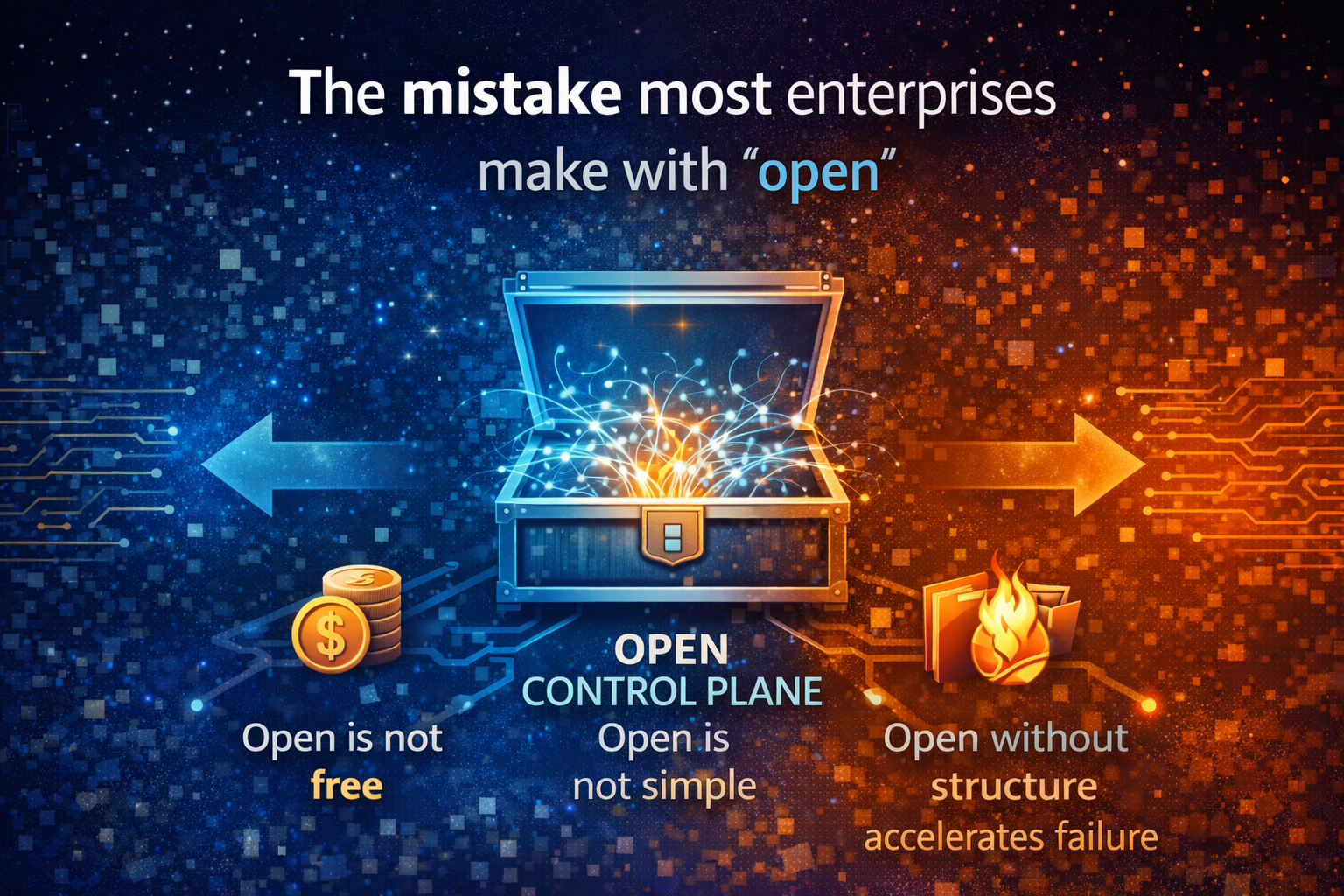
The mistake most enterprises make with “open”
The mistake most enterprises make with “open”
Open is not free.
Open is not simple.
Open without structure accelerates failure.
This is why Enterprise AI maturity is defined not by openness, but by operability, governance, and decision clarity.
👉 See the maturity framing here:
Enterprise AI Maturity Model: From Pilots to Governed Autonomy
https://www.raktimsingh.com/enterprise-ai-maturity-model/
Conclusion
The winning stance is not open vs closed.
It is this:
Closed models can be powerful.
Open architectures are essential.
Enterprise control must never be outsourced.
That principle connects:
👉 Enterprise AI Operating Model
https://www.raktimsingh.com/enterprise-ai-operating-model/
❓ Frequently Asked Questions (FAQ)
- What is an AI fabric in the enterprise?
An AI fabric is the operating environment that allows AI systems to run safely at scale. It includes models, tools, data access, identity, policy enforcement, cost controls, observability, and human accountability. Unlike a single AI tool or platform, an AI fabric governs how intelligence behaves in production, not just how it is built.
- What is the difference between open and closed AI fabrics?
An open AI fabric allows enterprises to mix and replace models, tools, and infrastructure while keeping governance and control enterprise-owned. A closed AI fabric tightly integrates models, tooling, and governance under a single vendor, offering speed and simplicity early but increasing lock-in and exit risk over time.
- Is an open AI fabric the same as open-source AI?
No. “Open” in enterprise AI usually refers to architectural openness, not licensing ideology. An open AI fabric may include open-source components, open-weight models, and closed commercial models—so long as the enterprise retains control over orchestration, policy, and decision governance.
- Why do enterprises struggle with open AI architectures?
Most enterprises underestimate the operational discipline required. Open AI is not free or simple—it requires a strong control plane, runtime governance, evaluation gates, security boundaries, and incident response. Open without structure often accelerates failure rather than innovation.
- Are closed AI fabrics bad for enterprises?
No. Closed AI fabrics can be extremely effective for rapid productivity gains, low-risk use cases, and early adoption. The risk emerges when enterprises allow closed platforms to own decision logic, memory, governance, and auditability, making AI difficult to control, scale, or exit later.
- What architecture is winning globally in 2026?
The most resilient pattern is an open enterprise AI control plane with mixed reasoning engines. In this model, enterprises keep governance, policy, identity, and audit open and enterprise-owned, while using both open and closed models as replaceable reasoning engines.
- How does this choice affect AI sovereignty and regulation?
AI sovereignty depends less on where a model is hosted and more on who controls data flows, decisions, and enforcement. Open control planes make it easier to meet regulatory expectations across regions (EU, US, India, Global South) by keeping accountability and audit inside the enterprise boundary.
- When should an enterprise prefer a closed AI fabric?
Closed fabrics make sense when speed matters more than flexibility, when use cases are advisory rather than decision-making, and when the organization lacks internal platform engineering capacity. Many enterprises start closed—but mature by decoupling governance from vendors.
- What is the biggest long-term risk in choosing the wrong AI fabric?
The biggest risk is irreversible coupling—where models, memory, policies, and workflows are so tightly bound to a vendor that changing strategy, complying with regulation, or responding to failures becomes prohibitively expensive or slow.
- How does this relate to Enterprise AI operating models?
Enterprise AI is not about deploying smarter models; it is about running intelligence as a governed capability. The open vs closed fabric decision determines whether an enterprise can implement an operating model with control, reversibility, accountability, and economic discipline at scale.
📘 Glossary
AI Fabric
The full operating environment that enables AI to function safely and repeatedly in production, including models, tools, data, governance, runtime controls, and human oversight.
Open AI Fabric
An AI architecture where components (models, tools, infrastructure) are replaceable and interoperable, while governance, policy enforcement, and accountability remain enterprise-owned.
Closed AI Fabric
A vertically integrated AI environment where models, tooling, governance, and runtime are tightly coupled and controlled by a single vendor.
Control Plane
The layer that governs identity, permissions, policy enforcement, auditability, observability, cost limits, and reversibility across AI systems.
Reasoning Engine
A model (open or closed) used to perform inference, reasoning, or decision support within an AI fabric.
Mixed Engines
An architectural pattern where multiple reasoning engines—open-weight and proprietary—are used interchangeably under a common control plane.
Vendor Lock-In
A condition where switching AI providers becomes costly or impractical due to proprietary interfaces, memory formats, governance logic, or operational dependencies.
Sovereign AI
AI systems designed to keep data, control, and decision authority within defined legal, geographic, or organizational boundaries.
Enterprise AI
AI systems designed to operate as a governed, auditable, and accountable enterprise capability—beyond pilots, demos, or isolated tools.
🔗 Further Reading
🌍 AI Regulation, Governance & Policy
- European Commission – Artificial Intelligence (AI Act & GPAI)
https://digital-strategy.ec.europa.eu/en/policies/artificial-intelligence - OECD – AI Policy Observatory (Global AI Governance)
https://oecd.ai - World Economic Forum – Responsible & Trusted AI
https://www.weforum.org/topics/artificial-intelligence
🏗️ Open vs Closed Systems, Platforms & Infrastructure
- Linux Foundation AI & Data Foundation
https://lfaidata.foundation - Apache Software Foundation – Open Standards & Governance
https://www.apache.org - Cloud Native Computing Foundation (CNCF)
https://www.cncf.io
🧠 Enterprise AI Strategy & Operating Models
- MIT Sloan Management Review – Artificial Intelligence
https://sloanreview.mit.edu/tag/artificial-intelligence - Harvard Business Review – AI, Strategy & Leadership
https://hbr.org/topic/artificial-intelligence - Gartner – Enterprise AI Architecture & Platforms (Conceptual Research)
https://www.gartner.com/en/topics/artificial-intelligence
🔐 Risk, Security & Trust Frameworks
- NIST AI Risk Management Framework (AI RMF)
https://www.nist.gov/itl/ai-risk-management-framework - ISO/IEC JTC 1/SC 42 – AI Standards
https://www.iso.org/committee/6794475.html



Raktim Singh is an AI and deep-tech strategist, TEDx speaker, and author focused on helping enterprises navigate the next era of intelligent systems. With experience spanning AI, fintech, quantum computing, and digital transformation, he simplifies complex technology for leaders and builds frameworks that drive responsible, scalable adoption.