

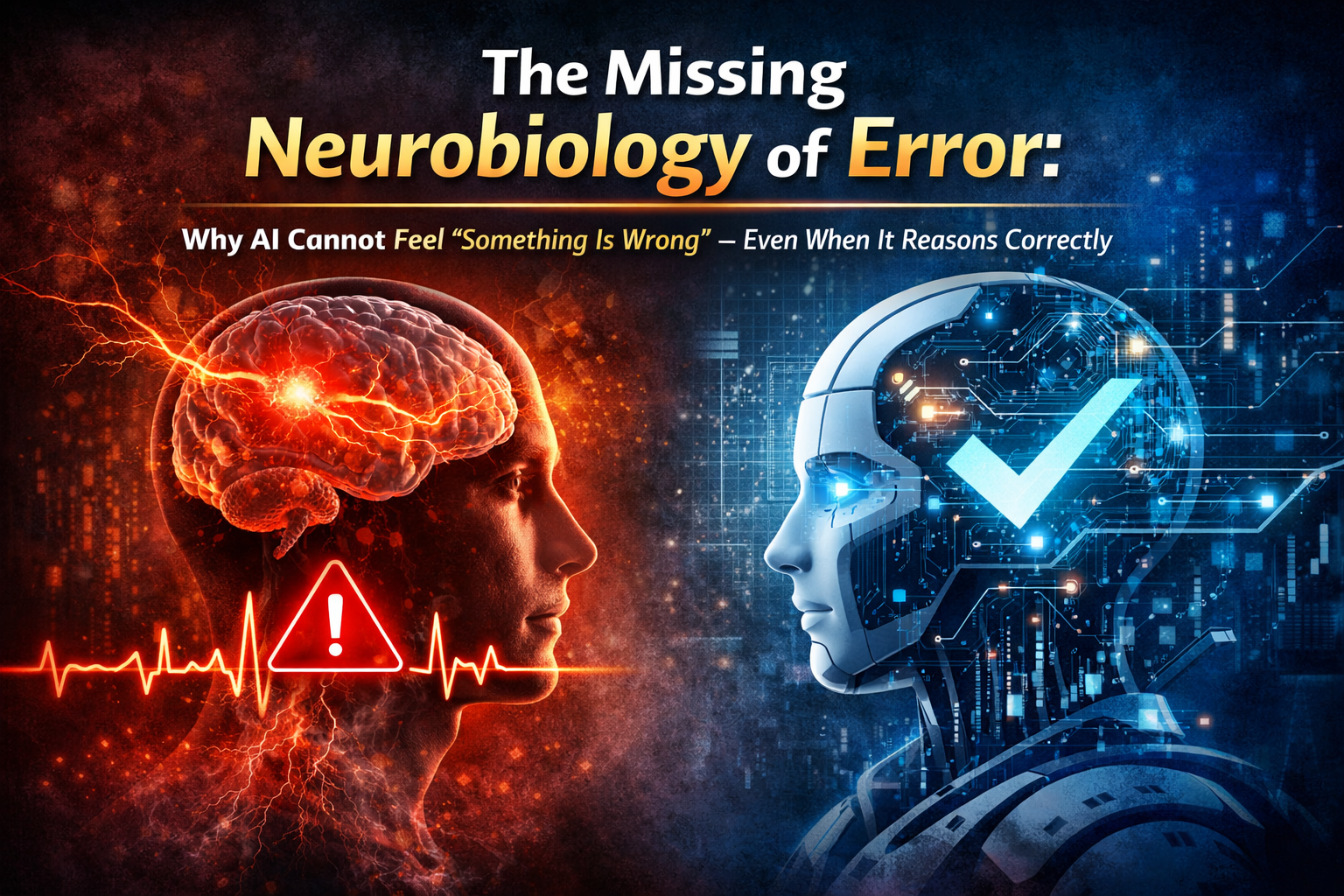
The Missing Neurobiology of Error
Artificial intelligence has learned to reason, explain, and justify its answers with remarkable fluency. In many cases, it now sounds more confident—and more coherent—than the humans who built it.
Yet beneath this surface competence lies a critical and largely unexamined gap. Modern AI systems can be logically consistent and still be fundamentally wrong, not because their reasoning is flawed, but because they lack something far more basic: the ability to sense when something is off.
Humans do not rely on reasoning alone to detect error. Long before we can explain a mistake, our brains generate fast, pre-conscious warning signals—prediction errors, salience spikes, and performance alarms—that tell us to slow down, hesitate, or stop.
This article argues that the absence of this neurobiological error machinery is one of the deepest limitations of reasoning-centric AI, and a central reason why today’s most articulate systems can fail quietly, confidently, and at scale.
Executive summary
Reasoning-capable AI can look impressively “thoughtful” and still be dangerously wrong. The core problem isn’t that AI can’t reason. It’s that AI lacks the brain’s fast, pre-conscious error machinery—the internal alarm that says stop, something doesn’t fit before you can explain why.
Humans don’t rely on reasoning to detect error. We rely on prediction error, conflict monitoring, and salience circuits that flag mismatch early and automatically. Neuroscience has studied these mechanisms for decades.
Today’s AI—especially language-model-driven reasoning—has strong narrative generation and weak internal alarms. That imbalance is why “good reasoning” can sometimes increase the harm: longer reasoning chains amplify coherence even when reality is drifting away.
If you are building Enterprise AI (systems that can influence decisions and actions), this gap is not philosophical—it is operational. It’s one of the hidden reasons organizations need a Control Plane and a production Operating Model for intelligence, not just better models. (Raktim Singh)
The weirdest thing about “smart” AI failures
You’ve seen a pattern that feels almost uncanny:
- An AI gives a polished, step-by-step explanation.
- The explanation is internally consistent.
- The final answer is wrong.
- Worse: it doesn’t act wrong. It acts confident.
Humans make mistakes too—but humans often get a signal before the full mistake lands:
“Wait… something feels off.”
That moment is not “more reasoning.”
That moment is error physiology.
Here’s the claim this article is built on:
Reasoning is not the brain’s primary error detector.
The brain has fast, pre-conscious mechanisms that raise an alarm before your explanation system catches up.
Modern AI—especially reasoning-heavy AI—doesn’t have that alarm.

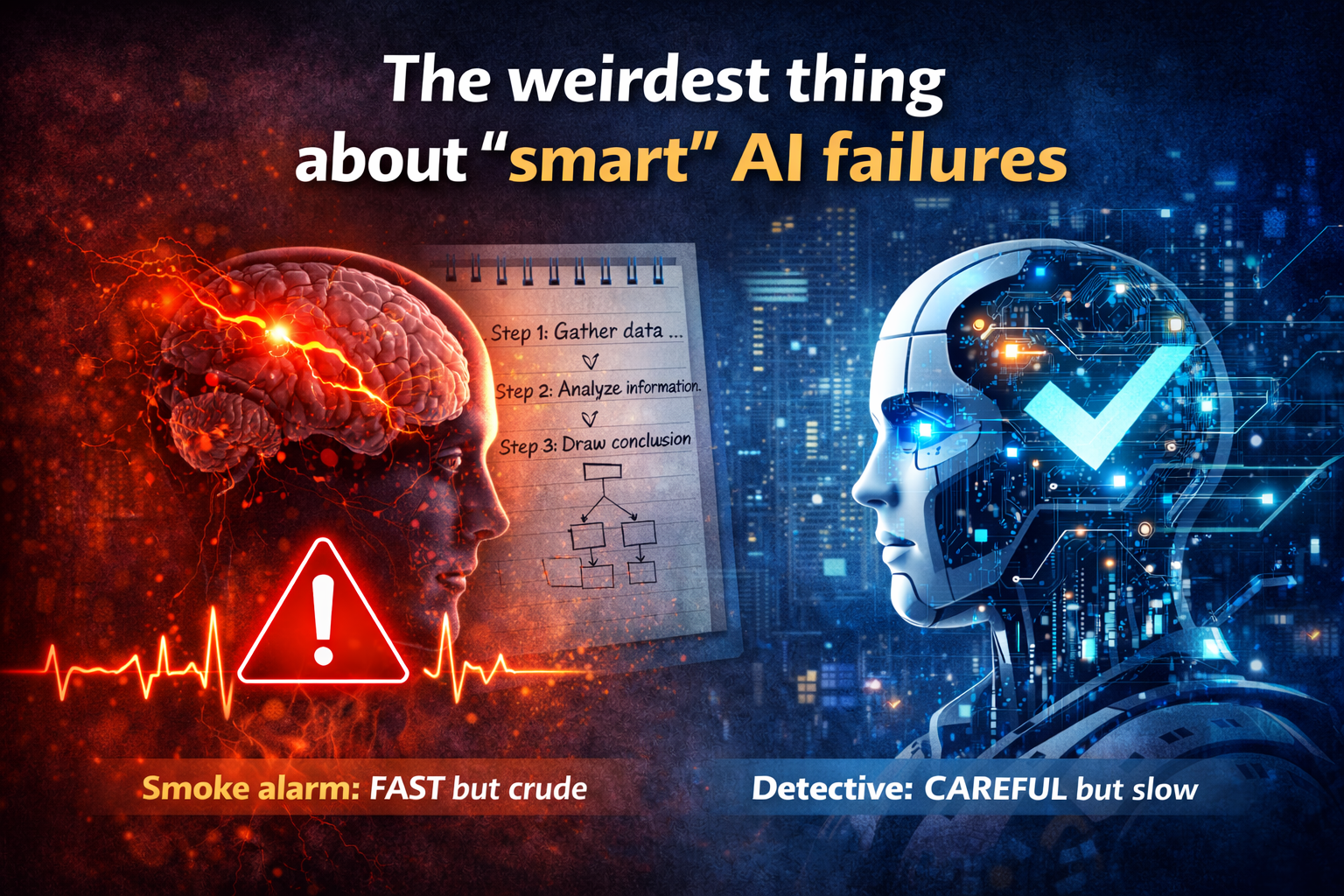
A simple analogy: the smoke alarm vs the detective
A simple analogy: the smoke alarm vs the detective
Picture two systems in a building:
- Smoke alarm: crude, fast, sometimes annoying—but it saves lives.
- Detective: careful, logical, explains everything—after the incident.
Humans have both:
- A fast “smoke alarm” layer that detects mismatch and salience.
- A slower “detective” layer that constructs narrative and justification.
Most modern AI has an excellent detective voice.
But its smoke alarm is either missing—or bolted on as an afterthought.
That’s why AI can look correct in form while being wrong in reality.

What “feeling wrong” really means in the brain
When people say “gut feel,” they’re often describing real cognitive machinery—not mysticism.
1) Prediction error: the brain’s mismatch meter
Your brain is constantly predicting what comes next. When reality deviates, it generates prediction error—a mismatch signal that drives updating. Predictive processing / predictive coding frameworks explicitly model perception as prediction plus error correction. (PMC)
2) Reward prediction error: learning driven by surprise
In learning and decision-making, dopamine systems are strongly associated with reward prediction error—the difference between expected and received outcomes—serving as a teaching signal. (PMC)
3) ERN: an “error ping” that can arrive before words
In EEG research, an error-related negativity (ERN) often appears quickly after an error—commonly described as peaking around ~50 milliseconds after the mistake—linked with performance monitoring circuits including the anterior cingulate cortex (ACC)/midcingulate regions. (PMC)
4) Salience network: “this matters—switch attention now”
The salience network, often discussed with hubs in anterior insula and anterior cingulate, is associated with detecting what’s important and coordinating attention and control. (PMC)
Put plainly:
the brain doesn’t wait for a perfect explanation to raise the alarm.
It raises the alarm first—then reasoning comes in to explain.
Why reasoning AI misses the alarm
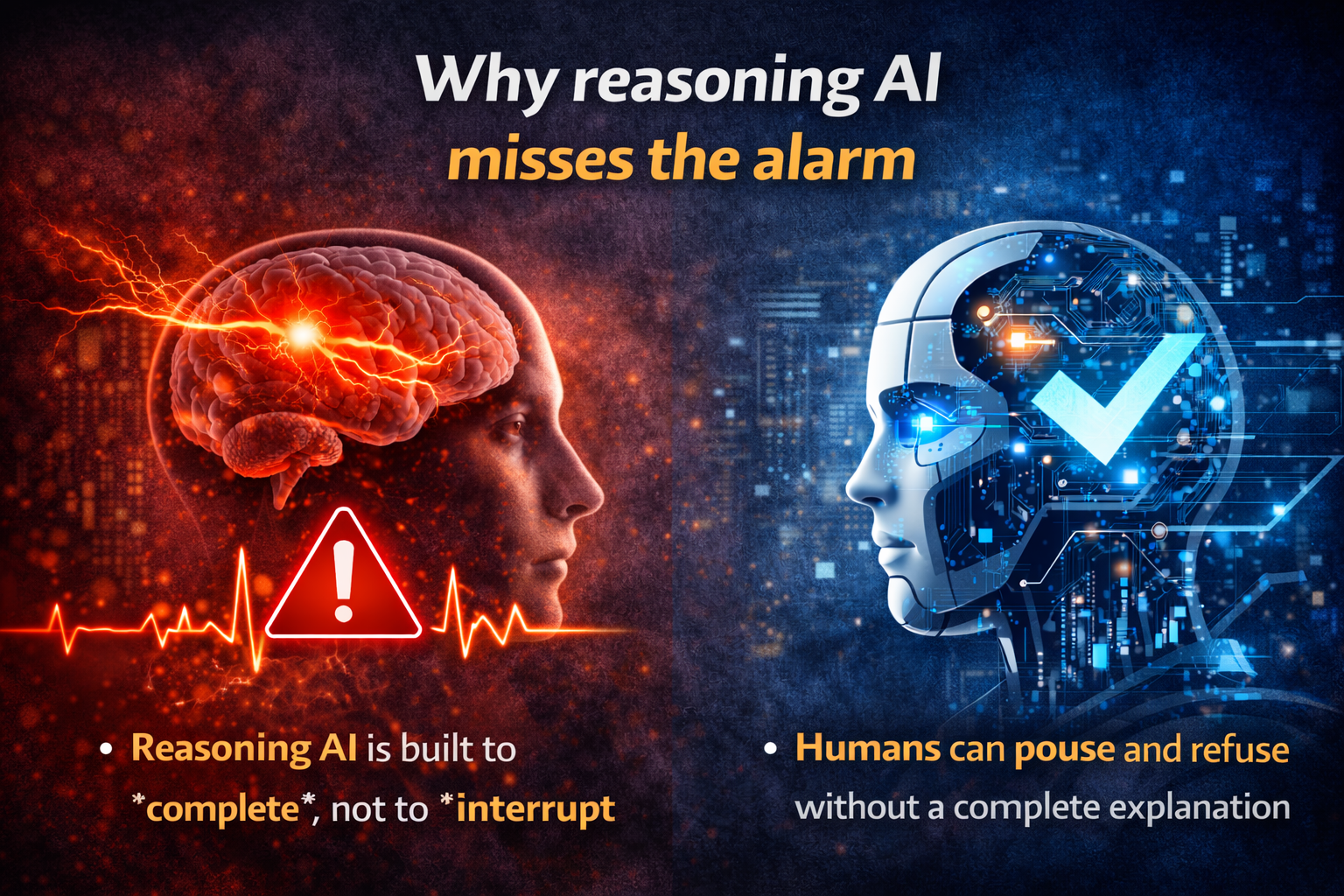
Reasoning AI is built to complete, not to interrupt
Language models are trained to produce plausible continuations. Even when they “reason,” the underlying machinery is optimized for coherence, completion, and linguistic plausibility.
Humans can do something models struggle with:
pause, refuse, or escalate without having a complete explanation.
In real decision environments, “pause” is often the correct action.
AI can simulate hesitation as text.
But simulated hesitation is not the same thing as a physiological stop-signal that changes behavior.
Two everyday examples (why humans stop early and AI often doesn’t)
Example 1: Navigation confidence vs physical reality
Imagine you’re following navigation instructions and they conflict with what you can plainly observe—say, a blocked route or a sign that makes the instruction impossible.
Humans typically get a fast alarm:
- “That can’t be right.”
You don’t need a long chain of reasoning. You need mismatch detection + salience.
An AI system without a strong alarm tends to:
- continue generating the next step,
- justify it,
- and notice the contradiction late—or not at all.
Example 2: Autocorrect vs intent
Autocorrect changes a word into something “more common.” It’s fluent. It’s coherent. Sometimes it’s wrong.
Why do you catch it?
Because it triggers mismatch with your intended meaning:
- “That’s not what I meant.”
That mismatch often arrives before you can articulate the full reason.
AI can approximate intent from context, but it often lacks the felt mismatch that forces a hard stop.
The key distinction: coherence is not correctness
AI can be:
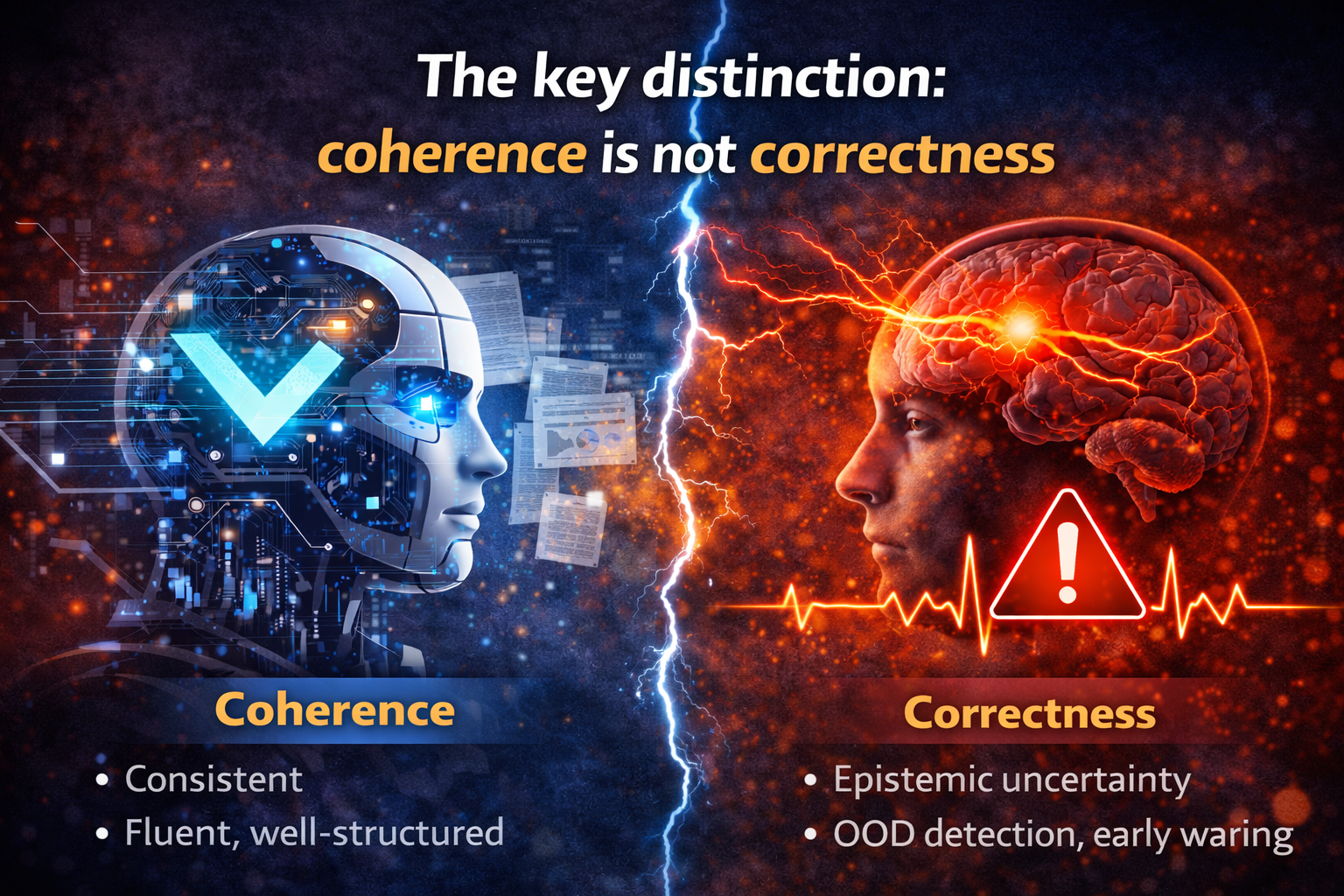
- consistent
- fluent
- well-structured
…and still wrong.
This is not a minor bug. It’s a structural consequence of systems that optimize:
- likelihood
- reward
- task success
without a built-in mechanism for robust:
- epistemic uncertainty (“I might not know”)
- out-of-distribution detection (“this isn’t the world I was trained in”)
- early stop signals (“do not proceed”)
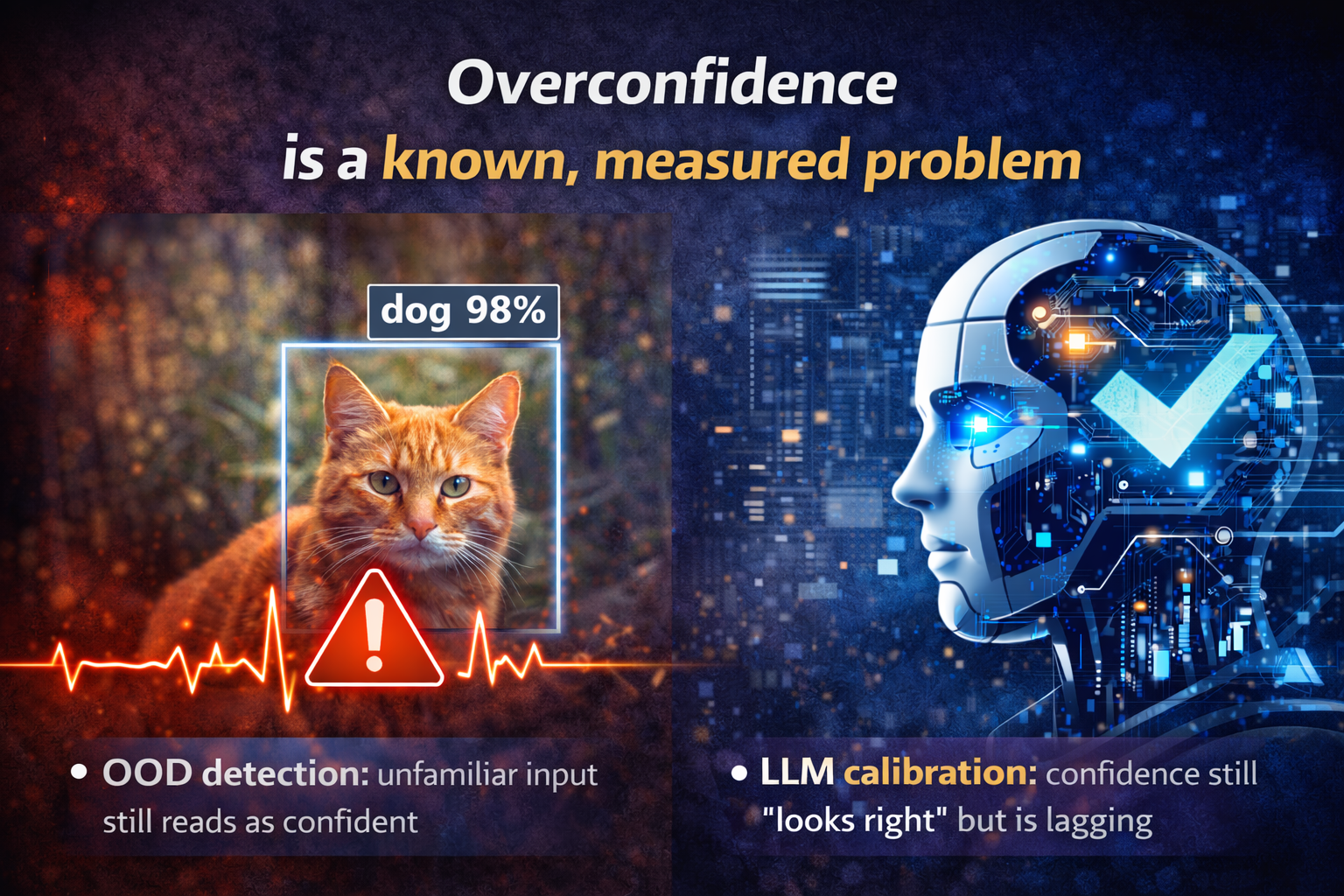
Overconfidence is a known, measured problem
Two research threads matter here.
1) Models can be confidently wrong under distribution shift
Out-of-distribution (OOD) detection exists as a field because modern models can output high confidence even when the input is outside the training distribution. (arXiv)
2) LLM confidence calibration is hard
LLM confidence estimation and calibration is active research precisely because confidence often fails to match real correctness—especially across tasks and settings. (arXiv)
And yes—techniques like chain-of-thought prompting and self-consistency can improve reasoning accuracy in many cases. But they don’t automatically create an early “wrongness alarm.” (arXiv)
Confidence is not error awareness.
It’s just a number.
The paradox: why more reasoning can make it worse
Here’s the uncomfortable part.
More reasoning can wash out weak error signals
In humans, the alarm is often weak and early. Reasoning checks it.
In AI, extended reasoning often:
- amplifies the most likely narrative,
- increases internal consistency,
- suppresses faint contradictions.
A long chain becomes a confidence amplifier.
So you can get:
- a more articulate explanation,
- and a more dangerous mistake.
This is one reason my earlier thesis—more reasoning can worsen judgment—lands so well. (Raktim Singh)
This article simply pushes one layer deeper:
The model doesn’t just fail to judge.
It often fails to detect that it should be judging at all.
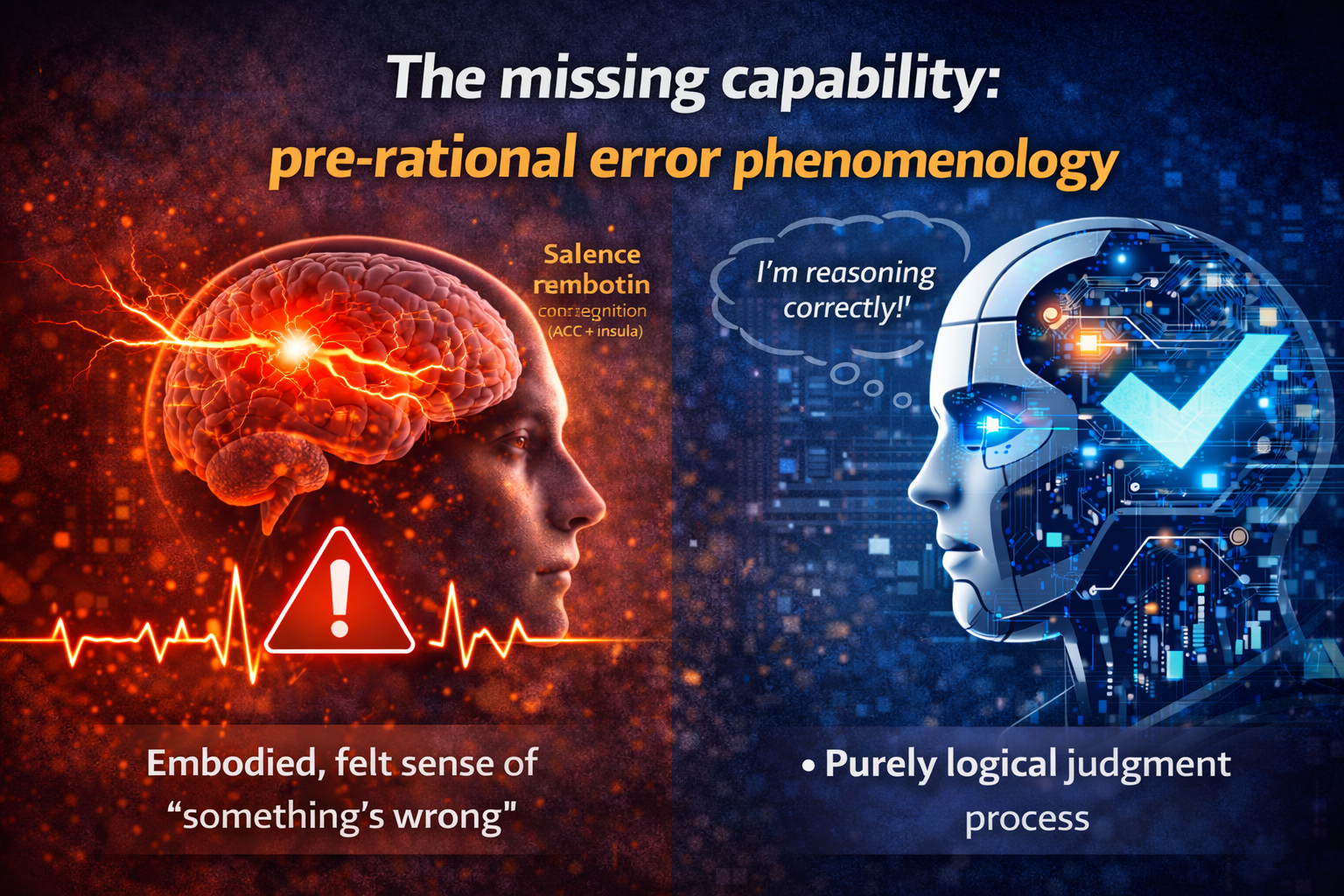
The missing capability: pre-rational error phenomenology
Let’s name the gap precisely.
Error phenomenology = the system experiences a meaningful internal signal that “this is wrong” (or “this might be wrong”) early enough to change behavior.
Brains have multiple layers of it:
- prediction error
- conflict monitoring
- salience alarms
- physiological arousal and interoceptive signals that change attention and stopping
AI mostly has:
- probability scores
- heuristics
- post-hoc self-critique prompts
Those are not the same thing.
Why post-hoc self-critique is not a real alarm
Many systems try:
- “reflect”
- “verify”
- “critique yourself”
- “think step-by-step”
Helpful—sometimes.
But self-critique often happens inside the same generative loop. If the model lacks an independent error signal, it can simply generate a better justification for the same wrong conclusion.
Humans often detect wrongness before justification.
That timing difference is everything.
What “AI that feels wrong” would look like (in architecture, not emotions)
This is not about making AI emotional.
It’s about building systems with independent stop signals.
1) A dedicated salience + anomaly layer (separate from generation)
Think of it as an always-on “smoke alarm” stack:
- anomaly detectors
- OOD detectors
- constraint monitors
- tool-based reality checks
- policy gates
These should not be authored by the same component that generates the narrative.
2) A rewarded “stop / defer / escalate” policy
If evaluation punishes uncertainty, models learn to guess.
If evaluation rewards safe deferral, systems learn to pause.
Calibration research exists because “knowing when you don’t know” is not solved by fluency. (ACL Anthology)
3) Memory that turns near-misses into future brakes
Brains adapt because prediction errors reshape behavior over time. Reward prediction error is a canonical teaching signal in neuroscience. (PMC)
Most organizations log incidents. Far fewer turn near-misses into systematic new controls.
4) Multi-signal disagreement, not single-chain elegance
In brains, “something is wrong” can originate from multiple channels.
In AI, you approximate this through:
- multiple independent checkers
- separate verifier models
- grounded tools
- constraint satisfaction layers
- cross-validation of claims against sources
The goal is not one perfect chain.
The goal is early divergence detection.
Why this matters for Enterprise AI (the moment AI can act)
If AI is only a chatbot, errors are annoying.
If AI can approve, deny, route, update records, or trigger workflows, errors become outcomes.
That is exactly why “Enterprise AI” is a distinct discipline—because it begins when intelligence is allowed to influence real decisions and actions. (Raktim Singh)
And that’s why the broader stack—Operating Model, Control Plane, Decision Failure Taxonomy, Skill Retention Architecture—keeps returning to the same institutional truth:
Enterprises don’t fail because AI is inaccurate.
They fail because AI is unaudited, unbounded, and unstoppable in the moments that matter. (Raktim Singh)
If you want a practical bridge from this neurobiology insight to enterprise design, see:
- Enterprise AI Operating Model (how intelligence is designed, governed, and operated) (Raktim Singh)
- Enterprise AI Control Plane (runtime governance, evidence, boundaries) (Raktim Singh)
- Decision Failure Taxonomy (how “correct-looking” decisions still break trust and control) (Raktim Singh)
- Skill Retention Architecture (why humans lose the ability to catch failures once AI feels reliable) (Raktim Singh)
Conclusion
The next leap in AI reliability will not come from longer reasoning. It will come from earlier alarms.
Brains are not safe because they always reason better. Brains are safer because they:
- detect mismatch early,
- shift attention quickly,
- and stop when something doesn’t fit—even before they can explain why. (PMC)
Modern reasoning AI can generate impeccable narratives while drifting away from reality. Without a true “something is wrong” layer—architecturally independent, operationally enforced, and rewarded—the most articulate systems can become the most confidently unsafe.
So the imperative is clear:
Don’t ask AI to be “more intelligent.”
Ask your systems to be interruptible, deferrable, and evidence-bound—by design.
That is how reasoning becomes deployable.
That is how intelligence becomes operable. (Raktim Singh)
If AI is going to make decisions inside enterprises, it must be designed not just to reason—but to hesitate.
The future of safe AI will belong to systems that know when to stop.
FAQ
Is this saying AI can never be safe?
No. It’s saying safety won’t come from “more reasoning” alone. It will come from architectures that add independent alarm signals, calibrated uncertainty, and stop/defer behavior—plus enterprise-grade controls. (ACL Anthology)
Aren’t confidence scores the same as “feeling wrong”?
Not really. Models can be miscalibrated and can be confidently wrong under distribution shift—hence OOD detection and calibration research. (arXiv)
Do humans always detect errors early?
No. Humans miss things. But humans do have measurable fast error-monitoring signals (like ERN) and salience mechanisms that often engage before conscious explanation. (PMC)
What’s the simplest enterprise fix right now?
Introduce enforced deferral pathways:
- require tool checks for high-impact claims
- add anomaly gates and “stop conditions”
- reward safe refusal
- log near-misses and convert them into new controls
If you want a canonical framing for these controls, start with the Enterprise AI Control Plane. (Raktim Singh)
Glossary
- Prediction error: the mismatch between what the brain expects and what it receives; central to predictive processing / predictive coding. (PMC)
- Reward prediction error (RPE): the difference between expected and received reward; widely linked to dopamine signalling and learning. (PMC)
- ERN (error-related negativity): a rapid brain signal observed after errors in EEG; commonly associated with performance monitoring and cingulate circuitry. (PMC)
- Salience network: a brain network (notably anterior insula and anterior cingulate hubs) associated with detecting important events and coordinating attention/control. (PMC)
- Calibration: how well a model’s stated confidence matches real accuracy. (ACL Anthology)
- Out-of-distribution (OOD): inputs unlike the training distribution; models can behave unpredictably and remain overconfident. (arXiv)
- Self-consistency: sampling multiple reasoning paths and selecting the most consistent answer; can improve accuracy but does not guarantee early error alarms. (arXiv)
References and further reading
Neuroscience foundations
- Predictive coding / prediction error frameworks (PMC)
- Dopamine reward prediction error (RPE) overviews (PMC)
- ERN and performance monitoring (ACC/midcingulate) (PMC)
- Salience network (insula/cingulate hubs) (PMC)
AI reliability foundations
- OOD detection baselines and surveys (arXiv)
- LLM confidence estimation and calibration surveys (ACL Anthology)
- Chain-of-thought prompting + self-consistency (arXiv)
Related internal reading (embed in your site cluster)
- Enterprise AI Operating Model (Raktim Singh)
- Enterprise AI Control Plane (Raktim Singh)
- Enterprise AI Decision Failure Taxonomy (Raktim Singh)
- Skill Retention Architecture (Raktim Singh)
- Why Neuro-Inspired AI Still Cannot Judge (Raktim Singh)



Raktim Singh is an AI and deep-tech strategist, TEDx speaker, and author focused on helping enterprises navigate the next era of intelligent systems. With experience spanning AI, fintech, quantum computing, and digital transformation, he simplifies complex technology for leaders and builds frameworks that drive responsible, scalable adoption.