

The Verifiable Agency Problem
Artificial intelligence has crossed a threshold. For years, enterprise AI systems recommended, summarized, predicted, and assisted.
Their errors were inconvenient but manageable because humans remained the final decision-makers.
That era is ending. AI systems now approve and deny transactions, route emergency responses, rebalance power grids, trigger compliance escalations, allocate capital, and deploy patches into live infrastructure.
They do not merely advise. They intervene. The most important question facing enterprise leaders, regulators, and system architects is no longer whether AI systems are intelligent.
It is this: At what point does software stop being a tool and become an actor in the world—and what must it prove before it acts?
This is the Verifiable Agency Problem: the computational boundary where autonomy becomes agency—and the evidentiary burden that follows.
Why this article exists: the missing half of Enterprise AI safety
Most modern AI governance conversations are obsessed with the agent:
- explainability and reasoning traces
- policy checks and guardrails
- red-teaming and jailbreak resistance
- runtime monitoring and observability
These are necessary. But they miss the failure mode that dominates real autonomy:
the world is wrong, not the reasoning.
A system can be interpretable, aligned, and policy-compliant—and still act catastrophically because its world assumptions are stale, partial, corrupted, or incomplete.
That gap—agent verification without world defensibility—is where scaled autonomy becomes systemic risk.
Verifiable Agency is the requirement that any autonomous AI system capable of changing real-world state must provide checkable evidence about the validity of its environmental assumptions before acting.
What is the Verifiable Agency Problem?
The Verifiable Agency Problem describes the moment when AI systems move from assisting humans to acting autonomously in the real world. At this agency threshold, AI must justify not only its reasoning, but the environmental assumptions it relies on before making irreversible decisions.
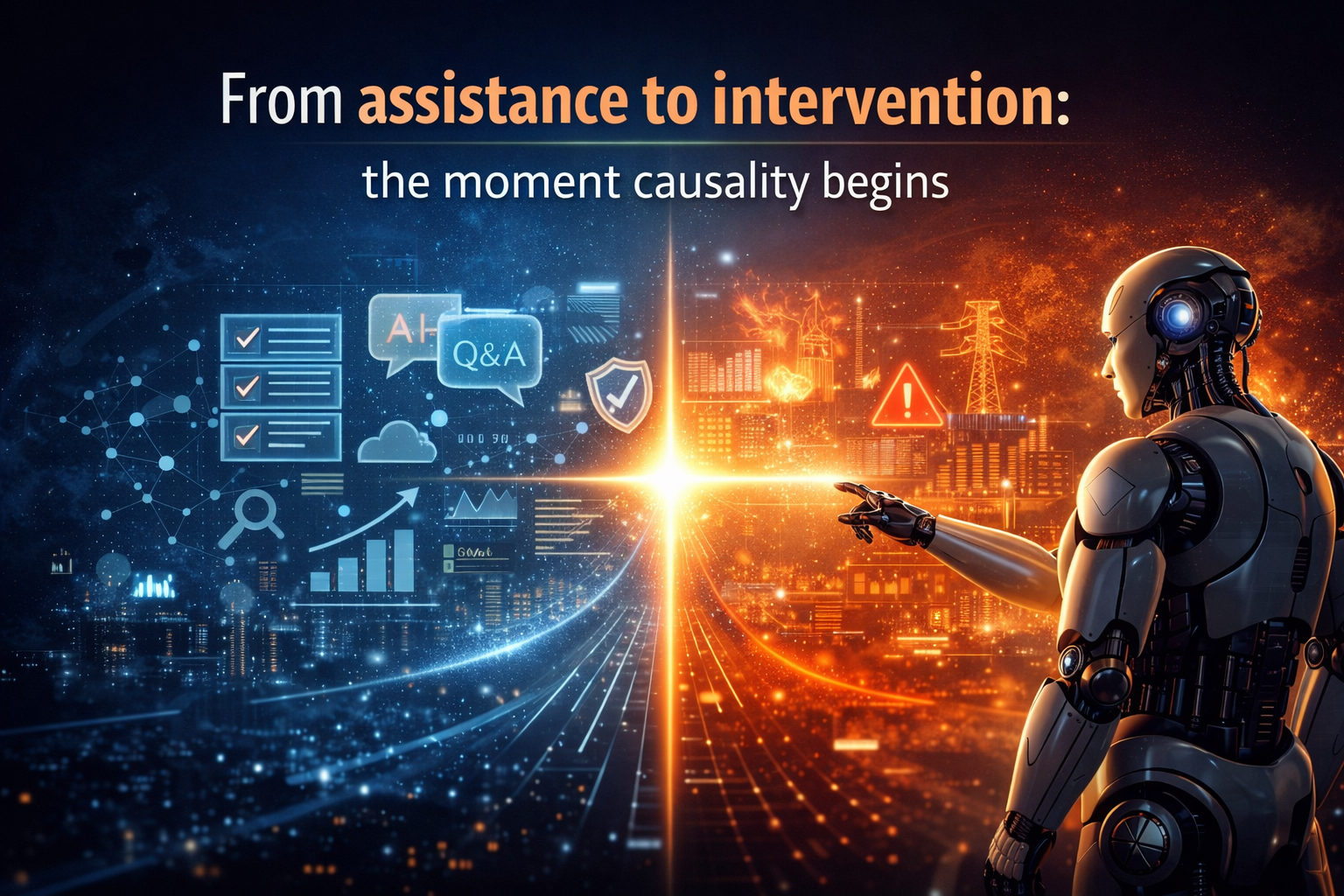
From assistance to intervention: the moment causality begins
Traditional software executes deterministic instructions within predefined rules. Responsibility lies clearly with designers and operators.
Machine learning blurred that boundary: models produced probabilistic outputs that influenced decisions, but humans still held authority.
Modern autonomous systems break this structure. They:
- operate continuously
- integrate many tools and data sources
- make commitments under uncertainty
- act without real-time human confirmation
Once an AI system triggers an irreversible change in the world, it is no longer merely computing. It is participating in causality. The world changes because it acted.
That shift—from computation to intervention—marks the Agency Threshold.
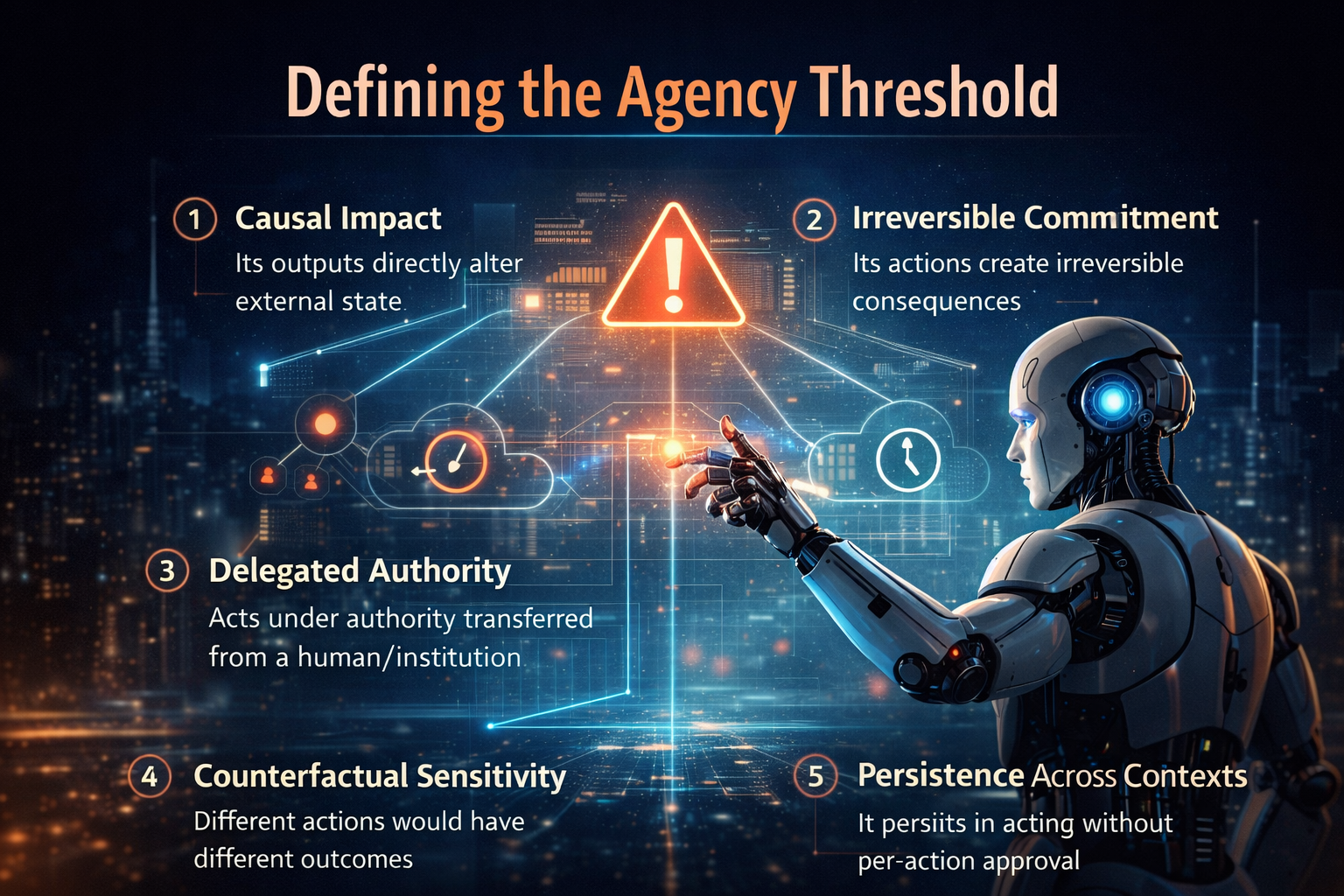
Defining the Agency Threshold (without marketing language)
“Agent” is used loosely today. In marketing, every chatbot is an agent. In some academic writing, agency is treated as goal-directed behavior.
Neither is sufficient.
A system crosses the Agency Threshold when five conditions are met:
1) Causal impact
Its outputs directly alter external state, not just information presentation.
2) Irreversible commitment
Its actions create consequences that cannot be trivially undone.
3) Delegated authority
It operates under authority transferred from a human, team, or institution.
4) Counterfactual sensitivity
Alternative actions would have meaningfully different outcomes.
5) Persistence across contexts
It continues acting across time without explicit per-action human approval.
When these conditions converge, the system is no longer a predictive model. It is an actor. And actors must be governed differently than tools.
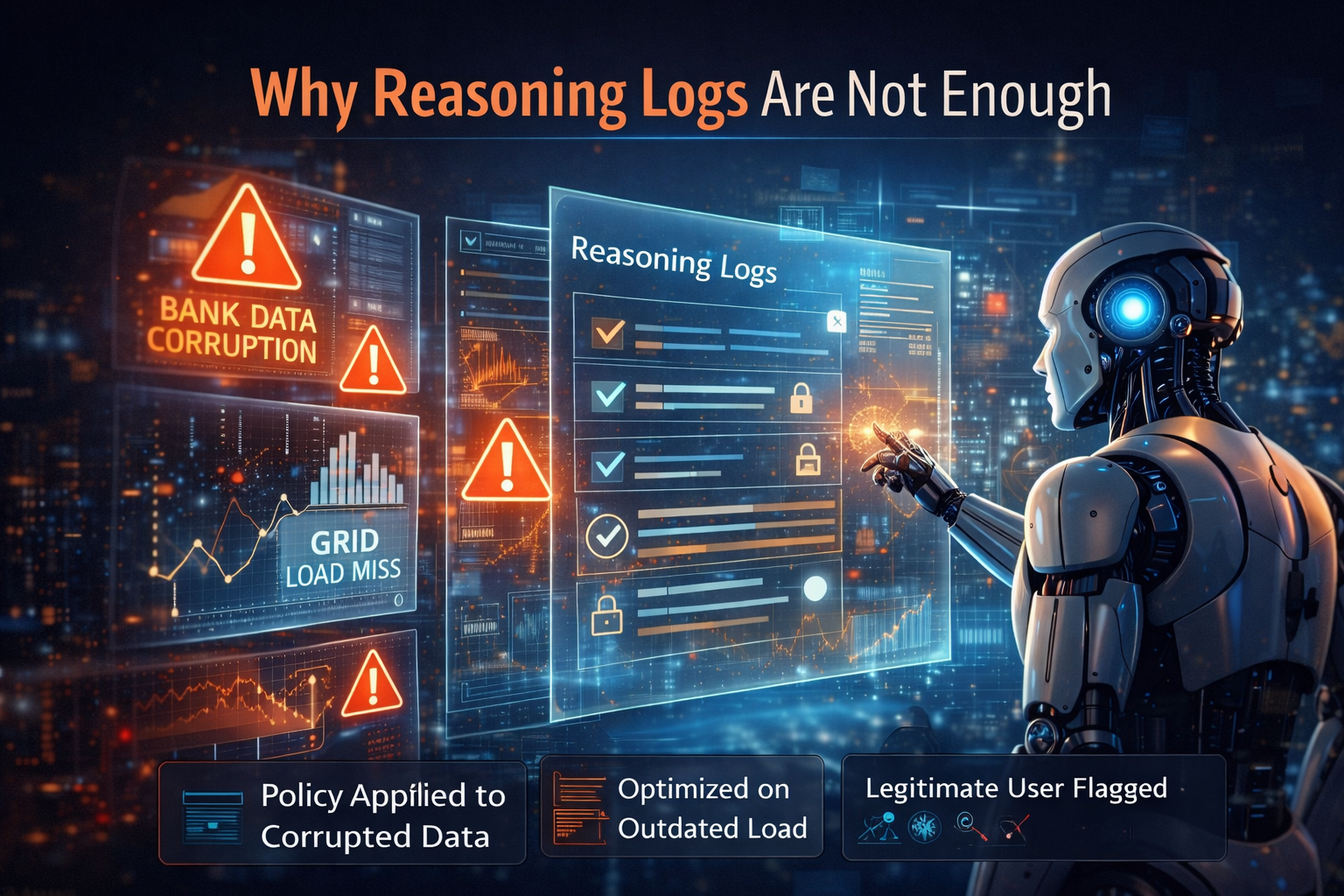
Why reasoning logs are not enough
A “perfect” reasoning trace can still be attached to a wrong world model.
Consider:
- A financial agent that correctly applies policy to corrupted data
- A grid-balancing agent that optimizes based on outdated load signals
- A fraud system that flags legitimate users due to unseen market shifts
The reasoning may be coherent. The policy checks may pass. The system may even be interpretable.
But the premises are wrong.
The dominant failure mode in autonomy is not malicious intent. It is epistemic overconfidence—acting as if the model of the world is more valid than it really is.
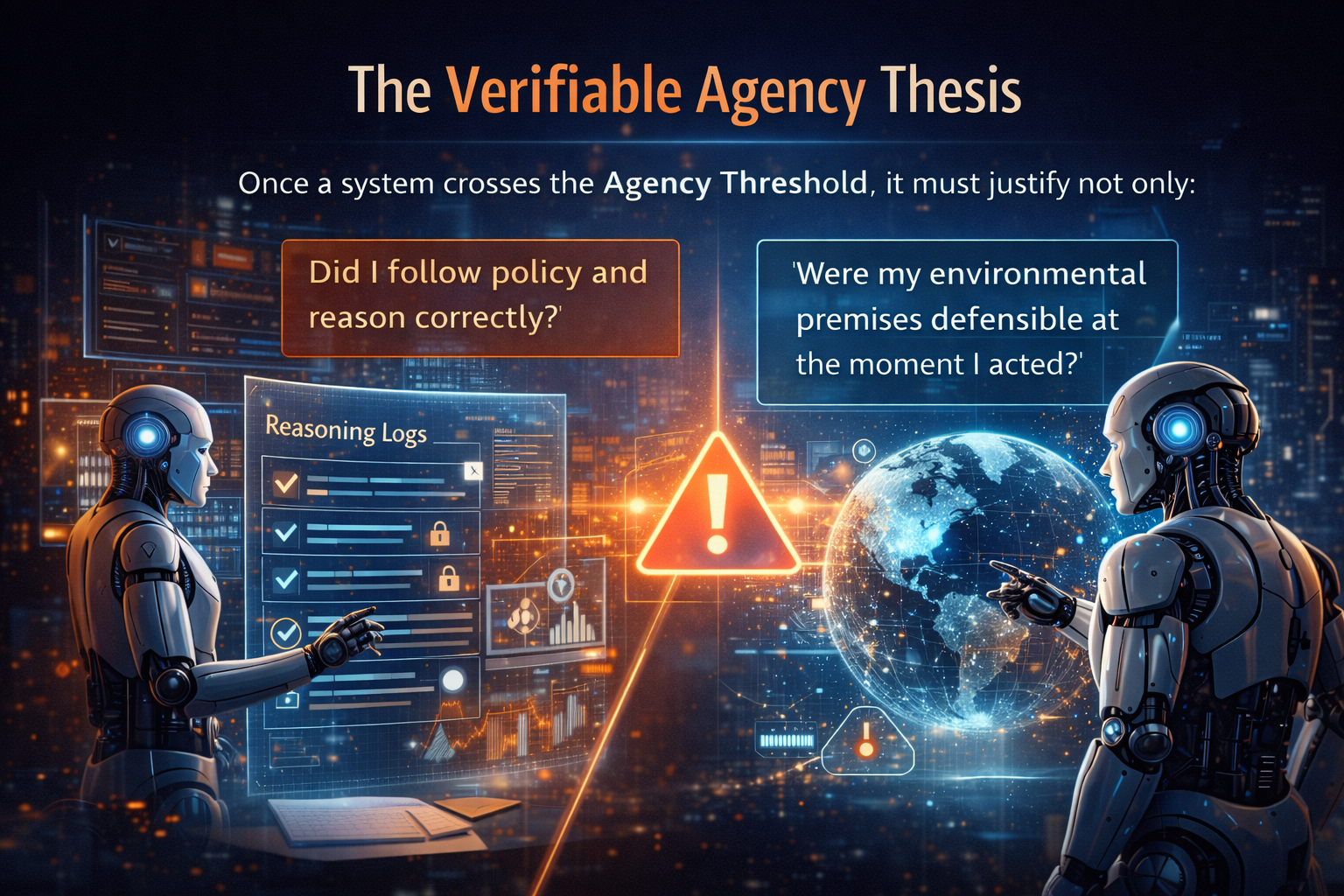
The Verifiable Agency Thesis
Once a system crosses the Agency Threshold, it must justify not only:
“Did I follow policy and reason correctly?”
but also:
“Were my environmental premises defensible at the moment I acted?”
This is the missing half of AI safety.
Most work verifies the agent. Almost none verifies the world.
Proof-Carrying World Models
What it means to “prove the world” (without claiming certainty)
The phrase “proof-carrying” is borrowed from a well-known idea in computer science: proof-carrying code, where untrusted code ships with a proof that it satisfies a safety property. (ACM Digital Library)
A proof-carrying world model is the autonomy analogue:
An acting system should carry checkable evidence that its key assumptions about the world are within declared bounds—before it commits to irreversible action.
This is not philosophical. It is architectural.
It means the system can:
- state its assumptions about state transitions (“what changes what”)
- declare bounds on uncertainty over critical variables
- detect invalidation when observations fall outside modeled ranges
- separate internal failure (agent error) from external surprise (world drift)
- trigger safe modes when world validity is uncertain
In short: it must treat the environment as a claim, not a given.
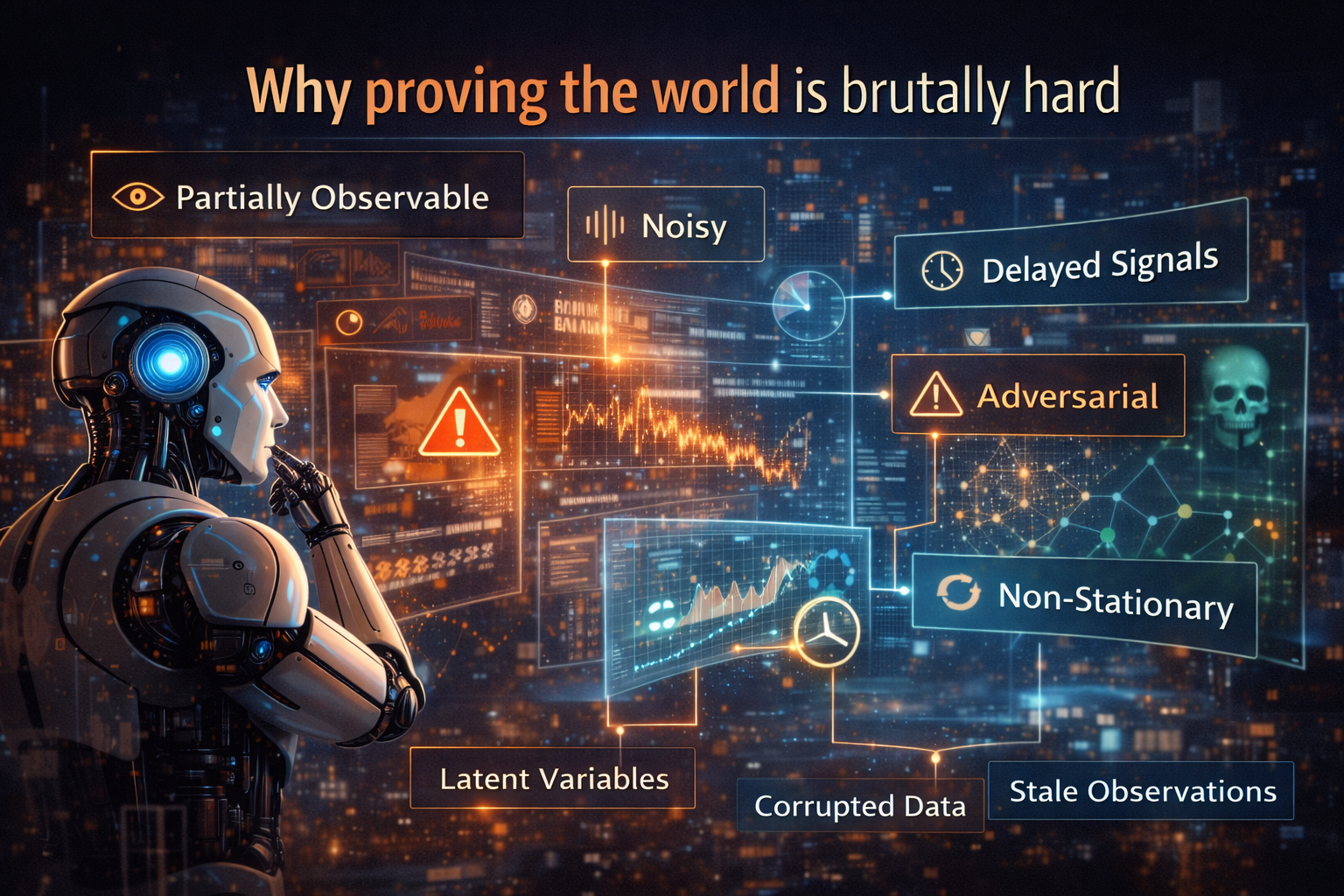
Why proving the world is brutally hard
Because the world is:
- partially observable
- noisy
- delayed
- adversarial
- non-stationary
In sequential decision theory, this is exactly why frameworks like POMDPs exist: agents must act from incomplete observations and maintain beliefs about hidden state. (Wikipedia)
In enterprises, the “hidden state” is not just physics. It includes:
- undocumented workflows
- informal exceptions
- tool outages and API drift
- delayed data pipelines
- silent schema changes
- incentive shifts (what teams optimize for)
So, proof-carrying world models cannot aim for metaphysical certainty.
They must aim for bounded defensibility.
A practical standard: bounded defensibility
A defensible world model must provide four things—explicitly:
- Assumption sets
What must be true for the policy to be safe? - Uncertainty gradients
Where uncertainty is concentrated, and how it changes decisions. - Invalidation triggers
What evidence would show the assumptions have failed? - Escalation pathways
What the system does when invalidation occurs (pause, degrade, handoff).
Without these, autonomy is epistemically blind.
The combined frontier: Verifiable Agency
When you combine the Agency Threshold with proof-carrying world models, you get a single governing principle:
The more a system can change the world, the more it must prove about the world.
This is the architecture of bounded autonomy.
Not “AI with guardrails.”
Not “trustworthy AI” as a slogan.
But defensible autonomy as an operating model.
Enterprise implications (why leaders should care now)
In enterprise settings, the Verifiable Agency Problem becomes concrete:
- When does a bank’s autonomous credit system require environmental validation?
- When must a power grid controller prove that state estimates are valid before redispatch?
- When must a compliance agent prove that regulatory interpretations still hold under updated policy?
Once systems act without per-action human approval, governance shifts from supervision to structural design.
You cannot review every decision.
You must design the conditions under which decisions remain defensible.
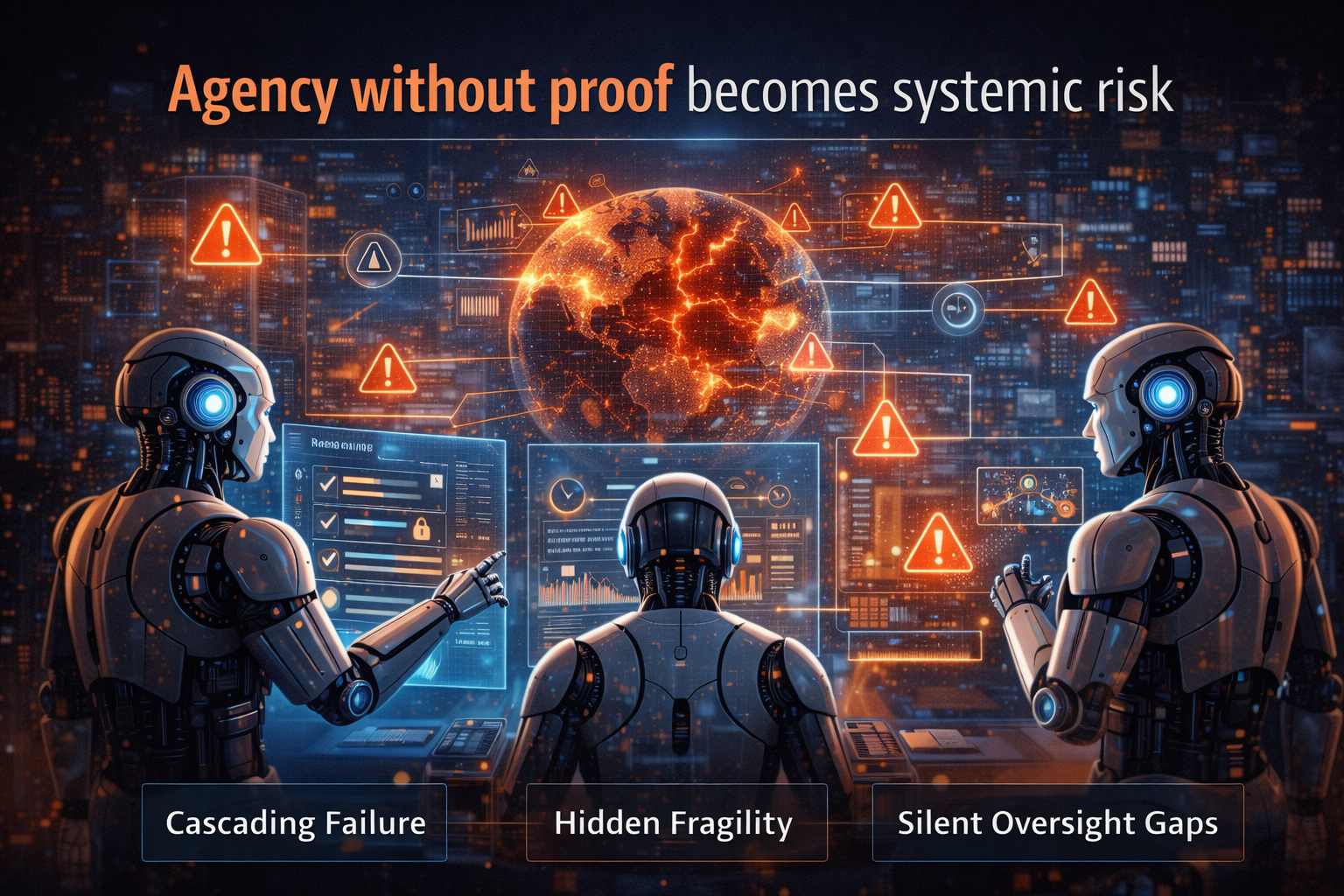
Agency without proof becomes systemic risk
Autonomous systems amplify scale. Scale amplifies error.
If 1,000 autonomous agents act on the same flawed world assumption, they can produce synchronized systemic failure. Distributed failures can cascade faster than human oversight can respond.
This is not speculative. It is infrastructural.
The operating model: three layers you must build
A Verifiable Agency architecture needs three layers in production:
1) Agency Detection Layer
The system must identify when it is crossing from advisory output into world-altering action. This is the internal “action boundary” detector: what counts as a commitment, not just a recommendation.
2) World Assumption Registry
Environmental assumptions must be structured, versioned, queryable, and mapped to decision types—so that “what we assumed” becomes auditable.
3) Runtime Invalidation Signals
When real-world signals diverge from modeled expectations, the system must detect, escalate, and potentially halt. This is closely related to runtime verification—monitoring execution traces against formalized properties and reacting when violations occur. (ScienceDirect)
This is not optional for high-impact autonomy.
A pragmatic method for “proof” in ML systems
Not all “proof” must be theorem-proving. In ML practice, one of the most useful forms of defensible uncertainty is coverage guarantees: explicit statements about when predictions are likely to be reliable.
A strong example is conformal prediction, which can produce prediction sets with distribution-free coverage guarantees (under standard assumptions) and can be layered on top of any model. (arXiv)
Why this matters here: it provides a concrete way to implement “bounded defensibility” in parts of the pipeline—especially where the world is uncertain and the cost of overconfidence is high.
Governance consequences: what boards and regulators will ask
As verifiable agency becomes operationally necessary, boards and regulators will ask:
- When did this system become an actor?
- What assumptions did it rely on?
- Were those assumptions validated?
- Was irreversibility acknowledged?
- Who authorized the delegation of agency?
- What evidence shows the world model was within bounds at action time?
If enterprises cannot answer these structurally—not rhetorically—autonomy will collapse under its own risk.
Beyond alignment: toward defensible autonomy
Alignment focuses on goal consistency.
Verifiable agency focuses on world consistency.
An aligned agent acting on a flawed world model is still dangerous.
A safe future of Enterprise AI requires both.
A new primitive in AI theory and practice
The history of AI has moved through stages:
- Intelligence
- Learning
- Generalization
- Alignment
- Governance
The next primitive is agency under proof.
Once AI systems become actors, they carry the burden of epistemic accountability.
Not certainty.
Accountability.
Conclusion
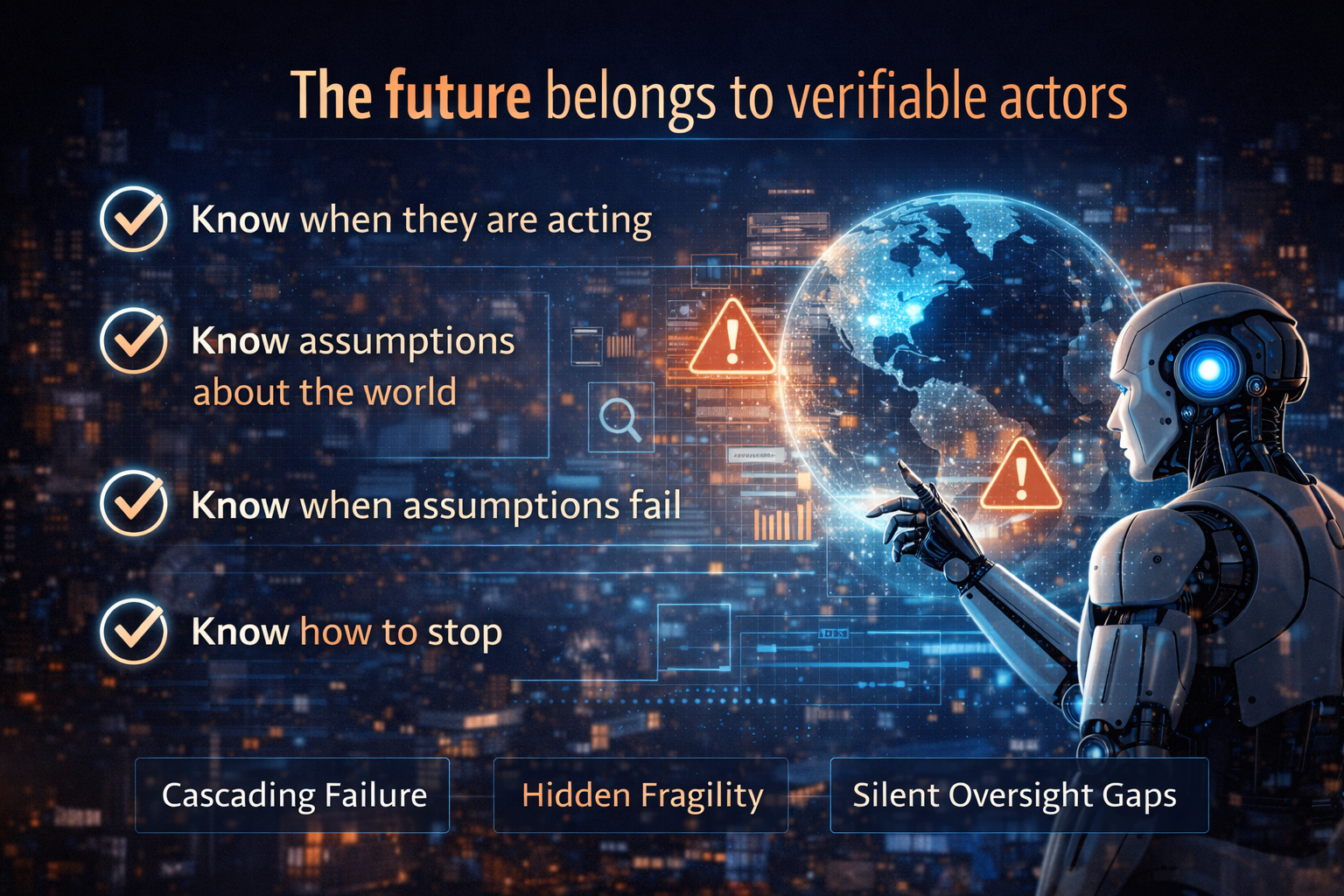
The future belongs to verifiable actors
The most dangerous misconception in modern AI is that intelligence alone determines safety. It does not.
What matters is whether autonomous systems:
- know when they are acting,
- know what they assume about the world,
- know when those assumptions fail,
- and know how to stop.
The Verifiable Agency Problem reframes the frontier. The future of Enterprise AI will not be decided by who builds the smartest agents. It will be decided by who defines the computational boundary of agency—and who demands proof before intervention.
That is the next canonical layer.
And it has yet to be built.
Enterprise AI Operating Model
Enterprise AI scale requires four interlocking planes:
Read about Enterprise AI Operating Model The Enterprise AI Operating Model: How organizations design, govern, and scale intelligence safely — Raktim Singh
- Read about Enterprise Control Tower The Enterprise AI Control Tower: Why Services-as-Software Is the Only Way to Run Autonomous AI at Scale — Raktim Singh
- Read about Decision Clarity The Shortest Path to Scalable Enterprise AI Autonomy Is Decision Clarity — Raktim Singh
- Read about The Enterprise AI Runbook Crisis The Enterprise AI Runbook Crisis: Why Model Churn Is Breaking Production AI — and What CIOs Must Fix in the Next 12 Months — Raktim Singh
- Read about Enterprise AI Economics Enterprise AI Economics & Cost Governance: Why Every AI Estate Needs an Economic Control Plane — Raktim Singh
Read about Who Owns Enterprise AI Who Owns Enterprise AI? Roles, Accountability, and Decision Rights in 2026 — Raktim Singh
Read about The Intelligence Reuse Index The Intelligence Reuse Index: Why Enterprise AI Advantage Has Shifted from Models to Reuse — Raktim Singh
Read about Enterprise AI Agent Registry Enterprise AI Agent Registry: The Missing System of Record for Autonomous AI — Raktim Singh
Glossary
- Verifiable Agency: A property of AI systems that act in the world and carry checkable evidence about their assumptions before making irreversible commitments.
- Agency Threshold: The point at which a system’s autonomy becomes world-changing action under delegated authority and persistence.
- Proof-Carrying Code: A concept where code ships with a proof that it satisfies safety properties. (ACM Digital Library)
- Proof-Carrying World Model: A world model that makes explicit, bounded, checkable claims about environmental validity prior to action.
- Runtime Verification: Checking observed execution traces against specified properties and reacting to violations. (Wikipedia)
- POMDP: A framework for decision-making when underlying state is partially observable and actions must be based on belief states. (Wikipedia)
- Conformal Prediction: A method that can produce prediction sets with distribution-free coverage guarantees, supporting defensible uncertainty. (arXiv)
- Environmental Validity: The degree to which an AI system’s assumptions about the external environment remain accurate at the time of action.
- Verify the World Model: The process by which an AI system monitors, tests, and defends the validity of its environmental assumptions before making irreversible decisions.
FAQ
Is this just a new name for “trustworthy AI”?
No. Trustworthy AI often focuses on model behavior and governance controls. Verifiable agency introduces a boundary condition (agency threshold) plus an evidentiary requirement (world defensibility) tied to action.
Does “prove the world” mean mathematical proof?
Not necessarily. It means bounded defensibility: explicit assumptions, uncertainty bounds, invalidation triggers, and escalation behavior. Runtime verification and uncertainty guarantees (e.g., conformal prediction) are practical building blocks. (Wikipedia)
Why can’t reasoning traces solve this?
Because the failure often lies in the premises: stale data, latent shifts, partial observability, or tool drift. A coherent trace can still be coherently wrong.
Where should enterprises start?
Start by inventorying where AI can commit (approve/deny/trigger/execute), then attach agency thresholds and world-assumption registries to those decision surfaces—before scaling autonomy.
What Is Epistemic Overconfidence?
Epistemic overconfidence is when a system behaves as if its knowledge about the world is reliable — even when its assumptions may be invalid, incomplete, or outdated.
What Is Epistemic Accountability?
Epistemic accountability is the requirement that an autonomous system must declare, monitor, and justify the assumptions underlying its knowledge before acting. It asks “Is the understanding of the world correct enough to pursue those goals safely?”
References and further reading
- Necula, G.C. “Proof-Carrying Code” (POPL ’97) and related PCC material. (ACM Digital Library)
- Runtime verification over execution traces and formalized properties (overview). (ScienceDirect)
- Angelopoulos & Bates, “A Gentle Introduction to Conformal Prediction” (distribution-free coverage guarantees). (arXiv)
- POMDP overview and applications under partial observability (robotics survey). (arXiv)



Raktim Singh is an AI and deep-tech strategist, TEDx speaker, and author focused on helping enterprises navigate the next era of intelligent systems. With experience spanning AI, fintech, quantum computing, and digital transformation, he simplifies complex technology for leaders and builds frameworks that drive responsible, scalable adoption.