

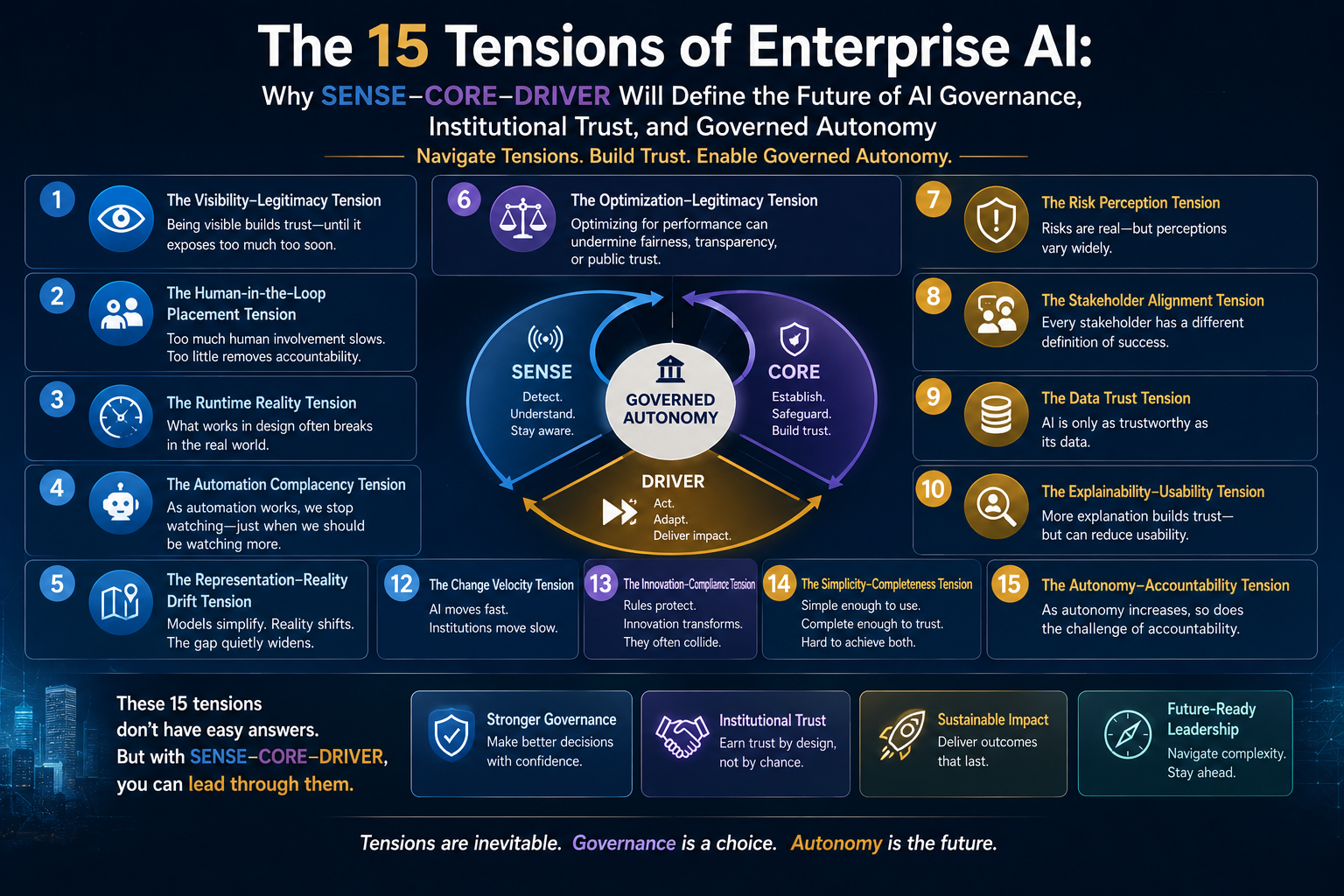
The 15 Tensions of Enterprise AI:
AI does not fail only because models are weak. It fails because representation, reasoning, governance, and human judgment evolve at different speeds.
Enterprise AI is not just a technology shift.
It is an institutional shift.
Most organizations still treat AI adoption as a model problem: Which model should we use? Which agent should we deploy? Which workflow should we automate?
But the deeper challenge is architectural.
AI systems do not operate directly on reality. They operate on representations of reality. They reason over those representations. Then they act through institutional systems.
This is why the SENSE–CORE–DRIVER framework matters.
- SENSE makes reality machine-legible.
- CORE reasons over represented reality.
- DRIVER governs execution, legitimacy, authority, verification, and recourse.
The real challenge is that these three layers do not mature evenly.
Sometimes SENSE becomes stronger than DRIVER.
Sometimes CORE becomes stronger than human judgment.
Sometimes automation becomes faster than recourse.
Sometimes visibility improves before legitimacy catches up.
These are not minor implementation issues.
They are structural tensions of AI-era institutions.
Below are the 15 tensions every CIO, CTO, enterprise architect, board member, and AI governance leader must understand.
-
The Visibility–Legitimacy Tension
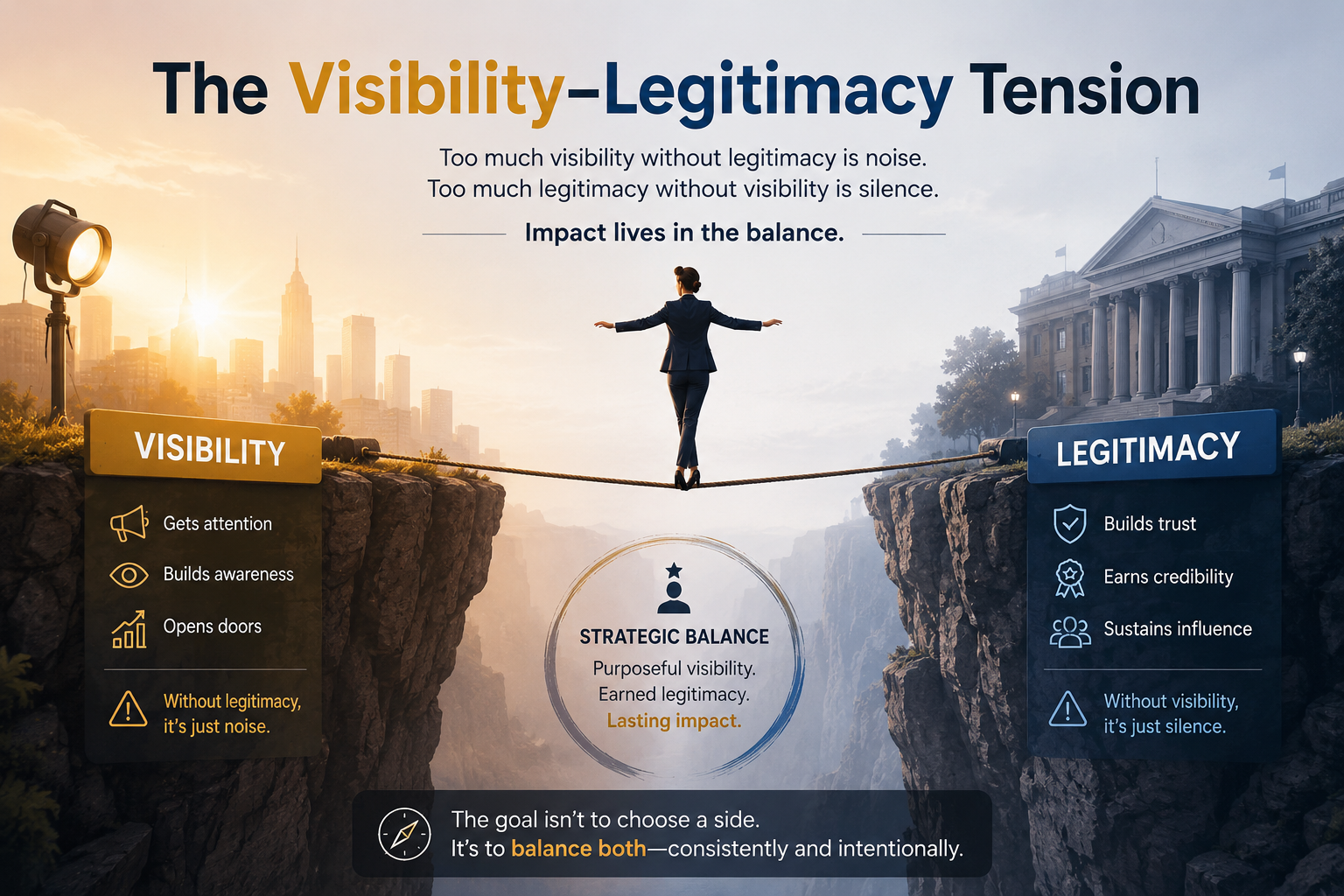
As SENSE becomes stronger, institutions can see more.
They can monitor more signals, infer more patterns, track more behavior, predict more outcomes, and detect more change.
But stronger visibility does not automatically create stronger legitimacy.
In fact, it can make legitimacy harder.
An enterprise may gain the technical ability to observe customers, employees, machines, transactions, locations, conversations, and behaviors in real time. But should it observe everything it can observe?
That is the tension.
Better SENSE can weaken DRIVER if consent, authority, explanation, boundaries, and recourse are not designed properly.
Core insight:
Better visibility without stronger legitimacy creates institutional fragility.
The sweet spot is not maximum visibility.
The sweet spot is governable visibility — visibility that remains explainable, authorized, bounded, auditable, and contestable.
-
The Human-in-the-Loop Placement Tension
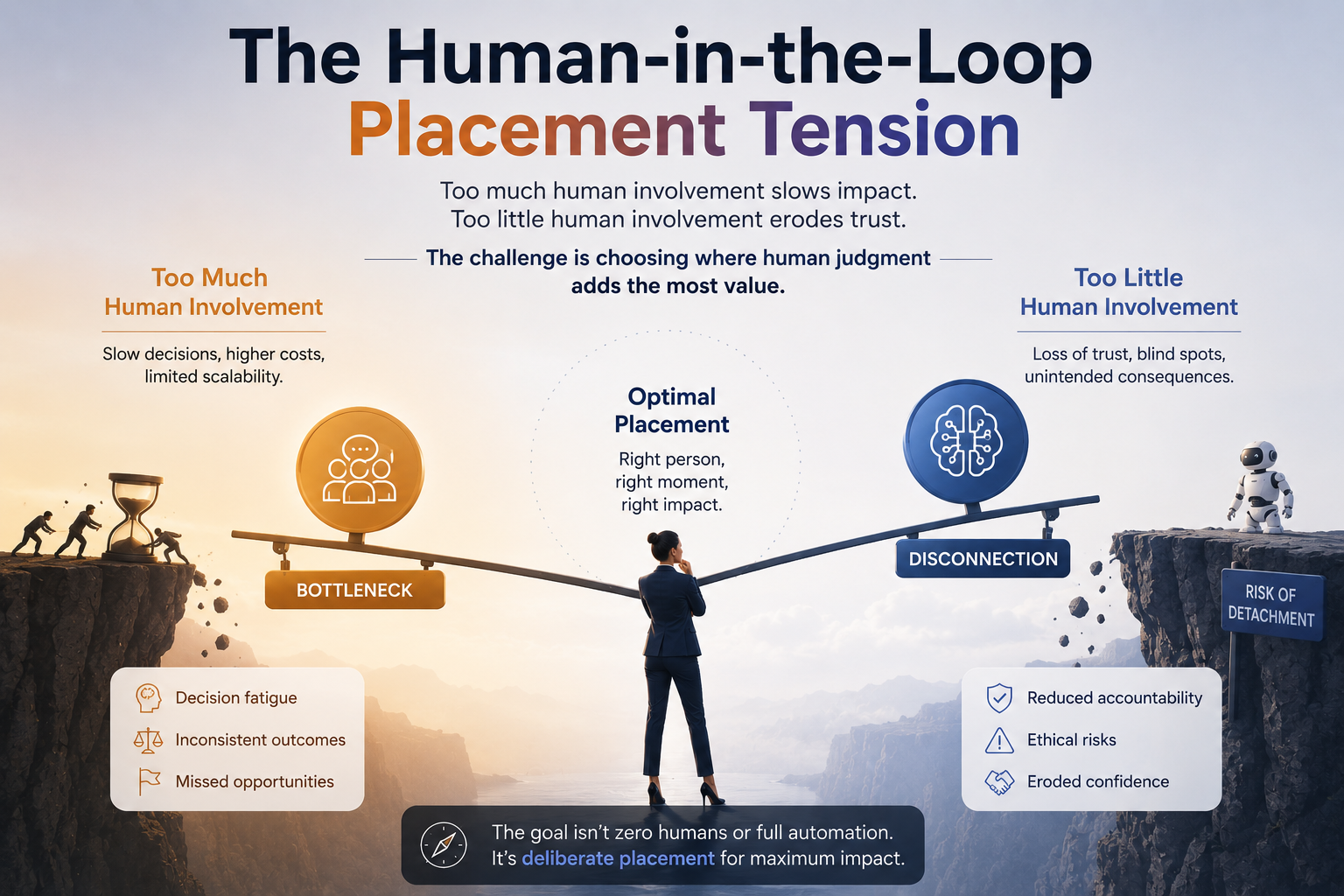
Most organizations ask the wrong question:
Should humans be in the loop?
The better question is:
Where exactly should humans enter the loop?
Human judgment can enter at different layers.
A human can intervene in SENSE by validating whether the system has represented reality correctly.
A human can intervene in CORE by reviewing reasoning, recommendations, or plans.
A human can intervene in DRIVER by authorizing action, verifying legitimacy, or approving execution.
A human can also intervene after action through appeal, correction, escalation, or recourse.
These are very different forms of oversight.
Putting a human at the wrong layer creates false safety.
A person approving an AI recommendation may not know that the underlying reality was poorly represented. A person reviewing an output may not know that the action itself was unauthorized. A person handling an appeal may be too late to prevent harm.
Core insight:
The future question is not “human-in-the-loop.”
It is “which layer requires human sovereignty?”
-
The Runtime Reality Tension
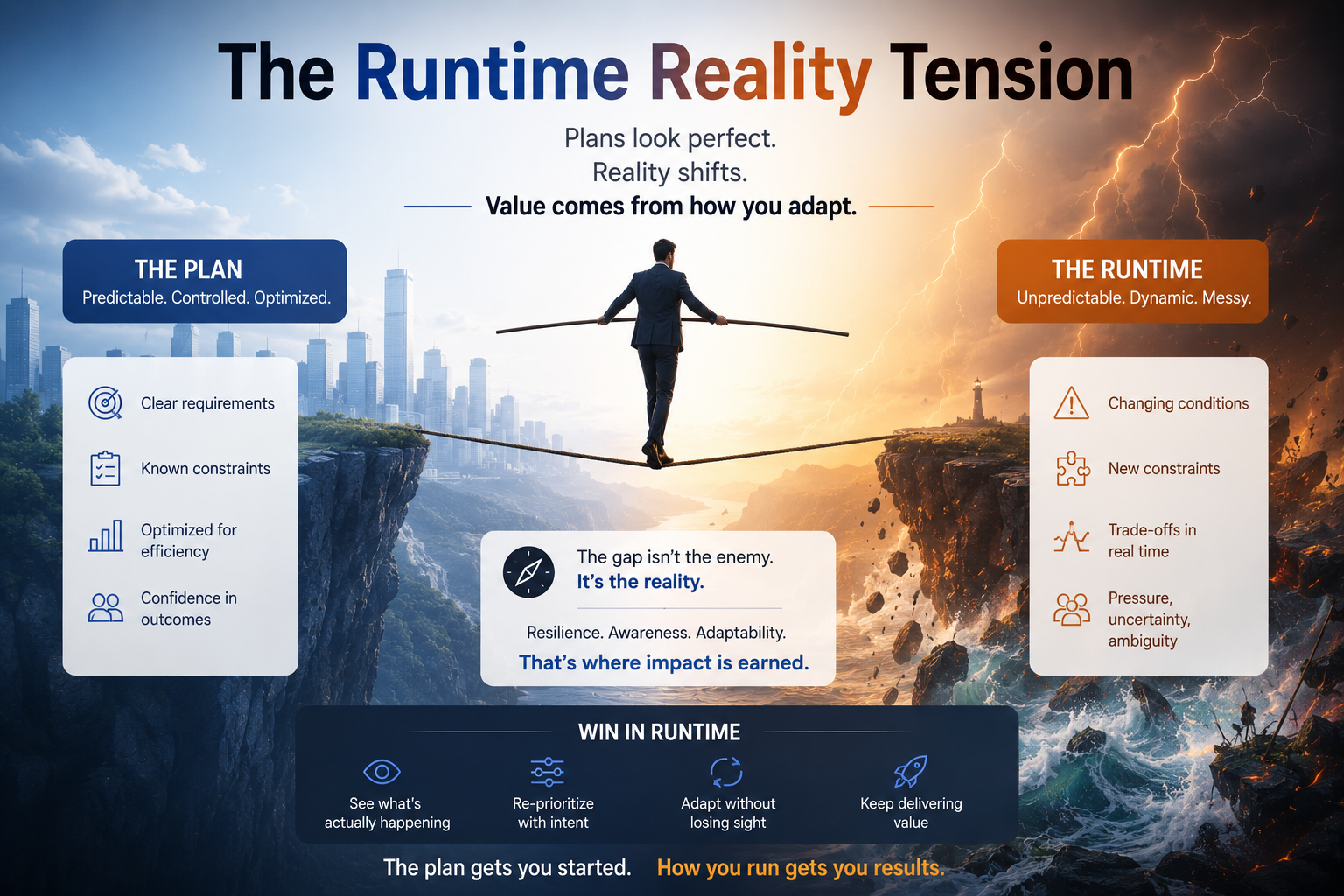
Traditional governance is slow.
AI systems operate fast.
Most governance today is document-driven, committee-driven, audit-driven, and periodic. But AI systems increasingly operate in dynamic environments where reality changes continuously.
Customer state changes.
Fraud patterns change.
Market signals change.
Cyber threats change.
Supply chain conditions change.
Policy constraints change.
Business context changes.
This creates a runtime challenge.
SENSE must update reality continuously.
DRIVER must govern action continuously.
Static governance cannot control dynamic autonomy.
Enterprises therefore need runtime SENSE and runtime DRIVER.
That means event-driven architecture, continuous entity resolution, live context graphs, policy-as-code, real-time authority checks, audit trails, escalation paths, rollback mechanisms, and recourse workflows.
Core insight:
AI governance cannot remain static when AI action is dynamic.
-
The Automation Complacency Tension
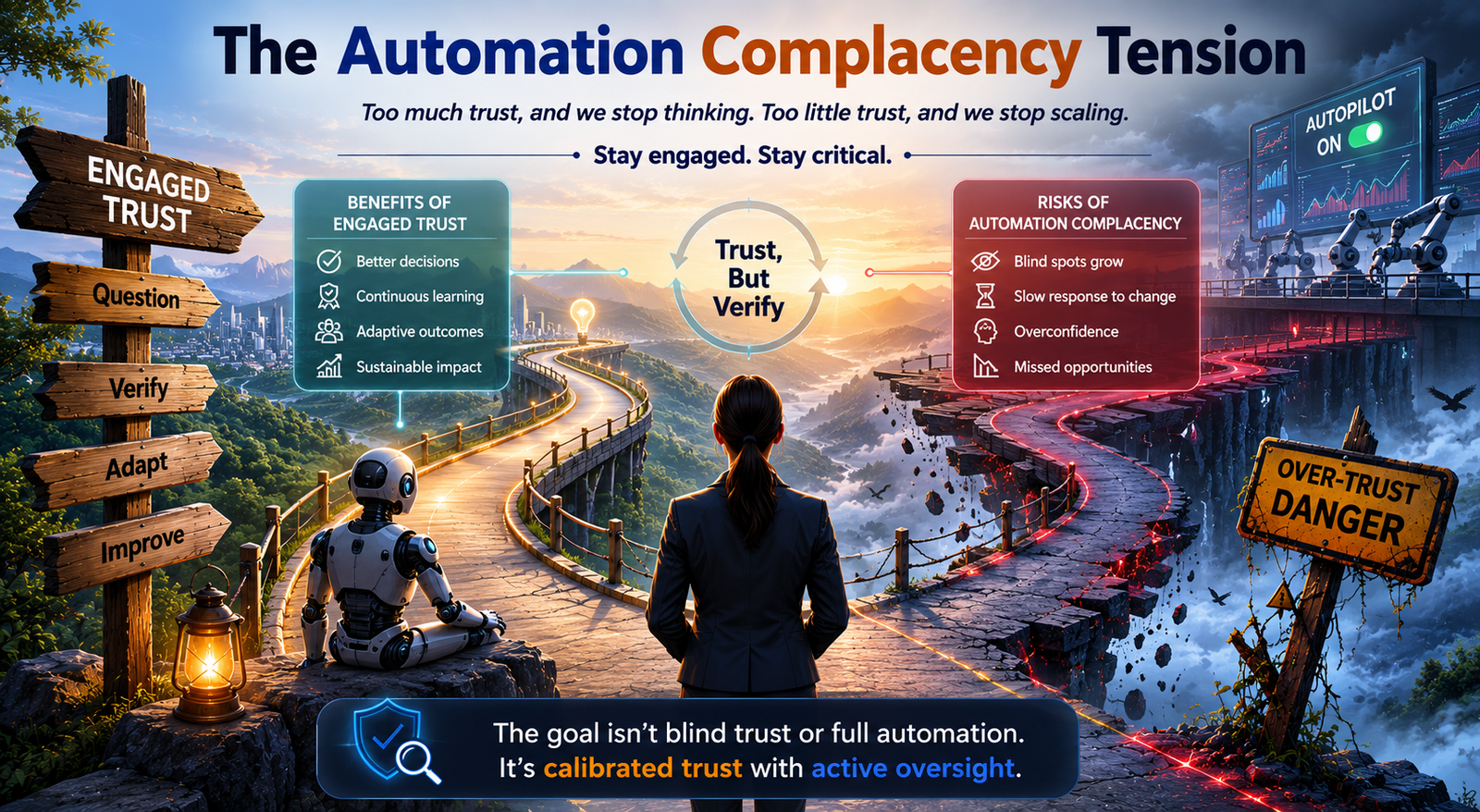
As CORE becomes stronger, humans may stop thinking deeply.
This is one of the biggest hidden dangers of enterprise AI.
When AI recommendations become consistently useful, humans begin to trust them. Over time, they may stop challenging them. Review becomes ritual. Approval becomes rubber-stamping. Oversight becomes symbolic.
The formal authority may still sit with humans.
But cognitive authority slowly moves to the machine.
This is dangerous because institutions may lose their judgment muscle.
People may forget how to question assumptions, detect weak signals, challenge system outputs, or intervene confidently.
Core insight:
Strong AI can silently transfer cognitive authority away from humans long before formal authority changes.
This is not only automation risk.
It is institutional cognition risk.
-
The Representation–Reality Drift Tension
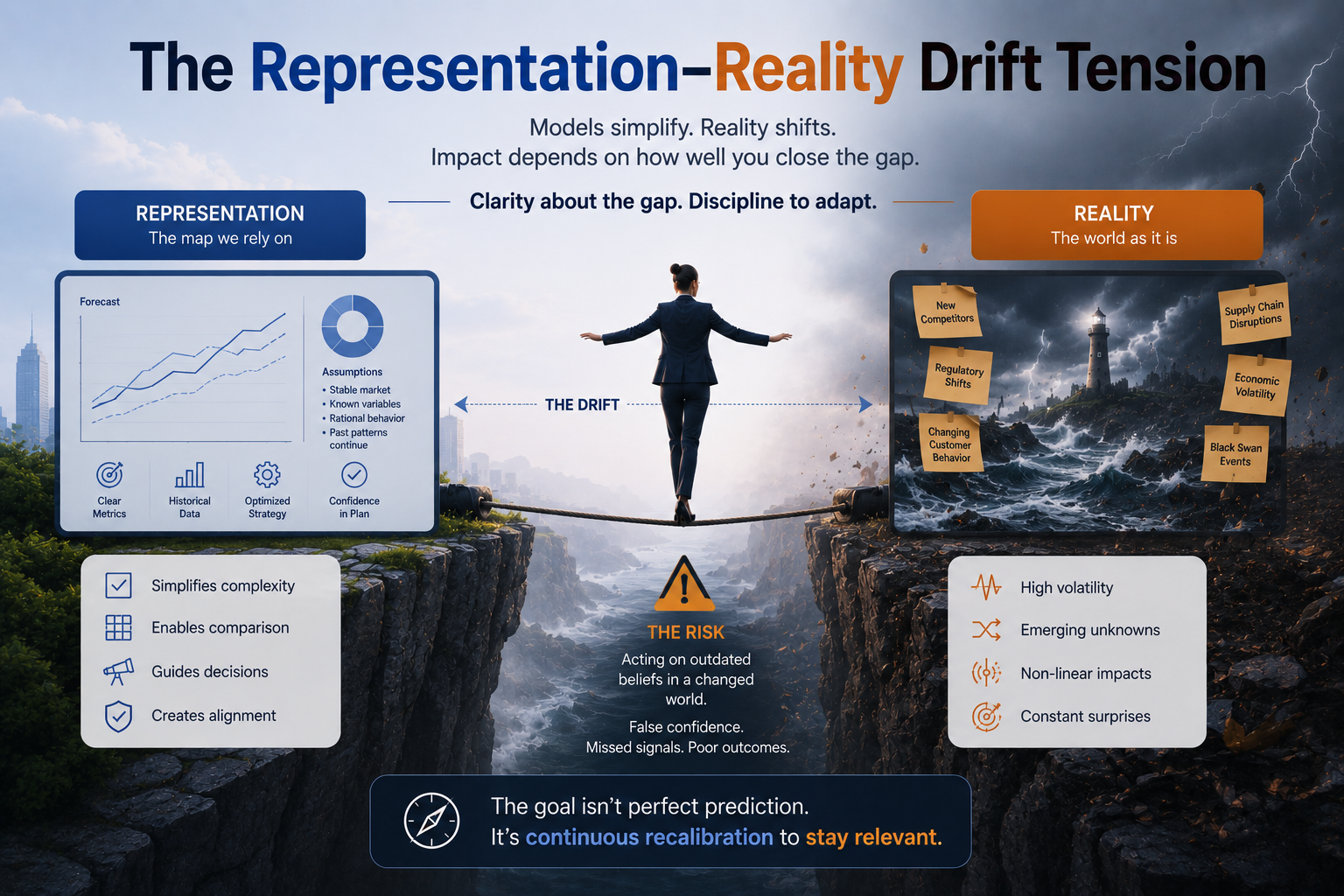
Reality changes.
Representations become stale.
This is the Reality Gap.
A customer profile may no longer reflect the customer’s real condition.
A supplier rating may not reflect current fragility.
A risk model may not reflect new behavior.
A digital twin may no longer match the physical asset.
A policy representation may not reflect updated regulation.
When represented reality drifts away from actual reality, AI systems may reason brilliantly over an obsolete world.
This is why representation must be continuously refreshed, tested, and reconciled.
Core insight:
AI systems do not fail only because they reason badly.
They fail because represented reality drifts away from lived reality.
-
The Optimization–Legitimacy Tension
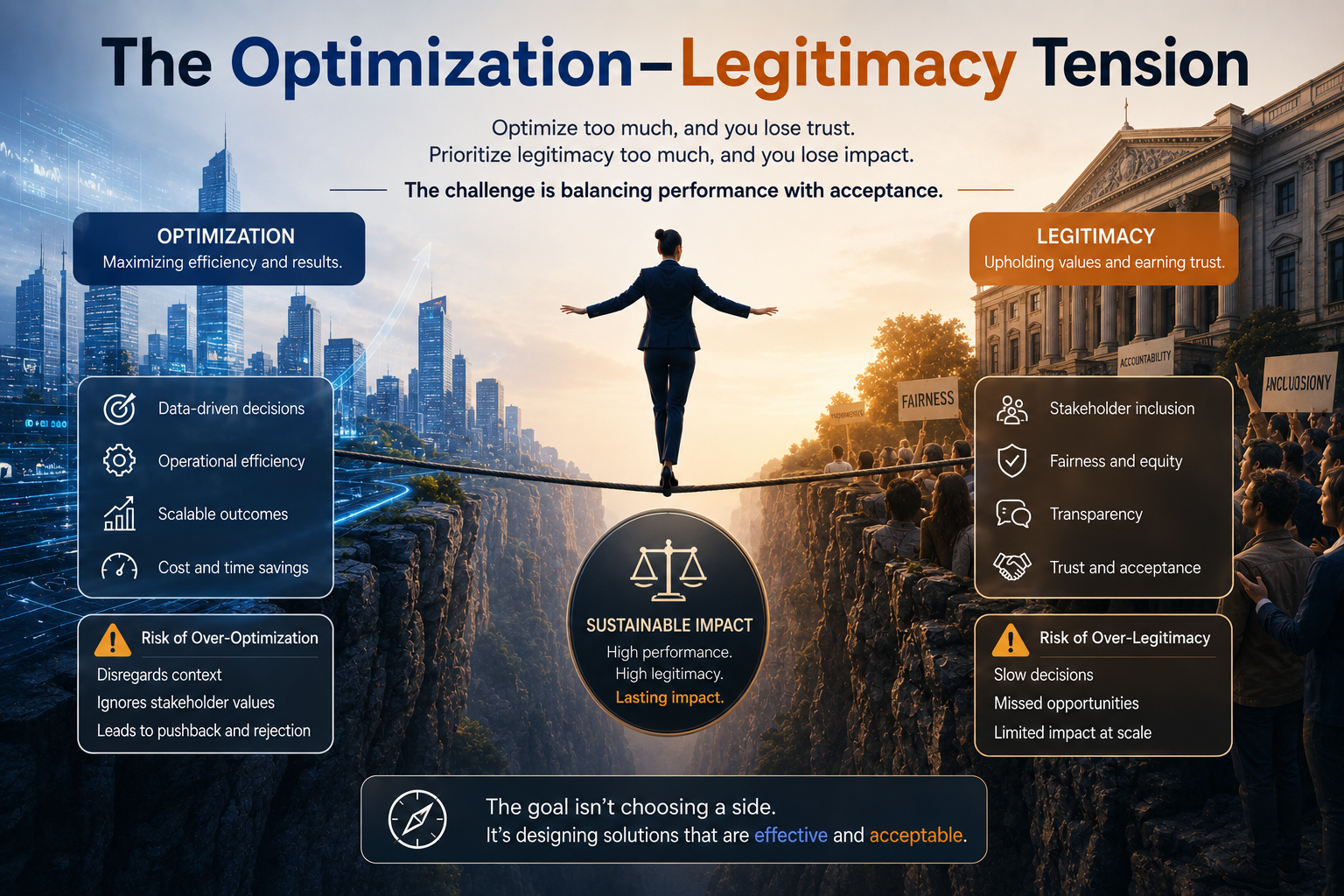
CORE optimizes.
But optimization is not the same as legitimacy.
An AI system may produce an efficient decision that is institutionally unacceptable.
It may reduce cost but damage trust.
It may increase speed but reduce fairness.
It may improve conversion but weaken dignity.
It may maximize output but violate customer expectations.
It may optimize risk but become socially unacceptable.
This is especially important in banking, insurance, healthcare, education, public systems, and employee-facing AI.
The best mathematical answer may not be the most legitimate institutional answer.
Core insight:
The most optimized decision is not always the most legitimate decision.
DRIVER must therefore constrain CORE.
-
The Scale–Context Tension
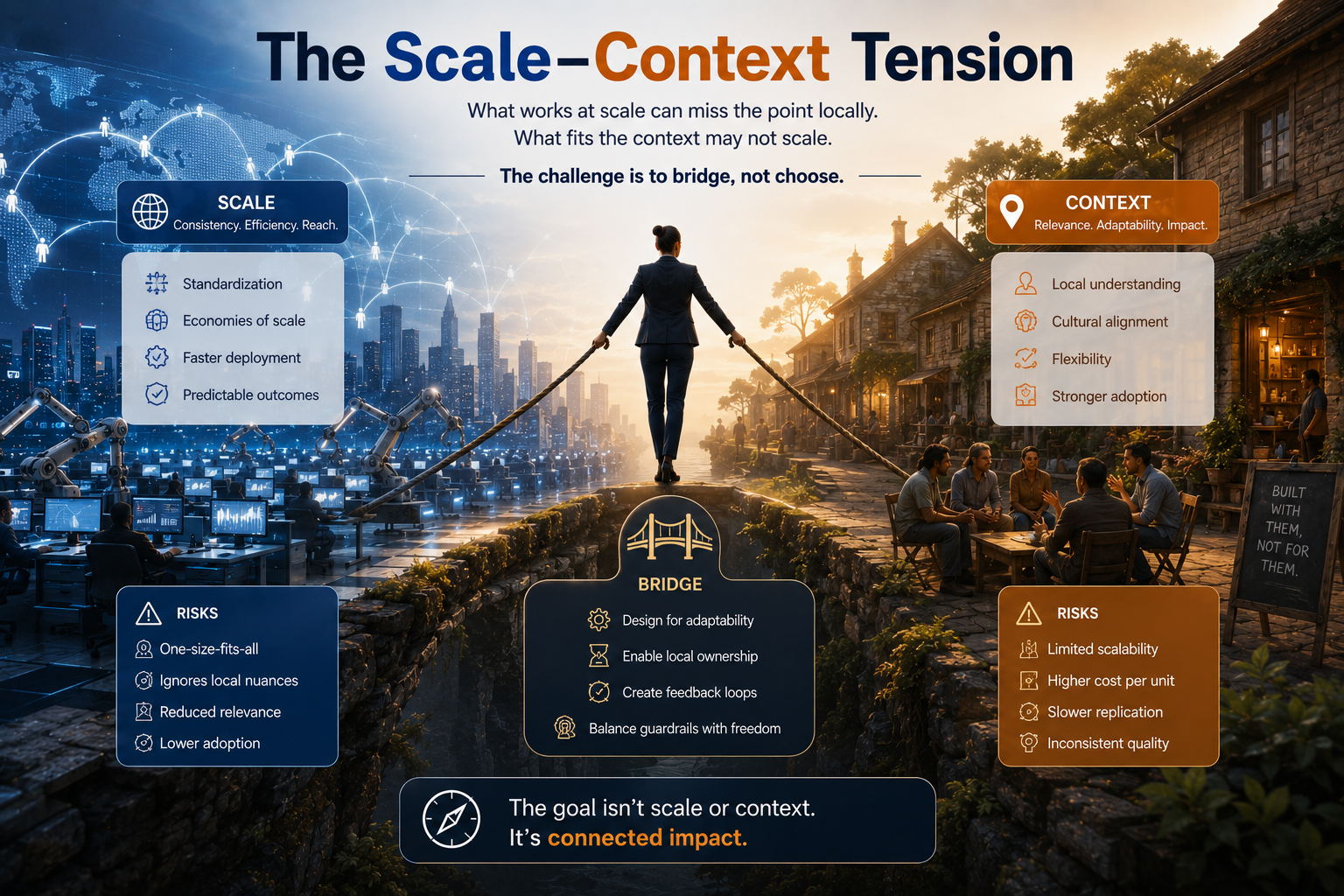
AI scales through abstraction.
Reality depends on context.
That is the tension.
To scale AI across thousands or millions of decisions, institutions must standardize categories, processes, rules, and representations.
But context often lives in exceptions, relationships, local knowledge, history, emotion, timing, and tacit judgment.
As systems scale, context gets compressed.
A local customer issue becomes a generic service ticket.
A complex patient condition becomes a category.
A fragile supplier relationship becomes a score.
A nuanced employee situation becomes a policy case.
The larger the system, the greater the risk of context loss.
Core insight:
Scale naturally compresses context.
Enterprise AI must therefore design mechanisms to preserve critical context where it matters most.
-
The Delegation–Accountability Tension
AI allows institutions to delegate more work to machines.
But accountability does not evolve as fast as delegation.
An AI agent may recommend, route, approve, reject, summarize, escalate, or execute. But when something goes wrong, who is accountable?
The business owner?
The technology team?
The model provider?
The process owner?
The human approver?
The compliance team?
The vendor?
The enterprise architect?
AI diffuses agency.
But institutions still need responsibility.
This creates a serious DRIVER problem.
Delegation must be mapped. Authority must be explicit. Decision rights must be clear. Execution must be traceable.
Core insight:
AI systems diffuse operational agency faster than institutions evolve accountability.
-
The Speed–Recourse Tension
AI makes decisions faster.
But recourse often remains slow.
This creates asymmetry.
A system can reject a transaction instantly.
Block an account instantly.
Flag a customer instantly.
Deny eligibility instantly.
Trigger escalation instantly.
Change a recommendation instantly.
But correction, appeal, explanation, and reversal may take days or weeks.
That is not just inefficient.
It creates helplessness.
In AI-mediated institutions, speed without recourse becomes power without accountability.
Core insight:
Faster decisions without faster recourse create institutional helplessness.
The future of trustworthy AI will require faster recourse architectures.
-
The Compression–Meaning Tension
AI systems compress reality.
They convert documents into summaries, behavior into scores, language into embeddings, people into profiles, and situations into categories.
Compression enables scale.
But compression also loses meaning.
Every representation simplifies reality. That is unavoidable. But the danger begins when the institution forgets what was lost in compression.
A summary may omit uncertainty.
A score may hide context.
An embedding may capture similarity without explanation.
A category may flatten complexity.
A dashboard may hide lived reality.
Core insight:
Every representation gains scalability by sacrificing some reality.
Good enterprise AI must know what its representations leave out.
-
The Visibility–Autonomy Feedback Tension
As SENSE improves, institutions become more confident.
As confidence increases, they delegate more.
As delegation increases, systems act more autonomously.
As autonomy increases, the consequences of representation errors become larger.
This creates a feedback loop.
Better visibility creates more automation.
More automation increases dependence on visibility.
Greater dependence makes visibility failures more dangerous.
This is why success can create fragility.
An AI system may work well in controlled conditions. That success encourages broader deployment. But once deployed widely, even small representation errors can scale rapidly.
Core insight:
The more autonomy depends on visibility, the more dangerous visibility failure becomes.
-
The Institutional Memory Tension
AI can summarize knowledge.
But summarization is not memory.
As organizations use AI to summarize meetings, decisions, incidents, customer histories, policies, and project updates, people may engage less deeply with the underlying material.
Over time, the organization may become dependent on retrieved summaries rather than lived understanding.
This weakens institutional memory.
People may know what the AI summary says but not why things happened. They may lose historical intuition, cultural context, exception memory, and informal knowledge.
The organization becomes efficient but shallow.
Core insight:
AI can improve knowledge access while weakening institutional memory.
This is a major long-term risk for leadership, expertise, and culture.
-
The Simulation–Reality Tension
Enterprises are increasingly using digital twins, synthetic data, scenario models, simulations, and AI-generated environments.
These are powerful tools.
But they create a new risk.
Institutions may begin optimizing for simulated success rather than real-world resilience.
A simulation can simplify uncertainty.
A digital twin can miss hidden dependencies.
Synthetic data can underrepresent rare events.
Scenario models can reflect designer assumptions.
Agent simulations can behave differently from real people and real institutions.
The better simulations become, the easier it is to confuse simulated reality with actual reality.
Core insight:
AI can make simulated worlds more convincing than the real-world uncertainty they are meant to represent.
-
The Governance–Innovation Tension
Weak DRIVER creates unsafe autonomy.
But excessive DRIVER can paralyze innovation.
This is a real enterprise tension.
If governance is too weak, AI systems create risk.
If governance is too heavy, experimentation slows down.
If every AI use case requires excessive approval, teams bypass governance.
If governance is too loose, systems scale without control.
Organizations often oscillate between chaos and paralysis.
The answer is not less governance or more governance.
The answer is better governance architecture.
Low-risk experimentation should move fast.
High-impact action should be tightly governed.
Reversible decisions can be delegated more easily.
Irreversible decisions need stronger controls.
Core insight:
AI governance must be risk-sensitive, not bureaucracy-heavy.
-
The Trust–Opacity Tension
The most powerful AI systems are often the hardest to interpret.
Capability rises.
Transparency may fall.
This creates a trust problem.
Boards, regulators, customers, employees, and enterprise leaders may be asked to trust systems they cannot fully inspect.
This tension becomes sharper as AI systems become multimodal, agentic, self-improving, tool-using, and deeply embedded in enterprise workflows.
The institution may gain capability but lose explainability.
That is not sustainable.
Trustworthy AI will require new forms of evidence, auditability, observability, verification, and recourse.
Core insight:
AI capability without institutional explainability creates fragile trust.
The Bigger Pattern: AI Creates Institutional Imbalance
These 15 tensions reveal a deeper truth.
AI does not destabilize institutions only because it becomes intelligent.
It destabilizes institutions because five things evolve at different speeds:
- representation,
- reasoning,
- execution,
- governance,
- and human judgment.
SENSE may improve faster than DRIVER.
CORE may improve faster than human oversight.
Execution may accelerate faster than accountability.
Visibility may expand faster than legitimacy.
Automation may scale faster than recourse.
That is the real institutional challenge of AI.
Not just whether AI can think.
But whether institutions can remain legitimate, accountable, and reality-aligned when machines begin to sense, reason, and act at scale.
Why SENSE–CORE–DRIVER Matters
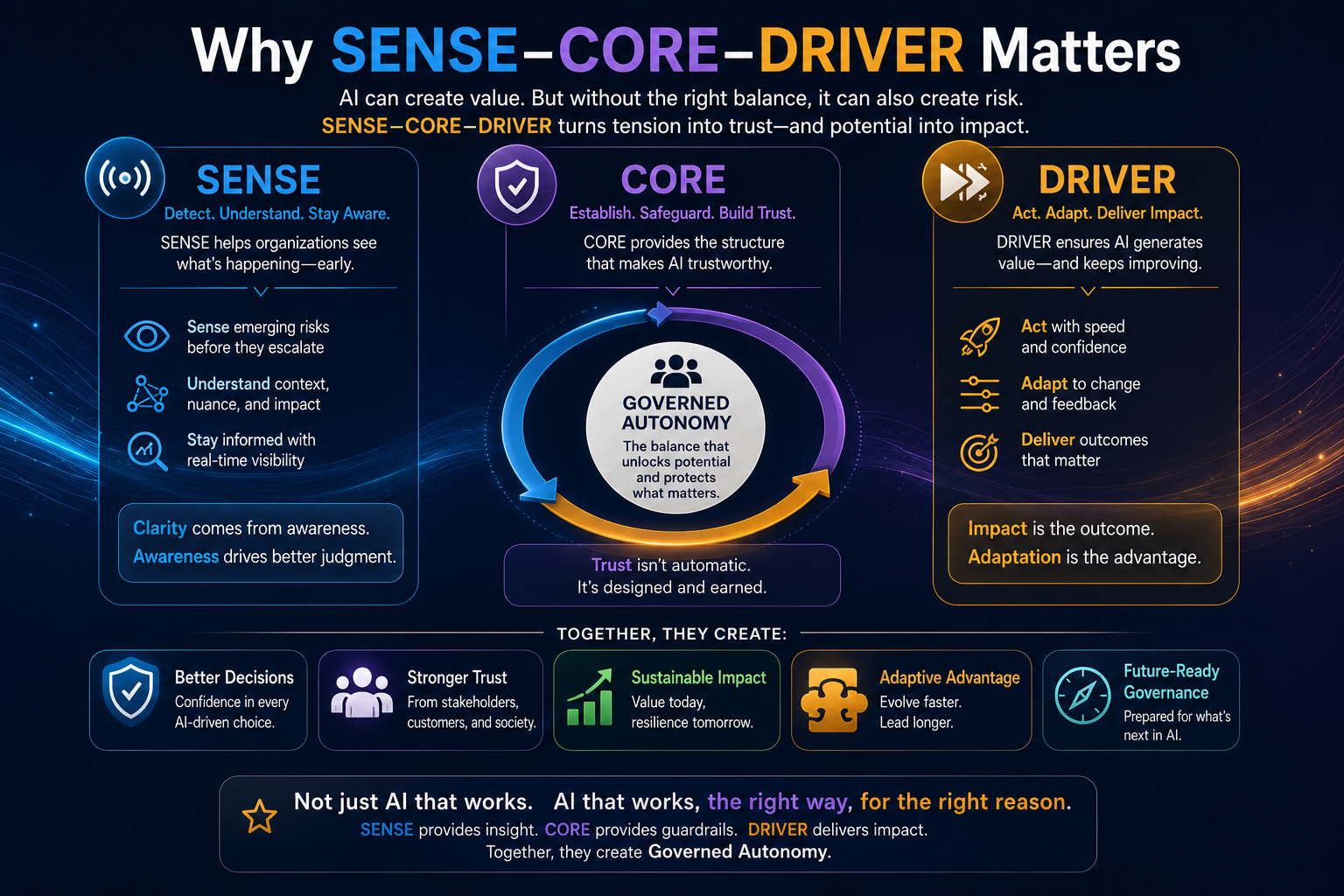
SENSE–CORE–DRIVER helps leaders ask better questions.
Instead of asking only:
Which AI model should we use?
Leaders can ask:
What reality is being represented?
How current is that representation?
What is the AI reasoning over?
Who authorized the action?
What evidence supports the decision?
Where should human judgment enter?
What happens if the system is wrong?
Can the decision be reversed?
Can affected stakeholders challenge it?
Is visibility becoming stronger than legitimacy?
Is automation becoming stronger than accountability?
These are the questions that define the next era of enterprise AI.
Conclusion: The Future Belongs to Balanced AI Institutions
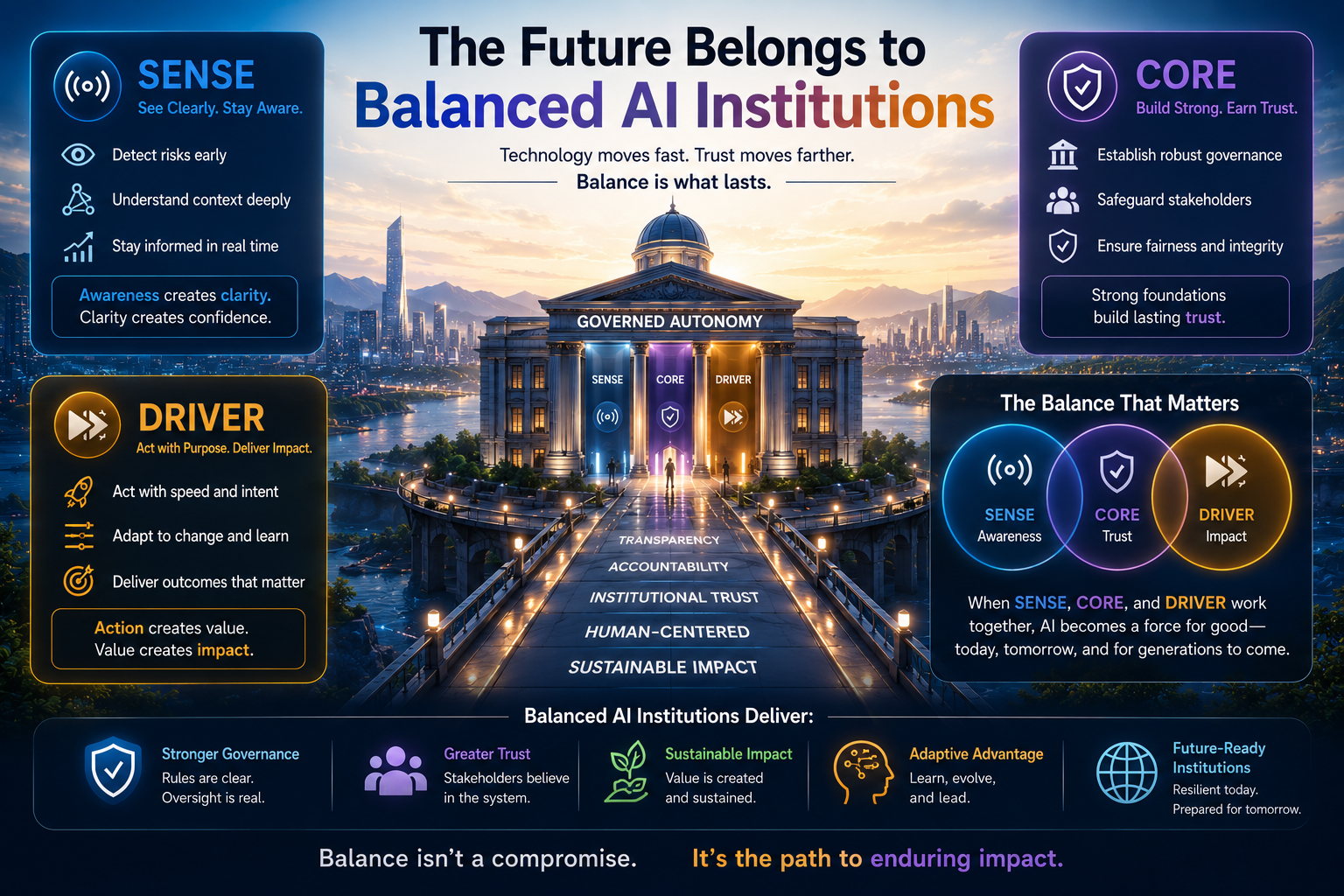
The future will not belong simply to organizations with the most powerful AI models.
It will belong to institutions that can balance SENSE, CORE, and DRIVER.
They will see better without overreaching.
They will reason better without surrendering judgment.
They will act faster without eliminating recourse.
They will automate more without diffusing accountability.
They will scale intelligence without flattening reality.
That balance is the real challenge.
And it may become the defining leadership discipline of the AI era.
The next generation of AI strategy will not be about intelligence alone.
It will be about institutional equilibrium.
Because in the AI era, the question is not only:
Can machines reason?
The deeper question is:
Can institutions remain trustworthy when machines begin to sense, reason, and act on their behalf?
That is why SENSE–CORE–DRIVER matters.
Summary
The 15 Tensions of Enterprise AI explains how artificial intelligence systems create structural tensions between machine visibility, reasoning, governance, autonomy, legitimacy, accountability, recourse, and human oversight. Using the SENSE–CORE–DRIVER framework, the article argues that enterprise AI failures often emerge not from weak models, but from institutional imbalance across representation, cognition, and governed execution layers.
Who developed the 15 Tensions of Enterprise AI framework?
The “15 Tensions of Enterprise AI” framework was developed by Raktim Singh as part of his broader Representation Economy and SENSE–CORE–DRIVER research initiative focused on enterprise AI governance, machine-legible reality, institutional AI systems, runtime governance, and governed execution.
What is SENSE–CORE–DRIVER?
SENSE–CORE–DRIVER is a conceptual framework created by Raktim Singh to explain how enterprise AI systems operate across three layers:
- SENSE → machine legibility and representation of reality
- CORE → reasoning, cognition, prediction, optimization, and orchestration
- DRIVER → execution, legitimacy, authority, verification, and recourse
Why are enterprise AI tensions important?
Enterprise AI tensions explain why AI systems create instability even when models become more powerful. These tensions emerge because representation, reasoning, governance, execution, and human judgment evolve at different speeds.
What is the biggest hidden risk in enterprise AI?
One of the biggest hidden risks is institutional imbalance — where visibility grows faster than legitimacy, automation grows faster than accountability, or AI reasoning grows faster than human oversight.
Why does governance matter in AI systems?
As AI systems increasingly act autonomously, governance becomes critical for ensuring:
- legitimacy,
- explainability,
- recourse,
- accountability,
- reversibility,
- and institutional trust.
Where can I read more work by Raktim Singh?
You can explore additional frameworks, articles, research papers, and enterprise AI thought leadership by Raktim Singh at:
- RaktimSingh.com
- Representation Economy GitHub Repository
- LinkedIn Profile
- ResearchGate Publications
- OSF Research Project
- Zenodo Research Archive
- OpenAlex :https://openalex.org/authors/a5136665700



Raktim Singh is an AI and deep-tech strategist, TEDx speaker, and author focused on helping enterprises navigate the next era of intelligent systems. With experience spanning AI, fintech, quantum computing, and digital transformation, he simplifies complex technology for leaders and builds frameworks that drive responsible, scalable adoption.