

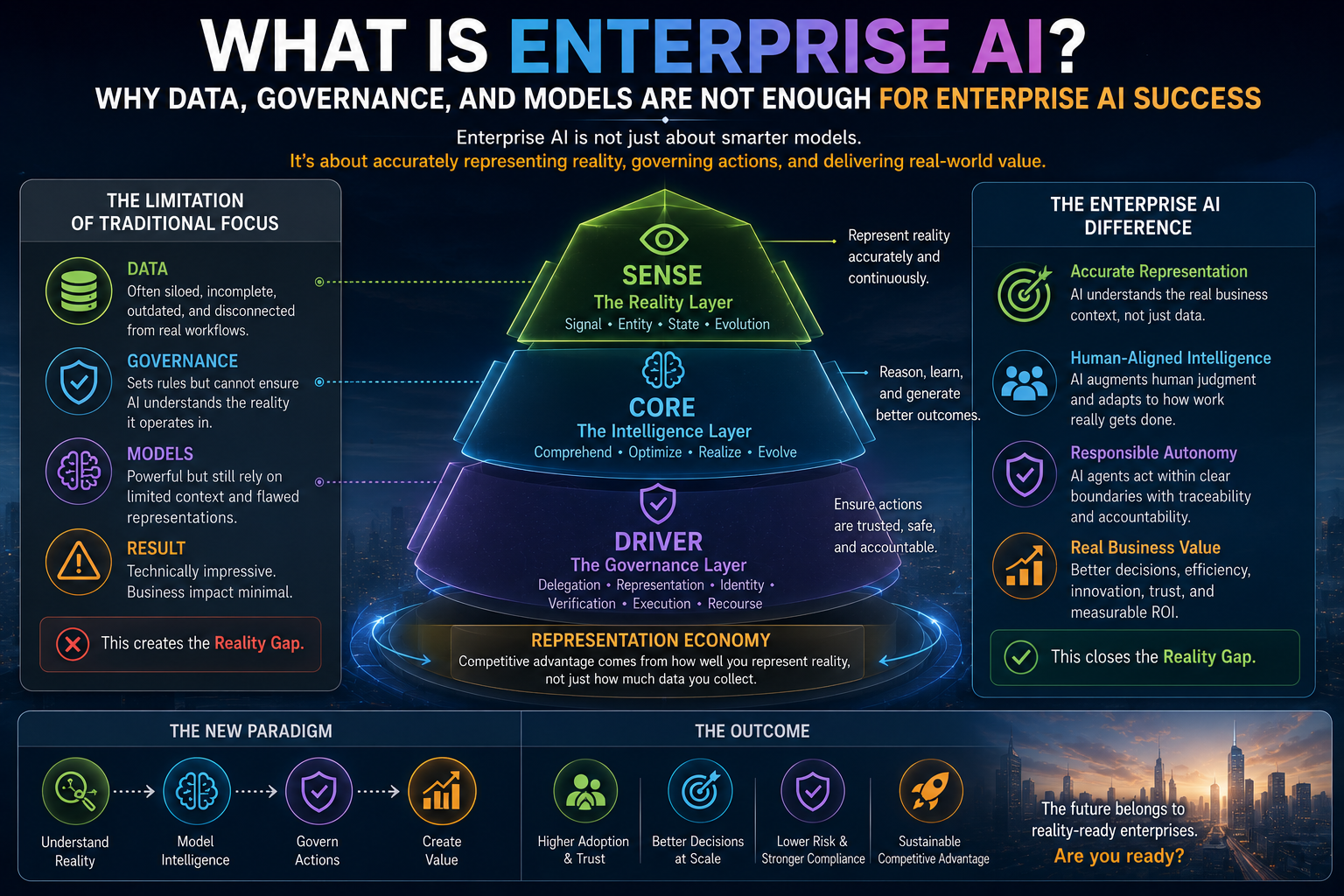
What Is Enterprise AI? Why Most Enterprise AI Projects Fail Even When the Technology Works
A practical guide for CIOs, CTOs, enterprise architects, and business leaders on Enterprise AI, AI operating models, AI governance, digital anthropology, and the emerging Representation Economy.
Enterprise AI refers to the application of artificial intelligence across enterprise processes, workflows, decisions, operations, products, and customer interactions to improve efficiency, decision quality, productivity, risk management, and business outcomes.
Unlike consumer AI, Enterprise AI must operate within complex environments that include regulations, legacy systems, organizational structures, governance requirements, business objectives, and human workflows.
Most organizations initially view Enterprise AI as a technology problem.
Increasingly, however, successful organizations are discovering that Enterprise AI is also a representation problem, an operating-model problem, and a governance problem.
This distinction explains why many AI projects demonstrate impressive technical performance but struggle to generate measurable business value.
Enterprise AI Is Not Just About Models
Many organizations focus on:
- Larger models
- Better prompts
- More data
- Faster infrastructure
- More AI agents
These investments often improve technical capability.
Yet many AI initiatives continue to struggle with:
- Low adoption
- Poor trust
- Weak ROI
- Limited scalability
- Operational friction
The issue is often not the intelligence of the model.
The issue is whether the AI system accurately represents the reality of the enterprise in which it operates.
The Evolution of Enterprise AI
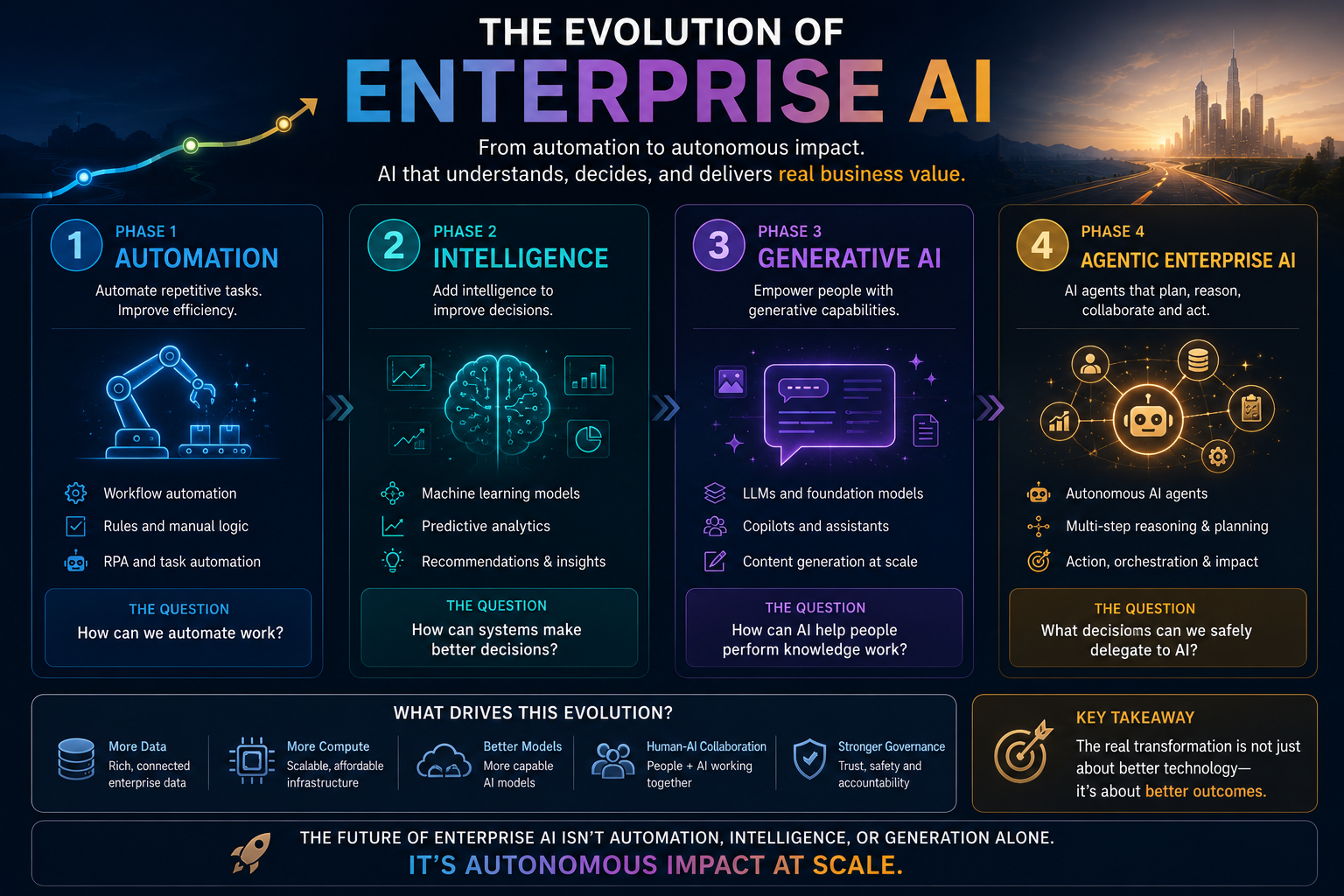
Phase 1: Automation
Organizations automated repetitive tasks.
Focus:
- Workflow automation
- Rule engines
- RPA
Question:
“How can we automate work?”
Phase 2: Intelligence
Organizations introduced machine learning and predictive analytics.
Focus:
- Predictions
- Recommendations
- Classification
Question:
“How can systems make better decisions?”
Phase 3: Generative AI
Organizations adopted large language models.
Focus:
- Content generation
- Search
- Assistants
- Copilots
Question:
“How can AI help people perform knowledge work?”
Phase 4: Agentic Enterprise AI
Organizations are deploying AI agents that can:
- Plan
- Reason
- Coordinate
- Execute actions
Question:
“What decisions can we safely delegate to AI?”
This shift introduces entirely new challenges involving governance, accountability, trust, representation, and legitimacy.
Why Enterprise AI Projects Fail Even When The Models Work
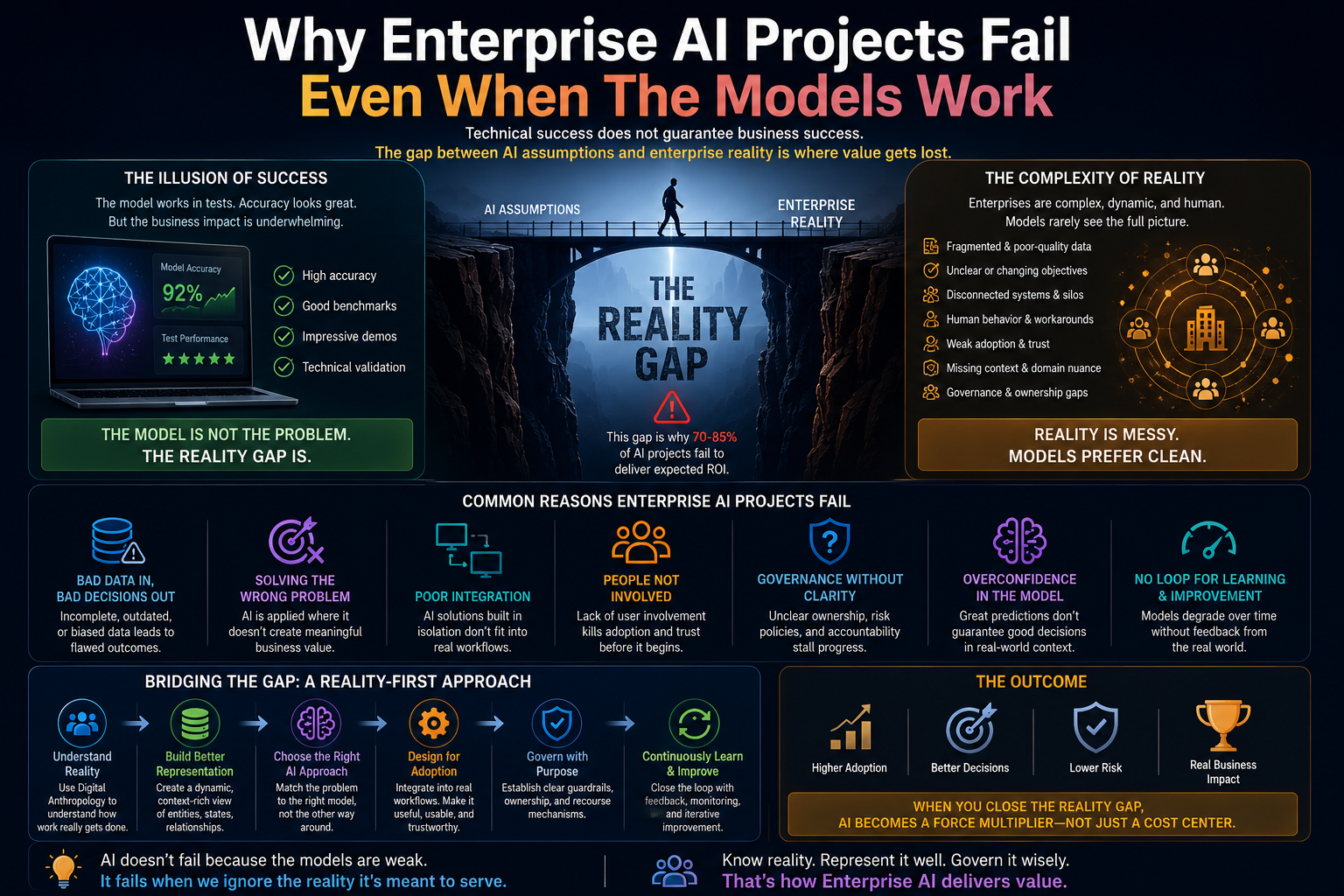
One of the most surprising findings across Enterprise AI deployments is that many projects fail despite technically successful models.
The model works.
The enterprise does not benefit.
This creates what can be called the Reality Gap.
The Reality Gap emerges when AI systems operate on incomplete, outdated, fragmented, or poorly represented views of enterprise reality.
Examples include:
- Customer data spread across multiple systems
- Inconsistent business definitions
- Missing workflow context
- Weak organizational ownership
- Poor understanding of human behavior
In such situations, AI may optimize the wrong thing perfectly.
Enterprise AI Requires More Than Governance
Many organizations assume governance can solve Enterprise AI failures.
Governance is essential.
But governance alone cannot repair poor representation.
Governance can determine:
- What AI may do
- Who approves actions
- How decisions are audited
Governance cannot determine whether the AI system actually understands the reality it is acting upon.
This is why many organizations are beginning to move from AI Governance toward Reality Governance.
Digital Anthropology: The Missing Layer in Enterprise AI
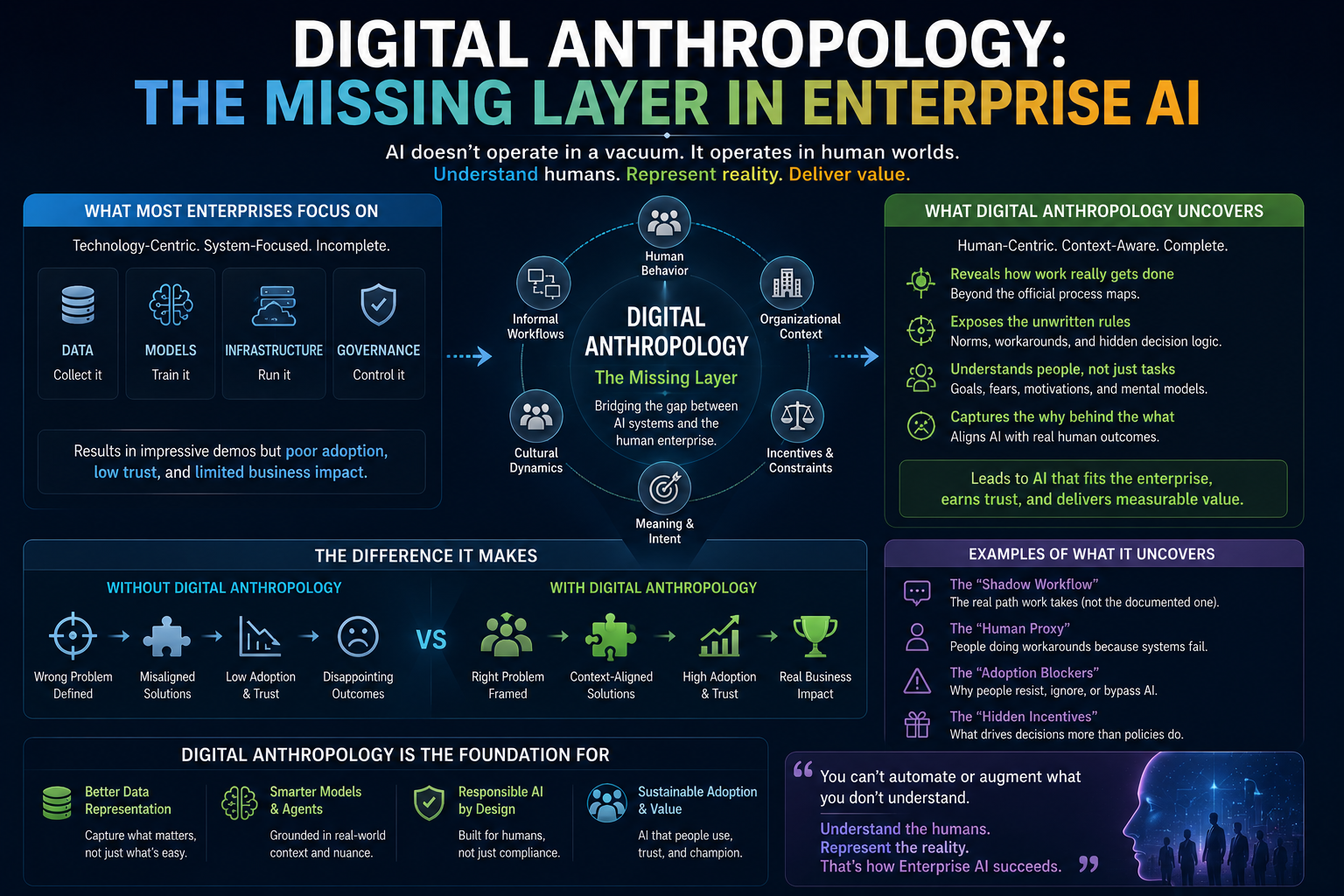
Most Enterprise AI programs focus on:
- Data
- Models
- Infrastructure
- Governance
Very few focus on understanding:
- Human behaviors
- Informal workflows
- Organizational incentives
- Hidden decision processes
- Cultural dynamics
Digital Anthropology attempts to understand the human and institutional realities into which AI is being introduced.
Without this understanding, AI systems frequently optimize processes that humans never actually follow.
The Representation Economy Perspective
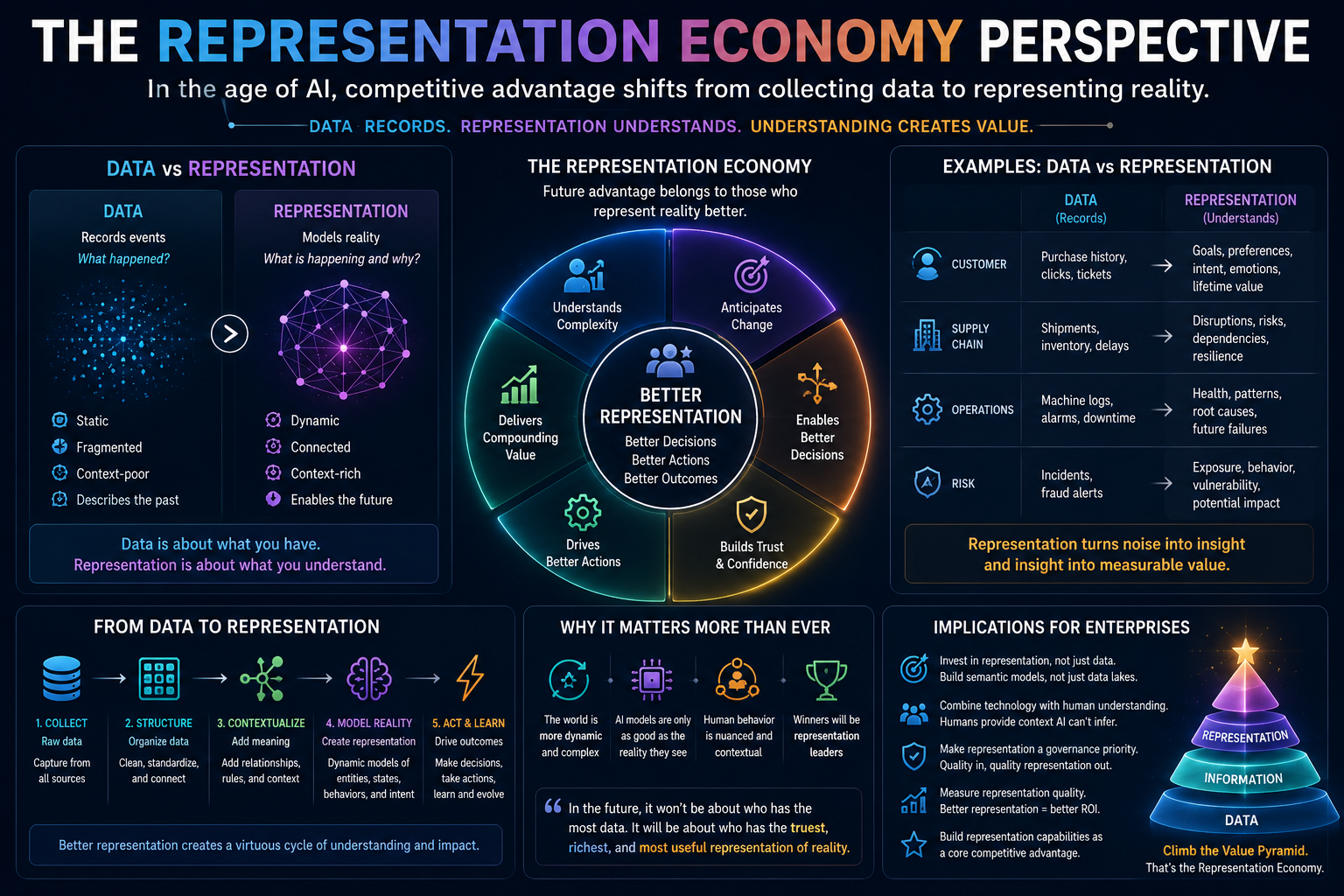
Traditional digital systems focused on storing data.
Enterprise AI increasingly depends on representing reality.
Data records events.
Representation models reality.
For example:
A customer record is data.
A continuously updated understanding of a customer’s goals, context, relationships, behaviors, preferences, and evolving needs is representation.
Organizations that create better representations of reality may increasingly outperform organizations that simply collect more data.
This shift can be viewed as the emergence of a Representation Economy.
The SENSE–CORE–DRIVER View of Enterprise AI
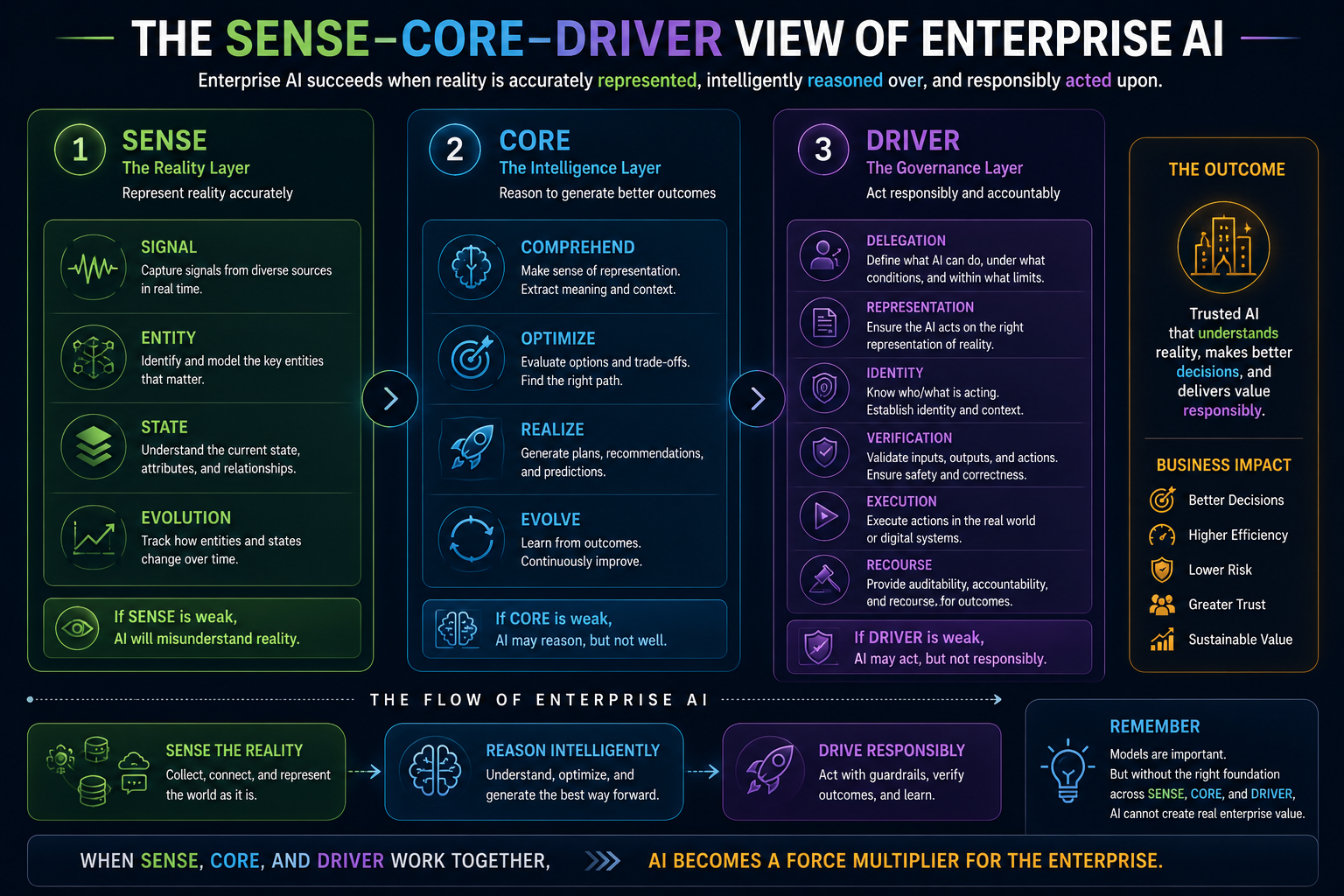
A useful way to understand Enterprise AI is through three layers:
SENSE
The reality layer.
Includes:
- Signal
- Entity
- State
- Evolution
SENSE determines how accurately reality is represented.
CORE
The intelligence layer.
Includes:
- Comprehend
- Optimize
- Realize
- Evolve
CORE determines how effectively AI reasons.
DRIVER
The governance layer.
Includes:
- Delegation
- Representation
- Identity
- Verification
- Execution
- Recourse
DRIVER determines how actions are authorized and governed.
The Future of Enterprise AI
The future of Enterprise AI will likely depend less on who has the largest models and more on who can:
- Represent reality accurately
- Govern actions responsibly
- Integrate AI into human workflows
- Build trust at scale
- Create measurable business value
The organizations that master these capabilities will be better positioned to realize sustainable AI outcomes.
Frequently Asked Questions
What is Enterprise AI?
Enterprise AI refers to the application of artificial intelligence across enterprise workflows, operations, decisions, products, services, and customer interactions to improve business outcomes, efficiency, risk management, and organizational performance.
Why do Enterprise AI projects fail?
Many Enterprise AI initiatives fail not because the models are inaccurate, but because organizations struggle with adoption, workflow integration, governance, ownership, trust, and representation quality. Technical success does not automatically translate into business value.
What is an Enterprise AI operating model?
An Enterprise AI operating model defines how people, processes, governance structures, technology platforms, data assets, and business functions work together to create measurable value from AI investments.
What is Enterprise AI governance?
Enterprise AI governance consists of the policies, controls, accountability mechanisms, oversight structures, and risk-management practices that guide the responsible deployment and operation of AI systems.
What is the Reality Gap?
The Reality Gap is the difference between the reality represented inside an AI system and the reality that actually exists inside the enterprise. Many AI failures emerge when AI systems operate on incomplete, outdated, or distorted representations of the business.
Why is Digital Anthropology important for Enterprise AI?
Enterprise AI operates inside human organizations. Digital Anthropology helps organizations understand informal workflows, incentives, organizational behavior, and cultural realities that often determine whether AI succeeds or fails.
What is the Representation Economy?
The Representation Economy is the idea that future competitive advantage increasingly depends on how accurately organizations represent reality rather than how much raw data they collect. Better representations enable better decisions, stronger trust, and more effective AI systems.
What is the SENSE–CORE–DRIVER framework?
SENSE–CORE–DRIVER is an Enterprise AI framework that separates AI systems into three architectural layers:
- SENSE – representation of reality
- CORE – reasoning and intelligence
- DRIVER – governance and execution
Together, these layers help explain how AI systems perceive, reason, and act within enterprise environments.
Who should own Enterprise AI?
Successful Enterprise AI programs typically involve shared ownership among CIOs, CTOs, business leaders, risk teams, compliance functions, and operational stakeholders. Enterprise AI is both a technology and organizational capability.
What determines Enterprise AI ROI?
Enterprise AI ROI depends on the organization’s ability to translate AI outputs into operational improvements, better decisions, higher productivity, risk reduction, customer value, and measurable business outcomes.
Related Enterprise AI Resources
For readers interested in deeper exploration of Enterprise AI, governance, AI agents, digital anthropology, and value realization, the following resources provide additional perspectives:
- Why Enterprise AI Projects Fail Even When the Models Work
- Why AI Creates Value in One Company and Fails in Another
- AI Agent Governance: How CIOs Should Decide What AI Agents Are Allowed to Do
- The Human–AI Reality Gap
- What Is the Representation Economy?
- What Is the SENSE–CORE–DRIVER Framework?
About the Author
Raktim Singh is an Enterprise AI strategist, author, researcher, and creator of the Representation Economy and SENSE–CORE–DRIVER frameworks. His work focuses on Enterprise AI, AI governance, digital anthropology, machine-legible reality, intelligent institutions, and the organizational conditions required for successful AI adoption at scale.
His research explores why many AI initiatives fail despite technically successful models and how organizations can build trustworthy, governable, and value-generating AI systems.



Raktim Singh is an AI and deep-tech strategist, TEDx speaker, and author focused on helping enterprises navigate the next era of intelligent systems. With experience spanning AI, fintech, quantum computing, and digital transformation, he simplifies complex technology for leaders and builds frameworks that drive responsible, scalable adoption.