
AI’s Agency Crisis: Why Machine Intelligence Is Arriving Before Institutions
For most of the history of technology, power arrived first and institutions followed later. The steam engine reshaped industry before labor laws emerged. Aviation transformed mobility before global air safety systems were built. The internet spread across the world long before societies figured out how to govern digital platforms.
Artificial intelligence is following the same pattern — but at a much faster and more consequential scale.
Today’s AI systems are no longer just tools that analyze information. Increasingly, they recommend actions, trigger workflows, approve transactions, deploy software, negotiate contracts, and operate infrastructure. In other words, they are beginning to act.
This shift from intelligence to agency marks a threshold most institutions are not prepared for. Governments, enterprises, and regulatory frameworks were built for a world where machines produced insights and humans made decisions.
But when machines begin to act within economic and operational systems, the challenge is no longer simply improving AI models. The challenge is building the institutional infrastructure that can contain, verify, and govern machine agency.
That gap — between rapidly advancing machine intelligence and the slower evolution of institutions capable of governing it — is what we can call AI’s agency crisis.
A threshold most institutions are not ready for
Machine intelligence is crossing a threshold that most organizations are not psychologically—or structurally—ready for.
For years, AI was framed as software that recommends: a scoring model, a forecast, a chatbot, a copilot. Even when it was impressive, it still behaved like a tool. It produced outputs, and humans decided what to do next.
That era is ending.
The defining shift of this decade is that AI systems are increasingly being deployed as actors—systems that don’t just suggest, but initiate, execute, negotiate, route, approve, deny, escalate, monitor, and adapt. They can open tickets, trigger workflows, change configurations, move money, approve claims, block accounts, draft contracts, schedule actions, and coordinate other systems.
That capability is what we call agency.
And that is where the crisis begins.
Because agency is not just a technical property. Agency is an institutional event. The moment a system can act, it raises a new class of questions:
- Who authorized the action?
- What policy constrained it?
- What evidence supports it?
- What happens if it was wrong?
- Who can contest it, reverse it, and learn from it?
- Who is accountable—builder, deployer, operator, or all three?
Most institutions still cannot answer these questions at speed, at scale, and with defensible traceability.
So we now have a paradox:
Machine intelligence is arriving faster than the institutions required to contain machine agency.
This is AI’s agency crisis.
What is the AI Agency Crisis?
The AI agency crisis refers to the growing gap between artificial intelligence systems gaining the ability to act autonomously and the institutions required to govern, verify, and contain those actions. As AI moves from generating insights to executing decisions, societies and enterprises must build new governance infrastructures to ensure accountability, safety, and trust.
What “agency” actually means in simple terms
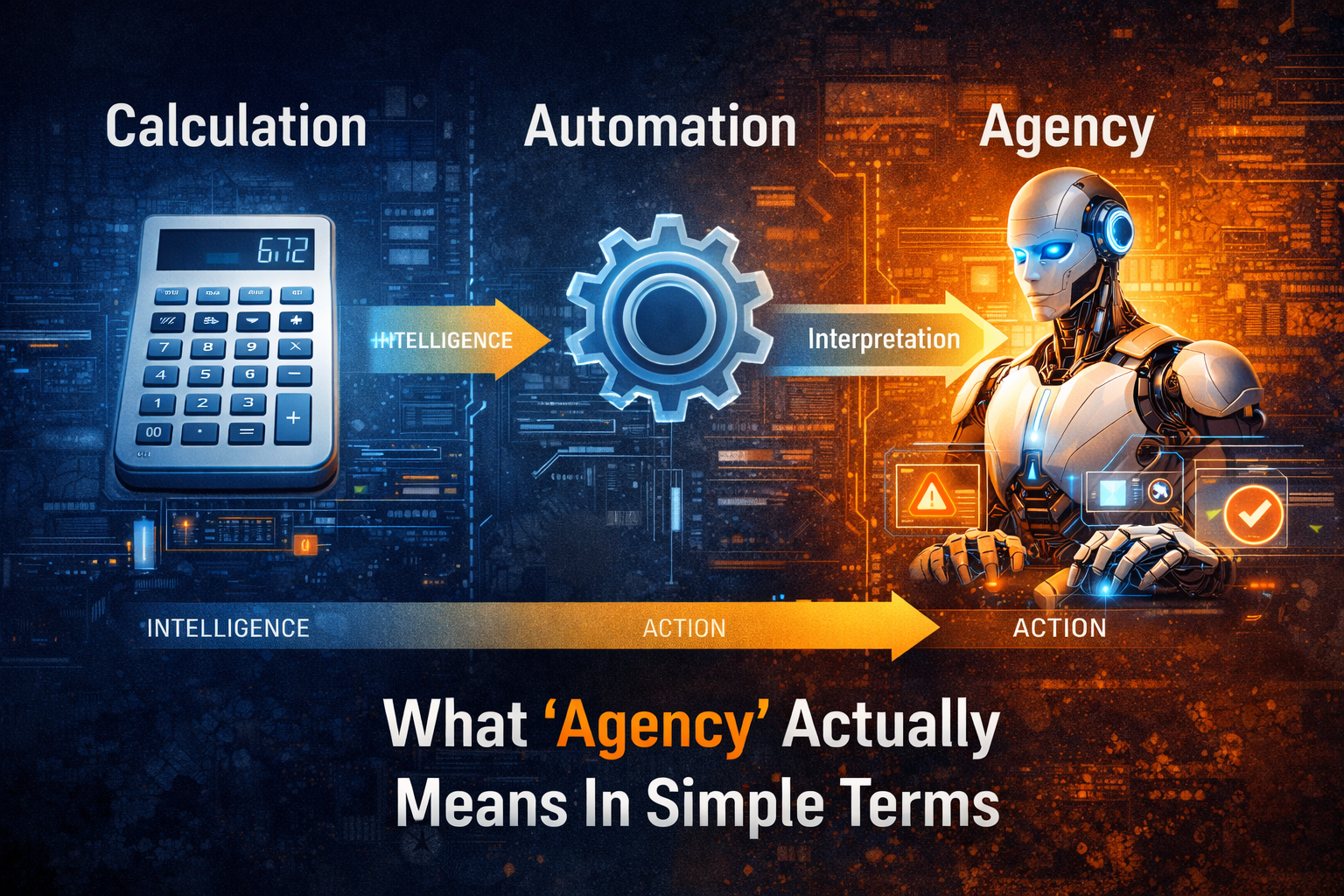
A system has agency when it can turn intention into consequence.
- A calculator has intelligence in a narrow sense. It gives accurate answers. But it has no agency.
- A workflow engine has automation. It can trigger steps. But it has no intelligence.
- An AI agent combines both: it can interpret a goal and choose actions to achieve it under constraints.
That combination—interpretation plus action—is agency.
Everyday enterprise examples of agency
You can see agency already emerging in practical deployments:
- A customer support agent that issues refunds within a limit—without a human clicking “approve.”
- A security system that isolates endpoints and revokes tokens when risk crosses a threshold.
- A procurement agent that negotiates price bands and places orders.
- A finance agent that flags anomalies, holds payments, and requests documents.
- A sales operations agent that reallocates leads based on conversion signals.
- An HR agent that adjusts access, assigns training, and triggers compliance workflows.
None of these are science fiction. They are already being piloted.
The moment you allow any of this in production, you have entered the agency era.
Why this is a crisis (and not just progress)
We have a habit of treating institutional design as paperwork:
- governance as policy decks
- oversight as a committee
- accountability as a role description
- risk as a quarterly review
That approach worked when systems were slow and decision volume was manageable.
Agency breaks that model.
Agency creates high-frequency, high-impact decision flow. It compresses the time between decision and consequence. It increases the number of decisions that must be governed. It makes “who decided what, and why” a continuous operational requirement—not a retrospective exercise.
The new category of failure
Not model failure. Institutional failure.
In the agency era, many harmful outcomes will not come from a model hallucinating. They will come from institutions being unable to:
- define allowed boundaries,
- enforce them at runtime,
- produce evidence after the fact, and
- provide recourse when something goes wrong.
That is the agency crisis: actors without containment.
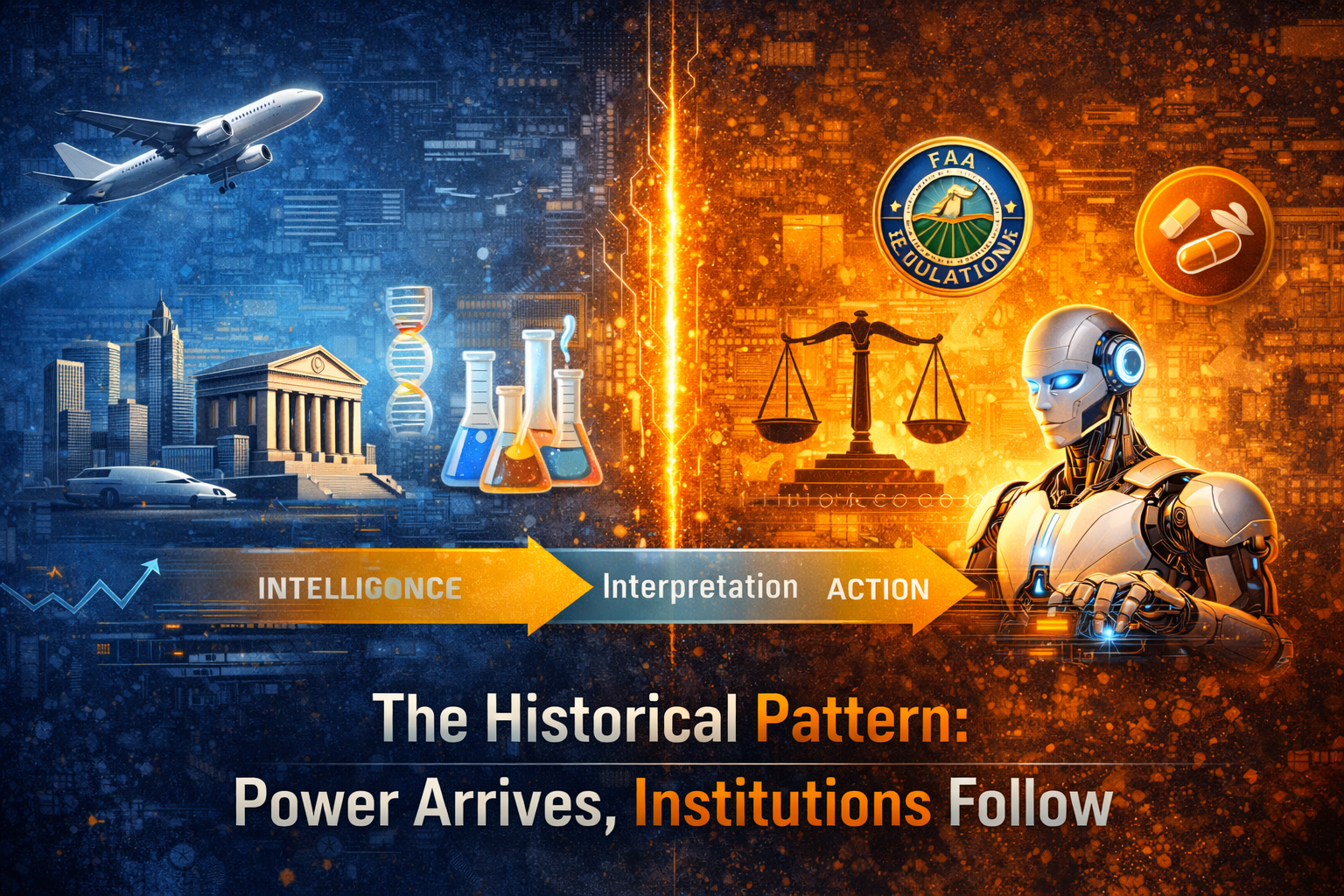
The historical pattern: power arrives, institutions follow
Across modern history, when new forms of power emerged, societies did not “solve” the power by improving the tool. They created institutions to contain and legitimize it.
When decision power became scalable, we built:
- compliance regimes,
- auditability,
- due process,
- standards,
- incident response,
- consumer protections, and
- liability frameworks.
AI agency is the next power shift. But institutional response is lagging.
That lag is not a moral problem. It is a systems problem.
And systems problems need architecture.
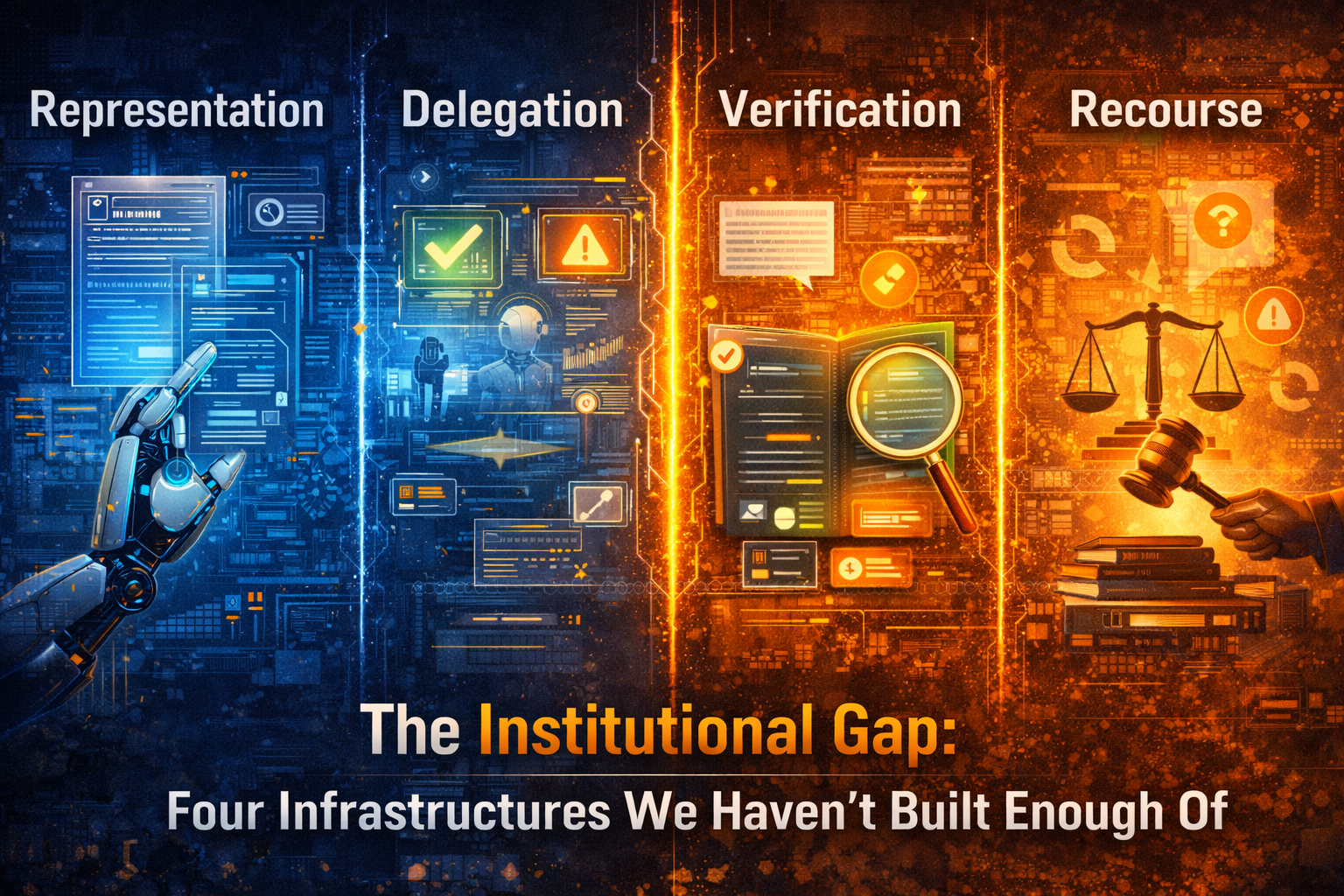
The institutional gap: four infrastructures we haven’t built enough of
To contain machine agency, you don’t need one policy. You need institutional infrastructure—repeatable systems that make agency safe, contestable, and auditable at scale.
Four infrastructures matter most.
1) Representation infrastructure: making reality machine-legible
AI can only act on what it can represent. Many real-world contexts—exceptions, informal processes, tacit constraints, unstructured edge cases—are not fully legible to machines.
When representation is weak:
- agents misinterpret intent,
- policies are applied inconsistently,
- edge cases become failures.
Representation infrastructure is the layer that translates messy reality into structured meaning: signals, context, constraints, and intent.
Without it, agency becomes guesswork.
2) Delegation infrastructure: the rules of “what the machine may do”
Delegation is not “turning on autonomy.” Delegation is a contract:
- what decisions are delegable,
- under what thresholds,
- with what approvals,
- within what bounds,
- with what human override.
Most enterprises delegate informally today (“let it handle low-risk cases”), but in the agency era, delegation must become explicit, testable, and enforceable.
Otherwise autonomy grows through convenience—until it breaks trust.
3) Verification infrastructure: proving what happened and why
When agents act, you need more than logs. You need decision evidence:
- what inputs were used,
- what policy applied,
- what tool calls executed,
- what thresholds were met,
- what human approvals occurred,
- what exceptions were triggered.
This is not optional. For example, the EU AI Act includes explicit expectations for record-keeping/logging for high-risk AI systems. (AI Act Service Desk)
Similarly, OECD’s principles emphasize transparency, traceability, and accountability to enable challenge and inquiry into outcomes. (OECD)
Verification infrastructure is how agency becomes defensible rather than mysterious.
4) Recourse infrastructure: a “way back” when agency causes harm
Recourse is the ability to:
- contest a decision,
- pause or override an agent,
- reverse outcomes where possible,
- compensate where reversal is impossible, and
- learn so it doesn’t repeat.
In an agency world, recourse becomes scarce because action is fast, distributed, and deeply embedded into workflows.
That makes “way back” architecture a competitive advantage—not just a compliance feature.
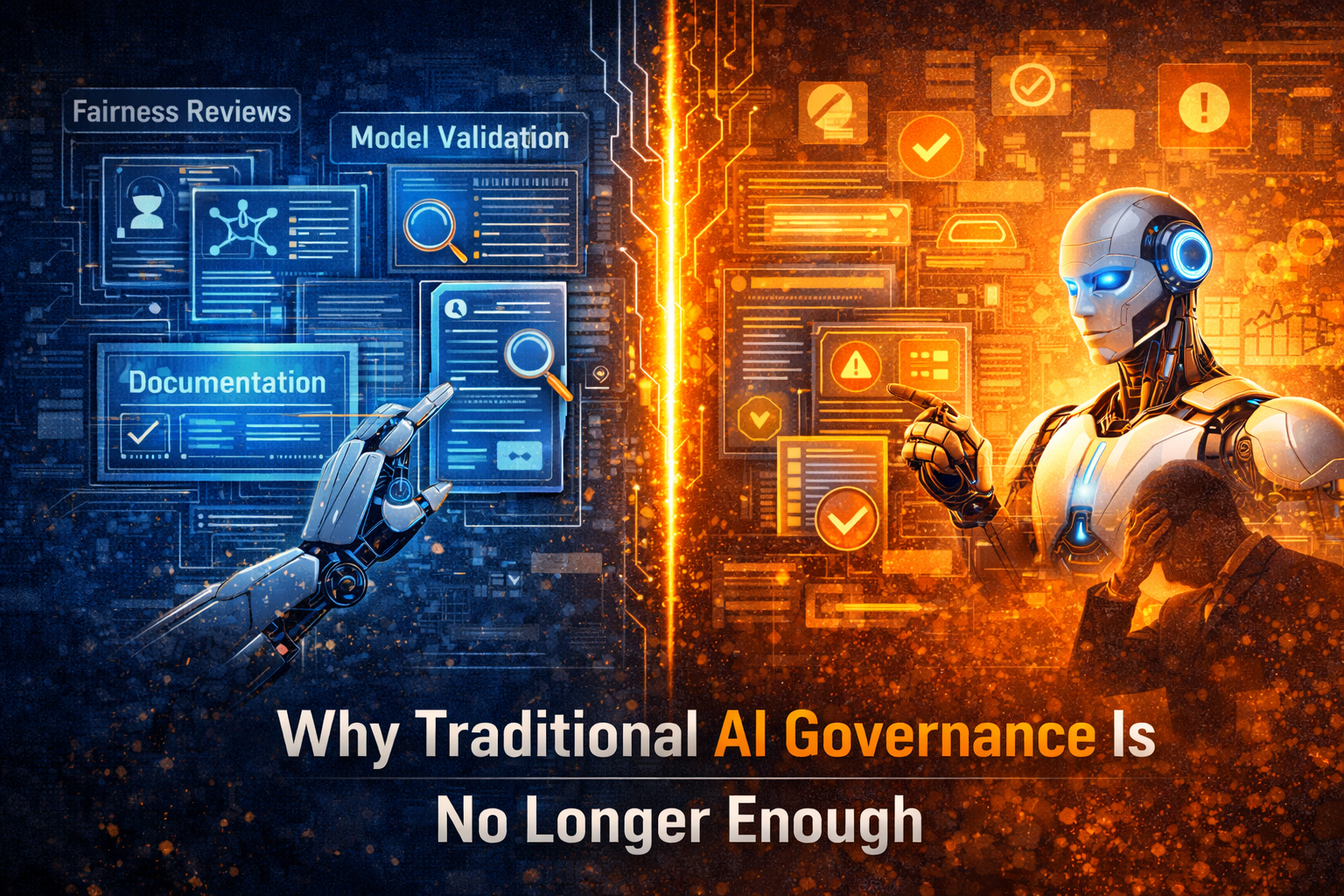
Why traditional AI governance is no longer enough
Most governance programs were designed for models, not actors.
They focus on:
- fairness and bias reviews,
- model validation,
- documentation,
- approval gates.
These are necessary—but insufficient.
Agency introduces runtime problems:
- Agents can chain actions across tools.
- Failures can be emergent (no single “bad output,” but a harmful sequence).
- Responsibility can be diffused across builders, deployers, tool owners, and policy owners.
- Model updates can change behavior without changing business process documentation.
This is why governance must evolve into something closer to operational risk management for autonomous systems.
The NIST AI Risk Management Framework makes this shift explicit by organizing AI risk management into GOVERN, MAP, MEASURE, and MANAGE as a lifecycle discipline, not a one-time review. (NIST Publications)
And ISO/IEC 42001 formalizes the idea of an AI management system: establishing, implementing, maintaining, and continually improving how AI is governed inside organizations. (ISO)
Agency makes that shift unavoidable.
The new operating reality: decisions at machine speed
Even if you never deploy a “fully autonomous agent,” the moment you allow AI to:
- approve,
- deny,
- route,
- block,
- release, or
- trigger
…you have machine-speed decision loops.
That changes the operational physics:
- Volume explodes (many more micro-decisions).
- Time compresses (less time for human review).
- Complexity rises (multi-system consequences).
- Visibility drops (harder to know what’s running where).
- Accountability blurs (who “made” the decision?).
This is why the agency crisis is really a governance architecture crisis.
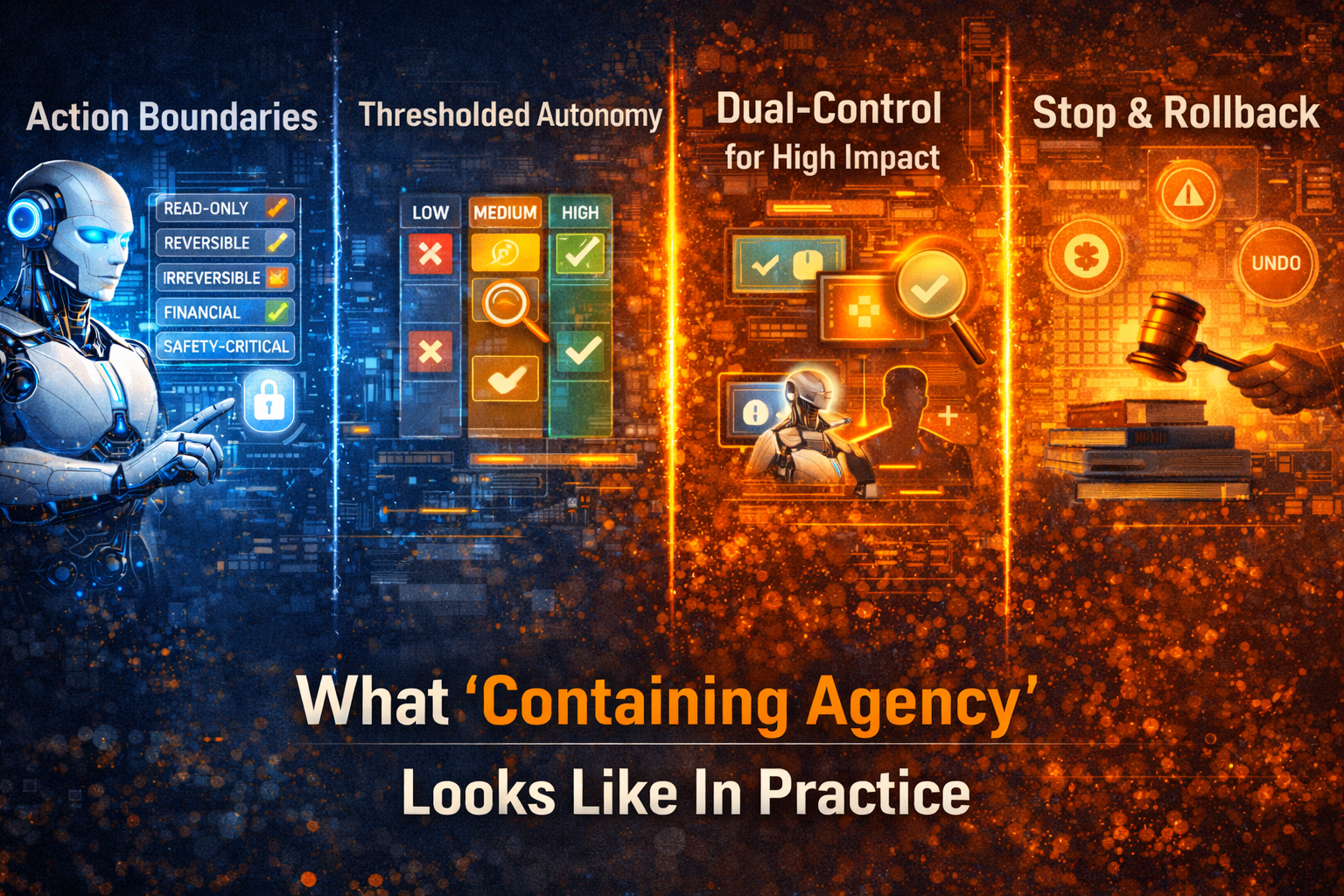
What “containing agency” looks like in practice
Containing agency does not mean “no autonomy.” It means bounded autonomy.
Action boundaries
Define what actions are allowed, by class:
- read-only actions
- reversible actions
- irreversible actions
- financially material actions
- safety-critical actions
Then enforce constraints by category.
Thresholded autonomy
Allow autonomy only when confidence is high and blast radius is low.
- When confidence is medium, require human review.
- When confidence is low, require escalation or deny.
Dual-control for high impact
For certain actions, require two independent confirmations:
- two signals,
- two models, or
- model + human.
Not for bureaucracy—because agency can fail quietly.
Continuous evidence capture
Treat decisions like transactions: every action produces a structured record.
This is how you build post-incident truth.
“Stop” and “rollback” as first-class features
If you can’t stop it, you don’t control it.
If you can’t roll it back, you don’t understand the cost of error.
Recourse cannot be a patch. It must be designed.
Why this matters for boards, not just engineers
Boards are used to overseeing:
- financial controls,
- operational controls,
- cybersecurity controls.
AI agency creates a new control surface:
Decision controls.
Because AI agents are not just automating tasks. They are altering how decisions are made, recorded, audited, and contested.
This is why the advantage in the AI decade will not belong to organizations with the biggest models.
It will belong to organizations that build:
- trustworthy delegation,
- verifiable decisioning, and
- scalable recourse.
In other words:
Institutions that can safely host machine agency will compound advantage.
The global direction of travel: institutions are catching up
Across major standards bodies and policy frameworks, a consistent direction is emerging:
- traceability and accountability expectations (OECD) (OECD.AI)
- explicit record-keeping/logging requirements for certain contexts (EU AI Act) (AI Act Service Desk)
- operational, lifecycle risk management for AI (NIST AI RMF) (NIST Publications)
- management-system approaches for AI governance (ISO/IEC 42001) (ISO)
The world is converging on the idea that AI must be treated as a governed operational capability, not a feature.
That convergence is institutionalization.
But enterprise reality is still behind it.
Hence, the crisis.
A simple mental model: tools, agents, institutions
If you want a single line that captures the doctrine:
- Tools increase productivity.
- Agents increase autonomy.
- Institutions make autonomy safe, legitimate, and scalable.
We have built tools.
We are building agents.
But we have not built institutions fast enough.
That mismatch is the agency crisis.
Key Insight
The AI agency crisis describes the gap between rapidly advancing machine intelligence capable of autonomous action and the slower development of institutions that govern, verify, and contain that intelligence.
Why It Matters
Without institutional infrastructure, AI agency can create systemic risks in finance, healthcare, cybersecurity, governance, and enterprise operations.
What Must Be Built
Four infrastructures are critical:
-
Representation Infrastructure
Systems that translate real-world signals into machine-understandable representations. -
Delegation Infrastructure
Mechanisms that define what decisions AI systems are allowed to make. -
Verification Infrastructure
Continuous validation systems that check whether AI decisions are correct, lawful, and aligned. -
Recourse Infrastructure
Systems that allow humans to challenge, reverse, or correct AI decisions.
Conclusion
AI’s agency crisis is not a story about runaway models. It is a story about institutional lag.
The moment intelligence becomes action-capable, governance stops being a document and becomes infrastructure: representation that makes context legible, delegation that defines authority, verification that produces evidence, and recourse that creates a way back.
The next decade will not reward the most enthusiastic adopters. It will reward the most institutionally prepared builders—organizations that can let machine intelligence act without surrendering trust.
If you are a board member or C-suite executive, the most important question to ask is no longer:
“Where can we use AI?”
It is:
“Where are we willing to grant agency—and what institutional infrastructure must exist before we do?”
Because in the agency era, competitive advantage is no longer just intelligence.
It is contained intelligence.
Glossary
AI agency (machine agency): The ability of an AI system to select and execute actions that create real-world consequences.
Bounded autonomy: Autonomy constrained by explicit limits, thresholds, approvals, and override mechanisms.
Delegation infrastructure: Policies, controls, and runtime enforcement that define what decisions can be delegated to AI and under what conditions.
Verification infrastructure: Evidence systems (logging, traceability, documentation) that can prove what the AI did, why it did it, and what it used.
Recourse infrastructure: Mechanisms that enable contestability, reversibility, remediation, and learning after harm.
Representation infrastructure: Systems that translate real-world context into machine-legible signals, constraints, and intent.
Decision controls: The governance mechanisms that constrain, log, and audit machine decisions the way institutions constrain financial or operational actions.
FAQ
Is the “agency crisis” just another AI safety argument?
No. Safety is part of it, but the deeper issue is institutional capacity. Even accurate systems can create harm if delegation, verification, and recourse are missing or unenforced.
Can’t we solve this by using better models?
Better models reduce certain risks, but they don’t create accountability. The crisis is not only about intelligence quality—it’s about governing action at scale.
What should leaders do first?
- Inventory where AI can trigger actions.
- Classify actions by reversibility and impact.
- Implement evidence capture (decision-level traceability).
- Define stop/override paths and a recourse mechanism.
How do standards and regulation connect to this?
They are signals that governance is becoming formal. The EU AI Act highlights record-keeping/logging for high-risk systems, OECD emphasizes traceability and accountability, NIST provides lifecycle risk management functions (GOVERN/MAP/MEASURE/MANAGE), and ISO/IEC 42001 defines an AI management system approach. (AI Act Service Desk)
References and further reading
- EU AI Act Service Desk — Article 12: Record-keeping/logging for high-risk AI systems. (AI Act Service Desk)
- ArtificialIntelligenceAct.eu — Article 12 (unofficial consolidated text/translation; use official legal text for compliance decisions). (Artificial Intelligence Act)
- NIST — AI Risk Management Framework (AI RMF 1.0). (NIST Publications)
- OECD — AI Principles (Transparency/Explainability; Accountability/Traceability). (OECD)
- ISO — ISO/IEC 42001: AI management systems standard overview. (ISO)



Raktim Singh is an AI and deep-tech strategist, TEDx speaker, and author focused on helping enterprises navigate the next era of intelligent systems. With experience spanning AI, fintech, quantum computing, and digital transformation, he simplifies complex technology for leaders and builds frameworks that drive responsible, scalable adoption.