

That may sound abstract. It is not.
It is already visible in the gap between AI adoption and durable enterprise value. McKinsey’s 2025 global survey found that 78% of organizations use AI in at least one business function and 71% regularly use generative AI in at least one function. Yet most respondents still reported no material enterprise-level EBIT impact from generative AI. Adoption is spreading faster than structural value creation. (McKinsey & Company)
That gap matters because it tells us something important: the next phase of AI competition will not be decided simply by who has access to a model. It will be decided by who can turn machine capability into trusted delegated action.
That is where Delegation Capital Markets begin.
In the age of Representation Economics, capital will increasingly flow toward institutions that can demonstrate five things with credibility:
- they can represent reality well,
- they can reason over that reality responsibly,
- they can delegate bounded authority to machines,
- they can verify and correct mistakes,
- and they can do all of this at scale.
That is the valuation logic of the AI era.
Delegation Capital Markets describe the emerging valuation logic of the AI era. As AI becomes cheaper and more accessible, competitive advantage shifts to organizations that can safely delegate machine authority. In the Representation Economics framework, this depends on strong SENSE (reality representation), CORE (reasoning), and DRIVER (governance and execution). The future winners will not simply use AI—they will institutionalize trusted machine action at scale.

Why today’s AI conversation is still incomplete
Most AI strategy conversations are still stuck in an old frame.
They focus on questions like:
Who has the biggest model?
Who has the most data?
Who has the best copilots?
Who has the lowest inference cost?
These questions matter, but they are no longer sufficient.
Stanford’s 2025 AI Index shows why. The cost of querying a model performing at GPT-3.5 level dropped from $20 per million tokens in November 2022 to $0.07 per million tokens by October 2024, a more than 280-fold reduction. At the same time, the Stanford report notes that corporate AI investment reached $252.3 billion in 2024. In other words, intelligence is becoming cheaper to access even as investment in AI infrastructure and adoption continues to rise. (Stanford HAI)
When intelligence becomes cheaper and more available, value shifts elsewhere.
It shifts from raw cognition to institutional operability.
A chatbot that answers questions is useful. But an AI system that approves a loan, re-routes a shipment, changes a claims decision, releases a payment, escalates a fraud case, or modifies a supply-chain workflow is something very different.
The moment AI moves from advice to action, a deeper economic question appears:
How much machine authority can this institution safely carry?
That is what Delegation Capital Markets will price.
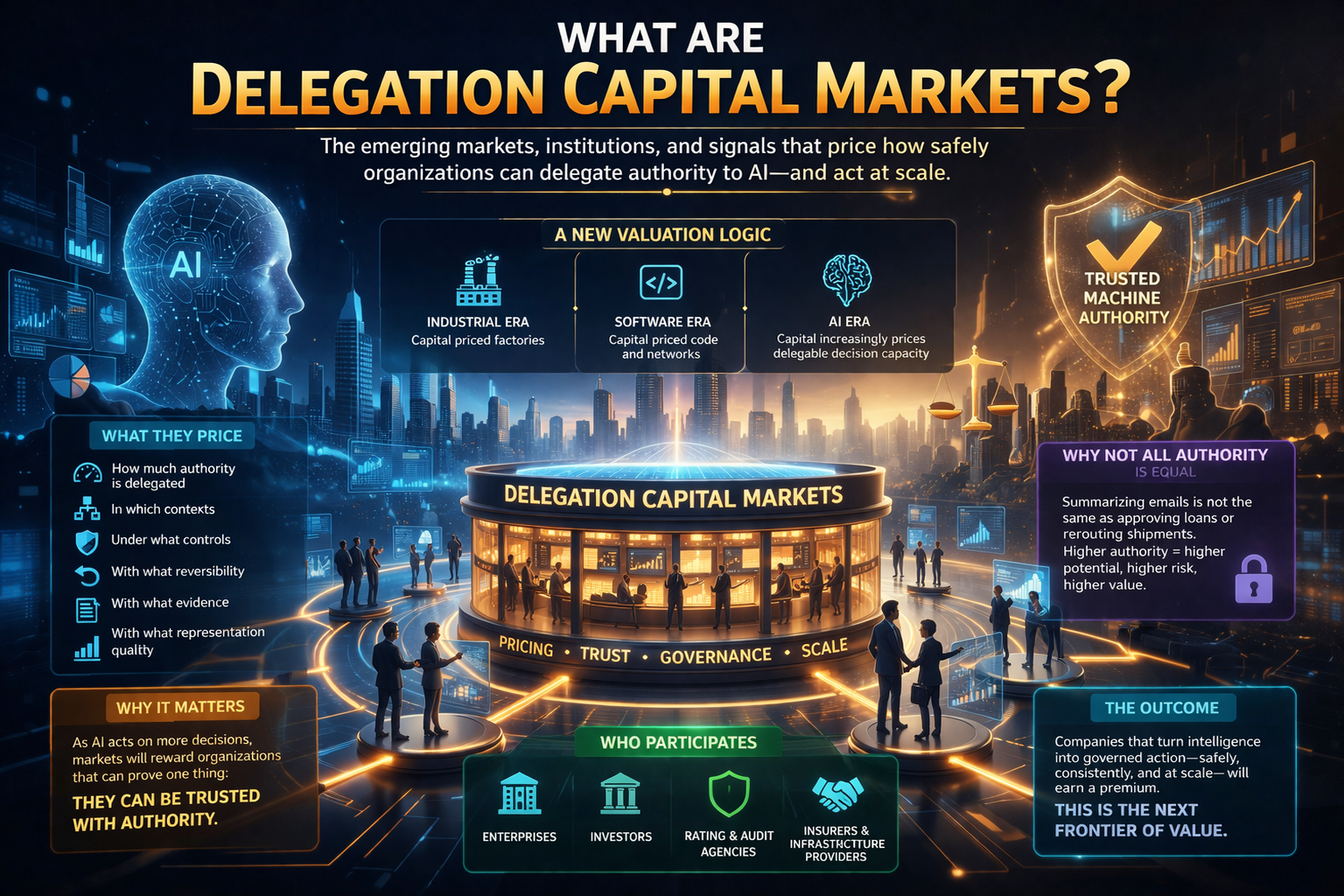
What are Delegation Capital Markets?
Delegation Capital Markets are the emerging markets, institutions, metrics, signals, and intermediaries that will determine how organizations are valued based on their ability to absorb, govern, and scale machine authority.
Put simply:
In the industrial era, capital priced factories.
In the software era, capital priced code and networks.
In the AI era, capital will increasingly price delegable decision capacity.
Not all machine authority is equal.
A company that uses AI to summarize meetings is not in the same category as a company that lets AI negotiate discounts with suppliers, dynamically triage insurance claims, optimize power-grid operations, or coordinate thousands of semi-autonomous workflows.
The second company is operating with a higher degree of delegated authority. That creates speed, scale, and margin potential. But it also creates fragility, liability, governance risk, and reputational exposure.
So markets will increasingly ask:
- How much authority is being delegated?
- In which contexts?
- Under what constraints?
- With what reversibility?
- With what evidence?
- With what representation quality?
Those questions will shape future premiums.
A simple example: two logistics companies
Imagine two logistics firms.
Both license strong AI models.
Both have similar technology budgets.
Both describe themselves as AI-enabled.
But inside the business, they are fundamentally different.
Company A uses AI for internal productivity. It drafts emails, summarizes reports, and helps analysts explore operational data.
Company B does all that too. But it also lets AI systems recommend rerouting decisions, predict port delays, rebalance warehouse flows, identify contractual exceptions, and prepare actions for approval. In a few low-risk contexts, it allows the system to act automatically within pre-defined limits.
To an outsider, both firms appear to be “using AI.”
To Delegation Capital Markets, they are not remotely the same.
Company B has a stronger delegation profile. If it has designed the right controls, it can convert intelligence into faster action, lower friction, better asset utilization, and improved customer responsiveness.
But only if its foundations are strong.
That is why Delegation Capital Markets cannot be understood through models alone. They depend on the full institutional stack behind machine action.
Why SENSE–CORE–DRIVER matters
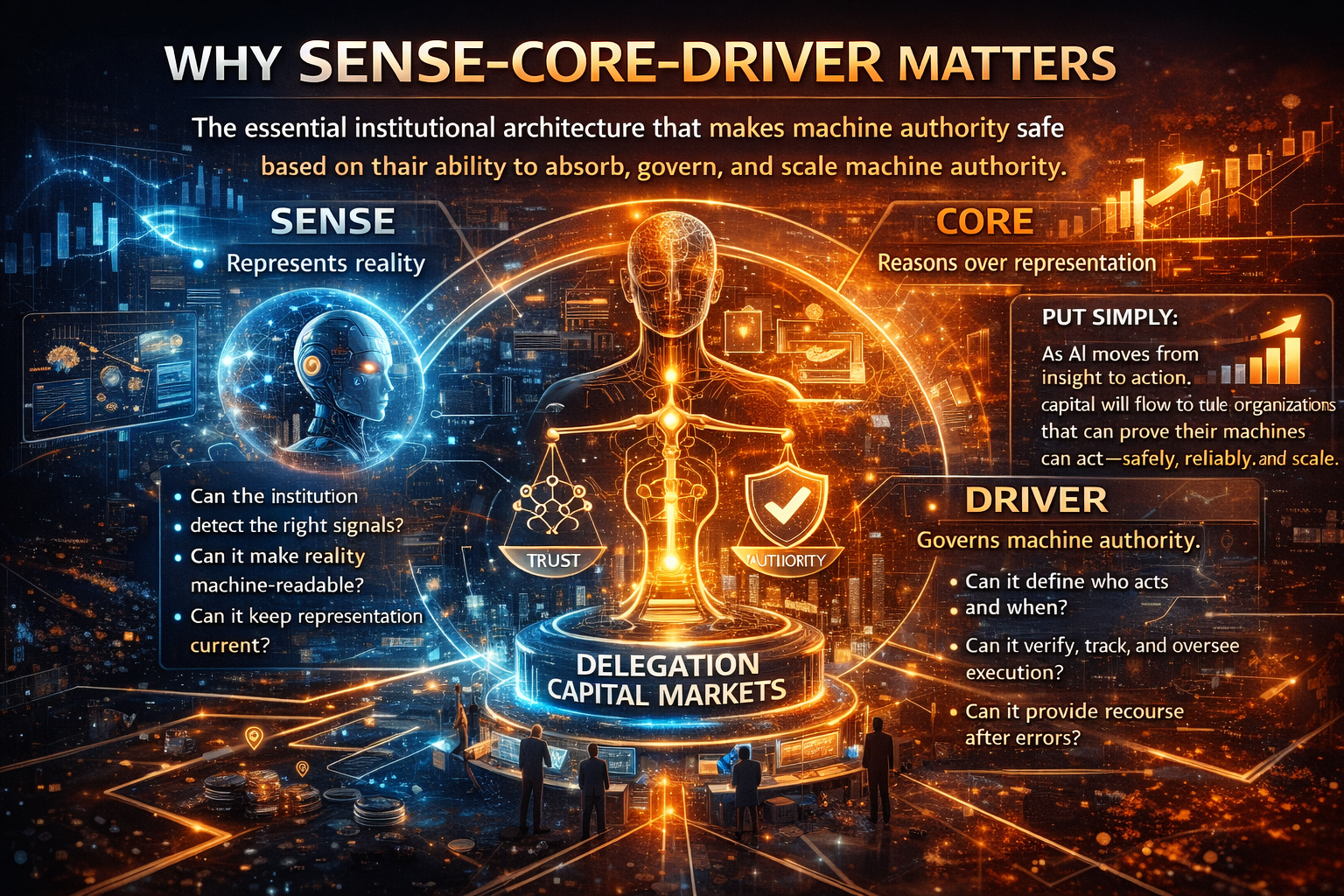
This is where the SENSE–CORE–DRIVER framework becomes essential.
Delegation is not just a software issue. It is an institutional architecture issue.
SENSE: Can the institution represent reality clearly?
Can it detect the right signals, attach them to the right entities, build a usable state representation, and keep that representation updated as reality changes?
If not, AI will act on a distorted view of the world.
A bank cannot safely delegate credit decisions if income records, fraud history, entity linkage, and repayment behavior are fragmented.
A hospital cannot safely delegate triage if patient state is incomplete.
A manufacturer cannot safely delegate maintenance scheduling if sensor data is stale or missing.
This is why so many AI failures begin before the model begins.
CORE: Can the institution reason over that reality responsibly?
Can it apply enough context, policy awareness, trade-off handling, and judgment to make decisions that are not just plausible, but dependable?
If not, the system may sound intelligent while remaining operationally unsafe.
DRIVER: Can the institution govern machine action?
Can it define who delegated authority, under what limits, with what verification, with what execution controls, and with what recourse when something goes wrong?
If not, even a technically correct recommendation can become a damaging institutional action.
This is the central point:
Delegation Capital Markets will not price intelligence in isolation. They will price the full stack required to let intelligence act safely.
That is why this topic sits naturally inside Representation Economics.
Because the market is not ultimately rewarding “smart systems.”
It is rewarding representable, governable, delegable systems.

Why this is becoming a real market question
Three global shifts are converging.
First, AI adoption is broad, but scaled value still depends on workflow redesign, management discipline, and operating model change. McKinsey’s 2025 findings show that organizations seeing more bottom-line impact from AI are more likely to redesign workflows, track ROI carefully, and involve senior leaders in AI governance. (McKinsey & Company)
Second, AI systems are moving closer to real-world action. The World Economic Forum has argued that, as AI agents gain access to tools, systems, and external environments, autonomy and authority must be treated as deliberate design variables rather than accidental byproducts. Higher-consequence tasks require clearer boundaries, segmented access, stronger evaluation, logging, and accountability. (World Economic Forum)
Third, global governance is converging around trustworthiness, accountability, transparency, robustness, and lifecycle oversight. The OECD AI Principles, updated in 2024, frame trustworthy AI as a global policy priority, while NIST’s AI Risk Management Framework explicitly aims to embed trustworthiness into the design, development, use, and evaluation of AI systems. (OECD)
Put these together, and the implication is clear:
The market is moving from
Can you deploy AI?
to
Can you institutionalize delegated machine authority?
That is a far more consequential question.
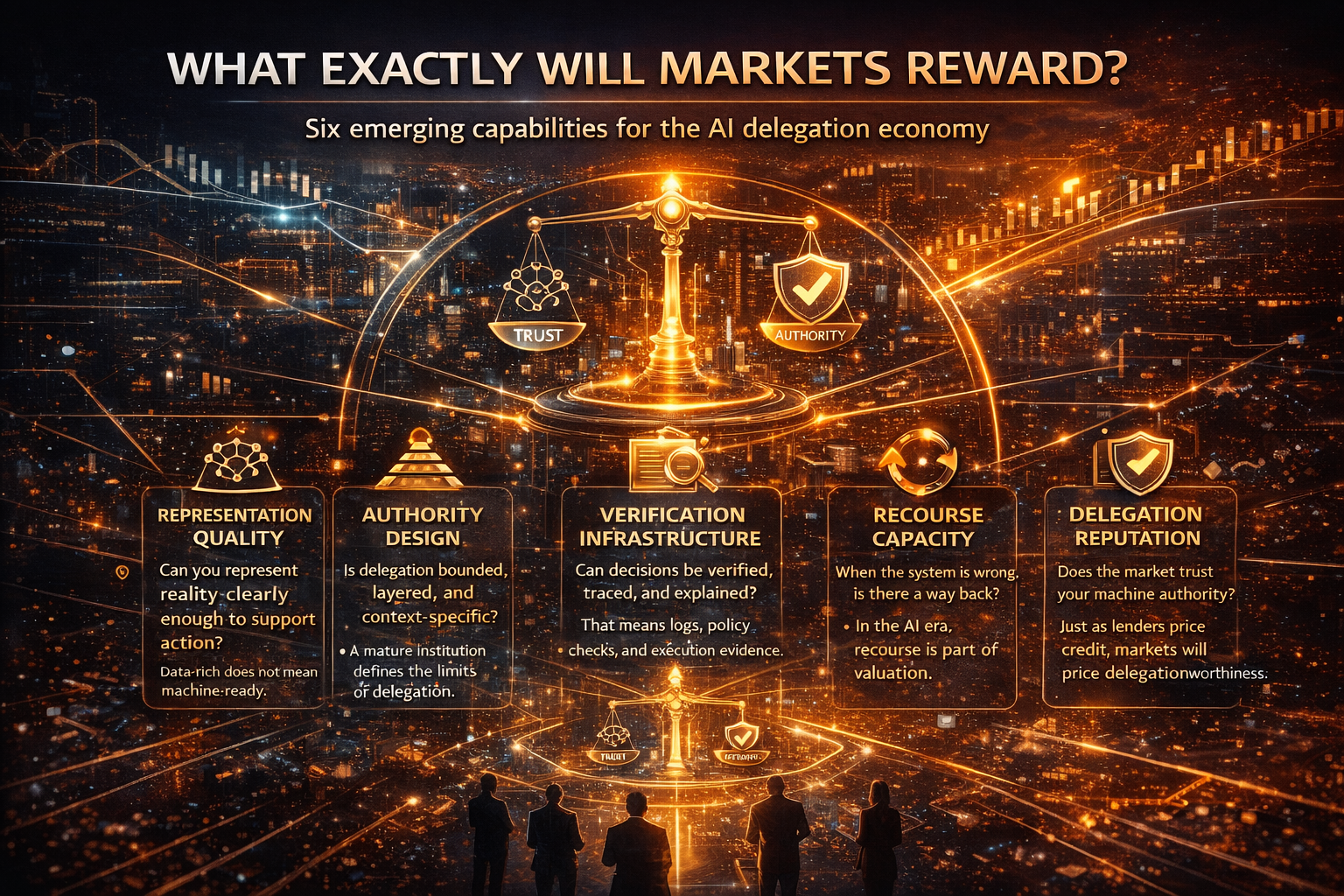
What exactly will markets reward?
Delegation Capital Markets are likely to reward six capabilities.
-
Representation quality
Can your systems see reality clearly enough to support action?
This is not just a data issue. It is a representational issue. Data-rich does not always mean machine-ready.
-
Authority design
Is delegation bounded, layered, and context-specific?
A mature institution does not say, “Let the agent handle everything.”
It defines:
- what can be recommended,
- what can be executed,
- what requires approval,
- what is reversible,
- and what is never delegable.
-
Verification infrastructure
Can the institution reconstruct what the system saw, why it acted, and whether it stayed within its mandate?
That means logs, policy checks, decision records, state snapshots, approval trails, and incident reconstruction.
-
Recourse capacity
When the system is wrong, is there a way back?
In the AI economy, recourse is not a footnote. It is part of valuation. A firm with no correction pathway may look efficient in the short term, but fragile in the long term.
-
Change resilience
Can the institution remain aligned as models, tools, workflows, regulations, and operating conditions change?
Static compliance will not be enough. Lifecycle governance is increasingly the real requirement. (NIST)
-
Delegation reputation
Does the market trust this institution’s machine authority?
Just as lenders price creditworthiness, future markets may increasingly price delegationworthiness.

The new firms that may emerge
A strong theory does not just explain today’s world. It predicts tomorrow’s categories.
If Delegation Capital Markets become real, several new types of firms are likely to emerge.
Delegation rating agencies
These firms would assess how safely an institution can delegate machine authority in specific operating contexts.
Delegation auditors
These evaluators would test not only model quality, but authority boundaries, execution chains, rollback paths, decision evidence, and control maturity.
Delegation insurers
These players would underwrite machine-action risk where governance maturity is strong enough.
Delegation exchanges
These could become platforms where trusted, machine-operable organizations are easier to finance, partner with, insure, procure from, or integrate into multi-party workflows.
Delegation infrastructure providers
These firms would provide the control layer between AI reasoning and real-world execution.
These categories will not emerge because they sound fashionable. They will emerge because markets need ways to price, compare, and trust machine authority.
Why this changes valuation logic for boards and investors
For decades, companies were valued through familiar lenses: labor scale, physical assets, software leverage, brand power, network effects, and market share.
In the AI era, another variable is entering the picture:
delegated operating capacity
Imagine two insurers with similar books of business.
One still depends heavily on manual teams to process exceptions, update underwriting assumptions, investigate anomalies, and resolve claims disputes.
The other has built stronger representation layers, clearer escalation rules, tighter auditability, stronger recourse, and safer bounded autonomy. It allows machines to handle far more routine and semi-routine action without losing control.
Over time, the second insurer may deserve a premium not because it merely “uses AI,” but because it has a superior ability to convert intelligence into governed operating throughput.
That is the beginning of Delegation Capital Markets.
Why most companies are not ready
Many firms are overinvesting in CORE and underinvesting in SENSE and DRIVER.
They are buying models before fixing entity resolution.
They are piloting agents before defining authority boundaries.
They are celebrating automation before designing correction.
They are discussing productivity before establishing legitimacy.
That is why so many AI programs look impressive in demos but weak in production.
The problem is not always intelligence.
The problem is that the institution has not yet become a safe carrier of delegated machine authority.
The question every board should now ask
Boards need a new strategic question:
What is our Delegation Capacity, and what is preventing it from compounding?

That single question forces a better conversation.
It pushes leadership to examine:
- representation quality,
- decision clarity,
- escalation design,
- reversibility,
- regulatory defensibility,
- and the economics of machine action.
It also separates hype from structural advantage.
A company may have strong AI branding and still have weak delegation capacity.
Another may appear quiet externally while building the deepest long-term advantage in its sector.
Why this matters globally
This is not only an enterprise architecture issue. It is a global competitiveness issue.
Countries, sectors, and firms that build better systems for representation, bounded delegation, and institutional trust will likely move faster in the AI economy than those that focus only on models.
That is why Delegation Capital Markets have GEO value as a concept. The idea connects enterprise AI, governance, valuation, risk, policy, trust, and operating model redesign in one frame. It answers a question executives, investors, regulators, and strategy editors are all beginning to ask in different ways:
What separates firms that merely use AI from firms that become structurally stronger because of AI?
My answer is this:
They differ in how much machine authority they can safely absorb.
Conclusion: the next premium in the AI economy
The next premium in the AI economy will not come simply from owning intelligence.
It will come from proving that intelligence can be trusted with authority.
That is what markets will increasingly reward.
Not the loudest AI story.
Not the largest model budget.
Not the flashiest demonstration.
But the institution that can say:
We can represent reality well.
We can reason over it responsibly.
We can delegate within boundaries.
We can verify what happened.
We can recover when things go wrong.
And we can do all of this at scale.
That is not just an operational advantage.
It is a new form of capital.
And the firms that understand this early will not just use AI better.
They will be priced differently because of it.
Conclusion column
What boards should remember
Delegation Capital Markets are the missing bridge between AI capability and enterprise value. As intelligence becomes cheaper and more accessible, the real premium will move to firms that can govern machine authority responsibly. In practical terms, that means strong representation, disciplined reasoning, bounded delegation, verification, and recourse. The future winners of AI will not simply deploy more models. They will build institutions that machines can act through without breaking trust.
Glossary
Delegation Capital Markets
The emerging valuation logic through which firms are assessed based on how safely and effectively they can delegate machine authority.
Machine authority
The practical power given to an AI system to recommend, trigger, approve, or execute actions within defined boundaries.
Delegation capacity
An institution’s ability to absorb, govern, and scale machine authority without losing trust, control, or reversibility.
Representation Economics
A strategic and economic lens that argues AI-era value will increasingly depend on who can make reality legible, reliable, and actionable for machines.
SENSE
The legibility layer: signal detection, entity attachment, state representation, and evolution over time.
CORE
The cognition layer: the reasoning, interpretation, optimization, and learning processes that convert represented reality into decisions.
DRIVER
The governance and legitimacy layer: delegation, representation, identity, verification, execution, and recourse.
Delegation reputation
The degree to which markets trust an institution’s ability to let AI act responsibly.
Recourse
The ability to challenge, correct, reverse, or recover from an AI-driven decision or action.
Delegationworthiness
A practical way to describe how trustworthy a firm is as a carrier of machine authority.
FAQ
What are Delegation Capital Markets?
Delegation Capital Markets are the emerging market mechanisms through which firms will increasingly be valued based on how safely and effectively they can delegate authority to AI systems.
Why is this different from general AI adoption?
Because many firms can use AI tools, but far fewer can let AI act inside real workflows with strong controls, accountability, reversibility, and trust.
How does this relate to Representation Economics?
Representation Economics explains that value in the AI era depends on making reality legible and actionable for machines. Delegation Capital Markets describe how markets may price that capability.
Why does SENSE–CORE–DRIVER matter here?
Because safe delegation depends on three conditions at once: reality must be represented clearly, reasoning must be dependable, and action must be governed with verification and recourse.
Why should boards care about this now?
Because the economic upside of AI increasingly depends on action, not just insight. Once AI starts influencing or executing operational decisions, governance maturity becomes a source of valuation premium.
What kinds of companies could emerge from this shift?
Likely categories include delegation rating agencies, delegation auditors, delegation insurers, delegation infrastructure providers, and delegation exchanges.
What is the simplest way to understand this idea?
AI by itself is not the premium. The premium comes when an institution can let AI act without breaking trust.
References and further reading
For the market and governance context behind this article, the most relevant current references are:
- McKinsey, The State of AI: How Organizations Are Rewiring to Capture Value — for adoption rates, workflow redesign, and value realization patterns. (McKinsey & Company)
- Stanford HAI, AI Index 2025 — for cost compression, market momentum, and investment signals. (Stanford HAI)
- OECD, AI Principles — for the global policy framing of trustworthy AI. (OECD)
- NIST, AI Risk Management Framework — for lifecycle trustworthiness and governance design. (NIST)
- World Economic Forum, From Chatbots to Assistants: Governance Is Key for AI Agents and related agent-governance work — for the shift from passive AI tools to bounded autonomy. (World Economic Forum)
Explore the Architecture of the AI Economy
This article is part of a broader research series exploring how institutions are being redesigned for the age of artificial intelligence. Together, these essays examine the structural foundations of the emerging AI economy — from signal infrastructure and representation systems to decision architectures and enterprise operating models. If you want to explore the deeper framework behind these ideas, the following essays provide additional perspectives:
-
- The Representation Economy: Why AI Institutions Must Run on SENSE, CORE, and DRIVER – Raktim Singh
- The Representation Economy: Why Intelligent Institutions Will Run on the SENSE–CORE–DRIVER Architecture – Raktim Singh
- Representation Failure: Why AI Systems Break When Institutions Misread Reality – Raktim Singh
- The Firm of the AI Era Will Be Built Around Representation: Why Institutions Must Redesign Themselves for the SENSE–CORE–DRIVER Economy – Raktim Singh
- The Representation Stack: The New Architecture of Intelligent Institutions in the AI Economy – Raktim Singh
- Representation Economics: The New Law of Value Creation in the AI Era – Raktim Singh
- Representation Alpha: Why Competitive Advantage Will Come from Better Representation, Not Better Models – Raktim Singh
- • Why Most AI Projects Fail Before Intelligence Even Begins
- What Is the Representation Economy? (raktimsingh.com)
- The Representation Economy: Why AI Institutions Must Run on SENSE, CORE, and DRIVER (raktimsingh.com)
- Decision Scale: Why Competitive Advantage Is Moving from Labor Scale to Decision Scale (raktimsingh.com)
- Firms Won’t Be Defined by Employees. They Will Be Defined by Delegation – Raktim Singh
- The New Company Stack: The 7 Business Categories That Will Emerge in the Representation Economy – Raktim Singh
- The Representation Attack Surface: Why AI’s Biggest Threat Is Reality Hacking, Not Model Hacking – Raktim Singh
- The Chief Representation Officer: Why Institutions Collapse When Machine-Readable Reality Falls Behind – Raktim Singh
- The Scarcity of Reality: Why the AI Economy Will Be Defined by the Lifecycle of High-Trust Representation – Raktim Singh
- Delegation Rating Agencies: Why the AI Economy Needs a New System to Rate Machine Authority – Raktim Singh
- The Machine-Readable Franchise: How Small Firms Will Win in the AI Trust Economy – Raktim Singh
- Representation Due Diligence: Why Every AI-Era Deal Must Start with a Reality Audit – Raktim Singh
Together, these essays outline a central thesis:
The future will belong to institutions that can sense reality, represent it clearly, reason about it intelligently, and act through governed machine systems.
This is why the architecture of the AI era can be understood through three foundational layers:
SENSE → CORE → DRIVER
Where:
- SENSE makes reality legible
- CORE transforms signals into reasoning
- DRIVER ensures that machine action remains accountable, governed, and institutionally legitimate
Signal infrastructure forms the first and most foundational layer of that architecture.
AI Economy Research Series — by Raktim Singh



Raktim Singh is an AI and deep-tech strategist, TEDx speaker, and author focused on helping enterprises navigate the next era of intelligent systems. With experience spanning AI, fintech, quantum computing, and digital transformation, he simplifies complex technology for leaders and builds frameworks that drive responsible, scalable adoption.