
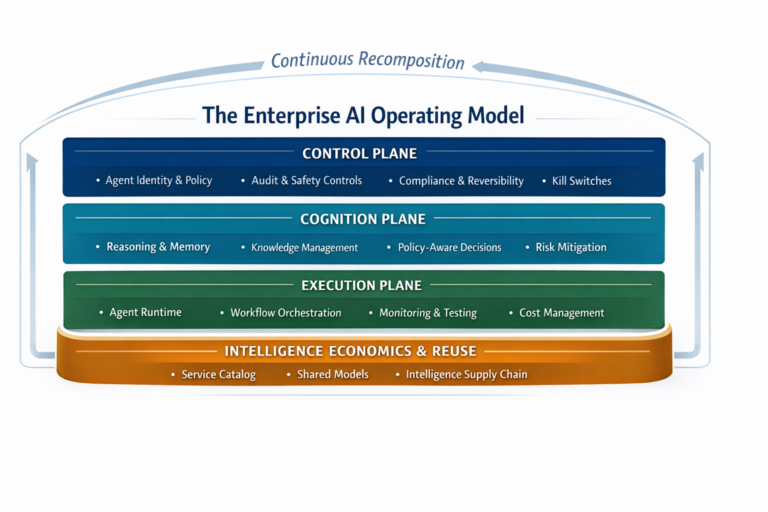
Once AI systems begin to reason, decide, and act inside real workflows, the challenge changes: enterprises must learn how to run intelligence—safely, visibly, and economically—at scale.This page defines the Enterprise AI Operating Model: a practical, architecture-level framework for building and operating AI systems that are:
- Accountable (actions are explainable and auditable)
- Governed (policy is enforced, not documented)
- Operable (reliable, observable, reversible)
- Economically sustainable (reuse beats reinvention)
- Change-ready (the system evolves without breaking)
If you’ve ever seen AI look “fine” in pilots and then unravel in production—this is the missing blueprint.
What “Enterprise AI” Actually Means
Many initiatives labeled “enterprise AI” are simply AI tools inside an enterprise.
Enterprise AI begins when:
- AI outputs influence decisions, customers, compliance, or money, and
- AI starts taking actions (directly or via humans-in-the-loop), and
- the enterprise must guarantee safety, traceability, and stability over time.
In other words: Enterprise AI is an operating discipline, not a deployment milestone.
Read next:
What Is Enterprise AI? A 2026 Definition for Leaders Running AI in Production – Raktim Singh
The Action Threshold: Why Enterprise AI Starts Failing the Moment It Starts Acting – Raktim Singh
The Enterprise AI Failure Pattern
Most production failures are not caused by “bad models.” They are caused by missing operating structure.
Here’s the common pattern:
- Pilot success: AI is scoped, supervised, and “quiet.”
- Early scale: more teams adopt; more workflows connect.
- Autonomy expands: AI starts influencing decisions and actions.
- Visibility drops: no one can confidently answer: what is running, where, and with what permissions?
- Runbooks break: model churn, prompt drift, tool changes, and policy changes outpace operational control.
- Trust collapses: incidents, cost spikes, inconsistency, audit friction, user resistance.
The solution is not “a better model.”
The solution is an Enterprise AI Operating Model.
Read next:
What Problem This Model Solves
Most enterprises do not fail at AI because their models are inaccurate; they fail because intelligence cannot be operated safely at scale.
As AI systems move from advising humans to acting inside real workflows—approving transactions, triggering processes, enforcing policies, and coordinating systems—the risk shifts from wrong answers to wrong outcomes.
The Enterprise AI Operating Model solves this gap by defining how intelligence is designed, governed, observed, controlled, and reused once it crosses the action threshold. It provides the missing operating layer that ensures AI behaves in production exactly as intended—under change, scale, regulatory pressure, and economic constraints—turning experimental AI into accountable, runnable enterprise capability.
The Enterprise AI Operating Model (At a Glance)

To scale AI safely, enterprises need three coordinated planes, plus an economic layer that makes the system sustainable.
These planes are not conceptual layers; they are operational responsibilities that must exist explicitly in production environments.
Plane 1: The Control Plane
Governance that runs in production
The Control Plane ensures AI systems remain safe, compliant, and manageable as they evolve. It’s the layer that answers:
- Who can the AI act as?
- What can it access?
- Which policies must always hold?
- How do we audit decisions and actions?
- How do we stop or reverse harmful behavior?
Typical Control Plane capabilities
- Agent identity, authentication, authorization
- Policy enforcement and guardrails
- Audit logs and traceability
- Safety gates, approvals, and kill switches
- Reversibility and rollback for autonomous actions
- Compliance mapping and evidence generation
In practice, enterprise control planes increasingly align with global, risk-based governance approaches such as the AI Risk Management Framework | NIST , which emphasizes visibility, accountability, and lifecycle governance for AI systems in production.
Read next:
Plane 2: The Cognition Plane
Reasoning and memory that stay aligned
The Cognition Plane is how enterprise AI systems “think” in a way that is consistent, explainable, and policy-aware.
It answers:
- How does the AI reason, not just generate?
- How does it use enterprise knowledge safely?
- How does it learn and remember without becoming unsafe?
- How do we prevent hallucination-driven action?
Typical Cognition Plane capabilities
- Retrieval + reasoning patterns (beyond basic RAG)
- Enterprise memory with governance (what can be stored, for how long, under what policy)
- Reflection and meta-reasoning (checking confidence, constraints, evidence)
- Structured reasoning artifacts (traces, proofs, rationales suitable for audit)
- Causal and policy-aware reasoning patterns for high-stakes workflows
Read next:
Plane 3: The Execution Plane
Safe action in real systems
The Execution Plane is where AI touches production reality: tools, workflows, records, approvals, and customer outcomes. This is where “helpful AI” becomes operational AI.
It answers:
- How does AI take action safely?
- How do we observe it like production software?
- How do we test and validate autonomous workflows?
- How do we control costs and failure modes?
Typical Execution Plane capabilities
- Agent runtime / production kernel (timeouts, retries, tool safety, deterministic boundaries)
- Observability and SRE practices for autonomous systems
- Quality engineering for agent workflows (testing, evaluation, regression, red-teaming)
- Cost controls and operational budgets (Agentic FinOps)
- Incident management and runbooks for autonomy
Read next:
Enterprise AI Runtime: Why Agents Need a Production Kernel to Scale Safely – Raktim Singh
Agentic FinOps: Why Enterprises Need a Cost Control Plane for AI Autonomy – Raktim Singh
The Economic Layer
Reuse beats reinvention
Enterprises rarely run out of AI ideas. They run out of reuse.
If every team builds bespoke prompts, agents, and workflows, scale collapses under:
- duplicated effort
- inconsistent behavior
- governance gaps
- runaway cost
- fragile integrations
The economic answer is to treat intelligence as a managed asset:
- Reusable AI services, not one-off projects
- Cataloged capabilities with ownership, versioning, SLOs, and cost envelopes
- Supply-chain discipline for models, prompts, tools, and policies
- Reuse metrics that executives can manage
Read next:
Why Enterprises Are Quietly Replacing AI Platforms with an Intelligence Supply Chain – Raktim Singh
The Workforce Reality
The Human–Agent Ratio
Scaling autonomy changes execution. Execution, in turn, reshapes how work is designed, supervised, and trusted.
As AI systems act, leaders must manage a new operational balance:
- how many autonomous workflows can be safely supervised per human, and
- how much judgment must remain human by design.
This is not about replacing people. It’s about ensuring that:
- accountability is clear,
- escalation paths exist,
- control remains intact as volume grows.
Read next:
Continuous Recomposition
Why static architectures fail
Enterprise AI systems are not “implemented.” They are continuously recomposed.
Models change. Tools change. Policies change. Workflows change.
If the enterprise cannot absorb change safely, AI will keep breaking in new ways.
Continuous recomposition is the operating ability to:
- update policies without destabilizing production
- swap models without rewriting the enterprise
- change workflows without losing auditability
- evolve capabilities without fragmenting governance
Read next :
What This Framework Is (and is not)
This is:
- an operating blueprint for production enterprise AI
- a practical architecture for governance + reasoning + runtime
- a way to connect executive intent to engineering reality
In regulated environments, particularly across the European Union, enterprise AI operating models must anticipate obligations emerging from the EU Artificial Intelligence Act | Up-to-date developments and analyses of the EU AI Act, including risk classification, traceability, human oversight, and post-deployment monitoring.
This is not:
- a vendor platform
- a single product category
- a maturity model that ends at “deployment”
The Enterprise AI Operating Model exists because the real challenge is no longer “Can AI work?”
It is: Can we run it—safely and repeatedly—at scale?
Start Here
If you’re building or scaling enterprise AI, begin with these pillars:
- Establish the Control Plane (identity, policy, audit, reversibility)
- Build Cognition that can be governed (memory, reasoning traces, evidence)
- Standardize Execution (runtime, testing, observability, cost controls)
- Productize reuse (service catalog + supply chain discipline)
- Design for recomposition (change velocity as a first-class requirement)
Explore the Library
Control Plane
The AI Platform War Is Over: Why Enterprises Must Build an AI Fabric—Not an Agent Zoo – Raktim Singh
Cognition Plane
Execution Plane
Enterprise AI Runtime: Why Agents Need a Production Kernel to Scale Safely – Raktim Singh
Agentic FinOps: Why Enterprises Need a Cost Control Plane for AI Autonomy – Raktim Singh
https://www.raktimsingh.com/enterprise-ai-runbook-crisis-model-churn-production-ai/
Economics & Reuse
Why Enterprises Are Quietly Replacing AI Platforms with an Intelligence Supply Chain – Raktim Singh
Operating Reality
The Action Threshold: Why Enterprise AI Starts Failing the Moment It Starts Acting – Raktim Singh
https://www.raktimsingh.com/who-owns-enterprise-ai-roles-accountability-decision-rights/
Glossary
Enterprise AI Operating Model: The structure required to run AI safely at scale across governance, reasoning, runtime, and economics.
Control Plane: The enforcement layer for identity, policy, auditability, and reversibility.
Cognition Plane: The reasoning + memory layer that enables consistent, explainable decisions.
Execution Plane: The runtime layer where AI takes action safely, reliably, and observably.
AgentOps: DevOps-like discipline for building, testing, deploying, monitoring, and governing autonomous agents.
Enterprise AI Runtime: A production kernel for agent behavior (tool safety, constraints, stability).
Intelligence Supply Chain: Managed pipeline of models, prompts, tools, policies, and reusable intelligence components.
Service Catalog of Intelligence: Productized AI capabilities with ownership, versioning, SLOs, and cost envelopes.
Intelligence Reuse Index (IRI): A metric that captures how effectively an enterprise reuses intelligence components across teams.
Continuous Recomposition: The ability to evolve AI systems continuously without losing control, auditability, or stability.
Definitions
Enterprise AI
Enterprise AI is AI whose outputs influence decisions, customers, compliance, money, or operations—and whose actions must be explainable, governed, observable, and reversible in production environments. It is not defined by model sophistication, but by operational consequence.
Operability
Operability is the enterprise’s ability to run intelligence reliably over time—knowing what AI is doing, why it is doing it, how it can be controlled, and how failures can be detected and corrected. Operable AI is observable, auditable, reversible, and economically sustainable.
Governed Autonomy
Governed Autonomy is autonomy with enforced boundaries. AI systems are allowed to act independently within clearly defined policy, risk, cost, and authority constraints, with human oversight by exception—not constant supervision.
The Five Properties of Enterprise-Grade AI
- Accountable – Every decision and action is explainable and auditable
- Governed – Policy is enforced in runtime, not documented afterward
- Operable – Behavior is observable, controllable, and reversible
- Economical – Reuse is prioritized over reinvention
- Change-Ready – Systems evolve without breaking production trust
The Action Threshold Principle
AI failure patterns change the moment systems begin to act:
- Before action: accuracy dominates
- After action: control, visibility, and trust dominate
The Core Shift Enterprises Must Make
- From models → to operating intelligence
- From projects → to systems
- From manual oversight → to policy-driven control
- From one-off pilots → to reusable capability
The Enterprise AI Operating Model Layers
- Design Layer – Intent, policies, risk boundaries
- Execution Layer – Agents, copilots, automated workflows
- Control Layer – Observability, audit, rollback, kill-switches
- Economic Layer – Reuse, cost envelopes, ROI visibility
- Evolution Layer – Continuous recomposition under change
Executive Summary
- Enterprise AI fails not because models are weak, but because intelligence is not operable
- Once AI starts acting, governance must move from documents to runtime enforcement
- The Enterprise AI Operating Model defines how organizations design, govern, and scale intelligence safely
- It enables governed autonomy—AI that moves fast without breaking trust
- The competitive advantage in AI is no longer intelligence creation, but intelligence execution and reuse
FAQs
1) Why do enterprises need an “operating model” for AI?
Because AI that influences decisions and actions behaves like a production system—requiring governance, observability, incident response, and change management.
2) Is this framework only for agents?
No. It applies to any enterprise AI that affects workflows, records, customers, compliance, or financial outcomes—agents simply make the operating requirements unavoidable.
3) Where should teams start first?
Start with the Control Plane. Without identity, policy enforcement, auditability, and reversibility, scale will amplify risk faster than value.
4) How does this reduce cost?
By shifting from bespoke builds to reuse: a service catalog, supply chain discipline, and measurable reuse metrics prevent duplication and fragmentation.
5) How do you keep AI aligned over time?
Through governed cognition (memory + reasoning traces) and operational discipline (testing, observability, runbooks), designed for continuous recomposition.
About the Author
Raktim Singh writes and advises on how enterprises scale AI from pilots to production operating environments—focusing on governance, reasoning architectures, runtime safety, and reusable intelligence systems. His work spans long-form research-style writing and practitioner frameworks across enterprise platforms.
Institutional Perspectives on Enterprise AI
Many of the structural ideas discussed here — intelligence-native operating models, control planes, decision integrity, and accountable autonomy — have also been explored in my institutional perspectives published via Infosys’ Emerging Technology Solutions platform.
For readers seeking deeper operational detail, I have written extensively on:
- What Makes an Enterprise Intelligence-Native? The Blueprint for Third-Order AI Advantage
https://blogs.infosys.com/emerging-technology-solutions/artificial-intelligence/what-is-enterprise-ai-the-operating-model-for-compounding-institutional-intelligence.html - Why “AI in the Enterprise” Is Not Enterprise AI: The Operating Model Difference Most Organizations Miss
https://blogs.infosys.com/emerging-technology-solutions/artificial-intelligence/why-ai-in-the-enterprise-is-not-enterprise-ai-the-operating-model-difference-that-most-organizations-miss.html - The Enterprise AI Control Plane: Governing Autonomy at Scale
https://blogs.infosys.com/emerging-technology-solutions/artificial-intelligence/the-enterprise-ai-control-plane-governing-autonomy-at-scale.html - Enterprise AI Ownership Framework: Who Is Accountable, Who Decides, and Who Stops AI in Production
https://blogs.infosys.com/emerging-technology-solutions/artificial-intelligence/enterprise-ai-ownership-framework-who-is-accountable-who-decides-and-who-stops-ai-in-production.html - Decision Integrity: Why Model Accuracy Is Not Enough in Enterprise AI
https://blogs.infosys.com/emerging-technology-solutions/artificial-intelligence/decision-integrity-why-model-accuracy-is-not-enough-in-enterprise-ai.html - Agent Incident Response Playbook: Operating Autonomous AI Systems Safely at Enterprise Scale
https://blogs.infosys.com/emerging-technology-solutions/artificial-intelligence/agent-incident-response-playbook-operating-autonomous-ai-systems-safely-at-enterprise-scale.html - The Economics of Enterprise AI: Designing Cost, Control, and Value as One System
https://blogs.infosys.com/emerging-technology-solutions/artificial-intelligence/the-economics-of-enterprise-ai-designing-cost-control-and-value-as-one-system.html
Together, these perspectives outline a unified view: Enterprise AI is not a collection of tools. It is a governed operating system for institutional intelligence — where economics, accountability, control, and decision integrity function as a coherent architecture.
Closing
This page is a living canon. As enterprise AI systems evolve—especially as reasoning and autonomous execution mature—the Enterprise AI Operating Model will be refined with new patterns, controls, and operating lessons.
If you want one place to understand how enterprise AI is run, not just deployed—start here.



Raktim Singh is an AI and deep-tech strategist, TEDx speaker, and author focused on helping enterprises navigate the next era of intelligent systems. With experience spanning AI, fintech, quantum computing, and digital transformation, he simplifies complex technology for leaders and builds frameworks that drive responsible, scalable adoption.