

AI agents are leaving the “chat era” and entering the “action era”: approving requests, updating records, triggering workflows, and coordinating across tools. That shift is exciting—but it changes the risk equation.
When AI starts acting inside real enterprise systems, the question is no longer “Is the model smart?”
It becomes: Can we operate autonomy safely at scale?
Gartner predicts that over 40% of agentic AI projects will be canceled by the end of 2027 due to escalating costs, unclear business value, or inadequate risk controls. (Gartner) That forecast is less a verdict on agents—and more a verdict on missing operating discipline. Harvard Business Review echoes the same failure pattern: teams chase capability, then get stuck on cost, value, and guardrails when moving into production. (Harvard Business Review)
This article argues that most enterprises are trying to scale agents without two foundational layers:
- The Enterprise AI Control Plane — the governance-and-operations foundation that makes agent behavior observable, auditable, and reversible.
- The Enterprise AI Service Catalog — the product operating model that packages AI outcomes into reusable, versioned, measurable services, so adoption scales through reuse—not endless bespoke projects.
Together, these become a practical Enterprise AI Operating Model 2.0: managed autonomy at portfolio scale.
Why this topic matters now
For a decade, enterprise software learned a hard lesson: production reliability is not “extra.” It is the product. Agentic AI is repeating that lesson—at higher speed and with higher blast radius.
Executives are increasingly asking the questions that separate “cool pilots” from “real production”:
- What did the agent do—exactly—and in what order?
- What data did it access, and under whose permission?
- Which policy allowed (or blocked) the action?
- If something went wrong, can we stop it, undo it, and prove what happened?
At the same time, regulatory expectations are moving toward traceability and lifecycle oversight. For high-risk systems, the EU AI Act’s record-keeping obligations emphasize automated logging over a system’s lifetime as part of traceability and oversight. (ai-act-service-desk.ec.europa.eu)
So the “now” is simple:
Enterprises are moving from AI that suggests to AI that changes state—and state change demands controls.
The structural shift: from “AI as an app” to “AI as an operating layer”
In wave one, enterprise AI largely lived behind a chat interface: copilots, search, summarization, internal Q&A. The system was assistive, and failures were mostly recoverable through human correction.
In wave two, agents can:
- call internal and external tools
- write to operational systems
- coordinate across steps and teams
- run long-lived workflows
When AI becomes an operating layer, it behaves like a distributed production system—with all the expectations that come with that: reliability, auditability, incident response, and change control.
The winners won’t be those who run more demos. They will be those who build an operating model that makes autonomy safe, governable, and scalable.
Part I — The Enterprise AI Control Plane
What is an Enterprise AI Control Plane?
In classic infrastructure, a “control plane” governs how systems behave—separate from the workload itself.
In the same spirit, an Enterprise AI Control Plane is the layer that supervises how AI agents plan and act across:
- enterprise applications (ERP, CRM, HR, ITSM)
- data systems (warehouses, lakes, knowledge stores)
- model endpoints (LLMs, smaller language models, specialist models)
- tools/APIs (internal and external)
- human approvals and exception handling
It doesn’t replace your agent framework. It makes your agent framework operable.
A useful simplification:
- Agents are the doers.
- The control plane is the governor.
- It turns “autonomous actions” into managed autonomy.
Salesforce architecture guidance uses similar language—describing an enterprise orchestration layer as the “control plane” coordinating, governing, and optimizing workflows spanning agents, humans, automation tools, and deterministic systems. (Salesforce Architects)
The big idea: reversible autonomy
Most autonomy discussions assume a forward-only mindset: “the agent acts; we monitor outcomes.” That breaks in production.
Reversible autonomy means every meaningful agent action comes with three guarantees:
- Observability — you can see what the agent is doing (in real time and after the fact).
- Auditability — you can prove what happened (tamper-evident) for governance, security, and regulators.
- Rollback — you can undo actions or repair state with controlled recovery paths.
When autonomy is reversible, enterprises can move faster because they can recover when something goes wrong—without freezing innovation under fear.
Pillar 1: Observability — make agents visible, not magical
If you can’t observe a system, you can’t run it.
What “agent observability” really means
Observability is not “we have logs somewhere.” Observability is structured visibility into:
- Action timeline: tool calls, reads/writes, updates, approvals—step by step
- Context snapshot: what the agent knew at decision time (inputs, retrieved items, system state)
- Decision trace: the plan chosen and why a branch was selected (operator-grade rationale)
- Operational health: latency, failure rates, tool reliability, retries, drift signals, cost per run
Why this is different from classic app logging
Traditional apps have deterministic code paths. Agents have probabilistic planning, tool uncertainty, changing context, and multi-step autonomy. App logs show what happened. Agent observability must also show why.
Pillar 2: Audit — turn “I think it did X” into “Here is the proof”
Audit is observability’s stricter sibling.
Where observability supports daily operations, audit supports:
- compliance and security reviews
- incident investigations
- regulatory inquiries
- internal risk committees and board oversight
HBR explicitly points to risk controls (and the absence of them) as a central reason agentic AI projects fail when moving from pilots to production. (Harvard Business Review)
What an enterprise-grade AI audit trail should include
- Tamper-evident event records (immutable or cryptographically verifiable)
- Identity binding: which user/role/service identity the agent acted for
- Policy evidence: which rule allowed/blocked the action at decision time
- Data lineage: what sources were accessed and what was written back
For high-risk contexts, the EU AI Act’s record-keeping obligation reinforces logging as a traceability mechanism tied to oversight and monitoring across the system lifecycle. (ai-act-service-desk.ec.europa.eu)
Pillar 3: Rollback — the enterprise-grade safety net
Rollback is the most underrated capability in agentic AI.
Enterprises already know rollback from failed deployments, bad data pipelines, and accidental permission changes. Agents need the same discipline because they change real systems.
What rollback means in agentic AI
Rollback is not always “undo everything instantly.” It is the ability to:
- stop an agent mid-flight (circuit breaker)
- revert specific changes (compensating actions)
- replay with corrected rules (controlled reprocessing)
- restore prior state (checkpoints/versioning)
- document recovery (so the organization learns)
The key design shift: define compensating actions for high-impact steps.
For each high-impact action (create/update/approve/provision/post), define:
- the rollback pathway
- who owns recovery
- the evidence required
- the reversal time window
What happens without a control plane
When enterprises skip the control plane, failures become predictable:
- black-box actions (“We can’t explain what happened.”)
- uncontained blast radius (one bad instruction triggers many bad actions)
- compliance exposure (no evidence, no defensibility)
- security risk (agents drift into privileged “super-user” behavior)
- cost blowouts (manual cleanups erase ROI)
This aligns directly with Gartner’s cancellation drivers: cost, unclear value, inadequate risk controls. (Gartner)
How to build an Enterprise AI Control Plane in practice
You do not need one monolithic platform. You need a disciplined set of capabilities that can be composed.
1) Instrument everything that matters
Treat agents like distributed systems:
- every tool call emits telemetry
- every read/write is captured
- every retrieval has a pointer + timestamp
- every approval is logged with identity + policy context
2) Centralize telemetry + metadata
Create a unified store for:
- traces/logs/decision artifacts
- model/version metadata
- policy decisions and outcomes
- identity context
- incident markers and remediation
3) Add an enforceable policy engine
Policies must be executable, not just documented. This aligns with the NIST AI RMF framing of GOVERN/MAP/MEASURE/MANAGE as a lifecycle discipline rather than a one-time checklist. (NIST Publications)
4) Capture decision rationale in plain language
Not hidden chain-of-thought. Not raw tokens.
What you want is an operator-grade rationale:
- inputs used
- policies applied
- tools called
- key assumptions
- uncertainty indicators
- why escalation happened (if it did)
5) Engineer rollback from day one
- define compensations
- define checkpoints
- define reversal windows
- define escalation paths
Rollback is hard only if you treat agents as ad-hoc scripts. With design discipline, rollback becomes normal operations.
Part II — The Enterprise AI Service Catalog
Why project-based AI breaks at scale
Project delivery built modern enterprise IT. It still matters. But AI changes what is being delivered—and the old project container cracks under AI’s lifecycle reality.
AI systems require continuous discipline across:
- data freshness and quality
- drift monitoring
- evaluation and re-evaluation
- governance and access control
- audit evidence
- model/prompt/tool updates
- change management
When AI is executed as a stream of projects, five failure patterns appear:
- pilot proliferation
- integration debt
- governance bottlenecks
- no reuse
- no outcome accountability
Projects produce artifacts. Enterprises need services that produce outcomes.
The strategic shift: from “build an AI project” to “ship an AI service”
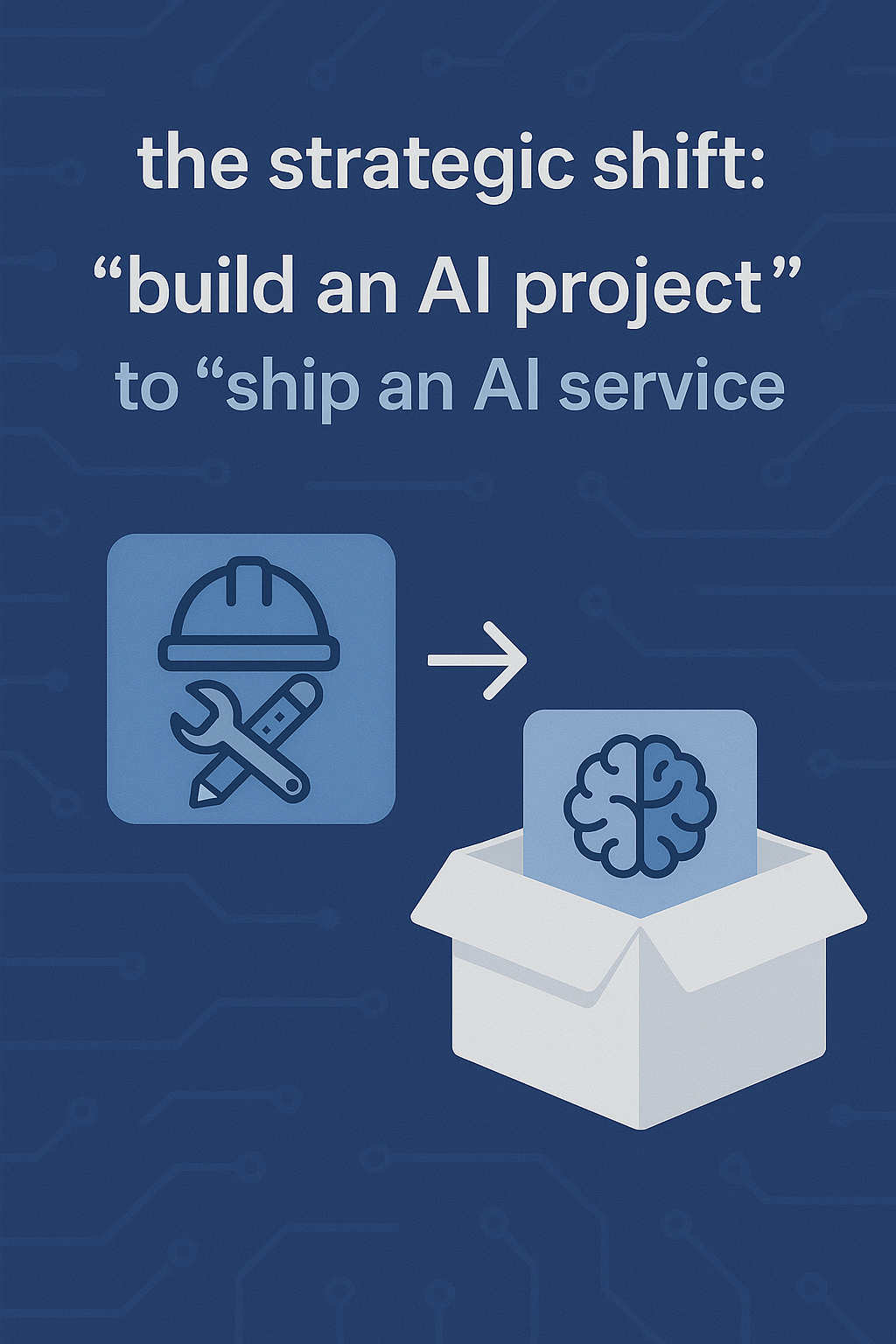
A service-catalog mindset reframes the question.
Instead of: “Can we build an AI solution for this team?”
Leaders ask: “Can we productize this capability so it can be reused across the enterprise?”
What is an enterprise AI service?
An AI service is not “a model.” It is an outcome-delivering capability that bundles:
- workflow (trigger → execute → approve → close)
- model/prompt/agent behavior
- connectors to real systems
- guardrails and policy controls
- observability + audit + incident response
- ownership, support model, and SLA
- value metrics and cost-to-serve
If AI is the operating layer, services are the units of value that layer delivers.
Why a “service catalog” model is natural
In ITSM, a service catalog is a structured inventory of services users can request and consume with clear expectations (and it is not the same thing as a portal UI). (ServiceNow)
The enterprise AI analog is: a discoverable marketplace of AI outcome-services—each with governance, measurement, and operational ownership.
What a service catalog looks like in real enterprise life
A well-designed catalog feels simple to the business:
- what the service does
- who can use it
- what boundaries apply
- how success is measured
- who owns it
Example patterns (industry-neutral):
- Contract clause risk review service
- ingests text
- flags risk clauses based on policy thresholds
- routes to approval if risk exceeds limits
- stores evidence and approvals
- Employee onboarding completion service
- orchestrates tickets and provisioning requests
- tracks completion across steps
- escalates exceptions
- stores audit evidence of approvals and changes
- Invoice exception resolution service
- detects mismatches
- checks thresholds
- requests missing data
- posts updates
- records audit trail and reversibility
Users are not “using AI.” They are consuming repeatable services.
Why CIOs prefer a catalog over projects
- Reuse becomes the default
- Governance becomes a product feature
- Value tracking becomes real
- Procurement and vendor strategy simplify
- Reliability and support improve (versioning, monitoring, incident response, deprecation)
The missing insight: you can’t run a service catalog without a control plane
This is where most enterprises stumble:
- A catalog without a control plane becomes a directory of fragile pilots.
- A control plane without a catalog becomes a well-governed lab that never scales adoption.
So the operating model must fuse both:
- The control plane makes autonomy operable (observe/audit/rollback).
- The catalog makes outcomes scalable (productize/reuse/measure).
This fusion matches how leading agentic architecture narratives describe orchestration/control-plane functions as the governance backbone for end-to-end work. (Salesforce Architects)

Reference architecture: Control Plane + Catalog as one system
Layer 1: Trust, identity, and access
- identity binding, least privilege, approvals, policy enforcement
- immutable audit evidence
Layer 2: Data readiness and governed context
- lineage, quality, permissions, retrieval boundaries
- “what the agent can know” is governed—not accidental
Layer 3: Agent runtime
- model endpoints, prompts, tools, memory patterns
- bounded autonomy levels per service
Layer 4: Orchestration
- triggers, approvals, exception routes, long-running coordination
- business process models and KPIs
Layer 5: Control plane operations
- telemetry, incident response, rollback, policy decisions, version rollouts
- operability as a first-class product
Layer 6: Service management and catalog experience
- publish services with SLAs, owners, metrics, costs
- discoverability, request flows, entitlements
Services are the “what.”
The control plane is the “how safely.”
Designing “human-by-exception” as the default operating stance
The most scalable model is not “human-in-the-loop everywhere.” It’s human-by-exception:
Humans intervene only at high-leverage moments:
- risk threshold exceeded
- ambiguity detected
- policy conflict
- high-impact write or irreversible action
- safety signals triggered
This makes autonomy real—without making it reckless.
Portfolio governance: how to scale from 3 services to 300
Step 1: Define service tiers by risk and autonomy
- Tier A (Assistive): read-only, drafts, no writes
- Tier B (Controlled Writes): writes allowed with policy gates + approvals
- Tier C (High Impact): stricter audit + rollback + stronger evaluation/monitoring
Step 2: Standardize “golden paths” for building services
Templates, logging defaults, evaluation harnesses, security patterns, deployment gates, rollback patterns.
Step 3: Make observability + audit non-negotiable acceptance criteria
A service cannot enter the catalog unless it has:
- action timeline
- context snapshot
- identity binding
- policy evidence
- rollback plan
Step 4: Run services like products, not like deployments
Owners, SLAs, dashboards, incident playbooks, versioning and deprecation rules.
The economics: how this prevents cost blowouts
Agentic AI cost blowouts are usually not about model pricing alone. They come from:
- repeated rework and re-integration
- manual cleanup after failures
- high exception rates due to weak policy gates
- lack of reuse (rebuilding the same thing)
- incidents that erode trust and stall adoption
A control plane reduces cost through fewer incidents and faster recovery.
A service catalog reduces cost through reuse and standardized delivery.
Together they protect the only ROI that matters in enterprise AI:
repeatable outcomes at controlled cost-to-serve.
Common misconceptions (and what to do instead)
Misconception 1: “We have logs, so we have observability.”
Logs are raw events. Observability is structured truth tied to identity, context, and policy.
Misconception 2: “We’ll review decisions after deployment.”
Pre-action controls matter: policy checks, approvals, limits, redaction, allowlists.
Misconception 3: “Rollback is too hard.”
Rollback is hard only if agents are ad-hoc scripts. With compensating actions and checkpoints, rollback becomes normal operations.
Misconception 4: “A catalog is just a portal.”
A portal without service management is theater. A catalog is ownership, SLAs, metrics, lifecycle, deprecation. (ServiceNow)
Misconception 5: “Orchestration is enough.”
Orchestration coordinates work. A control plane makes that work governable, observable, auditable, and reversible. (Salesforce Architects)
Practical rollout plan: a 90-day blueprint
Days 0–30: Choose three outcomes and design for reversibility
- pick three broadly demanded workflows
- define tier/risk level
- define policy gates and approval points
- define rollback pathways for the top risky actions
Days 31–60: Build the control plane foundations
- instrumentation + unified telemetry
- identity binding and policy engine integration
- operator-grade rationales
- dashboards for health, exceptions, and cost
Days 61–90: Publish services into the catalog
- publish service descriptions, owners, SLAs
- enforce reuse-first policies
- measure adoption, outcome impact, exceptions
- iterate on thresholds and rollback playbooks
The goal by day 90 is not perfection. It is a working flywheel:
build → govern → publish → reuse → measure → improve
The C-suite value proposition
In executive language, the combined model delivers:
- Risk: smaller blast radius, provable compliance, controlled autonomy
- Cost: fewer escalations, fewer incidents, less manual remediation
- Speed: faster rollout because reversibility makes experimentation safer
- Trust: defensible decisions for customers, regulators, and boards
- Scale: move from pilots to a portfolio of services without chaos
Conclusion column: The enterprise advantage won’t be “more agents”—it will be operable autonomy
There’s a quiet trap in today’s agent narrative: the assumption that capability automatically becomes adoption.
It doesn’t.
Enterprises adopt what they can operate.
The next era won’t be decided by who demos the most impressive agent. It will be decided by who builds the discipline to run hundreds of agentic workflows with the same confidence they run core business systems.
That discipline has a shape:
- A Control Plane that makes autonomy observable, auditable, and reversible.
- A Service Catalog that turns successful workflows into reusable outcome-products.
Put them together and you get the real prize: managed autonomy—the ability to scale action without scaling chaos.
If you’re a CIO or CTO, the question to ask on Monday morning is simple:
Are we building agents—or are we building the operating model that makes agents trustworthy in production?
Glossary
- AI agent: Software that can plan and execute tasks using models and tools, often via multi-step workflows.
- Control plane: A supervisory layer that governs system behavior through policy, monitoring, limits, and operational controls.
- Enterprise AI Control Plane: Governance + operations layer that makes agents observable, auditable, and reversible.
- Reversible autonomy: Autonomy designed with observability, auditability, and rollback pathways.
- Observability: Ability to understand what a system did and why using traces, timelines, context snapshots, and health signals.
- Audit trail: Tamper-evident record of actions, identity binding, policy evidence, and data lineage.
- Rollback: Ability to stop, revert, repair, or replay actions via compensating actions and checkpoints.
- Policy engine: Executable rules that enforce what agents can access and what actions they can take.
- Service catalog: Structured inventory of services users can request and consume with clear expectations. (ServiceNow)
- Enterprise AI Service Catalog: Curated catalog of reusable, governed AI outcome-services with owners, SLAs, and metrics.
- Record-keeping/logging (high-risk AI): Automated logging across a system’s lifetime to support traceability and oversight. (ai-act-service-desk.ec.europa.eu)
- NIST AI RMF (GOVERN/MAP/MEASURE/MANAGE): Lifecycle functions organizing AI risk management activities. (NIST Publications)
FAQ
1) Is an AI control plane the same as an orchestration layer?
Not exactly. Orchestration coordinates workflows; a control plane ensures those workflows are governed, observable, auditable, and reversible. Many architectures treat orchestration as part of the control plane, but the control plane is broader. (Salesforce Architects)
2) Do we need this only for regulated environments?
No. Any enterprise allowing agents to write to systems (tickets, access, contracts, finance ops, approvals) needs reversible autonomy to reduce operational and reputational risk.
3) Can we bolt this on later?
Pieces can be added later, but audit and rollback are far easier when designed early—especially identity binding, policy enforcement, and compensating actions.
4) What’s the fastest first step?
Start with instrumentation + unified telemetry for one high-value workflow, then add policy enforcement and rollback pathways for the most risky actions.
5) Doesn’t governance slow innovation?
In practice it speeds innovation—because reversible autonomy makes experimentation safer and reduces fear-based blockers. This is the operational lesson embedded in both Gartner’s cancellation drivers and HBR’s production-readiness critique. (Gartner)
6) Why isn’t a service catalog “just a portal”?
Because a real catalog includes ownership, SLAs, lifecycle management, metrics, and governance embedded in the service—not merely a UI listing. (ServiceNow)
7) What’s the connection between the catalog and the control plane?
A catalog scales adoption through reuse; a control plane scales trust through operability. You need both to scale agentic AI responsibly.
References and further reading
- Gartner press release (Jun 25, 2025): “Over 40% of agentic AI projects will be canceled by the end of 2027…” (Gartner)
- Reuters coverage (Jun 25, 2025): Summary of the Gartner forecast and drivers (cost/value/risk controls). (Reuters)
- Harvard Business Review (Oct 21, 2025): Why agentic AI projects fail and how to set them up for success. (Harvard Business Review)
- NIST AI RMF 1.0 (NIST AI 100-1): GOVERN / MAP / MEASURE / MANAGE lifecycle framing. (NIST Publications)
- EU AI Act record-keeping (Article 12) + Commission “AI Act Service Desk”: Logging/traceability expectations for high-risk systems. (Artificial Intelligence Act)
- Salesforce Architects: Enterprise orchestration layer as “control plane” for end-to-end work in an agentic enterprise. (Salesforce Architects)
- ServiceNow: Definition and framing of an IT service catalog (and why it’s not merely a portal). (ServiceNow)
- The Composable Enterprise AI Stack: From Agents and Flows to Services-as-Software – Raktim Singh
- AI Agents Will Break Your Enterprise—Unless You Build This Operating Layer – Raktim Singh
- The Enterprise AI Control Plane: Why Reversible Autonomy Is the Missing Layer for Scalable AI Agents | by RAKTIM SINGH | Dec, 2025 | Medium
- The Enterprise AI Service Catalog: Why CIOs Are Replacing Projects with Reusable AI Services | by RAKTIM SINGH | Dec, 2025 | Medium



Raktim Singh is an AI and deep-tech strategist, TEDx speaker, and author focused on helping enterprises navigate the next era of intelligent systems. With experience spanning AI, fintech, quantum computing, and digital transformation, he simplifies complex technology for leaders and builds frameworks that drive responsible, scalable adoption.