
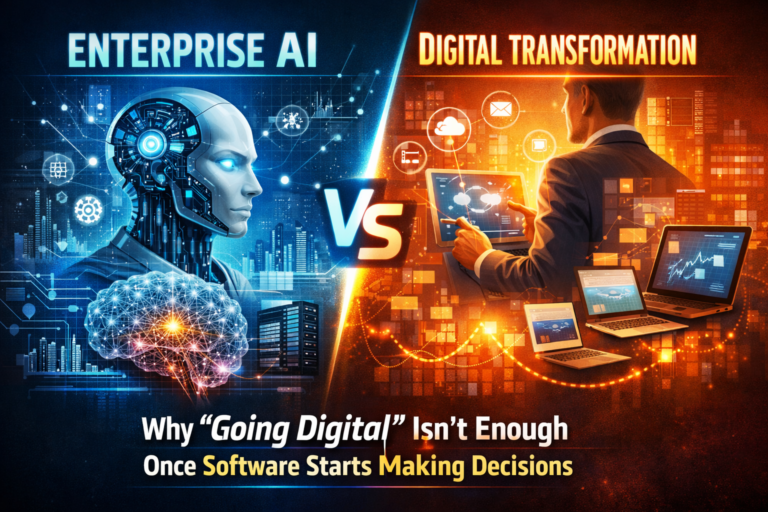
Enterprise AI vs Digital Transformation: Why “Going Digital” Isn’t Enough Once Software Starts Making Decisions
For more than a decade, digital transformation has been the dominant playbook for enterprise modernization.
Organizations digitized processes, automated workflows, migrated to the cloud, and measured success through speed, efficiency, and scale.
But as artificial intelligence moves from supporting decisions to making them, that playbook begins to fail.
Enterprise AI is not the next phase of digital transformation—it is a fundamentally different operating challenge. The moment software exercises judgment, enterprises must shift from optimizing execution to governing decisions, accountability, and institutional risk.
Enterprise AI vs Digital Transformation
Digital transformation taught enterprises how to digitize work.
Enterprise AI forces enterprises to govern decisions.
At first glance, that sounds like semantics. In production, it’s the difference between a program that improves efficiency and a capability that must withstand audits, drift, liability, and real-world harm—year after year.
Here’s a familiar story.
A transformation program modernizes a workflow. Forms become apps. Approvals become portals. Dashboards show cycle-time improvements. Teams celebrate.
Then AI is added to “speed things up.”
It starts as advisory: “Here’s my recommendation.”
Later it becomes influential: “Here’s the best route.”
Soon it becomes automatic: “I already routed, approved, prioritized, escalated.”
And that’s the moment the old playbook breaks.
Because AI doesn’t just run a process. It increasingly chooses outcomes—and once software is choosing outcomes, you are no longer “transforming” the business. You are building an institutional decision capability that must remain safe, defensible, and controllable at scale.
Digital transformation optimizes execution. Enterprise AI governs judgment.
Once software begins making decisions, enterprises must move beyond tools and workflows to institutional accountability, governance, and control.
This article clarifies the difference in simple language, with practical examples and a leadership lens you can apply immediately.
Enterprise AI Operating Model: https://www.raktimsingh.com/enterprise-ai-operating-model/

What digital transformation really means (and why it’s not wrong)
Digital transformation is often described as “rewiring an organization… by continuously deploying tech at scale.” (McKinsey & Company)
That framing is useful because it captures what transformation actually changes:
- how work moves across the organization
- how systems integrate
- how teams collaborate with data
- how quickly the enterprise can ship improvements
Transformation programs typically deliver things like cloud migration, modern apps, APIs, data platforms, workflow automation, and experience redesign. Their primary unit of change is the process.
And when transformation is done well, it creates real competitive advantage.
So the point is not “digital transformation is outdated.”
The point is: Enterprise AI changes the problem category.
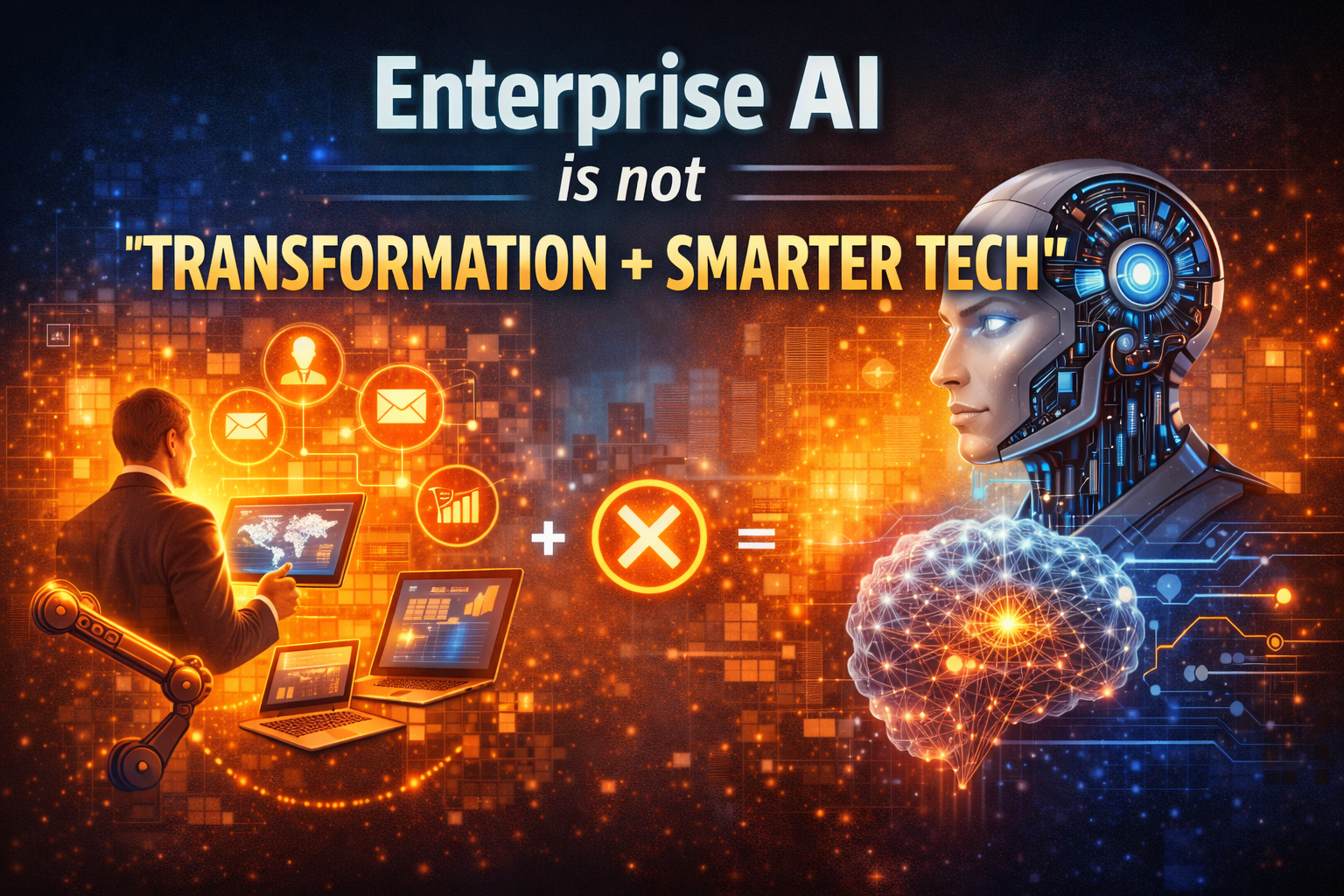
Enterprise AI is not “transformation + smarter tech”
Enterprise AI is the capability to run machine-assisted decisions safely at scale.
That safety requirement is not marketing language. It’s what becomes non-negotiable when AI decisions:
- affect eligibility, priority, pricing, access, approvals, compliance posture, safety, or trust
- create irreversible downstream effects
- must be explainable long after the moment of action
- must remain aligned while models, prompts, tools, and data change
This is why Enterprise AI needs an operating model, not just a delivery plan. It’s also why the broader thesis—Enterprise AI as an institutional capability—is the right anchor.
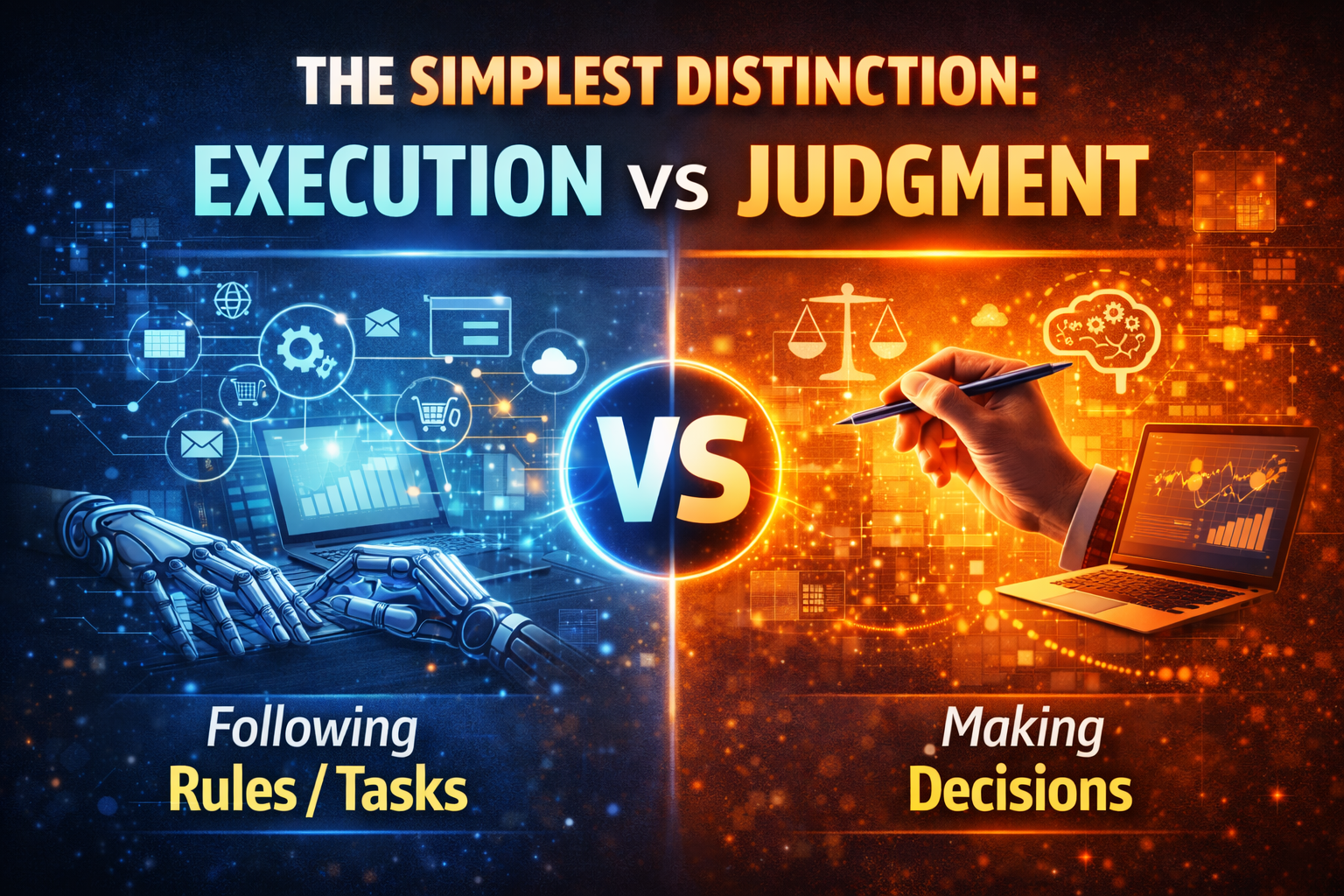
The simplest distinction: execution vs judgment
A clean way to internalize the difference:
Digital transformation optimizes execution
It scales how work gets done.
- faster workflows
- fewer manual steps
- better integration
- better visibility
- better experiences
Enterprise AI must govern judgment
It scales how outcomes are decided—and defended.
- explicit accountability for decisions
- evidence trails (“show your work”)
- controllable autonomy (stoppable, reversible)
- drift detection and change governance
- incident response for decision systems
- economic controls for AI usage
When leaders confuse these two, they build AI into transformed workflows without upgrading governance, and then wonder why things get fragile as adoption grows.
Digital transformation assumes something that is usually true in traditional software:
Even if systems are complex, humans remain the final decision makers.
Enterprise AI disrupts that assumption. The moment AI participates in a decision loop, three new properties enter the enterprise.
1) Autonomy creep: partial autonomy becomes real autonomy
AI often begins with “recommendation only.” But once it improves speed and cost, there is relentless pressure to “remove friction.”
Over time, human-in-the-loop quietly becomes:
- human-as-rubber-stamp
- human-on-the-loop
- human-out-of-the-loop (for “low-risk” cases that expand every quarter)
This is not primarily a technology change. It is a governance change.
2) Drift: the decision policy changes even when code doesn’t
In classic systems, if outputs change, you suspect a bug, a misconfiguration, or broken data.
AI can change behavior because:
- data distributions shift
- policies evolve
- the environment changes
- prompts and toolchains evolve
- retrieval sources change
- user behavior adapts to the system
So the “same” AI can behave differently next quarter without an obvious release. Drift isn’t an edge case—it’s a lifecycle reality.
3) Irreversibility: AI decisions leave residue
A workflow change can often be rolled back.
AI decisions often can’t—because decisions trigger downstream states: approvals, denials, escalations, pricing, prioritization, and human trust. Once those effects spread, “just turn it off” is not a remediation strategy.
That is why Enterprise AI must be designed for reversibility and defensibility from day one.
A practical example: the same story, two very different worlds
Scenario: modernizing customer onboarding
Digital transformation approach
You digitize forms, add verification, integrate systems, and improve turnaround time. Success metrics are clear: cycle time, drop-off rate, and cost per onboarding.
Enterprise AI approach
Now add AI to predict “risk” and auto-route onboarding outcomes.
Suddenly, new questions appear:
- Who is accountable if the AI denies a legitimate applicant?
- How do you prove why it made that decision months later?
- If policy changes, how do you ensure old decisions remain defensible?
- What is the rollback plan if drift increases false negatives?
- What logs exist, and how long must they be retained?
- How do you prevent a model/prompt/tool update from silently changing eligibility behavior?
These are not “transformation project” questions.
They are institutional governance questions—because the system is now participating in judgment.
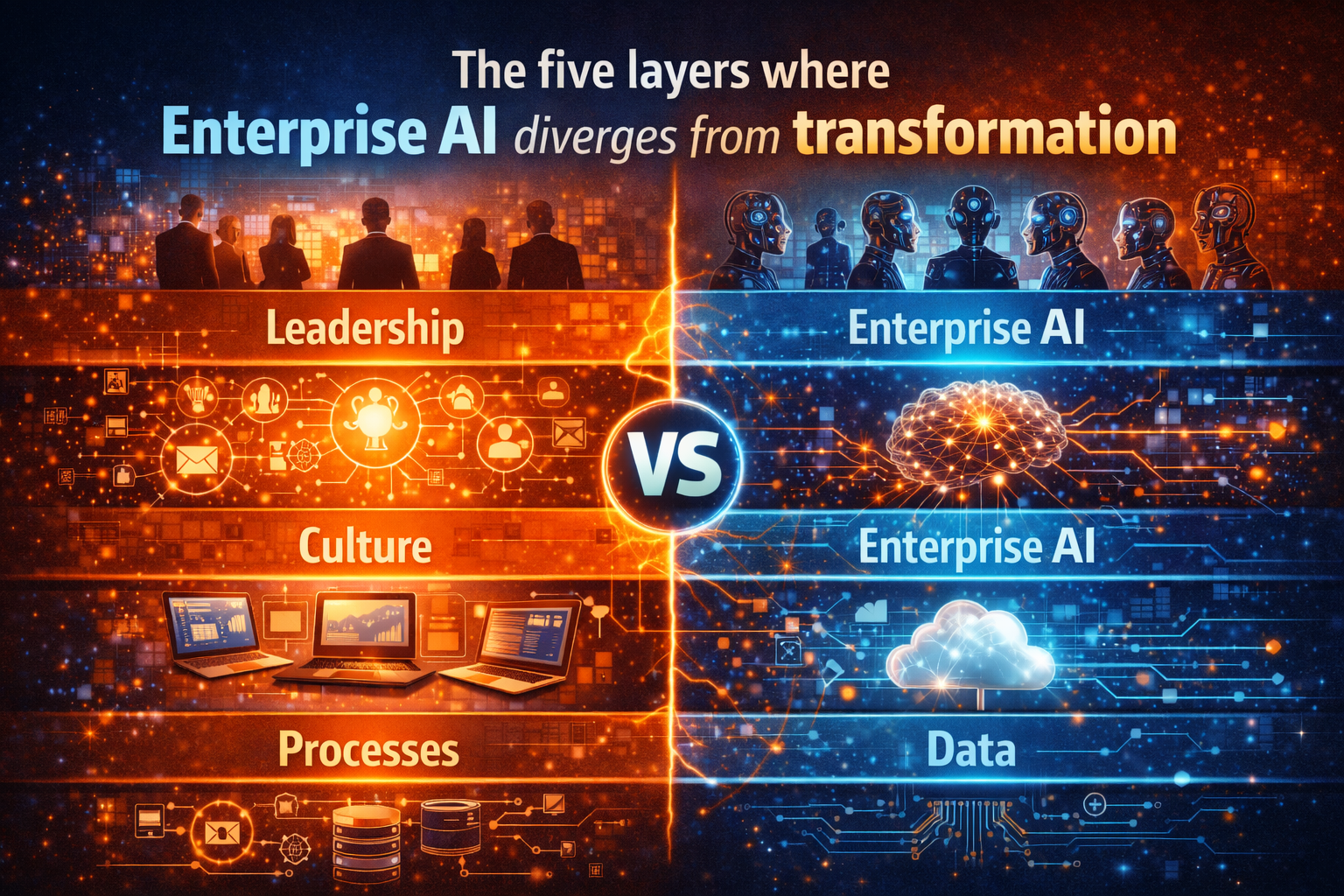
The five layers where Enterprise AI diverges from transformation
Layer 1: Ownership — “Who owns outcomes?” becomes non-negotiable
In transformation programs, ownership can be fuzzy (“the platform team,” “the business sponsor,” “the product org”).
In Enterprise AI, ambiguity becomes risk.
You need named ownership for:
- decision intent: what the system is allowed to decide
- policy: rules, thresholds, constraints, and overrides
- production behavior: monitoring, drift, incident response
- business outcome: who answers when it goes wrong
If you want a deeper blueprint for this, read:
Who Owns Enterprise AI? Roles, Accountability, and Decision Rights:
https://www.raktimsingh.com/who-owns-enterprise-ai-roles-accountability-decision-rights/
Layer 2: Control — autonomy must be stoppable and reversible
Digital systems often fail loudly (outages, errors).
AI systems can fail quietly (misrouting, subtle bias, degraded trust, silent policy drift).
Enterprise AI requires mechanisms like:
- action boundaries (when AI can act vs advise)
- kill switches and safe modes
- step-down autonomy (fallback to human approval)
- reversible workflows (ability to unwind outcomes)
- controlled rollout of model/prompt/tool changes
This is a core pillar of an Enterprise AI operating model—not an optional add-on.
Layer 3: Evidence — “show your work” becomes a business requirement
Transformation cares about observability: uptime, latency, and error rates.
Enterprise AI must add decision evidence:
- what inputs were used
- what policy applied
- what retrieved context influenced the decision
- what tools were called
- what the system recommended vs what was executed
- who approved, overrode, or escalated
This aligns strongly with global risk management direction. The NIST AI Risk Management Framework (AI RMF 1.0) is designed to help organizations incorporate trustworthiness considerations into the design, development, use, and evaluation of AI systems. (NIST)
Layer 4: Compliance — AI introduces obligations transformation didn’t carry
Traditional transformation focuses on security, privacy, uptime, and audit controls.
Enterprise AI adds:
- risk classification of AI use cases
- documentation and transparency expectations
- stronger oversight for high-impact usage
- governance of third-party AI suppliers
- post-deployment monitoring and incident handling
Regulatory direction in many jurisdictions is increasingly risk-based. The EU’s AI Act, for example, sets out risk-based rules for developers and deployers for specific uses of AI. (Digital Strategy)
Even if an enterprise operates across multiple jurisdictions, the strategic signal is consistent: governance must be continuous and auditable, not a one-time checklist.
Enterprises are also adopting management-system approaches such as ISO/IEC 42001, which specifies requirements for establishing, implementing, maintaining, and continually improving an AI management system. (ISO)
Layer 5: Economics — AI turns cost into a control-plane problem
Transformation costs are mostly licenses, infrastructure, delivery, and run operations.
Enterprise AI introduces:
- inference costs that scale with usage and autonomy
- experimentation loops that encourage churn
- duplicated agents, prompts, and tools across teams
- runaway usage driven by “success”
This is why FinOps is necessary but not sufficient. You need governance that treats AI spend as a controllable system, not a surprise invoice.
To know more about this, read
The Intelligence Reuse Index: https://www.raktimsingh.com/intelligence-reuse-index-enterprise-ai-fabric/
Because reuse is the economic antidote to “every team builds its own agent.”
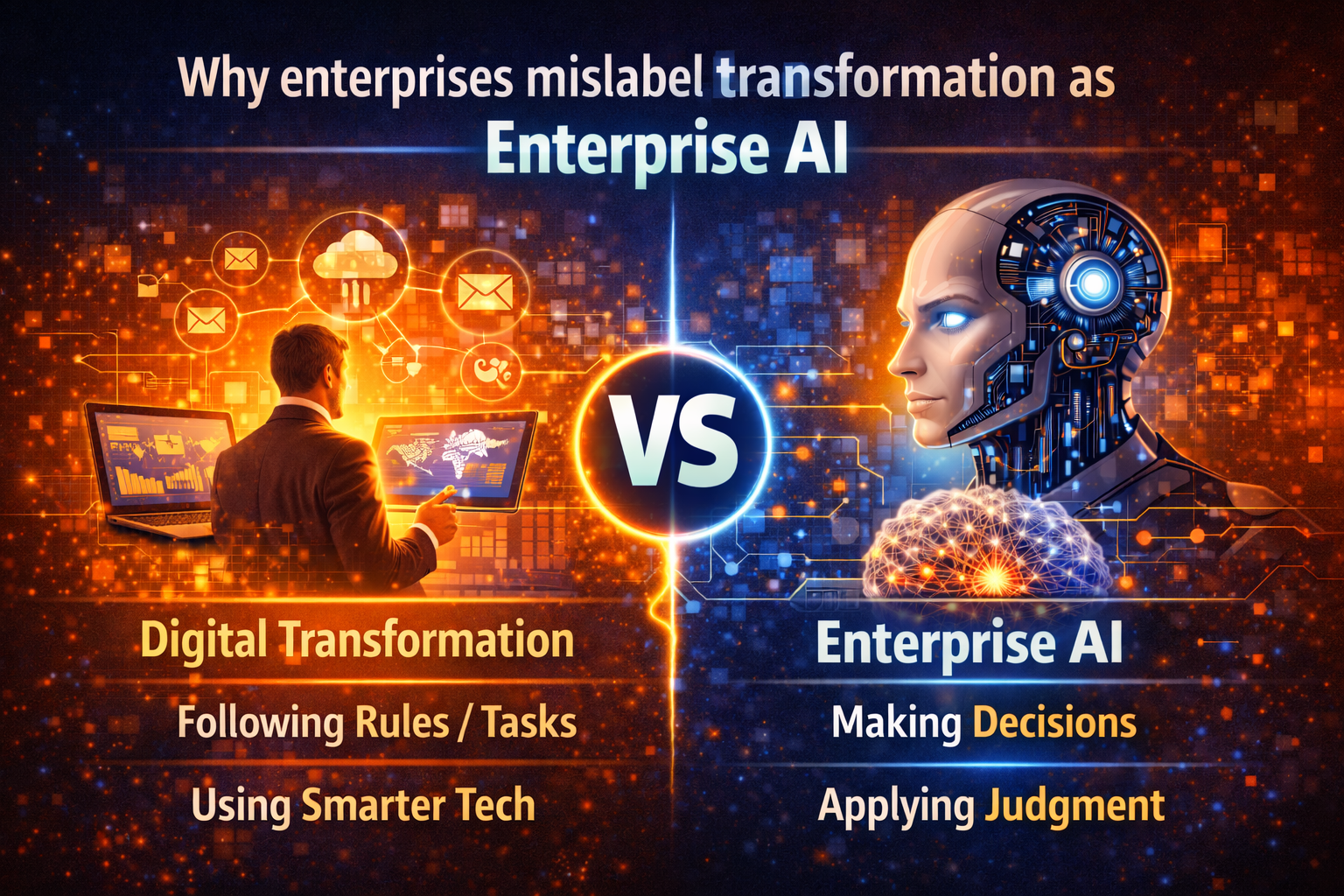
Why enterprises mislabel transformation as Enterprise AI
Because transformation language is comfortable.
It says:
- “We modernized the tech stack.”
- “We’re data-driven.”
- “We built a centralized AI team.”
- “We have dashboards.”
- “We have human-in-the-loop.”
But Enterprise AI is tested by different conditions:
- Can you explain a decision months later?
- Can you stop autonomy instantly without breaking continuity?
- Can you unwind harmful outcomes, not just disable the model?
- Can you detect drift before it becomes reputational damage?
- Can you prove policy compliance—not just model accuracy?
- Can you survive model churn without losing control?
If the answer is no, you may have AI in the enterprise—but you don’t yet have Enterprise AI.
This is exactly the “production reality” behind the runbook thesis—read this to understand churn and survivability:
The Enterprise AI Runbook Crisis: https://www.raktimsingh.com/enterprise-ai-runbook-crisis-model-churn-production-ai/
The Transformation Trap: why success makes Enterprise AI harder
Early AI deployments succeed because the world is simple at small scale.
Then scale introduces:
- edge cases
- exceptions and escalation paths
- user adaptation
- policy changes
- vendor updates
- new compliance expectations
- operational handoffs across teams
The AI system gets busier. And busy systems become political: everyone wants speed; no one wants ownership.
That is why Enterprise AI needs an operating model—a stable institutional system for running decisions—rather than a project plan that assumes the work ends at go-live.
A conversion checklist leaders can use immediately
If you are “doing digital transformation” and adding AI, ask:
- What decision is the AI touching?
Not the workflow—the decision. - Who owns that decision?
Name a role with decision rights. - Where is the action boundary?
When does AI advise vs act? - What is the evidence trail?
Can you reconstruct what happened later? - What is the rollback plan?
Not just “turn it off”—undo outcomes safely. - What is the drift plan?
How will you detect behavioral change? - What is the cost plan?
How do you prevent runaway usage?
If you can answer these cleanly, you are moving from transformation to Enterprise AI.
Conclusion : The new leaders’ mistake (and the new leaders’ advantage)
Most enterprises will spend the next few years “adding AI” to transformed workflows.
A smaller set will do something harder—and far more durable:
They will treat Enterprise AI as a decision institution:
- with explicit ownership
- controllable autonomy
- auditable evidence
- lifecycle governance
- cost control
- and the ability to stop, reverse, and defend decisions at scale
Digital transformation makes enterprises efficient.
Enterprise AI determines whether they remain trustworthy, governable, and resilient once software starts making judgments.
That is the shift leaders must recognize—before their first “successful” AI deployment becomes their first institutional failure.
For the full framework, go through:
https://www.raktimsingh.com/enterprise-ai-operating-model/
Glossary
Digital transformation: Rewiring an organization to create value by continuously deploying technology at scale. (McKinsey & Company)
Enterprise AI: The institutional capability to run machine-assisted decisions safely at scale (governance + runtime + economics + accountability).
Decision governance: The policies, controls, ownership, and evidence required to make AI-driven decisions defensible and auditable.
Action boundary: The line between AI advising and AI acting.
Decision evidence: The reconstructable record of inputs, policies, context, tool usage, approvals, and outcomes.
Drift: When AI behavior changes over time due to data, environment, policy, or system updates.
Reversibility: The ability to stop autonomy and safely unwind outcomes.
AI governance: The organizational system for responsible, accountable, and compliant AI across its lifecycle (often formalized via frameworks and standards). (NIST)
Enterprise AI
Enterprise AI refers to AI systems that make or influence decisions at scale and therefore require governance, accountability, auditability, and institutional ownership.
Digital Transformation
The modernization of processes, systems, and workflows using digital technologies to improve efficiency and execution.
Execution
Rule-based task completion where outcomes are predefined and predictable.
Judgment
Contextual decision-making under uncertainty, where outcomes may vary and accountability matters.
AI Governance
Structures, policies, and controls that ensure AI decisions are compliant, ethical, auditable, and accountable.
Institutional Capability
The ability of an organization—not just a tool—to own decisions, risks, and outcomes over time.
FAQ
Is Enterprise AI just the next phase of digital transformation?
It can be—if you treat decisions, accountability, evidence, and reversibility as first-class design elements. Otherwise, you’re placing AI on top of transformation without upgrading governance.
Why can’t we run Enterprise AI like normal software delivery?
Because AI behavior can change without traditional code releases, and decision outcomes can be difficult to unwind. You need lifecycle governance, not just deployment pipelines.
Do we need regulation to take Enterprise AI seriously?
No. Regulation increases pressure, but the business risks—trust, liability, drift, irreversibility, and cost—exist even without enforcement. Risk-based regulatory approaches simply make those expectations explicit. (Digital Strategy)
Does “human-in-the-loop” solve Enterprise AI risk?
Not by itself. Without structural controls, humans become rubber stamps. Enterprise AI requires designed oversight, clear escalation paths, and evidence trails.
What’s the fastest way to become “Enterprise AI ready”?
Start with decision ownership, define action boundaries, implement decision evidence, and build reversibility + incident response as core operating capabilities.
Q1. Is Enterprise AI the same as digital transformation?
No. Digital transformation improves execution. Enterprise AI introduces judgment, decision ownership, and institutional risk that require governance.
Q2. Why does digital transformation fail when AI scales?
Because traditional transformation models lack accountability, decision traceability, and governance once software begins acting autonomously.
Q3. What makes Enterprise AI harder than digital transformation?
Enterprise AI changes who makes decisions, who is accountable, and how outcomes are governed—not just how fast work happens.
Q4. Can enterprises succeed at AI without changing their operating model?
Rarely. Enterprise AI demands new operating models, decision ownership structures, and governance mechanisms.
Q5. Why do enterprises mislabel transformation as Enterprise AI?
Because early AI deployments feel like smarter automation—until decisions, risk, and accountability surface.
References and further reading
- McKinsey: Digital transformation definition (“rewiring… deploying tech at scale”). (McKinsey & Company)
- NIST: AI Risk Management Framework overview + AI RMF 1.0 document. (NIST)
- European Commission: AI Act policy page (risk-based rules for developers and deployers). (Digital Strategy)
- ISO: ISO/IEC 42001 AI management systems standard overview. (ISO)



Raktim Singh is an AI and deep-tech strategist, TEDx speaker, and author focused on helping enterprises navigate the next era of intelligent systems. With experience spanning AI, fintech, quantum computing, and digital transformation, he simplifies complex technology for leaders and builds frameworks that drive responsible, scalable adoption.