
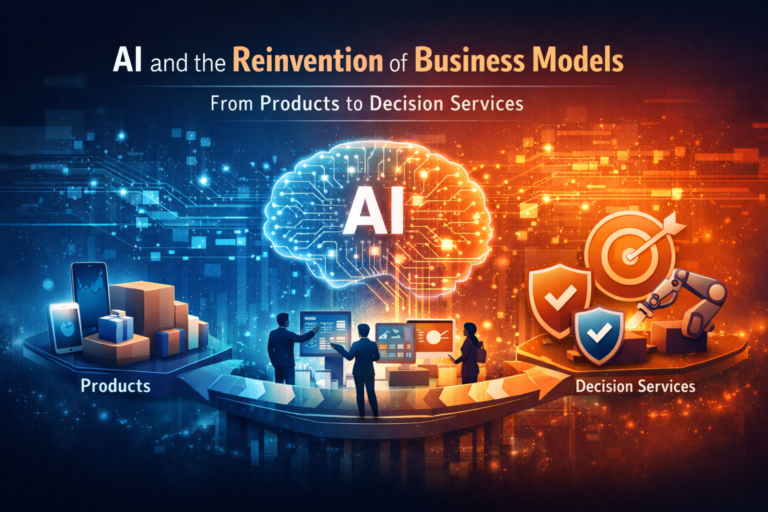
Enterprise Decision Services
Most enterprises use AI to optimize existing processes.
Very few use it to create entirely new growth categories.
The real breakthrough is not better models — it is the design of decision services: scalable, governed, reusable decision systems embedded into enterprise workflows. When decisions become services, growth stops being incremental and starts becoming structural.
Most business models were designed for a world where value was delivered as products (you buy them), software (you use it), or services (people do it for you). AI changes the unit of value again—quietly at first, then all at once.
Enterprise AI growth strategy
In the AI era, the most defensible advantage is not “having a model.” Over time, most competitors can access similar foundation models. The advantage moves to something harder to copy:
Owning and improving high-stakes decisions at scale—pricing decisions, eligibility decisions, routing decisions, fraud decisions, replenishment decisions, and resolution decisions—continuously, safely, and measurably.
That is the shift from products to decision services.
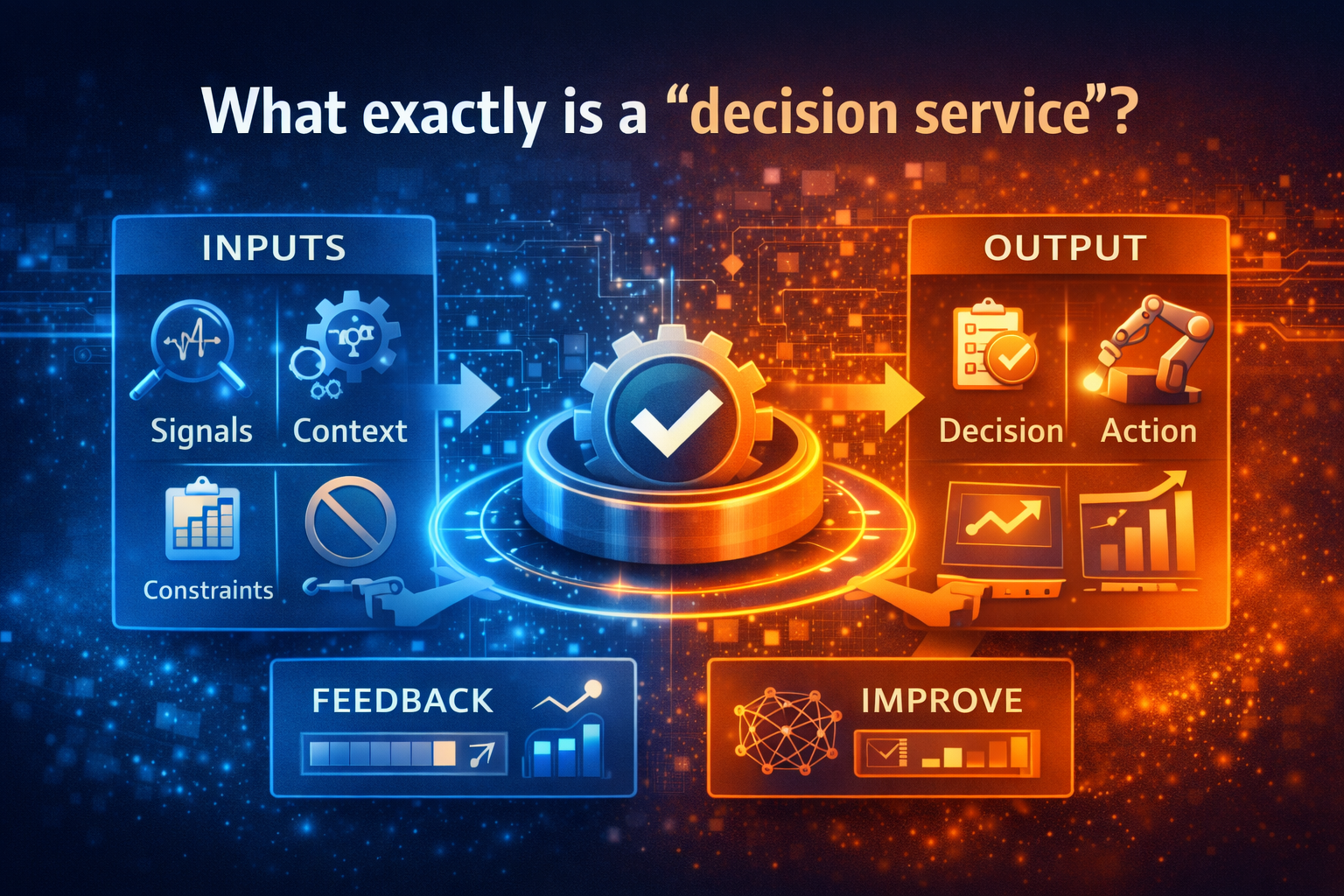
A decision service is a repeatable, governed capability that:
- takes inputs (signals, context, constraints),
- produces a decision (or recommendation + action),
- learns from outcomes (feedback loops),
- and improves over time.
In plain terms: AI doesn’t just help you work faster. It lets you package judgment as a scalable service.
This is not a technology trend. It is a business model redesign.
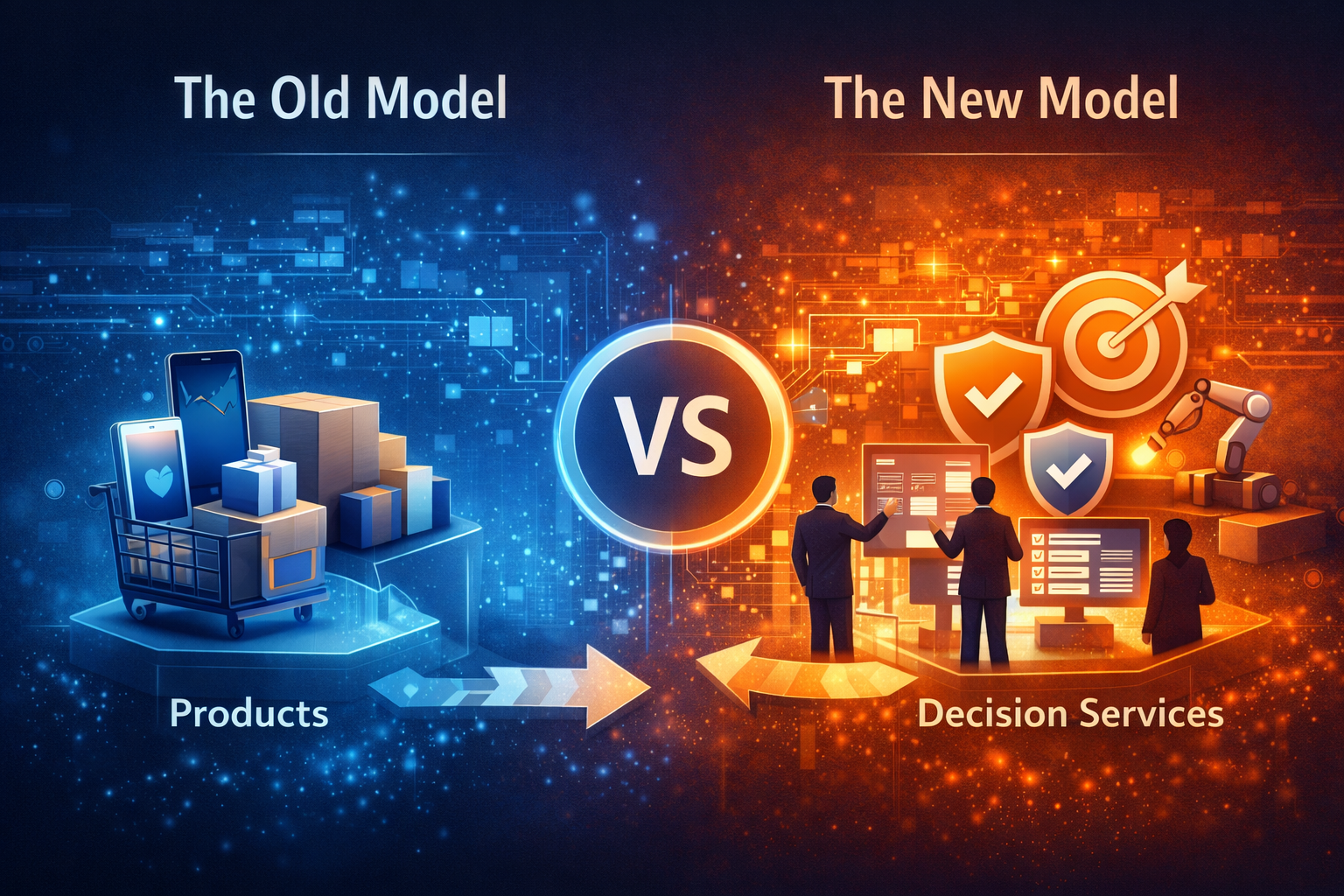
The old model vs the new model (in simple terms)
1) The product model: “We sell you a thing”
Value is delivered at the moment of purchase. Improvement comes through versions, upgrades, add-ons, and bundles.
Examples:
- A device
- A software license
- A feature pack
- A report or dataset
2) The service model: “We do the work for you”
Value is delivered continuously, but it is still mostly human-driven. Scale is limited by people and process throughput.
Examples:
- Managed operations
- Consulting
- Customer support outsourcing
3) The decision service model: “We run the decision for you”
You don’t sell access. You sell an outcome powered by decisions.
The buyer is not paying for:
- model tokens,
- seats,
- dashboards,
- or “AI features.”
They are paying for:
- fewer bad decisions,
- faster decisions,
- more consistent decisions,
- decisions that adapt to change,
- and decisions that can be governed and audited.
This aligns with the global shift toward outcome-based pricing—where vendors are accountable for measurable results, not tool usage. (lek.com)
Board-level takeaway: When AI becomes operational, value migrates from “software you use” to “decisions you trust.”
What exactly is a “decision service”?
What exactly is a “decision service”?
A decision service has five defining properties:
1) It is explicit
The decision is named, scoped, and owned:
- “Approve or decline”
- “Route this request”
- “Set the next best offer”
- “Resolve this issue”
- “Replenish this item”
2) It is repeatable
It can run thousands—or millions—of times with consistent logic and guardrails.
3) It is improvable
It improves because outcomes are measured and fed back into the system. This is central to decision intelligence, which explicitly treats decisions as assets that can be engineered and improved. (Gartner)
4) It is governed
Policies, constraints, approvals, escalation paths, and audit evidence exist—especially when AI moves from advice to action.
5) It can be packaged
It can be exposed through APIs or embedded into workflows so multiple products and channels can reuse the same decision logic.
The simplest definition (for boards):
A decision service is a productized “decision capability” that improves over time and can be governed like a business-critical system.
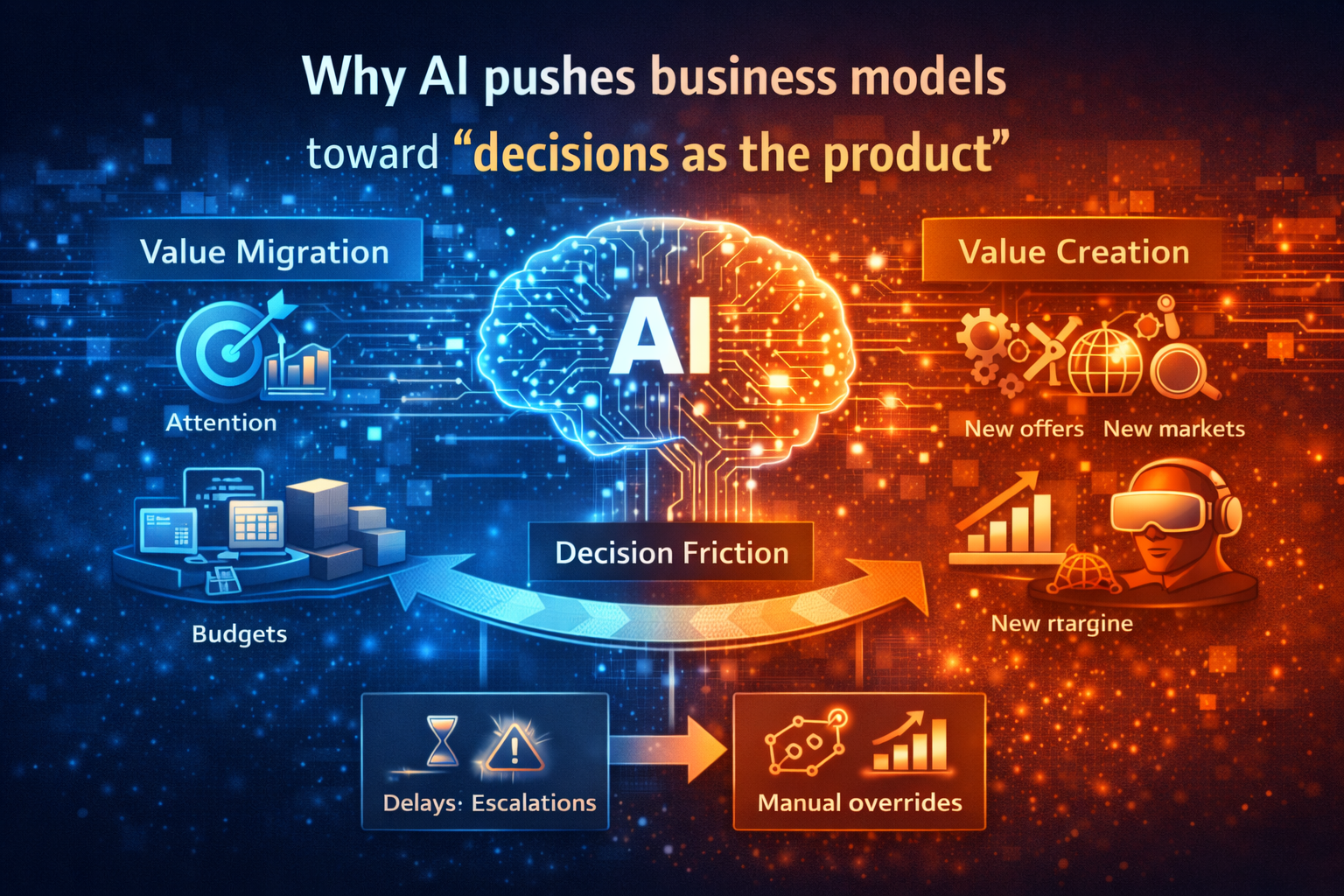
Why AI pushes business models toward “decisions as the product”
AI targets one of the most expensive and invisible layers in enterprises:
Decision friction — the cost of making, coordinating, validating, and correcting decisions.
Decision friction appears as:
- delays,
- escalations,
- rework,
- manual overrides,
- missed opportunities,
- inconsistent customer experiences,
- and the toxic sentence: “Nobody owns this call.”
When AI reduces decision friction, two things happen:
- Value migrates (attention and budgets shift toward decision systems)
- Value is created (new offers, new markets, new margins, new experiences become possible)
This is the pattern boards repeatedly underestimate:
value migration often precedes value creation.
And AI accelerates both.
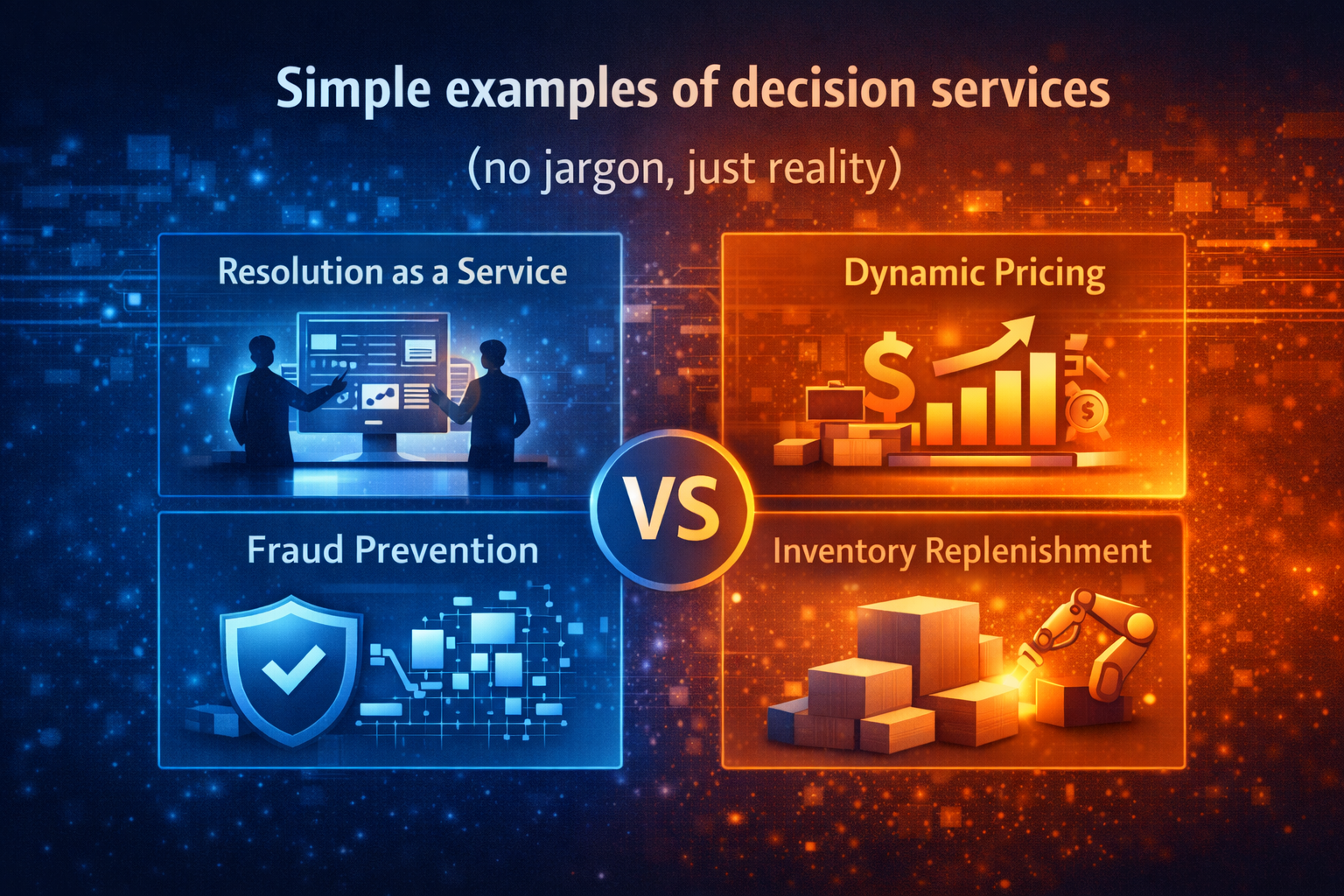
Simple examples of decision services (no jargon, just reality)
Example 1: “Resolution as a service” in customer operations
Old model: You buy a tool. Teams use it. You still manage staffing, scripts, workflows, quality.
Decision service model: A provider commits to outcomes like:
- “resolved in one interaction,”
- “reduction in escalations,”
- “faster resolution time,”
- “measurable deflection without customer harm.”
What changes is not just the software. It’s accountability.
Why this matters: Procurement shifts from “software spend” to “performance spend.” Incentives shift from “more usage” to “better decisions.”
Example 2: Dynamic pricing (and the line between smart and risky)
AI-powered pricing can outperform traditional methods by responding to changes continuously—especially in complex environments. (BCG Global)
But there is a governance edge: if customers perceive pricing as unfair or exploitative, trust collapses—regardless of revenue lift.
Public debates around AI-driven pricing demonstrate why decision services must be designed with transparency and guardrails, not just optimization. (The Verge)
Board lesson: Decision services create value, but decision integrity and trust determine whether the value is durable.
Example 3: Fraud prevention as a decision service
Old model: Buy a fraud tool, tune rules, staff investigations.
Decision service model: The product becomes “loss avoided with false-positive control,” continuously improved with feedback and governed for explainability and audit.
Example 4: Inventory and replenishment as a decision service
Old model: Buy planning software; humans decide.
Decision service model: The enterprise buys outcomes like:
- availability targets,
- capital efficiency,
- reduced waste,
- faster response to demand volatility.
The decision service becomes a performance layer across channels, not a one-time implementation.
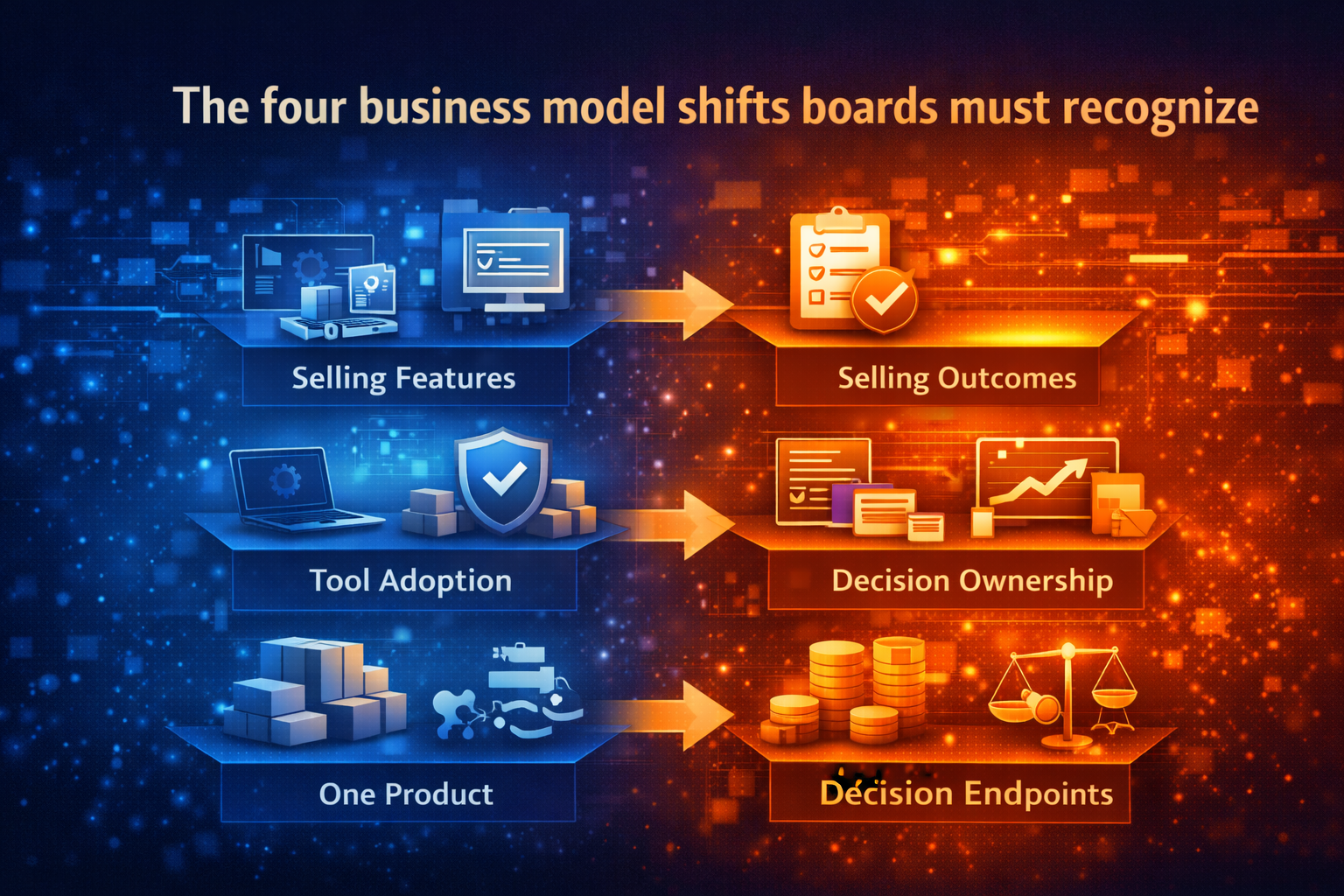
The four business model shifts boards must recognize
The four business model shifts boards must recognize
Shift 1: From selling features to selling measurable outcomes
In the AI era, the buyer increasingly wants impact, not interface:
- faster resolution,
- fewer losses,
- better conversion,
- lower cost-to-serve,
- improved reliability.
Outcome-based models in SaaS and services are rising because they align price with measurable value and force metric clarity. (lek.com)
Shift 2: From “tool adoption” to “decision ownership”
In the old model, the buyer owned results.
In the decision-service model, the provider must own:
- decision performance,
- drift management,
- monitoring,
- governance evidence.
This is why decision intelligence platforms are positioned around decision-centric design, orchestration, monitoring, and governance. (Gartner)
Shift 3: From one product to many embedded decision endpoints
The same decision service can power:
- web,
- mobile,
- call centers,
- partner channels,
- in-product experiences.
That’s how intelligence becomes reusable—and compounding.
Shift 4: From predictable revenue to risk-sharing revenue
Outcome pricing introduces shared risk:
- demand shifts,
- data changes,
- constraints evolve,
- external conditions move.
Winning providers build:
- clear measurement definitions,
- transparent baselines,
- safe guardrails,
- escalation paths,
- and “what happens when the world changes” clauses.
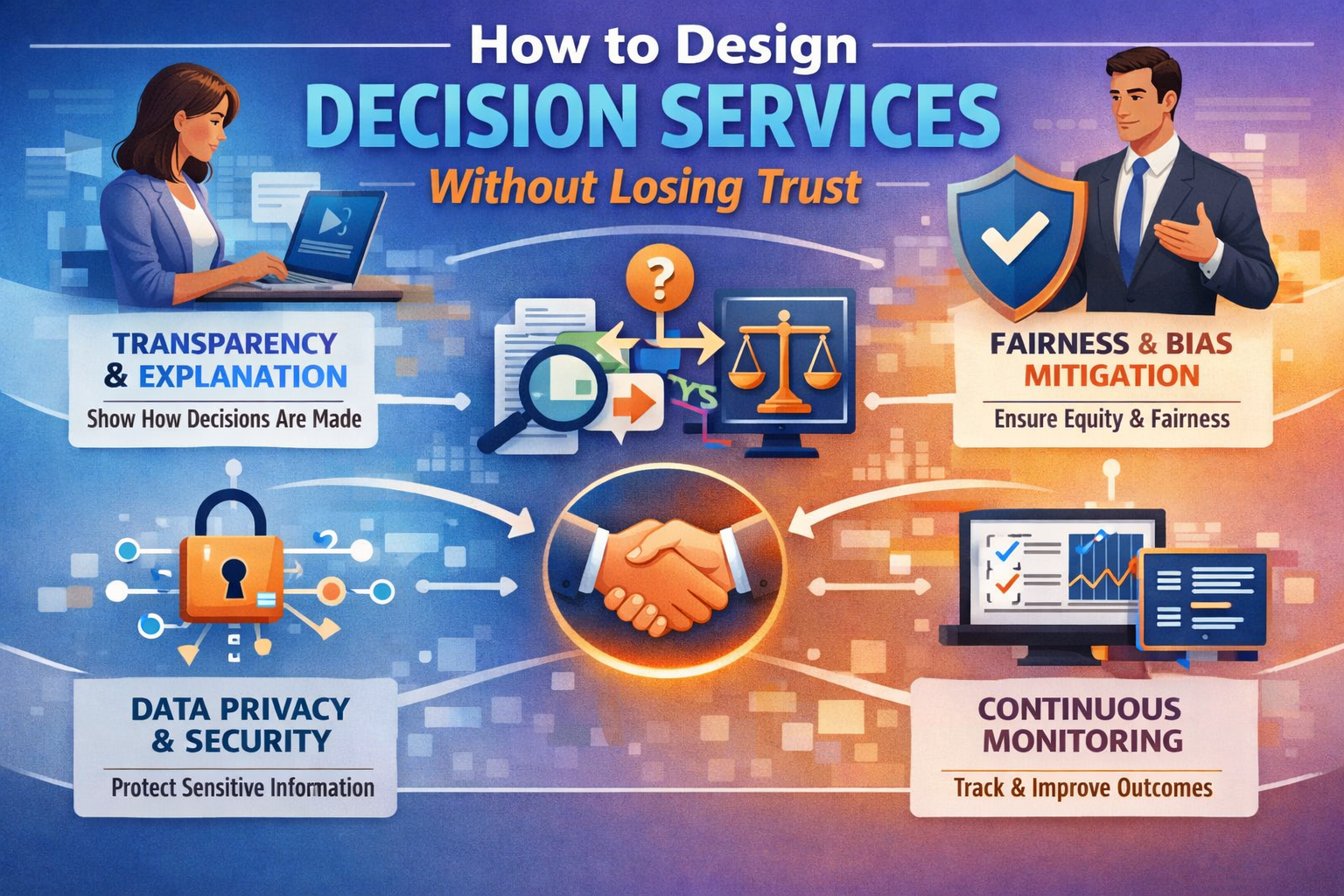
How to design decision services without losing trust
This is where most “AI business model transformation” narratives fail: they sell the outcome dream but ignore the trust mechanics.
A decision service must be credible to boards, which means it needs an operating discipline.
1) Define the decision boundary
What decisions are included? Which ones require a human checkpoint?
2) Make constraints explicit
Examples:
- budget caps,
- risk thresholds,
- policy rules,
- safety exclusions,
- stop mechanisms and reversibility.
3) Build feedback loops that are outcome-based, not vanity-metric based
Decision intelligence emphasizes evaluating and improving outcomes via feedback. (Gartner)
4) Treat decision logic as an asset, not a one-off implementation
Decision services scale when they can be reused across products and contexts.
5) Monitor drift like a product quality problem
Boards don’t need model internals. They need assurance that:
- decision quality is measured,
- anomalies are detected,
- incident response exists,
- reversibility is real.
The meta-point: A decision service is not “AI plus automation.” It is AI plus governance plus accountability.
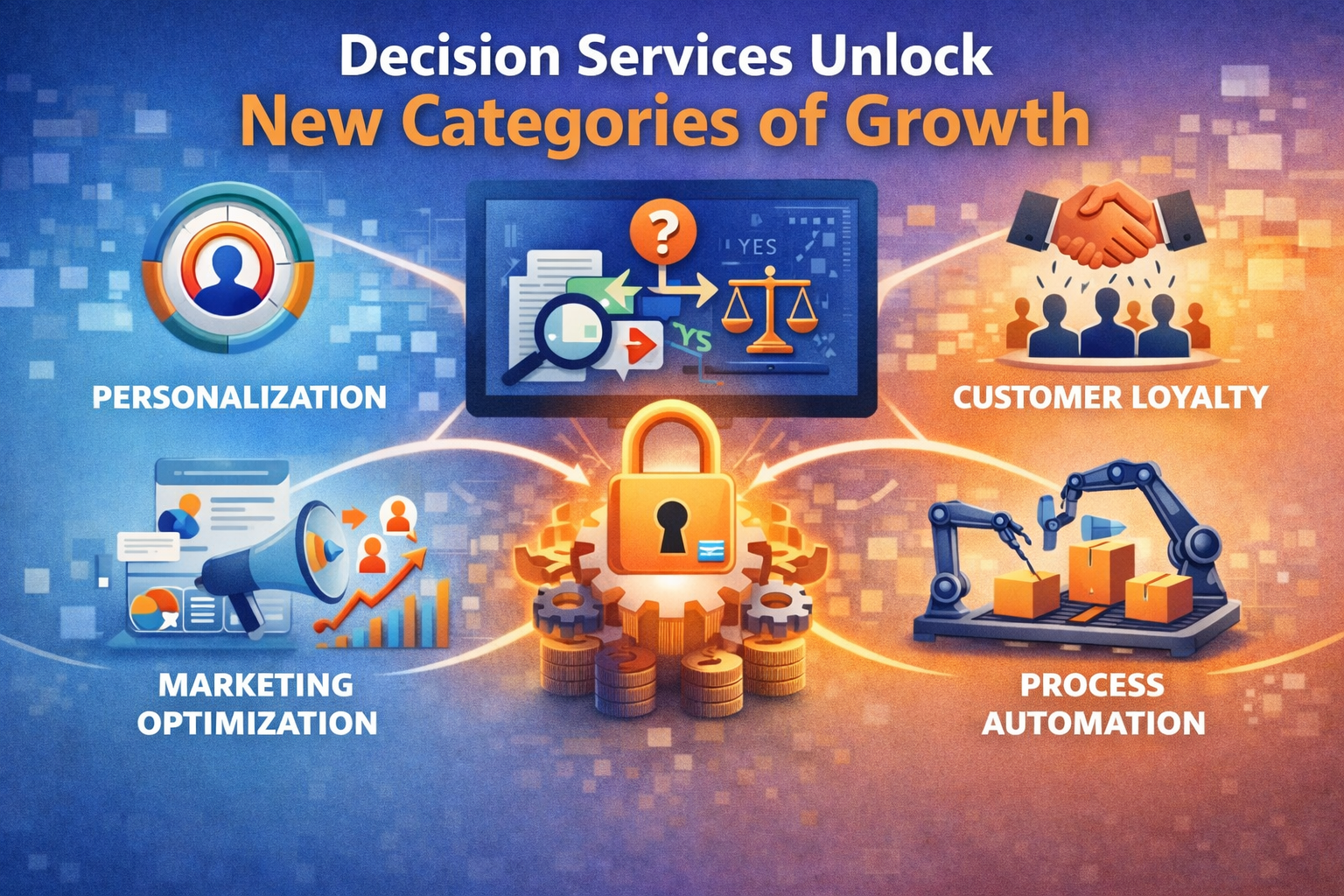
The viral “aha”: decision services unlock new categories of growth
Decision services expand business models in four compounding ways:
1) You can charge for results, not access
Willingness-to-pay rises when buyers can justify spend against outcomes.
2) You can sell continuous improvement
Products are static. Decision services get better. Buyers pay for compounding performance.
3) You can create new categories
When a provider sells decision outcomes, it becomes a performance partner, not a vendor.
4) You can expand into adjacent workflows
A trusted decision service spreads:
- from one decision,
- to a chain of decisions,
- to an operating layer.
This is how platforms are born—not by branding, but by reuse.
Board navigation: what to embrace, what to watch, what to change
What to embrace
- Outcome-linked offerings where measurement is credible
- Decision-centric product thinking (decisions as reusable assets)
- Governance as a runtime capability (not annual policy review)
- Feedback loops as a first-class requirement
What to watch
- Trust risk from aggressive personalization, especially in pricing and eligibility decisions (The Verge)
- Measurement gaming (bad incentives produce “good-looking” metrics)
- Vendor black boxes (boards should demand auditability, not only accuracy)
What to change
- Move product teams from “features shipped” to “decision performance improved”
- Create decision ownership: each high-value decision needs an accountable leader
- Upgrade procurement language: buy outcomes, but contract for governance evidence
Embedded reading from my Enterprise AI canon
- The Enterprise AI Operating Model (canonical anchor):
https://www.raktimsingh.com/enterprise-ai-operating-model/ - The Intelligence Reuse Index (why reuse beats novelty):
https://www.raktimsingh.com/intelligence-reuse-index-enterprise-ai-fabric/ - What Is the AI Dividend? (how boards capture structural gains):
https://www.raktimsingh.com/ai-dividend-boards-structural-gains/ - Enterprise AI Economics & Cost Governance (why cost+control+value must be designed as one system):
https://www.raktimsingh.com/enterprise-ai-economics-cost-governance-economic-control-plane/ - Who Owns Enterprise AI? (decision rights + accountability):
https://www.raktimsingh.com/who-owns-enterprise-ai-roles-accountability-decision-rights/
The thesis: decision services require an operating model, reuse discipline, economics design, and decision rights clarity.
Glossary
Decision Service: A productized capability that produces a specific decision repeatedly, learns from outcomes, and is governed for trust.
Outcome-Based Pricing: A commercial model where customers pay based on measurable business outcomes rather than seats or usage. (lek.com)
Decision Intelligence: A discipline that improves decision-making by explicitly engineering decisions and improving outcomes via feedback. (Gartner)
Decision Friction: The hidden cost of delays, escalations, and rework caused by unclear ownership and slow decision cycles.
Drift: When real-world conditions change and decision performance degrades over time.
FAQ
1) What is the difference between AI features and decision services?
AI features help users do tasks. Decision services take responsibility for a decision outcome, continuously improve it, and govern it.
2) Why will outcome pricing increase in the AI era?
Because AI can operate workflows end-to-end, making it feasible for providers to commit to measurable outcomes—if governance and measurement are strong. (lek.com)
3) What is the biggest risk in decision services?
Trust. If decisions feel unfair, opaque, or inconsistent, the model may optimize revenue while destroying legitimacy. Public backlash around AI pricing makes this concrete. (The Verge)
4) How should boards evaluate a decision service vendor?
Demand clarity on:
- decision boundaries,
- outcome measurement,
- governance evidence,
- drift management,
- reversibility and escalation design.
5) Is decision intelligence a recognized enterprise category?
Yes. Gartner defines decision intelligence as engineering and improving decisions through feedback, and positions decision intelligence platforms around decision modeling, orchestration, monitoring, and governance. (Gartner)
What is a decision service in enterprise AI?
A decision service is a reusable AI-powered decision system embedded into enterprise workflows and governed at runtime.
How are decision services different from AI models?
AI models generate outputs. Decision services operationalize those outputs into governed, traceable enterprise actions.
Why do decision services unlock new growth?
They create scalable decision infrastructure that enables new revenue models, personalization, and operational intelligence.
How do enterprises build trust in decision services?
Conclusion: the idea boards should remember
Every major technology disruption changes where value sits before it changes how value is created.
AI shifts value toward an enterprise’s ability to:
- make better decisions,
- faster,
- with governance,
- and improve those decisions continuously.
That is why the next generation of winners will not be defined by “AI adoption” or “AI features.”
They will be defined by something deeper:
Decision services—governed, accountable, compounding systems of institutional judgment.
Boards that recognize this early will not just modernize.
They will re-architect their business model around compounding intelligence—and build an advantage that is difficult to copy.
References and further reading
- Gartner — Decision Intelligence definition (Gartner)
- Gartner — Decision Intelligence Platforms overview (Gartner)
- L.E.K. Consulting — Outcome-based pricing in SaaS (lek.com)
- Pragmatic Institute — Outcome-based pricing explanation (Pragmatic Institute – Corporate)
- BCG — AI-powered pricing and dynamic pricing adoption (BCG Global)
- Reuters / The Verge — Public scrutiny and trust risks around AI pricing (Reuters)



Raktim Singh is an AI and deep-tech strategist, TEDx speaker, and author focused on helping enterprises navigate the next era of intelligent systems. With experience spanning AI, fintech, quantum computing, and digital transformation, he simplifies complex technology for leaders and builds frameworks that drive responsible, scalable adoption.